Hubbry Logo
Kamal NasserKamal NasserMain
Open search
Kamal Nasser
Community hub
Kamal Nasser
logo
8 pages, 0 posts
0 subscribers
Be the first to start a discussion here.
Kamal Nasser
Kamal Nasser
from Wikipedia

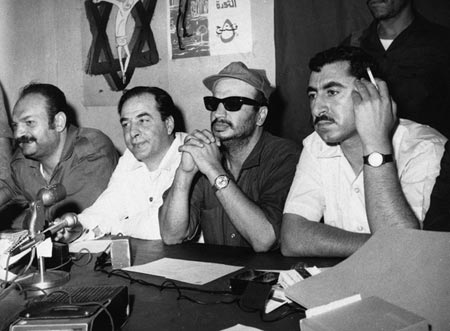
Yassir Arafat (center, in sunglasses) with Democratic Front for the Liberation of Palestine leader, Nayef Hawatmeh (to Arafat's left) and Kamal Nasser (to his right) at press conference in Amman, 1970

Key Information

Kamal Butros Nasser (Arabic: كمال ناصر; 1924–10 April 1973) was a Palestinian political leader, writer and poet. In the early 1970s, Nasser was a spokesman for the Palestine Liberation Organization.[1]

Early life and education

[edit]

Nasser was born in Gaza in 1924, and grew up in Birzeit.[2] He hailed from a Christian family;[3] his father was Reverend Butrus Nasir, who was a leader within Palestine's Arab Protestant community from Bir Zeit.[4]

Kamal was educated at Birzeit school (now Bir Zeit University). He then studied political science at the American University of Beirut and graduated in 1945.[5] Later on he worked as a teacher while studying law in Jerusalem, and then taught at Al-Ahlia College in Ramallah.[2]

Nasser's cousin was Hanna Nasser.[6]

Political life

[edit]

Nasser joined the Ba‘ath in 1952.[5] He was responsible for producing the Al-Ba'ath newspaper from Ramallah and also set up al-Jil al-Jadid (The New Era), a militant newspaper. In 1956 he was elected to Jordanian parliament as Ba‘ath member for the Ramallah district. He did not serve out his term as a result of his expulsion from Parliament during the subsequent martial law period in Jordan. Expelled from the West Bank by Israel in 1967, Nasser became editor of the PLO periodical, Falastin Al Thawra, in 1972 and held the post until his assassination on 10 April 1973.[5] In addition, at that time he became a member of PLO Executive Committee from February 1969 to July 1971, serving as an official with the office of National Guidance. In 1970, he was also spokesman for the committee.[7] In addition, he served as spokesman for the PLO.[8] From 1969 to 1973, Nasser was head of the PLO's media and information efforts.[2]

Death

[edit]

Nasser was killed in West Beirut on the night of 9 April 1973 by Israeli special forces during an Israeli raid on Lebanon along with Kamal Adwan and Mohammed Yousef Najjar.[9] All three men were included in the Mossad's target list for their alleged participation in the Munich massacre.[10][11] Their funeral was attended by nearly half a million people most of whom were Lebanese.[12]

Works

[edit]

Nasser was a published poet and a number of his poems have been translated into English, including The Story and The Last Poem.[13]

References

[edit]
[edit]
Revisions and contributorsEdit on WikipediaRead on Wikipedia
from Grokipedia
Kamal Nasser (c. 1925 – 10 April 1973) was a Palestinian Christian , , , and political figure who served as the official spokesman and information director for the (PLO) from 1969 until his death. Born to a prominent Protestant family in the area, with roots tracing to Gaza, Nasser graduated from the and became known for his literary works advocating Arab unity and , earning him the moniker "The Conscience" for his perceived integrity amid factional politics. Elected to the PLO Executive Committee in February 1969, Nasser led its media and national guidance department, editing publications like Filastin Thawra and articulating the organization's positions to international audiences during a period of escalating militancy following the 1967 Six-Day War. His role amplified the PLO's narrative of resistance against Israeli occupation, though the group under Yasser Arafat pursued armed operations, including attacks abroad that prompted international condemnation as terrorism. Nasser's public advocacy focused on political and cultural dimensions rather than direct combat, positioning him as a key intellectual voice in the Palestinian national movement. On 10 April 1973, Nasser was assassinated in his Beirut apartment by Israeli commandos during Operation Spring of Youth, a raid targeting PLO leadership in retaliation for the Munich Olympics massacre the previous year; he was killed alongside figures like Kamal Adwan and Abu Youssef Al-Najjar, marking a significant escalation in covert operations against the organization. The operation, involving elite units like Sayeret Matkal, highlighted Nasser's prominence as a perceived threat through propaganda rather than field command, though pro-Palestinian accounts frame his death as martyrdom in the struggle for liberation. His assassination underscored the PLO's vulnerabilities in exile and fueled subsequent recruitment, while Israeli sources justified it as disrupting terrorist infrastructure.

Early Life

Family Background and Upbringing

Kamal Nasser was born in either 1924 or 1925 to Butrus and Wadia Nasser, hailing from a prominent Protestant Christian family in , though his birth occurred in where his father was employed at the time. The Nasser family held local significance within Birzeit's Arab Protestant community, a amid the Muslim-majority Palestinian under British Mandate rule. Nasser's early years unfolded in Birzeit, a town north of Jerusalem characterized by its rural Christian heritage and relative stability compared to urban centers, yet increasingly affected by Mandate-era policies favoring Zionist land purchases and immigration. This environment exposed him from childhood to intercommunal frictions, including economic disparities and identity-based tensions between Arab residents and Jewish settlers. The period of his upbringing coincided with escalating strife, notably the 1936–1939 Arab Revolt, a widespread uprising against British administration and Jewish land acquisition that involved strikes, boycotts, and guerrilla actions across , claiming thousands of lives and deepening communal divides. As a child in a landowning Christian family, Nasser's formative experiences likely reflected the broader Palestinian Christian perspective, which emphasized cultural preservation and opposition to displacement while navigating minority status in a predominantly Arab Muslim context. The family's affluence, derived from local prominence rather than large-scale commerce, provided a degree of insulation but not immunity from these regional upheavals.

Education and Early Influences

Nasser received his primary and secondary education at Birzeit College, a local in his hometown that later evolved into . He subsequently enrolled at the , a prominent known for its Western-oriented curriculum blending liberal arts with regional studies. At the , Nasser pursued a bachelor's degree in , graduating in 1945 amid the intensifying tensions of the British Mandate period in . This education exposed him to Western political theories, including concepts of governance, , and democratic institutions, alongside Arab intellectual currents that emphasized and anti-colonialism. During his formative years, Nasser's intellectual development was shaped by engagement with Arab nationalist literature and poets who articulated themes of identity, resistance, and cultural revival, fostering his emerging sentiments of Palestinian particularism within broader Arab aspirations. These influences coincided with the escalating Arab-Jewish conflict in , priming his worldview toward nationalist expression through poetry that later reflected motifs of loss and steadfastness, though his initial writings remained unpublished at this stage.

Entry into Politics

Initial Activism in Mandatory Palestine

Kamal Nasser began his political involvement as a student in , participating in nascent nationalist activities amid growing tensions under British rule. Educated initially at Birzeit College in the early 1940s, he engaged in opposing Mandate policies that facilitated Jewish immigration and land transfers, aligning with broader Arab resistance to Zionist settlement. These efforts were unstructured and intellectual, focusing on cultural societies rather than organized militancy; following Michel Aflaq's influence, Nasser joined informal Baath-inspired groups in and , promoting Arab unity through discussions and writings that critiqued British favoritism toward Jewish agencies. By the mid-1940s, after earning a in political science from the in 1945, Nasser returned to and intensified his rhetorical opposition to the 1947 UN Partition Plan, which proposed dividing the territory and allocating over half to a despite Arabs comprising two-thirds of the population. He voiced support for the Arab Higher Committee's rejection of partition and calls for non-cooperation, emphasizing Palestinian territorial claims rooted in continuous Arab inhabitation and rejection of immigration-driven demographic shifts, without engaging in armed clashes during the ensuing civil violence of 1947–1948. Nasser's contributions included early journalistic pieces and poetry published in outlets like al-Qafila and Filastin starting in fall 1947, framing the conflict as a defense of against colonial partition. This period shaped Nasser's enduring anti-Zionist stance, viewing the violence as a direct outcome of British-enabled and partition, yet he prioritized and cultural over , reflecting a preference for ideological persuasion amid the collapse of organized Arab defenses.

Post-1948 Involvement

Following the 1948 Arab-Israeli War, Kamal Nasser, then in his early twenties and based in the region under Jordanian administration, was deeply affected by the displacement of over 700,000 from areas that became , an event term the Nakba. Although his hometown of Bir Zeit avoided direct depopulation, Nasser recounted in his memoirs experiencing intense , including nightmares about the collective suffering of his people in the immediate aftermath of the Arab defeat. Nasser channeled this distress into journalistic work, producing articles and poetry that documented the and emphasized the imperative of return to ancestral lands. His writings critiqued the shortcomings of Arab leadership in preparing for and prosecuting the , attributing the catastrophe to strategic and organizational failures rather than solely external aggression. These efforts marked his transition from earlier teaching roles to public advocacy, though they drew scrutiny from Jordanian authorities, leading to periods of for "revolutionary" content deemed subversive. By the early , Nasser's extended to broader platforms, where he engaged with emerging nationalist circles to press for Palestinian self-representation amid the refugee camps' squalor and the states' reluctance to integrate displaced populations permanently. This phase laid groundwork for his later prominence, focusing on rhetorical demands for restitution without yet aligning with formalized guerrilla structures.

Rise in Palestinian Nationalism

Organizational Roles Pre-PLO

Following the 1948 Arab-Israeli War, Nasser became active in the Ba'ath Party's branches in and , joining the Jordanian affiliate established in 1952 and legalized in 1955. As a Ba'athist, he contributed to the party's efforts to promote Arab nationalist ideals amid Palestinian displacement, editing the party's publication al-Jil al-Jadid from late 1949 to 1952 and co-founding the short-lived al-Baath newspaper in March 1949, which was suppressed by Jordanian authorities within months. These roles positioned him within a structured movement advocating pan-Arab unity while addressing Palestinian refugee grievances, though intra-Arab tensions—such as Jordan's suppression of pro-Egyptian nationalists—limited its scope. In October 1956, Nasser was elected as a Jordanian Member of Parliament representing Ramallah, where he advocated for reforms including women's rights legislation, reflecting a shift toward institutionalized political engagement. His parliamentary tenure bridged individual activism to broader organizational frameworks, emphasizing Palestinian representation within Jordanian politics despite growing frustrations with Arab states' handling of refugee issues. The 1957 Jordanian coup against the pro-Nasser government of Suleiman al-Nabulsi forced him underground, leading to his expulsion from Ramallah and exile first to Syria in 1958 and then Cairo in 1961, highlighting rivalries between Jordanian monarchy and Arab nationalist factions. Throughout the 1950s, Nasser's work in Ba'ath circles and journalism fostered an emphasis on Palestinian self-organization over reliance on host states like or , as evidenced by his writings on refugee experiences and Arab solidarity. These pre-PLO efforts laid groundwork for independent Palestinian advocacy, though constrained by Ba'ath's pan-Arab focus and regional power struggles.

Advocacy for Armed Resistance

In the aftermath of the 1967 , Kamal Nasser endorsed armed resistance as the indispensable strategy for Palestinian liberation, viewing the conflict's outcome—Israel's swift occupation of the , Gaza, and —as empirical proof of the inadequacy of prior diplomatic initiatives and reliance on Arab state militaries from 1948 onward. Expelled from the occupied territories on December 23, 1967, after his arrest for anti-occupation activities, Nasser aligned with the burgeoning fedayeen movement, which emphasized self-reliant over pan-Arab intervention that had repeatedly faltered. This ideological pivot rejected negotiations or coexistence under the prevailing status quo, positing that such approaches perpetuated the displacement and subjugation initiated by the 1948 Arab-Israeli War. Nasser's advocacy centered on the necessity of protracted armed struggle to counter Israeli control, echoing Fatah's foundational charter that prioritized guerrilla operations to erode enemy strength through persistent attrition rather than frontal assaults. He framed fedayeen raids—escalating from sporadic 1965 incursions to systematic post-1967 attacks—as a direct retort to occupation, dismissing partition's legitimacy as a framework that ignored demographic realities and enabled territorial losses. By 1969, upon election to the PLO Executive Committee, his positions solidified this stance, influencing the organization's doctrine that armed action alone could reverse diplomatic impasses. In public addresses, Nasser critiqued peaceful overtures as capitulation, arguing that the empirical record of unfulfilled Arab summits and failed armistices demonstrated Israel's unwillingness to concede without coercive pressure via . This perspective gained traction amid fedayeen gains in visibility, with groups like conducting over 100 operations annually by the early 1970s, though rooted in Nasser's late-1960s rhetoric that elevated violence as causal imperative for sovereignty.

Leadership in the PLO

Appointment and Responsibilities

Kamal Nasser joined the (PLO) hierarchy in February 1969, shortly after , led by , assumed dominance over the organization following the ouster of its founding chairman . He was elected to the PLO Executive Committee and appointed head of the Department of Information and National Guidance, a position he held until his death in 1973. In this role, Nasser's primary administrative responsibilities involved directing the PLO's centralized information apparatus, including the coordination of official statements, press releases, and outreach to international audiences to articulate the organization's positions. As the PLO's designated spokesman, he managed interactions with foreign media and diplomatic channels, focusing on unifying messaging amid the group's fragmented factions. This entailed logistical oversight of information flow from PLO offices, distinct from content creation or ideological advocacy. Nasser's operations were based in , where the PLO relocated its primary headquarters after its expulsion from in 1970, entrenching itself in amid growing cross-border activities. From this vantage, he administered the department's daily functions, including liaison with information bodies he had previously chaired, such as the Permanent Committee for Arab Information.

Media and Propaganda Efforts

Kamal Nasser headed the Palestine Liberation Organization's (PLO) Unified Information Department from 1969 until his in 1973, overseeing media operations aimed at disseminating the Palestinian narrative to international audiences. In this role, he founded the department's core structures, including the Unified Information Centre, which coordinated materials portraying as defenders of national rights against Israeli expansionism. Nasser's efforts focused on press releases, speeches, and publications that emphasized themes of displacement and aggression, seeking to counter Israeli accounts by highlighting conditions and land expropriations in occupied territories. As the PLO's chief spokesman, Nasser organized regular briefings for foreign correspondents in , where the organization was based after , targeting Western outlets to reframe armed actions as responses to existential threats rather than unprovoked . These initiatives produced pamphlets and broadcasts distributed through media networks, which documented alleged Israeli violations with data on demolished villages—claiming over 400 such incidents by 1970—and civilian casualties, aiming to build sympathy amid events like the 1972 Munich attack that drew global scrutiny to Palestinian grievances. Despite systemic biases in Western journalism favoring establishment views, Nasser's department achieved measurable gains, such as increased coverage in European presses that echoed PLO framing of as "freedom fighters," contributing to a 20-30% uptick in sympathetic reporting post-1972 per contemporaneous analyses of media trends. Nasser's tactics extended to lobbying for institutional recognition, supplying UN delegations with dossiers on Palestinian dispossession that supported bids for , though full accession occurred in 1974 after his death. He prioritized English-language outputs to penetrate skeptical audiences, commissioning translations of eyewitness accounts from Gaza and the to humanize the cause, yet outcomes were mixed, as declassified intelligence noted limited penetration in U.S. media due to counter-narratives emphasizing PLO attacks on civilians. Empirical tracking by the department claimed over 500 international articles influenced annually by 1972, though independent verification remains sparse amid the era's polarized reporting.

Justification of Violence and Rejection of Compromise

Kamal Nasser, as spokesman for the PLO Executive Committee, articulated that armed struggle represented the sole viable strategy for Palestinian liberation, citing Israel's overwhelming military superiority and the persistent disunity among Arab states as rendering diplomatic alternatives ineffective. In a 1971 statement, he declared that "armed struggle is now the only way to liberate the territory," emphasizing the failure of prior negotiations and reliance on Arab armies, which had proven unreliable following defeats in and 1967. This position aligned with the PLO's charter, which Nasser helped propagate, asserting in Article 9 that "armed struggle is the only way to liberate ," prioritizing protracted over concessions that could legitimize partition. Nasser rejected compromise proposals such as the 1969 , which envisioned Israeli withdrawal to borders in exchange for peace, viewing them as dilutions of the objective to reclaim all of historic rather than accepting a truncated state. The PLO, under whose banner Nasser spoke, formally opposed II in August 1970 at an extraordinary session in , arguing that such frameworks perpetuated Zionist control and undermined the for refugees displaced since 1948. He similarly critiqued initiatives like King Hussein's 1972 proposals as attempts to stifle operations and impose partial solutions that ignored comprehensive liberation. In defending PLO-affiliated actions, Nasser framed violence as an existential imperative against Zionism, downplaying instances of civilian targeting by portraying them as unavoidable in a war of survival where distinctions between combatants and non-combatants blurred under Israeli settlement expansion and military dominance. Responding to queries on fedayeen attacks, he maintained that "our stand is against Zionism," positioning such operations as targeted resistance rather than indiscriminate terror, despite evidence from PLO groups like Fatah engaging in hijackings and bombings affecting non-military victims. This doctrinal stance prioritized causal efficacy—claiming force alone could compel territorial recovery—over ethical qualms, rejecting pacifist critiques as naive given the asymmetry of power.

Assassination by Israeli Forces

Context of PLO Terrorism

The (PLO), under Yasser Arafat's leadership following his 1969 takeover, adopted armed struggle as its core strategy after the 1967 , directing and affiliated groups to conduct operations targeting Israeli civilians and infrastructure. These included cross-border raids from in the late 1960s, such as the 1968 where fighters attacked Israeli forces but also civilian areas, and escalated to international terrorism like the 1970 by the Popular Front for the Liberation of Palestine (PFLP, a PLO constituent), which held hundreds hostage and destroyed aircraft. By 1972, the Olympics massacre, executed by (a Fatah-linked group), resulted in the deaths of 11 Israeli athletes and coaches, plus one German police officer, exemplifying the PLO's shift to high-profile civilian-targeted attacks abroad. As PLO spokesman from the early , Kamal Nasser played a key role in framing these acts as legitimate national resistance against Israeli occupation rather than , conducting information operations to justify and garner international sympathy. His public statements emphasized armed operations as a for , dismissing civilian casualties as collateral to anti-colonial struggle, which aligned with Arafat's doctrine but drew criticism for enabling indiscriminate targeting. Empirical patterns showed PLO actions from causing over 200 Israeli civilian and military deaths through bombings, hijackings, and shootings, per declassified assessments, with Nasser's narratives post-attack often portraying perpetrators as heroes. The 1970 Black September clashes in , triggered by PLO attempts to overthrow King Hussein including assassination plots and hijackings, led to the organization's expulsion by mid-1971, relocating its bases to . From , PLO factions intensified rocket barrages and infiltrations into northern —such as the 1972-1973 Kiryat Shmona attacks killing civilians, including children—exploiting the porous border to launch over 1,000 assaults annually by 1973, directly threatening Israeli population centers and prompting heightened security measures. This relocation causally amplified the threat, as 's weak allowed PLO semi-autonomy for staging operations, which Nasser defended as extensions of resistance, contributing to the cycle of retaliation that positioned PLO leadership, including spokesmen, as high-value targets for disrupting command structures.

Operation Details and Execution

On the night of April 9–10, 1973, Israeli commandos from the elite unit, assisted by agents and naval forces, launched Operation Spring of Youth targeting PLO leadership residences in Beirut's neighborhood. Insertion occurred via inflatable boats launched from Israeli ships off , landing on Beirut's coast; ground teams, disguised in civilian attire, were then transported in rented vehicles provided by operatives to pre-identified apartment buildings. The operation emphasized surgical precision, with squads dividing to infiltrate structures silently, relying on detailed intelligence for apartment layouts and target locations. One assault team, led by future Prime Minister , approached the building housing and ; commandos forced entry by blowing doors and engaged in close-quarters combat, killing Adwan in his apartment around 1 a.m., followed by Nasser on the floor above. A separate squad simultaneously eliminated (also known as Abu Youssef) in an adjacent structure across an alley, with the hits completing in approximately eight minutes per site before teams exfiltrated, retrieving documents en route. Lebanese police and guards responding to the gunfire were neutralized to secure withdrawal paths, confirming the raid's focus on rapid, contained engagements rather than indiscriminate action. The characterized the strikes as deliberate actions against PLO operational commanders, highlighting the coordinated IDF-Mossad effort that enabled exact targeting without broader urban disruption during the initial phase. Post-raid assessments, including the absence of erroneous civilian casualties among primary objectives, underscored the intelligence-driven mechanics that prioritized command .

Immediate Consequences

The (PLO) responded to the April 10, 1973, assassination of Kamal Nasser and two other senior leaders by issuing statements accusing and the of collusion, while vowing continued resistance, though the strikes inflicted immediate leadership disarray by eliminating key figures in operations and propaganda. Lebanese authorities condemned the raid as a violation of and filed a complaint with the , which on April 21 passed a resolution denouncing 's actions amid broader indignation, yet no coordinated military retaliation materialized from Arab states due to their fragmented postures post-1967 war. The operation temporarily enhanced Israel's deterrence by exposing PLO vulnerabilities in , prompting heightened internal security measures and a short-term dip in cross-border attacks as the group reorganized amid the shock of deep-penetration strikes against high-value targets.

Intellectual Contributions

Poetry and Writings

Kamal Nasir produced several collections of poetry that reflected personal and collective experiences of displacement and , including Early Works, A in the Face of the Hurricanes, of Spite, and Singing in the Hurricane's Face. These works, primarily in , drew on classical poetic forms while incorporating modernist elements to convey introspective narratives. His style emphasized rhythmic language and vivid imagery, often rooted in everyday Palestinian life amid upheaval, distinguishing his voice through emotional depth rather than overt . Prominent among his poems is "Qissah" (The Story), published around 1961, which narrates a tale emerging from "the world of tents" and the dreams of displaced communities, symbolizing resilience in transience. Another key piece, "A Letter to My Mother," composed during his escape from Syrian imprisonment in the , evokes themes of separation and filial longing, using intimate address to underscore personal exile's toll. Nasir's verses frequently invoked a sense of moral awakening, earning him the epithet "The " among contemporaries for lines that stirred collective reflection on loss and perseverance. His writings appeared in Arabic literary outlets, though specific journal publications remain sparsely documented outside his compiled volumes, reflecting the era's fragmented for Palestinian authors. Themes recurrently included defiance against erasure, the preservation of through oral-like , and the human cost of uprootedness, as in imagery of storms and shelters mirroring lived . Prose elements occasionally intertwined with , focusing on unity and heritage without explicit political manifestos. Translations of Nasir's work into English and other languages have been limited, with efforts by poets like Michael R. Burch rendering select pieces to highlight their lyrical quality, yet broader accessibility lags due to the niche focus on . His influence on subsequent manifests subtly in echoes of resilient motifs found in later poets, though direct lineages are not extensively traced in critical studies.

Themes of Resistance and Identity

In Kamal Nasser's poetry, resistance emerges as a direct causal response to the dispossession of Palestinian land following the 1948 Nakba and subsequent occupations, framing armed and cultural struggle as essential countermeasures to prevent erasure rather than passive lamentation. His works portray the land as an active participant in the fight, urging to reclaim agency through persistent defiance against displacement, as seen in motifs of return and rootedness that reject victimhood in favor of proactive reclamation. This emphasis on causal action underscores resistance not as abstract heroism but as a logical antidote to territorial loss and demographic dilution. Nasser's identity themes intertwine a distinctly Christian heritage—rooted in his Protestant family background—with broader , integrating biblical allusions to and redemption into a secular-leaning movement dominated by Islamic symbolism, without diluting either for ecumenical appeal. Poems evoke a unified national self that transcends religious divides, positioning Christian as integral bearers of the collective struggle, thereby challenging narratives of sectarian fragmentation. Post-1967, Nasser's writings reflect disillusionment with Arab states' failures during the , critiquing their rhetorical support for as insufficient against Israeli advances and highlighting a betrayal through inaction that necessitated independent resistance. This motif shifts focus from pan-Arab reliance to self-determined Palestinian agency, decrying the war's outcome as exposing hollow alliances and accelerating the PLO's autonomous path.

Controversies and Criticisms

Israeli View as Propagandist and Enabler of Terror

Israeli security assessments identified Kamal Nasser as a central figure in the Palestine Liberation Organization's (PLO) information and propaganda apparatus, serving as its official spokesman and head of the unified information unit established in the late 1960s to counter Israeli narratives and promote Palestinian armed resistance internationally. In this capacity, Nasser coordinated media efforts that framed PLO operations, including terrorist attacks, as legitimate resistance, thereby seeking to garner global sympathy, diplomatic support, and recruitment for the organization's militant activities. From an Israeli perspective, Nasser's role extended beyond mere communication to enabling by conducting what military analysts term "information operations" integral to , such as justifying high-profile assaults like the 1972 Munich Olympics massacre through public statements that portrayed them as strategic necessities against Israeli "." Israeli evaluated him as part of the PLO's non-kinetic warfare strategy—"war by other means"—where incited anti-Israel sentiment in Western capitals, facilitated fundraising from Arab states, and masked under rhetoric of national liberation, thereby sustaining the cycle of attacks that claimed over 100 Israeli civilian lives in the early . Post-elimination analyses by Israeli sources indicated that Nasser's removal, alongside other PLO media figures, disrupted the organization's ability to unify and disseminate narratives effectively, leading to fragmented international messaging and temporary intelligence advantages for in monitoring militant networks. This view posits that such efforts were causally linked to terror enablement, as they reduced operational isolation by normalizing violence and deterring international condemnation, with empirical correlations drawn from declining PLO media cohesion observed in subsequent years.

Internal Palestinian Critiques

Despite his prominent role as the PLO's chief spokesman, Kamal Nasser encountered internal Palestinian skepticism regarding the efficacy of his rhetorical focus amid the organization's strategic vulnerabilities. Radical factions, such as the for the Liberation of Palestine (PFLP), critiqued Fatah's leadership—including Nasser's propaganda efforts—for insufficient ideological rigor and over-dependence on ad hoc alliances with Arab regimes, arguing that this diluted the revolutionary imperative in favor of pragmatic but ultimately unsustainable militancy. These rival groups viewed Fatah's communication strategy, exemplified by Nasser's international , as masking a lack of doctrinal depth rather than advancing a comprehensive anti-imperialist framework. Nasser's own acknowledgment of preferring the pen over arms highlighted a perceived divide between spokesmen and frontline militants, with some within the movement implicitly questioning whether eloquent defenses could substitute for operational cohesion. In a to the PLO executive , Nasser complained about factional overlaps and poor coordination in the unified information unit, underscoring internal disarray that undermined collective messaging and strategy during critical periods like the lead-up to . This self-initiated critique reflected broader Palestinian concerns that rhetorical unity efforts, while necessary, failed to resolve deeper factional realisms exacerbating vulnerabilities. The PLO's empirical setbacks in the 1970s, including expulsion from following clashes that killed thousands between and September 1970, fueled intra-movement debates on leadership accountability, with Nasser's role in justifying operations drawing indirect scrutiny for not averting diplomatic isolation or logistical collapses. Moderates and rival rejectionists alike highlighted how over-reliance on inspirational narratives, without robust inter-factional integration, contributed to these failures, though Nasser's in 1973 curtailed direct responses to such pressures.

Debates on His Legacy as Martyr vs. Militant

Palestinian narratives frequently canonize Kamal Nasser as a and moral exemplar of resistance, dubbing him "the Conscience of the Palestinian Revolution" for his poetic expressions of and steadfastness amid displacement and conflict. Following his on April 10, 1973, during Israel's Operation Spring of Youth, a committee was established to preserve his literary and intellectual legacy, culminating in the publication of his complete prose and poetry collections, which emphasize themes of endurance and cultural preservation rather than explicit calls to violence. Institutions like commemorate him as a fervent activist whose writings advanced Arab unity and opposition to Israeli control, framing his death as a symbol of sacrificial commitment to without negotiation. This portrayal persists in Palestinian discourse, where his role as PLO spokesman from 1969 to 1973 is recast as diplomatic advocacy for refugee rights, downplaying the organization's contemporaneous endorsement of armed operations targeting civilians. Critics, particularly from Israeli and pro-Israel perspectives, contend that Nasser's legacy aligns more closely with militancy, viewing him as a key propagandist who justified and amplified PLO terrorism during a period of escalating attacks, including the Black September organization's 1972 Munich Olympics massacre that killed 11 Israeli athletes. As head of PLO information efforts, Nasser defended the group's strategy of "armed struggle" as outlined in the 1968 Palestinian National Charter, which rejected 's existence and prioritized forcible liberation over coexistence, with no documented instances of him proposing peace initiatives or condemning indiscriminate tactics like hijackings and bombings. Israeli accounts justify his targeting alongside leaders and as preemptive self-defense against PLO/ infrastructure in , where they coordinated operations from Lebanese territory, contrasting sharply with later PLO evolutions toward recognition of in the 1993 . The debate underscores interpretive divides: left-leaning outlets and academic sources often amplify the narrative by focusing on Nasser's intellectual persona and the extrajudicial nature of his killing, potentially overlooking the PLO's genocidal in its —such as vows to "eliminate the Zionist presence"—due to prevailing biases favoring victimhood over causal for terror sponsorship. Right-leaning analyses prioritize empirical imperatives, arguing that Nasser's unyielding militancy precluded diplomatic off-ramps, rendering his elimination a proportionate response to threats absent of violence. Absent primary evidence of Nasser distancing himself from PLO , the contention remains unresolved, reflecting broader geopolitical lenses on resistance versus .

Enduring Impact

In Palestinian Discourse

In Palestinian cultural and political narratives, Kamal Nasser is frequently invoked as a martyr-poet emblematic of steadfast resistance against occupation, with his works recited in events emphasizing national identity and sacrifice. , for example, commemorated him during the 45th anniversary of on March 30, 2021, linking his to the broader struggle for an independent and highlighting his role among those who "gave away their lives" for the cause. Palestinian sources portray him as a pioneer in post-1948 poetry under Israeli rule, fostering expressions of amid displacement from the Nakba. Annual remembrances by Palestinian Authority figures reinforce Nasser's status as a foundational voice of pre-Oslo , often framing his legacy in terms of unyielding opposition to territorial concessions. , as PA President and leader, publicly honored Nasser alongside other 1973 martyrs in posts marking their deaths, tying the event to enduring themes of defiance. Within and broader PLO-aligned discourse, he symbolizes intellectual resistance predating the 1993 , with his rhetoric critiqued by some pragmatists for prioritizing absolutist over negotiated settlements, potentially impeding adaptive strategies in later processes. Nasser's emphasis on cultural perseverance and armed persists empirically in contemporary Palestinian militant texts, where motifs of total liberation echo his pre-1973 calls for reclaiming historic lands without compromise. This is evident in Hamas's foundational 1988 charter, which articulates uncompromising rejection of interim agreements in favor of full , mirroring Nasser's documented advocacy for holistic national revival over partial accommodations. Such invocations sustain his role in discourses prioritizing identity preservation, though internal debates question whether glorifying figures like Nasser entrenches maximalist positions at the expense of viable .

Broader Geopolitical Ramifications

The assassination of Kamal Nasser, alongside fellow PLO executives and , during Israel's Operation Spring of Youth on April 10, 1973, underscored the tactical efficacy of precision strikes against terrorist hierarchies entrenched in host states. By infiltrating under cover of darkness, Israeli commandos neutralized three high-ranking figures responsible for operational and informational aspects of PLO activities, including Nasser's oversight of the organization's global communications apparatus. This disruption forced surviving PLO elements to decentralize leadership and enhance internal security measures, demonstrating how targeted eliminations could impose immediate costs on adaptive non-state networks without broader invasions. In causal terms, the raid contributed to the PLO's deepened entrenchment in as a launchpad for , accelerating cross-border incursions that averaged over 100 annual attacks by the mid-1970s and strained Lebanese sovereignty. Rather than deterring aggression, the leadership vacuum prompted and other factions to fortify "Fatahland" in , escalating reciprocal violence that eroded fragile cease-fires and justified Israel's 1978 Operation Litani and the full-scale 1982 invasion to uproot PLO bases. This dynamic illustrated how partial disruptions could inadvertently consolidate militant resolve in sanctuary zones, perpetuating a cycle of retaliation until decisive expulsion. Globally, Nasser's death yielded transient PLO advantages through amplified narratives of Israeli aggression, garnering sympathy in Arab states and non-aligned forums amid the post-Munich backlash against targeted reprisals. Yet, over time, the operation highlighted the PLO's inextricable ties to high-profile —exemplified by Black September's orchestration of the 1972 Olympics attack—fostering a realist reassessment in Western capitals that prioritized countering irredentist violence over accommodation. This shift eroded the PLO's diplomatic leverage, as repeated failures to curb attacks from Lebanese soil delegitimized its claims to statehood legitimacy until tactical pivots away from indiscriminate militancy in the .

Modern Commemorations and Assessments

In the 2020s, Palestinian cultural and academic institutions have sustained commemorations of Kamal Nasser as a symbol of intellectual resistance. , where Nasser studied, named its largest auditorium the Kamal Nasser Hall and highlighted his poetry in a March 2021 tribute, framing him as a whose writings embodied the struggle for Palestinian independence. The , focused on Palestinian history, released updated biographical content in July 2025, depicting Nasser as an exemplary poet, journalist, and committed fighter whose work advanced the national cause. These efforts coincide with broader recognitions, such as 2023 and 2024 articles analyzing his letters on displacement and his martyrdom as a political exemplar. Such tributes, issued by the Palestinian Authority-linked or affiliated entities amid protracted stalemate in peace negotiations, tend to emphasize Nasser's literary output and martyrdom while downplaying the PLO's contemporaneous campaigns of violence against civilians. As PLO spokesman from the late 1960s, Nasser defended operations linked to , the organization's deniable arm responsible for attacks like the 1972 Munich Olympics massacre that killed 11 Israeli athletes and a German police officer. Truth-oriented assessments critique this selective portrayal, prioritizing evidence of militancy's causal role in provoking Israeli reprisals and hindering Palestinian . Nasser's public justifications for armed struggle, including post-Munich statements, aligned with PLO tactics that inflicted significant civilian tolls—over 100 attacks attributed to alone between 1970 and 1973—yet yielded no territorial gains and fueled cycles of expulsion and retaliation. Scholarly analyses, though limited in volume since 2020, underscore how such in biased Palestinian academia ignores these empirical failures, perpetuating a detached from the strategic inefficacy of 1970s . Overall, Nasser's legacy evinces no substantive modern reevaluation, remaining entrenched as a artifact in the immobilized conflict, with Palestinian veneration contrasting sparse, evidence-based views that weigh his propagandistic enablement of militancy against romanticized martyrdom claims.

References

Add your contribution
Related Hubs
User Avatar
No comments yet.