Hubbry Logo
KanzuKanzuMain
Open search
Kanzu
Community hub
Kanzu
logo
8 pages, 0 posts
0 subscribers
Be the first to start a discussion here.
Kanzu
Kanzu
from Wikipedia
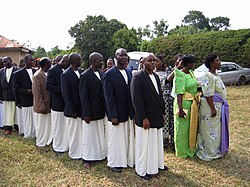
Men wearing kanzus at a wedding in Kampala, Uganda.

A kanzu is a white or cream coloured robe worn by men in the African Great Lakes region.[1][2] It is referred to as a tunic in English, and as the thawb in Arab countries. The kanzu is an ankle or floor length garment. It serves as the national costume of Tanzania as well as the Comoros, where it is called a kandu as well as a thawb. The robe is also worn in some coastal Muslim regions of Tanzania and Kenya. The men of Uganda consider it their most important dress. Kanzu is a Ganda word of Swahili origin, which means "robe" or "tunic". In Tanzania, the term is used interchangeably with kaftan.[2]

Ugandan kanzu

[edit]

The Kiganda/Ugandan kanzu was introduced to the Buganda Kingdom by Arab traders.[3] Kabaka Ssuuna was the first Kabaka of Buganda to wear the kanzu. After the Kabaka adopted the attire it became the formal wear of all Baganda men. The kanzu spread from the Baganda people to other ethnicities and is a national costume of Baganda men. (The Republic of Uganda has no pan-national costume for men as in neighboring Tanzania).

It is a variation of the Arabic thobe. Originally, the kanzu was made from barkcloth. Today the kanzu is made from silk, cotton, poplin, or linen. Linen kanzus are the most expensive. The main difference between the kanzu and the Arabic thobe is the design.

The traditional kanzu has maroon embroidery around the collar, abdomen, and sleeves. The embroidery is called the 'omuleela'. Some modern designers create a design of the kingdom emblem (shield, spear, and low-lying lion) lying at the lower part of the muleela. The major center of kanzu knitting and production is Mende, Uganda, but they are widely sold around the central business district in Kampala in places such as Kiyembe, Nakivubo, and other assorted shops.[4]

The kanzu is worn at wedding ceremonies during the introduction (also known as the Kwanjula). During the Kwanjula the groom's family is required to appear dressed in kanzu and they must also present a kanzu to the bride's family.[1][3]

The kanzu is worn with a suit jacket, blazer, or sport coat. It is customary for important persons to wear the kanzu with a black bisht.[1] Traditional attire for women in Baganda is the Gomesi.[1]

In popular culture, Ugandan clothing was featured in the film, The Last King of Scotland.[1]

Tanzanian kanzu

[edit]

In Tanzania, the kanzu was introduced by Arab traders and missionaries from Oman who were conducting dawah.[1] The Tanzanian kanzu is identical to the Arabic thobe. Originally, the kanzu was made from silk. Today, due to Islamic restrictions on silk garments, it is made from polyester or other synthetic fabrics made to resemble silk. The distinctive feature of the Tanzanian kanzu is the tassel that hangs from the collar.[5][1] In some families, the tassel is perfumed with African oils or Arabic attar (oils) before wedding ceremonies. The kanzu is always worn with a kofia, a small embroidered cap.[5]

In the West, and in many Arab countries, the Tanzanian kanzu is sold by merchants as an Omani thobe, Yemini dishdasha, or Emirati thobe. The best quality kanzus are manufactured in the United Arab Emirates. HKT is one of the manufacturers. Inexpensive Saudi- and Chinese-made versions are common.

A traditional Kofia (cap).

Among the Swahili men of Tanzania and Kenya, the kanzu is always worn with a suit jacket, blazer, or sport coat.[6] For formal wear a Tanzanian man will don a kanzu, a suit jacket, and a kofia (cap).[5] Tribal chiefs wear the kanzu with a black bisht when attending a black tie event. A white or ivory bisht is worn to white tie events. In many Western countries, the bisht is sold by merchants as a Saudi abaya or Abayah. According to custom, a kanzu must be crisp, that is dry cleaned and starched, before it is suitable for formal wear.[5][6]

The kanzu is the national costume of Tanzania, and is the formal wear of most of the tribes in the country. For informal events, a Saudi manufactured thobe with a mandarin collar or the dashiki shirt and a kofia is the traditional attire. Although the Tanzanian kanzu was borrowed from Arab culture, it is worn by all religious faiths, including Christians, Muslims, African Jews, and members of African traditional religions.[5]

Kenya

[edit]

In Kenya, the kanzu is worn by Muslims of all tribes. Christians rarely wear the kanzu for informal events, including church services. The formal wear for Christian weddings mainly use the dashiki shirt or kitenge shirt. Both religious communities wear a kofia, a small cap with the kanzu. In Kenya, it is customary for tribal chiefs and Muslim Imams to wear a black bisht with the kanzu when attending a formal event. Kenya is the only African country that does not have a national costume,[7] thus, many Kenyan men wear European suits or tuxedos for weddings and other formal events. Others have started to wear the Nigerian national costume, called an Agbada.[8] In Kenya, male Members of the Parliament are required to wear a European-style suit to sessions.[9]

West Africa

[edit]

In West Africa, similar yet highly distinct clothing are worn by predominantly Sahelian peoples. These include the Senegalese kaftan and the Boubou (often worn on formal occasions).

Wedding attire

[edit]

The kanzu is the traditional wedding attire for men in the Great Lakes region.[1] During wedding ceremonies it is customary for the groom to wear a white kanzu and a kofia. In Tanzania and Kenya, the groom wears a black or white bisht on top of the kanzu.[5] The groomsmen and other men who are members of the wedding party wear the kanzu with a suit jacket. In Uganda, the groom wears a suit jacket on top of the kanzu, and the bride's attire is the gomesi.[1]

In Tanzania and Kenya, the bride's attire is a white wedding dress or the West African boubou.[6] Use of wedding attire characteristic of the Great Lakes region has spread throughout the African diaspora. There are also some locals who prefer to wed in West African attire (see the dashiki).[7]

See also

[edit]

References

[edit]
[edit]
Revisions and contributorsEdit on WikipediaRead on Wikipedia
from Grokipedia
The kanzu is a traditional ankle-length , typically white or cream-colored and made from , worn by men in , particularly in , , and , as formal or ceremonial attire. Introduced to the Kingdom in the first half of the by traders along coastal trade routes, the kanzu derives its name from the word for "robe" and was initially adopted as a practical garment suited to the region's warm climate. Kabaka Ssuuna II, who ruled from 1832 to 1856, was the first king to wear it, establishing the as formal dress for men in the kingdom and influencing its spread across East African societies. In contemporary usage, the kanzu symbolizes and respectability, often paired with a for women during weddings, religious ceremonies, and national events in , where it holds semi-official status as a marker of heritage. Its design, featuring long sleeves and a loose fit, reflects influences from thobes while adapting to local tailoring traditions, and it remains a staple in Swahili-influenced coastal communities as well.

Definition and Description

Physical Characteristics

The kanzu is an ankle- or floor-length designed as a loose-fitting garment for men, providing comfort and in the warm climates of the region. It features long sleeves that extend to the wrists, allowing for full arm coverage while maintaining ease of movement. The standard color is white or cream, which conveys purity and formality in its traditional context. Key styling elements include a front opening secured by a series of buttons, facilitating dressing and adjustment. Collar styles include a stand-up or mandarin design, emphasizing simplicity and elegance. Optional embroidery borders, such as the maroon omuleela seen on cuffs and hems in some variants, add decorative accents without altering the garment's core form. The kanzu's design bears resemblance to the thawb, reflecting historical influences on its silhouette. It is commonly paired with accessories like the kofia cap for head coverage, a overcoat for added formality, or a to blend traditional and modern aesthetics.

Materials and Construction

The kanzu is traditionally crafted from natural fibers that align with East African ecological and cultural practices. In , among the , early versions were made from (lubugo), harvested from the inner bark of the mutuba tree (), beaten into a soft, durable sheet using wooden mallets in a labor-intensive process passed down through Ngonge clan craftsmen. This material provided a breathable, locally sourced alternative before the widespread adoption of woven fabrics. With trade influences, imported and emerged as primary materials, offering smoother textures and easier maintenance compared to . In coastal Swahili-influenced regions of Tanzania and , the kanzu is made from or . These fabrics, often lightweight and white-dyed for symbolic purity, form the base of the long, embroidered robe characteristic of the garment. variants also appeared in these areas for their natural cooling properties in humid climates. Contemporary kanzus prioritize practicality and accessibility. In , high-quality and dominate production for everyday and , while offers a premium option prized for its wrinkle resistance and superior drape. In and , synthetic fabrics such as blends are sometimes used for their low cost and durability. Construction techniques emphasize simplicity and reinforcement for the kanzu's loose, ankle-length form. Seams are traditionally hand-stitched with fine, even stitches to create a seamless flow, while hems are doubled and reinforced to withstand repeated wear and washing. In Ugandan styles, intricate —termed omulela—is applied by hand around the collar, cuffs, and midsection using maroon or threads, adding cultural distinction and preventing fabric fraying. The overall build favors straight cuts from rectangular fabric panels, minimizing waste and ensuring a modest, billowing fit. Production has evolved from village-based artisanal tailoring, where individual sewers worked by hand on custom pieces, to mechanized processes in urban workshops across and . Machine sewing now handles bulk seams and hems for efficiency, though embroidery often remains manual to preserve authenticity; this shift has scaled output while supporting local economies through tailoring cooperatives.

History and Origins

Introduction by Arab Traders

The kanzu emerged as a regional variant of the thawb, a traditional long-sleeved robe originating from the and , where it is known today as the thobe or dishdasha. This garment was introduced to primarily through the activities of and traders, who established extensive commercial ties along the starting from the 8th century CE. These traders, often Muslim merchants from regions like and the , brought not only goods but also cultural elements, including attire suited to the and Islamic practices. The spread of the kanzu was facilitated by vibrant networks that connected coastal ports such as and to inland East African kingdoms, exchanging commodities like , spices, and slaves for textiles and other imports. Omani and intermediaries played a pivotal role, with Omani sultans exerting influence over from the late 17th century, intensifying cultural exchanges into the 19th century. Early adaptations of the into the kanzu reflected practical and religious considerations in . Islamic prohibitions against men wearing —rooted in traditions emphasizing and —prompted a shift from luxurious imports to more accessible local or cotton-based fabrics, making the garment suitable for everyday and use. The word kanzu derives from Arabic qandura, and similar thawb-like garments were present in societies by the , often worn by merchants in or cream hues to denote purity and status.

Adoption in East African Societies

Following its introduction by Arab traders along East African trade routes in the early , the kanzu underwent significant localization as it integrated into indigenous societies across the region. In the Kingdom of present-day , the kanzu was adopted as royal attire during the reign of Kabaka Ssuuna II (1832–1856), who was the first to wear it, thereby elevating it to a symbol of prestige within the court. This endorsement facilitated its rapid spread from elite circles to commoners, becoming a staple of male dress by the mid- and reflecting the kingdom's engagement with external influences while adapting the garment to local customs. Along the in and , the kanzu became integrated into coastal societies by the 1800s, evolving from an imported item into a versatile garment worn across religious communities—including , , and adherents of traditional beliefs—as a marker of and respectability. In these multicultural trading hubs, affluent individuals favored finer versions of the kanzu to signify wealth and cultural sophistication, blending aesthetics with social norms. In the Comoros Islands, the kanzu adapted into the local "kandu," a long white robe that by the incorporated influences from Arab-Swahili trade networks and emerging French colonial contacts, solidifying its place in Comorian male attire as a symbol of and formality. Through ongoing migration, trade, and cultural exchanges in the , the kanzu extended to areas like and , where it appeared in formal and ceremonial contexts among diverse ethnic groups.

Regional Variations

Ugandan Kanzu

The Ugandan kanzu, particularly prominent among the people of the Kingdom, traces its adoption to the when Kabaka Ssuuna II (reigned 1832–1856) became the first ruler to wear it, establishing it as formal attire for men. This adaptation transformed the garment from its Arab origins into a symbol of and formality within Ugandan society. Distinctive features of the Ugandan kanzu include embroidery known as omuleela, typically applied around the collar, cuffs, sleeves, , and hem, setting it apart from plainer regional variants. The garment is often paired with a Western-style or suti for added formality, blending traditional and colonial influences. In Baganda culture, the embodies ethnic identity, dignity, and respect, serving as a marker of formality in social and official settings. It is widely regarded as Uganda's national men's dress, reflecting its widespread adoption beyond the Baganda to symbolize national pride. The kanzu is commonly worn during parliamentary sessions, where it remains an accepted form of attire under the dress code, alongside other traditional garments. It also features in national holidays and introduction ceremonies known as kwanjula, where the groom's family dons it to honor customs. Production of the kanzu occurs primarily through local tailoring in , with artisans using materials like , , or to craft the ankle-length . Modern versions often incorporate kingdom emblems, such as clan symbols or the crested crane, embroidered for ceremonial significance, especially on garments worn by the Kabaka to represent all clans.

Tanzanian Kanzu

The Tanzanian kanzu, a long white or beige robe reaching the ankles or floor, serves as the country's national costume for men, reflecting its coastal origins influenced briefly by traders who introduced similar thobe-like garments centuries ago. This attire transcends ethnic and religious boundaries, worn by , , and others across Tanzania's diverse of over 120 tribes, fostering a sense of . Its adoption as formal wear solidified post-independence, symbolizing unity and cultural pride in a multi-ethnic society. Distinctive to the Tanzanian variant is a hanging from the collar, known locally and often perfumed with African or Arabic oils for ceremonial occasions, adding a sensory element to its elegance. It is typically paired with an embroidered kofia, a cylindrical featuring intricate stitching and tiny perforations for ventilation, enhancing both style and practicality in tropical climates. The robe's clean lines and bright whiteness evoke purity and cohesion, distinguishing it from more regionally varied styles elsewhere in . In contemporary usage, the kanzu appears prominently during public holidays, Eid celebrations, and political events, where it underscores formality and collective harmony among Tanzania's varied groups. Politicians and officials don it for national ceremonies, reinforcing its role as a unifying emblem beyond religious contexts. This widespread embrace highlights its evolution from coastal traditions to a pan-Tanzanian symbol of shared heritage. Production centers in , where local artisans mass-produce the garment using affordable to replicate traditional textures, making it accessible to a broad population. Imported synthetic versions further support this, ensuring the kanzu remains a staple in everyday formal wardrobes while preserving its cultural essence.

Kenyan Kanzu

In , the kanzu is predominantly worn by Muslim men in coastal regions such as and , as well as urban centers, serving as a key element of Islamic attire rather than a national dress. Unlike more ornate variations elsewhere, the Kenyan kanzu features a simpler , typically a long, white cotton robe reaching the ankles without heavy embroidery, emphasizing modesty and practicality in the humid coastal climate. It is often paired with a kofia, a traditional embroidered cap, for everyday wear, while a bisht—an outer cloak—may be added for added formality during significant events. In 's Swahili communities, subtle variations include tailored fits that reflect local aesthetics, such as slightly flared sleeves adapted to regional preferences. The kanzu holds cultural significance among Kenyan , particularly during religious observances like and Eid celebrations, as well as weddings and coastal festivals such as Maulidi, where it symbolizes faith, dignity, and community identity. It is not designated as official national attire, distinguishing it from usages in neighboring countries, but remains integral to traditions shared historically with Tanzania's coastal populations. In urban settings like , it is commonly adopted by Somali and communities for prayers, social gatherings, and ceremonies, reflecting migration patterns from the coast and integration into city life. Production of the Kenyan kanzu occurs locally in coastal towns like and , where skilled tailors craft custom pieces using lightweight cotton fabrics, often imported from to suit the tropical environment. This process is influenced by longstanding Kenyan-Indian tailoring techniques, introduced through historical trade and the presence of Indian artisans, which emphasize precise stitching and durable construction for daily and ceremonial use.

Kanzu in Comoros and Other East African Regions

In the , the traditional men's garment known as the represents a localized of the kanzu, functioning as the national costume and reflecting Arab-Swahili influences blended with the islands' Islamic heritage. This ankle-length cotton robe, typically white or cream-colored with subtle embroidery, is worn by men during formal and ceremonial occasions, often paired with a taqiyah (or kofia) cap for added cultural significance. The kanzu also appears in the highland regions of Burundi and Rwanda as part of the broader Great Lakes cultural attire, where it serves as a formal for men in traditional contexts. In these areas, the garment maintains its long-sleeved, loose-fitting design but aligns with the region's ethnic diversity, appearing in community gatherings that honor pre-colonial customs. Recent efforts in the since 2020 have emphasized cultural revival through tourism initiatives, promoting traditional attire like the kandu as a symbol of to attract visitors and preserve heritage amid . These programs, supported by international organizations, highlight local costumes in festivals and guided experiences to foster while safeguarding intangible cultural elements.

Cultural and Social Significance

Formal and Ceremonial Uses

In political settings across , the kanzu serves as a symbol of authority and , frequently donned by lawmakers and leaders during official proceedings. In , members of parliament commonly wear the kanzu paired with a jacket as acceptable formal attire within the , reflecting a blend of and in . The garment holds particular prominence in religious ceremonies, where it embodies modesty and spiritual devotion. Among Muslim communities in , men wear a clean kanzu for Jummah prayers on Fridays, often complemented by a kofia cap, to signify purity and reverence during communal worship. During national events, the kanzu features prominently in celebrations that affirm collective heritage. In , it is worn by participants in Independence Day parades and related festivities, such as those marking the nation's 62nd anniversary, to honor historical milestones through traditional dress. Symbolically, the kanzu conveys , maturity, and cultural , often reserved for elders and leaders to denote and social standing. Its typical white fabric, sometimes accented with subtle for added formality, demands meticulous , including avoidance of stains to maintain its pristine appearance as a marker of .

Role in Weddings and Festivals

In East African weddings, the kanzu serves as the primary attire for grooms and male participants, symbolizing purity, respect, and . In Uganda's Kwanjula , the introduction of the to the groom's family, the groom and his delegation wear a white or cream kanzu paired with a , often featuring omulela in around the collar, , and sleeves to denote formality and clan affiliation. In and , grooms don a starched white kanzu complemented by a kofia () or bisht (), enhancing the garment's elegant during the nikah or matrimonial vows. Specific rituals underscore the kanzu's ceremonial role, integrating sensory and symbolic elements. During Tanzanian wedding ceremonies, the tassels on the kanzu are perfumed with African or oils, a practice that invokes blessings and connects the wearer to ancestral traditions while preparing for the union. In Ugandan Kwanjula proceedings, the kanzu's serves to display emblems, reinforcing familial ties as the groom's party engages in negotiations, music, and dances with the bride's relatives. These adjustments and displays highlight the garment's adaptability in rituals that blend solemnity with communal joy. Beyond weddings, the kanzu features prominently in East African festivals, where it facilitates cultural expression through movement and celebration. At Kenya's Maulid festival in , honoring the Prophet Muhammad's birth, men don their finest kanzu with kofia for processions, dances accompanied by , and recitations, pairing the garment's flowing design with rhythmic performances. Gender contrasts in these events emphasize complementary attire, fostering visual harmony. In Ugandan weddings, the groom's kanzu pairs with the bride's , a colorful busuti-style , creating a balanced representation of heritage during the Kwanjula.

Modern Adaptations

Contemporary Designs and Fashion

In recent years, the kanzu has evolved through innovative styling that blends traditional forms with modern aesthetics, appealing to younger generations and urban lifestyles across . Designers have introduced colored variants and other modifications, adding vibrancy to the classic white or cream palette. In and other regions, more tailored versions have appeared in urban settings. The kanzu's integration into pop culture has further elevated its contemporary appeal. It gained international visibility when British-Ugandan actor wore a traditional kanzu to the 2018 premiere of , highlighting its elegance on a global stage. Since the mid-2010s, the garment has been promoted by fashion enthusiasts on platforms, where users showcase styled kanzus for everyday and festive occasions, contributing to its resurgence among younger demographics. At fashion events, the kanzu has appeared in hybrid forms that fuse East African heritage with Western elements. During Tanzania's annual Swahili Fashion Week in , designers have featured kanzu adaptations that blend tradition with contemporary styles, creating versatile looks for since the event's expansions in the late . These hybrids, often in luxury fabrics like , emphasize a semi-formal aesthetic suitable for weddings and urban events. Youth adaptations have focused on practicality, with traditional materials, such as , increasingly blended with synthetic fibers for durability in modern contexts. As of 2025, social media platforms continue to highlight modern kanzu designs, including embroidered and fused styles at events like Swahili Fashion Week.

Global Production and Cultural Export

The kanzu's production has expanded beyond , with Ugandan producers facilitating exports to diaspora communities in the UK through online platforms, enabling access to authentic garments for cultural events. In global sales, the kanzu is often marketed as an "Omani thobe" or similar variant in the , appealing to shared aesthetic traditions in attire. Online retailers offer it to communities in the and for African heritage events. The garment's production contributes to economic impacts in , employing tailors in local workshops focused on traditional attire like the kanzu, supporting livelihoods amid the recycling and customization of imported fabrics. In , where it is known as a , the kanzu features prominently in , with visitors encountering men in this traditional robe during cultural explorations in towns like Moroni. Among the diaspora, the kanzu remains integral to Ugandan weddings in the UK, where grooms and attendees wear it to honor heritage during ceremonies blending local and traditional elements. Similarly, it appears at annual Kenyan cultural festivals in , such as the Atlanta Majuu event, showcasing East African attire and traditions to promote community identity abroad.

References

Add your contribution
Related Hubs
User Avatar
No comments yet.