Hubbry Logo
search
logo
1281985

Kavalappara Nair

logo
Community Hub0 Subscribers
Read side by side
from Wikipedia
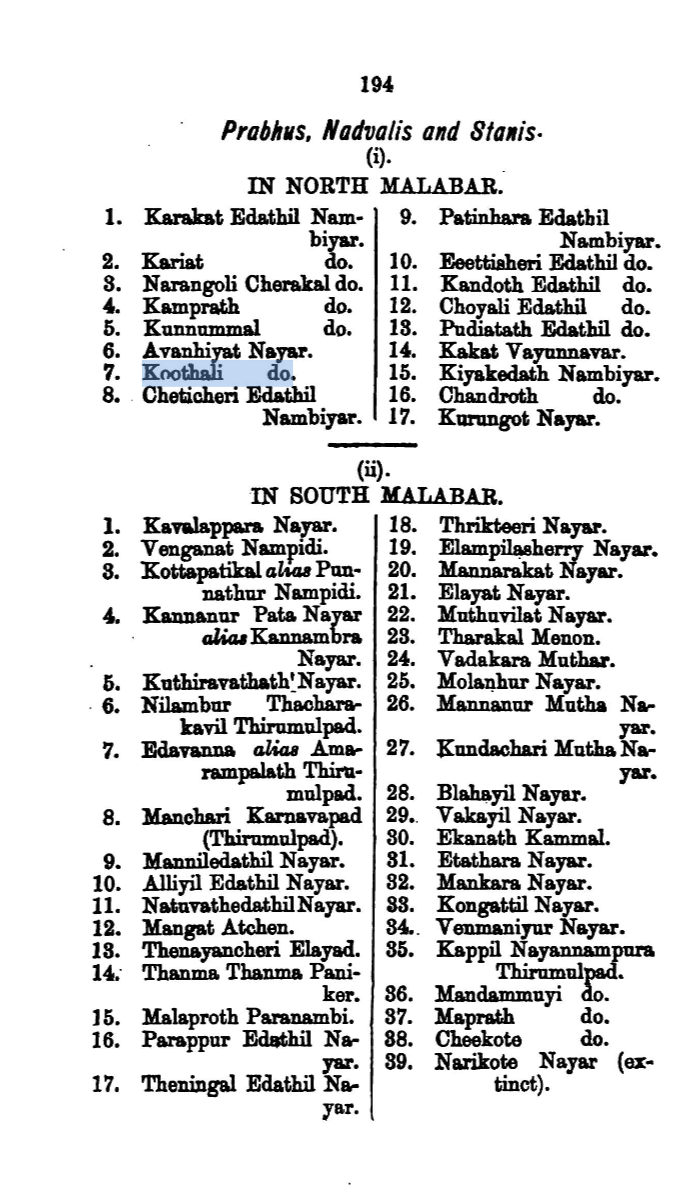
Elite sthanams in Malabar, including the Kavalappara at the head of the Southern tables

The Kavalappara is an princely Indian Nair tharavad or swaroopam, whose estates and powers vested in the matrilineally-mediated succession to and from each Kavalappara Nair, who headed the family and held the rank of Moopil Nair. In medieval Kerala, they served as part of the jenmi, or allodially landed nobility, and were sworn to the service of the rajas of the area, first that of Palghat and then later that of Cochin. Based at Kavalappara Desam in Karakkat, Valluvanada, their holdings extended to areas such as Kailiad and Panayur, ultimately compassing some 155,358 acres of jenmom estates, and ranking preeminent among the jenmimars of Malabar.[1]

Early history

[edit]

The Kavalappara Moopil Nayar, also known as the Karakkattu Kumaran Raman, were one of the four chiefly dynasties or perumpata nayar of ancient Nedunganad.[2] They became independent from the chieftainship of Nedungethiri in the 15th century, soon after the arrival of the Zamorin of Calicut to Nedunganad. Based at Eruppe Desam near Karakkat, Nedunganad, their holdings included some ninety-six villages.[3]

Nedunganad

[edit]

Nedunganad, one of the seventeen districts during the Chera regime[4] of Kodungallur, was situated between Kalladikkodan hills to the seashore villages of Ponnani-Purang. The chieftain of Nedunganad, known as Nedungethirippad, was an inefficient ruler. Kavalappara Nayar with other three (Thrikkateeri Nayar, Vattakkavil and Veettikkad nayars) became more powerful than Nedungethiri. Nedungethiri asked the help of the Zamorin of Calicut.[5] The procession of the Eralppad was known as kottichezhunnallathu. The Zamorin built a palace at Karimpuzha. This was happened soon after 1487. It was the same Zamorin who, later, in 1498, met with Vasco da Gama. When the Zamorin's procession reached Karimpuzha, the three Nayar chiefs of Nedunganad, came and received him. Kavalappara refused to attend the meeting of the Eralppad at Karimpuzha. He declared independence and asked the help of Cochin. He was so fortunate, because his land was situated on the banks of River Nila, adjacent to the boundary of the King of Cochin.

Mythology and medieval history

[edit]

The family are Moopil Nairs and claim to be descendants of Karakalamma, a child of Vararuchi, a Brahmin saint, and a Pulayar woman. Through this association, they also share kinship with the Kadambur Brahmins and the two communities recognise their shared ancient heritage in occasional rituals. The Kavalapparas also claim to have been independent chieftains from the later stages of the Chera dynasty until the arrival of the Zamorin of Calicut in 1748, although this is not historically accurate. K. K. N. Kurup, a historian of the Malabar region, notes that absence of their name from highly detailed documents of the period indicates that they were no more than "dependent landed aristocracy", variously of the rajas of Palghat and of Cochin. They were naduvazhi of the raja of Palghat, meaning that they were a form of feudatory governor who inherited their role, which included some political powers, but were subservient to him.[6][7]

During the period when clashes between the Zamorin of Calicut and the king of Cochin were common, which coincided with the arrival of Europeans in the area, the Kavalapparas were able to exploit the uncertainty and unrest to their advantage. They successfully fought in an alliance with forces from the kingdom of Travancore against the Zamorin and by around 1760 they [8]had reached a deal with the kingdom whereby they gained independence from interference in return for ceding to it a monopoly of the pepper growing on family properties. Unhampered by the objections previously raised by the Zamorin and by the raja of Cochin, they constructed a kottaram as a physical symbol of their independence. This residence took a form common to the royal family of Travancore and thus different from the kovilakam palaces that traditionally belied the status of Malabar rulers. Thereafter, the Kavalapparas and the royal house of Travancore retained close ties and it was to Travancore that the family fled when the Mysorean occupation of Malabar dispossessed them of their properties.[9]

The Kavalappara joined with Kesava Pillai and forces of the East India Company (EIC) in the Third Anglo-Mysore War, supplying both soldiers and grain. In recognition of this, Pillai, who was Diwan of Travancore and acting for the Bombay Presidency, reinstated their position as chieftains. A dispute arose because this arrangement contradicted one made around the same time between the king of Cochin and the Madras Presidency, which allowed for the king to have control of the Kavalappara territories. In 1792, the Kavalappara chieftain — who was seeking reinstatement in Kavalappara itself and in Edatara, Kongad and Mannur — was given a one-year reinstatement in a subordinate role by a Joint Commission instituted by the EIC in the Bombay Presidency. This was challenged by the king of Cochin, who said that the Kavalappars were his "acknowledged dependent[s]" and paid tribute to him, but the arrangement was continued with some financial amendments in 1793.[10]

The traditional system of land tenancies and land ownership in Malabar, known as janmi, had resulted in a small number of families owning most of the land. The EIC had determined to use a slightly modified form of the existing janmi administrative processes to collect revenue. Under this modified system, the janmis were granted leases on land and were responsible for collecting revenue — almost entirely based on a proportion of agricultural produce — on behalf of the EIC. The janmis, such as the Kavalapparas, sublet to tenants known as kanakkarans, who had some security of tenure, and both could sublet to verumpattakkars, who were tenants-at-will.[8][a] Thus, in 1794, the EIC granted the Kavalappara family a quinquennial lease on lands but it also disbarred from the feudal privileges of collecting death taxes from the Mappila[disambiguation needed]s and some festival offerings from the ryots. All revenue collecting responsibilities were lost in 1796 when they were transferred to direct control of the EIC, although the EIC did return a portion of the funds collected by the system of malikhana that recognised the loyalty of certain ruling families. In common with many of his peers, the Kavalappara chieftain had amassed considerable arrears in revenue monies that he was supposed to hand over and as a result of the transfer of revenue collection he now became nothing more than a landed aristocrat without political influence. Some feudal rights were retained, notably of control over some temples, but by the end of the nineteenth century the family estates were being administered by the Court of Wards and remained so until 1910.[10]


Today

[edit]

Today the traditional eight-acre palace complex that was long the seat of the Kavalappara Nair is mostly in ruin, with many core palace structures demolished or destroyed by storms. The present complex retains only the Oottupura or ceremonial banqueting hall, the Agraśālā, and the 'stepped mansion' complex, all of which are in derelict condition.

portions of the Kavalappara kottaram palace complex in ruins, in 2022

See also

[edit]

References

[edit]

Further reading

[edit]
Revisions and contributorsEdit on WikipediaRead on Wikipedia
from Grokipedia
The Kavalappara Swaroopam was a Hindu Nair feudal estate in the Malabar region of Kerala, India, ruled by the Kavalappara Moopil Nair family through matrilineal succession.[1]
Established amid the instability of the Chera dynasty in the late 15th century, it emerged as a vassal state under the Zamorin of Calicut but later formed alliances with the Kingdom of Cochin and Travancore to assert autonomy.[1]
The estate governed 96 villages spanning from Muttangal to Thottungal, encompassing agricultural lands focused on paddy, pepper, and riverine trade along the Nila River, with its headquarters at the now-ruined Kavalappara Palace near Ottapalam.[1][2]
Known for the martial prowess of its Nair rulers, the swaroopam participated in regional power struggles, including support for the East India Company during the Third Anglo-Mysore War, before losing political independence to British colonial administration by 1796.[1]
Culturally, it patronized temples like Arayankavu and Eruppe Shiva, hosting festivals such as the Pooram, while folklore figures like Kavalappara Komban highlight its legacy in local traditions.[1]
By the 19th century, the family's influence waned under British land reforms and Court of Wards management, reducing them to landed gentry; today, the palace complex lies in neglect, overgrown and housing reptiles amid deteriorating historical records.[1][2]

Origins and Foundations

Mythological Accounts

The Kavalappara Nairs trace their mythological origins to the legend of Vararuchi, a Brahmin astrologer and scholar, and his wife from the Pulaya caste, whose union produced twelve children known as the Parayi Petta Panthirukulam.[1] According to this tradition, one daughter, Karakalamma (or Karala Amma), is regarded as the ancestral figure for the Kavalappara lineage, linking them to broader Nair subcastes and associating their forebears with Kadambur Brahmins through this semi-divine progeny.[1][3] This narrative, common to several Kerala communities, posits the children as progenitors of distinct social groups, with Karakalamma's descendants embodying martial and landholding traits attributed to Nair aristocracy.[1] Local traditions further intertwine the clan's foundations with divine intervention at the Eruppe Shiva Temple, established by the inaugural Kavalappara Moopil Nair on land obtained from the Kummini Mana Namboodiri family.[1] During construction, excavation reportedly yielded blood from the earth, interpreted via astrological consultation as a sign of an embedded Shivalingam, which was then enshrined, marking the site's sacred potency and the clan's role as custodians of divine favor.[1] Such accounts emphasize supernatural validation of territorial claims, aligning with broader Nair mythological motifs of warrior origins under figures like Parasurama, though specific ties to the avatar's reclamation of Kerala from the sea remain generalized rather than uniquely documented for Kavalappara.[4] These stories, preserved in oral and temple lore, underscore a cosmology where human endeavor intersects with cosmic sanction, yet lack corroboration from pre-colonial inscriptions, reflecting their status as foundational myths rather than empirical history.[1]

Historical Establishment under Perumals

The Kavalappara Moopil Nairs, a prominent lineage within the Nair aristocracy, trace their territorial establishment in Nedunganad—a strategic district under the Chera Perumal dynasty (c. 800–1120 CE)—to roles as local chieftains and military administrators. Nedunganad, encompassing areas between the Kalladikkodan hills and the Ponnani-Purang villages, fell within the Chera realm centered at Mahodayapuram, where Nayars served as elite warriors, including in the Perumals' personal guard known as the Ayiram (a thousand Nair fighters).[1] The Kavalappara family positioned itself among the Perumpata Nayars, four chiefly dynasties of ancient Nedunganad responsible for regional governance and defense amid the Perumals' feudal structure.[5] Family traditions assert that the core lands were granted by Cheraman Perumal, a titular Chera ruler, during his purported conversion to Islam and departure for Mecca (legendarily dated to c. 825 CE), with the Moopil Nair tasked to administer the area via karyasthans (managers).[6][7] However, this narrative lacks corroboration from contemporary inscriptions, copper plates, or traveler accounts, aligning instead with later medieval folklore that romanticizes Perumal-era fragmentation; historians note such claims often served to legitimize post-Chera autonomy without empirical backing.[8] The Perumals' reliance on Nair intermediaries for agrarian oversight and troop levies in peripheral nadus like Nedunganad provided a plausible historical kernel, as evidenced by sangam-era and early medieval records of Nair integration into Chera hierarchies, though specific Kavalappara documentation emerges only in later feudal contexts.[1] By the waning Perumal phase (11th–12th centuries), as central authority eroded due to Chola incursions and internal revolts, the Kavalappara Nairs consolidated de facto control over 96 desams (sub-units) in Nedunganad, transitioning from vassalage to semi-independent swaroopams while invoking Perumal-era precedents for legitimacy.[1] This establishment reflected broader causal dynamics: the Perumals' janmi land grants to Brahmin settlers and martial Nayars fostered localized power centers, enabling families like the Kavalapparas to endure the dynasty's collapse around 1120 CE.[9]

Territorial and Administrative Structure

The Nedunganad Region

Nedunganad encompassed a strategic lowland region in southern Malabar, Kerala, bounded by the Bharathappuzha (Nila) River to the north and the Gayathripuzha (Toothappuzha) River to the south, extending eastward from the Kalladikkode hills to westward coastal areas including Kunnamkulam, Chavakkad, Veliyancode, Ponnani-Purangu, and Vettathunad.[1][10] This territory, historically part of the Chera dynasty's domain, comprised approximately 152 desams (village units) and served as a buffer zone between the Zamorin of Calicut and the Raja of Cochin, fostering political volatility due to rival influences.[1][11] Administratively, Nedunganad functioned as a semi-autonomous principality under Nedungadi (Nedungathiri) chieftains from the 11th to 13th centuries, with Cherpulasseri as its capital, before subjugation by the Valluvakkonathiri and subsequent Zamorin conquest in the 14th century via the Kottichezhunnallaththu route, leading to a Zamorin headquarters at Karimpuzha.[10] Local Nayar lineages, including the Kavalappara Moopil Nairs—one of four dominant chiefly families—exerted significant control, particularly over 96 villages spanning from Muttangal to Thottungal along the Nila's northern bank, incorporating areas like Ottappalam, Chittur, and Palakkad, totaling around 736 acres.[1] These holdings formed the core of the Kavalappara Swaroopam's feudal structure, managed matrilineally by Moopil Nairs who maintained a standing army and resisted full Zamorin integration, leveraging ties to the Cochin dynasty for autonomy.[1][10] The region's desam-based organization supported agrarian revenue from rice cultivation and trade routes, but internal feuds—such as Nedungathiri appeals to the Zamorin against insurgent Nayar houses like Kavalappara—undermined cohesion, culminating in fragmentation by the late medieval period.[10] Kavalappara's domain within Nedunganad, initially vassal to the Zamorin, shifted alliances toward Cochin and later British lessees by 1794, reflecting adaptive governance amid colonial encroachments that eroded traditional authority by 1796.[1]

Governance and Military Role

The Kavalappara Swaroopam operated as a feudal principality under the authority of the Kavalappara Moopil Nair, the senior-most male member of the matrilineal Nair dynasty, who exercised sovereign rights over a territory spanning approximately 31 square kilometers in the Nedunganad region of Valluvanad.[2][12] This governance structure emphasized the centralized management of impartible estates and local desams (administrative villages), with the ruler responsible for property administration, revenue collection, and maintaining feudal obligations within a confederation of 96 villages bounded by the Kaniyampuram and Ongallur streams.[13][12] As a nominal feudatory of the Vellattiri Raja, the Moopil Nair retained significant autonomy in internal affairs, reflecting the decentralized yet hierarchical nature of pre-colonial Kerala polities where matrilineal succession ensured continuity of power among eligible male heirs.[12] Militarily, the Swaroopam relied on the martial traditions of the Moopil Nairs, a subgroup renowned for their prowess in warfare and capacity to mobilize forces for defense and expansion.[14] The principality maintained a standing army drawn from Nair warriors, enabling participation in regional power struggles and strategic alliances; for instance, it supported Cochin against Calicut incursions, leveraging its position along the Bharathapuzha River for tactical advantages.[14] This military apparatus proved instrumental during external threats, as evidenced by the Swaroopam's contributions of troops and grain to allied efforts against Mysorean incursions in the late 18th century, underscoring its role in broader resistance networks amid colonial encroachments.[14]

Medieval Conflicts and Alliances

Relations with Zamorin of Calicut

The Kavalappara Nairs emerged as vassals of the Zamorin of Calicut during the latter's expansion into the Nedunganad region in the late 15th century, with an ancestor meeting the Calicut prince at Karakkad while initially serving under Valluvanad.[15] By around 1487, the Zamorin asserted influence by constructing a palace at Karimpuzha, incorporating Kavalappara territories and appointing local chieftains, though the Nairs claimed semi-autonomy stemming from earlier Chera grants and resisted full submission during Zamorin processions.[1] In ceremonial capacities, Kavalappara Nayars performed Akampati duties during the Zamorin's state visits to Calicut and held ritual significance, such as notifications of their leaders' deaths triggering household observances.[15] Militarily, Kavalappara leaders supported the Zamorin as feudatories, with figures like Karakkitu Muttavan (alias Kavalappara Nayar) commanding 1,000 Nayars in feudal levies and accompanying campaigns against Cochin and Portuguese forces at Bardela in 1560.[15] They also joined anti-Dutch alliances in 1689 alongside other chieftains to counter European influence in Cochin, reflecting aligned interests against external threats.[15] Prior to escalating tensions, Kavalappara Moopil Nairs participated in the Mamankam festival, standing beside the Zamorin as a symbol of vassalage.[1] Relations deteriorated in the mid-18th century amid the Zamorin's bids for greater control, with Kavalappara seeking alliances with Cochin against Calicut influence and refusing to yield during the Eralppad's 1748 procession at Karimpuzha, prompting direct confrontation.[1] By 1760, Kavalappara shifted toward Travancore under Marthanda Varma, contributing to attacks on Zamorin forces at Thrissur in 1762 and ceding pepper revenues for temporary autonomy, marking a transition from subordination to open rivalry.[1] This enmity ended their joint ceremonial roles, including at Mamankam, and aligned Kavalappara with broader resistance networks until British interventions further eroded both powers' autonomy in the 1790s.[15][1]

Key Rulers and Events

The Kavalappara Swaroopam gained prominence in the late 15th century, when Kavalappara Nayar, a local Nair leader, declared independence from the chieftainship of Nedungethiri amid the instability of the Chera dynasty's decline. This move was facilitated by alliances with the Kingdom of Cochin against the expanding Zamorin of Calicut, establishing the Swaroopam as a semi-autonomous entity ruling over territories in Nedunganad. Around 1487 CE, the Zamorin's intervention in the region, prompted by the ineffective governance of Nedungethirippad, included the construction of a palace at Karimpuzha to consolidate influence, heightening territorial rivalries.[1] Under subsequent rulers, particularly the Kavalappara Moopil Nairs, the Swaroopam reached its zenith, commanding up to 5,000 Nayar warriors and controlling 96 desams stretching from the Bharathappuzha River to the Palakkad Gap. These Moopil Nairs, hereditary governors, initially maintained vassalage to the Zamorin, participating in ceremonies like the Mamankham festival, but relations soured by 1748 due to strategic disputes over trade routes and territory. A notable Moopil Nair constructed the Eruppe Shiva Temple, symbolizing cultural patronage alongside military prowess, with the palace serving as the administrative headquarters.[1][3] Key events in the 18th century included the 1760 alliance with Travancore under Marthanda Varma, which secured independence from Zamorin dominance during the Mysore-Zamorin conflicts; however, this came at the cost of ceding control over pepper production. In 1762, Kavalappara forces joined Travancore in attacking Zamorin's army at Thrissur, further weakening Calicut's hold. The Third Anglo-Mysore War in the 1790s saw the Swaroopam support the East India Company, leading to reinstatement as chieftains post-victory; a 1792 agreement granted them a property assessment of Rs 18,000 and annual malikhana payments of Rs 1,000 by 1804, though revenue collection rights were revoked by 1796, reducing them to zamindari status.[1][3] By the 19th century, the lineage continued through numbered Moopil Nairs, with the 15th incumbent's death in 1872 placing the estates under British Court of Wards administration, marking the effective end of autonomous rule.[16]

Decline and Transition

Challenges from Colonial Powers

Following the Third Anglo-Mysore War (1790–1792), the Kavalappara Swaroopam allied with the British East India Company by providing soldiers and grain supplies, securing a temporary revenue lease in 1794 as reward.[1] However, the Company assumed direct control of revenue collection across Malabar by 1796, stripping the Kavalappara Nairs of fiscal autonomy and reclassifying them as dependent jenmis within the colonial land revenue system, which curtailed traditional feudal levies such as death duties.[1] This shift marked the onset of diminished political authority, as British policies emphasized centralized taxation over local prerogatives, transforming erstwhile chieftains into aristocratic proprietors subject to oversight from Madras Presidency administrators.[1] The estate faced intensified intervention in 1872 after the death of the 15th Moopil Nair, who left no avuncular male heir and an inheritance encumbered by debts totaling over Rs. 200,000, largely from sustaining 150 retainers amid matrilineal succession disputes favoring a six-year-old niece.[16] British authorities invoked the Court of Wards Act, placing the 6,000-plus-acre holdings—spanning eight desams in Malabar and portions in Cochin—under District Collector management until 1910, treating it as tarwad property despite contested sthanam status.[16][17] This custodianship addressed arrears and inefficiency by replacing underperforming managers, reducing liabilities to Rs. 30,000 by 1911 through rigorous fiscal reforms, but it exemplified colonial paternalism overriding indigenous inheritance norms and eroding family sovereignty.[16] Colonial land policies, which rigidified the janmi-kudiyan hierarchy without resolving tenancy grievances, indirectly fueled the 1921 Malabar Rebellion, where anti-British Mappila insurgents targeted Nair landlords like the Kavalappara, attacking the residence of Lieutenant Kavalappara Moopil Nayar and exploiting pre-existing restrictions on Muslim tenants overnighting in their domains.[18] The uprising, initially Khilafat-linked resistance to British rule, devolved into communal violence against Hindu estates, compounding the Swaroopam's vulnerabilities under a system that preserved jenmi privileges while stoking agrarian unrest through unyielding revenue demands.[19] In response, Kavalappara M. Nayar published Tenancy Agitation in Malabar in 1922, critiquing the tenancy movements that British inaction had intensified, highlighting how colonial governance exacerbated landlord-tenant frictions without granting substantive reforms.[19]

Post-Independence Integration

Upon India's attainment of independence on August 15, 1947, the territories historically associated with the Kavalappara Swaroopam, situated in the Malabar District under direct British administration, seamlessly integrated into the Dominion of India without the need for a separate instrument of accession, as they were not classified as a sovereign princely state.[12] The region's administrative continuity persisted under the Madras Presidency's successor state until the States Reorganisation Act of 1956, which, effective November 1, 1956, transferred the Malabar areas including Ottapalam and Shoranur—core locales of Kavalappara influence—from Madras State to the newly formed Kerala State, aligning linguistic and cultural boundaries. The family's feudal authority over estates, spanning approximately 96 villages and rooted in the jenmi system of land tenure, faced dissolution through post-independence agrarian legislation aimed at redistributing land to tenants. The Kerala Agrarian Relations Act, 1957, initiated restrictions on landlord rights, followed by the comprehensive Kerala Land Reforms Act, 1963, which vested intermediary interests in the government, conferred ownership to cultivating tenants, and abolished jenm rights, thereby curtailing the economic base of Nair swaroopams like Kavalappara. As jenmis, Kavalappara family members contested the reforms' impact on their holdings in litigation, notably in the Supreme Court case Kavalappara Kottarathil Kochuni & Ors. v. State of Madras (1960), where the court affirmed the laws' protection under Article 31A of the Constitution against challenges on property rights grounds.[12] By the mid-1960s, implementation of these reforms had effectively privatized former estate lands among tenants, reducing the swaroopam to titular status with retention primarily of the palace structure amid family disputes over residual assets.[20] This transition exemplified the broader causal shift from hereditary feudalism to egalitarian land ownership in Kerala, driven by empirical pressures of tenancy inequities and political mobilization, though it prompted legal resistance from affected elites without altering the reforms' trajectory.[12]

Cultural and Social Legacy

Matrilineal System and Nair Traditions

The Kavalappara Nair lineage, as a prominent swaroopam within the Nair community of Malabar, followed the marumakkathayam system of matrilineal inheritance, where descent, succession, and property rights traced through the female line to nephews rather than sons.[21][22] This framework structured family organization around the taravad, a joint household comprising descendants of a common female ancestor, who lived together in an ancestral nalukettu-style dwelling managed collectively.[23] The karnavan, typically the eldest male in the matrilineage, served as the administrative head responsible for estate decisions and external relations, though authority derived from the collective matrilineal interest rather than individual patrilineal claim.[23][24] Nair traditions emphasized martial prowess alongside this kinship structure, with men training from youth in kalari (martial arts) and serving as warriors or administrators, often leaving the taravad for campaigns while women oversaw domestic economies, including agriculture and trade oversight.[25] Sambandham alliances formed the core of marital customs, functioning as visiting unions without full cohabitation or dowry transfer, enabling hypergamous ties with higher-status families like Samanthan Nairs while preserving taravad integrity and allowing multiple partners to sustain lineage flexibility amid high male mortality in warfare.[24] Property remained impartible in elite swaroopams like Kavalappara, vesting in the lineage for maintenance of sthanams (thrones or estates), with customs obligating support for junior members, including education and upkeep, as upheld in legal precedents tied to the family's estates.[21] Rituals reinforced matrilineal bonds, such as puberty ceremonies (talikettu kalyanam) for girls around age 10-12, symbolizing entry into reproductive roles within the taravad, followed by later sambandham initiations, and ancestor veneration at the family shrine honoring maternal forebears.[26] This system afforded Nair women greater property custodianship and decision-making latitude than in patrilineal Hindu counterparts, fostering economic stability for warrior households, though male elders retained de facto control over major dispositions.[24] In Kavalappara's case, these traditions underpinned the swaroopam's semi-autonomous governance, integrating martial service to overlords like the Zamorin with internal lineage continuity until colonial-era disruptions.[23]

Contributions to Performing Arts

Kavalappara Narayanan Nair (1882–1948), a scion of the Kavalappara lineage, emerged as a leading exponent of Kathakali, specializing in portrayals of Hanuman that emphasized dynamic agility and expressive mudras.[27] His innovations included the development of stylized training techniques and notation systems for sub-minor roles, which standardized character-acting patterns still emulated by subsequent practitioners.[27] As a tutor, he imparted foundational knowledge of Kathakali's 24 basic hand gestures to early Western scholars, facilitating the art form's initial documentation and global dissemination.[28] The Kavalappara Mooppil Nairs extended patronage to temple-based performing traditions, notably Kathakali, integrating it into regional cultural practices amid their feudal governance.[29] This support sustained performances in palace and temple settings, preserving the form's narrative depth drawn from Hindu epics. In the realm of shadow puppetry, the Kavalappara chieftains originated and fostered the Tholpavakoothu tradition over four centuries, with troupes like the Kavalappara Sangam performing ritualistic plays in local temples using leather puppets to depict mythological tales. Under Mooppil Nair's auspices, this art form evolved as a communal rite, emphasizing silhouette storytelling accompanied by folk songs and percussion, distinct from broader Kathakali influences yet complementary in regional temple rituals. Such patronage ensured Tholpavakoothu's continuity in areas from Ottapalam to Ongalur, linking aristocratic oversight to vernacular performance heritage.[30]

Current Status and Preservation

State of Kavalappara Palace

The Kavalappara Palace, located in Shoranur within the Palakkad district of Kerala, spans an eight-acre complex that has deteriorated into ruins over decades. The main palace structure was demolished in the mid-1980s, leaving behind remnants engulfed by overgrown vegetation and serving as habitat for reptiles and insects.[20] [31] Legal disputes originating from court cases since 1967 have resulted in portions of the estate, including palace properties, being placed under government control, exacerbating neglect and hindering restoration efforts. The absence of systematic conservation has allowed the site to become a near-impenetrable thicket infested with snakes, rendering it inaccessible to the public and unsafe for visitation.[31] [6] Over 10,000 historical records belonging to the Kavalappara Swaroopam, once stored at the palace, are also in a state of decay due to lack of maintenance. As of recent observations in 2024, the palace remains closed to visitors, with no documented major preservation initiatives undertaken to reverse the ongoing degradation.[20]

Modern Descendants and Recognition

The descendants of the Kavalappara Nair, a matrilineal Nair swaroopam historically tied to the Moopil Nair lineage, have faced fragmentation due to prolonged property litigations that began in the 1960s, leading to the dispersal of family members and the court's oversight of remaining assets.[6] Some branches relocated to Thrissur, where they maintain a low-profile existence amid unresolved disputes over ancestral holdings, which were progressively eroded post-independence through land reforms and legal challenges.[3] The Kavalappara Palace complex, emblematic of the family's former status, remains in ruins under judicial administration owing to these intra-family conflicts, with over 10,000 historical records at risk of further deterioration.[6][1] In contemporary times, the lineage receives limited formal recognition, primarily through scholarly examinations of its feudal role in Kerala history rather than active societal or governmental honors.[1] Legal precedents, such as the 1969 Supreme Court case involving Kavalappara Kottarathil Parvathi Nethiar, have affirmed customary maintenance rights under Marumakkathayam law for the family's impartible estate, underscoring enduring judicial acknowledgment of its traditional structure despite modern socio-economic shifts.[21] No prominent public figures or institutional tributes to living descendants are documented, reflecting the swaroopam's transition from regional authority to obscurity following the abolition of privy purses and zamindari systems in India.[20]

References

User Avatar
No comments yet.