


Community hub
Recent from talks
Contribute something
Nothing was collected or created yet.
Shoranur
View on Wikipedia
Shoranur is a town and municipality located on the banks of the Bharathapuzha River, in the Palakkad district of Kerala. The town is spread over an area of 32.28 km².
Key Information


Geography
[edit]Shoranur is located at 10°46′N 76°17′E / 10.77°N 76.28°E.[1] It has an average elevation of 49 metres (160 feet).
History
[edit]This place was originally a part of the Nedunganad Swaroopam dynasty, which ruled over the present-day Pattambi and Ottapalam Taluks.[2] By the end of the 15th century CE, Nedunganad came under the Zamorin of Calicut.[2] The Chieftains of Shoranur known as the Kavalappara Moopil Nair maintained his territory as a buffer zone between the Zamorin and the Rajas of kochi often taking sides keeping in mind his personal interests of the time .[2] With the annexation of Malabar by the British Kavalappara became part of Walluvanad Taluk of Malabar District, with the Taluk headquarters at Perinthalmanna.[2]
Politics
[edit]Shoranur became a municipality in 1978 and is divided into 33 electoral wards. It is a part of Shoranur Legislative Assembly Constituency and Palakkad Parliamentary Constituency.[3] Shoranur assembly constituency was formed in 2011. Before that Shoranur municipality was under Pattambi assembly constituency.
Transport
[edit]Shoranur well connected by road to the nearest cities of Thrissur and Palakkad . SH 22 which is also called the Shoranur - Kodungallur road passes through Thrissur, while the Ponnani - Palakkad road passes through Kulappully.
There are regular bus services to Ottapalam, Thrissur, Chelakkara, Pattambi and Cherpulassery from shoranur. Kulappully serves buses from Palakkad and Guruvayur.
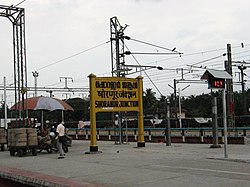
Shoranur Junction is the largest railway station in Kerala and it handle trains to almost all parts of the country. The most popular daily express in Kerala the Venad Express runs between Shoranur and Trivandrum.
Educational institutions
[edit]- Institute Of Printing Technology & Government Polytechnic College, Shoranur
- Institute for Communicative and Cognitive Neurosciences, Kavalapara, Shoranur
- Vishnu Ayurveda College, Kulapully, Shoranur
- MPMMSN Trust College, Shoranur
- Carmel CMI School, Shoranur
- Al Ameen Engineering College
- Jyoti engineering college, Cheruthuruthy
- National Research Institute for Panchakarma, Cheruthuruthy
Notable people
[edit]- Balan K. Nair, actor
- Meghanathan, actor
- A. K. Lohithadas, film director
Villages
[edit]Culture and literature
[edit]Literature and history
[edit]In December 2024, poet and teacher V. M. Girija published Chiramannur to Shoranur: Oru Deshavazhiyude Katha (Malayalam: ചിറമണ്ണൂർ ടു ഷൊർണൂരോരു ദേശവഴിയുടെ കഥ, “From Chiramannur to Shoranur: The Story of a Land Route”). The work, brought out by Manorama Books, examines the cultural history of Shoranur by tracing the transformation of its former name, Chiramannur, into the present town. Blending historical research with personal reflection, the book explores the region’s heritage, social memory, and cultural landscape across time. It was launched at the Hortus Cultural Festival, inaugurated by writer Sara Joseph.[5]
See also
[edit]References
[edit]

- ^ Falling Rain Genomics, Inc - Shoranur
- ^ a b c d Logan, William (2010). Malabar Manual (Volume-I). New Delhi: Asian Educational Services. pp. 631–666. ISBN 9788120604476.
- ^ maps of india - shornur assembly constituency
- ^ "Polling Booth in Shornur Assembly Constituency". elections.in. Retrieved 27 June 2023.
- ^ "Sara Joseph launches student's book by V. M. Girija". Manorama Online (in Malayalam). Malayala Manorama. 14 December 2024. Retrieved 19 September 2025.


| States/UTs | |
|---|---|
| Districts |
|
| Taluks |
|
| Municipal Corporations |
|
| Municipalities |
|
| Other towns |
|
| Historical regions | |
Shoranur
View on GrokipediaShoranur is a municipal town in the Palakkad district of Kerala, India, located on the banks of the Bharathapuzha River.[1] It functions as a key transportation hub, primarily due to Shoranur Junction railway station, which is the largest in Kerala by area and connects major rail lines from Chennai and Mangalore, along with a branch line to Nilambur.[2][1] As per the 2011 Census of India, the town's population stood at 43,533, with 10,420 households.[3] The significance of Shoranur stems from its strategic railway infrastructure under the Palakkad division of Southern Railway, facilitating connectivity across southern India and serving as a gateway to central Kerala regions.[1][4] Economically, the town benefits from its role in rail transport, though detailed sector-specific data remains limited in official records beyond general census demographics indicating a mix of urban and peri-urban activities.[3] Historically, the junction's development, including expansions like the Shoranur-Eranakulam line, has bolstered its operational importance since the early 20th century, though primary archival sources emphasize its ongoing utility over past events.[1]
Geography and Environment
Location and Physical Geography
Shoranur lies on the northern banks of the Bharathapuzha River in Palakkad district, Kerala, India, at coordinates 10.77°N 76.28°E.[5][6] The Bharathapuzha, originating in the Western Ghats northeast of Palakkad and flowing westward across coastal plains, marks the town's primary natural boundary and influences its riverine character.[7] The topography features flat alluvial plains at an average elevation of 49 meters above sea level, shaped by river sediments that deposit fertile soils ideal for agriculture, including paddy fields.[5] These low-lying areas, typical of Palakkad's riverine lowlands, consist of clayey alluvial deposits with good workability for cultivation.[8] To the east, the terrain rises toward the Western Ghats, providing a natural demarcation from higher elevations.[7] Physically, Shoranur's position astride the Bharathapuzha establishes it as a transitional zone between central Kerala's interior and the northern Malabar region, with the river facilitating connectivity across its basin spanning latitudes 10°26' to 11°13' N and longitudes 75°53' to 77°13' E.[9] The alluvial soils here, base-rich and near-neutral in reaction, support intensive farming due to their fertility and drainage properties derived from periodic flooding.[8][10]
Climate and Environmental Factors
Shoranur exhibits a tropical monsoon climate, with average annual precipitation of approximately 1,538 mm distributed over 243 rainy days, predominantly during the southwest monsoon from June to September.[11] Temperatures typically range between 24°C and 35°C throughout the year, accompanied by high humidity levels that exacerbate thermal discomfort, particularly in the pre-monsoon hot season from March to May. June records the highest monthly rainfall, averaging around 485 mm, contributing to intense seasonal downpours that define the region's hydrological patterns. The Bharathapuzha River, adjacent to Shoranur, poses recurrent flood risks due to overflows during heavy monsoon rains, leading to localized inundations that disrupt transportation and settlements.[12] In August 2018, exceptional statewide rainfall exceeding normal levels by over 70% in nearby Palakkad district triggered severe flooding, resulting in train service suspensions on Shoranur-linked routes and widespread submersion along the riverbanks.[13][14] Similar events in 2022 prompted flood warnings for areas along the Bharathapuzha, highlighting the river's vulnerability to upstream water releases and prolonged precipitation.[15] Environmental pressures in the region include river siltation from excessive sand mining and upstream erosion, which diminishes channel capacity and amplifies flood susceptibility by reducing the Bharathapuzha's natural conveyance.[16] Nearby urbanization and agricultural expansion exert deforestation influences on catchment areas, accelerating soil erosion and sediment loads into the river, thereby compromising long-term ecological stability and habitability without direct evidence of reversal trends.[17] These factors underscore causal linkages between land-use changes and heightened hydrological vulnerabilities specific to Shoranur's riparian setting.Historical Development
Pre-Colonial and Early History
The region of modern Shoranur, situated on the southern banks of the Bharathapuzha River (also known as the Nila), supported early human settlements driven by the river's utility for agriculture, water supply, and inland navigation. Archaeological evidence from the broader Bharathapuzha basin reveals prehistoric activity, including Neolithic posthole structures and pillared halls in the Gayathripuzha tributary valley, dating to approximately 2500–1500 BCE, which point to organized communities exploiting riverine resources for sustenance and rudimentary exchange.[18] These patterns of habitation likely extended to lower basin areas like Shoranur, where the river's flow facilitated seasonal flooding for fertile alluvial soils suitable for paddy cultivation and early trade in goods such as spices and timber.[19] By the medieval period, the locality was designated Cheruvannoor, a name implying a small-scale village ("cheru" denoting diminutive or modest in Malayalam) amid wooded terrain, reflective of agrarian clusters rather than urban centers.[20] This settlement emerged within the administrative framework of Valluvanad, an early feudal division of the Chera kingdom that encompassed territories along the Bharathapuzha from at least the 12th century, with the river serving as a natural boundary and conduit for regional connectivity via ferries prior to engineered crossings.[21] The area's integration into Valluvanad's domain supported localized markets for agricultural produce and river-borne commerce, though limited by the absence of large-scale infrastructure and reliance on monsoon-dependent transport.[22] Valluvanad's governance, under rulers like the Valluvakonathiri, emphasized control over riverine routes extending southward from the Bharathapuzha, fostering modest economic nodes like Cheruvannoor through tribute systems and protection of trade paths linking inland Kerala to coastal outlets.[23] Historical records indicate no major urban development or monumental constructions in the Shoranur vicinity during this era, aligning with the causal constraints of flood-prone topography and decentralized feudal authority, which prioritized subsistence farming and intermittent exchange over expansive settlement.[24]Colonial Period and Railway Establishment
During the British colonial era, Shoranur emerged as a pivotal railway hub within the Madras Presidency, with the Shoranur Junction station becoming operational on April 14, 1862, as part of the South Indian Railway's extension from Tirur northward toward Beypore and Mangalore.[2] This development aligned with broader colonial railway policies aimed at facilitating troop movements and exporting raw materials, integrating remote areas like Malabar into imperial trade networks.[25] Initial tracks followed the standard Indian broad gauge of 5 ft 6 in (1,676 mm), enabling efficient connectivity that supplanted traditional riverine transport along the Bharathapuzha, though primarily serving British economic extraction over local priorities.[26] By the early 20th century, Shoranur Junction had expanded into Kerala's largest railway station by area, incorporating lines to Ernakulam opened on July 16, 1902, and to Nilambur Road in 1927, alongside eastward routes via the Palakkad Gap to Coimbatore.[2] These extensions supported the transport of cash crops such as coconut copra from Malabar plantations and emerging rubber estates, accelerating export volumes to ports like Cochin and Bombay while fostering a modest influx of laborers and traders to the region.[27] The railway's strategic role extended to military logistics, with junctions like Shoranur aiding troop deployments during World War I and II, as colonial infrastructure diverted resources for Allied efforts, including shipments to the Middle East.[28] This connectivity boosted regional economic activity but entrenched dependency on export-oriented monocultures, disrupting pre-existing fluvial trade systems without equitable benefits for indigenous economies.[25]Post-Independence Administration and Expansion
Following the States Reorganisation Act of 1956, Shoranur, previously part of the Malabar district in Madras State, was integrated into the newly formed Kerala state on 1 November 1956, marking a shift to unified Malayalam-speaking regional governance.[29] This reorganization facilitated localized administrative reforms, with Shoranur transitioning to panchayat status in 1961 to manage basic civic functions such as sanitation and local roads under the Kerala Panchayat Raj Act. By 1978, escalating urban pressures prompted its upgrade to municipality status, enabling expanded responsibilities in planning, taxation, and public services amid post-independence decentralization efforts.[30] Population growth underscored this administrative evolution, with Shoranur's recorded inhabitants rising to 42,029 by the 2001 census, more than doubling from mid-20th-century estimates around 20,000 amid broader Kerala demographic expansion driven by improved healthcare and migration patterns.[31] State-led initiatives under five-year plans accelerated infrastructure, including widespread electrification by the 1980s—achieving near-universal village coverage in Palakkad district—and literacy campaigns that elevated local rates from below 50% in 1951 to over 85% by 2001, though uneven implementation favored urban cores over peripheral agrarian zones.[32] Kerala's land reforms of the 1960s and 1970s, including tenancy abolition and ceiling limits under the Kerala Land Reforms Act of 1963, redistributed holdings in Shoranur's rice-dependent Bharathapuzha basin but yielded limited productivity gains, as empirical analyses reveal persistent smallholder fragmentation and stagnant yields without complementary irrigation or credit access—contrasting with expectations of boosted output from tenant empowerment. Central government policies, such as community development programs, supplemented state efforts but faced critiques for bureaucratic inefficiencies, evident in delayed rural road linkages that hindered Shoranur's integration with Thrissur until later decades. These dynamics reflected causal tensions between redistributive intent and structural agrarian constraints, prioritizing equity over efficiency in a context of high population density.[33]Recent Infrastructure and Urban Developments
Shoranur Junction railway station underwent a ₹12.94 crore renovation under the Amrit Bharat Station Scheme, with works progressing toward completion by October 2, 2025, including upgrades to the terminal building and facilities.[34] As part of this project, the century-old footbridge was replaced with a modern structure to improve accessibility, particularly for elderly passengers facing difficulties with the steep original incline.[35] In August 2025, Southern Railway launched a new MEMU passenger service between Shoranur Junction and Nilambur Road, operating as a night train departing Shoranur at 8:35 p.m. and arriving at Nilambur by 10:05 p.m., with the return journey starting at 3:45 a.m.[36][37] This extension enhances connectivity along the route, complementing existing passenger services and supporting late-evening and early-morning travel needs. Track upgradation on the Mangaluru-Shoranur section reached 90% completion by June 2025, enabling trains to operate at speeds up to 130 km/h, up from previous limits, thereby reducing travel times and increasing line capacity.[38][39] Concurrently, the rollout of the Kavach indigenous train collision avoidance system began on the Ernakulam-Shoranur corridor in 2025, marking Kerala's first implementation of this technology to prevent signal passing at danger and mitigate collision risks.[40][41] Urban residential developments have included projects such as Neamath Acacia villas, contributing to housing expansion amid growing demand driven by improved rail links.[42] Shoranur Municipality has pursued detailed urban planning initiatives, focusing on areas like the Kulappulli-Shoranur bus stand to address traffic and infrastructure needs.[43] These enhancements are projected to stimulate local employment in construction and ancillary services while fostering tourism through better accessibility, though rapid urbanization raises concerns over land acquisition impacts on existing communities.[44]Demographics and Social Structure
Population Dynamics and Census Data
The 2011 Census of India recorded the population of Shoranur Municipality at 43,533, with 20,757 males and 22,776 females, yielding a sex ratio of 1,097 females per 1,000 males.[45][3] The overall literacy rate stood at 95.19%, surpassing the Kerala state average of 94%.[3] From 2001 to 2011, the population increased from 42,029 to 43,533, reflecting a decadal growth rate of approximately 3.58%, which aligned closely with Kerala's statewide rate of 4.91% during the same period.[31][46] This modest expansion occurred amid Kerala's broader demographic transition, characterized by declining fertility rates below replacement levels and net out-migration for employment, offsetting potential inflows from the town's role as a railway junction.[46] Shoranur's population density was 1,349 persons per square kilometer in 2011, based on its municipal area of 32.28 square kilometers, exceeding the Kerala state average of 860 persons per square kilometer.[47][46] This elevated urban density underscores Shoranur's concentration as a transport node within a predominantly rural state, though it remains moderate relative to denser Kerala municipalities.Ethnic, Linguistic, and Religious Composition
Shoranur's linguistic composition is dominated by Malayalam, the official language of Kerala, spoken by the vast majority of residents as their mother tongue, consistent with statewide patterns where Malayalam accounts for over 96% of primary languages.[48] Proximity to Tamil Nadu through the Palakkad Gap introduces a Tamil-speaking minority, particularly among communities in border-adjacent areas of Palakkad district, where Tamil constitutes a significant secondary language influencing local dialects and trade interactions.[48] This bilingual element fosters cultural exchanges, such as in festivals and markets, without displacing Malayalam's primacy in administration, education, and daily life. Ethnically, the population primarily consists of Malayali groups, including upper-caste Nairs historically associated with landownership and martial traditions, and Ezhavas forming a substantial backward-class community engaged in agriculture and toddy-tapping. Scheduled Castes comprise 17.1% of the total, often integrated into village economies, while Scheduled Tribes represent a marginal 0.2%, reflecting Kerala's low indigenous tribal density outside forested highlands. Migrant laborers from neighboring states add transient diversity, particularly in railway and construction sectors, but do not alter the core Malayali ethnic fabric shaped by Dravidian and Indo-Aryan admixtures over centuries. Religiously, Hindus form the overwhelming majority at 83.15% of the 2011 census population, centered around temple worship at sites like the Sree Mahadevar Temple, which draws pilgrims linking Shoranur to broader Thrissur-Thiruvilwamala circuits. Muslims account for 12.79%, predominantly Mappila communities maintaining mosque-based practices and riverine trade ties, while Christians at 3.89% include Syrian and Latin rite adherents with church institutions supporting education. This distribution supports empirical observations of interfaith coexistence, rooted in shared Bharathapuzha riverine rituals and agrarian interdependence, rather than reported statewide tensions elsewhere in Kerala.[3][49]Economy and Local Livelihoods
Agricultural and Traditional Sectors
Agriculture in Shoranur, situated in the Bharathapuzha river basin within Palakkad district, primarily involves cultivation of paddy, coconut, rubber, banana, and vegetables, with paddy area showing a consistent decline over recent years due to land conversion and water constraints. The district's cropping intensity stands at approximately 139%, enabling multiple cropping cycles where irrigation from the Bharathapuzha and its tributaries supports about 44% of the net sown area, though 75% of the local population relies on these surface water sources for farming needs.[10] Traditional irrigation practices tied to the seasonal flow of the Bharathapuzha facilitate vegetable and short-cycle crop farming on riverine sandbeds during low-water periods, but over-reliance on monsoon rains has exposed vulnerabilities, as evidenced by the river reducing to a trickle in 2023 amid a 45% rainfall deficit, exacerbating drinking and irrigation water shortages in Shoranur and nearby areas.[50][51] Groundwater depletion trends in Kerala, including northern and central districts like Palakkad, further compound these risks, with excessive extraction and variable recharge lowering water tables and threatening sustainability of rainfed and irrigated agriculture.[52] In traditional sectors, riverine fishing along the Bharathapuzha persists on a small scale but has declined due to reduced water volumes, seasonal variability, pollution from urban sewage, and agrochemical runoff, with poor data availability highlighting dispersed and intermittent landing centers.[53][54] Handloom weaving, involving local production and retail of cotton fabrics, remains a supplementary livelihood in Shoranur villages, though it faces competition from mechanized alternatives and urbanization, without evidence of large-scale traditional clusters comparable to nearby Thrissur hubs.[55] These activities underscore a shift from subsistence-based practices toward mixed or non-farm incomes, driven by environmental pressures and infrastructural changes.Modern Commerce, Services, and Emerging Industries
Shoranur's service-oriented economy leverages its status as a major transportation node, with the Shoranur Junction railway station enabling logistics and freight handling that underpin local commerce. The station, the largest in Kerala by area, supports the movement of goods across the Palakkad division, where freight revenues surpassed targets by 24% in 2024, achieving ₹218 crore against a projection of ₹176 crore.[56] This connectivity fosters retail trade and small-scale vending around the junction, serving daily passenger traffic and regional distribution needs. Tourism services have emerged as a key sector, exemplified by heritage Ayurvedic resorts such as The River Retreat, a 4-star property located nearby in Cheruthuruthy, which offers wellness treatments, multi-cuisine dining, and accommodations overlooking the Bharathapuzha River.[57] The resort, housed in a former royal palace, draws visitors for holistic therapies including Panchakarma, contributing to employment in hospitality and ancillary services amid Kerala's broader push for sustainable tourism.[58] Infrastructure upgrades signal potential growth in emerging industries tied to enhanced connectivity. Renovation of Shoranur station under the Amrit Bharat Station Scheme, valued at ₹12.94 crore, is slated for completion by October 2025, improving facilities for passengers and logistics.[34] Additionally, the proposed third rail line between Ernakulam and Shoranur, estimated at ₹12,000 crore, aims to alleviate congestion on this high-density corridor, potentially boosting transport-related services and spillover from Kochi's economic hubs through better freight and commuter links.[59] These developments, while promising efficiency gains from post-liberalization rail investments, highlight disparities where skilled logistics roles expand but unskilled labor faces competition from mechanization.Governance and Politics
Municipal Administration and Local Governance
Shoranur Municipality, established in 1978, administers an area of 32.33 square kilometers across 33 wards, enabling localized decision-making on urban services within the Palakkad district framework.[60] The council oversees core functions such as public health, sanitation, and infrastructure maintenance, with responsibilities including solid waste management and coordination of utility provisions under the Kerala Municipality Act.[61] These duties extend to facilitating water supply schemes, drawing primarily from the Bharathapuzha River through Kerala Water Authority-managed projects that serve approximately 30,000 residents, though seasonal river depletion has prompted check-dam interventions to sustain flows.[62][63] Efficiency in sanitation is tracked via national benchmarks, with all 33 wards achieving 100% door-to-door waste collection under Swachh Bharat Mission guidelines, reflecting operational capacity despite resource constraints.[64] Recent projects emphasize infrastructure resilience, including the 2024-25 annual plan's allocation for road maintenance like the Post Office Road upgrades, which incorporate drainage enhancements to mitigate flood risks from Bharathapuzha overflows during monsoons.[65] Kerala's decentralization model grants municipalities statutory powers, yet empirical evidence indicates persistent state-level oversight on budgeting and approvals hampers full autonomy, as major initiatives require government concurrence, delaying responses to localized challenges like drainage-linked flood control.[66] This structure, while enabling plan formulation, ties municipal outlays to state fiscal allocations, with Shoranur's reserves and grants—totaling over ₹165 million in recent balances—subject to centralized directives rather than independent revenue mobilization.[63][67]Electoral History and Political Representation
Shornur is encompassed by the Shornur Assembly constituency (No. 51), which has been a stronghold of the Left Democratic Front (LDF), led by the Communist Party of India (Marxist or CPI(M), since its formation following the 2008 delimitation. In the 2021 Kerala Legislative Assembly elections, P. Mammikutty of CPI(M) secured victory with 74,400 votes, representing approximately 46% of the valid votes cast, defeating T.H. Firoz Babu of the Indian National Congress (INC, part of the United Democratic Front or UDF) who received 37,726 votes (23%) and Sandeep Varier of the Bharatiya Janata Party (BJP, part of the National Democratic Alliance or NDA) with 36,973 votes (23%).[68][69] Voter turnout stood at 76.64%.[70] Prior to 2011, the area fell under the Pattambi Assembly constituency, where LDF candidates also prevailed in most elections from the 1950s onward, reflecting Kerala's pattern of alternating LDF-UDF governments at the state level but with LDF dominance in rural Palakkad segments.[71]| Year | Winner | Party/Front | Votes | Margin |
|---|---|---|---|---|
| 2021 | P. Mammikutty | CPI(M)/LDF | 74,400 | 36,674 over INC |
| 2016 | P. Mammikutty | CPI(M)/LDF | ~65,000 (est.) | LDF retained amid UDF challenge |
| 2011 | K. Achuthan | CPI(M)/LDF | Initial post-delimitation win | LDF control established |