


Community hub
Recent from talks
Contribute something
Nothing was collected or created yet.
P-270 Moskit
View on WikipediaThe P-270 Moskit (Russian: П-270 «Моски́т»; English: Mosquito) is a Soviet supersonic ramjet powered anti-ship cruise missile. Its GRAU designation is 3M80, air launched variant is the Kh-41 and its NATO reporting name is SS-N-22 Sunburn (one of two missiles with that designation). The missile system was designed by the Raduga Design Bureau during the 1970s as a follow-up to the P-120 Malakhit (NATO reporting name "SS-N-9 Siren"). The Moskit was originally designed to be ship-launched, but variants have been adapted to be launched from land (modified trucks), underwater (submarines) and air (reportedly the Sukhoi Su-33, a naval variant of the Sukhoi Su-27), as well as on the Lun-class ekranoplan. The missile can carry conventional and nuclear warheads. The exact classification of the missile is unknown, with varying types reported. This uncertainty is due to the secrecy surrounding an active military weapon. The missile has been purchased and exported to the People's Liberation Army Navy (China) and Egyptian Navy (Egypt).
Key Information


Design
[edit]
The missile is capable of reaching a speed of Mach 3 (3,700 km/h; 2,300 mph) at high altitude and Mach 2.2 at low-altitude. This speed is 4.25 to 3 times more than speed of the subsonic American Harpoon. The Moskit was designed to be employed against smaller NATO naval groups in the Baltic Sea (Danish and German) and the Black Sea (Turkish) and non-NATO vessels in the Pacific (Japanese, South Korean, etc.), and to defend the Russian mainland against NATO amphibious assault.[3] The missile can perform intensive anti-defense maneuvers with overloads in excess of 10 g, which completed for 9 kilometres (5.6 mi) before the target.[1][4][5]
Variants of the missile have been designated 3M80M, 3M82 (Moskit M).[6] The P-270 designation is believed to be the initial product codename for the class of missile, with the Russian Ministry of Defense GRAU indices (starting with 3M) designating the exact variant of the missile. The 3M80 was its original model. The 3M80M model (also termed 3M80E for export) was a 1984 longer range version of the missile, with the latest version with the longest range being the 3M82 Moskit M. The ASM-MSS / Kh-41 variant is the 1993 air-launched version of the missile.[7]
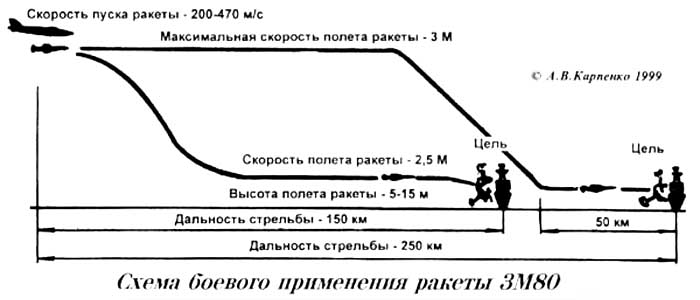
The 3M80MVE variant has an optional longer 240 kilometres (150 mi) range through a second, high-altitude flight profile setting, however using the higher altitude profile would make the missile detectable at much greater distances.[8]
Specifications
[edit]
- Launch range:
- min: 10–12 km (6.2–7.5 mi; 5.4–6.5 nmi)
- Maximum firing range:[1]
- 3M80E – 120 km (75 mi; 65 nmi) (surface ship)
- 3M80MVE – 140 km (87 mi; 76 nmi) (surface ship, low-altitude trajectory); 240 km (150 mi; 130 nmi) (surface ship, combined trajectory)
- Missile flight speed: 2,800 km/h (1,700 mph; Mach 2.3)
- Missile cruising altitude: 10 – 20 m (low-altitude trajectory), under 7 m for the attack at the target.[1][10]
- Launch sector relative to ship’s lateral plane, ang.deg: ±60
- Launch readiness time:
- From missile power-on till first launch: 50 seconds
- From combat-ready status: 11 seconds
- Inter-missile launch time (in a salvo): 5 seconds
- Launch weight:
- 3M-80E missile 4,150 kg (9,150 lb)
- 3M-80E1 missile 3,970 kg (8,750 lb)
- Warhead type: penetrator
- Warhead weight: 300 kg (explosives 150)
- Dimensions:
- Length: 9.385 m
- Body diameter: 0.8 m
- Wing span: 2.1 m
- Folded wing/empennage span: 1.3 m
Variants
[edit]- P-80 Zubr (with missile 3M80) shorter dimensions and range.
- P-270 Moskit (with missile 3M82) longer range and dimensions, maybe faster.
- Kh-41 air launched AGM (air-to-ground missile) or AShM (anti-ship missile).
- P-270MV Coastal Anti-Ship, GLCM (ground launch cruise missile), LACM (land attack cruise missile) variants, SSC-7/12 .
- P-270MVE export version.
Operators
[edit] Russia is the main user, under VMF, GLCM in coastal missile defence (raketnjy berezhnjy\govaja okhrana), ALCM in VVS
 Egypt Used on P-32 Molniya class missile boat[11]
 India
India Iran
Iran People's Republic of China[12]
 Vietnam
 North Korea (unknown)


Former operators
[edit]
Notes
[edit]References
[edit]- ^ a b c d "Противокорабельная ракета 3M80 (3М80Е) Москит". Retrieved 8 October 2015.
- ^ "Moskit / SS-N-22 Sunburn". Archived from the original on 28 August 2016. Retrieved 1 October 2014.
- ^ "dtig.org" (PDF). Archived from the original (PDF) on 5 February 2012. Retrieved 8 October 2015.
- ^ "ПКР Москит". Retrieved 8 October 2015.
- ^ "Вооружение РКВП "Бора" и "Самум" Черноморского флота". Archived from the original on 23 September 2015. Retrieved 8 October 2015.
- ^ "eDefense - Detect. Decide. Shoot. Survive". Archived from the original on 30 April 2006. Retrieved 1 October 2014.
- ^ "История" [History] (in Russian). Archived from the original on 6 August 2014. Retrieved 25 August 2016.
- ^ Gormley, Dennis M.; Erickson, Andrew S.; Yuan, Jingdong (30 September 2014). "A Potent Vector: Assessing Chinese Cruise Missile Developments". Joint Forces Quarterly (75). National Defense University: 102. Archived from the original on 22 March 2016. Retrieved 11 January 2016.
- ^ "Х-41". Archived from the original on 3 March 2016. Retrieved 8 October 2015.
- ^ a b "X-41 (3M-80E) Москит".
- ^ "ГВАРДЕЙСКИЙ РАКЕТНЫЙ КАТЕР "Р-32" ПЕРЕДАН ЕГИПТУ". balabin-1712.livejournal.com (in Russian). 13 August 2015. Archived from the original on 13 August 2015.
- ^ "Tactical Missiles Corporation Missile Exportation Since 1992" (PDF). Moscow Defense Brief (4/2008): 27.
External links
[edit]- FAS report Archived 28 August 2016 at the Wayback Machine
- Global Security report
- Moskit Online Photoalbum from BSF
- DTIG.org report (PDF)
- "Asia’s Advanced Precision Guided Munitions" (PDF)
- Missile analysis (PDF)
- Start from the plane for a combined trajectory (concept of combat employment). (Ru)

P-270 Moskit
View on GrokipediaDevelopment
Origins and requirements
During the 1970s, the Soviet Navy identified a critical need for advanced anti-ship missiles capable of countering the growing threat posed by U.S. Navy carrier battle groups, which were increasingly equipped with advanced air defense systems like Aegis and SM-2 surface-to-air missiles.[5] Earlier subsonic missiles, such as the P-15 Termit (NATO: SS-N-2 Styx), had proven vulnerable to electronic countermeasures and interception during naval exercises and simulations, prompting a shift toward supersonic designs that could compress enemy reaction times to mere seconds.[6] This strategic imperative was driven by the broader Cold War naval competition, where the Soviets prioritized sea denial over power projection, relying on fast, sea-skimming cruise missiles to overwhelm NATO defenses in potential conflict zones like the North Atlantic and Norwegian Sea.[7] Development of the P-270 Moskit (GRAU: 3M80) began in 1973 at the Raduga Design Bureau, part of the NPO Mashinostroyeniya state corporation, as a direct successor to the P-120 Malakhit (NATO: SS-N-9 Siren), which had introduced supersonic capabilities but fell short in range and payload for engaging large surface combatants. The project aimed to integrate lessons from these predecessors, emphasizing ramjet propulsion for sustained high-speed flight above Mach 2, low-altitude sea-skimming trajectories to evade radar detection, and enhanced resistance to electronic jamming through rapid terminal maneuvers and minimal exposure time.[6] Key design decisions focused on arming smaller surface platforms, such as destroyers and corvettes, to bolster fleet missile brigades against carrier-centric task forces.[5] Specific requirements outlined for the Moskit included a combat range of approximately 90-130 km to enable standoff strikes from forward-deployed ships, a 300 kg high-explosive semi-armor-piercing warhead sufficient to disable major warships, and operational speeds reaching Mach 3 at altitude (Mach 2.2 in low-level attack mode) to reduce defensive response windows to 25-30 seconds.[1] These parameters were shaped by the need to penetrate layered U.S. defenses, ensuring the missile's active radar seeker and inertial guidance could maintain accuracy despite countermeasures.[5] The emphasis on ramjet augmentation over pure rocket propulsion marked a conceptual evolution from the Termit and Malakhit, prioritizing endurance at supersonic velocities for saturation attacks on high-value targets like aircraft carriers.[6]Testing and production
The testing phase of the P-270 Moskit (3M80) missile began with initial ground evaluations in the mid-1970s, transitioning to flight tests between 1979 and 1982. These early flight trials utilized modified Il-28 bombers for air-launch simulations and surface platforms, including test boats and destroyers, to validate the missile's ramjet propulsion and sea-skimming capabilities.[8] Key milestones during testing included the successful ramjet ignition at Mach 2.5 in 1981, demonstrating the engine's high-speed performance under operational conditions. Full system integration trials followed in 1983-1984 at the Black Sea test range, where the missile's guidance, propulsion, and warhead delivery were rigorously assessed in naval environments. A total of 15 flight tests were conducted, with 8 fully successful outcomes, 5 partial successes, and 2 failures primarily due to control system and engine issues.[8] Production commenced in 1984 at the Progress plant in Arsenyev, with an initial annual output of 50 units that scaled to 200 by 1990 to meet Soviet Navy demands. Early production faced challenges, including failures in low-altitude sea-skimming modes caused by radar altimeter inaccuracies, which were resolved by 1983 through design refinements.[9] The missile was officially adopted by the Soviet Navy in 1985 following state trials. First operational deployments occurred in 1986 aboard Sovremenny-class destroyers, marking the integration of the Moskit into frontline surface combatants.Design
Airframe and propulsion
The P-270 Moskit features a cylindrical airframe designed for aerodynamic efficiency and compatibility with naval launch systems, measuring 9.385 meters in length and 0.76 meters in diameter.[2][8] Its structure incorporates an ogival nose cone made from radio-transparent fiberglass for seeker integration, a central fuselage with four side-mounted air intakes, and a rear section housing the propulsion elements, constructed primarily from titanium alloys such as OT4 and steel spars for durability under high-speed flight.[8][5] The missile employs folding cruciform wings and tail surfaces in a clipped delta configuration, with a wingspan of 2.1 meters when extended and 1.3 meters when folded, enabling compact storage in launch canisters or rails.[2][8] These folding mechanisms, along with the overall low-profile sea-skimming flight path at altitudes of 7 to 20 meters, exploit the radar horizon to reduce detection range by enemy defenses.[2][8] Propulsion is provided by a combined solid-fuel booster and liquid-fueled ramjet system, with the booster—integrated into the ramjet nozzle—accelerating the missile to approximately Mach 1.5 during a burn time of 3 to 4 seconds before separation via airflow.[8][5] The ramjet, designated 3D80 and fueled by kerosene, then sustains cruise speeds of Mach 2.5 to 2.8, enabling the missile's supersonic performance throughout its trajectory.[2][8] For launch integration, the Moskit supports inclined rail launches from platforms including Sovremenny-class destroyers and Tarantul III corvettes, with wings and control surfaces unfolding post-launch.[2][5] Booster separation occurs shortly after initial acceleration, transitioning seamlessly to ramjet operation.[8]Guidance and countermeasures
The P-270 Moskit missile utilizes an inertial navigation system for mid-course guidance, directing the weapon toward the designated target area during the initial flight phase. This autopilot-based system ensures stable flight over long distances, with the missile climbing to higher altitudes for efficient cruise before descending for the terminal approach.[5][2] In the terminal phase, guidance shifts to an active radar seeker housed in the missile's radar-transparent nose cone, enabling autonomous target acquisition and homing. The seeker supports both active and passive modes, allowing it to detect and track surface vessels at ranges sufficient for engagement within the missile's operational envelope, while the overall system achieves an accuracy of approximately 1 km circular error probable (CEP).[1][5][2] The missile follows a sea-skimming trajectory, maintaining altitudes of 7 to 20 meters above the ocean surface to reduce radar cross-section and evade early detection by shipboard defenses. For target acquisition, it executes a programmed pop-up to higher altitude before a final dive, followed by S-pattern evasive maneuvers in the approach phase to complicate interception efforts; these maneuvers are supported by the missile's aerodynamic controls and propulsion system, enabling turns that reduce effective range but enhance survivability.[2][5] To counter defensive measures, the Moskit's design emphasizes resistance through its Mach 2+ speed and low-altitude profile, which severely limit the reaction time for detection, tracking, and engagement by anti-missile systems, leaving only 25 to 30 seconds for countermeasures in optimal scenarios. The active/passive seeker configuration provides inherent electronic counter-countermeasure (ECCM) capabilities, including the potential for home-on-jam operation to exploit enemy radar emissions, while the missile's overall kinematics overwhelm chaff, decoys, and jamming attempts by saturating defenses.[5][1][2]Warhead options
The P-270 Moskit missile is equipped with a baseline high-explosive fragmentation warhead weighing 300 kg, containing approximately 150 kg of explosive filler equivalent to a similar amount of TNT for destructive effect.[10] This semi-armor-piercing design enables penetration of ship hulls to cause structural damage and flooding, augmented by the missile's high kinetic energy upon impact.[5] An alternative nuclear warhead option was developed for the missile, featuring a yield of 120 kt, intended for strategic strikes against large naval formations such as aircraft carrier groups.[1] This capability was part of Cold War-era designs but has not been produced or deployed in significant numbers following the Soviet Union's dissolution, with operational use limited to conventional payloads in modern inventories.[5] Fuzing mechanisms for the warhead include a delayed impact fuze that allows penetration before detonation, maximizing internal damage to armored targets.[10] The system supports semi-armor-piercing effects to induce flooding, with fuze arming coordinated via the missile's guidance electronics.[5] The warhead is integrated forward in the missile structure, positioned immediately behind the nose-mounted guidance and seeker section and separated from the rear ramjet engine and fuel tank by a bulkhead for safety and structural integrity. The total missile launch weight is approximately 4,000-4,500 kg, incorporating around 800 kg of liquid fuel for the ramjet sustainer, though exact fuel allocation varies by variant.[5]Technical specifications
Dimensions and weights
The baseline 3M80 variant of the P-270 Moskit measures 9.385 meters in length, with a body diameter of 0.76 meters.[8][2] The wingspan is 2.1 meters when extended and 1.3 meters when folded for storage or launch.[8][2] The missile's launch weight is 3,950 kg, which includes a 300-320 kg high-explosive penetrating warhead.[8][2][11] Some sources report a maximum weight of up to 4,500 kg for the baseline configuration, potentially accounting for variations in fuel load or launch adaptations.[11][5]| Parameter | Value | Source |
|---|---|---|
| Length (without booster) | 9.385 m | Missilery.info, Weaponsystems.net |
| Diameter | 0.76 m | Missilery.info, RedStar.gr |
| Wingspan (extended/folded) | 2.1 m / 1.3 m | Missilery.info, Weaponsystems.net |
| Total launch weight | 3,950–4,500 kg | Missilery.info, RedStar.gr, GlobalSecurity.org |
| Warhead weight | 300–320 kg | Missilery.info, RedStar.gr |