Hubbry Logo
Kindley Air Force BaseKindley Air Force BaseMain
Open search
Kindley Air Force Base
Community hub
Kindley Air Force Base
logo
8 pages, 0 posts
0 subscribers
Be the first to start a discussion here.
Kindley Air Force Base
from Wikipedia

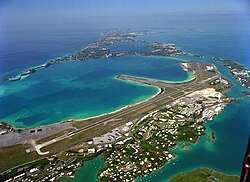
St. David's, in 1676. The shape of St. David's Island, and of Castle Harbour (originally Southampton Harbour), was radically altered by the construction of the airfield, which began in 1941.

Key Information

Kindley Air Force Base was a United States Air Force base in Bermuda from 1948–1970, having been operated from 1943 to 1948 by the United States Army Air Forces as Kindley Field.

History

[edit]
Kindley Field, shortly after construction

World War II

[edit]

Prior to American entry into the Second World War, the governments of the United Kingdom and the US led by Prime Minister Winston Churchill and President Roosevelt came to an agreement exchanging a number of obsolete ex-US Naval destroyers for 99-year base rights in a number of British Empire West Indian territories. Bases were also granted in Bermuda and Newfoundland, though Britain received no loans in exchange for these. This was known as the destroyers for bases deal.

As the government of Bermuda had not been party to the agreement, the arrival of US engineers in 1941 came as rather a surprise to many in Bermuda. The US engineers began surveying the colony for the construction of an airfield that was envisioned as taking over most of the West End of the Island. Frantic protests to London by the Governor and local politicians led to those plans being revised. The US Army would build an airfield at the north of Castle Harbour. The US Navy would build a flying boat station at the West End

The airfield was intended to be a joint US Army Air Forces/Royal Air Force facility, to be used by both primarily as a staging point for trans-Atlantic flights by landplanes. When the US Army occupied the area, it created Fort Bell, with Kindley Field (named in honour of an American pilot, Field E. Kindley, who had served with the Royal Flying Corps during World War I), being the airfield within it.

There were two air stations operating in Bermuda at the start of the Second World War, the civil airport on Darrell's Island, which was taken over by the Royal Air Force for the duration, and the Royal Naval Air Station on Royal Naval Air Station Bermuda on Boaz Island. Both were limited to operating flying boats, as Bermuda's limited and hilly landmass offered no obvious site for an airfield. The US Army succeeded in building the airfield by levelling small islands and infilling the waterways between (at the West End, the U.S. Navy used the same methods to create its Naval Air Station, which—like the British bases—was restricted to use by seaplanes).

USAAF 390th Bomb Group B-17s, in transit from the US to UK, at Kindley Field on the 22 June, 1943

The US Army levelled Longbird Island, and smaller islands at the north of Castle Harbour, infilling waterways and part of the harbour to make a land-mass contiguous with St. David's Island and Cooper's Island. This added 750 acres (3 km2) to Bermuda's land mass, bringing the total area of the base to 1,165 acres (4.7 km2). The area had already been in use for centuries by the British Army, with islands across the southern mouth of Castle Harbour, including Cooper's Island, housing obsolete fortified coastal batteries (the US Army placed a modern coastal artillery battery on Cooper's Island, though this was removed at the end of the Second World War), a rifle range on Cooper's Island, and a tent camp on St. David's Island for the infantry guarding nearby St David's Battery was relocated nearer the battery as the underlying land became part of Fort Bell. The airfield was completed in 1943, and known as Kindley Field after World War I aviator Field E. Kindley. Most of the base was taken up by the US Army Air Forces. The northern end of the airfield, near the causeway, was taken up by the Royal Air Force and Royal Navy Fleet Air Arm. The first aircraft to operate from the airfield were Blackburn Roc target tugs of 773 Fleet Requirements Unit, FAA, which had been formed at RNAS Bermuda on the 3 June 1940. These monoplanes were normally meant to operate from carrier decks, and had retractable undercarriage. To operate from RNAS Bermuda, which was only able to handle flyingboats and floatplanes, they had been fitted with floats, but they were stripped of their floats and moved to Kindley Field as soon as the first runway became operational later in 1943. They towed targets for anti-aircraft gunnery practice by Allied vessels working-up at Bermuda, as well as for a United States Navy anti-aircraft gunnery training centre operating on shore at Warwick Parish for the duration of the war.[1] RAF Transport Command, formerly based at Darrell's Island, re-located to the landplane base, leaving only RAF Ferry Command operating on Darrell's.[2][3][4][5][6]

Postwar use

[edit]

The US Army was left as the only military establishment on the base after both RAF establishments (at Kindley Field and Darrell's Island) were withdrawn at the end of the war (followed by the closure of most of the Royal Naval Dockyard and withdrawal of the last regular British Army unit in the 1950s), although the RAF (and the Royal Navy Fleet Air Arm) has continued to use its end of the field, converted to a Civil Aviation Terminal by the Civil Aviation department of the Bermuda Government (headed by wartime RAF commander Wing Commander Mo Ware), as a staging post for trans-Atlantic flights.

The United States Army garrisoned Bermuda with ground forces for the remainder of the war, including Fort Bell. Following the end of hostilities, its ground forces were withdrawn, other than those required for the defence of Fort Bell, on 1 January 1946, when US Army Air Transport Command took control of the entire base. The airfield ceased to be distinguished within the base as the name Fort Bell was discontinued and Kindley Field came to be applied to the entire facility.[7]

In 1947, it was decided to separate the U.S. Army Air Forces from the U.S. Army to create a separate air service, the United States Air Force (USAF). Fort Bell lost its distinction from Kindley Field at that time and the entire base was renamed Kindley Air Force Base (although some civilians still refer to it as Kindley Field). The USAF continued to operate the base, primarily as a refuelling station for trans-Atlantic flights by Military Air Transport Service (MATS) and Strategic Air Command (SAC) aircraft.

Theater at Kindley AFB in early 1953
Boeing 377 Stratocruiser Cathay at Kindley AFB Bermuda in December 1953
Lockheed Constellation Columbine II during President Eisenhower's visit to Bermuda for the December 1953 Western Summit
Kindley AFB as U.S. Naval Air Station Bermuda, 1970

During the Cuban Missile Crisis, the base was also used to operate land-based U.S. Navy P-2 Neptune and P-3A Orion reconnaissance flights by aeroplanes tracking Soviet shipping in the Atlantic. By the 1960s, with the increase in ranges of transport aircraft, Kindley Field's usefulness to the USAF had rapidly diminished.

At the same time, the U.S. Navy was still operating anti-submarine air patrols with P5M/SP-5B Marlin seaplanes from NAS Bermuda at the West End. Whereas the Second World War air patrols had protected merchant shipping in the Atlantic, the Cold War patrols aimed to guard US cities from Soviet submarines armed with ballistic missiles with nuclear warheads. The Martin flying boats the Navy had used since the 1950s were withdrawn and replaced by landplanes. In 1965, the US Navy moved its air operations to Kindley Field, flying land-based SP-2H Neptune and P-3 Orion aircraft. With the airfield having attained vastly greater importance to naval operations, it was permanently transferred to custody of the U.S. Navy in 1970, operating until 1995 as U.S. Naval Air Station Bermuda.

During the latter stages of the Cold War, the U.S. Navy would normally station an entire patrol squadron consisting of nine P-3C Orion aircraft on six-month rotations from their home bases at either NAS Jacksonville, Florida, or NAS Brunswick, Maine. These squadrons were frequently augmented by Naval Air Reserve P-3A or P-3B aircraft from various bases in the eastern United States, as well as NATO/Allied support consisting of Royal Air Force Hawker Siddeley Nimrod MR2s, Canadian Armed Forces CP-140 Auroras and other similar maritime patrol and reconnaissance aircraft from other NATO nations. During one period in 1985 that was characterized by exceptionally heavy Soviet Navy submarine activity off the United States, additional P-3C aircraft from NAS Brunswick and NAS Jacksonville, as well as several U.S. Navy S-3 Viking aircraft, the latter normally a carrier-based ASW platform with a home base of the former NAS Cecil Field near Jacksonville, Florida, were also temporarily deployed to Bermuda in order to augment the forward deployed P-3C squadron.

The previous NAS Bermuda was renamed the NAS Annex and served primarily as a dock area for visiting U.S. naval vessels and as a support facility for the nearby Naval Facility (NAVFAC) Bermuda that supported the Sound Surveillance System (SOSUS) activity. Both bases closed in 1995 and the former Kindley Field became the present Bermuda International Airport.

Since 1962, several sounding rockets were launched from Kindley and the National Aeronautics and Space Administration has operated a tracking and telemetry station on Cooper's Island, at the eastern edge of the former Naval Air Station since the 1960s in support of crewed space flight operations.

See also

[edit]

References

[edit]
[edit]
Revisions and contributorsEdit on WikipediaRead on Wikipedia
from Grokipedia
Kindley Air Force Base was a installation located in St. George's Parish, , that operated from 1948 until 1970. The facility originated as Kindley Field under the U.S. Army Air Forces, with construction beginning in 1941 and the airfield completed in 1943 to support transatlantic ferry routes for combat aircraft en route to Europe and North Africa during . Named for World War I aviator Field Eugene Kindley, who achieved 12 aerial victories before dying in a training accident, the base facilitated joint U.S.-British operations as a stopover for heavy bombers and transport aircraft. Following the war, as a USAF base during the early , it hosted units such as the for hurricane tracking from 1947 onward and supported patrols with Navy P-3 Orion aircraft in later years. The installation gained diplomatic prominence as the arrival point for the 1953 Conference, where U.S. President met with Allied leaders to discuss postwar security arrangements. In 1970, the Air Force relinquished control, transferring operations to the U.S. Navy as until its full closure in 1995 amid shifting strategic priorities and local agreements.

Establishment and World War II Operations

Pre-War Planning and Construction

The Destroyers for Bases Agreement, signed on , 1940, between the and the , granted the U.S. a 99-year lease on strategic sites in , including St. David's Island, in exchange for 50 aging U.S. Navy destroyers transferred to the Royal Navy. This arrangement addressed the urgent U.S. military requirement for forward Atlantic bases to safeguard sea lanes and routes against German interdiction, enabling air and naval operations closer to potential threat zones rather than relying solely on continental U.S. facilities. The deal reflected pragmatic strategic necessities amid Britain's precarious position after the fall of , prioritizing operational reach over diplomatic formalities in countering risks to transatlantic supply lines. U.S. Army forces occupied the designated site on St. David's Island on April 16, 1941, establishing initial control under the Bermuda Base Command and designating the area Fort Bell, with immediate surveys for an airfield tailored to long-range aircraft suited for anti-submarine and response. The selection emphasized the island's position astride key North Atlantic air routes, facilitating rapid deployment of bombers and fighters to extend coverage beyond the horizon-limited range of shore-based operations from the U.S. East . assessments integrated the new airfield with existing British coastal defenses, focusing on durable to withstand tropical weather and support heavy aircraft loads essential for sustained maritime interdiction. Construction commenced in 1941 under wartime exigencies, involving massive operations in adjacent Castle Harbour to generate fill material for expanding the airfield across reclaimed marshland and linking St. David's with Longbird Island, fundamentally reshaping over 1,000 acres of terrain. development prioritized concrete-paved surfaces capable of accommodating four-engined bombers, with parallel efforts to build hangars, depots, and support facilities amid material shortages and labor mobilization from local Bermudian workers supplemented by U.S. engineers. By August 11, 1943, the core infrastructure was deemed complete, marking a feat of rapid adaptation that underscored the causal imperative of proximity in aerial anti-submarine doctrine against U-boat wolfpack tactics.

Naming and Initial Activation

![USAAF B-17s of the 390th Bomb Group at Kindley Field, June 1943][float-right]
The airfield portion of the U.S. military installation in Bermuda, initially occupied by the U.S. Army on April 16, 1941, was designated Kindley Field by War Department orders issued on June 25, 1941. This naming honored Captain Field Eugene Kindley, a World War I flying ace who achieved twelve confirmed aerial victories flying Sopwith Camels with the 148th Aero Squadron and later the 94th Aero Squadron, demonstrating proven effectiveness in air-to-air combat against German aircraft. Kindley, who had initially served with British forces before transferring to U.S. units, died on February 2, 1920, in a training accident at Kelly Field, Texas, when his SE-5 biplane stalled during takeoff.
Following completion of construction on August 11, 1943, Kindley Field activated as a facility, intended as a joint U.S.-RAF site for transatlantic landplane operations under the 1940 Bases for Destroyers agreement but predominantly utilized by U.S. forces. Administrative handover from British oversight emphasized rapid integration into U.S. long-range networks, with initial operational flights commencing that summer, including B-17 Flying Fortresses of the 390th staging through the field en route from the U.S. to the on June 22, 1943. Infrastructure adaptations prioritized runway extensions to accommodate heavy bombers and patrol aircraft, enabling immediate utility for ferry and reconnaissance missions without reliance on seaplane bases like the nearby RAF Darrell's Island.

Anti-Submarine Patrols and Defense Role

The U.S. Army Air Forces established antisubmarine operations at Kindley Field in 1943 as part of the broader effort to counter German threats in the western Atlantic, deploying squadrons such as the 15th and 23rd Antisubmarine Squadrons to utilize the airfield for patrol missions. These units, equipped primarily with modified bombers like the B-24 Liberator and earlier types such as the A-29 Hudson, conducted long-range searches and offensive sweeps targeting submerged and surfaced submarines operating near Allied routes approaching the Americas. Operations emphasized over vast ocean sectors, with patrols extending hundreds of miles from to cover potential U-boat transit paths and ambush points, distinct from the base's concurrent ferry and refueling functions. Empirical data from the period indicate these squadrons contributed to the accumulation of thousands of flight hours across the Antisubmarine Command, aiding in the detection of submarine wakes, periscope sightings, and radio fixes derived from signals intelligence. While specific Bermuda-launched attacks by USAAF aircraft resulted in few confirmed sinkings—unlike contemporaneous Navy efforts that credited patrols from the region with downing U-158 on June 30, 1942, and U-84 on August 7, 1943—the presence of land-based air cover from Kindley correlated with a sharp decline in U-boat successes after May 1943, when monthly Allied shipping losses dropped from over 400,000 tons to under 100,000 tons amid intensified aerial hunting. This shift reflected the causal deterrent effect of persistent patrols, which forced submarines to dive more frequently, increasing their vulnerability to depth charge attacks and reducing operational efficiency near protected approaches. Kindley Field's role extended to hemispheric defense through integration with Bermuda's coastal radar network and assets, providing coordinated vectoring for intercepts and enhancing early warning against Axis probes toward the or eastern seaboard. By 1945, as deployments waned, these patrols transitioned toward mop-up operations, logging reconnaissance successes that verified submarine surrenders and supported post-hostility sweeps, underscoring the base's strategic value in denying safe havens without reliance on unverified claims of individual heroism. The transfer of primary antisubmarine responsibility to the U.S. Navy in late further streamlined USAAF efforts at Kindley toward defensive overwatch, aligning with overall reductions in Atlantic sinkings to near zero by war's end.

Ferry and Refueling Missions

Kindley Field served as a vital mid-Atlantic stopover for U.S. Army Air Forces Air Transport Command and Royal Air Force Ferry Command operations, enabling the ferrying of combat aircraft from North America to Europe and Africa following its activation in 1943. The base provided essential refueling, maintenance, and crew rest services for transatlantic flights, integrating into routes that progressed from U.S. airfields through Bermuda to the Azores or directly onward, thereby streamlining delivery timelines compared to sea transport. Heavy bombers and transports, including and Consolidated B-24 Liberators, routinely transited the facility en route to operational theaters. A documented example occurred on June 22, 1943, when B-17s of the USAAF 390th Bombardment Group landed at Kindley Field during their journey from the to the , underscoring the base's role in supporting group deployments. The island's position approximately 600 miles east-southeast of allowed for shorter hop segments, reducing fuel demands and weather-related risks for aircraft with marginal transoceanic range. Refueling capabilities at Kindley Field minimized turnaround times, facilitating rapid progression of ferry missions amid high-volume traffic. RAF Transport Command relocated operations to the airfield upon its completion, handling shuttle flights and supporting U.S.-bound returns, while USAAF personnel managed for eastward deliveries. This infrastructure amplified Allied air power projection by ensuring steady aircraft inflows without protracted delays, though exact throughput figures for 1943–1945 remain undocumented in available records.

Postwar and Cold War Operations

Transition to U.S. Air Force Control

Following the , signed into law on July 26 and effective September 18, the were reorganized into the independent , prompting a nationwide transfer of air assets, personnel, and installations from the Department of the Army to the new Department of the Air Force. At Kindley Field in , this entailed a seamless handover of operational control, with existing USAAF units and infrastructure retained under USAF jurisdiction to maintain strategic continuity in the Atlantic region. The base's formal redesignation as Kindley Air Force Base occurred in 1948, aligning with the broader policy shift that converted US Army Air Fields into Air Force Bases, discontinuing the prior Fort Bell nomenclature and applying "Kindley" to the entire facility. This administrative evolution emphasized bureaucratic realignment over operational disruption, as the USAF inherited the base's role in transatlantic support without immediate large-scale personnel reductions beyond the general postwar . Initial postwar adjustments included a drawdown in temporary ground forces by late 1945, followed by incremental reallocations to establish peacetime alert capabilities, reflecting imperatives for forward positioning in the . Squadron administrative transfers and minor command adaptations underscored the transition's focus on institutional stability, with declassified USAF records indicating sustained minimal staffing levels—primarily flight and maintenance crews—to preserve readiness amid fiscal constraints.

Strategic Air Command Deployments

During the early , Kindley Air Force Base served as a key forward operating location for (SAC) deployments, facilitating and rapid bomber positioning to extend U.S. nuclear strike capabilities across the Atlantic against Soviet targets. SAC stationed KC-97 Stratofreighters of the 303rd Air Refueling Squadron at Kindley from the mid-1950s into the early 1960s, enabling in-flight refueling for bombers en route to Europe and beyond, which enhanced operational range and deterrence posture by reducing reliance on vulnerable mainland bases. In January 1955, the 68th Strategic Reconnaissance Squadron deployed 23 aircraft and 373 personnel to Kindley specifically for turnaround refueling support of SAC bombers, including B-47s, demonstrating the base's role in sustaining high-tempo transatlantic operations amid escalating tensions. This supported alert rotations and readiness exercises, with KC-97s from units like the 305th Air Refueling Squadron providing critical mid-air refuelings that allowed B-47 wings to maintain global reach without intermediate stops, countering Soviet air defense advancements through sustained forward presence. Kindley's strategic efficacy was highlighted in the 1956 General Electric Trophy Race for Jet Bombers, where three SAC B-47s departed from the base for , with one achieving a course of 601.187 miles per hour despite 45-mile-per-hour headwinds, underscoring the bombers' speed and the base's utility for rapid deployment testing. Refueling operations extended to B-52 Stratofortresses as SAC transitioned to heavier assets, though logistical strains from tropical conditions and equipment wear were offset by the base's proximity to transatlantic routes, ensuring reliable support until KC-97 phase-out in the late prompted SAC withdrawals.

Scientific and Support Missions

During the and , Kindley Air Force Base functioned as a launch site for high-altitude stratospheric experiments, primarily aimed at gathering upper atmospheric data relevant to and defense applications. These operations involved s designed to maintain constant altitudes for extended durations, enabling measurements of cosmic , profiles, and patterns at elevations exceeding 60,000 feet. A notable example occurred on June 10, 1962, when flight P-29, a test, was launched from the base at 20:52 GMT, sustaining an altitude of 66,000 feet over its trajectory. Such launches were sporadic but contributed to empirical datasets used in evaluating atmospheric conditions for missile trajectories and satellite reentry simulations, distinct from the base's primary strategic deployments. The base also hosted weather reconnaissance missions through units like the 59th Weather Squadron, which conducted aerial surveys of tropical storms and hurricanes originating in the Atlantic. Reactivated at Kindley on , 1955, the squadron flew modified aircraft on reconnaissance tracks to collect on storm intensity, pressure, and movement, yielding critical meteorological intelligence for forecasting and . These flights, often extending hundreds of miles into systems, provided verifiable parameters that advanced predictive modeling, with operations continuing irregularly into the postwar era before full relocation. In addition to these specialized efforts, Kindley supported logistical functions for regional scientific and operational activities in the , serving as a refueling and staging point for non-combat aircraft involved in atmospheric sampling and detached from nuclear deterrence roles. This auxiliary utility emphasized the base's role in enabling missions that prioritized empirical over offensive capabilities, with facilitating integration and rapid deployment.

Notable Visitors and Events

Kindley Air Force Base served as a key arrival point for international dignitaries, underscoring its strategic infrastructure for secure, long-range transatlantic flights during the era. In December 1953, U.S. President landed at the base aboard his personal aircraft, the Columbine II, to attend the Conference with British Prime Minister and French Premier Joseph Laniel. The three-day summit, held from December 4 to 8, focused on strengthening Western alliances, nuclear cooperation, and responses to Soviet actions in and Korea. Earlier that year, on November 24, 1953, Queen Elizabeth II and Prince Philip arrived at Kindley Field during the monarch's first post-coronation tour of , marking her initial visit to the territory as reigning sovereign. The royal couple toured the base facilities, inspected U.S. Air Force personnel, and proceeded to public engagements, drawing thousands of spectators and highlighting the base's role in accommodating high-level protocol amid its dual military-civilian operations. On December 21, 1961, President arrived at the base for a two-day summit with British Prime Minister , addressing escalating tensions including the crisis and strategy. Kennedy inspected troops upon landing and departed the following day after discussions at , relying on the base's runway and support for efficient VIP handling. Additional royal engagements included Prince Charles's visit in October 1970, where the base facilitated his itinerary as part of a broader tour, demonstrating ongoing utility for British dignitaries. In terms of public events, the U.S. Air Force Thunderbirds precision flight team performed at Kindley in 1966, showcasing F-100 Super Sabre maneuvers over Castle Harbour and engaging local audiences with demonstrations of aerial capabilities.

Facilities and Infrastructure

Airfield and Runway Development

The airfield at Kindley Field was constructed by the between 1941 and 1943, involving significant efforts that leveled Long Bird Island and adjacent smaller islands while filling intervening waterways with dredged material to create approximately 750 acres of usable terrain on St. David's Island in Castle Harbour. This engineering project, initiated following surveys in October 1940, addressed the challenging topography of to enable a major transatlantic staging point for . Construction reached completion on August 11, 1943, allowing the first runway to become operational and supporting initial deployments of U.S. Army Air Forces heavy bombers such as the B-17 Flying Fortress. ![1943 USAAF 390th Bomb Group B-17s in transit at Kindley Field, Bermuda][float-right] The original airfield configuration included four runways designed for diverse wind conditions and to facilitate operations across the Atlantic, with infrastructure emphasizing durability against the islands' coral-based soil and exposure to tropical storms. Hangars and support aprons were built to accommodate patrol bombers and , incorporating elements suited to the region's hurricane vulnerability, as evidenced by ongoing maintenance for weather units stationed there. Postwar transitions under U.S. control from 1948 necessitated progressive enhancements to handle deployments, including extensions, resurfacing with asphalt for heavier loads, and installation of advanced lighting systems to enable night and instrument approaches for jet-powered bombers and tankers. By the , these upgrades supported operations of larger requiring longer takeoff distances, culminating in a primary configuration approaching 10,000 feet to accommodate evolving jet requirements before the base's handover to naval administration in 1970.

Support and Housing Structures

The 1604th USAF served as the primary medical support structure at Kindley Air Force Base, originating from a 30-bed infirmary established at Ferry Reach in August 1941 and expanding into the 221st Station Hospital with 150 beds by May 1943. Following deterioration of wartime facilities, a temporary 52-bed setup operated in Building 200 from November 1950, until a purpose-built permanent was dedicated on May 29, , featuring an initial 50-bed capacity expandable to 100 beds under modern standards, including air-conditioning, obstetrical and pediatric wards added earlier in 1946, and self-contained staffing of seven physicians, four dentists, and nine nurses. The facility received accreditation from the on Accreditation of Hospitals in 1962 and the Council on Dental Education in 1966, before downgrading to a 25-bed clinic in 1966 and a in 1967 amid reduced operations. Housing structures encompassed for enlisted and unaccompanied personnel, alongside family quarters for officers and dependents to facilitate extended deployments in Bermuda's isolated setting. These were supplemented by warehouses and utility installations developed during base expansions, including 750 acres of reclaimed via completed by August 1943 on Longbird Island and Cooper's Island, enabling storage and sustainment independent of local . Such assets supported transient and permanent troops requiring rest and recovery, underscoring the base's design for operational autonomy.

Logistics and Refueling Capabilities

Kindley Base featured dedicated ground-based refueling infrastructure, including multiple underground storage tanks for aviation fuels such as , which supported rapid turnaround for transatlantic . During a U.S. project testing bacteriological effects on systems, two such underground tanks at the base were each filled with approximately 40,000 gallons of , illustrating the facility's capacity to handle substantial on-site volumes for operational sustainment. This storage enabled the base to serve as a critical refueling node, minimizing delays in and deployment missions amid Bermuda's geographic isolation. Fuel supply integrated commercial and military pipelines with maritime tanker deliveries, as undersea pipelines from bulk storage tanks—managed by providers like —delivered aviation fuel directly to Kindley Field during , remaining the primary source for the island's aerial operations. Postwar, these systems persisted under U.S. Air Force control, linking offshore tanker integrations to ground distribution networks for consistent throughput, essential for sustaining detached units without reliance on frequent resupply flights. Logistics for the base's remote setting emphasized resilient supply chains via sea routes from the U.S. mainland, incorporating specialized ground handling for fuels, parts, and provisions to counter limited local resources and vulnerability to weather disruptions. This approach differed from pure airfield functions by prioritizing pipeline and storage redundancy, ensuring causal reliability in fuel availability that underpinned the base's role in supporting detachments and transatlantic logistics.

Controversies and Incidents

Environmental Contamination from Agent Orange

During the Vietnam War era, U.S. military personnel stationed at Kindley Air Force Base in Bermuda reportedly disposed of Agent Orange herbicide residues by emptying approximately 200 barrels into open pits at a Southside landfill, igniting the contents for several days, and then bulldozing the remnants toward the sea near Annie's Bay. These actions, described by U.S. Air Force veteran Ronald Slater who served at the base from 1965 to 1967, involved minimal protective gear and were purportedly part of waste management for herbicide containers handled during base operations in Bermuda's subtropical environment, where vegetation control was necessary for runway and facility maintenance. Veteran testimonies, including Slater's, have linked such handling to personal health issues like diabetes and tumors, though the U.S. Department of Veterans Affairs has found no documentary evidence of Agent Orange storage or use at Kindley during relevant periods and denied related service-connection claims absent verified exposure. Soil and sediment testing commissioned by the Bermuda government in response to these allegations, including analysis of top 10 cm samples from 15 sites at the former Southside baselands by A.L.S. Laboratory Group in , detected no appreciable levels of or its dioxin contaminant (TCDD) at concentrations suggesting a risk. Earlier 1995 tests similarly yielded negative results for significant contamination, leading Bermuda Water Consultants to conclude the site posed no environmental or human threat from these agents. While dioxins' chemical stability raises theoretical concerns for long-term persistence in localized areas, the absence of elevated empirical measurements contrasts with unsubstantiated fears of broader or marine impacts near Clearwater Beach, underscoring the gap between anecdotal reports and rigorous sampling data. Such disposal practices aligned with military priorities for efficient base operations amid logistical demands, including potential transit handling of herbicides en route to Vietnam, but incurred no documented post-closure remediation costs at Kindley due to the lack of confirmed hazards. Environmentalist critiques emphasizing toxicity overlook the negative test outcomes and fail to establish causal links to veteran exposures without epidemiological controls for confounding factors like direct service. Official assessments prioritize verifiable soil data over unproven narratives, affirming the site's safety for following base closure.

1960 Mass Shooting Incident

On March 1960, Bill Cook, an air policeman from assigned to the 1604th Air Squadron at Kindley Air Force Base, accessed a sub-machine from the basement armoury of the base's police headquarters while undergoing disciplinary action for failing to properly maintain his assigned weapon. Cook then fired on his superiors and colleagues, killing Irby McNeill and Dino Martelli, and seriously wounding George Baxter. The attack stemmed from a personal over the ongoing discipline, with Cook reportedly "going berserk" during the confrontation. Colleagues immediately sought cover by running or hiding under desks, and another air policeman subdued Cook shortly after the shooting began, preventing further casualties. The base initiated an internal and investigation, though details were restricted and not widely disseminated beyond military channels, reflecting standard protocol for such incidents on overseas installations. Examinations focused on procedural lapses, including how Cook, under direct supervision for , reached the unsecured weapons storage, underscoring vulnerabilities in armoury access controls amid routine policing duties. Cook faced a and received a sentence of 33 years imprisonment at the at , . Eyewitness accounts described the perpetrator as unremarkable prior to the event, portraying it as an abrupt, isolated outburst rather than indicative of broader screening failures, though the remote, high-stress environment of the posting was noted in retrospective local recollections as potentially exacerbating personal tensions without evidence of systemic discipline breakdowns. No further incidents of this nature occurred at the base, and the event remained largely obscure outside military records.

Aviation Accidents and Safety Issues

On June 29, 1964, two aircraft—a Douglas HC-54D Skymaster (42-72590) from the 55th Air Rescue Squadron and a KB-50J tanker (48-0075)—collided mid-air during an mission approximately 50 miles southeast of Kindley Air Force Base to support NASA's Gemini program. The HC-54D carried 10 members, while the KB-50J had 14; the collision resulted in 17 fatalities and 7 survivors who parachuted before impact, with both aircraft destroyed. Post-accident investigations cited possible pilot incapacitation, such as a heart attack in the HC-54D , and inadequate training for the low-altitude as contributing factors, rather than mechanical failure or base maintenance issues. A B-50 weather from Kindley AFB was reported missing on February 4, 1959, after departing for a mission west of , with all 12 crew presumed lost when the plane failed to return and debris was not recovered despite searches. The incident highlighted risks of overwater operations in the era's propeller-driven bombers, but official reports attributed the loss to undetermined causes without evidence of systemic safety lapses at the base. Other USAF incidents in the and included a July 14, 1950, Boeing B-29 crash at Hamilton-Kindley Field during landing, resulting in fatalities among the crew, and a , 1965, mishap at the airfield with all aboard surviving but the aircraft sustaining damage. These events, while tragic, occurred amid intensive transatlantic and operations, with empirical data from accident archives indicating that Kindley's accident rate aligned with broader USAF trends for similar high-risk missions, improving in the through and procedural enhancements despite no dedicated hurricane-related aircraft ground mishaps documented in base logs. The base's role in deterrence and support justified the operational tempo, as investigations consistently pointed to mission-specific hazards over infrastructural neglect.

Closure, Legacy, and Current Status

Transfer to U.S. Navy and Final Decommissioning

The Air Force's operations at Kindley Air Force Base wound down in the late as technological advances in capabilities, such as longer-range aircraft and improved refueling methods, reduced the base's strategic value for transatlantic ferry missions and emergency diversions. Concurrently, the facility's role in naval and grew in importance, prompting an internal U.S. military realignment to optimize under existing lease agreements with the British government, which permitted dual-use for efficiency. On July 1, 1970, custody of the base was formally transferred from the U.S. Air Force to the U.S. , renaming it . Under Navy control, NAS Bermuda primarily supported Patrol Squadron detachments operating aircraft for patrols in the western Atlantic, monitoring Soviet naval activities during the . Rotational squadrons conducted surveillance missions from the base's expanded facilities, which included maintenance hangars and support infrastructure adapted for maritime operations, reflecting a period of Navy investment to counter submarine threats near North American approaches. Following the Soviet Union's dissolution in , the strategic rationale for maintaining a forward ASW hub in eroded, as advancements in ranges allowed adversarial forces to operate farther from U.S. shores, diminishing the need for localized patrols. This shift, combined with broader U.S. Department of Defense budget constraints and base realignment efforts under the () process, led to the Navy's decision to decommission . A formal decommissioning ceremony occurred on June 6, 1995, with remaining operations ceasing by August 31, 1995, marking the end of U.S. presence at the site.

Conversion to Civilian Airport

Following the closure of U.S. military operations in 1995, the airfield at the former Kindley Air Force Base was transferred to the Bermuda government and repurposed exclusively for civilian aviation, operating initially as Bermuda International Airport under the management of the Bermuda Airport Authority. The existing runway and supporting airfield infrastructure, originally constructed and expanded during World War II and subsequent military use, were directly inherited without major alterations, enabling immediate compatibility with commercial jet operations. On April 16, 2007, the airport was renamed to honor L. Frederick Wade, a former leader of the Progressive Labour Party who had advocated for Bermuda's political independence. This rebranding coincided with ongoing efforts to modernize facilities amid growing air traffic, which reached approximately 900,000 passengers in 2006, reflecting a 7% increase from the prior year. Terminal infrastructure saw significant upgrades in the due to the deterioration of the aging passenger facilities, which were deemed vulnerable to . A public-private partnership initiated a comprehensive , including construction of a new purpose-built terminal designed to handle increased capacity and meet international safety standards. Originally slated for completion in summer 2020, the project faced delays from the , with substantial finishing work postponed; the terminal ultimately opened on December 9, 2020. As Bermuda's sole , L.F. Wade facilitates the island's -dependent economy by serving as the primary entry point for visitors, with air arrivals driving hotel occupancy and related services. In 2022, —bolstered by airport connectivity—directly accounted for 3.8% of GDP and supported 2,113 jobs, representing 6.6% of total employment. Annual flight operations, primarily from North American and European carriers, sustain this influx, though volumes fluctuated post-2020 due to global travel restrictions.

Remnants, Economic Impact, and Strategic Reflections

Several repurposed structures from Kindley Air Force Base persist at the site, now integrated into and surrounding areas, including former hangars adapted for civilian use and a building retained in its original footprint. Concrete boat ramps adjacent to the former base, such as the one on Kindley Field Road near Ferry Reach, underwent rehabilitation proposals in late 2023 and December 2024, with government tenders seeking restoration of launch surfaces and access improvements to enhance public maritime access. A permanent plaque overlooking Annie's Bay, unveiled in August 2022, commemorates St. David's Islanders displaced in 1941 for base construction, highlighting the human cost of wartime expansion without restoring lost homes or fisheries. The base's conversion to civilian operations has bolstered Bermuda's aviation and sectors, with generating widespread economic ripple effects through redevelopment contracts awarded to nearly 400 local businesses since 2017, sustaining jobs in , , and services. , facilitated by the airport, contributed significantly to Bermuda's pre-pandemic GDP, with air arrivals driving hotel occupancy and related expenditures exceeding $500 million annually in peak years, though now dominates overall output at over 80% of GDP. Enhanced U.S.-Bermuda ties persist via historical basing agreements, supporting and security dialogues, yet the shift forfeited recurring U.S. military expenditures that once injected direct and spending into the local during the base's active era. Strategically, Kindley's role in transatlantic —evident in its support for B-17 bomber transits in 1943 and KC-97 refueling operations for fighter deployments during the early —demonstrated empirical value in deterring Soviet advances across the Atlantic, with the base enabling rapid reinforcement absent today. Closure in 1970, amid post-Vietnam retrenchment, incurred opportunity costs by vacating a forward-operating site in a maritime chokepoint, reducing U.S. responsiveness to threats in the contested Western Atlantic where Russian patrols and Chinese merchant influence have intensified since the , per defense analyses emphasizing persistent basing needs for deterrence. While burdens linger from fuel spills and defoliants, the base's track record in upholding hemispheric underscores military infrastructure's indispensability over demilitarization trends that prioritized fiscal cuts, as critiqued in strategic retrospectives favoring sustained projection capabilities.

References

Add your contribution
Related Hubs
User Avatar
No comments yet.