Hubbry Logo
Kingsland explosionKingsland explosionMain
Open search
Kingsland explosion
Community hub
Kingsland explosion
logo
8 pages, 0 posts
0 subscribers
Be the first to start a discussion here.
Kingsland explosion
Kingsland explosion
from Wikipedia

Kingsland explosion
Part of World War One
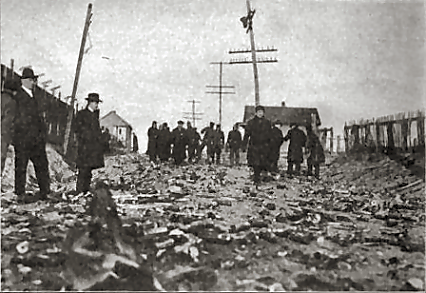
A view of a section of the Canadian Car and Foundry Company's Plant, Kingsland, New Jersey, after the fire and explosions of January 11, 1917 (International Film Service, Inc.)
LocationLyndhurst, New Jersey, U.S.
DateJanuary 11, 1917 (1917-01-11)
Attack type
Sabotage, state-sponsored terrorism
Deaths0
Injured0
PerpetratorsImperial German agents
MotiveDeny munitions to Allied powers
b&w photo of a fire
Flaming buildings of the Canadian Car & Foundry Co., Kingsland, New Jersey
b&w photo of a fire
Smoke in the distance from the Canadian Car & Foundry Co., Kingsland, New Jersey
b&w photo of a fire
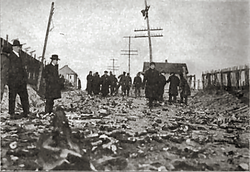
Trees and telephone poles were cut down by flying shells

The Kingsland explosion was an incident that took place during World War I at a munitions factory in Lyndhurst, New Jersey, U.S., on January 11, 1917. An arbitration commission in 1931 determined that, "In the Kingsland Case the Commission finds upon the evidence that the fire was not caused by any German agent."[1] However, decades later, Germany paid damages to American claimants.[2]

The Canadian Car and Foundry Company, based in Montreal, had signed large contracts with Russia and Britain for delivery of ammunition. An enormous factory was constructed in the New Jersey Meadowlands, which was then referred to as Kingsland. The company executives decided not to take any chances with security for their plant. They constructed a 6-foot-high (1.8 m) fence around the plant and hired security guards to conduct 24-hour patrols around the perimeter and screen each worker as they entered the plant. It was located on the site of Lyndhurst's present industrial park. A brick stack, believed to be the remaining part of the Foundry, is located in the area bounded by Valley Brook Avenue, Polito Avenue, and the office buildings on Wall Street West.

On January 11, 1917, a fire started in Building 30 of the Canadian Car and Foundry Company at Kingsland in Bergen County, New Jersey. In four hours, probably 500,000 pieces of 3-inch (76 mm) explosive shells were discharged.[3] The entire plant was destroyed.[4] It was said to have been a spectacle more magnificent than the nearby 1916 explosion at Black Tom. From office buildings and tall apartments, people in New York City watched with amazement.

The building

[edit]

In March 1916, World War I was in progress. Although the United States was neutral in the conflict at that time, the country was selling war supplies to the Allied powers due to the British blockade of Germany, meaning that the Allies were the only potential customers. Munitions, including shells, shell cases, shrapnel, and powder were shipped to Kingsland from over 100 different factories. At the foundry they were assembled for shipment to Russia. Producing three million shells per month, the factory was a worthy objective for German saboteurs.

Building 30 was used exclusively for cleaning out shells; it contained 48 workbenches. On the bench in front of each employee was a pan of gasoline and a small rotating machine operated by a belt. The cleaning process included several steps:

  • The shells were dusted with a brush
  • A cloth, moistened in the pan of gasoline, was wrapped around a foot-long piece of wood
  • The shell was placed in the rotating machine and the wood was inserted into the shell as it turned
  • A dry cloth was wrapped around the stick and the shell was dried in a similar manner.

The suspected sabotage

[edit]

Rumor had it that a group of saboteurs operated under the direction of Frederick Hinsch. He recruited a German national, Curt Thummel, who changed his name to Charles Thorne. Hinsch instructed Thorne to obtain employment at the factory. Thorne was hired as assistant employment manager. In this position he facilitated the hiring of several operatives sent by Hinsch to infiltrate the factory. One of those employees supposedly was Theodore Wozniak.

After the Kingsland plant was completely destroyed, police and federal investigators uncovered the source of the fire. It started at Wozniak's workbench in Building 30.[3]

Other workmen alleged that the fire began in front of Wozniak's wooden roller. One of the company directors, Mr. Cahan, remarked about Wozniak's nervous behavior and contradictions during an interview about the incident. Wozniak, who admitted that he had served time as a draftee in the Austrian Army, was told by Mr. Cahan that he would be needed in New York as part of the investigation into the fire. Wozniak, who lived at the Russian Immigrant House on Third Street in New York City, eluded the detectives who were watching him and disappeared.

The heroine

[edit]
Newspaper photo showing the fire that happened after the explosion.

Kingsland resident Theresa Louise "Tessie" McNamara, who operated the company switchboard, was credited with saving 1,400 lives; despite the fire McNamara stayed at the switchboard. She plugged in each of the buildings and shouted the warning, "Get out or go up!"[3] No one was killed in the fire as a result of her announcements. Fleeing workers were able to cross the frozen Hackensack River or run up Valley Brook Avenue to safety. Some of those who crossed the Hackensack River made their way to the buildings on Snake Hill.

The National Special Aid Society later presented McNamara with a check to honor her for her bravery.

The Lyndhurst Historical Society has created a vest pocket park dedicated to McNamara's memory. The park is located on Clay Avenue, between Valley Brook Avenue and Wall Street West. The brick stack can be seen from this park.

Newspaper account

[edit]

“Whatever happened, the building was in flames in an instant. Ten minutes passed before the first and mightiest explosion. In those ten minutes panic broke loose in the plant. It is believed that there were 1,400 men working in the factory. Each of these realized what would happen if fire caught hold of any of a dozen isolated buildings.”

“They started to get out. The entrance to the building was by a narrow gate, guarded by 12-foot walls. In a moment this was jammed by workers, mostly Italians and negroes, who fought desperately to get away. Guards were forced at last to drive back the mob with pistols and rifles.” “They broke and scattered. Many of them run to the rear of the plant, which is separated from the swampy meadow by a high barbed-wire fence. They went through this like a drove of cattle. Frantic with terror, they paid no attention to the wire, which cut some of them cruelly, but went ploughing, the whole terror-struck crowd, through the mud and thin ice of the marsh. Many of them who reached solid ground and safety were plastered with slime from head to heel. Many more were soaked with icy water.”

“Then came the first great roar. It is said that a building in which the loaded shells were stored was the first to go.”

“The terrific blast spread the panic, which had hitherto been confined to the factory yard, to Kingsland and the adjoining village of Lyndhurst. After the first detonation came the steady roll of bursting shrapnel and high explosive shells. In a minute the little Jersey towns were transformed into villages upon the European battle front. Shells that had been intended for the armies of the Czar burst in terrific salvos over the roofs of the houses, shattered chimneys, riddled the car repair barns of the Lackawanna Railway, and set two dwellings on fire.”[5]

Two miles of the Delaware, Lackawanna, and Western Railroad tracks were torn up by the explosions. Commuters from New York City were delayed by up to four hours and at one point 40,000 were jammed into the Hoboken station in a "clamoring, close-packed mass." Express trains to and from Washington D.C. were disrupted and a comical dispute over rights to a diner car ensued. Dairy and produce shipments to New York City were delayed by 24 hours as well.[6]

Terror ruled Snake Hill

[edit]

There were Hudson County penal and charitable institutions at Snake Hill, in Secaucus. The Almshouse, Penitentiary, and Hospital for the Insane, Contagious Diseases Hospital, and Tuberculosis Sanitarium, were all grouped on the north side of Snake Hill. When the fire and ensuing explosions started, the residents of Snake Hill began to panic, fearing the world was coming to an end. From the windows they could see what the warden later described as a big display of fireworks. As the 900+ inmates of the asylum grew more panicked, the superintendent, Dr. George W. King, and Dr. James Meehan, chairman of the Hospital committee figured a way to calm the residents. Dr. Meehan hurried to the hospital with supplies of ice cream, fruits and candies. The inmates were assembled in the lecture hall and they were told that the European War had ended and the explosions were detonations of big guns to celebrate the event.[7]

Aftermath

[edit]

A reparations case was launched by John J. McCloy against Germany in 1934,[citation needed] which dragged on for many years and was finally settled in the 1950s. Germany never admitted guilt, but paid $50 million during 1953–1979 to settle claims arising from the 1917 Kingsland explosion and the 1916 Black Tom explosion.[2]

See also

[edit]

References

[edit]
[edit]
Revisions and contributorsEdit on WikipediaRead on Wikipedia
from Grokipedia
The Kingsland explosion was a catastrophic series of detonations on January 11, , at the Canadian Car and Foundry Company's munitions plant in what was then Kingsland, (now Lyndhurst), where a ignited approximately 500,000 loaded artillery shells prepared for shipment to , resulting in the near-total destruction of the facility over four hours of continuous blasts without any fatalities. The incident originated from a small in Building 30, likely caused by a spark on drying racks, which high winds rapidly spread amid the volatile materials, propelling shells up to two miles away and inflicting about $5 million in across two square miles while sparing the 1,400 workers on site due to swift evacuation efforts led by Theresa McNamara, who alerted personnel despite the chaos. Occurring months before U.S. entry into , the explosion fueled suspicions of deliberate sabotage by German operatives seeking to hinder munitions supplies to the Allies, with the plant's production of shells under Russian contracts making it a strategic target similar to the earlier Black Tom incident; postwar revelations, including German military records and agent testimonies, confirmed such acts as part of a broader campaign, though no direct perpetrator was prosecuted for Kingsland specifically. The event underscored vulnerabilities in neutral America's industrial base, prompting enhanced security measures, while McNamara's heroism earned her recognition as the "Heroine of the Kingsland Explosion," highlighting human factors in averting greater tragedy amid mechanical failure and potential malice.

Historical Context

World War I and U.S. Neutrality

Upon the outbreak of in on July 28, 1914, President issued a for the on August 4, 1914, urging Americans to remain impartial in thought and action toward the belligerents. This policy reflected widespread domestic sentiment for non-involvement, as the U.S. lacked direct stakes in the European conflict and sought to avoid the human and financial costs of war. Wilson's administration enforced this stance through measures such as prohibiting loans to belligerents initially, though legal interpretations later permitted private credits and trade. Despite official neutrality, the U.S. developed extensive economic ties with the Allied powers, particularly Britain and , through exports of foodstuffs, raw materials, and munitions that sustained their efforts. By 1916, American firms had supplied billions in goods, with munitions exports alone reaching significant volumes, including shells and powder shipped via Atlantic ports to prevent German blockades from starving Allied forces. This commerce generated a wartime boom, as European gold payments bolstered U.S. reserves and shifted production toward Allied demands, effectively subsidizing the Entente while adhering to the legal bounds of neutrality. Imperial , facing naval blockade and supply shortages, responded with covert operations to disrupt American industrial output and shipments, viewing U.S. exports as prolonging the war by aiding its enemies. German agents, including diplomats and reservists, orchestrated and targeting East Coast facilities, with incidents escalating from 1915 onward to include incendiary devices on ships and infiltration of factories. These efforts aimed to deter munitions flows without provoking overt U.S. retaliation, exploiting the neutral status that limited federal . New Jersey emerged as a critical hub for wartime production, hosting numerous facilities manufacturing shells, fuses, and other ordnance for Allied contracts, which amplified regional vulnerability amid minimal security protocols. State industries, leveraging proximity to ports like , prioritized output over fortified defenses, as neutrality doctrine discouraged militarized safeguards that might signal bias or invite escalation. This lax approach—relying on private guards rather than coordinated federal oversight—facilitated foreign interference, as evidenced by prior undetected plots, underscoring how economic engagement eroded the practical isolation neutrality promised.

German Sabotage Campaigns in America

During , Imperial Germany orchestrated sabotage operations in the United States to disrupt the flow of munitions and supplies to the Allied powers, compensating for the British naval blockade that restricted German access to global trade. These efforts targeted American ports, warehouses, and factories handling exports, employing covert agents to ignite fires that would detonate cargoes, thereby delaying shipments without overt military confrontation. German naval intelligence, under Alfred von Tirpitz's influence, viewed such asymmetric tactics as essential to maintaining U.S. neutrality and weakening Entente logistics, with operations peaking between 1915 and 1917. A prominent example was the Black Tom Island explosion on July 30, 1916, at a , munitions depot on landfill extending into . German agents, including Michael J. Kristoff—a Slovenian laborer recruited and paid by the German Foreign Office—sneaked onto the site and ignited small fires using liquid incendiaries hidden in slippers to evade detection. The resulting blasts, equivalent in force to approximately 6 tons of TNT from detonating over 2 million pounds of munitions, killed at least seven people, injured hundreds, shattered windows across , and caused an estimated $20-25 million in damages (equivalent to over $500 million today). Post-war investigations confirmed German orchestration, leading to a 1939 settlement where Germany paid $50 million in reparations to affected parties. To execute these operations with minimal traceability, German authorities recruited proxies from immigrant communities, particularly German-Americans and Eastern Europeans sympathetic to the Kaiser's cause, often through consulates or front companies posing as commercial entities. Agents like Franz von Rintelen, a naval lieutenant dispatched from , coordinated cells that included reservists and disaffected laborers, training them in simple incendiary techniques to mimic accidents. This recruitment leveraged ethnic ties and anti-Allied sentiments within the U.S. , numbering over 8 million, to infiltrate waterfronts and rail yards, framing as defensive measures against perceived British . Such patterns underscored a deliberate strategy of state-sponsored disruption, predating U.S. entry into the war on , 1917, and providing a causal framework for subsequent incidents involving munitions facilities.

The Facility

Construction and Operations

The Canadian Car and Foundry Company constructed a large munitions assembly plant in in (now part of Lyndhurst), to fulfill contracts for artillery shells primarily destined for the Russian government, with additional production for Britain. The facility, spanning roughly 40 acres, consisted of approximately 40 wooden-frame buildings designed for rapid assembly rather than long-term durability, reflecting the wartime imperative for quick scaling of output. Components such as empty shell casings, shrapnel, and propellants arrived from over 100 supplier factories, where they were loaded and fused on-site, culminating in a production capacity of up to 3 million 3-inch high-explosive shells per month. At full operation, the plant stored more than 500,000 loaded shells alongside substantial stockpiles of TNT and , concentrated across structures like Building 30, which handled shell cleaning using flammable gasoline-soaked rags. This layout amplified inherent risks, as the proximity of volatile materials in combustible buildings created a high to ignition from routine processes like or handling. Daily operations employed around 1,400 workers, including a significant proportion of recent immigrants drawn by wartime labor demands, who performed repetitive tasks such as inserting TNT charges, powder loads, and fuses into shells under compressed timelines. protocols were rudimentary, emphasizing production speed over isolation of explosives; fires were nominally suppressed with , but the use of open flames and solvents in enclosed spaces underscored the facility's prioritization of volume—evident in its monthly output—over mitigation of cascading hazards from densely packed ordnance.

Munitions Production and Workforce

The Canadian Car and Foundry Company's Kingsland facility specialized in the loading of shells with explosives, primarily 3-inch shrapnel shells under contracts for export to British and Russian forces. Operating amid U.S. neutrality prior to April , the plant adhered to legal allowances for private munitions sales to belligerents, focusing on high-volume assembly to meet Allied demand. By early , production had scaled to an estimated capacity of three million shells per month, reflecting efficient wartime mobilization despite logistical constraints like sourcing TNT and powder. The workforce numbered around 1,400 employees, comprising skilled machinists who performed precise filling tasks and unskilled laborers managing shell and storage. Labor dynamics emphasized rapid throughput, with shifts organized to maximize output in a sprawling complex of over 40 buildings dedicated to various stages of munitions handling. Immigrant-heavy demographics, common in New Jersey's industrial sector during the , introduced diverse backgrounds, including potential pro-German elements among German-American or recent European arrivals, heightening risks of internal disloyalty in a high-stakes environment. Operational efficiency came at the cost of security gaps, as the plant's expansion prioritized volume over rigorous vetting; background checks were minimal, relying on basic employment screenings insufficient to detect sympathies. Fire prevention protocols exhibited causal weaknesses, permitting ignition sources like waste materials near loaded shells, which post-incident analysis linked to the blaze's unchecked spread from a single workstation. These lapses, evident in the facility's vulnerability to deliberate acts despite stated tight perimeter controls, underscored how workforce scale and procedural shortcuts amplified disaster potential in munitions handling.

The Incident

Initial Fire and Ignition

On January 11, 1917, a fire erupted in Building 30 of the Canadian Car and Foundry Company's munitions plant in Kingsland, New Jersey (now Lyndhurst), during standard shell-filling procedures involving the loading and drying of approximately 500,000 three-inch artillery shells packed with TNT. The incident commenced in the afternoon, with the blaze first detected in the drying room where recently filled shells awaited processing, amid operations handling highly flammable explosives and propellants. Factory records and initial reports indicated the fire may have stemmed from a discarded match or stray spark in the vicinity, though definitive ignition mechanisms remained under investigation at the time. The flames escalated swiftly due to the volatile nature of the TNT-laden shells and adjacent stores of gunpowder, igniting secondary blasts that shattered Building 30's framework within minutes and propelled debris outward. Eyewitnesses among the plant's workforce, numbering over 1,000 that day, recounted observing dense smoke billowing from the drying area, accompanied by popping sounds signaling the onset of detonations in nearby shell casings. High winds prevalent that afternoon exacerbated the spread, carrying embers toward adjacent structures while workers initiated hasty evacuations. A single worker was documented in proximity to the initial outbreak per operational logs, heightening early scrutiny of on-site activities. No fatalities occurred in this phase, attributable to the timing during a shift transition that left fewer personnel in the immediate danger zone.

Sequence of Explosions

The sequence of explosions at the Kingsland munitions facility commenced shortly after the initial fire ignited dry waste material around 1:00 p.m. on January 11, 1917, rapidly escalating into a as flames spread to nearby buildings containing loaded shells. The first major occurred at approximately 2:08 a.m. the following day, marking the onset of a prolonged barrage that continued for about four hours, with exploding shells raining down intermittently across the site. During this span, roughly 500,000 three-inch shrapnel shells detonated in phased sequence, driven by the progressive ignition of munitions stockpiled for shipment to , equivalent in destructive power to the combustion of several hundred tons of high explosives including TNT and . The blasts propagated across the 900-acre complex, obliterating over 1,300 wooden structures in a cascading manner, with seismic vibrations registering as far as Yonkers and , while fragments projected up to several miles, some embedding in the . The detonations generated towering fireballs and smoke plumes visible from Manhattan skyscrapers, resembling an sustained artillery bombardment due to the rhythmic popping and whistling of shells bursting in rapid succession. Despite the immense energy release—far exceeding contemporary non-nuclear events in scale—the explosions remained largely contained by the facility's isolated, open terrain, averting propagation into adjacent urban areas and limiting the primary destruction to the plant itself. Subsequent smaller blasts persisted for days, but the core sequence's physics underscored the munitions' vulnerability to sequential sympathetic detonation under fire exposure.

Human Response and Heroism

Evacuation Efforts

As a broke out in the shell-drying building around 11 a.m. on , , alarms sounded throughout the Canadian Car and Foundry plant in Kingsland, , triggering an immediate mass evacuation of approximately 1,400 workers. Verbal warnings from supervisors and the plant's communication system directed personnel toward open meadows and away from the exploding munitions areas, amid chaotic scenes of stampeding crowds that knocked down fences and scaled barriers. Despite the rapid sequence of detonations that hurled shells over a mile away, the dispersal across expansive, undeveloped terrain—including flights toward the frozen —prevented any worker from being caught in the blasts. Local fire brigades from surrounding towns mobilized swiftly but were unable to contain the inferno due to the intensity of the explosions, shifting their efforts to protecting adjacent structures while management focused on guiding the exodus clear of danger zones. This coordinated response, occurring during daytime hours when visibility aided flight and the plant's layout facilitated outward movement, resulted in zero fatalities or severe injuries among plant personnel, underscoring the efficacy of prompt alarms and geographic advantages over potential nighttime scenarios with limited escape routes.

Theresa McNamara's Actions

Theresa Louise "Tessie" McNamara, employed as the primary at the Canadian Car and Foundry Company's Kingsland facility since 1915, stayed at her station on , , after spotting from a in the drying room. Amid incoming shells that penetrated her office walls and ignited flames around her desk, she manually connected telephone lines to outlying buildings, issuing urgent evacuation warnings such as "Get out or go up!" to supervisors and workers in remote sections. This facilitated rapid shutdowns of operations in isolated structures, averting scenarios where personnel might have been sealed inside during the four-hour barrage of detonations that consumed over 1,300 freight cars of munitions. McNamara prioritized alerting external authorities, including local fire departments and company executives, before fleeing the burning switchboard room herself, despite direct exposure to exploding 3-inch shells and structural collapse risks. Her persistence maintained critical communication lines when physical access between buildings became impossible due to flying debris and fire spread, directly enabling the escape of hundreds in peripheral areas that would otherwise have lacked timely notice. Contemporary New York Times reporting highlighted her role in preventing communication blackout, noting that failure of the switchboard could have trapped workers amid the chain reactions. In subsequent , McNamara described her focus on preserving lives over , stating her initial instinct upon detecting the blaze was to notify all connected buildings despite the encroaching explosions. This composure under duress was credited in immediate accounts with mitigating what investigators deemed a high of mass casualties, given the facility's dispersed layout and the estimated 1,200 on-site workers that day. Her efforts earned prompt recognition, including a gold watch and monetary purse from company donors, as detailed in February 1917 press coverage.

Evidence of Sabotage

Immediate Investigations

In the immediate aftermath of the January 11, , fire at the Canadian Car and Foundry Company's Kingsland facility, federal agents from the Department of Justice's Bureau of Investigation, alongside local authorities and company officials, commenced on-site examinations of the wreckage. The primary emphasis was on forensic collection of debris from Building 30, the reported origin of the blaze, to detect traces of deliberate incendiary mechanisms such as matches, timed fuses, or accelerants that could indicate non-accidental ignition. Investigators conducted extensive interviews with workers present during the shift, compiling affidavits and statements to reconstruct the sequence leading to ignition. Accounts from these sessions highlighted observations of a suspicious individual at the fire's starting point, including reports of lit matches being discarded near combustible materials like shell casings or rags, which aligned with preliminary assessments of burn patterns suggesting human intervention rather than spontaneous or mechanical failure. To methodically exclude alternative causes, teams reviewed maintenance logs confirming operational integrity of machinery and equipment, with no evidence of faults capable of sparking the initial fire. Weather documentation for the dry, wind-swept conditions on January 11 further eliminated lightning as a factor, directing scrutiny toward physical remnants and corroborated eyewitness details as the most reliable indicators of the ignition mechanism.

Attribution to German Agents

The fire that ignited the Kingsland explosion originated at the workbench of Theodore Wozniak, an Austrian-Polish hired just weeks prior on December 28, 1916, who was observed pouring a clear liquid—suspected to be an —onto ignited rags in Building 30 around 3:40 p.m. on January 11, 1917. Wozniak's supervisors reported his evasive behavior and immediate flight from the scene without alerting others, consistent with tactics employed by Imperial German operatives targeting U.S. industrial sites to hinder munitions shipments to Allied powers. Wozniak's connection to German intelligence emerged through investigations revealing his recruitment by agents in the network led by figures such as , a key architect of operations from the German embassy in , who placed sympathizers in sensitive facilities. British intelligence had previously flagged Wozniak as a German or Austrian agent, a detail corroborated post-war by affidavits from associates like Golka and Panas, who attested to his contacts with handlers including and his receipt of payments for disruptive activities. This aligned with confessions from co-conspirators, such as Paul Hilken and Fred Herrmann, who admitted under to orchestrating factory arsons under Berlin's directives, with Herrmann specifically implicating the placement of agents like Wozniak in such as Kingsland to exploit lax protocols—open oil lamps and flammable materials near shell-loading areas—for low-tech ignition leading to chain reactions. The incident fit a documented pattern of Imperial German sabotage, including the confirmed of July 30, 1916, executed by overlapping agents like Michael Kristoff, who used similar incendiary methods on munitions stockpiles; intercepted diplomatic cables and declassified U.S. records post-1917 revealed explicit orders from Count von Bernstorff's embassy to prioritize disruptions of Canadian Car and Foundry's output, which supplied over 15 million shells annually to and Britain. The motive stemmed from Germany's strategic imperative to sever U.S. neutrality-flaunting exports, as Allied dependence on American arms threatened the ' war effort; this causal chain—agent infiltration, targeted arson amid wartime haste, and resultant destruction of 500,000 loaded shells without fatalities due to rapid evacuation—mirrored eleven other U.S. plant fires attributed to the same network between 1914 and 1917.

Counterarguments and Debunking Accident Theories

Despite initial suggestions of in oily rags used for shell cleaning or ignition from machinery sparks during routine operations, these accident theories were undermined by the fire's precise origin at the workstation of employee Michael Wozniak on January 11, 1917, at 3:40 p.m., during a low-hazard phase of shell lacquering where no prior incidents had occurred in comparable facilities despite similar residue accumulation. Witnesses reported Wozniak pouring a clear liquid—consistent with or another —onto smoldering rags, ostensibly to extinguish but instead intensifying the flames, a inconsistent with spontaneous or mechanical mishaps that typically exhibit diffuse ignition patterns without accelerant traces. Early investigative reports, such as the 1917 Johnson affidavit attributing sparks to shell-dipping machinery, were later discredited upon discovery of fabricated elements, including letters predating their claimed timeline based on paper watermarks analyzed post-1926. Wozniak's immediate flight from the site, denial of involvement despite his central position, and a disputed alibi placing him in Tupper Lake, New York—contradicted by affidavits from associates linking him to German consular contacts in Mexico under aliases like "Karowsky"—further negated accidental causation, as no comparable worker errors had triggered chain reactions in the plant's year-long operations. Contemporary media and some official hedging, which downplayed sabotage in favor of industrial accident narratives, reflected U.S. neutrality constraints prior to April 1917 entry into World War I, prioritizing diplomatic avoidance over forensic scrutiny, yet contrasted with the Mixed Claims Commission's eventual inference of deliberate incendiarism based on serial correlations to confirmed German acts like the July 1916 Black Tom explosion. Testimonies from pro-German immigrant workers asserting a mere "mishap" with rags were overridden by agent linkage evidence, including Wozniak's associations with figures like Franz von Rintelen's network, and the absence of spontaneous combustion residues typical in unguarded facilities, as affirmed in rehearing documents negating industrial accident plausibility. Germany's 1953 settlement of $50 million (part of a $55 million package including Black Tom) implicitly conceded liability for orchestrated sabotage rather than fortuitous error.

Immediate Aftermath

Physical Destruction

The Kingsland munitions plant of the Canadian Car and Foundry Company in Lyndhurst, New Jersey, suffered total obliteration from the January 11, 1917, explosions and fires, reducing over 40 buildings and warehouses to rubble across a 200-acre site. Approximately 500,000 three-inch explosive shells detonated over four hours, scattering debris including shell fragments that severed trees and telephone poles within the vicinity. The resulting fires consumed remaining structures and munitions stockpiles, with flames persisting into the following day before being fully extinguished on January 12. Direct property losses at the plant were estimated at $17 million in 1917 dollars, encompassing destroyed facilities, machinery, and unfilled shell casings valued in the millions. Local impacts included shattered windows in nearby Lyndhurst residences and businesses, though no major such as bridges or rail lines collapsed. The field extended outward from the , with explosive fragments landing up to several miles away, but surveys confirmed containment without broader regional structural failures.

Casualties and Local Impact

Despite the detonation of approximately 500,000 three-inch explosive shells over four hours, the Kingsland explosion resulted in no fatalities, a stark contrast to the six months earlier, which killed seven people. Only minor injuries were reported among the roughly 1,400 workers present, primarily from shrapnel, falls, or during the chaotic evacuation as employees fled the facility. This outcome highlighted the munitions plant's remote location and the timing after the lunch break, which limited occupancy and prevented greater loss of life. In the nearby neighborhood of Lyndhurst (then Kingsland), the blasts triggered immediate terror among residents, with contemporary newspaper accounts describing scenes of panic as shockwaves shattered windows, uprooted trees, and hurled debris across the area. Local homes and structures sustained damage from flying shells and concussive force, yet the community experienced relatively swift physical recovery, with no prolonged displacement reported beyond initial evacuations. The incident induced significant psychological strain on the surviving workforce, fostering fears of and recurrent attacks that eroded confidence in industrial safety. This unease contributed to temporary slowdowns in munitions production at nearby facilities, as workers and management grappled with heightened vigilance and morale issues in the ensuing weeks. The absence of deaths, despite the event's scale, underscored vulnerabilities in wartime industrial security but also demonstrated how procedural timing and rapid dispersal mitigated potential catastrophe.

Broader Consequences

Military and Economic Effects

The destruction of approximately 500,000 three-inch explosive shells at the Canadian Car and Foundry plant represented a substantial loss of munitions destined for the Russian Imperial Army, which was heavily dependent on imported artillery ammunition to sustain operations on the Eastern Front. These shells formed the final portion of a major consignment, exacerbating Russia's supply vulnerabilities amid ongoing domestic production constraints and logistical challenges during the aftermath. While the precise delay in replenishing this volume is undocumented in contemporaneous military assessments, the incident underscored the fragility of transatlantic supply chains, though broader Allied redundancy—stemming from expanding U.S. and British manufacturing capacity—limited the effect to a temporary shortfall rather than a strategic collapse. Economically, the explosion inflicted direct damages estimated at $5 million, encompassing the incinerated shells, facility infrastructure, and ancillary equipment, which imposed immediate financial strain on the Canadian Car and Foundry Company. The Montreal-based firm, which had constructed the expansive Kingsland assembly plant specifically to execute multimillion-shell contracts with and Britain, faced halted production and elevated rebuild expenditures, diverting capital from ongoing war-related expansions. This localized disruption contributed to short-term pressures on war materials , though the company's diversified operations and subsequent negotiations helped avert , with no evidence of cascading failures in Allied funding mechanisms. In response, the incident catalyzed procedural enhancements in U.S. defense sector safeguards, including the widespread adoption of perimeter fencing, round-the-clock guard patrols, and stricter worker vetting at munitions sites, as factories emulated post-Kingsland fortifications to counter perceived risks. These measures, implemented in the months preceding U.S. belligerency on April 6, 1917, reflected a direct causal response to the vulnerability exposed, fostering a pre-war posture of industrial resilience without reliance on formal mobilization.

Diplomatic Tensions

The Kingsland explosion on January 11, 1917, immediately sparked suspicions of deliberate by German agents, given the pattern of prior incidents targeting U.S. munitions production for Allied powers, intensifying public and official scrutiny of German actions during American neutrality. Contemporary press reports described the blast as a potential act of foreign interference, contributing to widespread in New York and beyond, where the shockwave was felt and smoke visible for miles. This outrage, documented in January 1917 coverage, aligned with escalating threats and pressured the Wilson administration amid debates over arming , highlighting the risks of continued neutrality in the face of covert aggressions. The incident's timing—just days before the January 16 interception of the Zimmermann Telegram proposing a German-Mexican against the U.S.—amplified diplomatic strains, as initial investigations linked it to broader German efforts to disrupt American war material supplies. German diplomatic representatives in Washington denied any official involvement, insisting through neutral intermediaries that the fire resulted from industrial accident, a stance consistent with rejections of responsibility for similar events like the 1916 . U.S. State Department communications in early emphasized this as part of recurrent neutrality violations, underscoring a pattern of asymmetric threats that official probes could not dismiss as coincidental. These tensions, compounded by Germany's February 1 resumption of , eroded the viability of U.S. , providing empirical grounds for viewing inaction as perilous. By April 1917, the cumulative evidence of such —ignored at potential national peril—factored into the congressional push for , as articulated in Wilson's citing repeated German infringements on American rights and security.

Investigations and Resolutions

Official Probes and Findings

Following the January 11, 1917, explosion, U.S. Department of Justice investigators, in coordination with military ordnance experts, pinpointed the fire's origin to deliberate by Canadian Car and Foundry employee Theodore Wozniak at his bench in Building 30, where shells were being cleaned and packed with TNT. Eyewitness accounts from multiple workers detailed Wozniak pouring a —likely acetone or —onto rags and igniting them shortly before 11:20 a.m., with no evidence of mechanical sparks or spontaneous ignition from nearby machinery. Wozniak confessed in a signed statement to federal agents that German operative Frederick R. Hinsch had recruited and paid him $500 to sabotage the facility, providing instructions on using accelerants to ensure rapid spread amid the dense storage of over 500,000 unfused shells. By spring 1917, interagency reviews by Justice Department and Army-Navy ordnance boards correlated these testimonies with site forensics, excluding internal negligence or accident as the initiating cause while noting that lax safety protocols—such as unseparated flammable materials and inadequate fire suppression—exacerbated the chain-reaction detonations. Declassified German diplomatic and intelligence records seized after the , along with post-war interrogations, corroborated the operation's ties to Berlin's network under naval attaché and consul Heinrich Albert, validating agent recruitment tactics observed in parallel incidents like Black Tom. Wozniak's 1942 perjury conviction for recanting his confession further upheld the probes' determination, with courts affirming the original evidence's reliability over his later claims of . The Mixed Claims Commission, established under the Treaty of Berlin on August 25, 1921, between the and , adjudicated American claims for damages from German actions during neutrality, including sabotage incidents like the Kingsland fire. The Agency of Company, Ltd., operator of the Kingsland munitions facility, filed claims for property destruction and lost production valued at approximately $17 million in principal damages, attributing the January 11, 1917, explosion to deliberate by German agents. contested liability, alleging accidental causes and presenting testimony from suborned witnesses, but the U.S. commissioners certified disagreement, advancing the case to the umpire. In decisions rendered in the late 1920s and 1930s, the commission's umpire, including in the consolidated sabotage proceedings, affirmed Germany's responsibility for directing agents to ignite the Kingsland fire, establishing precedent for state accountability in covert operations against neutral powers' economic interests. An award of $5,871,105 was granted to the Canadian Car and Foundry agency for direct losses, part of broader sabotage claims totaling over $40 million including interest across Black Tom and Kingsland cases. This ruling rejected perpetrator denials, validating evidence of orchestrated incendiary acts despite forensic challenges in proving exact ignition methods, and influenced interwar frameworks for reparations in treaties addressing state-sponsored subversion. Enforcement faced delays from Weimar-era fiscal constraints and German objections tied to Versailles reparations debates, with Nazi Germany's 1933 withdrawal from the commission halting proceedings. Post-World War II, the Federal Republic of Germany resumed obligations under the 1953 London Debt Agreement, settling outstanding sabotage awards—including Kingsland's—for a combined $50 million paid to U.S. claimants by 1979, enforcing liability on the aggressor state despite protracted resistance. This resolution underscored causal links between state-directed sabotage and economic harm, prioritizing victim restitution over initial perpetrator narratives of happenstance.

Legacy

Historical Assessments

The Kingsland explosion of January 11, 1917, is assessed by historians as a critical instance of Imperial German sabotage targeting U.S. industrial output prior to American entry into , underscoring the effectiveness of covert operations in disrupting Allied supply chains without direct military engagement. Scholars note its scale—destroying approximately 1.3 million 75mm shells and igniting fires across a two-square-mile complex—positioned it among the largest non-combat explosions in U.S. history up to that point, with shockwaves shattering windows up to 25 miles away and registering on seismographs in New York and . This event, following the 1916 , exemplified early hybrid tactics blending espionage and industrial disruption, as German agents exploited neutral America's lax oversight to delay munitions shipments valued at over $83 million destined for . Critiques of U.S. highlight systemic vulnerabilities, particularly in worker and site , where the of Michael J. Wozniak—a Polish laborer with suspected ties to German intelligence—despite prior warnings from British agents, revealed inadequate and background screening for wartime industries reliant on European migrant labor. Data from the incident, including the ease of igniting accelerant-soaked rags amid unsecured flammable materials, demonstrated causal links between porous hiring practices and heightened risk, prompting post-event reforms like perimeter fencing and 24-hour patrols that influenced federal industrial security guidelines. These assessments counter narratives minimizing the explosion as accidental oversight, emphasizing its metric-driven impact: the loss equated to months of delayed production, potentially altering Eastern Front dynamics if not offset by U.S. resilience. A balanced scholarly perspective acknowledges the explosion's exposure of pre-war frailties alongside American adaptive strengths, as the facility was rebuilt and operational within six months, fulfilling Allied contracts and averting broader economic paralysis. This duality informed realist approaches to , prioritizing causal preventive measures—such as enhanced countermeasures and hardening—over reactive recovery, lessons echoed in subsequent doctrines emphasizing deterrence through vigilance rather than . The incident's legacy thus lies in validating as a viable asymmetric tool, with its zero-fatality outcome attributable to fortuitous evacuation rather than inherent safeguards, reinforcing the need for proactive in industrial defense.

Modern Commemorations and Lessons

In 2017, the centennial of the Kingsland explosion prompted commemorative events in Lyndhurst, New Jersey, including public gatherings and historical reenactments organized by local authorities and educational institutions to highlight the incident's role as a major act of foreign sabotage by German agents. University students participated in simulations of the sabotage attempt, drawing on archival evidence to underscore the deliberate ignition by an insider, Michael J. Wozniak, who fled afterward and was later identified as a German operative. Memorials honoring key figures persist, notably a plaque dedicated to Theresa "Tessie" McNamara, who remained at her post to alert workers and authorities amid the detonations, preventing casualties despite the destruction of over 500,000 shells. Recent media, such as from 2021 and 2025, have reaffirmed the explosion's attribution to German espionage based on eyewitness accounts, forensic traces of incendiary materials, and Wozniak's evasion, rejecting alternative accident narratives lacking empirical support. The event informs contemporary counter-espionage strategies, illustrating vulnerabilities in to insider threats from adversarial states, as seen in parallels to modern incidents of industrial amid U.S.- and U.S.- tensions. Empirical review of the Kingsland case emphasizes rigorous vetting of personnel in munitions and energy sectors, where foreign actors exploit lax oversight, a risk amplified by and supply-chain dependencies without corresponding safeguards.

References

Add your contribution
Related Hubs
User Avatar
No comments yet.