Kriangsak Chamanan
Kriangsak Chamanan
Main page
2204184

Kriangsak Chamanan

logo
Community Hub0 subscribers
Read side by side
from Wikipedia

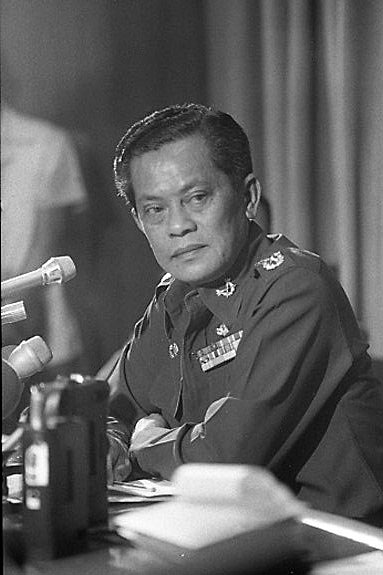
Kriangsak Chamanan (Thai: เกรียงศักดิ์ ชมะนันทน์, pronounced [kria̯ŋ.sàk tɕʰā.má(ʔ).nān]; 17 December 1917 – 23 December 2003) was the 15th prime minister of Thailand, serving from 1977 to 1980. After staging a successful coup, he was asked to become Prime Minister in 1977. He ruled until 1980 and is credited with "steering Thailand to democracy" in a time when communist insurgents were rampant internally and neighbouring countries turned to communist rule following the communist takeover of Vietnam: South Vietnam (by the Viet Cong), Laos (by the Pathet Lao), and Cambodia (by the Khmer Rouge).[1]

Key Information

Regarded as one of the most notable statesmen in modern Thailand, his landmark developmental policies include the founding of Eastern Seaboard through the founding of PTT, facilitating the building of a deep-sea port in Laem Chabang and negotiating for bilateral trade agreements between Thailand and Japan through Takeo Fukuda to include Thailand in the flying geese paradigm. Chomanan founded the Petroleum Authority of Thailand, transforming it into PTT in a merger between three fragmented state-owned energy companies, serving as a major economic and industrial stimulus in the rise of Thailand secondary production economy in the 1980s and 1990s. Moreover, the founding of PTT also served to lessen the reliance on the global energy market, which was affected by a severe global oil price crisis in the 1970s.[2] His other notable works include the founding of the Chatuchak Market which also helped to solve the Din Daeng Garbage Mountain issue, the Village Health Volunteers organization which acts as a crucial model in Thailand public primary care, the founding of the Ministry of Science and Technology,[3] the passing of the first-ever bills to include tourism in the government economic development plans and the upgrading of the Tourism Authority of Thailand from organizational level to state level,[4] the passing of the current consumer protection acts and organizations and the founding of Sukhothai Thammathirat Open University. After his time in office, he was invited to the InterAction Council of Former Heads of State and Government in solving various global issues, becoming the only Thai prime minister until now[5] and one of fewer than three from Asia at the time of his membership.[6]

A professional soldier, in WWII he was posted in occupied Shan State.[7] He fought against the French in the Franco-Thai War from 1940-1943, serving as platoon leader, and against the communists in both the Korean War and the Vietnam War. In Korea, he served as commander of Infantry Battalion III which fought in the Battle of Pork Chop Hill, from which he was one of only a few of the non-citizen officers to receive the Legion of Merit.[8] After the Korean War, Chomanan joined the United States Army Command and General Staff College at Fort Leavenworth, where he is the only Thai person to be included in the Fort Leavenworth Hall of Fame.[6] He's also the only Thai coup leader to make an official visit to Washington where he was welcomed to the White House in 1979 by then-president Jimmy Carter, in contrast to previous leaders honoured in states distant from Washington.[9]

Early life and career

[edit]

Kriangsak Chamanan was born on 17 December 1917 in Mahachai Subdistrict, Mueang Samut Sakhon District, Samut Sakhon Province, a prominent Chinese trading port to the southwest of Bangkok. He was born to a wealthy business family that ran the Mahachai trading company, which dealt in importing and exporting goods between Thailand and the West and Japan. Mahachai in the 1800s and 1900s was one of Thailand's largest trading ports and grew to become the first city district with its own local government in 1897.[6]

Education

[edit]

From age six to twelve, Kriangsak attended Samut Sakhon Wittayalai and later Patumkongka School. After graduating from primary school, Kriangsak moved to Bangkok to attend the prestigious Amnuay Silpa School (Its alumni include six prime ministers of Thailand) where he excelled academically.

He later attended Chulachomklao Royal Military Academy (Thai: โรงเรียนนายร้อยพระจุลจอมเกล้า, RTGSRongrian Nai Roi Phra Chulachomklao, abbreviated as รร.จปร.), known for its intense training program and one of the lowest admission rates among learning institutions in Thailand, until he graduated in 1938. During his time in the army, he further attended the Thai Army Command and General Staff College (CGSC) and the Thailand National Defence College.

After his time in the Korean War, he also got a scholarship to attend the United States Army Command and General Staff College at Fort Leavenworth, Kansas, a graduate school for United States Army and sister service officers, interagency representatives, and international military officers.[6]

Military career

[edit]

Kriangsak fought in the Korean War as a commander of the Thai Army in the 21st Infantry Regiment, which earned the nickname "Little Tigers" for their valour. He showed exemplary skills as a major, playing a pivotal role in defending Pork Chop Hill. On 15 March 1953, by direction of the US president and under the provision of the 1942 Act of the US Congress, then-lieutenant Kriangsak became one among few non-U.S. military personnel to be awarded the Legion of Merit (Officer degree) for exceptionally meritorious conduct in the performance of outstanding services.[10]

He became a full general in 1973, and army chief of staff a year later.[1] In 1974, he also secretly brokered a prisoner exchange with the Burmese government, in which the opium warlord Khun Sa was ransomed for the freedom of two Soviet doctors whom Khun Sa's followers had kidnapped.[11]

In 1977, Kriangsak was part of the National Administrative Reform Council (NARC), which staged a successful coup d'état against Prime Minister Thanin Kraivichien.[12] Thanin himself had come into power the year before, after another coup by Sangad Chaloryu suspended the constitutional monarchy. The NARC was composed entirely of what contemporaneous press reports characterised as moderate military leaders, not from the extreme right wing. It was distinguished from previous military ruling groups "as an effort to institutionalize power relationships within the military in contrast to the personal factions and cliques which entered the political arena in the past." Kriangsak was then asked to become prime minister, partially against his will according to his wife Khunying Virat Chomanan.[6][13]

Premiership

[edit]

Coup d'état and ascension

[edit]

Prior to Kraingsak, the Thanin Kraivichien administration had spiraled the country into a perilous state of civil war. Incidents involving the Communist Party of Thailand (CPT) in rural areas across Thailand and border clashes with Cambodia and Laos incidents were becoming increasingly frequent. The administration's forceful suppressive policy had the perverse effect of increasing the CPT's popularity. Furthermore, members and close aides of the royal family also became targets of attacks by the communist insurgents, including the assassination of the queen's secretary and a bomb explosion near the king while he was visiting the south of Thailand. The country-wide deterioration and increased activity of communist insurgents induced reactions within the Thai armed forces. The first attempt to overthrow the Thanin administration took place in March 1977 and was led by General Chalad Hiranyasiri. However, it was unsuccessful and Chalad was executed on Thanin's order. With increasing unrest, the Thanin government was finally successfully overthrown on 20 October 1977 when a clique of Thai military officers known as the Young Turks pressured Kriangsak and General Sangad Chaloyu, who had led the 1976 coup that ousted the elected civilian government of Seni Pramoj and appointed the royal favorite Thanin as prime minister. Kriangsak was later appointed the new prime minister by a majority vote through both the National Assembly and the NARC.[citation needed]

As prime minister, Kriangsak moved to moderate and neutralize his predecessor Thanin's severe measures, which had driven young Thai intellectuals from multiple universities to join the communist insurgency in the countryside. In 1978, in a major risk to his political position with his right leaning supporting base, he submitted an amnesty bill to the National Legislative Assembly to release the Bangkok 18, a group of leftist students and labor activist jailed after the Thammasat University massacre that preceded the 1976 coup. The move greatly bolstered his international position as a Southeast Asian humanitarian leader and was noted in commemorations from many international bodies. He also started a successful amnesty program for communists as part of a reconciliation policy.[14][15]

Kriangsak is widely credited with defusing the long-running communist insurgency in northern Thailand. He was reported to have met in 1979 with Deng Xiaoping, then supreme leader of the People's Republic of China, allowing China to ship arms to the rebel Khmer Rouge in Cambodia in exchange for the PRC withdrawing its support for the communist insurgency in Thailand.[16] These reports were confirmed contemporaneously by the Sunday Times and wire services.[17] However, claims of a deal involving the Khmer Rouge was denied by the Thai government, which cites his policy of reunification and offers of amnesty as the primary reason for the decline of the communist insurgency. The other benefit of the deal with China for Thailand was that it would not have Vietnamese troops on its border. In the same way Kriangsak had secret deals with rebel armies across the border in Burma, which provided a buffer zone against Burmese aggression.[17]

International relations and foreign policy

[edit]
Kriangsak in 1979

One of Kriangsak's main accomplishments was normalising and improving foreign relations. He led rapprochements towards the neighboring countries of Cambodia, Lao PDR, Vietnam, and Myanmar (known as the CLMV countries) and fostered closer relationships with Singapore, Indonesia and Malaysia. Moreover, he was one of the few leaders of a non-communist country to visit the People's Republic of China and the Soviet Union and to have fostered diplomatic relationships with both countries. Kriangsak visited Beijing in late March 1978. PRC leader Deng Xiaoping returned the favour in November 1978 and in a significant public moment visited Kriangsak's private house and discussed political issues both on national television and privately.[18]

In April 1975, Thailand was the first country in Southeast Asia to recognize the communist Khmer Rouge regime in Phnom Penh. In October the two countries agreed in principle to resume diplomatic and economic relations; the agreement was formalized in June 1976, when they also agreed to erect border markers in poorly defined border areas.[19]

Meanwhile, the withdrawal of all American troops from Thailand by July 1976 paved the way for the Thai-Vietnamese agreement on normalizing relations in August. In January 1978, Bangkok and Hanoi signed an accord on trade and economic and technical cooperation, agreeing also to exchange ambassadors, reopen aviation links, resolve all problems through negotiations, and consult on the question of delimiting sea boundaries. Progress toward improved relations with the Indochinese states came to an abrupt halt, however, after Vietnam invaded Cambodia in December 1978, and in January 1979 installed in Phnom Penh a new communist regime friendly to Hanoi.[19] This invasion not only provoked a Chinese attack on Vietnam in February 1979 but also posed a threat to Thailand's security. Kriangsak could no longer rely on Cambodia as a buffer against Vietnamese power. Bangkok was forced to assume the role of a frontline state against a resurgent communist Vietnam, which had 300,000 troops in Cambodia and Laos. The Kriangsak government began increasing its defense capabilities. While visiting Washington in February 1979, Kriangsak asked for and received reassurances of military support from the United States. His government also launched a major diplomatic offensive to press for the withdrawal of all Vietnamese forces from Cambodia and for continued international recognition of Democratic Kampuchea under Pol Pot's Khmer Rouge regime. As part of that offensive, Kriangsak also journeyed to Moscow in March 1979, the first visit ever by a Thai prime minister, to explain the Thai position on the Cambodian question and to reassure the Soviets that Thailand's anti-Vietnamese position was neither anti-Soviet nor pro-Chinese. Such reassurances were believed to be necessary in view of Vietnamese accusations that Thailand collaborated with China and the United States in aiding and abetting the Khmer Rouge forces against the Heng Samrin regime.[19]

The Thai offensive, backed by Bangkok's ASEAN partners, was rewarded in a United Nations (UN) General Assembly resolution adopted in November 1979. The resolution called for immediate withdrawal of all foreign forces from Cambodia, asked all nations to refrain from interfering in, or staging acts of aggression against, Cambodia, and called on the UN secretary general to explore the possibility of an international conference on Cambodia.[19]

Khunying Virat Chomanan, Rosalynn Carter, Kriangsak Chomanan and Jimmy Carter at Arrival Ceremony for the Prime Minister of Thailand in 1979

Kriangsak also made significant economic deals with regional neighbors. When the Malaysian prime minister Tun Hussein Onn arrived in Thailand to sign an oil treaty over drilling rights along the Thai-Malaysian border and in the Gulf of Thailand, both flew to the northern Thai city of Chiang Mai to sign the pact. While in a convoy on the way from the Chiang Mai Airport, Kriangsak ordered his limousine to stop and took Tun Hussein to a noodle shop to enjoy the "best beef noodles in Thailand". When Hussein became agitated about being late for the signing, Kriangsak reportedly took out the agreement and signed it on the spot, asking his guest: "Now would you care for some more noodles?"[17]

Despite taking power in a military coup, The Times and The New York Times report that Kriangsak was known for leaning towards democracy. He enlisted more civilians to top jobs than any previous regime, granted amnesty to communists and dissidents who were jailed for fighting a military crackdown in 1976, promulgated the country's 12th constitution, and set up a timetable for full parliamentary democracy in 1979. But this democratic step reportedly cost him the support of the military.[17][1]

Relations with the United States of America

[edit]

Prior to Kriangsak's time in office, with America clearly in retreat from military involvement on the Southeast Asian mainland, Thai self-preservation dictated a policy of realignment. Within days of the congressional cutoff of American bombing in Cambodia in August 1973, the U.S. and Thai governments announced the first drawdown of U.S. personnel in Thailand. The fall of the regime of Thanom Kittikachorn and Praphas Charusathien on 15 October 1973, added further impetus, because the student protestors, who had sparked the revolt, demanded, among other things, a more independent foreign policy for Thailand, including the removal of American bases.[20]

In May 1974, U.S. forces in Thailand were cut to 34,000 (compared with a wartime high of 50,000 in December 1972), and statements by Thai officials clearly indicated an inclination toward complete U.S. military withdrawal. Concurrently, Thailand sought to add balance to its diplomacy by improving relations with Hanoi and Moscow. Diplomatic recognition was extended to Romania, Outer Mongolia, and Czechoslovakia, a North Korean trade delegation visited Bangkok, and relations with China continued to warm. During 1973-1976, a consensus developed within the Thai foreign policy elite, favoring decreased reliance upon the United States and returning to a more traditional Thai stance of establishing cordial relations with as many contending powers as possible as the most efficacious means of protecting Thailand's sovereignty.[21]

The governments of both Seni Promoj and Kukrit Pramoj sought complete withdrawal of American bases, improved relations with North Vietnam, and diplomatic relations with China. In late March 1975, the Thai government decided to cut the lifeline of the Lon Nol regime by stating that the U.S. government "had no right" to transship ammunition through Thailand. As the April denouement approached in Vietnam and Cambodia, Thailand's survival instincts dictated increased public resistance to U.S. security policies in Indochina. American policymakers in the immediate aftermath of Saigon's fall made public statements indicating that previous commitments to the defense of Thailand might no longer be binding. When Secretary of Defense Schlesinger was asked whether the U.S. would continue to be obligated to defend Thailand from external attack, he replied: "[I] would have to consult my lawyers." Furthermore, Secretary Kissinger omitted Thailand from a listing of defense commitments in Asia. High American officials seemed to be publicly undermining what little deterrent value remained in the U.S.–Thai security relationship. Perhaps the absolute nadir in U.S.–Thai security relations was reached in the closing days of 1975, when Senate Majority Leader Mike Mansfield urged the abrogation of the Manila Treaty as well as closing out American economic aid to Thailand. In June 1975, former Foreign Minister Thanat Khoman clearly elucidated the new policies to be followed by Thailand in disengaging from the U.S.-Thai alliance:

"The present government is committed to following a policy of equidistance—Thailand should try to keep on the best possible terms with major powers—the U.S., Soviet Union, China, Japan, Western and Eastern Europe. If we allow one power to station troops here, we may get into trouble with another large power, or one of the smaller powers. It was not my personal feelings, but the resolution of the American Congress banning U.S. forces from taking part in overseas operations. If they can't perform military duties why are they here? As tourists? It doesn't make sense. We have seen the sad situation in South Vietnam and Cambodia of the U.S. Congress refusing credits to those countries. Executive agreements are completely meaningless if Congress is not willing to go ahead. What are promises worth if we are unsure of the position of the [American] legislative branch? If the U.S. Congress was to pass a resolution tomorrow that if Thailand were attacked the U.S. would join Thailand's defense, I would be the first to advocate that American forces remain. At present, however, they are a liability."[22]

The year 1976 was dominated by the final withdrawal of American forces from the bases in Thailand. There was a feeble American attempt to maintain a residual force, but this was rejected with a certain amount of political fanfare by Kukrit Pramoj. The U.S. response to the Thai government announcement on 20 March that U.S. military activity in Thailand must end "forthwith" was a forthright "We don't stay where we are not wanted." In the period 1973–1976, Thailand had rapidly readjusted its pattern of international relations: moving away from the U.S. (but without dissolving the relationship entirely); moving toward China (but without becoming a client); and seeking outright accommodation with Hanoi along with limited advances toward the Soviet Union.[23]

The policy of moving away from dependence on the United States gradually eliminated American involvement in Thai politics. But when Thanin took over, his policy of suppressing communist activities within Thailand and limiting external communist expansion toward Thailand's borders encouraged a new series of American involvements. Yet, even though the policies of the two countries coincided, the American involvement in Thailand during this period did not quite reach the same high level as in the previous period. In 1977, SEATO was dissolved and the U.S. cut back its aid programs to Thailand.

Kriangsak came to power in November 1977 and quickly adopted a new and actively independent foreign policy, compared to Thanin's rigid stance. He travelled extensively, visiting the People's Republic of China and the Soviet Union, in addition to the United States. With his own unique style of "survival diplomacy," Kriangsak tried to reestablish more balanced relations with the rest of the world. However, he also succeeded to a certain extent in convincing the U.S. government of Thailand's strategic importance and persuaded the U.S. to adopt a more "credible" policy toward Thailand. It was becoming apparent that it was in the interest of the United States to help Thailand and ASEAN develop and that bilaterally, the United States could afford to improve close relations with Thailand while playing an important role in encouraging indigenous regionalism capable of coping with political and security problems.

Toward the end of his premiership, Kriangsak was able to restore close and friendly relations with the United States. Although anti-Americanism still existed, it was at a low level, compared to what it had been during the Thanom-Prapas period.[24]

Relations with neighboring states

[edit]

Kriangsak's position toward Vietnam following the December 1978 invasion of Cambodia was remarkably steadfast and obscures the fact that Thai foreign policy in 1973–1978 was based on diplomatic flexibility and accommodation with Hanoi and Phnom Penh. This basic policy was present even during the stridently anti-communist government of Thanin Kraivichien (October 1976–October 1977). Immediately after the October 1976 coup, which reasserted the military's role in Thai politics. Kriangsak, as secretary-general of the National Administrative Reform Council, reiterated the policy of détente: "We want good relations with Laos, Vietnam, and Cambodia" and "our policy towards China has not changed." Clashes with the Khmer Rouge occurred repeatedly along the border, as the Khmer Rouge involved themselves in border conflicts with Vietnam, Laos, and Thailand simultaneously. Thai policy in responding to the Khmer Rouge differed markedly from Vietnamese responses to similar incidents. Whereas the Thais never ceased protesting the frequent border violations, Thailand nevertheless continued its pursuit of a diplomatic solution. In contrast, the Vietnamese response to Khmer Rouge activity was entirely military: escalation and counterstrikes by both sides led eventually to full-scale war and invasion. Thailand, especially under Kriangsak, calculated that the most serious threat to Democratic Kampuchea came from Vietnam and that the Khmer Rouge must eventually come to terms with Thailand if they were to have any chance whatever of survival. In response to a series of raids across the Thai border, he stated that the Thai government would accelerate its efforts to establish better relations with Cambodia. Bangkok even provided possible rationales for the border violations. such as confusion and poor communication between the border area and Phnom Penh, or, alternately, inaccurate maps. Thailand went out of its way to play down the border incidents. As Vietnam and Democratic Kampuchea engaged in conflict, both antagonists sought better relations with Thailand. Military security along the Thai–Cambodian border improved slowly after Thai Foreign Minister Upadit Pachariyangkun's "goodwill visit" to Phnom Penh in late January 1978, which resulted in an agreement to exchange ambassadors. During 1978, Thailand displayed an ability to fine-tune its foreign policy; even while the border raids into its territory continued in February, government spokesmen reiterated the contention that the border situation had improved. When fifty Thais were killed, Thailand sent a "report" rather than a "protest" note, because "Cambodian leaders might not know what is happening on the border."

Kriangsak also strengthened relations with the United States, and was warmly received in his first state visit to the White House with U.S. President Jimmy Carter on 6 February 1979. According to the internal talking points prepared for Carter, the President cited the close historical relations as well as economic and regional cooperation in Southeast Asia.[25]

Honorable resignation

[edit]

Kriangsak voluntarily resigned in February 1980, telling parliament that he no longer felt he had the support of the public. He was the first and only[citation needed] leader of a coup in Thailand ever to resign voluntarily, and was celebrated for his decision, often cited in comparison to many of Thailand's past military governments.[12][26] It was reported that the primary cause for his loss of support was rising prices, particularly of oil, electricity and other commodities.[17] "I have decided to resign the prime ministership so that democracy can be maintained," Kriangsak told a special session of parliament, which had gathered to debate his governments policies before a vote of confidence. He said his intention was "to open the way for other capable people to administer the country."[27]

He was succeeded by General Prem Tinsulanonda, his former longtime aide. In 1981 he re-entered politics at the head of a new political party, the National Democratic Party, which emerged as the only credible political opposition to Prem.

Humanitarian principles

[edit]

The case of the Cambodian refugees

[edit]

Large influxes of Cambodian refugees took place between 1979 and 1980, after Vietnamese troops invaded Cambodia and installed the Heng Samrin regime in place of Pol Pot's Khmer Rouge in December 1978. Fleeing the devastating war, starvation and disease, 200,000 Cambodian refugees were estimated to be on the border attempting to enter Thailand. On 18 October 1979, Kriangsak visited the Thai–Cambodian border. Two days later, taking a major political risk, he altered the government's policy towards the refugees, declaring a new "open door" policy granting temporary asylum to Cambodian refugees. Thailand would still not recognize them as refugees but placed them in "holding centers". On 22 October, a Thai colonel contacted UNHCR and said that the Kriangsak government had decided to additionally admit 90,000 Cambodians who were situated on the border. The Thai military planned to begin relocating them to a site near the town of Sa Kaeo within two days. Sa Kaeo Holding Center was about 64 kilometres west of the border near the town of Sa Kaeo and 209 kilometres by road from east of Bangkok.[28]

Refoulement of Cambodian refugees

[edit]

Also during Kriangsak's premiership, it was speculated by an official that Thailand's government carried out the forcible repatriation of up to 45,000 Cambodian refugees who were forcibly expelled from the country by having them walk down a steep slope and over a minefield in one of the worst refoulements in history with over 3000 refugees dying in the process and those that refused claimed to be shot by Thai soldiers.[citation needed]

Death

[edit]

Kriangsak died on 23 December 2003, aged 86.[29][30]

Honours

[edit]

received the following royal decorations in the Honours System of Thailand:

Foreign Honours

[edit]

Citations

[edit]
  1. ^ a b c "Kriangsak Chamanand, Thai General, Dies at 86". New York Times. 25 December 2003. Retrieved 30 January 2019.
  2. ^ ณัฐิกานต์, วรสง่าศิลป์. "เส้นทางวิบากที่ถูกลืมของ ปตท. กับความท้าทายในอนาคต (5)". Matichon Weekly. Retrieved 15 April 2020.
  3. ^ "คณะผู้บริหารในอดีต". www.mhesi.go.th. Retrieved 2 May 2020.[permanent dead link]
  4. ^ "National Assembly Announcement" (PDF). The National Assembly Library. นร 0110.1 2520 ฉ.ม.
  5. ^ "FINAL STATEMENT Adopted at the First Session Vienna" (PDF). INTERACTION COUNCIL Final Statement. 16–18 November 1983.
  6. ^ a b c d e Krīangsak, Chamanan. thīralưk Ngān Phrarātchathān Phlœng Sop Phon ʻēk Krīangsak Chamanan: ʻadīt Nāyokratthamontrī 12 Pho. Yo. 2549 translated as Official Documents of Cremation Volumes in honour of former Thai president Kriangsak Chomanan. Krung Thēp: Khunying Wirat Chamanan, 2006. Print.
  7. ^ Smith, Martin. Burma: Insurgency and the Politics of Ethnicity". Zed Books. 1991.
  8. ^ a b "South Korea remembers the "Little Tigers"". The Nation (Thailand). 21 August 2013. Archived from the original on 22 January 2022. Retrieved 26 January 2019.
  9. ^ "US-Thai ties warming up". Bangkok Post. 3 July 2017. Retrieved 20 June 2024.
  10. ^ a b General Orders No.8, Order of the Secretary of the US Army, W.C. WESTMORELAND, General United States Army, Chief of Staff. Published HEADQUARTERS DEPARTMENT OF THE ARMY, Washington, D.C., 4 February 1969. TAGO-849A-February 340-472*-69
  11. ^ *Lintner, Bertil. "Death of a Drug Lord". Asia Times Online. 1 November 2007. Retrieved 14 January 2018. p.2
  12. ^ a b "Kriangsak Chomanan". The Economist. 8 January 2004. Retrieved 24 August 2017.
  13. ^ Frank C. Darling, Thailand in 1976: Another Defeat for Constitutional Democracy, Asian Survey, Vol. 17, No. 2, A Survey of Asia in 1976: Part 2 (Feb., 1977), p. 132; Published by: University of California Press
  14. ^ "Kriangsak Chamanand, Thai General, Dies at 86". New York Times. 25 December 2003. Retrieved 30 January 2019. [verification needed]
  15. ^ Garrett, Stephen A. "Human Rights in Thailand: The Case of the Thammasat 18." Universal Human Rights, vol. 2, no. 4, 1980, pp. 43–56. JSTOR, www.jstor.org/stable/761850.
  16. ^ "Kriangsak Chomanan". The Economist. 8 January 2004. Retrieved 24 August 2017.
  17. ^ a b c d e "General Kriangsak Chomanan". The Times. 22 January 2004. Retrieved 25 January 2019.
  18. ^ Heaton, William R. (1 August 1982). "China and Southeast Asian Communist Movements: The Decline of Dual Track Diplomacy". Asian Survey. 22 (8): 779–800. doi:10.2307/2643647. ISSN 0004-4687. JSTOR 2643647.
  19. ^ a b c d "Thailand - Foreign Affairs". Federal Research Division of the United States Library of Congress. Retrieved 1 February 2019. Public Domain This article incorporates text from this source, which is in the public domain.
  20. ^ Jackson, Karl D. (1986). "United StatesThailand Relations" (PDF). Institute of East Asian Studies University of California Berkeley, California. "Sharp Warning to U.S. Allies," Bangkok Post, June 28, 1975, INSTITUTE OF EAST ASIAN STUDIES UNIVERSITY OF CALIFORNIA: 164. ISBN 0-912966-95-5. LCCN 86-82801.
  21. ^ Norman Peagam, "Thailand: Questioning the American Presence," Far Eastern Economic Review, 17 June 1974, p. 27.
  22. ^ "The Thoughts of Thanat," Far Eastern EconomicReview, June 20, 1975, p. 34.
  23. ^ Norman Peagam, "We Don't Stay Where We Are Not Wanted," Far Eastern Economic Review, 2 April 1976, pp. 10-16; Norman Peagam, "Thailand: Bases—The Decision Stands," Far Eastern Economic Review, 11 June 1976, dd. 22-23.
  24. ^ Jackson, Karl D. (1986). "United States Thailand Relations". Institute of East Asian Studies University of California Berkeley, California 94720. United StatesThailand Relations: 200. ISBN 0-912966-95-5. LCCN 86-82801.
  25. ^ "Jimmy Carter Library Papers" (PDF). Jimmy Carter Library, Folder Citation: Collection: Office of Staff Secretary; Series: Presidential Files; Folder: 2/6/79;Container 106. 6 February 1979. Retrieved 28 January 2019.
  26. ^ "เราไม่มีเวลาทะเลาะกันอีกแล้ว". www.komchadluek.net (in Thai). 17 December 2017. Retrieved 30 January 2019.
  27. ^ "Thai Premier Kriangsak Resigns". Washington Post. 29 February 1980. Retrieved 30 January 2019.
  28. ^ "Refugee Workers in the Indochina Exodus, 1975-1982 - PDF Free Download". epdf.tips. p. 187. Retrieved 1 February 2019.
  29. ^ คณะทหารหนุ่ม (20) ปฏิวัติซ้อน
  30. ^ FootNote:บทเรียน เกรียงศักดิ์ ชมะนันทน์ อนุสติ ต่อ ประยุทธ์ จันทร์โอชา
  31. ^ SENARAI PENUH PENERIMA DARJAH KEBESARAN, BINTANG DAN PINGAT PERSEKUTUAN TAHUN 1967.
  32. ^ "Semakan Penerima Darjah Kebesaran, Bintang dan Pingat". Bahagian Istiadat & Urusetia Persidangan Antarabangsa. Retrieved 9 February 2019.
[edit]
Revisions and contributorsEdit on WikipediaRead on Wikipedia
from Grokipedia
Kriangsak Chomanan (17 December 1917 – 23 December 2003) was a Thai army general and politician who served as the prime minister of Thailand from 1977 to 1980.[1][2] A career military officer, he rose to become supreme commander of the Thai armed forces before leading a bloodless coup in October 1977 that deposed the right-wing civilian government of Thanin Kraivixen, which had itself come to power via an earlier military takeover amid post-1976 student unrest.[3][4] As prime minister, Chomanan prioritized national reconciliation by granting amnesties to communist insurgents and student activists imprisoned after the violent suppression of demonstrations in October 1976, facilitating a gradual return to civilian rule through elections in 1979 while maintaining military influence.[2] His administration navigated regional tensions by improving ties with China to curb support for Thai communists and hosting Cambodian refugees fleeing Vietnamese invasion, though it faced criticism for insufficient democratic reforms and later accusations of involvement in a failed 1985 coup attempt, from which he was eventually cleared.[5][6] Chomanan's tenure marked a pragmatic shift from ideological extremism toward stability, though his ouster in 1980 by another general highlighted the persistent role of the military in Thai politics.[7]

Early life

Birth, family background, and education

Kriangsak Chomanan was born on 17 December 1917 in Mahachai Subdistrict, Mueang Samut Sakhon District, Samut Sakhon Province, Thailand.[1][8] Public records provide limited details on his family background, with no prominent lineage or parental professions documented in available biographical sources. Chomanan completed his secondary education at Suankularb Wittayalai School in Bangkok in 1932.[8] He subsequently enrolled in the Chulachomklao Royal Military Academy in Bangkok, marking the start of his formal military training.[2]

Military career

Enlistment and early service

Kriangsak Chamanan graduated from the Chulachomklao Royal Military Academy in 1940 and was commissioned as an infantry officer in the Royal Thai Army, marking the start of his 40-year military career.[9] His initial active duty involved serving as a platoon leader during the Franco-Thai War (1940–1941), a brief conflict in which Thailand invaded French Indochina to reclaim disputed territories in Laos and Cambodia, achieving limited territorial gains before a ceasefire mediated by Japan.[1][10] Following the war's resolution, Chamanan remained in the infantry, continuing service amid Thailand's alignment with Japan during World War II, though specific early postings beyond the Indochina border remain sparsely documented in available records.[1]

Rise through ranks and key commands

Kriangsak Chomanan advanced steadily through the ranks of the Royal Thai Army following his early service, achieving the rank of full general in 1973.[1] The following year, in 1974, he was appointed army chief of staff, overseeing operational and administrative functions of the ground forces.[1] By 1976, Chomanan had risen to supreme commander of the Royal Thai Armed Forces, a position that granted him authority over the army, navy, and air force, concurrently holding the ranks of admiral and air chief marshal.[1] A pivotal early command came during the Korean War (1950–1953), where Chomanan led Infantry Battalion III of the Thai Expeditionary Force, participating in intense combat including the Battle of Pork Chop Hill.[11] This battalion, part of the 21st Infantry Regiment, earned recognition for its effectiveness against communist forces, contributing to Thailand's international military engagements under United Nations auspices.[11] His leadership in Korea bolstered his reputation and facilitated subsequent promotions, including attendance at advanced training programs such as the U.S. Army Command and General Staff College. In the post-war period, Chomanan held various operational commands within Thailand, focusing on internal security and border operations, though specific unit assignments prior to his high command roles remain less documented in available records. His ascent reflected a career marked by combat experience against communist threats in multiple theaters, including Laos and Vietnam, where he gained acclaim for personal bravery.[2] These roles positioned him as a key figure in the Thai military establishment by the mid-1970s.

Counter-insurgency operations

Kriangsak Chamanan, elevated to full general in 1973, assumed the role of Army Chief of Staff in 1974 and Supreme Commander of the Armed Forces in 1976, positions that placed him at the helm of Thailand's military response to the escalating Communist Party of Thailand (CPT) insurgency.[12] The CPT, bolstered by external support from China, North Vietnam, and Laos, fielded an estimated 10,000 to 14,000 guerrillas by the mid-1970s, conducting ambushes, assassinations, and territorial control in forested northern and northeastern provinces, where they exploited rural grievances and ethnic minority networks.[13] Under Kriangsak's oversight, the Royal Thai Army prioritized disrupting CPT logistics along porous borders, including joint patrols and fortified outposts to sever supply routes from neighboring communist states.[14] Military operations intensified following the October 1976 political upheaval, with Kriangsak coordinating sweeps in CPT strongholds, particularly in the north, where insurgents had established base areas amid post-Vietnam War regional instability.[15] These efforts involved ranger units and infantry battalions targeting guerrilla camps, resulting in hundreds of CPT casualties annually through the late 1970s, though exact figures for 1976 alone remain classified in available records.[13] Kriangsak's command emphasized professionalizing army tactics, drawing from his prior combat experience against communists in Korea and Vietnam, to counter the CPT's hit-and-run warfare while integrating paramilitary forces like the Border Patrol Police for intelligence and village defense.[12] This phase laid groundwork for later defections by applying sustained pressure that eroded insurgent morale and recruitment, crediting his strategic direction for initial reversals against the CPT in northern theaters.[14]

Ascension to power

Political instability of 1976

Thailand's experiment with parliamentary democracy, initiated after the popular uprising against military rule in October 1973, faced mounting challenges by 1976. Successive short-lived governments under appointed Prime Minister Sanya Dharmasakti and elected leaders Kukrit Pramoj and Seni Pramoj struggled with economic stagnation, including high inflation rates exceeding 20% and widespread unemployment, exacerbated by global oil shocks and domestic mismanagement.[16] The fall of Saigon in April 1975 intensified fears of communist expansion, as the Thai Communist Party escalated its rural insurgency, controlling significant territory in the north and northeast.[17] Student activism, initially driving democratization, increasingly aligned with leftist ideologies, polarizing society and prompting accusations of government weakness against perceived subversive elements.[18] Seni Pramoj's coalition government, formed after inconclusive April 1976 elections, inherited these tensions but proved indecisive and ineffective in addressing them. The administration faced repeated no-confidence motions and internal coalition fractures, while controversies arose over its handling of returning ex-dictators, including Field Marshal Thanom Kittikachorn, who re-entered Thailand in October 1976 under monastic guise, reigniting protests at Thammasat University.[19] Right-wing organizations, such as the Village Scouts and Red Gaurs, mobilized against student demonstrators, viewing them as communist sympathizers amid regional upheavals. Seni's perceived leniency toward insurgents and failure to restore order eroded military confidence in civilian rule, fostering a climate of escalating violence and institutional paralysis.[16] The crisis peaked on October 6, 1976, when clashes at Thammasat University escalated into a massacre. Police forces, supported by royalist paramilitaries, assaulted student protesters opposing Thanom's return, resulting in at least 46 deaths according to official figures, though independent estimates suggest up to 100 fatalities from shootings, beatings, and burnings.[20] The violence prompted an immediate military coup d'état, orchestrated by Admiral Sangad Chaloryu and backed by army elements, dissolving parliament and establishing the National Administrative Reform Council (NARC) junta. This intervention ended the democratic interlude, citing the need to counter chaos and communist threats.[21] General Kriangsak Chomanan, serving as Royal Thai Army Commander-in-Chief, played a pivotal role in the military's response, aligning the army with the coup to prevent further disorder. Appointed Supreme Commander of the Armed Forces on October 26, 1976, shortly after the takeover, Kriangsak consolidated military authority amid the junta's fragile governance under Sangad, whose authoritarian measures failed to quell underlying divisions.[1] His position during this period of instability positioned him as a stabilizing figure within the military hierarchy, bridging conservative factions and preparing the ground for subsequent leadership transitions.[22]

1977 coup d'état and appointment as Prime Minister

Following the political turmoil after the October 1976 coup that installed Prime Minister Thanin Kraivixien, whose ultra-conservative administration implemented repressive measures against perceived leftist elements, military leaders grew dissatisfied with the government's direction.[3] On October 20, 1977, the Royal Thai Armed Forces executed a bloodless coup d'état under the nominal leadership of Admiral Sangad Chaloryu, the Defense Minister and head of the National Administrative Reform Council, dissolving Thanin's cabinet and assuming control to restore order.[23] [24] The action was prompted by Thanin's unpopularity among military factions and broader society due to his alignment with right-wing vigilante groups and suppression of democratic voices, which risked further instability amid ongoing communist insurgencies.[3] General Kriangsak Chomanan, serving as Supreme Commander of the Royal Thai Armed Forces, played a pivotal role in the coup's execution and was positioned as a stabilizing figure given his reputation for counter-insurgency successes.[1] The coup leaders established an interim government, and on November 11, 1977, following the promulgation of a new interim constitution by royal decree, Kriangsak was formally appointed Prime Minister, marking his transition from military command to executive leadership.[23] [25] This appointment reflected the military's preference for a pragmatic leader capable of balancing anti-communist policies with gradual political reconciliation, as Kriangsak announced intentions to hold elections within a year while maintaining martial law.[3]

Premiership (1977–1980)

Government formation and initial reforms

Following the bloodless coup d'état on October 20, 1977, which ousted the civilian government of Prime Minister Thanin Kraivichien, General Kriangsak Chomanan, as Supreme Commander of the Royal Thai Armed Forces, assumed leadership of the interim administration.[26] An interim constitution was promulgated on November 9, 1977, formalizing the transitional structure, and Kriangsak was officially appointed Prime Minister on November 11, 1977.[27] Kriangsak's cabinet, comprising 33 members, was appointed by royal command on November 12, 1977, blending senior military officers with civilian technocrats to balance control and expertise.[28] [25] Concurrently, a National Legislative Assembly of 360 appointed members was established via royal proclamation on November 16, 1977, with roughly 60 percent of seats allocated to military personnel, police, and aligned civil servants to maintain institutional oversight.[4] Initial reforms emphasized political stabilization and controlled liberalization. The government initiated drafting of a permanent constitution, promulgated on December 22, 1978, which established a bicameral legislature featuring an elected House of Representatives alongside an appointed Senate heavily weighted toward military and royalist elements, thereby preserving armed forces influence while scheduling national elections for April 1979.[12] [29] Press censorship from the prior regime was lifted, and constructive public criticism was encouraged to rebuild legitimacy without fully relinquishing authoritarian levers.[29] These measures reflected Kriangsak's strategy of gradual transition from junta rule, prioritizing anti-communist security and elite consensus over rapid democratization.[26]

Domestic policies and anti-communist strategy

Upon assuming the premiership following the October 20, 1977 coup, Kriangsak Chomanan announced a policy of national reconciliation on November 11, 1977, to address internal divisions stemming from the 1976 political violence and the ongoing Communist Party of Thailand (CPT) insurgency, which involved approximately 12,000 guerrillas by that year.[25] This shift marked a departure from the hardline anti-communist stance of his predecessor, emphasizing amnesty and reintegration over suppression alone.[30] As part of this strategy, he offered amnesty specifically to students who had fled to insurgent areas after the 1976 events, recognizing many as disillusioned youth rather than committed ideologues; around 24 returned shortly thereafter.[25] [31] In December 1977, coinciding with King Bhumibol Adulyadej's 50th birthday, Kriangsak granted a broad amnesty to 44,000 prisoners, including political detainees, which extended to 22 individuals involved in a prior coup attempt and facilitated legal proceedings with potential pardons for 18 students charged in the 1976 Thammasat University incident (excluding those facing lèse-majesté charges).[25] [30] Complementing these measures, domestic policies targeted socioeconomic grievances fueling rural support for the CPT, such as providing emergency aid to drought-affected farmers, low-interest loans to alleviate indebtedness, and initiatives for slum clearance, low-cost housing, and urban decentralization projects.[25] To fund such efforts, taxes were raised on gasoline, luxury goods, and high incomes.[25] Labor reforms included establishing a Labor Foundation and permitting union federations, even under martial law.[25] The anti-communist strategy combined soft incentives with military enhancements, focusing on developing combat strike forces and reserves while prioritizing economic development to detach peripheral supporters—particularly students—from CPT hardcore elements, avoiding indiscriminate violence.[30] [25] These policies initiated a decline in the insurgency, with amnesties yielding increasing defections; by the early 1980s, dramatic results emerged as thousands surrendered, bolstered by internal CPT fractures over the 1978-79 Sino-Vietnamese conflict, in which the CPT's alignment against China alienated pro-Peking nationalists.[31] [32] Kriangsak's pragmatic approach, acknowledging endogenous factors like inequality over purely exogenous threats, is credited with significantly weakening the CPT during his tenure.[33]

Foreign policy

Kriangsak Chomanan's foreign policy emphasized pragmatic diplomacy to counter the expansionist threats from communist regimes in Indochina, particularly following Vietnam's invasion of Cambodia on December 25, 1978.[34] He pursued a strategy of strengthening alliances with major powers like the United States and China to balance regional dynamics, while initially recognizing the Khmer Rouge regime in Cambodia as legitimate and managing the influx of refugees.[35] This approach reflected a shift from ideological rigidity toward flexible engagement, including overtures to communist states, amid concerns over border security and territorial integrity.[5]

Relations with the United States

Kriangsak maintained close security ties with the United States, rooted in longstanding mutual defense arrangements, and sought reassurances against Vietnamese aggression. On February 6, 1979, during his visit to Washington, D.C., he met President Jimmy Carter, who pledged continued U.S. military supplies and support for Thailand's independence and security in Southeast Asia.[36] [37] The joint statement highlighted discussions on narcotics control, Indochinese refugees, and Thailand's favorable climate for U.S. investment, underscoring the enduring diplomatic fabric between the two nations dating back nearly 150 years.[37] Kriangsak welcomed U.S. normalization of relations with China, viewing it as stabilizing for the region.[38]

Indochina dynamics and Cambodian refugee management

Facing Vietnamese incursions and the collapse of the Khmer Rouge regime, Kriangsak's government reversed its refugee policy in late October 1979, announcing an "open door" approach that permitted Cambodians to cross the border safely and receive temporary shelter, leading to the establishment of camps like Khao-I-Dang holding tens of thousands.[5] By November 1979, Thailand hosted between 80,000 and 100,000 Cambodian refugees amid border tensions, prompting international appeals for assistance.[37] Earlier in 1979, following the Vietnamese invasion, Kriangsak urged global recognition of the threat to regional stability in correspondence with Carter, while Thailand continued to acknowledge the Pol Pot government's legitimacy until practical shifts necessitated adaptation.[34] [35] This policy balanced humanitarian imperatives with security concerns, including facilitation of meetings between Cambodian factions.[5]

Outreach to China

To offset Indochinese communist dominance, Kriangsak initiated outreach to China, visiting in December 1978 to consolidate bilateral ties and secure support against Vietnam's influence in Laos and Cambodia.[39] The trip resulted in a trade agreement and mutual commitments to normalize relations with Southeast Asian communist states, with China pledging full backing for Thailand's diplomatic efforts.[40] Reciprocally, Deputy Premier Deng Xiaoping visited Thailand from November 5–9, 1978, reinforcing anti-hegemonist stances.[41] This engagement marked a pivotal diversification, aligning with Thailand's post-Vietnam War strategy of multipolar balancing rather than exclusive U.S. reliance.[5]

Relations with the United States

Kriangsak Chomanan's administration prioritized bolstering security ties with the United States amid post-Vietnam War regional instability and Vietnamese incursions into Cambodia. Thailand, as a key non-communist ally under the Southeast Asia Treaty Organization framework, benefited from continued US military aid, which supported Thai forces confronting insurgencies and border threats. In 1978, the US provided approximately $50 million in military assistance to Thailand, focusing on equipment and training to enhance counter-insurgency capabilities.[42] A pivotal moment occurred during Kriangsak's state visit to Washington from February 6-8, 1979, where he met President Jimmy Carter for discussions on bilateral cooperation. The joint press statement emphasized the "long and close relations" between the US and Thailand, with Carter pledging sustained arms supplies and support against external aggression.[37][38] Kriangsak welcomed the US normalization of relations with China, viewing it as complementary to Thailand's own diplomatic balancing act in Asia. The leaders agreed to expand joint efforts in intelligence sharing and military exercises, underscoring mutual interests in containing Soviet and Vietnamese influence. In June 1979, Kriangsak corresponded directly with Carter regarding Cambodian refugee pressures on Thai borders, seeking US humanitarian and logistical aid, which reinforced the alliance's practical dimensions.[34] These engagements solidified US commitment to Thailand's stability, with American officials praising Kriangsak's pragmatic anti-communist policies as aligning with Washington's strategic priorities in Southeast Asia. By 1980, annual US military grants to Thailand reached $30 million, funding modernization of Thai armored and air units.[43]

Indochina dynamics and Cambodian refugee management

During Kriangsak Chomanan's premiership, Thailand navigated escalating tensions in Indochina following the 1975 communist victories in Vietnam and Laos, which heightened fears of regional domino effects and direct threats to Thai security. Border clashes with Khmer Rouge-controlled Cambodia intensified from early 1976, involving artillery exchanges and incursions that displaced Thai villagers and strained military resources along the 800-kilometer frontier.[5] [44] The Vietnamese invasion of Cambodia in December 1978-January 1979, which toppled the Khmer Rouge regime, shifted dynamics further by installing a Hanoi-backed government in Phnom Penh and prompting Vietnamese forces to pursue retreating Khmer Rouge fighters into Thai territory, resulting in multiple cross-border violations, shelling of Thai positions, and the influx of over 200,000 Cambodian civilians fleeing atrocities.[45] [46] Kriangsak responded with a policy of military deterrence, reinforcing Thai army deployments along the border—numbering around 50,000 troops by mid-1979—and conducting limited counterstrikes against Vietnamese probes, while diplomatically condemning the invasion as aggression and calling for Vietnamese withdrawal in ASEAN forums and UN debates.[47] He balanced this firmness with pragmatic outreach, initially exploring détente with communist Indochina to mitigate risks, though Vietnamese expansionism, including support for Thai communist insurgents, eroded such overtures.[5] In coordination with the United States, Kriangsak secured commitments for military aid and intelligence sharing to bolster border defenses, emphasizing in a February 1979 joint statement with President Jimmy Carter the need for international burden-sharing amid Thailand's sheltering of Indochinese refugees.[37] Cambodian refugee management evolved under Kriangsak from initial restrictiveness—characterized by border patrols repelling entrants to avoid provoking Hanoi—to a pivotal "open door" policy announced on October 19, 1979, which permitted safe crossing and temporary asylum for Khmer civilians amid global outcry over the Cambodian humanitarian crisis.[5] [48] This shift facilitated the establishment of major camps like Khao-I-Dang, which by late 1979 housed approximately 130,000 refugees under Thai administration with UNHCR and international NGO support, providing food, medical aid, and security despite logistical strains costing Thailand millions in baht monthly.[5] However, implementation involved selective screening to exclude combatants, occasional forced returns of military-age males suspected of Khmer Rouge ties, and appeals for resettlement abroad, as Kriangsak highlighted the unsustainable burden in bilateral talks, urging donor nations to relocate refugees and fund operations to prevent spillover instability.[37] [49] This approach aligned with Thailand's strategic interest in internationalizing the crisis to isolate Vietnam diplomatically while maintaining non-recognition of the Phnom Penh regime.[46]

Outreach to China

In late March 1978, Prime Minister Kriangsak Chomanan conducted an eight-day official visit to the People's Republic of China, marking a deliberate effort to consolidate diplomatic relations established in 1975 and foster economic and technological exchanges amid regional tensions with Vietnam.[39] The trip, during which Kriangsak received a warm reception from top Chinese leaders including Hua Guofeng and Deng Xiaoping, resulted in the signing of a bilateral trade agreement and an accord on scientific and technological cooperation, facilitating commodity exchanges such as Thai agricultural products for Chinese machinery and expertise.[50][25] These pacts reflected Kriangsak's pragmatic détente approach, prioritizing border stability and anti-communist objectives over ideological confrontation, as China reaffirmed support for Thailand's foreign policy independence.[51] The visit's strategic undertones included negotiations to curb China's backing of Thai communist insurgents, a longstanding Thai security concern; subsequent engagements reportedly led to reduced overt support from Beijing, aligning with Kriangsak's domestic counter-insurgency campaigns.[52] Deng Xiaoping reciprocated in November 1978 with a four-day visit to Thailand (November 5–9), hosted by Kriangsak, which further emphasized mutual interests in containing Soviet-Vietnamese influence in Indochina and expanded discussions on border trade and non-interference.[41] This exchange of high-level visits under Kriangsak's tenure shifted Thailand's posture toward China from suspicion to cautious partnership, contributing to a decline in cross-border insurgent activities by the early 1980s.[5]

Resignation in 1980

Kriangsak Chomanan announced his resignation as Prime Minister on 29 February 1980, addressing parliament to state that he no longer possessed sufficient public support to continue leading effectively.[53] [54] Despite having been appointed through parliamentary processes following his 1977 coup, he emphasized the need for a leader with broader confidence amid deteriorating political conditions.[3] This voluntary step down was presented as a means to preserve democratic stability, avoiding the coups that had characterized much of Thailand's recent history.[21] The resignation stemmed primarily from economic challenges, including the global oil crisis that exacerbated inflation and fiscal strains on the government.[21] Policies under Kriangsak's administration, such as cuts to subsidies for electricity, fuel, and transportation, triggered public discontent over rising living costs, eroding his popularity.[55] Parliamentary gridlock and factional disputes within the coalition further weakened his position, with opposition growing from both civilian politicians and military elements.[56] Intensifying demonstrations and the threat of broader unrest prompted Kriangsak to resign preemptively, as assessed by contemporary diplomatic observers, facilitating a smoother transition to General Prem Tinsulanonda, who assumed the premiership in early March 1980.[57] [58] This event underscored the fragility of civilian-military hybrid governance in Thailand at the time, though it temporarily stabilized the political landscape without immediate upheaval.[59]

Post-premiership

Ongoing political role

Following his resignation as Prime Minister on 11 March 1980, Kriangsak Chamanan re-entered electoral politics in 1981 by founding the National Democracy Party, which he positioned as a democratic alternative to the military-influenced administration of Prem Tinsulanonda.[60] The party sought to broaden its appeal across military, bureaucratic, and civilian sectors, leveraging Kriangsak's prior influence in appointing Senate members during his premiership to build parliamentary support.[61] As leader, he emphasized ballot-box competition over coups, marking a shift toward institutionalized opposition in Thailand's fragile democratic transition.[60] Kriangsak's National Democracy Party contested subsequent elections, functioning as a key opposition force challenging Prem's coalition governments through parliamentary debates and policy critiques on economic management and security issues.[62] This role persisted into the mid-1980s, with the party securing representation in the House of Representatives, though it struggled against dominant coalitions.[7] His leadership underscored a commitment to moderating military dominance in politics via civilian mechanisms, despite limited electoral success against entrenched alliances.[60]

Retirement and later activities

After his resignation as prime minister on March 3, 1980, Kriangsak Chomanan withdrew from frontline politics and lived as a retired general.[12] In September 1985, he became entangled in a failed coup attempt against Prime Minister Prem Tinsulanonda's government, led by dissident military factions; Kriangsak was arrested at the plotters' headquarters but maintained he had no prior knowledge of the scheme.[12] Facing charges of armed rebellion punishable by death, Kriangsak was granted permission in April 1986 to depart Thailand temporarily for a meeting in Japan, amid ongoing legal proceedings.[63] His trial commenced in 1987, but a general amnesty declared in 1988 absolved him and other defendants, preventing a formal verdict or further punishment.[12] With the legal matters resolved, Kriangsak retreated to private life, eschewing public or political engagements thereafter.[12] No records indicate involvement in business ventures, advisory roles, or civil society initiatives during this period.[3]

Death

Final years and passing

Following a stroke in the late 1980s that left him paralyzed, Kriangsak Chomanan lived out his remaining years in seclusion, with limited public engagement due to his health condition.[1] Chomanan died on 23 December 2003 in Bangkok at the age of 86, from a blood infection and kidney failure.[1][3] He was survived by his wife, Khunying Virat Chomanan; son, Major General Pongpipat Chomanan; daughter, Ornampa Chomanan; seven grandchildren; and five great-grandchildren.[1]

Controversies

Authoritarian measures and civil liberties

Kriangsak Chomanan's government, established following the 6 October 1977 coup, retained the nationwide martial law declared after the 1976 events, enabling indefinite detention without trial, restrictions on public assembly, and military oversight of civilian administration in security-sensitive regions. This framework, inherited from the prior regime, facilitated suppression of perceived communist sympathizers and political dissidents, with special tribunals handling cases involving national security, often bypassing standard due process. For instance, operations against insurgent groups in the northeast and south involved warrantless arrests and village relocations, justified as counterinsurgency necessities amid ongoing armed rebellion.[29][25] Despite these continuities, Kriangsak moderated some repressive elements compared to his predecessor Thanin Kraivichien. In April 1978, he permitted the return of foreign journalists expelled under Thanin, easing prior censorship that had drawn international human rights criticism. The administration also curtailed the influence of ultra-rightist groups like the Village Scouts, which had mobilized against left-leaning elements post-1976, signaling a de-escalation in vigilante-style enforcement of ideological conformity.[25][64] A key test of civil liberties involved the ongoing trial of the "Thammasat 18," student activists charged in connection with the 1976 university massacre. Under Kriangsak, the proceedings—criticized for procedural irregularities and political motivation—culminated in convictions, but he intervened with a royal amnesty decree on 11 October 1978, freeing the remaining defendants and over 100 others imprisoned from the 1976 unrest. This executive action, while avoiding deeper judicial reforms, was framed as reconciliation amid public pressure, though human rights observers noted it perpetuated reliance on discretionary power over rule-of-law protections.[65][66] Kriangsak extended amnesties to non-communist political offenders and reduced overt suppression of urban radicals, announcing in 1978 an offer of dialogue with insurgents willing to renounce violence. However, anti-communist legislation, including the 1952 Prevention and Suppression of Communism Act, remained enforced, permitting surveillance and detention of suspected subversives without evidence thresholds typical in civilian courts. Martial law persisted in insurgency zones through his tenure, limiting freedoms of movement and expression, with full nationwide revocation delayed until later governments. These policies reflected a pragmatic authoritarianism prioritizing stability over full liberalization, as evidenced by the 1978 constitution's provision for an appointed senate dominated by military appointees, which constrained elected representation.[67][68]

Border security and refugee refoulement

During Kriangsak Chamanan's premiership, Thailand experienced repeated border clashes with Khmer Rouge forces, who conducted incursions into Thai territory from Cambodia, prompting enhanced military deployments along the frontier to safeguard national security.[5] These incursions intensified after the Vietnamese invasion of Cambodia in January 1979, as Khmer Rouge remnants retreated across the border, sometimes pursued by Vietnamese troops, leading Thailand to permit selective sanctuary for anti-Vietnamese factions while viewing the broader refugee influx as a potential vector for instability.[51][5] The arrival of hundreds of thousands of Cambodian refugees strained border resources and security, with the Thai government initially classifying most as illegal entrants rather than protected refugees, resulting in widespread forced repatriations that violated the non-refoulement principle under international law.[5] In June 1979, Thai military authorities expelled over 40,000 Cambodians from border areas near Preah Vihear temple, pushing them down steep mountainsides into Khmer Rouge-held territory, an action that caused numerous deaths and drew protests from humanitarian organizations.[69][70] Kriangsak defended the operation as necessary to prevent unlimited influxes that displaced Thai villagers, damaged crops, and overburdened local infrastructure, while warning of further returns absent greater international burden-sharing.[70] Policy shifted in late August 1979, with Kriangsak facilitating meetings for aid to Khmer resistance groups and announcing an "open door" approach for temporary asylum by October, following his October 18 border visit where he witnessed severe refugee suffering.[5][71] This led to the establishment of holding centers like Sa Kaeo and Khao I-Dang, UNHCR access, and selective aid prioritizing Khmer Rouge allies, though border security remained prioritized through military oversight of camps and cooperation with non-communist resistance to counter Vietnamese advances.[47][5] By early 1980, voluntary repatriation programs emerged, but underlying concerns over infiltration and resource depletion persisted, reflecting a pragmatic balance between humanitarian gestures and territorial defense.[5]

Legacy

Contributions to national stability

Following the political turmoil and violence surrounding the 6 October 1976 coup, Kriangsak Chomanan assumed power through a bloodless coup on 20 October 1977, ousting the conservative Thanin Kraivichien government and establishing the National Administrative Reform Council.[1] His administration prioritized national reconciliation to mend divisions between royalist conservatives, student activists, and communist insurgents, initiating policies that amnestied political exiles and reduced internal armed conflict.[25] This approach, articulated in his early policy statements, aimed to integrate former opponents into the political fold, thereby diminishing the appeal of communist rebellion in rural areas where insurgency had persisted since the 1960s.[72] Kriangsak's government enacted amnesty legislation in 1978, allowing thousands of communist sympathizers and student radicals—who had fled urban centers to join insurgent groups after the 1976 Thammasat University massacre—to return without prosecution, fostering a significant decline in guerrilla activities.[65] By balancing military oversight with overtures to leftist factions, he defused the protracted communist insurgency, which had claimed numerous lives and threatened territorial control, crediting his reconciliation efforts with restoring domestic tranquility.[5] Complementing internal measures, his foreign policy sought détente with neighboring communist regimes, including Vietnam, to avert border incursions and external destabilization, as evidenced by his 1979 diplomatic initiatives that prioritized regional balance over confrontation.[37] To institutionalize stability, Kriangsak oversaw the drafting and promulgation of Thailand's 1978 constitution on 22 December, which provided a framework for semi-democratic governance by expanding parliamentary representation while retaining military influence.[73] This paved the way for general elections on 22 April 1979, the first since 1974, enabling civilian participation and coalition governments, though Kriangsak retained the premiership until his resignation in 1980 amid economic pressures.[7] These steps transitioned Thailand from post-coup authoritarianism toward elected rule, averting the cycle of unrest that had plagued the 1970s and laying foundations for prolonged semi-democratic stability under successors like Prem Tinsulanonda.[1]

Balanced assessments and criticisms

Kriangsak Chomanan received praise for stabilizing Thailand after the violent 1976 coup and subsequent instability under Prime Minister Thanin Kraivichien, whom he ousted in October 1977, by adopting a more pragmatic approach that included loosening authoritarian restrictions and fostering political participation.[5] His government's promulgation of a new constitution on December 22, 1978, established a popularly elected House of Representatives, representing a shift toward semi-democratic institutions amid ongoing communist insurgency threats.[73] Kriangsak is also noted for holding general elections on April 22, 1979—the first since his coup—allowing civilian parties to gain seats, though the military-backed coalition retained control, which some analysts view as a moderate step in transitioning from pure military rule.[43] In a rare move for Thai leaders of his era, he resigned voluntarily on February 19, 1980, citing inability to address national challenges, rather than facing overthrow, which contemporaries described as a democratic precedent.[3] Critics, however, contend that Kriangsak's reforms were superficial, as his regime preserved military dominance over politics and failed to fully dismantle authoritarian structures inherited from prior juntas.[74] Economic austerity measures, such as cutting subsidies to public enterprises and state-supported rice prices starting in late 1979, exacerbated inflation—reaching 9.2% annually—and rural discontent, directly contributing to his ouster amid protests and elite opposition.[55] Assessments from the period highlight that while he mitigated immediate post-1976 chaos, his inability to resolve structural economic vulnerabilities and balance military influence with civilian governance limited long-term democratic consolidation, paving the way for successor Prem Tinsulanonda's more entrenched semi-authoritarian model.[1]

Honours

Domestic awards

Kriangsak Chomanan received Thailand's highest royal orders in recognition of his military leadership and service as supreme commander and prime minister. The most prestigious included the Knight Grand Cross of the Most Illustrious Order of Chula Chom Klao, awarded to senior military and civilian leaders for exceptional contributions to the nation. He also held the Knight Grand Cordon of the Most Exalted Order of the White Elephant, one of Thailand's supreme honors symbolizing purity and national service. Additionally, he was bestowed the Knight Grand Cordon of the Most Noble Order of the Crown of Thailand, conferred for distinguished public and military achievements. For his combat service, Chamanan earned military campaign medals such as the Victory Medal for World War II participation against Japanese occupation forces and the Victory Medal for the Korean War, where he commanded elements of the Thai Expeditionary Corps. Other decorations included the Freeman Safeguarding Medal (1st Class) for counter-communist operations, the Border Service Medal for frontier defense efforts, and the Chakra Mala Medal for valor in engagements. He further received the King Rama IX Royal Cypher Medal and the Boy Scout Citation Medal (1st Class) for exemplary conduct and civic contributions.

Foreign recognitions

In February 1978, during an official visit to Kuala Lumpur, Prime Minister Kriangsak Chomanan was conferred Malaysia's highest chivalric honor, the Seri Maharaja Mangku Negara (Honorary Grand Commander of the Order of the Defender of the Realm), by Yang di-Pertuan Agong Yahya Petra at Istana Negara.[75] This award acknowledged his leadership in fostering ASEAN cooperation and addressing shared security challenges in Southeast Asia, including Vietnamese expansionism following the fall of Saigon. Chomanan's earlier military service in the Korean War (1950–1953), where he commanded the Royal Thai Army's 3rd Infantry Battalion (later nicknamed the "Little Tigers" for actions at battles like Kapyong), qualified him for the United Nations Service Medal for Korea, a standard decoration for personnel serving at least 30 days in the theater under UN Command.[11] His battalion's distinguished combat performance also earned the U.S. Presidential Unit Citation, reflecting collective valor against North Korean and Chinese forces.

References

User Avatar
No comments yet.