Hubbry Logo
search
logo
2160207

Lateral lemniscus

logo
Community Hub0 Subscribers
Read side by side
from Wikipedia
Lateral lemniscus
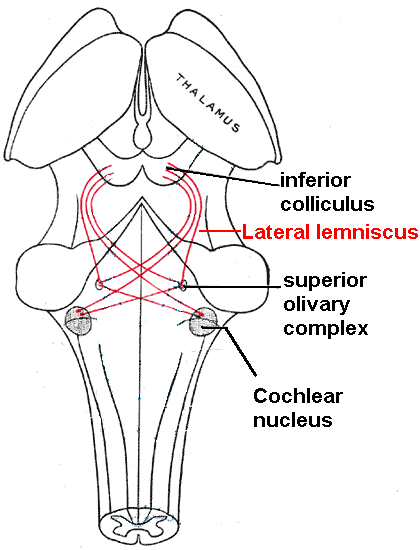
Lateral lemniscus in red, as it connects the cochlear nucleus, superior olivary nucleus and the inferior colliculus. Seen from behind.
Details
Identifiers
Latinlemniscus lateralis
NeuroNames609
NeuroLex IDbirnlex_976
TA98A14.1.05.317
A14.1.08.670
A14.1.06.204
TA25866
FMA72502
Anatomical terms of neuroanatomy

The lateral lemniscus is a tract of axons in the brainstem that carries information about sound from the cochlear nucleus to various brainstem nuclei and ultimately the contralateral inferior colliculus of the midbrain. Three distinct, primarily inhibitory, cellular groups are located interspersed within these fibers, and are thus named the nuclei of the lateral lemniscus.

Connections

[edit]

There are three small nuclei on each of the lateral lemnisci:

  • the intermediate nucleus of the lateral lemniscus (INLL)
  • the ventral nucleus of the lateral lemniscus (VNLL)
  • the dorsal nucleus of the lateral lemniscus (DNLL)

Fibers leaving these brainstem nuclei ascending to the inferior colliculus rejoin the lateral lemniscus. In that sense, this is not a 'lemniscus' in the true sense of the word (second order, decussated sensory axons), as there is third (and out of the lateral superior olive, fourth) order information coming out of some of these brainstem nuclei.

The lateral lemniscus is located where the cochlear nuclei and the pontine reticular formation (PRF) crossover. The PRF descends the reticulospinal tract where it innervates motor neurons and spinal interneurons. It is the main auditory tract in the brainstem that connects the superior olivary complex (SOC) with the inferior colliculus (IC). The dorsal cochlear nucleus (DCN) has input from the LL and output to the contralateral LL via the ipsilateral and contralateral Dorsal Acoustic Stria.

The two lemnisci communicate via the commissural fibers of Probst.

Nuclei of the lateral lemniscus

[edit]

The function of the complex of Nuclei of the lateral lemniscus is not known; however it has good temporal resolution compared to other cells higher than the cochlear nuclei and is sensitive to both timing and amplitude changes in sound. It is also involved in the acoustic startle reflex; the most likely region for this being the VNLL.

DNLL

[edit]

The cells of the DNLL respond best to bilateral inputs, and have onset and complexity tuned sustained responses. The nucleus is primarily GABAergic,[1] and projects bilaterally to the inferior colliculus, and contralaterally to the DNLL, with different populations of cells projecting to each IC.[2]

In rat, the DNLL has a prominent columnar organization. Nearly all neurons are stained for GABA, especially in the central part of the nucleus, and the remaining GABA negative cells are interspersed with the positive, and often stain for glycine. Two populations of GABA+ cells are visible: larger, lightly stained cells that project to the contralateral IC, and smaller, darker stained cells that project ipsilaterally. GABAergic axon terminals form dense groups surrounded by GABA-lemniscal fibers throughout the nucleus, and synapse on both somata and in the neuropil. Glycinergic axon terminals, on the other hand, are more finely localized, with the majority of recipient neurons located laterally in the nucleus.[3]

INLL

[edit]

INLL also has little spontaneous activity and broad tuning curves. The temporal responses are significantly different from cells of the VNLL.

This structure is greatly hypertrophied in the rat, forming a prominent bulge on the surface of the brainstem. GAD, GABA, and Glycine staining reveals several distinct regions that are not evident in standard cytoarchitectural preparations. A modest number of GABA-stained neurons are arranged in small groups, generally in the center of the nucleus, whereas glycine-stained neurons are more common and widely dispersed, with regional concentrations in the dorsolateral and ventrolateral portions of the nucleus. Most GABA+ cells are gly+ as well.[1][broken footnote]

VNLL

[edit]

Sound in the contralateral ear leads to the strongest responses in the VNLL, which deals with some temporary processing. The VNLL may also be essential to the IC’s decoding of amplitude modulated sounds.

VNLL cells have little spontaneous activity, broad and moderately complex tuning curves; they have both phasic and tonic responses and are involved in temporal processing.

In rat, the VNLL is composed of two subdivisions, the ventral (columnar) and dorsal (non columnar) regions. The columnar region contains many glycine-positive (0 GABA+) neurons, whereas the dorsal region contains clusters of GABA+ neurons intermingled with gly+ cells, with some cells containing both.[1]

Inputs and outputs to nuclei

[edit]

The table below shows that each of the nuclei have a complicated arrangement of ipsilateral and contralateral afferent inputs and outputs:[4]

Nucleus Input Output
  Contralateral Ipsilateral Contralateral Ipsilateral
VNLL Anterior and posterior ventral cochlear nuclei Medial nucleus of the trapezoid body   Inferior Colliculus
DNLL

Ventral Nucleus of the Trapezoid Body

Superior Paraolivary Nucleus

Medial Nucleus of the Trapezoid Body

INLL Anterior and posterior Ventral Cochlear Nucleus Medial nucleus of the trapezoid body   Medial Geniculate body
Inferior Colliculus

Ventral Nucleus of the Trapezoid Body

DNLL Anterior Ventral
Cochlear nucleus (and Bilateral)
Medial superior Olivary Nucleus
Lateral Superior Olivary Nucleus (and Bilateral)
DNLL
Inferior Colliculus
Mid brain reticular formation
Superior Olivary Complex
Inferior Colliculus
 Medial Geniculate Body
Mid brain reticular formation
Superior Olivary Complex

Additional images

[edit]

References

[edit]
Revisions and contributorsEdit on WikipediaRead on Wikipedia
from Grokipedia
The lateral lemniscus is a major ascending tract of axons in the brainstem that transmits auditory information from the cochlear nuclei and superior olivary complex to the inferior colliculus, serving as a critical relay in the central auditory pathway.[1][2] This structure, located in the pontomesencephalic tegmentum medial to the middle cerebellar peduncle, consists primarily of myelinated fibers originating from the dorsal and ventral cochlear nuclei, with significant contributions from the nuclei of the superior olivary complex, and it projects both contralaterally and ipsilaterally to support bilateral auditory processing.[1][3] Embedded within the fascicles of the lateral lemniscus are several associated nuclei that interrupt the pathway for additional processing, including the ventral nucleus of the lateral lemniscus (VNLL), which functions mainly as a relay with large somatic synapses for rapid signal transmission; the intermediate nucleus of the lateral lemniscus (INLL), which integrates inputs across frequencies; and the dorsal nucleus of the lateral lemniscus (DNLL), characterized by GABAergic neurons that provide inhibitory feedback.[3][2] Additional structures, such as the semilunar nucleus (SLN) and medial paralemniscal region, contribute to the complex's organization, forming a column of gray matter amid the ascending fibers.[3] These nuclei exhibit tonotopic organization, preserving the spatial representation of sound frequencies along the tract.[4] In terms of function, the lateral lemniscus facilitates key aspects of auditory perception, including binaural sound localization through integration of interaural time and intensity differences, and temporal encoding of sound onsets.[1] The VNLL supports precise timing for reflexes and midbrain processing, while the DNLL and INLL enhance inhibitory modulation to refine neural responses in the inferior colliculus.[3][2] Beyond its traditional ascending role, recent evidence indicates that portions of the lateral lemniscus nuclei, particularly the VNLL and INLL, contribute to descending projections that modulate lower auditory structures like the superior olivary complex, influencing feedback and gain control in the auditory system.[3]

Anatomy

Location and gross structure

The lateral lemniscus is a tract of axons in the brainstem that conveys auditory information from the cochlear nuclei and superior olivary complex to the inferior colliculus and associated nuclei.[5][6] It consists primarily of myelinated fibers originating from second-order auditory neurons.[7] This tract originates in the caudal pons, where fibers from the cochlear nuclei cross via the trapezoid body to form the initial bundle, incorporating inputs from the superior olivary complex.[5] It then ascends contralaterally and ipsilaterally through the pontine tegmentum, continuing into the midbrain tegmentum before terminating mainly in the inferior colliculus.[6][8] In gross anatomical sections, the lateral lemniscus appears as a compact bundle of fibers situated lateral to the medial lemniscus within the brainstem tegmentum, located in the pontomesencephalic tegmentum medial to the middle cerebellar peduncle.[6][1] It is prominently visible in transverse cross-sections of the pons and midbrain, often highlighted in neuroanatomical dissections and imaging.[8] Relationally, in the pons, it occupies the ventral tegmentum lateral to the spinothalamic tract and medial lemniscus, ventral to the superior cerebellar peduncle, and medial to the spinal trigeminal tract; in the midbrain, it lies in the lateral tegmentum, posterior to the substantia nigra, anterior to the central gray matter.[5][6][8]

Connections

The lateral lemniscus receives primary afferent inputs from both contralateral and ipsilateral cochlear nuclei, specifically the anteroventral and posteroventral divisions, as well as the dorsal cochlear nucleus, which convey second-order auditory information originating from the cochlea.[9][10] These afferents form the initial ascending fibers of the tract, contributing to the preservation of tonotopic organization.[11] Additionally, third-order inputs arise from the superior olivary complex, including the medial superior olive and lateral superior olive, which integrate binaural cues for sound localization.[12] Interconnections between the bilateral nuclei of the lateral lemnisci, particularly the dorsal nucleus (DNLL), occur primarily through the commissure of Probst, a bundle of fibers that crosses the midline in the midbrain to facilitate integration of auditory signals from both ears.[13] These commissural fibers, often GABAergic and inhibitory, link homologous regions of the nuclei, enabling coordinated processing across hemispheres without descending to the level of the trapezoid body.[13] The majority of efferent projections from the lateral lemniscus terminate in the central nucleus of the inferior colliculus, relaying processed auditory information to higher midbrain centers for further analysis.[9] Minor efferent pathways include sparse projections to the medial geniculate body, primarily from ventral zones of the lemniscal nuclei, and to the contralateral lateral lemniscus via the commissure of Probst. Many fibers within the lateral lemniscus, particularly those originating from the superior olivary complex, emit collateral branches that synapse in the embedded nuclei of the lateral lemniscus—such as the dorsal, intermediate, and ventral nuclei—prior to continuing to the inferior colliculus, allowing for intermediate processing along the tract.[12]

Nuclei of the lateral lemniscus

Dorsal nucleus (DNLL)

The dorsal nucleus of the lateral lemniscus (DNLL) represents the most dorsal of the three principal nuclei embedded within the lateral lemniscus, positioned along its trajectory in the rostral pons and extending into the caudal midbrain, immediately ventral to the inferior colliculus. This placement situates it as a distinct cytoarchitectural entity in the auditory brainstem tegmentum, traversed by dorsal fiber bundles of the lemniscus itself.[14][11] The cellular composition of the DNLL is dominated by inhibitory neurons, with immunocytochemical analyses revealing that the vast majority—estimated at over 90%—are GABAergic, utilizing GABA as their primary neurotransmitter for output. Some neurons exhibit glycinergic elements through colocalization of GABA and glycine within the same cells, potentially enabling mixed inhibitory signaling. Morphologically, these neurons are characterized as relatively large, triangular or multipolar cells, often featuring predominantly horizontal dendrites that facilitate integration of auditory signals. The nucleus forms a compact cluster of hundreds of neurons, reflecting its specialized role in auditory processing without expansive volume.[15][16][11] Organizationally, the DNLL receives prominent commissural inputs from its contralateral counterpart via the commissure of Probst, which contribute to the encoding of interaural timing differences essential for binaural auditory computations. Neurons within the nucleus respond to bilateral sound inputs, underscoring their involvement in integrating information from both ears. Recent molecular studies in mice have identified key markers such as Gad67 and Gad65 for GABA synthesis, along with VIAAT for vesicular transport of inhibitory transmitters, affirming the DNLL's role in inhibitory modulation of the auditory pathway. These findings highlight conserved genetic profiles across species for the nucleus's inhibitory function.[17][18][19][16] The DNLL provides inhibitory projections to the inferior colliculus, influencing higher-order auditory processing.[19]

Intermediate nucleus (INLL)

The intermediate nucleus of the lateral lemniscus (INLL) occupies an intermediate position along the lateral lemniscus within the mid-pons, extending across its full rostrocaudal extent as a compact column of gray matter embedded among lemniscal fiber bundles in the lateral tegmentum of the brainstem. It lies ventral to the dorsal nucleus of the lateral lemniscus and dorsal to the ventral nucleus, with boundaries that are often indistinct, particularly toward the ventral nucleus near the dorsal margin of the rubrospinal tract.[11] The cellular composition of the INLL features a mixed population of neurons, predominantly excitatory glutamatergic cells alongside a smaller proportion of inhibitory neurons that utilize GABA and/or glycine as neurotransmitters. In rodents such as rats and gerbils, the INLL is notably hypertrophied relative to other mammals, forming a prominent surface bulge on the brainstem that enhances its accessibility for neurophysiological and anatomical studies. Neurons here are morphologically diverse, primarily multipolar with triangular or polygonal somata averaging 15-16 μm in maximum diameter, alongside occasional fusiform or bushy-like forms with round or oval cell bodies; dendritic fields typically radiate in 3-4 primary branches oriented perpendicular to the lemniscal fibers, extending up to 700 μm.[20][21][22] Organizationally, the INLL displays a stratified or layered arrangement arising from the horizontal alignment of cell bodies and dendrites, contributing to its role in integrating auditory signals with broad frequency tuning characteristics among its neurons. This structure supports parallel processing pathways, with less dense packing of neurons compared to adjacent nuclei. In rodents, stereological estimates indicate the INLL contains thousands of neurons, contributing to a total of approximately 12,800-13,800 cells when combined with the ventral nucleus, underscoring its expanded scale.[11][16] A distinctive feature of the INLL in certain mammals, particularly rodents, is its larger relative volume compared to other lateral lemniscus nuclei, which likely reflects evolutionary adaptations enhancing temporal and spectral sound processing capabilities in species reliant on acute auditory localization. The INLL provides ascending outputs primarily to the inferior colliculus, contributing to midbrain auditory integration.[3][21]

Ventral nucleus (VNLL)

The ventral nucleus of the lateral lemniscus (VNLL) is the most ventral of the lemniscal nuclei, embedded within the fibers of the lateral lemniscus in the caudal pontine tegmentum, extending rostrally from the superior olivary complex to the ventral aspect of the dorsal nucleus of the lateral lemniscus.[23] This positioning situates it as a key relay station in the ascending auditory pathway, where it integrates monaural signals with a pronounced bias toward the contralateral ear.[24] The cellular composition of the VNLL is dominated by excitatory neurons, characterized by strong responses to contralateral auditory stimuli and sensitivity to temporal features such as onset timing and modulation.[25] Principal cell types include globular cells, which are round or oval with moderate dendritic arborization, and multipolar cells, which exhibit more elaborate, radiating dendrites suited for integrating multiple inputs.[20] These neurons primarily utilize glutamate as a neurotransmitter, supporting rapid excitatory transmission essential for preserving temporal fidelity in sound processing.[26] Organizationally, the VNLL is subdivided into distinct subregions, such as a ventral-lateral globular cell domain and a more dorsal multipolar region in rodents, while in species like cats and bats, it includes specialized compartments like the columnar (VNLLc) and multipolar (VNLLm) divisions that reflect functional specialization along the nucleus's length.[14] These subregions contribute to generating precise, rapid-onset neural responses that underpin auditory reflexes, such as the acoustic startle pathway.[27] A hallmark structural adaptation in the VNLL is the high density of endbulbs of Held, large somatic excitatory synapses formed by axons from the ventral cochlear nucleus, which ensure sub-millisecond precision in spike timing by minimizing synaptic jitter and supporting high-fidelity transmission.[28] Recent morphological analyses from 2023 highlight distinct rostrocaudal variations in neuronal morphology and synaptic input patterns within the VNLL, with rostral portions showing more uniform globular cell features and caudal areas exhibiting increased dendritic complexity.[20]

Physiology

Inputs and outputs

The ventral nucleus of the lateral lemniscus (VNLL) receives major synaptic inputs from the contralateral anterior and posterior ventral cochlear nuclei, as well as from the ipsilateral medial nucleus of the trapezoid body (MNTB).[29][30] Its primary outputs project to the ipsilateral inferior colliculus (IC) and the dorsal nucleus of the lateral lemniscus (DNLL), forming a key relay in the ascending auditory pathway.[29][31] The intermediate nucleus of the lateral lemniscus (INLL) is innervated by inputs from the contralateral anterior and posterior ventral cochlear nuclei and the ipsilateral MNTB, mirroring aspects of the VNLL's afferent pattern but with additional influences from other superior olivary complex nuclei.[32][9] Its outputs target primarily the ipsilateral IC, with collateral projections to the non-lemniscal divisions of the auditory thalamus, contributing to non-lemniscal auditory processing streams.[33] In contrast, the dorsal nucleus of the lateral lemniscus (DNLL) exhibits more binaural integration, receiving bilateral inputs from the anterior ventral cochlear nucleus and ipsilateral projections from the medial and lateral superior olivary nuclei. Its efferents include connections to the contralateral DNLL, bilateral IC, and MGB, supporting inhibitory modulation across hemispheres.[11] Across the lateral lemniscal nuclei, outputs are predominantly ipsilateral to the IC, while inputs show contralateral biases from the cochlear nuclei, with recurrent loops evident in DNLL interconnections and VNLL-to-DNLL projections that enhance temporal processing within the complex.[11][9]

Functional roles

The lateral lemniscus functions as a critical relay and processing hub in the central auditory pathway, conveying ascending signals from the cochlear nuclei to the inferior colliculus while refining them for enhanced auditory perception. It contributes to sound localization by integrating binaural cues such as interaural time and level differences, to intensity coding through neurons that modulate firing rates in response to varying sound amplitudes, and to temporal resolution via combination-sensitive cells that detect fine-grained temporal patterns in sounds.[34] The dorsal nucleus of the lateral lemniscus (DNLL) primarily delivers bilateral GABAergic inhibition to the inferior colliculus, modulating neuronal responses to suppress ipsilateral echo-like inputs and sharpen the encoding of interaural level differences, thereby supporting accurate sound localization in reverberant environments. Recent research as of 2024 has also identified GABAB receptor-mediated modulation in the developing DNLL, contributing to the maturation of inhibitory circuits.[35][3][36] This inhibitory network, characterized by sustained and delayed components, ensures that contralateral dominant responses in the inferior colliculus are not overwhelmed by secondary acoustic reflections.[3] In contrast, the intermediate nucleus of the lateral lemniscus (INLL) facilitates broad frequency integration, where high-best-frequency neurons receive excitatory drive combined with glycinergic inhibition from low-frequency sources like the medial nucleus of the trapezoid body, enabling the analysis of complex spectral features across distant frequency bands. This spectral processing enhances the auditory system's ability to parse overlapping sounds and maintain robustness in noisy conditions.[37] The ventral nucleus of the lateral lemniscus (VNLL) excels in high temporal precision, generating powerful, short-latency onset inhibition that delays initial responses to sound bursts and minimizes spectral splatter from transients, which is vital for detecting sound onsets with submillisecond accuracy. VNLL neurons also play a pivotal role in the acoustic startle reflex by relaying rapid excitatory signals to brainstem circuits, facilitating quick behavioral responses to sudden auditory stimuli.[38][39] Recent research from 2023 has revealed that the nuclei of the lateral lemniscus extend beyond bottom-up relay functions by providing descending projections, particularly from the VNLL and INLL, to modulate lower auditory structures like the superior olivary complex, potentially influencing feedback and gain control in the auditory system.[3]

Clinical significance

Lesions and symptoms

Lesions of the lateral lemniscus are uncommon and often arise from rare unilateral damage, such as hemorrhage within a cavernoma or ischemic events in brainstem strokes.[40][41] Bilateral involvement is less frequent but can result from traumatic injury or demyelinating processes that disrupt lemniscal fibers.[42] Damage to the lateral lemniscus typically manifests as contralateral auditory impairments, including hearing loss, tinnitus, and hyperacusis, alongside deficits in sound localization and temporal processing of auditory signals.[41] A notable 2005 case report documented a unilateral lesion from cavernoma bleeding, presenting with strictly contralateral tinnitus and auditory extinction during dichotic listening tests, without evidence of peripheral hearing involvement.[40] These symptoms arise due to the lemniscus's role in relaying ascending auditory information, leading to subtle contralateral abnormalities that may evade routine audiometric detection.[41] Such lesions are associated with broader neurological conditions, including brainstem strokes where approximately 57% of cases involve auditory deficits.[41] In multiple sclerosis, demyelination of lemniscal pathways can cause delayed neural conduction between the cochlear nucleus and lateral lemniscus, resulting in impaired temporal processing and central auditory dysfunction.[43][42] Additionally, disruptions in the lateral lemniscus contribute to central auditory processing disorder (CAPD), characterized by difficulties in recognizing environmental sounds, understanding speech in noise, and processing nonverbal auditory cues.[44] Prognosis following lateral lemniscus lesions varies, with partial recovery of auditory function possible through neuroplasticity in the brainstem circuits, particularly in response to auditory training that promotes synaptic reorganization.[45] However, persistent deficits in binaural hearing and sound localization often remain, especially in cases of extensive bilateral damage or progressive demyelination.[41][42]

Diagnostic imaging

Magnetic resonance imaging (MRI) serves as a primary modality for assessing the lateral lemniscus, a compact brainstem tract in the auditory pathway. T2-weighted sequences provide high contrast for delineating brainstem white matter structures, visualizing the lateral lemniscus as a bundle of ascending fibers from the superior olivary complex to the inferior colliculus.[46] Fluid-attenuated inversion recovery (FLAIR) imaging enhances lesion detection by suppressing cerebrospinal fluid signals, revealing hyperintensities or disruptions in the brainstem indicative of pathology affecting the lemniscus, such as demyelination or ischemia.[47] Diffusion tensor imaging (DTI), a specialized MRI technique, traces the orientation and integrity of fiber tracts like the lateral lemniscus by quantifying water diffusion anisotropy, with fractional anisotropy values helping to identify microstructural alterations in conditions such as sensorineural hearing loss or neurofibromatosis.[48] Functional imaging techniques offer insights into the dynamic activity of the lateral lemniscus within the auditory pathway. Functional MRI (fMRI) detects blood-oxygen-level-dependent (BOLD) signals during auditory stimuli, such as clicks or tones, revealing activation patterns along the pontine and midbrain segments of the lemniscus, often contralateral to the stimulated ear.[49] Positron emission tomography (PET), using tracers like fluorodeoxyglucose, evaluates metabolic changes in broader auditory pathways, indirectly assessing lemniscal involvement through altered glucose uptake in connected brainstem regions during sound processing tasks.[50] These methods complement structural imaging by highlighting functional deficits without invasive procedures. Electrophysiological assessments provide objective measures of lateral lemniscus function, particularly in suspected central auditory disorders. Auditory brainstem response (ABR) audiometry records evoked potentials from click stimuli, with wave IV—generated primarily by neurons in the lateral lemniscus and pontine tegmentum—showing prolonged latency or reduced amplitude in lemniscal lesions, aiding diagnosis of brainstem pathology like multiple sclerosis.[51] Otoacoustic emissions (OAEs), measured via transient or distortion-product protocols, evaluate outer hair cell viability in the cochlea to exclude peripheral causes of hearing impairment, ensuring that abnormalities in ABR waves IV or V are attributable to central structures including the lemniscus.[52] Imaging the lateral lemniscus presents challenges due to its small size and proximity to other brainstem tracts, which limits spatial resolution in conventional 1.5T or 3T MRI, often resulting in partial volume effects and imprecise tract delineation.[53] Advances in high-field MRI at 7T, as demonstrated in 2023 studies, address these limitations by providing superior signal-to-noise ratios and finer resolution (down to 0.3 mm isotropic voxels), enabling in vivo visualization of lemniscal nuclei and fibers with quantitative susceptibility mapping for enhanced contrast against surrounding tissue.[54]

References

User Avatar
No comments yet.