


Community hub
Recent from talks
Contribute something
Nothing was collected or created yet.
University of Lausanne
View on Wikipedia
The University of Lausanne (UNIL; French: Université de Lausanne) in Lausanne, Switzerland, was founded in 1537 as a school of Protestant theology,[1] before being made a university in 1890. The university is the second-oldest in Switzerland, and one of the oldest universities in the world to be in continuous operation. As of fall 2017, about 15,000 students and 3,300 employees studied and worked at the university. Approximately 1,500 international students attend the university (120 nationalities), which has a wide curriculum including exchange programs with other universities.
Key Information


Together with the École polytechnique fédérale de Lausanne (EPFL) the university forms a vast campus at the shores of Lake Geneva.
History
[edit]

The university was founded in 1537 as the Schola Lausannensis, one year after Bern annexed the territory of Barony of Vaud from the Duchy of Savoy, as a school of theology with the purpose of training pastors for the church.[2] It enjoyed great renown in its early years for being the first and, until the establishment of the Academy of Geneva in 1559, the only French-language Protestant school of theology. It quickly became a center of humanist learning, with thinkers such as Corderius and Celio Secondo Curione among its professors.[2] In 1558, the school had 700 students. It entered into a period of decline in the following years, after several members of the academic staff, including rector Theodore Beza and Pierre Viret, resigned their seats to join the newly established Academy of Geneva.[2]
In the seventeenth century, the institution became known as the Academy of Lausanne (Académie de Lausanne).[2] In 1741, it counted 150 students and seven professors. Starting in 1837, the academy was modernized by the authorities of the canton of Vaud, becoming a secular institution divided into three faculties (letters and sciences, theology, and law).[2] It continued to expand throughout the second half of the 19th century, until 1890, with the establishment of a medicine course, the academy received the name and status of a university.[2]
In 1909, Rudolphe Archibald Reiss founded the first school of forensic science in the world: the Institut de police scientifique.
From 1970, the university moved progressively from the old centre of Lausanne, around the Cathedral and Château, to its present site at Dorigny.
The end of the 20th century, witnessed the beginnings of an ambitious project aiming at greater co-operation and development among the French-speaking universities of Lausanne, Geneva, and Neuchâtel, together with the Swiss Federal Institute of Technology in Lausanne (EPFL). Among others, this led to the transfer of the sections of Mathematics, Physics and Chemistry from the university to the EPFL; the funds that were made available following this transfer were invested in the development of the life sciences at the university, including the creation of a Center for Integrative Genomics.
In 2003, two new faculties were founded, concentrating on the life and human sciences: the Faculty of Biology and Medicine and the Faculty of Geosciences and Environment.
On 1 January 2014, the Swiss Graduate School of Public Administration (IDHEAP) was integrated into the University of Lausanne.[3]
Since August 2021, the rector of the University of Lausanne is Frédéric Herman; before then, the university was led by Nouria Hernandez (2016–2021) and by Dominique Arlettaz (2006–2016).
Faculties and schools
[edit]

The University of Lausanne comprises seven faculties:
- Faculty of Arts (Faculté des lettres)
- Faculty of Biology and Medicine (FBM)
- Faculty of Business and Economics (HEC), also called HEC Lausanne
- Faculty of Geosciences and Environment (GSE)
- Faculty of Law, Criminal Justice and Public Administration (FDSC), including the Swiss Graduate School of Public Administration
- Faculty of Social and Political Sciences (SSP)
- Faculty of Theology and Religious Studies (FTSR)
The University of Lausanne also comprises schools and different sections, including but not limited to:
- School of Criminal Justice (ESC)
- School of French as a Foreign Language (EFLE)
- French summer and winter courses (Cours de vacances)
- Science-Society Interface
Campus
[edit]Main campus
[edit]The main campus is presently situated outside the city of Lausanne, on the shores of Lake Léman, in Dorigny. It is adjacent to the Swiss Federal Institute of Technology in Lausanne (EPFL) and is served by the Lausanne Metro Line 1 (M1). The two schools together welcome about 20,000 students.
The UNIL and the EPFL share an active sports centre located on the campus, on the shores of Lake Geneva[4] and their campus is also equipped with a bicycle sharing system.[5]
The university campus is made up of individual buildings with a park and arboretum in between. The university library also serves as eating hall and is centrally located. The view from the library across the sports fields to the lake of Geneva and the French and Swiss Alps. On a clear day, Mont Blanc can be seen.
The Swiss Institute of Comparative Law and the central administration of the Swiss Institute of Bioinformatics are also located on the main campus.
-
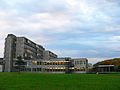 The main building of the Faculty of Law and Criminal Justice and of the Faculty of Business and Economics
 -
 The Extranef building
 -
 The Édouard Fleuret Library pavilion
 -
 The Génopode building of the University of Lausanne hosts the Center for Integrative Genomics of the University of Lausanne and the central administration of the Swiss Institute of Bioinformatics.
 -
 The School of Criminal Justice of the UNIL is the world's oldest school of forensic science and is one of the only European institution to offer a complete education in forensic sciences.
 -
 The Anthropole building
 -
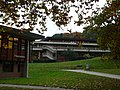 Unithèque building houses one of the two sites of the Cantonal and University Library of Lausanne on the main campus of the UNIL.
 -
 The Swiss Institute of Comparative Law, on the campus of the University of Lausanne
 -
 The Géopolis building: Faculty of Geosciences and Environment and Faculty of Social and Political Sciences
 -
 Vortex building, student residence on the campus


_by_Martin_Rulsch_79.jpg)
Other sites
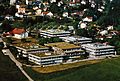
[edit]In addition to its main campus at the lakeside, the University of Lausanne also has other sites. The Faculty of Biology and Medicine is also located in two other sites: around the University Hospital of Lausanne (CHUV) (site called Bugnon) and in Épalinges (to the north of Lausanne).
The Department of Biochemistry, the Ludwig Cancer Research branch of the University of Lausanne and the WHO Immunology Research and Training Centre and some laboratories of the University Hospital of Lausanne are located in Épalinges. The Biopôle was built next to the Épalinges campus. The Faculty of Biology and Medicine also comprises a fourth site, the Psychiatric Hospital of Cery, in Prilly.
-
 Bugnon 21, headquarters of the University Hospital of Lausanne and of the deanship of the Faculty of Biology and Medicine
 -


Associated institutions
[edit]

- Biopôle
- Kurt Bösch Institute (IUKB)
- Center for Biomedical Imaging (CIBM)[6]
- Centre de recherches sur les lettres romandes (CRLR)
- Centre du droit de l'entreprise (CEDIDAC)
- Centre for Advanced Modelling Science (CADMOS)[7]
- École romande de santé publique (ERSP)
- Fondation Edouard Fleuret (FEF)
- Institut Benjamin Constant (IBC)
- Institut romand des sciences bibliques (IRSB)
- Institut universitaire romand de santé au travail (IST)[8]
- International Academy of Sport Science and Technology (AISTS)
- International Institute for Management Development (IMD)
- Jean Monnet Foundation for Europe
- Jules Gonin Eye Hospital
- Ludwig Cancer Research
- Swiss Cancer Centre
- Swiss Centre of Expertise in the Social Sciences
- Swiss Institute of Bioinformatics (SIB)
- Swiss Institute of Comparative Law
- Swiss Institute for Experimental Cancer Research (ISREC)
- Swiss School of Archaeology in Greece
- Swiss Vaccine Research Institute[9]
- University Centre of Legal Medicine (CURML)[10]
- WHO Immunology Research and Training Centre
Reputation and rankings
[edit]| University rankings | |
|---|---|
| Global – Overall | |
| ARWU World[11] | 101–150 (2023) |
| QS World[12] | =212 (2026) |
| THE World[13] | =143 (2024) |
| USNWR Global[14] | 182 (2023) |

The University of Lausanne is consistently ranked among the top 100 universities in the world. Between 2010 and 2018, the Leiden Ranking (CWTS) ranked the University of Lausanne 57th-98th globally, and 15th-38th among all universities in Europe.[15] According to the Times Higher Education World University Rankings (THE), the University of Lausanne ranked 62nd in life sciences worldwide (4th in Switzerland) in 2017.[16] The QS World University Rankings (QS)[17] placed the University of Lausanne 96th in life science and medicine.[18] The Academic Ranking of World Universities (ARWU) ranked the University of Lausanne 101-150 globally.[19]
Below are rankings for the University of Lausanne by the Leiden Ranking (CWTS).[15]
| Year | In Europe | In the World |
|---|---|---|
| 2015–2018 | 35 | 98 |
| 2014–2017 | 38 | 108 |
| 2013–2016 | 28 | 90 |
| 2012–2015 | 34 | 99 |
| 2011–2014 | 22 | 73 |
| 2010–2013 | 15 | 57 |
| 2009–2012 | 31 | 88 |
| 2008–2011 | 21 | 67 |
| 2007–2010 | 16 | 67 |
| 2006–2009 | 14 | 67 |
Press
[edit]The UNIL publishes a free monthly campus magazine entitled L'Uniscope[20] The UNIL also publishes Allez savoir !,[21] a free magazine aimed at a larger audience (general public), in January, May, and September.
Besides these, L'auditoire is the students' newspapers from both UNIL and EPFL, with a circulation of 19,000.
Alumni
[edit]ALUMNIL network
[edit]In 2011, an on-line network of the UNIL alumni, called ALUMNIL, was created.[22] Since then, regular events (throughout the year) and an annual party (in autumn) are organised every year for the alumni.
Royalty
[edit]- King Ananda Mahidol (Rama VIII) of Thailand (1925-1946)
- King Bhumibol Adulyadej (Rama IX) of Thailand (1927-2016)
- Princess Galyani Vadhana of Thailand
- Prince Bernhard of the Netherlands
- Princess Vera Ignatievna Giedroyc, Lithuanian princess and Russian-Ukrainian surgeon
Politics
[edit]- Jean-Luc Addor Swiss politician
- Samuel Bendahan Swiss politician
- Ignazio Cassis, President of the Swiss Confederation
- İsmail Cem, Minister of Foreign Affairs of Turkey
- Paul Ceresole, President of the Swiss Confederation
- Georges-André Chevallaz, President of the Swiss Confederation
- Pascal Couchepin, President of the Swiss Confederation
- Ernest Chuard, President of the Swiss Confederation
- Jean-Pascal Delamuraz, President of the Swiss Confederation
- Vedat Dicleli, Minister of Economy & Trade of Turkey
- Daniel-Henri Druey, President of the Swiss Confederation
- Florika Fink-Hooijer, prominent European civil servant
- Constant Fornerod, President of the Swiss Confederation
- Nuria Gorrite, President of the Council of State of Vaud
- Şemsettin Günaltay, Prime Minister of Turkey
- Max Huber, Swiss international lawyer and diplomat, President of the International Committee of the Red Cross
- Yvette Jaggi, Swiss National Councillor, Member of the Council of States, and Mayor of Lausanne
- Antoine Louis John Ruchonnet, President of the Swiss Confederation
- Fazıl Küçük, first Vice President of the Republic of Cyprus
- Pascoal Mocumbi, Prime Minister of Mozambique
- Benito Mussolini, Prime Minister of Italy, Duce of Italy
- Marguerite Narbel (1918–2010), member of the Grand Council of Vaud[23]
- Marcel Pilet-Golaz, President of the Swiss Confederation
- Eugène Ruffy, President of the Swiss Confederation
- Marc-Emile Ruchet, President of the Swiss Confederation
- Mohammad Sa'ed, Prime Minister of Iran
- Jonas Savimbi, leader of UNITA, an anti-Communist rebel group in Angola
- Lutz Graf Schwerin von Krosigk, Leading Minister of the German Reich
- Germaine Suter-Morax (1896–1974), Swiss-French Resistance member
- Christine Wohlwend, (born 1978), Liechtensteiner politician
Business
[edit]- Jean-Claude Biver, CEO of Hublot
- Louis C. Camilleri, CEO of Philip Morris International
- Jean Claude Gandur, CEO of Addax Petroleum[24]
Literature
[edit]- Philippe Jaccottet, Swiss poet
- Mohammad-Ali Jamalzadeh, prominent Iranian writer
- Edmond Pidoux, Swiss poet and novelist
- Charles Ferdinand Ramuz, Swiss writer
Scholars
[edit]- André Bonnard (1888–1959), Swiss Hellenist and philologist
- Jacques Dubochet (1942–), biophysicist and co-laureate of the Nobel Prize in Chemistry 2017.
- Pierre Gilliard (1879–1962), French professor, Legion of Honour recipient
- Leo Aryeh Mayer (1895–1959), rector of the Hebrew University of Jerusalem.
- Vilfredo Pareto (1848–1923) Economist, engineer, sociologist, philosopher, Professor of Economics at University of Lausanne, co-founder of the Lausanne School of economics, together with Léon Walras
- Jean Piccard (1884–1963), Swiss-born American chemist, engineer, professor and high-altitude balloonist.
- Martine Rebetez (1961–), Swiss climatologist
- Georges de Rham (1903–1990), Swiss mathematician, known for his contributions to differential topology.
- Pedro Rossello (1897–1970), Catalonian educator and Deputy Director of the International Bureau of Education.
- Jean de Serres (1540–1598), French humanist, Plato translator, Calvinist.
- Léon Walras (1834–1910) Economist, Professor of Economics at University of Lausanne, co-founder of the Lausanne School of economics, together with: Vilfredo Pareto
- Luc E. Weber (1941–), Rector Emeritus of the University of Geneva
- Alexandre Yersin (1863–1943), Swiss-French physician, co-discoverer of the bacillus responsible for the bubonic plague.
- Zaharina Dimitrova (1873–1940), Bulgarian doctor, Order of Civil Merit recipient, philanthropist.
- Marguerite Narbel (1918–2010), Swiss biologist[23]
Others
[edit]- Sepp Blatter, President of FIFA
- Murielle Bochud, Swiss physician who is the co-chief of the Department of Epidemiology and Health Systems of Unisanté
- Abraham Davel, independence hero of the Canton of Vaud
- Akbar Etemad, president of the Atomic Energy Organisation of Iran
- Christophe Keckeis, Head of the Swiss Army
- Claude Nicollier, Swiss astronaut
- Bertrand Piccard, Swiss psychiatrist and balloonist
- Nikolaus Senn (1926–2014), co-director of Schweizerische Bankgesellschaft
School of Lausanne
[edit]Neoclassical school of thought in economics founded at the University of Lausanne by two of its professors: Léon Walras and Vilfredo Pareto. The School of Lausanne is associated with the development of general equilibrium theory as well as the marginalist revolution.
See also
[edit]- Charles Guillaume Loys de Bochat
- List of largest universities by enrollment in Switzerland
- List of modern universities in Europe (1801–1945)
- List of universities in Switzerland
- Cantonal and University Library of Lausanne
- International Academy of Sport Science and Technology (AISTS)
- Jean Monnet Foundation for Europe
- Swiss School of Archaeology in Greece
- University Hospital of Lausanne (CHUV)
Notes and references
[edit]- ^ "The UNIL in the 16th century". Université de Lausanne.
- ^ a b c d e f University of Lausanne in German, French and Italian in the online Historical Dictionary of Switzerland.
- ^ Rapport annuel 2012 de l'Université de Lausanne[permanent dead link], www.unil.ch (page visited on 30 May 2013).
- ^ Service des sports UNIL-EPFL, sport.unil.ch (page visited on 10 May 2013).
- ^ Campus roule, www.publibike.ch (page visited on 15 May 2013).
- ^ Center for Biomedical Imaging (page visited on 2 October 2011).
- ^ CADMOS (page visited on 20 February 2012).
- ^ Institut universitaire romand de santé au travail Archived 18 June 2012 at the Wayback Machine (page visited on 1 October 2011).
- ^ Swiss Vaccine Research Institute (page visited on 14 April 2012).
- ^ Centre universitaire romand de médecine légale (page visited on 3 June 2012).
- ^ "ARWU World University Rankings 2034". www.shanghairanking.com. Retrieved 26 August 2022.
- ^ "QS World University Rankings".
- ^ "World University Rankings". timeshighereducation.com. 6 August 2023. Archived from the original on 19 September 2024. Retrieved 26 August 2023.
- ^ "U.S. News Education: Best Global Universities 2022-23". Retrieved 23 November 2023.
- ^ a b "CWTS Leiden Ranking". CWTS Leiden Ranking. Retrieved 19 April 2021.
- ^ "World University Rankings 2016-2017 by subject: life sciences". Times Higher Education (THE). 20 September 2016. Retrieved 19 April 2021.
- ^ "QS World University Rankings 2010 Results". Retrieved 19 April 2021.
- ^ "QS World University Rankings by Faculty 2015/16 - Life Sciences and Medicine". Top Universities. Retrieved 19 April 2021.
- ^ "Academic Ranking of World Universities in Life and Agriculture Sciences - 2016 | 2016 Top 100 Universities in Natural Sciences and Mathematics | ARWU-FIELD 2016". www.shanghairanking.com. Archived from the original on 20 November 2016. Retrieved 19 April 2021.
- ^ "Archives de l'uniscope". www.unil.ch. Retrieved 19 April 2021.
- ^ "Allez savoir !". Archived from the original on 15 February 2014. Retrieved 1 February 2014.
- ^ ALUMNIL, www.unil.ch (page visited on 1 November 2013).
- ^ a b Marion, Gilbert (7 July 2011). "Narbel, Marguerite". Historical Dictionary of Switzerland (in German). Translated by Alice Holenstein-Beereuter. Retrieved 20 January 2023.
- ^ "Jean Claude Gandur". Fg-art.org. Archived from the original on 6 November 2014. Retrieved 6 November 2014.
Bibliography
[edit]- (in French) Jean-Philippe Leresche, Frédéric Joye-Cagnard, Martin Benninghoff and Raphaël Ramuz, Gouverner les universités. L'exemple de la coordination Genève-Lausanne (1990-2010), Presses polytechniques et universitaires romandes, 2012 (ISBN 9782880749316).
- (in French) Nadja Maillard, L'Université de Lausanne à Dorigny, Éditions Infolio, 488 pages, 2013 (ISBN 978-2-88474-280-1).
External links
[edit]
- Official website
 (in English)
 - Cantonal and University Library of Lausanne (in English)


University of Lausanne
View on GrokipediaHistory
Founding and Theological Origins (1537–1890)
The Academy of Lausanne, predecessor to the University of Lausanne, was established in 1537 by the Bernese authorities following their conquest of the Pays de Vaud in 1536, with the explicit aim of propagating the Protestant Reformation and training ministers for the French-speaking Reformed churches.[7] [2] This institution, known as the Schola Lausannensis, initially comprised a college with six classes for general education and a dedicated chair of theology, reflecting its primary theological mandate as the sole French-language Protestant school of theology in Europe at the time.[7] [2] Pierre Viret, a key Reformed leader, played a central role in its founding in early January 1537 at Lausanne Cathedral, drawing on influences from Ulrich Zwingli and early Genevan reformers to emphasize scriptural authority and pastoral formation.[8] [9] The academy's theological orientation was deeply rooted in the Swiss Reformation's emphasis on biblical exegesis and ecclesiastical reform, attracting over 700 students by the mid-16th century from French-speaking regions and beyond, who studied under professors like Viret and later Jean Calvin's associates.[10] [8] Instruction focused on theology, Hebrew, Greek, and Latin to equip pastors for preaching and combating Catholic remnants, with the curriculum structured around Reformed doctrines such as predestination and covenant theology.[9] [11] Despite expansions into arts, law, and medicine by the 17th century, theology remained the core faculty, producing generations of ministers who disseminated Reformed teachings across Europe, including during the French Wars of Religion.[2] [9] Under Bernese oversight until 1798, the academy functioned as a state-supported instrument of confessional control, mandating attendance at Reformed services and suppressing Catholic influences, though internal disputes—such as those over Viret's orthodoxy—occasionally arose.[7] [11] Following Vaud's independence and the 1798 revolution, the institution was reorganized as the Academy of the Canton of Vaud, yet retained its theological primacy, with the faculty adapting to Enlightenment influences while upholding Protestant orthodoxy through seminaries like the Lausanne Theological Seminary (1726–1812), which trained pastors for clandestine French Reformed communities.[7] [12] By the 19th century, enrollment stabilized around pastoral training, but pressures for secular expansion mounted, culminating in the academy's transformation into a full university in 1890 amid broader demands for scientific and professional education.[2] [9]Establishment as a Secular University (1890–1945)
The Academy of Lausanne achieved full university status on May 10, 1890, via the Act on Higher Public Education, which renamed it the University of Lausanne and created the Faculty of Medicine with 13 professors.[7] [13] This legislative step, driven by Vaud canton's sovereignty and political needs for local medical training, diversified the institution beyond its theological origins, incorporating secular disciplines like medicine and sciences under state control.[14] Alexandre Maurer served as the first rector.[7] The transformation was enabled by philanthropist Gabriel de Rumine's 1871 bequest of 1.5 million Swiss francs to Lausanne for public buildings, which supported infrastructure development including the Palais de Rumine, inaugurated in 1906 and housing the university library and cantonal collections.[15] [16] Inaugural university celebrations occurred in 1891, followed by expansions such as the 1893 School of Physics and Chemistry.[7] Women gained access to degrees, with Charlotte Wedell earning the first bachelor's in 1894 and Charlotte de Mayer the first medical doctorate in 1897.[7] Further secular growth included the 1901 School of Social and Political Sciences, 1902 School of Modern French (both attached to existing faculties), and 1911 School of Business and Economics under the Faculty of Law.[7] The 1909 Institute of Forensic Science, attached to law, marked a global first in specialized training.[7] Student enrollment reached 1,000 by 1910.[7] The 1916 Act on Higher Education governed operations until 1977, reinforcing state oversight.[7] World War I (1914–1918) and World War II (1939–1945) saw the university host internees, maintaining operations amid disruptions.[7] Financial strains peaked in 1924 with a one-tenth budget cut, spurring calls for a unified university for French-speaking Switzerland.[7] The 400th anniversary in 1937 featured an honorary doctorate for Benito Mussolini.[7] Throughout, the institution emphasized scientific approaches across disciplines, including theology, solidifying its secular academic framework.[17]Postwar Expansion and Specialization (1945–2000)
Following World War II, the University of Lausanne underwent rapid expansion amid Switzerland's economic recovery and demographic pressures, with student enrollments growing from approximately 1,000 in the immediate postwar years to 1,700 by 1960.[7] This surge reflected broader European trends in higher education democratization, though constrained by limited infrastructure in the city's historic center. In 1946, the engineering school achieved greater autonomy as the École Polytechnique de l’Université de Lausanne (EPUL), marking an early step toward disciplinary specialization by elevating technical education's profile.[7] The 1960s catalyzed infrastructural transformation, as the Vaud Grand Council allocated CHF 22 million in 1963 for acquiring the Dorigny site, a former agricultural area west of Lausanne, to accommodate projected growth.[7] Student protests in 1968, echoing global unrest, coincided with the adoption of a rectorate system and master plan for the new campus, facilitating the university's relocation starting that year. By 1970, enrollments reached 3,000, and core operations shifted to Dorigny, enabling spatial separation of faculties and specialization in non-technical fields following EPUL's federal independence as the École Polytechnique Fédérale de Lausanne (EPFL) in 1969.[7] This bifurcation allowed UNIL to prioritize humanities, social sciences, medicine, and life sciences, unburdened by engineering's resource demands. The 1970s and 1980s emphasized specialized infrastructure, with the Physical Sciences Building (BSP) inaugurated in 1973 to house physics and related research, followed by the Faculty of Humanities Building I (BFSH I) in 1977 after the federal Higher Education Act granted the university fuller administrative independence.[7] Biology gained prominence with its dedicated building (BB) in 1983, supporting expanding programs in biomedical research amid Switzerland's growing pharmaceutical sector. The Cantonal and University Library relocated to Dorigny in 1982, centralizing resources, while the Anthropole building (BFSH II) opened in 1987 for social sciences, reflecting interdisciplinary specialization.[7] By the 1990s, further constructions underscored scientific focus: the School of Pharmacy building in 1991 and Chemistry building (BCH) in 1995, alongside enrollments surpassing 9,000 in 1996.[7] Economic pressures prompted a 1997 three-week strike against austerity measures, highlighting tensions between expansion and fiscal constraints. The decade closed with UNIL's engagement in the 1998 Bologna Process, initiating reforms for modular degrees and international comparability, though implementation emphasized research specialization over undergraduate breadth.[7] Overall, this era tripled student numbers and shifted UNIL toward a research-intensive model, leveraging Dorigny's modular design for faculty-specific growth in life sciences and humanities.[7]Modern Developments and Reforms (2000–Present)
In the early 2000s, the University of Lausanne underwent significant structural reforms to align with European higher education standards and refocus its academic profile. The Bologna Process was implemented across all faculties in 2005, transitioning to a three-cycle system of bachelor's, master's, and doctoral degrees to enhance mobility and comparability.[7] Concurrently, in 2003, the Faculty of Biology and Medicine (FBM) and Faculty of Geosciences and Environment (FGSE) were established following the transfer of fundamental sciences to the École Polytechnique Fédérale de Lausanne (EPFL), allowing UNIL to specialize in life sciences, environmental studies, and interdisciplinary approaches.[7] A new university law, strategic vision, and charter were adopted in 2004, formalizing governance and emphasizing research excellence.[7] Student enrollment expanded rapidly during this period, surpassing 10,000 in 2002 and reaching 12,000 by 2010, driven by new programs and international recruitment; by 2021, numbers had grown to over 17,000, reflecting a fivefold increase from earlier decades amid broader Swiss higher education trends.[7][18] Research infrastructure advanced with the inauguration of the Centre for Integrative Genomics in 2005 and the Centre for Biomedical Imaging in 2007, bolstering genomics and neuroimaging capabilities through partnerships like the UNIL-CHUV regulations enacted in 2005.[7] Internationalization efforts included the 2009 Triangle Azur partnership with universities in Strasbourg and Freiburg for cross-border collaboration, alongside the establishment of the Lausanne University Centre for Finance.[7] Infrastructure developments supported this growth, exemplified by the 2012 inauguration of the Géopolis building for geosciences and social sciences faculties, consolidating interdisciplinary research spaces.[7] Further expansions integrated the Institute of Public Administration and Political Science (IDHEAP) into the Faculty of Law in 2014 and launched specialized master's programs, such as in tourism studies.[7] In life sciences, agreements like the 2010 Ludwig Institute for Cancer Research affiliation enhanced translational research ties with the University Hospital of Lausanne (CHUV).[7] Since the 2010s, UNIL has prioritized sustainability and digital reforms amid global challenges. A digital governance strategy was adopted in 2019, including the TransNUM project for IT modernization and data sovereignty, while sustainability initiatives, building on over a decade of efforts, culminated in the CAP 2037 strategy and 2,000-Watt Society project for energy reduction targets by 2030–2050.[18] The 2021–2026 strategic plan addresses ecological transition, health, and digital technologies through 19 objectives, emphasizing open science, gender parity in professorships (targeting 60%), and reduced precariousness for early-career researchers.[18] Post-2020 adaptations included campus closures during COVID-19 and acquisition of the Vortex building for student housing, alongside hosting the 2020 Winter Youth Olympics to promote regional innovation.[7] These reforms underscore UNIL's shift toward societal impact, with ongoing collaborations like the CIVIS European alliance enhancing international visibility.[18]Governance and Organization
Administrative Structure and Leadership
The University of Lausanne operates under public law as a cantonal institution, granting it administrative autonomy while subject to strategic oversight by the Canton of Vaud's Council of State.[19] The primary executive authority is the Rectorate, responsible for directing university administration—including units, offices, and centers—overseeing faculty operations, defining long-term policies, preparing the strategic plan and statement of intent, negotiating inter-institutional agreements, appointing deans, ratifying regulations, and recruiting full professors.[19][20] The current Rectorate commenced its five-year mandate on 1 August 2021, concluding on 31 July 2026, with appointments made by the Council of State and ratified by the University Council.[20] It is headed by Rector Frédéric Herman, a professor specializing in climate change and mountain evolution, supported by six vice-rectors: Estelle Doudet, Benoît Frund, Jérôme Rossier (vice-rector for research), Marc de Perrot (secretary-general), Liliane Michalik, and Giorgio Zanetti.[20][21] The University Council functions as the central governing body and deliberative forum, representing all university constituencies—including faculties, staff, and students—to debate and decide on institutional proposals, such as enhancements to campus life and policy orientations.[19][22] Each of the seven faculties is led by a dean, appointed by the Rectorate and assisted by a dean’s office of 3–5 members, alongside a faculty council composed of elected representatives from teaching staff, intermediate and administrative/technical personnel, and students to ensure balanced input on faculty matters.[19] The Rectorate is further advised by term-specific consultative committees on strategic issues, while a staff committee, with three representatives per professional category, addresses personnel grievances and maintains liaison with executive leadership.[19]Faculties, Schools, and Academic Units
The University of Lausanne (UNIL) is structured around seven faculties, each overseeing specialized academic departments, institutes, and research centers dedicated to undergraduate, graduate, and doctoral education as well as scholarly inquiry. These units collectively enroll over 14,000 students and employ approximately 2,700 researchers, emphasizing interdisciplinary approaches in humanities, social sciences, life sciences, and environmental studies.[23][4]- Faculty of Theology and Religious Studies (FTSR): This faculty examines theological doctrines, religious history, and interfaith dynamics through biblical studies, church history, and practical theology programs. It maintains unique offerings in Switzerland for religious sciences, integrating empirical analysis of belief systems with philosophical inquiry.[24]
- Faculty of Law, Criminal Sciences, and Public Administration (FDCA): Encompassing legal theory, criminal justice, and administrative governance, FDCA includes the School of Criminal Justice (École des sciences criminelles; ESC), established in 1909 as the world's first institution dedicated to forensic science education. It provides comprehensive training in forensic methodologies—an applied hard science involving scientific methods (such as biology, chemistry, and physics) for criminal investigations and legal evidence—while integrating criminological studies, a social science focused on crime patterns, causation, and prevention, thereby positioning UNIL as a European leader in forensic science.[24][23]
- Faculty of Arts (Lettres): Focused on linguistics, literature, history, and philosophy, this faculty supports departments in French, English, German, and classical studies, fostering critical analysis of cultural artifacts and textual traditions.[24]
- Faculty of Social and Political Sciences (SSP): Covering sociology, political science, psychology, and sports sciences, SSP operates through institutes such as the Institute of Political Studies and Institute of Social Sciences, emphasizing empirical social research and policy evaluation.[25][24]
- Faculty of Business and Economics (HEC Lausanne): Known as HEC Lausanne, this unit specializes in economics, management, and actuarial science across ten departments, including finance and marketing, with a strong emphasis on quantitative methods and international business training.[26][24]
- Faculty of Geosciences and the Environment (GSE): This faculty addresses earth sciences, environmental management, and sustainability, with departments in geology, geography, and ecology, supporting research on climate dynamics and resource conservation.[24]
- Faculty of Biology and Medicine (FBM): Integrating biomedical research and clinical training, FBM collaborates with the University Hospital of Lausanne (CHUV) to offer programs in molecular biology, neuroscience, and public health, contributing to advancements in genomics and immunology.[24][27]
Academic Programs and Research
Undergraduate and Graduate Offerings
The University of Lausanne provides 15 bachelor's degree programs distributed across its seven faculties, encompassing disciplines including arts, biology and medicine, business and economics, geosciences and environment, law and criminal justice, social and political sciences, and theology and religious studies.[28] [29] These undergraduate offerings emphasize broad foundational knowledge, with programs typically lasting three years and requiring 180 ECTS credits for graduation.[30] Approximately 7,000 students are enrolled in bachelor's programs.[31] Instruction occurs primarily in French, though select courses in fields like business and economics incorporate English components to accommodate international perspectives.[32] Since autumn 2020, all bachelor's programs have been available on a part-time basis, extending duration to suit students balancing professional or family commitments while maintaining full academic rigor.[33] Specific bachelor's examples include the Bachelor of Science in Biology, offered by the Faculty of Biology and Medicine, which covers core topics in molecular, cellular, and ecological biology over 180 ECTS credits.[30] In business and economics, the Bachelor of Science in Economics from HEC Lausanne integrates quantitative methods, microeconomics, and macroeconomics across three years.[34] The Faculty of Law, Criminal Justice and Public Administration provides a Bachelor of Law focused on Swiss and international legal principles.[28] Admission generally requires a Swiss maturity certificate or equivalent foreign qualification, with alternatives like preliminary examinations for non-traditional candidates.[35] At the graduate level, the university offers 43 master's degree programs, enabling specialization and interdisciplinary training in areas such as actuarial science, finance, management, health sciences, and geosciences.[36] These programs build directly on bachelor's qualifications, typically spanning 90 to 120 ECTS credits over 1.5 to 2 years full-time, with around 3,000 students enrolled.[31] [37] Nearly all master's degrees support part-time study at 50% load, effectively doubling duration to align with professional demands, except for joint programs like the Master in Health Sciences with HES-SO.[38] Language of instruction remains predominantly French, but English dominates in HEC Lausanne offerings, such as the Master of Science in Finance or Management, to foster global employability.[39] Notable master's programs include the MSc in Actuarial Science from the Faculty of Business and Economics, emphasizing risk modeling and statistics; the MSc in Molecular Life Sciences from the Faculty of Biology and Medicine, advancing research in genomics and biochemistry; and the Master in Public Management and Policy from the Faculty of Social and Political Sciences, addressing governance and policy analysis.[40] [39] Entry requires a relevant bachelor's degree with sufficient ECTS credits (at least 180) and often specific prerequisites, evaluated for equivalence by the rectorate.[37] These graduate offerings integrate cutting-edge research access, preparing students for doctoral pursuits or professional roles in Switzerland's innovation-driven economy.[36]Research Institutes, Centers, and Outputs
The University of Lausanne (UNIL) operates over 190 research units across its seven faculties, engaging approximately 3,000 researchers, including 580 professors, in fields ranging from genetics to social sciences.[6] Key interdisciplinary centers include the Interdisciplinary Centre for Mountain Research (CIRM), which examines challenges in mountain regions through sustainability lenses; the Swiss Centre of Expertise in Life Course Research (LIVES), focusing on aging and life transitions; and the Interdisciplinary Centre for Ethics Research, fostering partnerships on ethical issues.[6] In life sciences and medicine, prominent entities encompass the Ludwig Lausanne Branch of Ludwig Cancer Research, dedicated to tumor immunology and immunotherapy development; the Center for Integrative Genomics (CIG), advancing genomic studies; and the Swiss Institute of Bioinformatics (SIB), providing computational biology resources.[41] The Faculty of Biology and Medicine supports 13 core facilities for services in genomics, proteomics, imaging, and structural biology.[42] National Centres of Competence in Research (NCCRs), such as NCCR Microbiomes, underscore UNIL's role in funded collaborative projects addressing microbial influences on health.[6] Research outputs emphasize high-impact publications, particularly in biological and health sciences. According to the Nature Index for the period August 2024 to July 2025, UNIL produced 313 articles with a Share of 77.15, reflecting fractional authorship contributions in premium journals, with biological sciences leading at a Share of 56.49.[43] Over the prior five years (2020–2024), annual Share rose from 70 to 82, indicating growing productivity and influence, while health sciences output expanded notably from negligible levels in 2020 to a 2024 Share of 26.[43] UNIL's Papago research information system had generated 3,954 records by June 2024, supporting data management and open science practices to enhance visibility and reproducibility.[6] Funding streams include internal grants like early-career and transition awards, alongside external sources via NCCRs and the Swiss National Science Foundation, facilitating innovation in areas such as precision medicine and environmental genomics.[44] These efforts contribute to societal applications, including patents and spin-offs, though outputs in social sciences may reflect prevailing academic paradigms requiring scrutiny for empirical robustness.[6]| Year | Share (Nature Index) | Key Subject Share (Biological Sciences) |
|---|---|---|
| 2020 | 70 | Not specified |
| 2021 | 70 | Not specified |
| 2022 | 64 | Not specified |
| 2023 | 72 | Not specified |
| 2024 | 82 | 56.49 (2024-2025 period) |
Funding, Innovation, and Criticisms
The University of Lausanne (UNIL) operates with an annual budget of approximately CHF 666.5 million, derived primarily from public sources including subsidies from the Canton of Vaud and the Swiss Confederation, which cover core operations such as teaching, administration, and infrastructure.[45] External research funding supplements this, with competitive grants from the Swiss National Science Foundation (SNSF) forming a key component; for instance, the HEC Lausanne faculty alone secured CHF 8.9 million in external funds in 2024 across various projects.[46] European Union programs, such as Horizon Europe, and private or industry partnerships provide additional resources, though public funding dominates to maintain institutional autonomy.[47] UNIL emphasizes innovation through technology transfer and commercialization of research outputs, supporting faculty and students via dedicated offices, workshops, and the HUB Entrepreneurship platform to develop spin-offs and startups.[48] The university participates in regional ecosystems like the Lausanne Innovation Park, fostering collaborations in fields such as life sciences, genomics, and social sciences, though specific metrics on patents or spin-offs remain limited in public disclosures—reflecting a focus on academic outputs over industrial metrics compared to technical institutes like EPFL.[6] Research impacts include contributions to bioinformatics via the Swiss Institute of Bioinformatics (SIB), which receives federal funding covering about 48% of its budget (CHF 46.5 million for 2025–2028), enabling tools for genomic innovation.[49] Criticisms of UNIL have centered on academic freedom, particularly the February 2025 non-renewal of lecturer Joseph Daher's contract for a module on Middle Eastern politics, which detractors attributed to his pro-Palestine activism and involvement in campus protests against Israeli policies in Gaza.[50][51] UNIL cited an administrative irregularity—involving the loan of a campus access card—as the basis, but international scholars and organizations protested the decision as arbitrary and politically motivated, highlighting tensions between institutional procedures and expression on contentious geopolitical issues.[52] Broader concerns include potential vulnerabilities from private funding, which could subtly influence research priorities and independence in Swiss universities, though UNIL's predominantly public financing mitigates this risk relative to more privatized systems.[53] Proposed federal cuts to education and research funding—up to CHF 460 million annually starting in 2027—have also drawn sector-wide critique for threatening innovation capacity and global competitiveness, with UNIL leaders warning of reduced attractiveness for talent.[54]Campus and Facilities
Main Dorigny Campus
![The Anthropole building][float-right] The Main Dorigny Campus of the University of Lausanne is located on the shores of Lake Geneva, to the west of central Lausanne, Switzerland, spanning a total surface area of 107 hectares, of which 77 hectares consist of green spaces including meadows, orchards, and protected forests.[18] The site occupies a former moraine formed approximately 15,000 years ago during the retreat of glaciers toward the Rhône Valley, providing a verdant setting that integrates natural landscapes with academic infrastructure.[55] It serves as the primary hub for the university, accommodating approximately 90% of UNIL's 20,000 students and employees engaged in teaching, research, and administration across multiple faculties.[56] Development of the campus began in the 1960s amid postwar expansion needs, with the Canton of Vaud granting CHF 22 million in 1963 to acquire the Dorigny property.[7] Construction commenced in 1968 under architect Guido Cocchi, following site suitability confirmation in 1965.[7] The relocation from central Lausanne started in 1970 with the inauguration of the Preparatory College building, later renamed Amphipôle, which featured four 300-seat auditoriums—a significant innovation at the time—and marked the campus's initial student population reaching 3,000.[7] Subsequent phases included the 1973 opening of the Physical Sciences building (Cubotron), the 1977 Faculty of Humanities Building I (Internef), housing law and business faculties, and ongoing expansions through the 1980s and 1990s with structures like Biophore (1983), Anthropole (1987), Génopode (1991), and Batochimy (1995).[7] In 2020, the Vortex building was acquired as student housing.[7] Key facilities on the campus emphasize interdisciplinary functionality and modern amenities, including the Uniték building, which integrates library services, cafeterias, and restaurants at the site's core.[57] Buildings such as Extranef and Internef support business and law programs, while Géopolis accommodates geosciences and social sciences faculties.[58] The campus adjoins the École Polytechnique Fédérale de Lausanne (EPFL), fostering joint planning for development akin to a small town serving up to 35,000 users daily.[59] Accessibility is enhanced by the TSOL tramway line commissioned in 1991, public transport integration, bike-sharing, and car parks, with most users arriving via sustainable modes.[7][18] Sustainability features distinguish the campus, with 90% green coverage promoting biodiversity through managed meadows grazed by sheep, footpaths along streams and lake shores, and initiatives like the Biodiversity Observatory established to inventory flora and fauna.[60][61] Varied architectural styles in state-of-the-art buildings coexist with natural elements, supporting research in fields from genomics to environmental sciences while prioritizing ecological management over urban density.[62]Satellite Sites and Infrastructure
The University of Lausanne operates several satellite sites outside its main Dorigny campus, concentrated in the Lausanne area to support clinical training, medical research, and specialized life sciences infrastructure integrated with partner institutions like the Lausanne University Hospital (CHUV). These sites facilitate interdisciplinary collaboration, particularly in biology, medicine, and health sciences, with facilities emphasizing advanced laboratories, hospital affiliations, and translational research capabilities.[63][64] The Bugnon campus, located in central Lausanne adjacent to the CHUV, serves as the primary hub for the Faculty of Biology and Medicine's clinical and preclinical activities. Bugnon 21 houses the faculty's deanship and administrative offices, alongside teaching spaces and research units focused on medical education at undergraduate and postgraduate levels.[64][65] Nearby structures, such as Bugnon 17, host the Institute of Social and Preventive Medicine, supporting epidemiological and public health studies in proximity to the hospital's 1,400-bed complex. This site enables direct integration of academic programs with patient care, including specialized platforms like the Cellular Imaging Facility at Bugnon 9 for microscopy-based biomedical research.[65][66] In Épalinges, to the north of Lausanne, UNIL maintains a dedicated research-oriented campus emphasizing life sciences innovation. This site features state-of-the-art laboratories for experimental biology, including the Center for Integrative Genomics and elements of the Swiss Institute of Bioinformatics administration.[64] The Center for Immunology and Infection Lausanne (CIIL), a joint UNIL-CHUV initiative established around 2007, operates here with facilities for immunological and microbiological studies.[67] Additional dispersed sites in Lausanne include the Hôpital de Cery for psychiatric research and training, the Jules-Gonin Eye Hospital for ophthalmology collaborations, the Institute of Radiophysics for medical physics applications, and facilities at Avenue de la Gare 1 and Avenue de Provence 82 for administrative or niche research functions. These smaller infrastructures, numbering around five key buildings, connect via public transport, bike hire, and car-sharing to the broader UNIL network, prioritizing accessibility for clinical partnerships over large-scale campus development.[63][67] Proximate to these, the Biopôle life sciences park in southern Lausanne hosts 13 core research facilities operated by UNIL's Faculty of Biology and Medicine, including labs for genomics, proteomics, and drug discovery, accommodating over 800 UNIL-CHUV personnel across 10 buildings as of 2024. This infrastructure supports startup incubation and industry-academia ties, with expansions like the Leucine building enhancing wet lab and office spaces for translational projects.[68][69]Sustainability Initiatives and Challenges
The University of Lausanne (UNIL) initiated its formal commitment to sustainability in 1989, elevating it to an institutional priority in 2011 through the appointment of a Vice-Rector for Sustainability and Campus, one of the few such senior positions globally.[70] This leadership has supported the creation of the Competence Centre in Sustainability (CCD), an interdisciplinary team of approximately 20 staff that coordinates efforts across research, education, and operations, including implementation of the CAP2037 ecological transition strategy aimed at aligning university activities with planetary boundaries by 2037.[71] Key initiatives include the Sustainability Transformation Research Initiative (STRIVE), launched to fund and promote interdisciplinary research on rapid socio-economic transformations toward sustainability.[72] UNIL also deploys a "navigation tool" to quantify and monitor environmental impacts, such as greenhouse gas emissions and resource use, while fostering events like Sustainability Week and the Durabilis Award to engage students and faculty in practical projects.[73] In education and research, UNIL offers a Master of Arts in Foundations and Practices of Sustainability, emphasizing analysis of environmental issues through interdisciplinary lenses, and integrates sustainability into curricula via CCD-supported pedagogical resources.[74] The university's efforts earned it top ranking among Swiss higher education institutions in the WWF's 2024 University Rating, which assessed 29 institutions on strategic commitment, teaching, research, and operations, crediting UNIL's comprehensive approach including impact assessments like the "UNIL Doughnut" framework based on planetary boundaries.[75] Operationally, initiatives target reductions in campus energy consumption and waste, with the Transition Assembly coordinating cross-faculty adaptations.[73] Despite these advances, challenges persist in fully operationalizing sustainability amid the scale of environmental pressures. The WWF 2024 rating highlights "significant room for improvement" in areas like deeper integration of sustainability metrics into governance and accelerated emission reductions, noting that even leading institutions like UNIL fall short of an "ideal sustainable university" due to persistent dependencies on high-impact infrastructure.[75] Internally, Vice-Rector Benoît Frund has described the transition as "daunting," necessitating ongoing experimentation and adaptability to shift from incremental measures to systemic changes, such as reversing traditional growth paradigms to prioritize planetary limits over expansion.[73] No major external criticisms of greenwashing or implementation failures were identified in independent assessments, though the inherent difficulties of retrofitting a large campus—spanning energy-intensive buildings and research labs—underscore causal barriers to rapid decarbonization without compromising academic output.[70]Reputation, Rankings, and Metrics
National and International Rankings (Including 2025 Data)
In global university rankings, the University of Lausanne (UNIL) consistently places in the top 250 institutions, reflecting strengths in research output, particularly in life sciences, medicine, and social sciences. According to the QS World University Rankings 2026, released in June 2025, UNIL is ranked joint 212th worldwide, an improvement from 224th in the prior edition.[76] The Times Higher Education (THE) World University Rankings 2026, published in October 2025, positions UNIL at joint 125th globally, up from joint 134th the previous year, with notable performance in citations and international outlook metrics.[77] In the Academic Ranking of World Universities (ARWU) 2025, released in August 2025 by ShanghaiRanking, UNIL falls within the 101-150 band, driven by indicators such as highly cited researchers and publications in top journals.[78]| Ranking Provider | Edition (Published 2025) | Global Position |
|---|---|---|
| QS World University Rankings | 2026 | =212 |
| THE World University Rankings | 2026 | =125 |
| ARWU (ShanghaiRanking) | 2025 | 101-150 |