


Community hub
Recent from talks
Contribute something
Nothing was collected or created yet.
Le Classique
View on Wikipedia
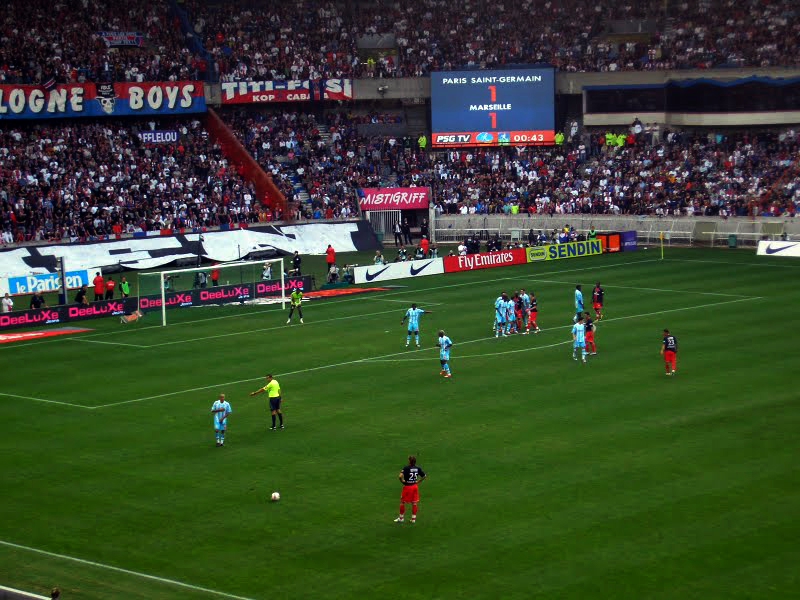
 PSG/OM at the Parc des Princes in September 2007. | |
| Other names | Le Classico, Le Clasico, Le Derby de France |
|---|---|
| Location | France |
| Teams | Paris Saint-Germain Olympique de Marseille |
| First meeting | 12 December 1971 Division 1 Marseille 4–2 Paris Saint-Germain |
| Latest meeting | 22 September 2025 Ligue 1 Marseille 1–0 Paris Saint-Germain |
| Next meeting | 8 January 2026 Trophée des Champions Paris Saint-Germain v Marseille |
| Stadiums | Parc des Princes, Paris Stade Vélodrome, Marseille |
| Statistics | |
| Meetings total | 110 |
| Most wins | Paris Saint-Germain (52) |
| Most player appearances | Steve Mandanda (30) |
| Top scorer | Zlatan Ibrahimović (11) |
| All-time record | Paris Saint-Germain: 52 Draw: 23 Marseille: 35 |
| Largest victory | Paris Saint-Germain 5–1 Marseille Division 1 (8 January 1978) Marseille 1–5 Paris Saint-Germain Ligue 1 (26 February 2017) |
  Olympique de Marseille  Paris Saint-Germain | |
Le Classique (French pronunciation: [lə klasik], The Classic) is the name given to any football match between rival French clubs Paris Saint-Germain (PSG) and Olympique de Marseille (OM). They are the two most successful clubs in French football and the only French teams to have won major European trophies. Therefore, this matchup is considered the biggest rivalry in France.
PSG and OM were the dominant teams before the emergence of Olympique Lyonnais in the 2000s, and are the most followed French teams internationally. Both clubs lead or come close to the top of French attendances each season. Their clashes during the 1970s gave little indication that they would become major adversaries. The newly formed Parisians were trying to form a competitive team, while the Olympians were Ligue 1 contenders.
The rivalry began in earnest in 1986, when PSG won their first championship and Bernard Tapie bought OM. By the end of the decade, PSG were battling Tapie's Marseille for the 1988–89 title. PSG president Francis Borelli's accusations of match-fixing against Tapie and OM during that season contributed to their growing rivalry.
In the 1990s, tensions between the two teams escalated. French television channel Canal+ bought PSG in 1991 with the aim of breaking Marseille's hegemony, but later agreed with Tapie to emphasize the animosity between them as a way to promote the league. With equivalent financial backing, PSG and OM became the main contenders for the title. Both teams were less successful in the late 1990s and 2000s, but the rivalry remained strong. Since the 2010s, PSG have dominated the duel, and the significant investment from their Qatari owners has created a significant rift between the clubs.
History
[edit]Origins
[edit].jpg)
Le Classique, the term used to describe matches between Paris Saint-Germain and Olympique de Marseille, is inspired by El Clásico, played between Real Madrid and Barcelona. The Spanish press borrowed the term Clásico from South America, where most countries use it to refer to the continent's biggest rivalries, such as the Superclásico between Boca Juniors and River Plate, and the Uruguayan Clásico between Nacional and Peñarol.[1] The fixture is also known as "Le Classico", "Le Clasico" or "Le Derby de France."[1][2][3]
PSG were founded in 1970, and during that decade they were not on the same level as OM, traditionally a giant of French football. Founded in 1899, Marseille have competed for trophies for most of their history and, for at least their first 87 years, were more concerned with games against Saint-Étienne or Bordeaux than trips to the capital.[4] Today, this clash is considered the greatest rivalry in France, as well as one of the most important in club football.[5][6] PSG and OM are the most successful clubs in French football and the only two French sides to have lifted a major European trophy.[7] They were also the undisputed leading teams before the emergence of Olympique Lyonnais in the early 2000s, and remain the two most popular French clubs in the world, ahead of Lyon.[2][7][8][9] Both teams routinely top the attendance charts each season.[2]
Like all great rivalries, it has a historical, cultural and social significance that makes it more than just a football match. In France, it is seen as a battle between the country's two greatest cities: Paris versus Marseille, the capital versus the province, the north versus the south, the centre of political power versus the working class, and the club of the aristocracy versus the club of the people.[7][2][10] Ironically, PSG were born as a team owned by their fans, while OM were founded by a coterie of aristocratic gentlemen.[11][12] In short, the seeds of the fiercest French rivalry were always there, but they only began to grow in 1986.[4] That year, PSG won their first league title and French businessman Bernard Tapie bought Marseille. He proceeded to invest huge amounts of money in star signings such as Chris Waddle, Abedi Pelé, Jean-Pierre Papin, Basile Boli, Enzo Francescoli, Eric Cantona, Didier Deschamps and Marcel Desailly.[7][4][10]
The clash took on a new dimension and ferocity when they played each other for the 1988–89 title, during which PSG president Francis Borelli accused Tapie and OM of match-fixing.[2][13][14] Between 1989 and 1992, the southerners won four consecutive Ligue 1 championships.[10][14] They also finished runners-up in the 1990–91 European Cup before lifting the 1992–93 UEFA Champions League.[10] Marseille fans have never let their PSG counterparts forget this triumph with the motto "A jamais les premiers" (Forever first).[15] However, all these successes were also marred by allegations of match-fixing by title rivals PSG and Monaco, as well as other clubs, further fueling the rivalry.[13][16][17][18]
Golden era and scandal
[edit]
PSG were finally able to compete with OM after Canal+, France's largest pay-TV network, bought the club in 1991.[10] The main reason behind the purchase was to revive interest in a Ligue 1 completely dominated by Marseille, as well as to attract more subscribers by assembling a squad that could beat them.[19] With Bordeaux a declining force, Tapie needed a new domestic rival to make the championship attractive again.[14][19] He encouraged Canal+ to help him promote the enmity between the two clubs to an adversarial level.[2][14] With the backing of their own wealthy owner, PSG began to flex their muscles in the transfer market with Tapie's Marseille recruiting top talents such as David Ginola, Youri Djorkaeff, George Weah and Raí.[2][10] The league was now a two-horse race and they battled each other for the title in the early 1990s.[10]
Between 1989 and 1998, PSG and OM won five league titles, four Coupe de France, two Coupe de la Ligue, one UEFA Champions League, one UEFA Cup Winners' Cup and reached two further European finals.[4] Many experts argue that Marseille (1989–1994) and PSG (1993–1998) were two of the greatest teams in French football history.[20][21] The publicity also increased tensions between fans, and reports of fan violence became more frequent in the 1990s.[4] The match-up has since been marred by injuries and arrests.[2]
The rivalry reached new heights during the 1992–93 French Division 1 season. PSG lost the title decider against OM and finished second.[20] Shortly afterwards, however, Tapie and Marseille were found guilty of match-fixing in the French football bribery scandal.[10][21] The French Football Federation stripped OM of their title and offered it to runners-up PSG, who turned it down because Canal+ felt that claiming the trophy would anger its Marseille subscribers.[20][22] As a result, the 1992–93 title remains unattributed. Canal+ even refused to allow PSG to participate in the following year's Champions League after UEFA expelled OM from the competition. Third-placed Monaco took the spot.[22] Marseille were administratively relegated to Ligue 2 in 1994.[10][23] PSG would win nine trophies during that decade, most notably their second league title in 1994 and the 1995–96 UEFA Cup Winners' Cup, becoming the second French team to win a major European title after OM.[24][25]
Marseille have since accused the Parisian political elite of conspiring against them to crown PSG kings of French football.[26][27] This sense of injustice stems from the political dimension of the rivalry, which FIFA has described as a clash between "the chosen ones of French football (the politically favored PSG) and their enfants terribles (the rebel OM)."[28] PSG president Daniel Hechter was found guilty of ticket fraud in 1977, and his replacement, Francis Borelli, incurred serious debts and financial irregularities in 1991. Unlike their arch-rivals, PSG were not relegated in either case; instead, they were bought by Canal+ with the specific aim of dethroning OM.[20] Two decades later, French president Nicolas Sarkozy, a well-known fan of PSG, which was then experiencing financial difficulties, facilitated the purchase of the club by Qatar Sports Investments (QSI).[29]
Rivalry today
[edit]OM quickly returned to the top flight in 1996 after two seasons in Ligue 2, but their new owner was not as keen to spend as Tapie.[10] Likewise, PSG's Canal+ slowly began to reduce its investment in the transfer market.[10] However, the rivalry remained just as intense.[4] Marseille only lost twice to their northern rivals between September 1990 and February 2000, before Paris became the dominant force in the 2000s, during which they went on an eight-match winning streak between 2002 and 2004.[30]
Despite both claiming to be the best clubs in France, PSG and OM have rarely been at their best at the same time, and have only competed directly for trophies on a handful of occasions. The 2006 Coupe de France final was the first time they met in a cup final, with Paris defeating Marseille 2–1 to win the title.[3][30] The two sides have never met in UEFA competitions.[30] In the 2008–09 UEFA Europa League, they came very close to reaching the semi-finals, but Ukrainian teams Dynamo Kyiv and Shakhtar Donetsk avoided that meeting.[31]

The scales briefly tipped in Marseille's favour when they claimed the Ligue 1 and Coupe de la Ligue double in 2010, ending their 17-year trophy drought, and then beat Paris in the 2010 Trophée des Champions on penalties.[13][30][32][33] However, the arrival of wealthy owners QSI in June 2011 allowed Paris to acquire a star-studded line-up the likes of which Ligue 1 had not seen since the Marseille sides of the early 1990s, including players such as Zlatan Ibrahimović, Neymar, Kylian Mbappé and Lionel Messi.[2][34][35][36] Since then, the clash has become a one-sided affair and PSG have monopolized French football, becoming the country's most successful club in history in terms of titles won.[11][34]
In turn, OM have struggled to keep pace.[34] Without a trophy since the 2011–12 Coupe de la Ligue, they have occasionally threatened PSG's hegemony.[30][37] Marseille faced eventual champions Paris for the league title in 2013, with both teams finishing in the top two for the first time since 1994, which PSG also won. They had previously competed for the championship in 1989 and 1993, with OM beating second-placed Paris on both occasions.[3][30] PSG were crowned champions ahead of Marseille in 2020, 2022 and 2025.[38][39] They also met in the 2016 Coupe de France final and the 2020 Trophée des Champions, with PSG winning both titles.[40][41]
In September 2020, Marseille's second win in nearly nine years reignited the rivalry.[42] OM midfielder Dimitri Payet mocked PSG's defeat in the 2020 UEFA Champions League final before kick-off, sparking a mass brawl involving PSG winger Neymar and Marseille defender Álvaro as protagonists.[42][43] PSG finally won their first Champions League title in 2025, equaling OM's feat of 1993, to become the first French club to win the continental treble, having also claimed the league title and the Coupe de France.[44][45][46] In September 2025, on the same night PSG were named the best team in the world at the 2025 Ballon d'Or ceremony, Marseille secured their first home league win over the reigning European champions in 14 years.[47]
Notable games
[edit]First blood for Marseille, biggest win for PSG
[edit]
- 12 December 1971 (OM 4–2 PSG). The inaugural match was played at the Stade Vélodrome, just over a year after PSG's founding. The Parisians were looking to avoid relegation in their first season in the top flight, while the Olympiacos were aiming for a second consecutive title. The match ended in a resounding victory for a Marseille side inspired by Josip Skoblar, who scored a brace.[13][48] Bernard Bosquier and Didier Couécou also scored; the former scored the first goal in the history of Le Classique.[13][30] Michel Prost scored both of PSG's goals.[48]
- 9 May 1975 (OM 2–2 PSG). PSG, underdogs, visited the Vélodrome in the quarter-finals of the Coupe de France. OM were comfortably leading 2–0 when François M'Pelé scored two goals to revive PSG's qualification hopes.[49] Angered by the result, Marseille fans erupted in several violent incidents after the final whistle. M'Pelé believes this match is the true origin of the animosity between the two clubs.[48][49]
- 13 May 1975 (PSG 2–0 OM). In the return leg, PSG secured their first victory against OM and advanced to the semi-finals of the Coupe de France with goals from Louis Floch and Jacques Laposte. At the end of the match, Marseille's Brazilian stars, Caju and Jairzinho, lost their tempers and physically assaulted the referee on the way to the locker room.[30][50] They were suspended and never played for the Olympians again.[50][51]
- 8 January 1978 (PSG 5–1 OM). Marseille scored first through Boubacar Sarr, but PSG responded with a M'Pelé brace, goals from François Brisson and Mustapha Dahleb, and OM's Marius Trésor own goal.[50][52] Paris also hit the bar three times and Carlos Bianchi missed a penalty.[48] It was PSG's first ever victory over Marseille, as well as their biggest victory over their rivals and one of the biggest wins in the history of the rivalry.[53]
- 7 April 1979 (PSG 4–3 OM). Carlos Bianchi gave PSG the victory in this goal-fest. Bernard Bureau, Dahleb and Armando Bianchi also scored for Paris, while Marc Berdoll (twice) and Robert Buigues were on target for OM. This match holds the record for most goals in Le Classique.[52][54]
- 8 December 1979 (OM 0–2 PSG). Paris had to wait eight years to finally secure their first away win. Goals from former Marseille striker Boubacar Sarr, who became the first player to score for both clubs, and Jean-François Beltramini gave PSG all three points at the Stade Vélodrome in a season in which OM were relegated to the second division.[30][53]
Marseille hegemony and the "Butchery of 1992"
[edit]- 28 November 1986 (OM 4–0 PSG). OM recorded their biggest win over PSG, with French legend Jean-Pierre Papin scoring the last goal against the title holders at the Stade Vélodrome.[13] PSG defender Philippe Jeannol replaced injured goalkeeper Joël Bats at half-time, conceding two goals in the second half.[55]
- 21 May 1988 (OM 1–2 PSG). Safet Sušić's opening goal and Gabriel Calderón's late winner gave PSG their second away win against OM, avoiding relegation and dashing Marseille's hopes of European qualification.[30][50][56] During the match, OM forward Papin was about to score when PSG defender Michel Bibard mimicked the referee's whistle. Papin inadvertently stopped his run and passed the ball to the goalkeeper. After realizing what had really happened, a heated argument broke out between the two players, which nearly escalated into a full-blown brawl.[56] At the final whistle, Bernard Tapie threatened the referee, claiming he would not ensure his safety after leaving the stadium.[50]

- 5 May 1989 (OM 1–0 PSG). The 1988–89 title decider at the Vélodrome set the tone for the years that followed.[14] PSG president Francis Borelli accused his Marseille counterpart Bernard Tapie of match-fixing.[13] Played out amid an electric atmosphere, the title looked to be heading for league leaders Paris with the score tied at 0–0 and only seconds remaining.[14] But a 25-yard shot from Franck Sauzée stunned PSG goalkeeper Joël Bats as OM overtook their rivals at the top of the table to seal their first trophy in 17 years.[14][57]
- 18 December 1992 (PSG 0–1 OM). This particularly violent match at the Parc des Princes became known as the "Butchery of 1992."[14] PSG manager Artur Jorge announced his side would crush OM, while David Ginola promised war. Tapie motivated his players by posting newspaper articles containing these provocations in the locker room.[19] Marseille did not disappoint, winning thanks to a goal from Alen Bokšić.[19][52] More than 50 fouls were called during the match, including one by OM's Éric Di Meco, who hit PSG's Patrick Colleter in the face.[19][50]
- 29 May 1993 (OM 3–1 PSG). League leaders Marseille hosted their closest rivals, PSG, in a title decider. OM quickly fell behind but responded with three goals, including one of the best seen in Le Classique: a collective goal capped by an 18-yard header from Basile Boli.[57]
- 8 November 1997 (PSG 1–2 OM). With the score tied, PSG's Éric Rabésandratana apparently brought down Marseille's Fabrizio Ravanelli inside the box. Laurent Blanc converted the controversial penalty that gave OM the victory in Paris. To this day, PSG accuse Ravanelli of a clear dive.[13]
- 4 May 1999 (PSG 2–1 OM). Marseille took the lead, but late goals from Marco Simone and Bruno Rodriguez dealt a serious blow to their title hopes.[52] After scoring the equalizer, Simone mocked the OM fans by showing off his Batman tattoo.[58] It was PSG's first league win over Marseille since April 1990.[30] OM were trailing Bordeaux, who played PSG on the final matchday. Bordeaux won with a late goal to become champions, much to the delight of the PSG fans.[13] To this day, Marseille accuse PSG of deliberately losing to Bordeaux.[13][52]
- 15 February 2000 (OM 4–1 PSG). Mid-table Marseille thrashed podium contenders Paris at the Stade Vélodrome in a heated encounter. The referee showed consecutive red cards to former PSG teammates Laurent Leroy and Jérôme Leroy, now at OM. Laurent reacted to a heavy challenge from Jérôme with a kick. They continued to exchange blows until the fight escalated.[57][59] Florian Maurice, who scored Marseille's final goal, celebrated by taking off his right shoe and throwing it at the fans.[60]
Eight consecutive wins for PSG: "The Big Eight"
[edit]- 10 February 2002 (PSG 1–1 OM). The two sides met in the Coupe de France for the first time since 1995. Daniel Van Buyten had put OM ahead midway through the second half and almost sent PSG home when Gabriel Heinze equalized five minutes from time. With the scores level after extra time, PSG goalkeeper Jérôme Alonzo was the hero of the penalty shoot-out, saving three of OM's nine attempts to reach the quarter-finals.[30][53]

- 26 October 2002 (PSG 3–0 OM). Ronaldinho led PSG to a crushing victory at the Parc des Princes with dribbles, sprints, no-look passes and goals.[13][61] He opened the scoring with a spectacular free kick and completed his brace by converting a penalty. Martín Cardetti added a third with a header.[61] On the touchline, PSG manager Luis Fernandez celebrated Ronnie's opener with an improvised samba.[61][62] The match marked the start of a run of eight consecutive victories against Marseille.[10][30]
- 9 March 2003 (OM 0–3 PSG). Jérôme Leroy opened the scoring with a 25-yard winner from an almost impossible angle. After the break, Ronaldinho intercepted a poor pass to break away and beat goalkeeper Vedran Runje to score. He made another fantastic run at the end. Starting from his own half, Ronnie held off Brahim Hemdani, evaded Runje inside the box, and then faked a shot, deceiving Hemdani, before calmly laying the ball off to Leroy.[61][63] It was PSG's first win at the Stade Vélodrome since May 1988.[13][30][57]
- 30 November 2003 (OM 0–1 PSG). Against a stronger home side, Fabrice Fiorèse finished off a 90th-minute counterattack to give PSG their second consecutive victory at the Stade Vélodrome for the first time in their history. He celebrated the goal by covering his ears and mocking the Marseille fans. Nine months later, Fiorèse signed for OM, declaring it "a dream come true."[64][65]
- 25 April 2004 (PSG 2–1 OM). Pauleta's stellar performance was the highlight of the evening. The Portuguese striker scored two goals, and his first of the match is one of the best of the rivalry: a precise chip from an impossible angle that beat Marseille goalkeeper Fabien Barthez.[66]
- 7 November 2004 (PSG 2–1 OM). The return of Frédéric Déhu and Fabrice Fiorèse to the Parc des Princes diminished the focus of the match. Both players had left the French capital to join Marseille in the summer of 2004 and received an exceptionally hostile reception from the PSG fans.[67][68] After just twenty minutes of play, PSG defender Sylvain Armand was sent off for a violent tackle on Fiorèse.[68] The former Parisian was also the target of multiple projectiles from the stands. CRS riot police had to protect Fiorèse whenever he took a corner.[58][69] Despite being a man down for most of the match, PSG claimed victory thanks to two superb goals from Pauleta and Édouard Cissé.[68][70]
- 10 November 2004 (OM 2–3 PSG). Three days later, the two sides met again in the second round of the 2004–05 Coupe de la Ligue. PSG manager Vahid Halilhodžić decided to rest his regular starters and Marseille quickly took a two-goal lead. It looked as though their fortunes were about to change, but PSG's youngsters and substitutes had other plans. Branko Bošković scored twice to tie the game before Bernard Mendy intercepted Bixente Lizarazu's back-pass to goalkeeper Barthez, dribbling past the latter and slotting the ball into an empty net to complete a stunning last-minute comeback.[71] This was PSG's eighth and final consecutive victory against OM, a run known to Parisian fans as "The Big Eight."[53]
PSG triumph in the Coupe de France final
[edit]
- 16 October 2005 (OM 1–0 PSG). Lorik Cana, who had signed for OM directly from PSG a few months earlier, scored the only goal of the game.[57][72] It was OM's first win since April 2002, ending PSG's nine-match unbeaten run in the fixture.[30] Two hours before kick-off, a smell of ammonia permeated the dressing room, forcing the Parisians to be moved to a new changing room located below the local supporters.[58][73][74] It was also claimed that OM ordered French porn star Clara Morgane to walk past the PSG dressing room and distract their players. Morgane attended the match but denied the allegations.[75][76] PSG manager Laurent Fournier complained about these incidents, while OM president Pape Diouf responded that they had to "learn to accept defeat."[74]
- 5 March 2006 (PSG 0–0 OM). Growing tensions among the fans led to fewer seats being allocated to visitors. In protest, Diouf sent the club's youth team to a match known to OM fans as "The Boys." They drew and were hailed as champions in the south.[13][52]
- 29 April 2006 (OM 1–2 PSG). Marseille faced Paris in the 2006 Coupe de France final at the Stade de France with the chance to win their first trophy since 1993. Bonaventure Kalou scored early in the match, and Vikash Dhorasoo extended PSG's lead with a 25-yard shot. Toifilou Maoulida pulled one back, but OM failed to equalize and Paris were crowned champions.[13][77]
- 26 October 2008 (OM 2–4 PSG). With a brace from Guillaume Hoarau, PSG scored four goals at the Vélodrome for the first time in their history, putting them on course to fight for the league title and preventing Marseille from overtaking them at the top of the table.[57]
- 15 March 2009 (PSG 1–3 OM). A win would give PSG first place. Marseille opened the scoring with a goal from Boudewijn Zenden, who fell into an advertising bin next to the corner flag while celebrating his goal, and Ludovic Giuly equalized for Paris just before half-time. With the score tied in the second half, Zoumana Camara's straight red card marked the turning point. Shortly after, Bakari Koné and Lorik Cana scored for OM, leapfrogging PSG into second place and ending their title hopes.[53][78]
H1N1 pandemic and Marseille's Super Cup victory
[edit]- 20 November 2009 (OM 1–0 PSG). Ten years before the COVID-19 pandemic, the 2009 swine flu pandemic hit France. Scheduled for October, this match was postponed after PSG players Ludovic Giuly, Mamadou Sakho and Jérémy Clément were diagnosed with H1N1 flu and the entire squad quarantined in their hotel in Marseille.[75][79] It was played in November when former idol Gabriel Heinze crucified Paris with the only goal of the game, becoming only the second player to score for both teams after Boubacar Sarr in 1979.[30][67]

- 28 February 2010 (PSG 0–3 OM). Goals from Hatem Ben Arfa, Lucho González and Benoît Cheyrou gave OM their biggest victory at the Parc des Princes against a mediocre PSG side that finished 13th. Marseille would go on to win both Ligue 1 and the Coupe de la Ligue, ending a 17-year title drought.[13]
- 28 July 2010 (OM 0–0 PSG). Marseille won their first Trophée des Champions in 2010, beating PSG 5–4 on penalties after a goalless draw. Neither side put up a great show in their first meeting in this competition. Both Peguy Luyindula and Ludovic Giuly missed penalties for the Parisians, and while Lucho also failed to score for OM, former PSG midfielder Édouard Cissé scored the winning penalty.[33]
- 7 November 2010 (PSG 2–1 OM). Nenê was in stellar form, and PSG secured their first home win over OM since November 2004. Mevlüt Erdinç opened the scoring by finishing in a rebound after Marseille goalkeeper Steve Mandanda failed to keep out a shot from Nenê. The Turkish striker celebrated by lifting his shirt to reveal one emblazoned with the club's slogan "Paris is magical!" Guillaume Hoarau extended PSG's lead soon after with a shot through Mandanda's legs, after Nenê had found him with a superb chip over the defenders. Lucho quickly pulled one back, but OM could not find an equalizer against PSG's resolute defense.[80][81]
- 27 November 2011 (OM 3–0 PSG). The Parisians arrived as league leaders, but returned home having lost their lead and being overtaken by a vastly superior OM side thanks to goals from Loïc Rémy, Morgan Amalfitano and André Ayew.[57] This was Marseille's last win over Paris until September 2020.[30]
Parisian supremacy: ten consecutive victories
[edit]- 7 October 2012 (OM 2–2 PSG). André-Pierre Gignac opened the scoring but PSG's Zlatan Ibrahimović turned things around with a volleyed back-heel and a 25-yard free-kick. Gignac ensured parity with his second of the night as OM remained top of the table.[57][82] This was the first time since January 1994 that both teams went into the game occupying the top two spots.[3]
- 24 February 2013 (PSG 2–0 OM). In the return match, despite an early own goal from Nicolas N'Koulou, OM dominated and had the better of the chances. PSG goalkeeper Salvatore Sirigu made several superb saves to preserve his side's lead, and Ibrahimović secured victory over their 2012–13 Ligue 1 title rivals in added time.[83]

- 6 October 2013 (OM 1–2 PSG). Thiago Motta was sent off after bringing down Mathieu Valbuena inside the box, and André Ayew converted the resulting penalty. Despite the numerical disadvantage, PSG came back with goals from Maxwell and Ibrahimović to beat Marseille on their own pitch for the first time since October 2008.[84]
- 5 April 2015 (OM 2–3 PSG). Leaders Paris visited second-placed Marseille for the decisive match. Gignac scored twice, but a curling shot from Blaise Matuidi, a lucky strike from Marquinhos and an own goal from Jérémy Morel catapulted PSG to the title.[57][85]
- 21 May 2016 (OM 2–4 PSG). The two teams met in the 2016 Coupe de France final at the Stade de France. PSG were aiming for the domestic treble, while Marseille were trying to salvage a mediocre season. In his final game for the club, Ibrahimović scored twice and provided another assist as Paris lifted the trophy in front of a record 80,000 spectators.[40] It was PSG's tenth consecutive victory.[30]
- 26 February 2017 (OM 1–5 PSG). Goals from Marquinhos, Edinson Cavani, Lucas Moura, Julian Draxler and Matuidi gave Paris their biggest away win to date.[34][57] It was their second 5–1 victory against Marseille, having won by the same margin at home in January 1978, and the first time they had scored five goals at the Vélodrome, surpassing the four they netted in October 2008.[30]
- 22 October 2017 (OM 2–2 PSG). Luiz Gustavo opened the scoring for OM with a 30-yard shot before Neymar equalized. Late in the match, OM regained the lead through Florian Thauvin, and Neymar was sent off. The Olympians were seconds away from their first win since November 2011, but Cavani's last-gasp free kick silenced the entire stadium.[30][86]
- 28 October 2018 (OM 0–2 PSG). Kylian Mbappé opened the scoring with a superb individual run three minutes after coming on in the second half. Marseille failed to score due to Marquinhos' theatrics, before Draxler scored PSG's second goal in stoppage time. The German winger celebrated by cupping his ears to the home fans.[87][88]
- 27 October 2019 (PSG 4–0 OM). A banner from the PSG fans set the tone for the match at the Parc des Princes. It read: "We have been hammering you for eight years and it's not over."[89] Mauro Icardi and Mbappé each scored twice in the first half as PSG edged out Marseille by a scoreline resembling the match's biggest thrashings.[30][89] This was PSG's twentieth and final unbeaten run against OM, a run in which the Parisians won seventeen times, including ten consecutive victories, and drew their remaining three matches.[53]
COVID-19 pandemic and the "Battle of Paris"
[edit]
- 22 March 2020 (match cancelled). On 30 April 2020, the French League awarded the 2019–20 Ligue 1 title to PSG following the French government's cancellation of the season due to the COVID-19 pandemic. As a result, the second leg between Marseille and Paris, scheduled for 22 March 2020, at the Stade Vélodrome, was never played, a first in the rivalry's history.[38]
- 13 September 2020 (PSG 0–1 OM). Shortly after PSG's defeat in the 2020 UEFA Champions League final, Dimitri Payet mocked PSG on social media, saying that OM were still the only French team to have won the trophy.[43] Florian Thauvin scored the only goal of the match in the first half, volleying in Payet's free kick from close range. It was Marseille's first win over Paris since November 2011.[90] In added time, a full-scale brawl broke out on the pitch. PSG's Neymar, Leandro Paredes and Layvin Kurzawa were sent off, as were OM's Darío Benedetto and Jordan Amavi. Neymar accused Álvaro of making a racist remark towards him.[42][43][90] Álvaro denied the allegations. Neymar himself was accused of homophobic and racist comments towards Álvaro and Hiroki Sakai. The French League took no action, citing lack of evidence.[42][91][92] Sakai also cleared Neymar of any wrongdoing against him.[93] PSG winger Ángel Di María received a four-match ban for spitting at Álvaro.[94] The game was dubbed the "Battle of Paris" by the media.[95]
- 13 January 2021 (PSG 2–1 OM). The Parisians gained revenge in the 2020 Trophée des Champions. Icardi put PSG ahead six minutes before half-time. During the second half, Neymar was targeted by Álvaro, who fouled him several times. Neymar had the last laugh, converting the winning goal from the penalty spot. Payet pulled one back for OM with one minute remaining, but PSG held on to secure the title.[41][42] After the match, Neymar mocked Álvaro and Payet and their empty trophy cabinet on social media.[42][96][97][98]
- 8 February 2023 (OM 2–1 PSG). The Olympians reached the quarter-finals of the Coupe de France thanks to an Alexis Sánchez penalty and a stunning goal from Ruslan Malinovskyi after PSG's Sergio Ramos equalized in the dying minutes of the first half. It was Marseille's first Coupe de France victory over PSG since April 1991, almost 32 years after winning 2–0 at the Parc des Princes; their first win against their rivals at the Stade Vélodrome in a cup match; and their first home victory in Le Classique since November 2011.[99][100]
- 26 February 2023 (OM 0–3 PSG). Paris responded with a resounding victory at the Stade Vélodrome. Mbappé and Lionel Messi combined to score three goals to end Marseille's title hopes. Both players reached individual milestones: Messi scored his 700th goal for the club, as well as his first and only strike in Le Classique, while Mbappé's brace made him the club's all-time top scorer, adding his 200th goal in 246 matches, 55 fewer than Cavani.[101]
- 24 September 2023 (PSG 4–0 OM). PSG comfortably defeated OM in a shared record victory. Achraf Hakimi scored from a free kick, followed by a goal from Randal Kolo Muani and a double from Gonçalo Ramos. It was Mbappé's last Le Classique at the Parc des Princes; he limped off with an injury in the first half.[102]
Marseille spoils PSG's Ballon d'Or win
[edit]- 22 September 2025 (OM 1–0 PSG). Scheduled for the previous day, the match had to be postponed due to a downpour. Despite PSG's desire to avoid the game clashing with the 2025 Ballon d'Or ceremony, OM argued that it should take place within 24 hours of the initial postponement under league rules, and threatened legal action if it was not. While PSG were named the best team in the world at the Ballon d'Or, with Ousmane Dembélé and Luis Enrique taking home best player and best manager awards respectively, they were second-best at the Vélodrome, losing a league match in Marseille for the first time in 14 years. An own goal by Marquinhos after a mistake by goalkeeper Lucas Chevalier gave OM their first home league win since November 2011. Meanwhile, in Paris, Gianluigi Donnarumma, who left PSG in the summer amid controversy, lifted the award for best goalkeeper.[47][103]
Supporters
[edit]Violent incidents
[edit]- 9 May 1975: Marseille fans, feeling they had been robbed of a penalty late in the match, attacked the PSG team bus after the final whistle and clashed with CRS riot police.[49]
- 29 May 1993: Both groups of fans clashed at the Stade Vélodrome, leaving fourteen injured. Marseille fans responded after receiving a dozen flares from PSG supporters, who also set fire to several OM shirts during the match.[104]
- 11 April 1995: 146 people were arrested and nine police officers were hospitalized following clashes between fans of both teams.[2]
- 4 May 1999: The two groups of fans started the match by fighting on the pitch at the Parc des Princes before kick-off.[13]
- 13 October 2000: Geoffrey Dilly, an 18-year-old Marseille fan, was paralyzed for life after being hit by a seat thrown from the PSG supporter section above.[58]
- 7 November 2004: PSG fans stoned the Marseille team bus upon its arrival at the Parc des Princes, and OM manager José Anigo suffered minor injuries.[58]
- 4 February 2007: Marseille fans stoned the PSG bus upon its arrival at the Stade Vélodrome. Buses carrying Parisian fans were also attacked upon arrival at the stadium.[58]
- 15 March 2009: PSG fans threw more than 60 flares during the match, including four rockets toward the visiting stands, causing burns to the neck of a Marseille fan.[105]
- 26 October 2009: Amid the 2009 swine flu pandemic, three PSG players were diagnosed with H1N1 flu and the match was postponed just hours before its scheduled kick-off.[79] 2,000 Parisian fans were already in Marseille and clashes broke out between the two sides.[106] Ten Marseille fans were arrested by CRS riot police and ten people were injured, including a PSG supporter who was hit by a car that fled the scene.[58][79]
- 5 April 2015: Marseille fans threw stones and other objects at the PSG bus before kick-off near the Stade Vélodrome. PSG star Zlatan Ibrahimović was reportedly nearly hit by a golf ball that went through the window of team manager Laurent Blanc. Police also clashed with OM fans blocking a roundabout near the stadium and used tear gas to disperse them. Eight officers received minor injuries, while eight Marseille fans were arrested.[107]
- 21 May 2016: Before the 2016 Coupe de France final at the Stade de France clashes broke out between PSG and OM fans. Paris won the match 4–2, and after the final whistle, furious Marseille fans lit two flares in the stands and set fire to some seats. Thirty people were arrested, but no one was injured.[108]
- 28 February 2018: After entering the Parc des Princes for the first time since 2014, the Marseille fans tore no fewer than 137 seats from the away stand, and some were even relocated to the side stands. They also damaged the stadium's restrooms.[109]
- 18 August 2020: Fans of both teams clashed in Marseille following PSG's UEFA Champions League semi-final victory against RB Leipzig. A man was arrested for assaulting a man wearing a PSG shirt. Hundreds of OM fans chanted anti-PSG chants and set off firecrackers.[43][110]
Tifo choreographies
[edit]
|


.jpg)
Statistics
[edit]- As of 22 September 2025.[30]
| Paris Saint-Germain (PSG) | Draw or Neutral Venue | Olympique de Marseille (OM) |
Honours
[edit]
| Competition | Titles won | |
|---|---|---|
| PSG | OM | |
| Ligue 1[111] | 13 | 9 |
| Ligue 2[112] | 1 | 1 |
| Coupe de France[113] | 16 | 10 |
| Coupe de la Ligue[114] | 9 | 3 |
| Trophée des Champions[115] | 13 | 3 |
| National total | 52 | 26 |
| UEFA Champions League[116] | 1 | 1 |
| UEFA Cup Winners' Cup[117] | 1 | 0 |
| UEFA Intertoto Cup[118] | 1 | 1 |
| UEFA Super Cup[119] | 1 | 0 |
| International total | 4 | 2 |
| Overall total | 56 | 28 |
Finals
[edit]| 29 April 2006 Coupe de France | Marseille | 1–2 | Paris Saint-Germain | Saint-Denis |
Maoulida  67' 67' |
Report | Kalou 6' Dhorasoo 49' |
Stadium: Stade de France Attendance: 79,061 Referee: Laurent Duhamel |
| 28 July 2010 Trophée des Champions | Marseille | 0–0 (5–4 p) | Paris Saint-Germain | Tunis, Tunisia |
| Report 1 Report 2 |
Stadium: Stade Olympique Hammadi Agrebi Attendance: 56,237 Referee: Aouaz Trabelsi | |||
| Penalties | ||||
Taiwo  Ben Arfa Lucho González  Kaboré Gnabouyou Cissé |
Luyindula Jallet Nenê Kežman Makélélé Giuly |
|||
| 21 May 2016 Coupe de France | Marseille | 2–4 | Paris Saint-Germain | Saint-Denis |
| Thauvin 12' Batshuayi 87' |
Report | Matuidi 2' Ibrahimović 47' (pen.), 82'Cavani 57' |
Stadium: Stade de France Attendance: 80,000 Referee: Clément Turpin |
| 13 January 2021 Trophée des Champions | Paris Saint-Germain | 2–1 | Marseille | Lens |
| Icardi 39' Neymar 85' (pen.) |
Report | Payet 89' |
Stadium: Stade Bollaert-Delelis Attendance: 0 [a] Referee: Ruddy Buquet |
| 8 January 2026 Trophée des Champions | Paris Saint-Germain | v | Marseille | Kuwait City, Kuwait |
| Stadium: Jaber Al-Ahmad International Stadium |
Overall record
[edit]| Competition | Matches | Wins | Draws | Goals | Goal difference | |||
|---|---|---|---|---|---|---|---|---|
| PSG | OM | PSG | OM | PSG | OM | |||
| Ligue 1 | 92 | 39 | 33 | 20 | 130 | 107 | +23 | −23 |
| Coupe de France | 14 | 10 | 2 | 2 | 27 | 13 | +14 | −14 |
| Coupe de la Ligue | 2 | 2 | 0 | 0 | 5 | 2 | +3 | −3 |
| Trophée des Champions | 2 | 1 | 0 | 1 | 2 | 1 | +1 | −1 |
| Total | 110 | 52 | 35 | 23 | 164 | 123 | +41 | −41 |
Head-to-head ranking in Ligue 1
[edit]| P. | 72 | 75 | 76 | 77 | 78 | 79 | 80 | 85 | 86 | 87 | 88 | 89 | 90 | 91 | 92 | 93 | 94 | 97 | 98 | 99 | 00 | 01 | 02 | 03 | 04 | 05 | 06 | 07 | 08 | 09 | 10 | 11 | 12 | 13 | 14 | 15 | 16 | 17 | 18 | 19 | 20 | 21 | 22 | 23 | 24 | 25 |
|---|---|---|---|---|---|---|---|---|---|---|---|---|---|---|---|---|---|---|---|---|---|---|---|---|---|---|---|---|---|---|---|---|---|---|---|---|---|---|---|---|---|---|---|---|---|---|
| 1 | 1 | 1 | 1 | 1 | 1 | 1 | 1 | 1 | 1 | 1 | 1 | 1 | 1 | 1 | 1 | 1 | 1 | 1 | 1 | 1 | ||||||||||||||||||||||||||
| 2 | 2 | 2 | 2 | 2 | 2 | 2 | 2 | 2 | 2 | 2 | 2 | 2 | 2 | 2 | 2 | 2 | 2 | 2 | 2 | |||||||||||||||||||||||||||
| 3 | 3 | 3 | 3 | 3 | ||||||||||||||||||||||||||||||||||||||||||
| 4 | 3 | 4 | 4 | 4 | 4 | 4 | ||||||||||||||||||||||||||||||||||||||||
| 5 | 5 | 5 | 5 | 5 | 5 | 5 | ||||||||||||||||||||||||||||||||||||||||
| 6 | 6 | 6 | 6 | |||||||||||||||||||||||||||||||||||||||||||
| 7 | 7 | 7 | 7 | |||||||||||||||||||||||||||||||||||||||||||
| 8 | 8 | 8 | ||||||||||||||||||||||||||||||||||||||||||||
| 9 | 9 | 9 | 9 | 9 | 9 | 9 | 9 | 9 | ||||||||||||||||||||||||||||||||||||||
| 10 | 10 | |||||||||||||||||||||||||||||||||||||||||||||
| 11 | 11 | 11 | 11 | |||||||||||||||||||||||||||||||||||||||||||
| 12 | 12 | 12 | 12 | |||||||||||||||||||||||||||||||||||||||||||
| 13 | 13 | 13 | 13 | 13 | ||||||||||||||||||||||||||||||||||||||||||
| 14 | 14 | |||||||||||||||||||||||||||||||||||||||||||||
| 15 | 15 | 15 | 15 | 15 | 15 | |||||||||||||||||||||||||||||||||||||||||
| 16 | 16 | 16 | ||||||||||||||||||||||||||||||||||||||||||||
| 17 | 17 | |||||||||||||||||||||||||||||||||||||||||||||
| 18 | ||||||||||||||||||||||||||||||||||||||||||||||
| 19 | 19 | |||||||||||||||||||||||||||||||||||||||||||||
| 20 |
• Total: Paris Saint-Germain with 24 higher finishes, Marseille with 22 higher finishes (out of 46 seasons with both clubs in Ligue 1).
Records
[edit]| Paris Saint-Germain (PSG) | Draw or Neutral Venue | Olympique de Marseille (OM) |

.jpg)


.jpg)
Most appearances
[edit]| Rank | Player | Position | Club | Period | Apps |
|---|---|---|---|---|---|
| 1 |  Steve Mandanda Steve Mandanda
|
GK | OM | 2007–2016 2017–2022 |
30 |
| 2 |  Marquinhos Marquinhos
|
DF | PSG | 2013– | 23 |
| 3 |  Marco Verratti Marco Verratti
|
MF | PSG | 2012–2023 | 22 |
| 4 | Sylvain Armand
|
DF | PSG | 2004–2013 | 18 |
| 5 | Jean-Marc Pilorget
|
DF | PSG | 1975–1989 | 16 |
| Édouard Cissé
|
MF | PSG | 1997–2007 | ||
| OM | 2009–2011 |
Top goalscorers
[edit]| Rank | Player | Position | Club | Period | Goals |
|---|---|---|---|---|---|
| 1 |  Zlatan Ibrahimović Zlatan Ibrahimović
|
FW | PSG | 2012–2016 | 11 |
| 2 | Kylian Mbappé
|
FW | PSG | 2017–2024 | 9 |
| 3 |  Edinson Cavani Edinson Cavani
|
FW | PSG | 2013–2020 | 7 |
| 4 |  Pauleta Pauleta
|
FW | PSG | 2003–2008 | 6 |
| 5 | Hervé Florès
|
FW | OM | 1975–1981 | 5 |
 Ángel Di María Ángel Di María
|
MF | PSG | 2015–2022 |
Hat-tricks
[edit]No player has scored a hat-trick in Le Classique.[89]
Biggest wins
[edit]Winning margin by 4 goals or more.
| Rank | Date | Home team | Result | Away team | Margin |
|---|---|---|---|---|---|
| 1 | 8 January 1978 | PSG | 5–1 | OM | 4 goals |
| 28 November 1986 | OM | 4–0 | PSG | ||
| 26 February 2017 | OM | 1–5 | PSG | ||
| 27 October 2019 | PSG | 4–0 | OM | ||
| 24 September 2023 | PSG | 4–0 | OM |
Most goals in a match
[edit]Six goals or more.
| Rank | Date | Home team | Result | Away team | Goals |
|---|---|---|---|---|---|
| 1 | 7 April 1979 | PSG | 4–3 | OM | 7 |
| 2 | 12 December 1971 | OM | 4–2 | PSG | 6 |
| 5 October 1974 | OM | 4–2 | PSG | ||
| 8 January 1978 | PSG | 5–1 | OM | ||
| 26 October 2008 | OM | 2–4 | PSG | ||
| 21 May 2016 | OM | 2–4 | PSG | ||
| 26 February 2017 | OM | 1–5 | PSG |
Winning runs
[edit]Six consecutive matches won or more.
| Rank | Club | From | To | Wins |
|---|---|---|---|---|
| 1 | PSG | 31 October 2012 | 21 May 2016 | 10 |
| 2 | PSG | 26 October 2002 | 10 November 2004 | 8 |
| 3 | PSG | 7 April 1979 | 8 September 1984 | 6 |
Unbeaten runs
[edit]Six consecutive matches unbeaten or more.
| Rank | Club | From | To | Wins | Draws | Matches |
|---|---|---|---|---|---|---|
| 1 | PSG | 8 April 2012 | 13 September 2020 | 17 | 3 | 20 |
| 2 | PSG | 26 October 2002 | 16 October 2005 | 8 | 1 | 9 |
| OM | 8 September 1990 | 11 April 1995 | 6 | 3 | ||
| 3 | PSG | 7 April 1979 | 8 September 1984 | 6 | 0 | 6 |
Highest attendances
[edit]All-time highest attendances (PSG home, OM home and Neutral venue).
| Home team | Date | Stadium | Location | Attendance |
|---|---|---|---|---|
| Neutral | 21 May 2016 | Stade de France | Saint-Denis, France | 80,000 |
| OM | 22 September 2025 | Stade Vélodrome | Marseille, France | 66,190 |
| PSG | 23 October 2016 | Parc des Princes | Paris, France | 47,929 |
Playing for both clubs
[edit]Despite the rivalry, as many as 52 players have played for both clubs.[121] Only two managers have ever coached both teams: Lucien Leduc and Tomislav Ivić. When Paris and Marseille became arch-rivals in the early 1990s, transfers began to make headlines. Jocelyn Angloma was the first high-profile signing between the two sides; he left Paris in 1990 in exchange for Marseille's Bernard Pardo, Bruno Germain and Laurent Fournier.[122] PSG took the next big step with the signings of Peter Luccin and Stéphane Dalmat from OM in 2000. They responded positively to the lures of the capital to compete in the 2000–01 UEFA Champions League.[123][124]
OM responded with PSG captain Frédéric Déhu and fan favorites Fabrice Fiorèse, Lorik Cana and Modeste M'bami.[68][72][125] In conflict with the Parisian manager, they moved south between 2004 and 2006. Déhu's free transfer to Marseille was announced days before the 2004 Coupe de France final. Booed by PSG fans throughout the match, he left the pitch in tears after lifting the trophy.[67] Fiorèse joined him soon after, adding that OM had always been his dream club.[64] Cana signed for Marseille in 2005 and stated he was joining "the club of my heart."[67][72][123] M'bami did the same in 2006, despite having said he would never play for OM.[125] Upon their return to the Parc des Princes, they were berated by PSG fans, who displayed two banners reading: "We have Jesus (along with a portrait of PSG defender Mario Yepes), you have Judas (Fiorèse)" and "Déhu, Fiorèse, Cana, M'bami, the list of whores keeps growing."[68][126]
PSG found solace in Peguy Luyindula, who signed from OM in 2007, claiming to have fulfilled a lifelong ambition. It was the last direct transfer to date.[127][128] Idolized in Paris, Gabriel Heinze told the press in 2005 that he loved PSG and would only play for them if he ever returned to France.[67][72] In 2009, with his return virtually a done deal, he decided to sign for Marseille at the last minute.[123] PSG fans welcomed him back to the Parc des Princes with insults, whistles and hostile banners, only for him to score OM's winning goal.[67][72] He became the second player, after Boubacar Sarr, to score for both clubs in the clash. Sarr remains the only player to have scored for both teams and been traded directly between them.[30][121]
The transfer war has since calmed down, with Qatar-backed PSG having the financial means to sign any player in the world, while OM have had to settle for more modest targets.[128] However, the animosity towards the players has not abated. Adrien Rabiot, a former PSG Academy and first-team player between 2010 and 2019, returned to the Parc des Princes as Marseille captain in March 2025. PSG ultras heavily abused him, as well as his mother and agent, Véronique Rabiot, and dedicated a banner to both of them at the start of the second half. It read: "Loyalty for men, betrayal for whores. Like father, like son. Véro, who's his real father? Déhu, Fiorèse, Cana or Heinze?"[129]
List of players
[edit]


|
|
|
|


Most expensive transfers
[edit]- As of 26 February 2023.[128]
| Rank | Player | Year | From | To | Fee (€) | Source |
|---|---|---|---|---|---|---|
| 1 | Peter Luccin
|
2000 | OM | PSG | €13.5m | [128] |
| 2 | Stéphane Dalmat
|
2000 | OM | PSG | €10.75m | [128] |
| 3 | Jocelyn Angloma
|
1991 | PSG | OM | €6m | [128] |
| 4 | Florian Maurice
|
1998 | PSG | OM | €6m | [128] |
| 5 | Peguy Luyindula
|
2007 | OM | PSG | €4m | [128] |
| 6 |  Lorik Cana Lorik Cana
|
2005 | PSG | OM | €4m | [128] |
| 7 | Fabrice Fiorèse
|
2005 | PSG | OM | €3m | [128] |
| 8 |  Modeste M'bami Modeste M'bami
|
2006 | PSG | OM | €2.5m | [128] |
Notes
[edit]- ^ Match was played behind closed doors due to restrictions on attendance related to the COVID-19 pandemic.[120]
References
[edit]- ^ a b "Du Classico au Classique ?". CulturePSG. 26 October 2019. Retrieved 29 October 2019.
- ^ a b c d e f g h i j "Joey Barton puts the "punch" back into the Marseille-PSG rivalry". Bleacher Report. 4 September 2012. Retrieved 29 July 2013.
- ^ a b c d "Le Classique: When two tribes go to war". French Football Weekly. 6 October 2012. Retrieved 16 December 2020.
- ^ a b c d e f "Marseille vs PSG: France's bitter and violent north-south divide laid bare". FourFourTwo. 1 June 2003. Retrieved 3 November 2017.
- ^ "The top 50 football derbies on the world 20-11". Mirror Online. 13 April 2018. Retrieved 29 March 2019.
- ^ "The 50 biggest derbies in world football". FourFourTwo. 12 December 2020. Retrieved 7 February 2021.
- ^ a b c d "Everything You Need to Know About Le Classique Rivalry Between PSG and Marseille". Bleacher Report. 28 February 2014. Retrieved 8 July 2021.
- ^ "Le PSG est le nouveau club préféré des Français". Onze Mondial. 22 March 2018. Retrieved 12 September 2019.
- ^ "The Top 15 Biggest and Most Supported Football Teams in the World". Zeelo Blog. 19 April 2019. Retrieved 12 September 2019.
- ^ a b c d e f g h i j k l "'Le Classique', French football's fallen icon". France 24. 16 March 2019. Retrieved 25 October 2019.
- ^ a b "Histoire". PSG.FR. 19 March 2020. Retrieved 19 March 2020.
- ^ "Only in Marseille: where ultras rule and temptation is never far away". The Guardian. 6 January 2015. Retrieved 8 July 2021.
- ^ a b c d e f g h i j k l m n o p "OM-PSG: dix "clasicos" qui ont marqué les esprits". L'Express. 26 November 2011. Retrieved 26 October 2019.
- ^ a b c d e f g h "'A Pistol Against a Tank'—The Ultras' View on the PSG vs. Marseille Rivalry". Bleacher Report. 28 February 2018. Retrieved 10 April 2019.
- ^ "VIDÉO – Les supporters de l'OM fêtent la défaite du PSG en Ligue des Champions". France Bleu. 24 August 2020. Retrieved 8 July 2021.
- ^ "Révélations sur l'OM: Corruption, titres volés à Monaco, adversaires drogués... L'ex-lieutenant de Tapie vide son sac". 20 Minutes. 3 March 2019. Retrieved 21 May 2020.
- ^ "20 mai 1989, l'affaire Lens-PSG…". Paris-canalhistorique. 20 May 2020. Retrieved 21 May 2020.
- ^ "The story of Marseilles' tainted 1993 Cup triumph". The Independent. London. 23 February 2011. Retrieved 21 May 2020.
- ^ a b c d e "L'histoire du PSG 1991-1998 : Le PSG devient un grand d'Europe". Paris United. 17 December 2018. Archived from the original on 9 April 2019. Retrieved 7 March 2019.
- ^ a b c d "The Greatest French Club Sides of All Time – Part 3". French Football Weekly. 19 July 2011. Retrieved 26 October 2019.
- ^ a b "The Greatest French Club Sides of All Time – Part 5". French Football Weekly. 24 July 2011. Retrieved 26 October 2019.
- ^ a b "Pourquoi le PSG a refusé le titre de champion retiré à l'OM en 1993". Oh My Goal. 15 November 2018. Archived from the original on 10 April 2019. Retrieved 25 October 2019.
- ^ "Marseille relegated due to lack of funds". The Irish Times. 1 June 2001. Retrieved 21 May 2020.
- ^ "La Recopa del PSG, el último título europeo de clubes franceses". FutbolSapiens. 19 August 2020. Retrieved 13 December 2020.
- ^ "A brief history of PSG". ESPN FC. 17 August 2012. Archived from the original on 12 November 2015. Retrieved 18 June 2014.
- ^ "1993 : le complot fomenté par Paris contre Marseille". PSG MAG. 10 March 2009. Retrieved 21 March 2020.
- ^ "Scandal leaves a stain on the white shirt of Marseille". The Independent. London. 13 July 1993. Retrieved 21 May 2020.
- ^ "France's passion play". FIFA. 12 March 2009. Archived from the original on 7 March 2021. Retrieved 25 October 2009.
- ^ "PSG v Manchester City emblematic of how Gulf rivals are fuelling football". The Guardian. 5 April 2016. Retrieved 11 March 2019.
- ^ a b c d e f g h i j k l m n o p q r s t u v w x y "Historique des Marseille-Paris". OhaiMe-Passion.com. Retrieved 26 October 2019.
- ^ "German and Ukrainian rivals set up semi-finals". UEFA. 16 April 2009. Retrieved 29 October 2020.
- ^ "Didier Deschamps hails Marseille's 'extraordinary' Ligue 1 title win". The Guardian. 6 May 2010. Retrieved 21 March 2020.
- ^ a b "Marseille win Trophee". Eurosport Australia. 29 July 2010. Retrieved 15 September 2020.
- ^ a b c d "PSG destroys Marseille 5-1 in French league". USA Today. 26 February 2017. Retrieved 28 February 2017.
- ^ "PSG Have Spent €1.17Billion on Players And Still Haven't Got Past Champions League QF's". SPORTbible. 7 March 2019. Retrieved 25 March 2019.
- ^ "Lionel Messi signs two-year Paris St-Germain deal after leaving Barcelona". BBC Sport. 10 August 2021. Archived from the original on 11 August 2021. Retrieved 10 August 2021.
- ^ "Former Dodgers Owner Frank McCourt to Buy French Soccer Team Marseille". Miami Herald. 29 August 2016. Retrieved 28 February 2017.
- ^ a b "Ligue 1: Paris St-Germain awarded French title as season finished early". BBC Sport. 30 April 2020. Retrieved 4 May 2020.
- ^ "PSG win record-tying tenth league title with draw against Lens". France 24. 23 April 2022. Retrieved 25 April 2022.
- ^ a b "Farewell, Zlatan: Ibrahimovic guides PSG to French Cup against Marseille". The Guardian. 21 May 2016. Retrieved 9 May 2020.
- ^ a b "Returning Neymar helps PSG to Champions Trophy triumph over Marseille". France 24. 14 January 2021. Retrieved 14 January 2021.
- ^ a b c d e f "PSG-Marseille: How Neymar and Alvaro Gonzalez's messy spat sparked a new fire into Le Classique". CBS Sports. 14 January 2021. Retrieved 14 January 2021.
- ^ a b c d "Neymar accuses Marseille defender Gonzalez of racism after being sent off for slap during brawl". Goal. 14 September 2020. Retrieved 14 September 2020.
- ^ "Doue fires PSG to Champions League glory". FIFA. 31 May 2025. Retrieved 25 June 2025.
- ^ "Paris win Champions League: Désiré Doué double helps secure record-breaking final win against Inter". UEFA. 31 May 2025. Retrieved 25 June 2025.
- ^ "Paris complete the 11th domestic league, domestic cup and European Cup/UEFA Champions League treble". UEFA. 31 May 2025. Retrieved 25 June 2025.
- ^ a b "PSG clean up at the Ballon d'Or … while losing to Marseille in Ligue 1". The Guardian. 23 September 2025. Retrieved 24 September 2025.
- ^ a b c d "Classique, acte 100 (1/4) : Les débuts !". PSG.FR. 4 February 2021. Retrieved 4 February 2021.
- ^ a b c "Quand les vitres du car du PSG ont pété". France Football. 30 March 2015. Retrieved 6 February 2021.
- ^ a b c d e f "37 ans de PSG-OM (1re partie)". Foot123. 7 April 2012. Retrieved 19 September 2020.
- ^ "Paulo Cesar and Jaïzinho, 2 World Champions at the Velodrome!". OM. 15 July 2020. Retrieved 15 July 2020.
- ^ a b c d e f "Spécial Clasico – Les PSG-OM les plus marquants de l'histoire". Goal. 4 November 2010. Archived from the original on 7 November 2010. Retrieved 26 October 2019.
- ^ a b c d e f "OM / PSG : épisode 100 !". Histoire du PSG. 6 February 2021. Retrieved 7 February 2021.
- ^ "PSG-OM : récit des matches précédents". PSG MAG. 23 February 2010. Retrieved 26 October 2019.
- ^ "Classique, acte 100 (2/4) : 1986 à 2000". PSG.FR. 5 February 2021. Archived from the original on 25 May 2023. Retrieved 6 February 2021.
{{cite news}}: CS1 maint: bot: original URL status unknown (link) - ^ a b "le match du jour, 21 mai 1988 : Marseille-PSG, une victoire capitale". Paris.canal-historique. 21 May 2017. Retrieved 7 February 2021.
- ^ a b c d e f g h i j "OM-PSG : du coup de boule de Boli au doublé de Gignac, ces Clasicos qui sont entrés dans l'histoire". La Provence. 21 October 2017. Retrieved 15 November 2019.
- ^ a b c d e f g "37 ans de PSG-OM (2e partie)". Foot123. 7 April 2012. Retrieved 19 September 2020.
- ^ "Les «clashicos» du Clasico (1/5): En 2000, OM-PSG, la bataille des Leroy". 20 Minutes. 30 March 2015. Retrieved 9 November 2019.
- ^ "Quand Florian Maurice a offert sa chaussure au Virage Nord". France Football. 31 March 2015. Retrieved 6 February 2021.
- ^ a b c d "Quand Ronaldinho enflammait un PSG-OM au Parc". SO FOOT.com. 23 October 2016. Retrieved 6 February 2021.
- ^ "Ronaldinho's smack in the mouth of Marseille". The Guardian. 10 March 2003. Retrieved 6 February 2021.
- ^ "50 matches de légende : Paris danse à Marseille". PSG.FR. 22 March 2020. Retrieved 6 February 2021.
- ^ a b "Fabrice Fiorèse, trahison, disgrâce". Ultimo Diez. 17 August 2015. Archived from the original on 10 July 2021. Retrieved 10 July 2021.
- ^ "Le jour où Fabrice Fiorèse a fait taire le Vélodrome". SO FOOT.com. 5 April 2015. Retrieved 10 July 2021.
- ^ "Quand Pauleta a mystifié l'OM de Barthez". PlanetePSG.com. 22 February 2018. Retrieved 15 July 2020.
- ^ a b c d e f "PSG-OM : ces "traîtres" qui passent à l'ennemi". Le Figaro. 27 February 2010. Retrieved 28 February 2017.
- ^ a b c d e "Déhu-Fiorèse, du jamais vu !". Sport 365. 20 July 2011. Archived from the original on 11 July 2021. Retrieved 1 October 2019.
- ^ "Former Dodgers owner Frank McCourt quickly makes moves after purchasing Marseille". Los Angeles Times. 21 October 2016. Retrieved 14 November 2019.
- ^ "Football : ces cinq PSG-OM restés dans les mémoires". Le Point. 23 October 2016. Retrieved 6 February 2021.
- ^ "le match du jour, 10 novembre 2004 : Marseille-PSG, le grand 8 pour Paris !". Paris.canal-historique. 10 November 2016. Retrieved 6 February 2021.
- ^ a b c d e "L1 : Cana, Déhu, Piquionne, Heinze... Le Top 10 des " traîtres "". Football 365. 7 April 2017. Retrieved 1 October 2019.
- ^ "Lyon extend unbeaten run, Marseille beat PSG". Rediff Sports. 17 October 2005. Retrieved 19 September 2020.
- ^ a b "Boozy Burps; and Chemical Warfare". The Guardian. 17 October 2005. Retrieved 20 September 2020.
- ^ a b "OM-PSG : tacles, coups bas, provocations... les plus sombres souvenirs des clasicos". Le Parisien. 6 February 2021. Retrieved 6 February 2021.
- ^ "Quand Clara Morgane a déconcentré le PSG". France Football. 2 April 2015. Retrieved 6 February 2021.
- ^ "PSG seal seventh French Cup win". UEFA. 29 April 2006. Retrieved 8 July 2021.
- ^ "PSG-OM, le clasico dans le rétro". Europe1. 6 November 2010. Retrieved 8 November 2019.
- ^ a b c "Paris-Marseille rivalry put on hold as PSG players sick with flu". RFI. 26 October 2009. Retrieved 14 November 2019.
- ^ "PSG beats rival Marseille". CBC Sports. 7 November 2010. Retrieved 3 October 2020.
- ^ "Kombouare delighted with win". The World Game – SBS. 26 May 2014. Retrieved 3 October 2020.
- ^ "Gignac matches Ibra as Marseille hold PSG". Bangkok Post. 8 October 2012. Retrieved 27 October 2019.
- ^ "Beckham enjoys winning PSG debut as Sirigu shines". Reuters. 25 February 2013. Retrieved 16 November 2019.
- ^ "Ibrahimovic penalty gives 10-man PSG victory in Marseille". Eurosport. 6 October 2013. Retrieved 6 February 2021.
- ^ "PSG make Marseille pay with quickfire double to return to top of Ligue 1". The Guardian. 5 April 2015. Retrieved 27 October 2019.
- ^ "Marseille 2-2 Paris St-Germain". BBC Sport. 22 October 2017. Retrieved 27 October 2019.
- ^ "Mbappe scores, both coaches sent off as PSG beat Marseille". Reuters. 28 October 2018. Retrieved 1 November 2020.
- ^ "PSG Small Talk Podcast: Le Classique Wrap-Up". PSG Talk. 29 October 2018. Retrieved 1 November 2020.
- ^ a b c "Icardi, Mbappe shine as PSG thrash Marseille". Reuters. 27 October 2019. Archived from the original on 30 October 2019. Retrieved 28 October 2019.
- ^ a b "Paris St-Germain 0-1 Marseille: Five sent off in injury time after brawl". BBC Sport. 13 September 2020. Retrieved 14 September 2020.
- ^ "Álvaro González denies racially insulting Neymar". AS.com. 24 September 2020. Archived from the original on 11 October 2020. Retrieved 7 February 2021.
- ^ "Neymar now accused of homophobia in latest twist following new footage from Le Classique". Get French Football News. 16 September 2020. Retrieved 7 February 2021.
- ^ "Neymar defended by Marseille's Sakai over racism claim". Goal. 2 October 2020. Retrieved 7 February 2021.
- ^ "Angel di Maria banned for four games for spitting at Marseille's Alvaro Gonzalez". Eurosport. 23 September 2020. Retrieved 15 January 2021.
- ^ "Neymar sees red as Marseille win 'the battle of Paris'". AS.com. 14 September 2020. Retrieved 19 September 2020.
- ^ "Alvaro répond à Neymar et le compare à une poubelle". CulturePSG. 14 January 2021. Retrieved 14 January 2021.
- ^ "La picante chicana de Neymar al Marsella y a Payet tras consagrarse campeón con PSG". TyC Sports. 14 January 2021. Retrieved 14 January 2021.
- ^ "Le PSG se paye Payet, Neymar s'offre Alvaro". CulturePSG. 14 January 2021. Retrieved 15 January 2021.
- ^ "Sorry PSG knocked out of French Cup by Marseille". ESPN. 8 February 2023. Retrieved 10 February 2023.
- ^ "OM-PSG: plus de 31 ans que les Marseillais attendaient cette victoire historique". RMC Sport. 9 February 2023. Retrieved 10 February 2023.
- ^ "Lionel Messi scores 700th career club goal as Paris Saint-Germain takes control of Ligue 1 title race". CNN. 27 February 2023. Retrieved 20 May 2023.
- ^ "Ligue 1 : le PSG écrase Marseille (4-0) dans un « classique » à sens unique". Le Monde. 25 September 2024. Retrieved 25 September 2024.
- ^ "D'abord attribué à Nayef Aguerd, le but de la victoire de l'OM face au PSG est finalement... un contre son camp de Marquinhos". L'Équipe. 23 September 2025. Retrieved 24 September 2025.
- ^ "PSG-OM : les 5 Classiques les plus chauds de l'histoire". L'Équipe. 14 September 2020. Retrieved 19 September 2020.
- ^ "Les supporters du PSG souvent mis en cause". francetv sport. 15 May 2013. Retrieved 19 September 2020.
- ^ "Six injured in clashes betwen [sic] Marseille and PSG fans after match cancelled". France 24. 26 October 2009. Archived from the original on 17 March 2011. Retrieved 14 November 2019.
- ^ "Marseille fans arrested after PSG bus attack involving golf ball". ESPN. 7 April 2015. Retrieved 20 September 2020.
- ^ "Stadium security 'failures' cast shadow over Euro 2016 football tournament". France 24. 23 May 2016. Retrieved 27 December 2019.
- ^ "PSG-OM : les supporters marseillais ont vandalisé une tribune du Parc des Princes". Le Parisien. 1 March 2018.
- ^ "Police cancel ban on Paris Saint-Germain shirts in Marseille for Champions League final". BBC News. 21 August 2020. Retrieved 14 September 2020.
- ^ "Ligue 1 » Champions". WorldFootball.net. 6 May 2025. Retrieved 6 May 2025.
- ^ "Ligue 2 » Champions". WorldFootball.net. 6 May 2025. Retrieved 6 May 2025.
- ^ "Coupe de France » Champions". WorldFootball.net. 6 May 2025. Retrieved 6 May 2025.
- ^ "Coupe de la Ligue : le palmarès par titres depuis 1995". L'Équipe. 6 May 2025. Retrieved 6 May 2025.
- ^ "Trophée des Champions : le palmarès par titres depuis 1995". L'Équipe. 6 May 2025. Retrieved 6 May 2025.
- ^ "Champions League » Champions". WorldFootball.net. 31 May 2025. Retrieved 31 May 2025.
- ^ "Cup Winners Cup » Champions". WorldFootball.net. 6 May 2025. Retrieved 6 May 2025.
- ^ "UI-Cup » Champions". WorldFootball.net. 6 May 2025. Retrieved 6 May 2025.
- ^ "UEFA Super Cup » Champions". World Football. 13 August 2025. Retrieved 13 August 2025.
- ^ "Neymar set to return for PSG against Marseille in 'special game'". Firstpost. 13 January 2021. Retrieved 19 August 2021.
- ^ a b c d "Avant-match historique : PSG – OM". Histoire du PSG. 17 April 2022. Retrieved 18 April 2022.
- ^ "PSG-OM : 45 joueurs ont joué dans les deux clubs". La Provence. 9 November 2014. Retrieved 27 January 2023.
- ^ a b c "Football – Ligue 1 : PSG-OM, le top 14 des "traîtres"". Le Point. 24 February 2013. Retrieved 10 July 2021.
- ^ "OM-PSG: En terre ennemie". Football.fr. 31 August 2006. Retrieved 10 July 2021.
- ^ a b "OM-PSG : le best of des phrases choc". RMC Sport. 4 October 2013. Retrieved 25 October 2019.
- ^ "Top 12 des banderoles les plus poétiques des " supporters " footeux". Topito. 17 October 2014. Retrieved 25 October 2019.
- ^ "Luyindula thrilled to join PSG". Sky Sports. 1 February 2007. Retrieved 10 July 2021.
- ^ a b c d e f g h i j k "PSG – OM : L'historique des transferts les plus chers entre les deux rivaux". Sportune. 24 February 2018. Retrieved 9 July 2021.
- ^ "PSG-OM : capitaine marseillais, Adrien Rabiot copieusement sifflé et insulté". Le Parisien. 16 March 2025. Retrieved 7 May 2025.
External links
[edit]
- Official websites
| Grounds | |
|---|---|
| Rivalries | |
| Tournaments | |
| Players | |
| Active departments | |
| Former departments | |

| Grounds | |
|---|---|
| Training ground | |
| Rivalries | |
| Related articles | |
| Owners |
|
Le Classique
View on GrokipediaBackground and Origins
Club Foundations and Early Context
Olympique de Marseille was founded on 31 August 1899 through a prefectural decree, with its official general assembly held on 8 January 1900, emerging as a successor to the earlier Football Club de Marseille established in 1897.[7] Based in the bustling port city of Marseille in southern France, the club quickly embodied the region's Mediterranean identity and drew support from a diverse, working-class populace tied to maritime trade and local industries. By the interwar period, Marseille had secured early national honors, including the French championship in 1929 and Ligue 1 titles in 1936–37 and 1947–48, establishing itself as one of France's pioneering football powers amid regional pride in provincial autonomy.[8] In contrast, Paris Saint-Germain (PSG) originated on 12 August 1970 from the merger of Paris FC and Stade Saint-Germain, a deliberate effort backed by local businessmen to create a unified professional club representing the French capital and revive top-tier football there after prior fragmentation.[9] PSG achieved immediate promotion by winning Ligue 2 in its debut season of 1970–71 but faced subsequent instability, including relegation in 1973–74 and inconsistent performances that yielded no major domestic titles until the mid-1980s, reflecting the challenges of building a cohesive identity in a city historically dominated by multiple smaller clubs rather than a singular football institution.[10] These foundational differences underscored inherent tensions between the clubs: Paris, as France's economic and political epicenter with a cosmopolitan, elite-oriented culture, contrasted sharply with Marseille's gritty, seafaring ethos rooted in southern resilience and resistance to northern centrality, fostering a backdrop of urban rivalry predicated on geographic and socioeconomic divides long before intensified on-pitch competition.[11][12]Initial Encounters and Pre-Rivalry Period
The first competitive encounter between Paris Saint-Germain (PSG) and Olympique de Marseille (OM) took place on 12 December 1971, during Matchday 18 of the 1971–72 Division 1 season, with OM defeating PSG 4–2 at the Stade Vélodrome in Marseille.[13] PSG, newly established in 1970 and competing in the top flight shortly after inception, faced an established OM side that had been a consistent presence in French elite football since the early 20th century. These early fixtures were infrequent, constrained by league scheduling and the clubs' occasional differing divisional statuses, with meetings primarily confined to league play when both teams aligned in Division 1.[14] Subsequent clashes in the 1970s and early 1980s remained sporadic, totaling fewer than a dozen league encounters by 1985, alongside occasional Coupe de France ties. Results were evenly contested, with OM securing victories like 2–1 on 17 February 1975, while PSG recorded emphatic triumphs such as 5–1 on 23 January 1978 at the Parc des Princes. Aggregate goals exchanged were roughly balanced, reflecting competitive parity without dominant performances by either side.[15] Notable incidents were scarce, limited to on-pitch action rather than off-field controversies, underscoring the fixture's status as routine inter-regional competition between representatives of France's two largest cities. During this period, the matches lacked the intense animosity that would later define Le Classique, viewed instead as standard professional contests devoid of entrenched regional or cultural friction. Fan engagement was subdued, with attendance and media coverage proportionate to general league games rather than elevated derby spectacles. Systemic factors, including PSG's developmental phase and OM's focus on broader European ambitions, contributed to this muted dynamic, absent the presidential rivalries or financial escalations that catalyzed deeper hostility post-1986.[1]Historical Evolution
1970s-1980s: Emergence and Intensification
The initial encounters between Paris Saint-Germain (PSG), founded in 1970, and Olympique de Marseille (OM) in the 1970s were dominated by the latter's experience, but PSG demonstrated emerging competitiveness through key victories. On 13 May 1975, PSG defeated OM 2–0 in the Coupe de France quarter-final return leg at Parc des Princes, attended by 46,471 spectators, marking their first win against the club.[16] This was amplified by a 5–1 Ligue 1 triumph on 8 January 1978, also at Parc des Princes with 33,386 in attendance, where goals from M'Pelé (twice), Brisson, and others overwhelmed OM after an early concession.[17] These results shifted the dynamic from one-sided affairs toward balanced contention, laying groundwork for intensified rivalry as PSG stabilized under president Francis Borelli. The 1980s saw causal drivers in ownership and achievements propel the fixture's prominence. PSG, led by Borelli since 1974, secured their first Ligue 1 title in 1985–86 under coach Gérard Houllier, establishing them as national challengers. Simultaneously, entrepreneur Bernard Tapie purchased OM on 12 April 1986 for a symbolic one franc, initiating aggressive recruitment and a push for supremacy that directly countered PSG's ascent.[18] This parallel ambition transformed sporadic clashes into high-stakes battles for domestic hegemony, with both clubs' presidents leveraging media narratives to amplify stakes. Rivalry fervor escalated amid mutual recriminations, exemplified by Borelli's late-1980s allegations of match-fixing against Tapie prior to title-relevant games, underscoring perceptions of foul play amid rising competition.[19] Such exchanges, rooted in ownership-driven escalations, fostered a narrative of antagonism partly cultivated by club leaders, boosting media coverage and spectator engagement as evidenced by substantial turnouts in pivotal fixtures.[11]1990s: Golden Age, Scandals, and Marseille Dominance
Under the presidency of Bernard Tapie, Olympique de Marseille achieved unprecedented domestic and European success in the early 1990s, marking a golden age for the club that intensified the Le Classique rivalry. Marseille secured three consecutive Ligue 1 titles from 1989–90 to 1991–92, establishing hegemony in French football through investments in high-profile talents like Jean-Pierre Papin, Chris Waddle, and later Rudi Völler and Abedi Pelé. On May 26, 1993, Marseille became the first French club to win the UEFA Champions League, defeating AC Milan 1–0 in the final at the Olympiastadion in Munich, with Basile Boli scoring the decisive goal via a header from a Marcel Desailly assist. This triumph, following a group stage that included three wins and three draws, underscored Marseille's tactical discipline under coach Raymond Goethals, though it was later overshadowed by revelations of impropriety.[20][21] In Le Classique encounters, Marseille's dominance was evident, with the club prevailing in the majority of matches during this period, exacerbating tensions with Paris Saint-Germain, who struggled to match OM's on-pitch prowess despite competitive squads. PSG president Francis Borelli publicly accused Tapie and Marseille of match-fixing, particularly referencing irregularities that he claimed tainted OM's supremacy, fueling perceptions of unfair advantage and deepening the rivalry's acrimony. These allegations, while not immediately substantiated, highlighted contrasts in club management: Marseille's aggressive recruitment and results contrasted with PSG's more restrained approach under Borelli, which yielded fewer trophies but avoided similar ethical clouds during the decade. PSG did claim a notable 1991 Coupe de France win over Marseille, but OM's overall superiority in head-to-heads reinforced their status as the era's preeminent force.[1][22] The pinnacle of Marseille's era unraveled with the May 1993 match-fixing scandal, known as VA-OM, where Tapie orchestrated bribes to Valenciennes players—totaling around 250,000 French francs via intermediary Marseille player Jacques Glassmann—to ensure OM's key players rested ahead of the Champions League final, securing a 1–0 league win on May 20, 1993. Investigations revealed systemic corruption under Tapie's leadership, leading to the stripping of Marseille's 1992–93 Ligue 1 title on June 28, 1994, and the club's administrative relegation to Division 2 that summer, despite sporting promotion eligibility. Tapie received a prison sentence of over two years, serving eight months, for corruption and related charges, while players like Jean-Jacques Eydelie were implicated. This scandal inflicted lasting reputational damage on Marseille's achievements, prompting debates over whether their success stemmed primarily from talent and strategy or unethical interventions, in stark contrast to PSG's relatively unblemished record amid lesser silverware. The fallout diminished OM's immediate dominance in Le Classique but cemented the fixture's narrative of triumph tainted by scandal.[23][24][20]2000s: Transitional Fluctuations
Following the scandals and dominance of the 1990s, Olympique de Marseille gradually stabilized, avoiding relegation after a perilous 15th-place finish in the 2000–01 Ligue 1 season and securing stronger results thereafter, including third-place finishes in 2002–03, 2005–06, and 2007–08.[25] This recovery under owner Robert Louis-Dreyfus involved moderate investments in squad rebuilding but was hampered by ongoing financial restrictions stemming from earlier match-fixing penalties and European bans.[26] Paris Saint-Germain, meanwhile, endured prolonged mid-table inconsistency, achieving a runner-up spot in 2003–04 but frequently settling for 7th to 11th positions, such as 9th in 2000–01 and 11th in 2007–08, due to ownership transitions and limited transfer spending prior to Colony Capital's 2006 acquisition.[27] The decade's Le Classique encounters reflected this parity, with league matches yielding balanced outcomes—PSG and Marseille each securing around half of the victories in their roughly 18 annual clashes from 2000 to 2009—lacking the lopsided results of prior eras.[14] Cup competitions injected sporadic drama, notably the 2006 Coupe de France final on April 29 at the Stade de France, where PSG triumphed 2–1 over Marseille, with goals from Vikash Dhorasoo and Ronaldinho securing the club's third title in the competition.[28] Such fixtures underscored persistent on-pitch competitiveness amid off-field flux, as both sides grappled with coaching turnovers—OM cycled through figures like José Anigo and Albert Emon, while PSG dismissed Vahid Halilhodžić and others—exacerbating inconsistent league campaigns.[29] Supporter fervor sustained the rivalry's edge despite the clubs' uneven trajectories, evident in choreographed displays like PSG's Boulogne ultras tifo during their 2–1 league victory over OM on April 10, 2004, at Parc des Princes. This era's fluctuations arose not from equivalent capabilities but from parallel challenges in governance and funding, preventing sustained excellence and fostering a temporary equilibrium in direct confrontations. Marseille's late-decade uptick, culminating in a 2008–09 third-place finish, hinted at potential resurgence, yet neither club mounted a title challenge until external capital infusions altered dynamics post-2010.[25]2011-Present: PSG Ascendancy and Financial Disparities
In 2011, Qatar Sports Investments (QSI) acquired Paris Saint-Germain (PSG), injecting substantial capital that enabled transformative investments in infrastructure and talent acquisition.[30] This shift positioned PSG as Ligue 1's financial powerhouse, with annual budgets reaching approximately €850 million by the 2025-26 season, dwarfing Olympique de Marseille's (OM) €260 million.[31][32] High-profile signings, including Zlatan Ibrahimović in 2012 and Neymar in 2017 for €222 million, exemplified QSI's strategy of leveraging resources to build a squad capable of domestic dominance.[33] While critics attribute PSG's edge to wealth disparities, empirical outcomes reveal superior resource allocation—converting expenditures into on-field results through strategic recruitment and management—rather than guaranteed success from spending alone, as evidenced by other high-investment clubs' underperformance.[34] PSG's ascendancy reshaped Le Classique dynamics, with the club securing a commanding record against OM since 2011, including 19 wins, three draws, and one loss in 23 encounters prior to recent developments.[3] A notable streak saw PSG claim six consecutive Ligue 1 victories over OM, underscoring tactical and individual superiority during the mid-2010s peak under managers like Laurent Blanc and Unai Emery.[35] OM, under ownership transitions from Margarita Louis-Dreyfus to American Frank McCourt in 2016, mounted resistance through investments in players like Dimitri Payet and stadium upgrades, yet struggled to consistently challenge PSG's hegemony amid Ligue 1's competitive landscape.[36] Claims of rivalry dilution overlook OM's occasional breakthroughs and the merit-based nature of PSG's achievements, where financial muscle amplified but did not supplant effective execution. Recent fixtures highlight persistent competitiveness despite imbalances. On March 16, 2025, PSG defeated OM 3-1 in Ligue 1, with Ousmane Dembélé scoring, advancing their title pursuit.[37] However, OM ended a 14-year home winless streak against PSG with a 1-0 victory on September 22, 2025, via Nayef Aguerd's header, demonstrating tactical resilience under Roberto De Zerbi.[38] These results affirm that while PSG's fiscal advantages facilitate talent depth—evident in wage bills exceeding €650 million annually versus OM's lower outlays—outcomes hinge on coaching, player integration, and match-day execution, sustaining Le Classique's intensity beyond monetary narratives.[39]Cultural and Social Dimensions
Fan Cultures and Ultras
The ultras of Paris Saint-Germain (PSG) originated with the Boulogne Boys, established in 1985 as the club's inaugural ultra-style group in the Boulogne stand of Parc des Princes, characterized by right-leaning political affiliations and English hooligan influences that fostered a confrontational identity.[40][41] This group clashed internally with the more multicultural, left-leaning Supras Auteuil in the opposite stand, reflecting broader divisions within PSG's support base between nationalist elements and diverse, anti-fascist factions inspired by Italian ultras models.[42][43] Following the 2010 Plan Leproux, which exiled violent groups amid government crackdowns, the Boulogne Boys were effectively disbanded, shifting dominance to the Collectif Ultras Paris (CUP) in Auteuil, which now coordinates choreographed support and emphasizes club loyalty over past political extremism.[44] Olympique de Marseille's (OM) ultras, centered in the Virage Sud of Stade Vélodrome, trace to Commando Ultras 84, France's pioneering ultra collective formed in 1984 to amplify matchday fervor through organized chanting and banners, followed by South Winners in 1987 as a key southern faction promoting unwavering devotion.[12][45] These groups cultivate a fiercely provincial identity tied to Marseille's port-city heritage, prioritizing collective rituals and anti-elite sentiments that reinforce the club's underdog status against Parisian institutions.[12] Cultural divergences underscore the rivalry's intensity: PSG's ultras embody Paris's cosmopolitan diversity, drawing from immigrant communities and urban multiculturalism, whereas OM's reflect a more insular, passionate provincial ethos rooted in local pride and resistance to central authority.[40][41] Despite these contrasts, both maintain an anti-establishment core, viewing ultras as guardians of authentic fandom against commercialization.[42] Their presence empirically elevates Le Classique's atmosphere, with coordinated displays driving attendance and intensity, though disputes have prompted boycotts, such as CUP's silent protest at the 2019 match's outset amid frustrations over club policies.[46][47]Tifos, Choreographies, and Traditions
Tifos and choreographies form a central visual tradition in Le Classique, where ultras groups from Paris Saint-Germain's Kop of Boulogne and Collectif Ultras Paris, and Olympique de Marseille's Commando Ultras 84 in the Virage Sud, deploy massive banners and coordinated displays to provoke rivals and amplify atmosphere. These spectacles often draw on rivalry lore, such as Marseille supporters' October 27, 2024, tifo at Stade Vélodrome honoring the 1994 head-to-head clash between Pierre Ducrocq and Fabrizio Ravanelli, evoking enduring antagonism.[48][49] Marseille's Virage Sud choreographies frequently underscore perceived financial imbalances, framing OM as a resilient "pistol" against PSG's "tank" in displays during heated fixtures, including September 2025 clashes that featured elaborate pre-kickoff routines.[50][51] PSG responses include Boulogne stand tifos, like the April 2004 league match banner at Parc des Princes mocking OM, contributing to the derby’s ritualistic intensity without direct ties to on-pitch outcomes. Pre-match traditions emphasize partisan chants sustaining the spectacle, with Marseille fans intoning rhythmic "OM" refrains and anti-PSG taunts to claim territorial dominance, while PSG ultras counter with "Allez Paris" calls and explicit anti-Marseille songs like "Anti-OM, anti-Marseillais," heightening psychological stakes across eras.[51][52] These vocal rituals, peaking in the 2010s amid PSG's rising dominance, reinforce fan identity and spectacle, distinct from broader hooliganism.[53]Violence, Hooliganism, and Security Challenges
Violence and hooliganism have persistently plagued Le Classique encounters, distinguishing the fixture through recurrent street clashes and prompting targeted security measures absent in most Ligue 1 rivalries. In response to escalating supporter confrontations, the French Football League banned away fans from Paris Saint-Germain (PSG) and Olympique de Marseille (OM) matches starting in October 2010, a restriction justified by authorities as necessary to mitigate risks of organized disorder. This policy stemmed from patterns of pre- and post-match violence, including brawls involving hundreds of ultras from both clubs, which had intensified in the preceding years.[54] Specific incidents underscore the volatility, such as clashes in the 2000s where approximately 2,000 PSG supporters traveling to Marseille engaged in street fights, resulting in 10 OM fan arrests. Bottle-throwing and pitch-side tensions have also erupted, though less frequently documented in this matchup compared to broader French football disruptions; post-COVID restrictions, including capacity limits and travel curbs, have amplified frustrations, leading to renewed bans like the prohibition on PSG fans attending OM's stadium in October 2021 and February 2023 over anticipated crowd trouble. In September 2025, OM supporters were similarly barred from the Parc des Princes vicinity. These measures reflect causal links between the fixture's geographic distance—fostering itinerant hooligan travel—and ultras' operational independence, where groups evade direct club control to coordinate actions.[22][55][56][57] Arrest data highlights the scale: following PSG's 5-1 win at OM on February 26, 2017, seven individuals were detained outside the Stade Vélodrome for assaults amid post-match riots, with three OM supporters receiving prison sentences. Both clubs' ultras bear responsibility—PSG's Boulogne Boys, notorious for racist extremism and hooliganism until disbanded after a 2010 supporter killing, and OM's Commando Ultras 84, implicated in similar organized skirmishes—rejecting narratives that attribute blame disproportionately to one side, as empirical patterns show mutual provocation sustains the cycle. French government responses, including the 2010 dissolution of seven violent fan associations amid national crackdowns, aimed to dismantle such networks but have yielded incomplete deterrence.[58][59][44] Long-term effects include curtailed away allocations, eroding attendance—often limited to neutral zones or zero for high-risk games—and undermining the event's accessibility for non-partisan or family audiences, as pervasive threats prioritize containment over inclusive spectacle. Persistent ultras autonomy, uncurbed by club incentives favoring revenue over reform, perpetuates vulnerabilities, evident in ongoing bans despite Ligue 1's post-2010 stability elsewhere.[54]Key Matches and Events
Early Landmark Games
The inaugural Le Classique match took place on 12 December 1971 during the 1971–72 Ligue 1 season, with Olympique de Marseille (OM) hosting Paris Saint-Germain (PSG) at the Stade Vélodrome and prevailing 4–2 before 18,798 spectators.[60][61] OM's goals were netted by Bernard Bosquier, Josip Skoblar (twice), and Didier Couécou, while PSG responded through an own goal by Joseph Bonnel and a strike from Othman Zahed.[61] This encounter established the competitive foundation of the rivalry, as both clubs, newly prominent in the top flight, showcased attacking intent amid OM's early edge. PSG registered one of its earliest emphatic triumphs on 8 January 1978, routing OM 5–1 at the Parc des Princes in Ligue 1.[17] Trailing 0–1 after Boubacar Sarr's 12th-minute penalty, PSG overturned the deficit with goals from François Brisson (29'), Mustapha Dahleb (44'), an own goal by Jean-Pierre Trésor (46'), François M'Bida, and Dominique Rocheteau.[62] The lopsided scoreline, attended by over 33,000, highlighted PSG's capacity for high-scoring dominance and briefly altered the head-to-head balance, which OM had led since the rivalry's outset. A subsequent thriller unfolded on 7 April 1979, when PSG edged OM 4–3 in Ligue 1 at home.[63] OM opened scoring via Marc Berdoll (2'), but Bernard Bureau equalized (5'); after halftime, Dahleb (55') and Armando Bianchi's penalty (58') extended PSG's lead, only for Robert Buigues (72'), Berdoll (79'), and Carlos Bianchi (87') to mount a late OM rally that fell short.[63] This seven-goal affair underscored the matches' potential for end-to-end drama and PSG's resilience in cup-like intensity. PSG's 2–0 victory over OM on 9 August 1985 at the Parc des Princes marked a pivotal early shift, occurring in the 1985–86 Ligue 1 season that culminated in PSG's first national title.[64] Luis Fernandez scored in the 1st minute, followed by Robert Jacques in the 22nd, as PSG controlled proceedings against a transitioning OM side.[65] This result, amid PSG's championship push under Gérard Houllier, intensified scrutiny on the fixture and foreshadowed escalated competition, prompting OM's subsequent investments to counter Paris's ascent.[19]Scandal-Linked Encounters
The 1992–93 Ligue 1 season's Le Classique fixtures unfolded against a backdrop of escalating accusations of match-fixing leveled by PSG president Francis Borelli against OM counterpart Bernard Tapie, who had long been suspected of influencing results to bolster Marseille's title challenge.[22] These claims, rooted in earlier 1980s suspicions but intensifying amid OM's dominance, amplified pre-existing tensions, with PSG finishing as runners-up by four points.[1] The season's return match on May 29, 1993, at Stade Vélodrome—mere days after OM's UEFA Champions League final victory over AC Milan on May 26—saw Marseille prevail 3–1 over PSG, with goals from Rudi Völler (16'), Basile Boli (38'), and Alen Bokšić (76'), securing what appeared to be the Ligue 1 title.[66] This encounter was marred by fan clashes, injuring 14 supporters after PSG ultras launched flares into the OM sections.[67] Revelations of the VA-OM bribery scandal soon emerged, confirming attempts to fix OM's May 20 league match against Valenciennes via inducements to opposing players, leading to the title's revocation and OM's eventual relegation.[24] The scandal's causal role in intensifying Le Classique hostility stemmed from empirical evidence of OM's orchestrated supremacy, including these derbies, which PSG viewed as emblematic of broader corruption under Tapie; investigations by magistrate Pierre Philippot uncovered not only the Valenciennes fix but patterns of influence extending to European ties, eroding trust and framing subsequent matches as symbolic reckonings.[23] Post-relegation, the first competitive clash on April 10, 1995, in the Coupe de France semi-finals pitted Ligue 1 PSG against demoted Ligue 2 OM, ending in a 2–0 Parisien win that underscored the punitive fallout while fan animosity persisted amid OM's diminished status.[68] Upon OM's 1995–96 Ligue 1 return, derbies reflected enduring bitterness, with heightened physicality and ultras confrontations traceable to the scandal's legacy of perceived illegitimacy in Marseille's 1990s hegemony, as PSG capitalized on the vacuum to claim the 1993–94 title OM might otherwise have contested absent penalties.[2] This dynamic shifted the rivalry from competitive parity to one laden with moral grievance, empirically evidenced by sustained violence spikes in early post-scandal encounters compared to pre-1993 norms.[69]Dominant Streaks and Cup Finals
Olympique de Marseille exerted significant control over Paris Saint-Germain during the 1990s, leveraging their five consecutive Ligue 1 titles from 1989 to 1993 to dominate multiple Le Classique encounters and establish a period of hegemony in the fixture.[3][70] This supremacy was evident in consistent victories that highlighted Marseille's superior squad depth and tactical edge under coaches like Raymond Goethals and later Didier Deschamps' early influences, though exact consecutive win sequences varied amid the era's competitive balance.[1] In the modern era, Paris Saint-Germain reversed this dynamic following the 2011 Qatar Sports Investments acquisition, compiling an eight-match winning streak against Marseille—the longest such sequence in rivalry history—and extending it into a broader 20-game unbeaten run across competitions that underscored their financial and competitive ascendancy.[71] This dominance persisted through the 2010s, with PSG securing nine wins and three draws in 12 away matches at the Stade Vélodrome since a 3-0 loss in 2011, reflecting superior resources and star acquisitions like Zlatan Ibrahimović and Neymar. However, streaks faltered in the early 2020s, including Marseille's 2-1 Coupe de France upset on February 8, 2023, before PSG reasserted control with a 3-1 Ligue 1 victory on March 16, 2025.[72][35] Marseille then interrupted PSG's away dominance with a 1-0 Ligue 1 win on September 22, 2025, snapping a 12-game home losing streak against the Parisians and halting their perfect Ligue 1 start that season.[73] High-stakes cup finals have further quantified periods of supremacy, with PSG prevailing in all major clashes since 2006. In the April 29, 2006, Coupe de France final at the Stade de France, PSG overcame Marseille 2-1, with goals from Vikash Dhorasoo and Ronaldinho securing the trophy amid intense rivalry tension.[14] PSG repeated success in the July 28, 2010, Trophée des Champions, defeating Marseille 5-4 on penalties after a 0-0 draw, and in the May 21, 2016, Coupe de la Ligue final, triumphing 4-2 with contributions from Edinson Cavani and Blaise Matuidi.[14] The pattern continued in the January 4, 2020, Trophée des Champions, where PSG won 2-0 via goals from Mauro Icardi and Pablo Sarabia, reinforcing their cup dominance over Marseille into the 2020s.[14] These outcomes, absent Marseille triumphs in finals, highlight PSG's tactical discipline and depth in knockout formats during eras of disparity.[74]Recent Clashes (2010s-Present)
In the 2010s, Paris Saint-Germain established dominance in Le Classique encounters, fueled by substantial Qatari investment that enabled acquisitions of elite talents like Zlatan Ibrahimović, who scored crucial goals including a penalty in a 2-0 Coupe de France win on February 27, 2013.[75] This financial edge allowed PSG to build squads with superior depth, correlating empirically with higher win rates against Marseille, as evidenced by PSG securing victories in 19 of 23 matches from the mid-2010s onward.[3] The 2019-2021 period marked PSG's peak streak, with consistent triumphs underscoring the causal impact of resource disparities on competitive outcomes, though Marseille occasionally disrupted this through tactical resilience and home support at the Stade Vélodrome. Interruptions emerged in the 2022-2023 season, where Olympique de Marseille claimed rare wins, highlighting the rivalry's underlying intensity despite PSG's structural advantages.[74] In the 2024-2025 campaign, PSG defeated Marseille 3-1 on March 16, 2025, at the Parc des Princes, with goals from Ousmane Dembélé (17'), Nuno Mendes (42'), and Pol Lirola own goal (76'), against Amine Gouiri's reply (51'), extending their lead in Ligue 1.[76] Conversely, on September 22, 2025, Marseille secured a 1-0 victory at home via Nayef Aguerd's fifth-minute header from a corner—effectively a Marquinhos own goal deflection—demonstrating OM's capacity for opportunistic success amid PSG's ongoing financial superiority.[77] These results affirm Marseille's empirical grit, preventing total subjugation despite PSG's talent influx.[78] The most recent Le Classique on February 8, 2026, saw Paris Saint-Germain deliver a resounding 5-0 victory over Olympique de Marseille at the Parc des Princes in Ligue 1. Ousmane Dembélé scored twice (12' and 37'), followed by an own goal from Facundo Medina (64'), Khvicha Kvaratskhelia (66'), and Lee Kang-in (74'). This result marked PSG's record margin of victory over OM in the rivalry's history and one of the most dominant performances in Le Classique encounters.[79][80][81]Statistical Overview
Head-to-Head Records Across Competitions
As of February 8, 2026, Paris Saint-Germain and Olympique de Marseille have contested 111 competitive matches across all competitions, with PSG recording 54 victories to Marseille's 36 and 21 draws. PSG has scored 180 goals to Marseille's 134, establishing a +46 goal differential that underscores their historical superiority in the fixture.[14]| Competition Aspect | Matches | PSG Wins | Marseille Wins | Draws | PSG Goals | Marseille Goals |
|---|---|---|---|---|---|---|
| Overall | 111 | 54 | 36 | 21 | 180 | 134 |
Ligue 1-Specific Performance
In Ligue 1, Paris Saint-Germain holds a slight edge over Olympique de Marseille in their head-to-head record, with 39 wins, 20 draws, and 33 defeats across 92 matches as of October 2025, alongside 130 goals scored to Marseille's 107.[83] This yields win percentages of approximately 42% for PSG and 36% for Marseille, a narrower margin than in all competitions combined, underscoring the fixture's historical competitiveness within the league context where both clubs have vied for domestic supremacy.[83]| Team | Wins | Draws | Losses | Goals For | Goals Against |
|---|---|---|---|---|---|
| Paris Saint-Germain | 39 | 20 | 33 | 130 | 107 |
| Olympique de Marseille | 33 | 20 | 39 | 107 | 130 |
Cup Honours and Finals
Olympique de Marseille and Paris Saint-Germain have contested four cup finals, underscoring the intensity of their rivalry in knockout competitions. PSG holds a 3-1 edge in these encounters. The first was the 2010 Trophée des Champions on 28 July 2010, where Marseille prevailed 0–0 (5–4 on penalties) against the defending Ligue 1 champions. PSG responded with dominance in subsequent meetings, defeating Marseille 2–1 after extra time in the 2006 Coupe de France final on 6 May 2006 at the Stade de France, thanks to extra-time goals from Bonaventure Kalou and Vikash Dhorasoo following Toifilou Maoulida's opener for Marseille. In the 2016 Coupe de France final on 21 May 2016, PSG triumphed 4–2, with Zlatan Ibrahimović scoring twice and assisting once in his farewell match for the club. The most recent clash came in the 2020 Trophée des Champions on 13 January 2021, where PSG won 2–1 with goals from Mauro Icardi and Neymar, despite a late consolation from Dimitri Payet. These finals highlight PSG's proficiency in domestic cup formats, contributing to their record 16 Coupe de France titles as of 2025, surpassing Marseille's 10. The Parisians' victories in the 2006 and 2016 finals directly against their rivals amplified the stakes, often serving as season-defining triumphs amid broader domestic trebles. Marseille, however, claims a singular European pinnacle absent from PSG's cabinet: their 1–0 victory over Milan in the 1993 UEFA Champions League final on 26 May 1993 at the Olympiastadion in Munich, with Basile Boli's header securing France's first and only continental crown to date. This achievement, under Raymond Goethals, elevated Marseille's global stature despite subsequent match-fixing scandals that tainted the era. The clubs have never met in a European final, limiting direct confrontation to domestic arenas, though their parallel paths in UEFA competitions—such as Marseille's 1990–91 European Cup Winners' Cup and PSG's 1996–97 Cup Winners' Cup successes—have fueled indirect rivalry through shared continental aspirations. Marseille's 1993 glory underscores a qualitative European edge, rooted in a cohesive squad blending French talents like Didier Deschamps with imports like Rudi Völler, while PSG's cup haul reflects quantitative domestic superiority, bolstered by financial investments enabling repeated final appearances and wins against top opposition, including Marseille. This contrast embodies the rivalry's core tension: Marseille's historic prestige against PSG's sustained trophy accumulation.Comparative League Success
Paris Saint-Germain has secured 12 Ligue 1 titles as of the 2023–24 season, surpassing Olympique de Marseille's total of 9.[21][86] Marseille's victories occurred in 1936–37, 1970–71, 1988–89, 1989–90, 1990–91, 1991–92, and 2009–10, with the earlier pre-professional era title in 1928–29 often included in official tallies by the French Football Federation.[21] PSG's triumphs span 1985–86, 1993–94, and then a dominant run from 2012–13 to 2023–24, including 10 titles in the 12 seasons following the 2011 Qatar Sports Investments takeover.[87][21] Marseille's peak league dominance came during Bernard Tapie's ownership from the late 1980s to early 1990s, yielding four consecutive titles amid heavy investment in talents like Jean-Pierre Papin and shrewd recruitment that elevated the club above rivals, including PSG.[88] In those campaigns, Marseille's league wins over PSG—such as 2–0 and 1–0 victories in 1990–91—contributed to substantial points margins, with OM finishing 13 points ahead that season, underscoring the derby's role in solidifying title leads during competitive overlaps.[89] Post-1992 scandal, Marseille's success waned due to financial instability and ownership turmoil, culminating in a 18-year title drought until 2009–10 under Didier Deschamps. PSG, conversely, experienced sporadic pre-2011 achievements but achieved unparalleled consistency afterward through state-backed funding exceeding €1.5 billion in transfers, enabling acquisitions like Zlatan Ibrahimović (2012) and Neymar (2017) that translated to on-pitch superiority.[87] In the QSI era, PSG's derby victories have often provided decisive edges in tight title races; for instance, in 2015–16, wins over Marseille helped maintain a seven-point lead over the runners-up, while consistent points from Le Classique fixtures—unbeaten in 14 straight league derbies from 2011 to 2019—amplified the financial model's efficacy in a league with financial fair play constraints.[4] Marseille, hampered by debt restructuring and less aggressive spending post-2010 (e.g., €100–200 million net spend vs. PSG's billions), has finished second at best in recent seasons but without the derby upsets needed to disrupt PSG's hegemony.[21] This disparity highlights causal factors: sustained capital infusion outperforms sporadic management booms, as evidenced by PSG's 93% win rate in title-deciding seasons against direct challengers like Marseille, per historical league tables.[89] No evidence suggests institutional biases obscure these outcomes; raw data from official records affirm investment-driven dominance over Marseille's historical but intermittent peaks.[86]Individual and Team Records
Top Goalscorers and Appearances
Zlatan Ibrahimović holds the all-time record for most goals scored in Le Classique matches across all competitions, with 11 goals for Paris Saint-Germain between 2012 and 2016, achieved in 10 appearances for an efficiency of 1.1 goals per game.[90][91] Kylian Mbappé ranks second overall with 9 goals, all for PSG from 2017 to 2024.[91] Edinson Cavani and Pedro Pauleta each scored 6 goals for PSG, with Pauleta's tally spanning 11 appearances from 2003 to 2006.[92][91] For Olympique de Marseille, Hervé Florès leads with 5 goals against PSG, recorded between 1975 and 1982.[93]| Player | Club | Goals | Span |
|---|---|---|---|
| Zlatan Ibrahimović | PSG | 11 | 2012–2016 |
| Kylian Mbappé | PSG | 9 | 2017–2024 |
| Edinson Cavani | PSG | 6 | 2013–2020 |
| Pedro Pauleta | PSG | 6 | 2003–2006 |
| Hervé Florès | OM | 5 | 1975–1982 |
Hat-Tricks, Biggest Wins, and Goal Feasts
Paris Saint-Germain recorded their most emphatic victory and largest margin in the rivalry on 8 February 2026, defeating Olympique de Marseille 5–0 at Parc des Princes in Ligue 1. Ousmane Dembélé opened the scoring in the 12th minute and added a second in the 37th minute, before an own goal by Facundo Medina in the 64th minute. Khvicha Kvaratskhelia scored the fourth in the 66th minute, and Lee Kang-in completed the rout in the 74th minute. This five-goal margin surpasses previous records of four-goal differences, such as those in PSG's 5–1 win in 1978 and multiple 4–0 results.[80] PSG's previous high mark for goals scored in a victory against Marseille came on 8 January 1978, with a 5–1 defeat of Olympique de Marseille at Parc des Princes. Marseille struck first through Boubacar Sarr, but PSG responded decisively via Éric M'Pelé's brace, alongside strikes from François Brisson, Mustapha Dahleb, and Safet Sušić, establishing a four-goal margin before 33,386 spectators.[17][96] This result matched the highest goal tally in a PSG win in the rivalry until equaled in 2026. PSG replicated a four-goal differential in a 4–0 Ligue 1 win on 27 October 2019, fueled by Mauro Icardi (two goals), Kylian Mbappé, and Pablo Sarabia.[97] No player has recorded a hat-trick in Le Classique encounters across all competitions. Among the fixture's goal feasts, two matches total six goals: Olympique de Marseille's 4–2 home victory on 12 December 1971 and PSG's aforementioned 5–1 reversal seven years later. These stand as the highest-scoring outcomes, with subsequent high-totals like 4–2 results in 2008 and 2016 falling short.[17]Winning and Unbeaten Streaks
Olympique de Marseille holds the record for the longest winning streak in Le Classique history, achieving nine consecutive victories over Paris Saint-Germain between October 29, 1989, and May 16, 1992, across Ligue 1 and cup competitions. This run, spanning the late Tapie era, featured emphatic results such as 5-1 and 3-0 league wins, reflecting OM's superior squad cohesion and tactical discipline under coach Raymond Goethals, which contributed to four straight Ligue 1 titles. The streak ended with a 1-0 PSG win on August 15, 1992, amid escalating rivalry tensions that culminated in the infamous "Butchery of 1992" match.[71] Paris Saint-Germain countered with an eight-match winning streak from November 2011 to November 2014, dubbed "The Big Eight," following Qatar Sports Investments' takeover, which bolstered squad depth through high-profile signings like Zlatan Ibrahimović and Thiago Silva. This sequence included 2-0 and 3-1 Ligue 1 triumphs, leveraging PSG's financial edge for sustained pressure and defensive solidity under Carlo Ancelotti. The run broke on November 9, 2014, with a 2-1 OM victory, highlighting how Marseille's localized motivation occasionally disrupted PSG's resource advantage despite the latter's broader dominance.[71][98] Unbeaten streaks underscore PSG's recent hegemony, with 12 consecutive away games without defeat at Marseille's Stade Vélodrome from 2012 to September 2025, comprising nine wins and three draws before OM's 1-0 Ligue 1 upset on September 22, 2025. Across all competitions, PSG maintained an unbeaten run of 22 matches against OM from 2011 until OM's 2-1 Coupe de France win on February 8, 2023, demonstrating durability through rotational depth and tactical adaptability, though breaks often stemmed from OM's high-stakes home intensity or individual errors like red cards. Validity across competitions reveals PSG's edge in multi-format endurance, contrasting OM's historical reliance on league-specific momentum.[73][3] Empirical analysis of breaks indicates causal realism in squad investment versus intrinsic rivalry fervor: PSG's streaks endured via superior talent pools enabling recovery from dips, while OM's interruptions to PSG runs correlated with elevated motivational surges, as evidenced by post-streak wins averaging higher goal differentials in high-attendance fixtures. Marseille's responses post-PSG streaks, such as the 2023 cup triumph, temporarily restored parity but lacked sustained follow-through due to inconsistent depth.[99]Attendance and Stadium Dynamics
The Stade Vélodrome in Marseille has a capacity of 67,394 spectators, while the Parc des Princes in Paris accommodates 48,583.[100][101] Le Classique fixtures consistently attract crowds near or at these limits, reflecting the rivalry's draw despite security measures. For instance, the March 2024 match at Vélodrome sold out with 65,800 attendees, approaching the venue's full capacity even without away supporters.[102] Attendance trends have been shaped by recurrent fan bans stemming from violence concerns, with French authorities imposing restrictions on away supporters for Le Classique since the late 2000s. Marseille fans faced a ban from Parc des Princes starting around 2010, extended multiple times due to incidents of hooliganism and property damage, resulting in predominantly home-only crowds that amplify partisan atmospheres but limit reciprocal fan presence.[103][104] Similarly, PSG supporters have been barred from Vélodrome for several editions, a policy justified by officials to mitigate pre- and post-match clashes, though it has drawn criticism for diminishing the match's bilateral intensity.[105] These measures correlate with stabilized but one-sided attendances, as home clubs report sell-outs driven by local demand. Post-COVID-19 restrictions, which included behind-closed-doors games and capacity caps in 2020-2021, attendance rebounded sharply, with Vélodrome Classiques routinely exceeding 65,000 by 2023-2024 as protocols eased.[106] Earlier eras, prior to widespread bans in the 2010s, saw fuller integration of away fans, contributing to higher overall engagement but also elevated risks of disorder; verifiable data from that period indicate averages closer to combined venue potentials when unrestricted.[46] The bans' persistence underscores a trade-off: enhanced safety enabling consistent high turnouts, yet altered dynamics favoring home dominance over balanced rivalry spectacles.[107]Shared Personnel and Transfers
Players Who Represented Both Clubs
Gabriel Heinze featured for Paris Saint-Germain from 2001 to 2004, appearing in 132 matches across all competitions and contributing to their 2004 Coupe de France triumph, before transferring to Olympique de Marseille in 2009, where he played 77 games over two seasons and helped secure the 2010 Trophée des Champions.[108] His move intensified fan backlash, with PSG supporters branding him a traitor for crossing the rivalry divide, a sentiment echoed in Marseille's heated atmosphere despite his defensive contributions there.[109] Hatem Ben Arfa developed in Marseille's youth system and played for the senior side from 2008 to 2011, logging 91 appearances with 15 goals, including clashes in Le Classique, prior to joining PSG in 2016 for a two-year stint marked by 23 Ligue 1 outings and limited impact due to injuries and squad depth.[110] The switch drew vitriol from OM fans, who viewed it as betrayal given his local roots, while PSG's tenure failed to replicate his earlier flair, underscoring the psychological toll of such transfers in the fixture.[109] Claude Makélélé represented Marseille from 1997 to 1999, making 66 appearances as a defensive midfielder, before a late-career return to PSG from 2011 to 2016, where he added 106 matches and aided their 2013 Ligue 1 title win.[111] His dual loyalty fueled derision from both sets of supporters, particularly as he featured in Le Classique encounters for each club, embodying the rarity of midfield stability amid the antagonism.[109] Zoumana Camara played for Marseille between 2000 and 2005, accumulating over 100 appearances as a versatile defender, then moved to PSG from 2007 to 2013, where he made 200+ outings and won multiple Ligue 1 titles, including captaining in derbies.[112] The transition cemented his status as a polarizing figure, with OM fans decrying his embrace of PSG's success, though his longevity highlighted defensive prowess transferable across the divide.[109] Vikash Dhorasoo had a brief spell at Marseille in 2002–2003 (18 appearances) before joining PSG from 2003 to 2005, contributing 66 games and a key role in their 2004 league and cup double.[109] His rapid shift amplified "mercenary" accusations in the rivalry's narrative, despite modest goal tallies, as he navigated midfield duties in high-stakes Classique matches for both.[112]| Player | PSG Period | OM Period | Derby Appearances (Both Sides) |
|---|---|---|---|
| Gabriel Heinze | 2001–2004 | 2009–2011 | Yes |
| Hatem Ben Arfa | 2016–2018 | 2008–2011 | Yes |
| Claude Makélélé | 2011–2016 | 1997–1999 | Yes |
| Zoumana Camara | 2007–2013 | 2000–2005 | Yes |
| Vikash Dhorasoo | 2003–2005 | 2002–2003 | Limited |