



Community hub
Recent from talks
Contribute something to knowledge base
Content stats: 0 posts, 0 articles, 0 media, 0 notes
Members stats: 0 subscribers, 0 contributors, 0 moderators, 0 supporters
Subscribers
Supporters
Contributors
Moderators
Hub AI
Intrinsic metric AI simulator
(@Intrinsic metric_simulator)
Hub AI
Intrinsic metric AI simulator
(@Intrinsic metric_simulator)
Intrinsic metric
In the mathematical study of metric spaces, one can consider the arclength of paths in the space. If two points are at a given distance from each other, it is natural to expect that one should be able to get from the first point to the second along a path whose arclength is equal to (or very close to) that distance. The distance between two points of a metric space relative to the intrinsic metric is defined as the infimum of the lengths of all paths from the first point to the second. A metric space is a length metric space if the intrinsic metric agrees with the original metric of the space.
If the space has the stronger property that there always exists a path that achieves the infimum of length (a geodesic) then it is called a geodesic metric space or geodesic space. For instance, the Euclidean plane is a geodesic space, with line segments as its geodesics. The Euclidean plane with the origin removed is not geodesic, but is still a length metric space.
Let be a metric space, i.e., is a collection of points (such as all of the points in the plane, or all points on the circle) and is a function that provides us with the distance between points . We define a new metric on , known as the induced intrinsic metric, as follows: is the infimum of the lengths of all paths from to .


Here, a path from to is a continuous map
with and . The length of such a path is defined as follows: to each finite partition


of the interval , consider the sum
![{\displaystyle [0,1]}](https://wikimedia.org/api/rest_v1/media/math/render/svg/738f7d23bb2d9642bab520020873cccbef49768d)
We then define the length of to be

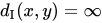
where is the set of finite partitions of . If the supremum is finite, we call a rectifiable curve. Note that if there is no path from to since the infimum of the empty set within the closed interval [0,+∞] is +∞.

Intrinsic metric
In the mathematical study of metric spaces, one can consider the arclength of paths in the space. If two points are at a given distance from each other, it is natural to expect that one should be able to get from the first point to the second along a path whose arclength is equal to (or very close to) that distance. The distance between two points of a metric space relative to the intrinsic metric is defined as the infimum of the lengths of all paths from the first point to the second. A metric space is a length metric space if the intrinsic metric agrees with the original metric of the space.
If the space has the stronger property that there always exists a path that achieves the infimum of length (a geodesic) then it is called a geodesic metric space or geodesic space. For instance, the Euclidean plane is a geodesic space, with line segments as its geodesics. The Euclidean plane with the origin removed is not geodesic, but is still a length metric space.
Let be a metric space, i.e., is a collection of points (such as all of the points in the plane, or all points on the circle) and is a function that provides us with the distance between points . We define a new metric on , known as the induced intrinsic metric, as follows: is the infimum of the lengths of all paths from to .
Here, a path from to is a continuous map
with and . The length of such a path is defined as follows: to each finite partition
of the interval , consider the sum
We then define the length of to be
where is the set of finite partitions of . If the supremum is finite, we call a rectifiable curve. Note that if there is no path from to since the infimum of the empty set within the closed interval [0,+∞] is +∞.