Hubbry Logo
LithologyLithologyMain
Open search
Lithology
Community hub
Lithology
logo
8 pages, 0 posts
0 subscribers
Be the first to start a discussion here.
Lithology
Lithology
from Wikipedia

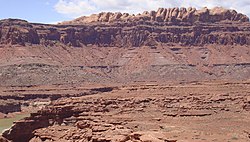
Stratigraphy as seen in southeastern Utah

The lithology of a rock unit is a description of its physical characteristics visible at outcrop, in hand or core samples, or with low magnification microscopy. Physical characteristics include colour, texture, grain size, and composition.[1][2][3] Lithology may refer to either a detailed description of these characteristics, or a summary of the gross physical character of a rock. Examples of lithologies in the second sense include sandstone, slate, basalt, or limestone.[4]

Lithology is the basis of subdividing rock sequences into individual lithostratigraphic units for the purposes of mapping and correlation between areas. In certain applications, such as site investigations, lithology is described using a standard terminology such as in the European geotechnical standard Eurocode 7.

Rock type

[edit]
A basalt, showing the 'pillow' lava shape characteristic of underwater eruptions, Italy

The naming of a lithology is based on the rock type. The three major rock types are igneous, sedimentary, and metamorphic. Igneous rocks are formed directly from magma, which is a mixture of molten rock, dissolved gases, and solid crystals. Sedimentary rock is formed from mineral or organic particles that collect at the Earth's surface and become lithified. Metamorphic rock forms by recrystallization of existing solid rock under conditions of great heat or pressure.[5]

Igneous rocks are further broken into three broad categories. Igneous rock composed of broken rock fragments created directly by volcanic processes (tephra) are classified as pyroclastic rock. Pyroclastic rocks are further classified by average fragment (clast) size and whether the fragments are mostly individual mineral crystals, particles of volcanic glass, or rock fragments.[6] Further classifications, such as by chemical composition, may also be applied.[7][8] Igneous rocks that have visible mineral grains (phaneritic rocks) are classified as intrusive, while those that are glassy or very fine-grained (aphanitic) are classified as extrusive rock. Intrusive igneous rocks are usually classified using the QAPF classification, which is based on the relative content of quartz, alkali feldspar, plagioclase, and feldspathoid. Special classifications exist for igneous rock of unusual compositions, such as ultramafic rock or carbonatites. Where possible, extrusive igneous rocks are also classified by mineral content using the extrusive QAPF classification, but when determining the mineral composition is impractical, they may be classified chemically using the TAS classification. This is based on the total content of silica and alkali metal oxides and other chemical criteria.[9][10][11]

Sedimentary rocks are further classified by whether they are siliciclastic or carbonate. Siliciclastic sedimentary rocks are then subcategorized based on their grain size distribution and the relative proportions of quartz, feldspar, and lithic (rock) fragments.[12] Carbonate rocks are classified with the Dunham or Folk classification schemes according to the constituents of the carbonate rock.[13]

Metamorphic rock naming can be based on protolith, mineral composition, texture, or metamorphic facies. Naming based on texture and a pelite (e.g., shale, mudrock) protolith can be used to define slate and phyllite. Texture-based names are schist and gneiss. These textures, from slate to gneiss, define a continually-increasing extent of metamorphism.[14] Metamorphic facies are defined by the pressure-temperature fields in which particular minerals form.[15] Additional metamorphic rock names exist, such as greenschist (metamorphosed basalt and other extrusive igneous rock) or quartzite (metamorphosed quartz sand).[16]

Grain/clast size

[edit]
A claystone, the finest-grained sedimentary rock, deposited in Glacial Lake Missoula, Montana

In igneous and metamorphic rocks, grain size is a measure of the sizes of the crystals in the rock. In igneous rock, this is used to determine the rate at which the material cooled: large crystals typically indicate intrusive igneous rock, while small crystals indicate that the rock was extrusive.[17] Metamorphism of rock composed of mostly a single mineral, such as quartzite or marble, may increase grain size (grain growth), while metamorphism of sheared rock may decrease grain size (syntectonic recrystallization).[18]

In clastic sedimentary rocks, grain size is the diameter of the grains and/or clasts that constitute the rock. These are used to determine which rock naming system to use (e.g., a conglomerate, sandstone, or mudstone). In the case of sandstones and conglomerates, which cover a wide range of grain sizes, a word describing the grain size range is added to the rock name. Examples are "pebble conglomerate" and "fine quartz arenite".[19]

Mineralogy

[edit]
An ultramafic mantle xenolith with olivine and pyroxene (altering brown to iddingsite) in a matrix of mafic basalt scoria

In rocks in which mineral grains are large enough to be identified using a hand lens, the visible mineralogy is included as part of the description. In the case of sequences possibly including carbonates, calcite-cemented rocks or those with possible calcite veins, it is normal to test for the presence of calcite (or other forms of calcium carbonate) using dilute hydrochloric acid and looking for effervescence.[20]

The mineralogical composition of a rock is one of the major ways in which it is classified. Igneous rocks are classified by their mineral content whenever practical, using the QAPF classification or special ultramafic or carbonatite classifications.[9][10][11] Likewise metamorphic facies, which show the degree to which a rock has been exposed to heat and pressure and are therefore important in classifying metamorphic rocks, are determined by observing the mineral phases that are present in a sample.[15]

Colour

[edit]

The colour of a rock or its component parts is a distinctive characteristic of some rocks and is always recorded, sometimes against standard colour charts, such as that produced by the Rock-Color Chart Committee of the Geological Society of America based on the Munsell color system.[21]

Fabric

[edit]

The fabric of a rock describes the spatial and geometric configuration of all the elements that make it up. In sedimentary rocks the main visible fabric is normally bedding, and the scale and degree of development of the bedding is normally recorded as part of the description. Metamorphic rocks (apart from those created by contact metamorphism), are characterised by well-developed planar and linear fabrics. Igneous rocks may also have fabrics as a result of flow or the settling out of particular mineral phases during crystallisation, forming cumulates.

Texture

[edit]
The lithology of this porphyritic basalt is characterized by olivine and augite phenocrysts.

The texture of a rock describes the relationship between the individual grains or clasts that make up the rock. Sedimentary textures include the degree of sorting, grading, shape and roundness of the clasts.[22] Metamorphic textures include those referring to the timing of growth of large metamorphic minerals relative to a phase of deformation—before deformation porphyroclast—after deformation porphyroblast.[23] Igneous textures include such properties as grain shape, which varies from crystals with ideal crystal shapes (euhedral) to irregular crystals (anhedral), whether the rock shows highly nonuniform crystal sizes (is porphyritic), or whether grains are aligned (which is described as trachytic texture).[24]

Small-scale structures

[edit]
Ripple marks from Mongolia

Rocks often contain small-scale structures (smaller than the scale of an individual outcrop). In sedimentary rocks this may include sole markings, ripple marks, mudcracks and cross-bedding. These are recorded as they are generally characteristic of a particular depositional environment and may provide information on paleocurrent directions.[25] In metamorphic rocks associated with the deeper levels of fault zones, small scale structures such as asymmetric boudins[26] and microfolds are used to determine the sense of displacement across the zone.[27] In igneous rocks, small-scale structures are mostly observed in lavas such as pahoehoe versus ʻAʻā basaltic flows,[28] and pillows showing eruption within a body of water or beneath ice.[29][30][31]

Surficial lithology

[edit]

Unconsolidated surficial materials may also be given a lithology. This is defined by grain size and composition and is often attached to an interpretation of how the unit formed. Surficial lithologies can be given to lacustrine, coastal, fluvial, aeolian, glacial, and recent volcanic deposits, among others. Examples of surficial lithology classifications used by the U.S. Geological Survey are, "Glacial Till, Loamy", "Saline Lake Sediment", and "Eolian Sediment, Coarse-Textured (Sand Dunes)".[32]

References

[edit]
Revisions and contributorsEdit on WikipediaRead on Wikipedia
from Grokipedia
Lithology is the description of the macroscopic physical characteristics of rocks, including their mineral composition, , texture, color, and primary structures, as observed in outcrops, hand specimens, core samples, or under low-magnification . It encompasses both the scientific study of these attributes and the specific character of a rock formation or stratigraphic unit. In , lithology serves as the primary basis for classifying and differentiating rock types, distinguishing it from , which focuses more on microscopic and rock origins. As a foundational element of lithostratigraphy, lithology enables the subdivision of rock sequences into mappable units, such as formations and members, based on observable lithologic properties and their stratigraphic relationships, without reliance on age or inferred depositional environments. This approach facilitates regional geological mapping, correlation of rock layers across distances, and the construction of stratigraphic columns essential for understanding Earth's history. Lithologic descriptions are standardized using symbols and patterns in geologic maps to represent diverse rock types, from igneous intrusions to sedimentary sequences and metamorphic complexes. Beyond classification, lithology profoundly influences geological and environmental processes. Rock lithology controls rates, resistance, and landscape evolution, with resistant lithologies like forming highlands while softer ones like contribute to lowlands. It also governs movement and storage, as the , permeability, and of rocks determine potential and water chemistry. Furthermore, surficial lithology affects , nutrient availability, patterns, and even the distribution of terrestrial ecosystems by mediating products and hydrologic connectivity. In applied contexts, lithologic informs resource exploration, assessment, and environmental management, underscoring its interdisciplinary significance in geosciences.

Introduction

Definition and Scope

Lithology is the macroscopic description of rocks based on their physical attributes, including composition, , texture, color, and , as observed in hand specimens, outcrops, or core samples without requiring microscopic or chemical analysis. This approach emphasizes field-identifiable characteristics to classify and interpret rock types, serving as a foundational tool in geological mapping and analysis. The scope of lithology extends to its application in , where it enables the delineation of rock bodies based on observable lithologic properties rather than inferred age or origin. Key concepts include lithologic units, which are homogeneous layers of rock defined by consistent lithologic traits within stratigraphic sequences, and lithofacies, which describe lateral or vertical variations in lithology that reflect changes in depositional environments or processes. These elements allow geologists to correlate rock layers across regions using practical, non-laboratory methods. Primary rock categories under lithology are igneous, sedimentary, and metamorphic. For instance, igneous rocks like are characterized by fine-grained, dark-colored textures; sedimentary rocks such as feature clastic grains cemented together; and metamorphic rocks like exhibit foliated structures. This classification supports broader geological interpretations without delving into detailed petrologic origins.

Historical Development

The practice of lithologic description traces its origins to the late 18th century, when Abraham Gottlob Werner developed a systematic classification of rocks based on their external characters, including color, texture, and structure, as part of his Neptunian theory positing aqueous origins for all rocks. This approach fueled the Neptunism versus Plutonism debates, with Neptunists prioritizing observable lithologic traits to infer sedimentary deposition from a primordial ocean, while Plutonists like James Hutton emphasized igneous processes. The term "lithology" itself entered English geological discourse in the early 18th century, with its earliest known use in 1716, referring to the macroscopic description of rock types distinct from mineralogical or chemical analysis. In the 19th century, Charles Lyell's advocacy for reinforced the focus on lithologic traits as evidence of ongoing geological processes, arguing that present-day observations of rock formation and could explain ancient strata without invoking catastrophes. Concurrently, American geologists such as Thomas C. Chamberlin advanced lithostratigraphy by defining rock units through consistent lithologic boundaries, integrating them into broader stratigraphic correlations during the late 1800s and early 1900s. These efforts shifted emphasis from theoretical origins to practical mapping and sequencing of rock layers. The 20th century saw refinements through integration with , notably Amadeus W. Grabau's seminal work on , which linked lithologic variations to depositional environments and rhythmic patterns in his 1913 publication Principles of . Standardization accelerated with the North American Stratigraphic Code, first issued in 1983 to codify lithostratigraphic naming and hierarchy, and updated in 2021 to incorporate modern . A key milestone was the post-1950s transition from qualitative field descriptions to semi-quantitative methods, enabled by logging tools that measured electrical resistivity, radioactivity, and acoustic properties for precise lithologic identification. Unlike lithology's macroscopic focus, developed later in the through microscopic techniques for detailed mineral analysis.

Core Descriptive Elements

Rock Type

Lithology fundamentally classifies rocks into three primary types based on their mode of formation and dominant geological processes: igneous, sedimentary, and metamorphic. This tripartite system, widely adopted in geological nomenclature, emphasizes the origin of the rock material rather than its current composition or texture. Igneous rocks form through the cooling and of or lava, with the primary process being solidification from a molten state. They are subdivided into intrusive (plutonic) rocks, which cool slowly beneath the Earth's surface to produce coarse-grained textures, and extrusive (volcanic) rocks, which cool rapidly at or near the surface to yield fine-grained varieties. A classic example is , an intrusive composed primarily of , , and . The (IUGS) provides detailed nomenclature for , focusing on mineral modes and silica content to refine classifications within this category. Sedimentary rocks originate from the accumulation and of sediments through depositional processes, often involving , , transportation, and compaction or cementation. They are categorized into clastic (fragmental like or ), chemical (precipitated minerals such as evaporites), and biogenic (organic remains like shells or matter). , formed largely from biogenic deposits, exemplifies this type. Unlike igneous or metamorphic rocks, sedimentary often relies on and diagenetic alterations rather than thermal processes. Metamorphic rocks result from the transformation of preexisting rocks under elevated , , or fluid activity, without , leading to recrystallization and structural reorganization. They are divided into foliated types, which develop aligned mineral layers due to directed stress (e.g., or ), and non-foliated types, lacking such alignment (e.g., ). , typically derived from or sedimentary s, features banded textures from metamorphic segregation. The IUGS Subcommission on the of Metamorphic Rocks standardizes naming based on fabric, mineral assemblage, and protolith. While this classification is robust, challenges arise with transitional or hybrid rocks that blur boundaries, such as (fragmental volcanic materials resembling both igneous and sedimentary) or metasandstone (metamorphosed retaining clastic features). Nomenclature conventions, like those from the IUGS, address these by prioritizing identification and composite descriptors to avoid ambiguity in mapping and database applications. Rock type broadly influences , as seen in the prevalence of in sedimentary rocks derived from weathered crustal materials.

Mineralogy

Mineralogy in lithology focuses on the types and proportions of minerals that constitute rocks, serving as a primary descriptor for identifying and classifying lithologic units through hand-sample examination. Minerals are distinguished as primary or essential, which form the dominant framework of the rock—such as comprising up to 90% in mature sandstones—and accessory or minor, occurring in trace amounts less than 1% by volume, like garnets that provide insights into or formation conditions without defining the rock type. The modal composition represents the actual volume percentages of observed minerals, typically estimated visually in hand samples, whereas normative composition is a calculated mineralogy derived from whole-rock chemical analyses, assuming standard from a melt and useful for comparing altered or fine-grained rocks where modal data is unavailable. The prevalence of specific minerals varies systematically by rock type, reflecting their origins. In igneous rocks, primary minerals often include feldspars (such as or ) and ferromagnesian silicates like , which dominate mafic varieties such as . Sedimentary rocks commonly feature as the essential mineral in limestones, alongside clay minerals like or that impart plasticity to shales. Metamorphic rocks are characterized by micas (e.g., or ) and amphiboles, which align to define in schists and gneisses. These assemblages briefly tie to broader rock classifications; for instance, the presence of alongside signals basaltic compositions. Identification of minerals in hand samples begins with visual inspection of properties like color, which can indicate composition (e.g., green hues from ), and cleavage, the tendency to break along planar surfaces due to atomic structure, as seen in the rhombohedral cleavage of . Simple field tests include assessing on the —where rates 1 and 7—by attempting to scratch the mineral with common objects like a fingernail (hardness ~2.5) or steel nail (~5.5), and determining streak by rubbing the sample on an unglazed plate to reveal the mineral's powdered color, which is more consistent than hand-sample appearance. Semi-quantitative estimation of modal percentages employs visual comparison charts or point-counting grids to approximate proportions, enabling lithologic descriptions without laboratory equipment. Variations in , particularly assemblages, reveal environmental conditions during rock formation or alteration. Specific combinations, such as , , and , suggest low- to medium-grade , while index minerals like —appearing in prismatic, twinned within pelitic schists—mark the transition to middle amphibolite facies, indicating temperatures around 550–600°C and pressures of 3–5 kbar. Pseudomorphs, formed when one replaces another while retaining the original shape (e.g., after ), provide lithologic clues to diagenetic or metamorphic processes, preserving evidence of precursor minerals in otherwise altered rocks.

Grain and Clast Size

In lithology, grain size refers to the average diameter of individual crystals in crystalline rocks, such as igneous or metamorphic types, or particles in amorphous rocks like . For fragmental or clastic rocks, clast size describes the dimensions of discrete rock or fragments derived from pre-existing materials, spanning from large boulders (over 256 mm) to fine clay particles (less than 0.0039 mm). The Wentworth scale provides a standardized for and clast sizes in sediments and sedimentary rocks, using (φ) units to express particle diameters logarithmically. The scale is calculated as ϕ=log2d\phi = -\log_2 d where dd is the particle diameter in millimeters; positive values indicate finer particles, while negative values denote coarser ones. Key size classes include (greater than 2 mm, φ < -1), sand (0.0625–2 mm, −1 ≤ φ ≤ 4), silt (0.0039–0.0625 mm, 4 ≤ φ ≤ 8), and clay (less than 0.0039 mm, φ > 8). Measurement of grain and clast sizes occurs through field estimation, often using visual comparators or hand lenses to approximate dimensions during examination, or via laboratory , where samples are passed through stacked sieves of decreasing mesh sizes to quantify size distributions. These determinations are critical for assessing rock properties, as larger sizes typically enhance and permeability by creating wider interconnected pore spaces, whereas finer sizes reduce them. Grain and clast sizes vary significantly by rock type, reflecting formation processes. In igneous rocks, rapid cooling produces aphanitic textures with fine grains typically under 1 in , while slower cooling yields phaneritic textures with coarser grains exceeding 1 . Sedimentary conglomerates feature clasts exceeding 2 , often reaching sizes over 64 in coarse variants. Sorting further characterizes these sizes, with well-sorted assemblages showing a narrow range of particle diameters and poor sorting indicating a broad mixture.

Color

Color serves as a fundamental visual attribute in lithologic descriptions, distinguishing rocks based on their appearance in both fresh and weathered states. Fresh rock surfaces often reveal intrinsic hues unaltered by exposure, while weathered exteriors may exhibit lighter or more subdued tones due to surface oxidation or staining. Geologists standardize color notation using the Munsell Rock Color Chart, which quantifies attributes through hue (the dominant color family), value (lightness from black to white), and chroma (saturation from dull to vivid). Rock colors arise primarily from mineral pigments, impurities, and post-depositional alterations. For instance, (Fe₂O₃) imparts a characteristic red pigmentation to many sedimentary rocks through its composition. Organic impurities, such as disseminated or algal remains, contribute black or dark gray tones, particularly in fine-grained clastic sediments deposited in low-oxygen settings. Alteration processes like oxidation can transform original colors, yielding brown shades via the formation of (FeO(OH)) from iron-bearing minerals. Descriptive terminology emphasizes qualitative variations to aid field identification. Terms such as or dark refer to overall , while vivid or dull denote color intensity; for example, a vivid suggests high chroma, contrasting with a dull of low chroma. Non-uniform patterns like banding (alternating color layers) or mottling (irregular spots or patches) further characterize heterogeneous rocks, often resulting from depositional or diagenetic processes. The interpretive value of color lies in its reflection of depositional and post-depositional environments, as well as its role in lithologic mapping. , for example, signal oxidizing conditions during , often in arid or settings where iron oxidizes to . Consistent color within a unit facilitates the delineation of mappable lithologies, with standardized schemes ensuring uniformity across geologic maps. Certain minerals, such as iron oxides, directly influence these colors, linking visual traits to underlying compositions.

Fabric

In geology, rock fabric refers to the preferred orientation of grains, crystals, or other structural elements within , reflecting the spatial arrangement that arises from formative processes. This orientation distinguishes anisotropic rocks, where properties vary directionally, from isotropic ones with random distributions. Fabric elements, such as aligned phyllosilicates or elongated clasts, create this pattern, often visible at microscopic to hand-sample scales. Fabrics are classified as primary or secondary based on their origin. Primary fabrics form during deposition or , such as the imbrication of clasts in conglomerates, where elongated pebbles overlap in a consistent direction due to current flow. Secondary fabrics, in contrast, develop through post-formation deformation, exemplified by lineation in metamorphic rocks, where mineral grains or deformed objects align linearly under . , a common secondary planar fabric like slaty cleavage in shales, results from the parallel alignment of platy minerals under compressional strain. Descriptive terms for fabric include "aligned" for coherent orientations, "random" for isotropic arrangements lacking preference, and "sheared" for fabrics showing offset or S-C patterns indicative of ductile flow. These are assessed qualitatively in the field or quantitatively via shape preferred orientation analysis of grain ellipsoids. Measurements typically involve recording the strike ( direction of a horizontal line on the plane) and dip (angle of inclination from horizontal) for planar fabrics like . Linear fabrics, such as lineations, are measured by trend () and plunge (dip angle). Interpretation of fabric reveals paleostress or flow directions; for instance, primary imbrication points upstream toward sources, while secondary slaty cleavage planes form perpendicular to the maximum , indicating regional . Lineations often align with the direction of maximum extension during deformation. Fabric thus provides directional context within a rock's texture, where aligned grains contribute to overall anisotropies like fissility.

Texture

In lithology, texture refers to the size, shape, and spatial arrangement of grains, , or clasts within a rock, influencing its overall physical character and formation history. This encompasses the packing density and interrelationships among components, distinguishing between clastic textures—where discrete fragments are cemented together—and crystalline textures, where interlocking form without fragments. Texture provides insights into depositional or environments, building on data to describe how components fit together. Rock textures vary by genetic type. In igneous rocks, phaneritic texture features coarse, visible interlocking crystals from slow cooling deep underground, as in , while texture combines large phenocrysts in a finer groundmass, indicating variable cooling rates. Sedimentary rocks exhibit clastic textures such as grain-supported fabrics, where larger clasts bear the load with minimal matrix, typical of high-energy deposits like conglomerates, versus matrix-supported textures, where fine matrix dominates, as in mudstones from low-energy settings. Metamorphic rocks often display granoblastic textures, with equigranular, polygonal crystals from recrystallization under heat and pressure, seen in marbles or quartzites. Key descriptors include grain rounding, which ranges from angular—indicating minimal in proximal deposits—to spherical, reflecting prolonged abrasion in distal environments like river sands. Sorting describes grain size uniformity, from well-sorted (uniform sizes in sands) to poorly sorted (mixed sizes in glacial tills), signaling energy. types, such as intergranular voids between tightly packed grains or larger vugs from dissolution, affect fluid storage and rock permeability. In field assessments, texture is evaluated tactilely; for instance, the gritty feel of arises from coarse, rounded grains, aiding rapid identification. Such characteristics imply : well-cemented, low-porosity textures enhance resistance to , while friable, porous ones, like some sandstones, promote and structural weakness in applications.

Small-Scale Structures

Small-scale structures in lithology refer to discrete internal features within rocks, observable at the hand-sample or scale (typically less than 1 meter), that provide insights into the rock's formation and depositional history. These structures include layering patterns and localized or biogenic accumulations that distinguish lithologic units without requiring regional mapping. Unlike pervasive textures, they manifest as distinct geometric elements such as planes, inclinations, or nodules, aiding in the identification of sedimentary, igneous, or metamorphic origins. Bedding represents the fundamental horizontal layering in sedimentary rocks, consisting of strata greater than 1 cm thick, separated by bedding planes that mark changes in composition, , or depositional conditions. These layers exhibit varying thickness (from centimeters to meters) and high lateral continuity, often extending over kilometers, reflecting discrete episodes of accumulation. , a finer variant, involves thin alternations less than 1 cm thick, known as laminae, which arise from subtle variations in suspension load or flow energy within a bed. occurs as inclined sets of laminae within bedding, formed by the migration of bedforms like ripples or dunes, with foreset geometries dipping at angles of 20–35 degrees in the direction of . Other notable small-scale structures include veins, nodules, and fossils. Veins are thin, mineral-filled fractures (millimeters to centimeters wide) formed by precipitation from fluids, such as or , often traversing the rock in various geometries including polygonal patterns from tectonic or diagenetic processes. Nodules and concretions are compact, rounded to irregular masses (typically centimeters to less than 1 meter in diameter) formed by early diagenetic mineral precipitation, such as or , around a nucleus within enclosing sediments; they may preserve internal sedimentary features or fossils and exhibit shapes like spheres or disks influenced by . Fossils, as biogenic structures, encompass preserved organic remains or traces (e.g., shells, burrows) at millimeter to decimeter scales, embedded within the matrix and revealing biological activity during deposition. The thickness, continuity, and geometry of these structures are critical for lithologic description: and show planar continuity, features inclined surfaces, veins display linear or anastomosing patterns, and nodules form isolated or clustered bodies. Their presence elucidates depositional and diagenetic processes—for instance, and associated ripples indicate unidirectional currents in shallow-water environments, while nodules signal localized cementation in reducing conditions. These features can also relate to fabric by implying grain orientations, such as alignment in cross-bedded foresets parallel to paleocurrents.

Specialized Aspects

Surficial Lithology

Surficial lithology refers to the study and description of unconsolidated or loosely consolidated materials at or near the Earth's surface, including , soils, , and , which overlie and contrast with the more rigid lithology below. These materials form a thin veneer, typically a few meters thick, and are distinguished by their lack of cementation and high susceptibility to modification by surface processes. Key characteristics of surficial lithology include loose grain arrangements, variable organic content in soils, and distinct grading patterns that reflect their depositional history. For instance, glacial till exhibits poor sorting with a mix of clay to boulder-sized particles, while consists of fine, uniform with minimal layering, and dune sands are well-sorted medium grains shaped by action. , derived from slope instability, often shows heterogeneous composition with angular clasts and poor sorting due to gravity-driven transport. , deposited by rivers, typically features stratified sands and s with better sorting in channel bars. is prominent in soils, influencing their dark colors and friable textures, whereas may include weathered fragments with inherited . These materials arise primarily from weathering, erosion, and deposition processes acting on the landscape over recent geological time. Weathering breaks down bedrock into regolith through physical, chemical, and biological means, while erosion by water, wind, or ice transports particles to form alluvium in fluvial settings or colluvium on slopes. Deposition occurs via glacial advance (producing unsorted till), aeolian activity (building dune sands), or fluvial flows (creating alluvial plains), often in dynamic Quaternary environments. Examples include glacial till from iceberg-rafted debris in proglacial lakes and wind-blown loess blankets from glacial outwash plains. Mapping surficial lithology involves delineating soil horizons, geomorphic units, and deposit distributions to understand landscape evolution, particularly in geology where these layers record the last 2.6 million years of and tectonic changes. Techniques combine aerial photo interpretation for initial polygon boundaries, field sampling for texture and composition (e.g., one sample per 1-4 km²), and modern tools like for detecting subtle features such as fault scarps or erosional terraces. This mapping highlights units like undifferentiated on hillslopes or sorted in valleys, aiding reconstructions of past environmental conditions. Surficial deposits may exhibit similarities to types, such as clast-supported fabrics akin to conglomerates in some .

Applications in Geology

Lithology plays a central role in by enabling the definition and delineation of lithostratigraphic units, such as formations, which are formal rock bodies distinguished primarily by their lithologic characteristics rather than age or content. These units facilitate the mapping and correlation of rock layers across regions, providing a framework for understanding sedimentary sequences and depositional environments. For instance, formations are divided based on observable differences in rock types, like versus , allowing geologists to construct stratigraphic columns that summarize the distribution of lithologic variations. In resource exploration, lithology is essential for identifying potential reservoirs, where porous sandstones often serve as primary storage and migration pathways for oil and gas due to their high permeability influenced by and texture. Similarly, in , lithology guides the targeting of ore-host rocks, such as or igneous formations that enclose deposits, by analyzing the petrophysical properties that favor fluid and mineral accumulation. This approach helps prioritize sites and optimize extraction strategies in sedimentary basins, where lithologic interplay with structural features to concentrate economic resources. Engineering geology relies on lithology for assessing , particularly in areas with weak shales prone to failure under , which informs the design of safe excavations and embankments. For foundation assessment, lithologic variations determine , with competent sandstones providing stable bases compared to expansive clays that risk settlement. In environmental applications, lithology aids aquifer delineation by identifying permeable units like gravelly sands that form productive zones, contrasting with impermeable clays that act as confining layers, thus supporting sustainable water resource management. Modern tools enhance lithologic analysis through core logging, where drilled samples are examined for detailed rock properties to correlate subsurface units, and geophysical methods like seismic and resistivity surveys that infer lithology from and electrical responses. Integration with geographic information systems (GIS) allows for three-dimensional modeling of lithologic distributions, facilitating spatial predictions for exploration and hazard mapping. These techniques, often automated with , improve accuracy in interpreting complex datasets from boreholes and . A notable involves logging in the Bengal Basin, where logs were used to identify lithology by detecting elevated natural radioactivity from clay minerals, enabling precise delineation of reservoir boundaries and estimation of volume for potential assessment. In another example from the Xujiahe Formation, integrated and resistivity logs distinguished lithofacies trends, correlating sandstones as reservoirs while highlighting shales as seals, which optimized decisions and improved recovery rates.

References

Add your contribution
Related Hubs
User Avatar
No comments yet.