


Community hub
Recent from talks
Contribute something
Nothing was collected or created yet.
Livebearers
View on Wikipedia
Livebearers are fish that retain their eggs inside the body and give birth to live, free-swimming young. They are especially prized by aquarium owners. Among aquarium fish, livebearers are nearly all members of the family Poeciliidae and include: guppy, molly, platy, endler’s and swordtails.[1]
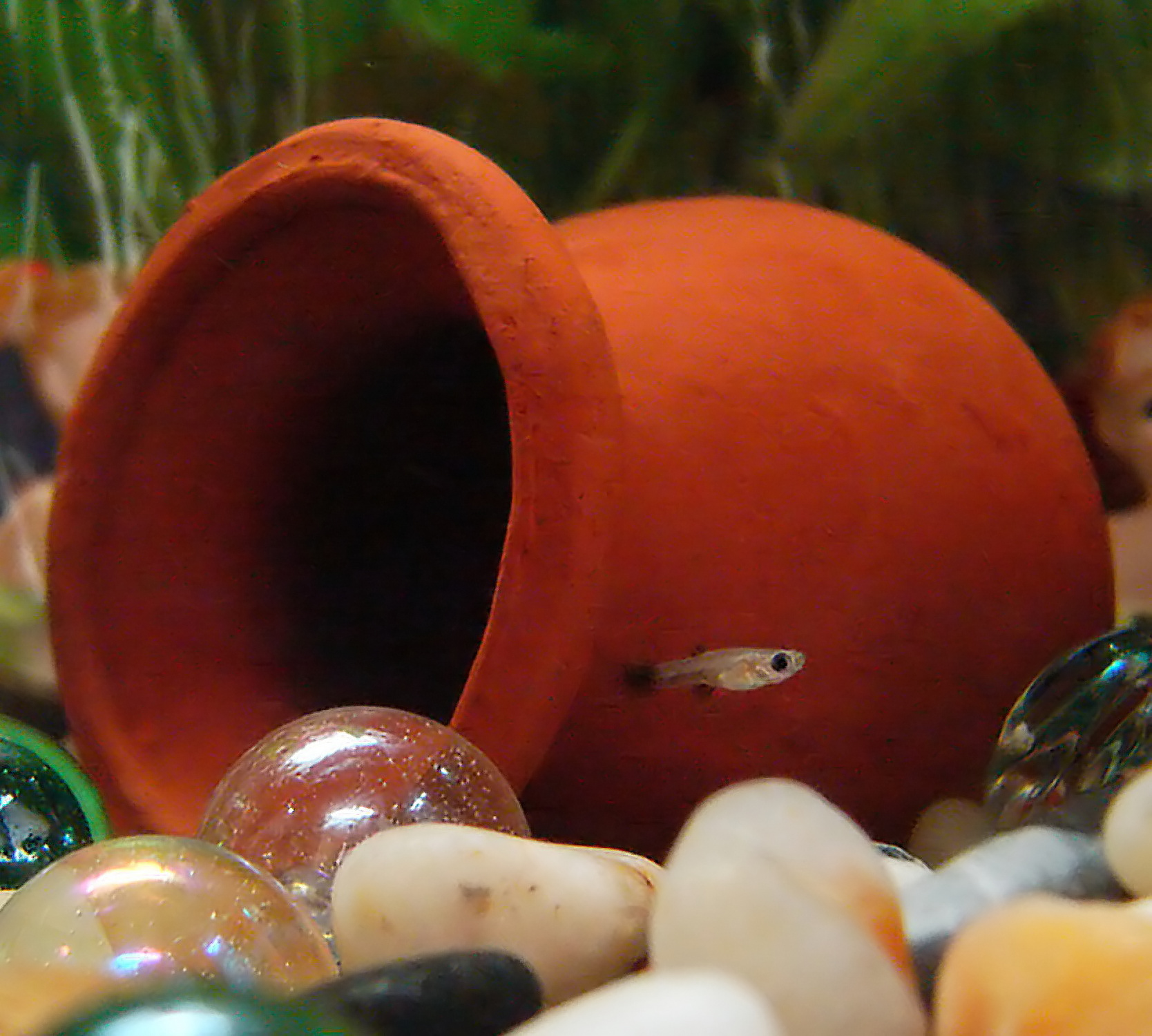
The advantages of livebearing to the aquarist are that the newborn juvenile fish are larger than newly-hatched fry, have a lower chance of mortality and are easier to care for. Unusual livebearers include seahorses and pipefish, where the males care for the young, and certain cichlids that are mouthbrooders, with the parent incubating the eggs in the buccal cavity.
Common aquarium livebearers
[edit]Species of interest to aquarists are almost always members of the family Poeciliidae, most commonly guppies, mollies, platies, swordtails, Endler's livebearer, and mosquitofish. Most of these are ovoviviparous, with the developing embryos receiving no nourishment from the parent fish, but a few are viviparous, receiving food from the maternal blood supply.[2]
Because the newborn fish are large compared to the fry of oviparous fish, which are those that lay eggs, newborn fish of livebearers are easier to feed than the fry of egg-laying species, such as characins and cichlids. This makes them much easier to raise, and for this reason, aquarists often recommend them for beginning fish breeder hobbyists. The larger livebearer fry makes them far less vulnerable to predation, as the parents often eat fry if hungry. With the sufficient cover in the way of plants or porous objects, they can sometimes mature in a community tank.[3]
Ovoviviparous and viviparous fish compared
[edit]Most of the Poeciliidae are ovoviviparous, that is, while the eggs are retained inside the body of the female for protection, the eggs are essentially independent of the mother and she does not provide them with any nutrients. In contrast, fish such as splitfins and halfbeaks are viviparous, with the eggs receiving food from the maternal blood supply through structures analogous to the placenta of placental mammals.[4]
Aberrant livebearers and mouthbrooders
[edit]Seahorses and pipefish can be defined as livebearers, although in these cases the males incubate the eggs rather than the females. In many cases, the eggs are dependent on the male for oxygen and nutrition so these fish can be further defined as viviparous livebearers. [5]
Many cichlids are mouthbrooders, with the female (or more rarely the male) incubating the eggs in the mouth. Compared with other cichlids, these species produce fewer but bigger eggs, and when they emerge, the fry is better developed and has higher survivability. Because the eggs are protected from the environment but do not absorb nutrients from the parent, this condition is analogous to, though not identical with, ovoviviparity.[6]
Livebearer fish gallery
[edit]


References
[edit]- ^ David Alderton (15 May 2012). Livebearers: Understanding Guppies, Mollies, Swordtails and Others. CompanionHouse Books. ISBN 978-1-62008-006-1.
- ^ "Livebearing Aquarium Fish—Habitat, Diet, and Breeding". The Spruce Pets. Retrieved 2025-05-15.
- ^ "Livebearers: Raise Guppies, Mollies, Platies & Swordtails in your Aquarium". www.liveaquaria.com. Retrieved 2022-09-08.
- ^ Blackburn, D.G. (2018). Jégou (ed.). Viviparity and oviparity: evolution and reproductive strategies. Michael K. Skinner (2nd ed.). Oxford. pp. 994–1003. ISBN 978-0-12-815145-7. OCLC 1045069010.
{{cite book}}:|work=ignored (help)CS1 maint: location missing publisher (link) - ^ Cole, Kathleen S. (2010). Reproduction and Sexuality in Marine Fishes: Patterns and Processes. Berkeley: University of California Press. pp. 129–150. ISBN 978-0-520-26433-5.
- ^ Keenleyside, Miles H.A. (1991). Cichlid Fishes: Behaviour, Ecology and Evolution. London: Chapman & Hall. pp. 191–210. ISBN 978-0-412-32200-6.
External links
[edit]- American Livebearer Association
- British Livebearer Association
- Keeping & Breeding Halfbeaks Includes growth rate chart and pictures of newborn fish.
- How to Keep Livebearers
Livebearers
View on GrokipediaDefinition and Reproductive Biology
Definition of Livebearing in Fish
Livebearers, also known as viviparous or live-bearing fish, are species that give birth to live offspring rather than depositing eggs externally, with the young emerging fully formed and immediately capable of free-swimming. This reproductive mode contrasts with the more common oviparity in fish, where fertilization and early development occur externally after egg-laying. Livebearing has evolved independently multiple times across various fish lineages, representing an adaptive strategy that enhances offspring survival by protecting embryos within the parent's body during critical early stages.[8][9] The fundamental mechanism of livebearing begins with internal fertilization, where males use specialized intromittent organs to transfer sperm directly into the female's reproductive tract. In many livebearer groups, such as poeciliids, the male's anal fin is modified into a gonopodium, a rod-like structure that facilitates precise sperm delivery and enables coercive or opportunistic mating. Following fertilization, embryos develop internally, relying on yolk reserves stored in attached yolk sacs for initial nourishment, supplemented in varying degrees by maternal contributions.[10] Embryonic nutrition in livebearers can involve histotrophic mechanisms, where the mother provides glandular secretions rich in proteins and lipids, or more advanced matrotrophic systems resembling placentation, in which vascularized embryonic tissues interface with the maternal ovary or oviduct for nutrient and gas exchange. These placental-like structures allow for prolonged gestation and larger, better-developed offspring compared to egg-layers. Approximately 2% of all fish species exhibit livebearing, with the majority inhabiting freshwater ecosystems, though notable marine exceptions include seahorses (Hippocampus spp.) and pipefishes (Syngnathus spp.), where males often brood the embryos to term.[11][9][12] This strategy encompasses a spectrum from ovoviviparity—where embryos derive nutrition primarily from yolk without significant maternal input—to true viviparity involving active maternal provisioning, distinctions explored in greater detail elsewhere.[9]Ovoviviparity Versus Viviparity
In livebearing fish, ovoviviparity refers to a reproductive strategy where eggs are fertilized internally and develop within the female's ovarian follicles, relying solely on yolk reserves for nourishment without significant post-fertilization maternal provisioning.[13] This lecithotrophic process results in embryos hatching inside the mother before being released as live young, but the offspring remain vulnerable to predation by the female or siblings immediately after birth.[13] Ovoviviparity is prevalent in families like Poeciliidae, where the Matrotrophy Index (MI)—a measure of embryonic dry mass gain relative to initial yolk mass—typically falls below 1, indicating no net maternal nutrient transfer.[13] Viviparity, in contrast, involves true maternal-fetal nutrient exchange beyond yolk provisions, often through specialized structures such as a follicular pseudoplacenta in some species or external trophotaeniae that absorb histotroph from ovarian secretions. This matrotrophic strategy supports substantial embryonic growth, with MI values exceeding 1 and reaching up to 1000-fold increases in dry mass in extreme cases.[13] In the Goodeidae family, including splitfins, embryos initially develop lecithotrophically within follicles before transitioning to the ovarian cavity for matrotrophic nourishment via trophotaeniae, enhancing offspring size and viability. The physiological and ecological distinctions between these strategies are summarized in the following table:| Aspect | Ovoviviparity (e.g., most Poeciliidae) | Viviparity (e.g., Goodeidae) |
|---|---|---|
| Embryo Development | Internal hatching from yolk-nourished eggs in follicles; no placental structures | Initial yolk use in follicles, followed by nutrient uptake in ovarian cavity via trophotaeniae or pseudoplacenta |
| Maternal Energy Investment | Low; limited to egg production and retention | High; includes nutrient secretion and structural maintenance for transfer |
| Offspring Characteristics | Numerous but smaller fry; higher predation risk post-birth | Fewer but larger, more developed fry; improved initial survival |
| Ecological Implications | Suited to stable, resource-rich habitats; faster reproductive cycles | Favors unpredictable environments; promotes diversification through enhanced dispersal and niche colonization[14] |