Hubbry Logo
LobioLobioMain
Open search
Lobio
Community hub
Lobio
logo
8 pages, 0 posts
0 subscribers
Be the first to start a discussion here.
Lobio
Lobio
from Wikipedia
Lobio
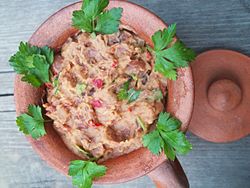
Lobio with summer savory and ajika
TypeStew
Place of originGeorgia
Main ingredientsBeans (cooked or stewed), onions, garlic, laurus leaf, chili pepper, coriander, satureja, fenugreek, walnuts,
  •   Media: Lobio

Lobio (Georgian: ლობიო) is a traditional Georgian[1] dish of various kinds of prepared beans (cooked or stewed), containing coriander, walnuts, garlic and onion. There are many varieties of lobio, both hot and cold.

History

[edit]

It is said to have originated in Georgia. While the dish may predate any division of the lands into countries, the most popular variant today uses red kidney beans, which are native to the Americas and introduced into Georgia after 1500. As with many Georgian dishes, lobio is spicy, but not necessarily hot. One of the traditional recipes for lobio does not call for hot peppers (as other recipes do) but relies solely on ground black pepper for its spice.

Preparation and ingredients

[edit]
Lobio with pomegranate juice

While there are many ways of making lobio, the most common of which is a cold dish called lobio nigozit, typically made with dark red kidney beans which are cooked and then mashed with garlic, onions,[2] walnuts, coriander, marigold petals, chili pepper and vinegar, and then allowed to marinate overnight. A hot version is usually made with white beans.

In other hot varieties lobio may contain meat. Beans would be put in the pot with water and spices and allowed to sit overnight. The following day, the pot would be placed over a fire or, if available, in a small exposed oven, and the beans slowly cooked. The cooked lobio would then be served in the clay pot, accompanied with mchadi (Georgian cornbread) and an assortment of pickled vegetables such as cabbage or cucumber.

Lobio, in its traditional format, progressed to become a standard recipe the ingredients of which varied depending on the area in which it was cooked.

See also

[edit]

References

[edit]
[edit]
Revisions and contributorsEdit on WikipediaRead on Wikipedia
from Grokipedia
Lobio is a traditional Georgian dish centered on stewed beans, most commonly kidney beans, simmered with aromatic spices like coriander, fenugreek, garlic, and onions to create a thick, flavorful stew that embodies the country's vegetarian culinary heritage. Often enriched with walnuts for a creamy texture and nutty depth, it is typically served warm in a clay pot known as a ketsi, paired with mchadi (cornbread made from cornmeal) and fresh herbs. The term "lobio" simply means "beans" in the Georgian language, referring broadly to a variety of bean-based preparations rather than a single recipe, though the kidney bean stew remains the most iconic form. Georgian cuisine, of which lobio is a , draws from the nation's spanning over 6,000 years, influenced by its position at the crossroads of and between and . This geographic and cultural interplay has fostered a robust vegetarian tradition, emphasizing local ingredients such as beans, walnuts, and seasonal vegetables, with lobio exemplifying the oral transmission of recipes passed down through generations rather than rigid written formulas. During the Soviet era, Georgian food gained popularity across the Union for its exotic yet comforting flavors, positioning dishes like lobio as accessible alternatives to meat-heavy meals. In contemporary Georgia, lobio holds deep cultural significance as a staple at supras (feast-like gatherings) and festivals such as Barbaroba, symbolizing hospitality, community, and national identity through its simple yet versatile preparation. Regional variations highlight this adaptability: in , it may include for a tangy note; in , wild mint and smoky elements; and in , a cold version with and herbs. Its enduring appeal lies in its nutritional profile—rich in protein and fiber—and its role in preserving Georgia's culinary legacy amid modern influences.

History and Origins

Ancient Roots

The origins of lobio trace back to ancient times in the region, where beans—known as lobio in Georgian—served as a staple crop integral to early agricultural societies. Archaeological evidence from the Kura-Araxes culture, which flourished from approximately 4000 to 2000 BCE, reveals legume cultivation in what is now Georgia, including sites in the like Chobareti in the Samtskhe-Javakheti region. Excavations indicate that by around 2000 BCE, during the Early , communities grew indigenous legumes such as field beans (Vicia faba), lentils (Lens culinaris), garden peas (Pisum sativum), and bitter vetch (Vicia ervilia), which formed a key part of the vegetal food economy alongside cereals. These crops supported sedentary farming practices in mountainous environments, providing protein-rich sustenance for diverse dietary needs. Early forms of bean-based dishes akin to lobio likely emerged from these agricultural foundations, involving simple preparations that highlighted the of in pre-Christian Caucasian communities. Beans were slow-cooked in clay vessels over open fires to create hearty stews that emphasized communal sharing during rituals and daily meals. This method preserved flavors and nutrients while reflecting the era's reliance on local resources for sustenance, with often rotated in fields to maintain . Such practices underscored the cultural role of beans in fostering social bonds through shared, unadorned feasts. By the 1st century CE, ancient trade routes connecting the to neighboring Persia and the enhanced the use of spices in proto-lobio preparations, integrating external flavors into local traditions. These influences evolved over centuries, with lobio later incorporating New World bean varieties following global exchanges.

Introduction of New Varieties

The introduction of beans, particularly the common bean (Phaseolus vulgaris), commonly known as the , marked a pivotal transformation in the composition of lobio following the after 1492. Originating from Central and , these beans spread to via Spanish and explorers and traders, with the first definite evidence of their cultivation appearing in the mid-16th century, approximately 40 years after Columbus's voyages. As maritime and overland trade networks expanded, kidney beans reached the and adjacent regions, including the , likely by the 16th-17th centuries, where they began supplementing or replacing indigenous legumes such as cowpeas (Vigna unguiculata) and other traditional pulses like dolichos in local stews and dishes. In Georgia, the arrival of these "new beans" integrated them into existing culinary traditions, with P. vulgaris varieties becoming synonymous with lobio and reducing the cultivation of pre-existing pulses that had dominated home gardens and recipes prior to their introduction. Historical accounts from the broader Near Eastern and Caucasian contexts during the 16th and 17th centuries reference novel bean types in prepared dishes, reflecting their gradual incorporation into regional diets amid Ottoman and Persian trade influences. Their dissemination was likely further promoted in the 19th century under rule, which annexed Georgia in 1801. The distinct texture of kidney beans—their firmer skin and creamier interior—prompted adaptations in lobio preparation, enabling innovations like mashed, cold-served versions that contrasted with earlier hot stews made from softer local varieties. Early ethnographic observations from the 18th and 19th centuries in the highlight this shift, noting how the beans' properties allowed for versatile cooking while maintaining ancient practices such as slow in clay pots. This evolution not only diversified lobio's forms but also elevated its status as a staple, blending global imports with enduring local techniques.

Cultural Significance

Role in Georgian Cuisine

Lobio serves as a foundational daily staple in , embodying the communal spirit of the supra, the traditional feast that has symbolized and social bonding since . In these elaborate gatherings, which can last for hours and involve toasts, , and shared plates, lobio provides a hearty, accessible dish that balances the meat-heavy elements of the meal with its vegetarian profile, fostering inclusivity for both everyday meals and grand celebrations. Deeply integrated with iconic Georgian ingredients like walnuts—a hallmark of the nation's culinary identity—and fresh herbs such as and , lobio has historically offered a vital source of plant-based protein in rural diets shaped by Georgia's rugged, mountainous , where access to was often limited. This combination not only enhances flavor through the creamy texture of ground walnuts but also underscores the dish's role in sustaining communities through seasonal and economic challenges. As a cultural emblem of resilience, lobio appears in Georgian and festivals, such as the Barbaroba celebration, where bean-based dishes like reinforce themes of endurance and tradition during periods of and communal reflection. Its flavors capture the essence of Georgian resourcefulness, adapting to local ingredients while preserving ancient practices that highlight the country's enduring culinary heritage.

Traditional Serving Practices

In Georgian tradition, lobio is typically served hot during winter months as a warming stew, while in summer it is often prepared and presented cold as a refreshing salad-like dish. It is invariably accompanied by mchadi, a dense cornbread made from cornmeal, which diners use to scoop up the beans directly from the serving vessel, and paired with pickled vegetables such as jonjoli (pickled bladdernut tree sprouts) to provide a tangy contrast to the earthy flavors. These accompaniments enhance the communal eating experience, emphasizing lobio's role as a versatile, everyday staple in Georgian meals. During supras, the elaborate Georgian feasts, lobio is passed family-style among guests, with portions generously sized for sharing to foster social bonds. It is commonly presented in small clay pots known as ketsi, which retain heat effectively and add to the rustic authenticity of the table. The , or toastmaster who leads the proceedings, guides the ritualistic structure of the supra, underscoring themes of gratitude and community. Lobio holds particular prominence during Orthodox Christian holidays, especially fasting periods like , when meatless versions—relying solely on beans, herbs, and spices—are prepared to align with religious abstinence from animal products. These adaptations emphasize lobio's adaptability to spiritual observances, serving as a sustaining, plant-based option that reinforces its cultural and devotional significance in Georgian life.

Preparation

Key Ingredients

The core of traditional lobio revolves around beans as the primary ingredient, with red beans (Phaseolus vulgaris) being the most commonly used variety due to their firm texture and vibrant color that holds up well during prolonged cooking. These beans provide the dish's hearty base, absorbing flavors while maintaining structure in the stew-like consistency. Historically, lobio was prepared with dolichos beans (a type of native to the region), which were later supplanted by more accessible New World imports like beans as they became widespread in Georgian agriculture. For milder versions, white beans such as or Great Northern varieties are substituted, offering a subtler flavor and softer texture. Essential flavorings elevate the beans, starting with ground walnuts formed into a paste, which impart a creamy richness and nutty depth central to the dish's signature . Fresh (cilantro) and provide pungent, aromatic notes that cut through the earthiness, while sautéed onions serve as the foundational base, caramelizing to add sweetness and complexity. Spices like contribute sharpness, utskho-suneli (dried blue leaves) offers a distinctive earthy and slightly bitter undertone unique to , and ground dried marigold petals lend a subtle earthiness along with a warm hue for visual appeal. In purest traditional forms, lobio remains vegetarian, emphasizing plant-based elements without . However, non-vegetarian adaptations occasionally incorporate smoked , such as Racha ham, for added smokiness and savoriness in regional recipes. For cold variants, acidity is introduced via or , balancing the richness and enhancing refreshment when served chilled.

Cooking Methods

The traditional hot method for preparing lobio emphasizes slow simmering to develop deep flavors and a creamy consistency. Beans, typically or similar varieties, are first soaked overnight in cold water to soften them and reduce cooking time. The soaked beans are drained and placed in a clay pot with finely chopped onions, , and spices such as seeds and . This mixture is then simmered over low heat for 2 to 4 hours, adding water as needed to maintain a stew-like consistency, until the beans become tender and begin to break down. Near the end of the cooking process, a paste made from ground walnuts is stirred in to thicken the dish and impart a rich, nutty depth. Optionally, the onions and spices can be tempered in a small amount of oil before adding the beans, enhancing aroma and flavor integration. In contrast, a version of the walnut-enriched lobio (lobio nigvzit) produces a refreshing, marinated preparation suited for warmer weather or as a . Kidney beans are boiled until fully tender, typically for 1 to 2 hours depending on size. Once cooked and drained, the beans are coarsely mashed and combined with ground walnuts, minced , ground , chili or hot red pepper for heat, and for acidity. This blend is then transferred to a container and allowed to rest in the for several hours, melding the ingredients and intensifying the flavor. Authentic preparation often utilizes a ketsi, a traditional Georgian clay pot, which imparts a subtle earthen flavor and helps retain moisture during slow cooking. This equipment is particularly valued in the hot method for its heat retention properties, contributing to even cooking without scorching.

Variations

Regional Styles

Lobio exhibits notable regional differences across Georgia, reflecting local ingredients, climate, and culinary traditions. In , the dish incorporates dry red wine for a complex flavor, stewed with beans to highlight the region's wine-making heritage. Another Kakhetian style, known as Kirkazhi lobio, involves cooking beans with leaves and , then mixing with chopped onions, , mint, and unrefined for a fresh, herbed preparation served hot. In , lobio is stewed with wild mint, imparting a smoky, rustic warmth suited to the mountainous terrain. The Adjarian variation is served cold, combining kidney beans with fresh and for a lighter, zesty profile influenced by the climate.

Modern Adaptations

In recent years, particularly since the 2010s, lobio has seen increased adoption in Western vegetarian and vegan cooking, valued for its hearty, plant-based profile. highlighted a traditional yet accessible version in 2018, emphasizing its layers of flavor from mashed kidney beans, raw , browned onions, and fresh like cilantro, positioning it as an everyday vegetarian . This promotion in mainstream outlets has encouraged home cooks to experiment with pantry staples, such as canned kidney beans, to simplify preparation while maintaining authenticity. As a naturally vegan and gluten-free dish—relying on beans, walnuts, onions, , and spices without animal products or sources—lobio requires minimal adaptation for dietary restrictions. Recipes from vegan-focused sites, such as those published in 2022, underscore its compatibility with allergy-friendly diets by suggesting substitutions like white beans for variety, though kidney beans remain the core for their texture and nutrition. In communities across the and , fusions have emerged, blending lobio with local elements; for example, -based adaptations pair the stew with or incorporate it into salads for a fusion twist, as shared by food writers in 2018. Commercial availability has expanded since the early 2000s, with Georgian seasoning mixes designed specifically for lobio enabling quick replication of its spice profile at home. Brands like Permeris offer pre-blended packets containing , , and other essentials, distributed internationally through specialty retailers. These products reflect broader trends in globalizing traditional cuisines. Nutritional enhancements in contemporary recipes align with 21st-century focuses, such as plant-based eating, by highlighting lobio's high protein content—approximately 15 grams per cup serving from beans—and omega-3-rich walnuts. Low-sodium variations reduce added salt while preserving flavor through herbs and , appealing to those managing in vegan diets.

References

Add your contribution
Related Hubs
User Avatar
No comments yet.