Hubbry Logo
Low German houseLow German houseMain
Open search
Low German house
Community hub
Low German house
logo
8 pages, 0 posts
0 subscribers
Be the first to start a discussion here.
Low German house
Low German house
from Wikipedia
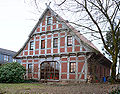
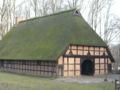
Dat groode Hus, a 1795 Low German house at the Winsen Museum Farm
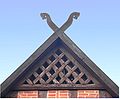
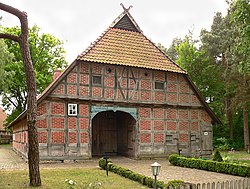
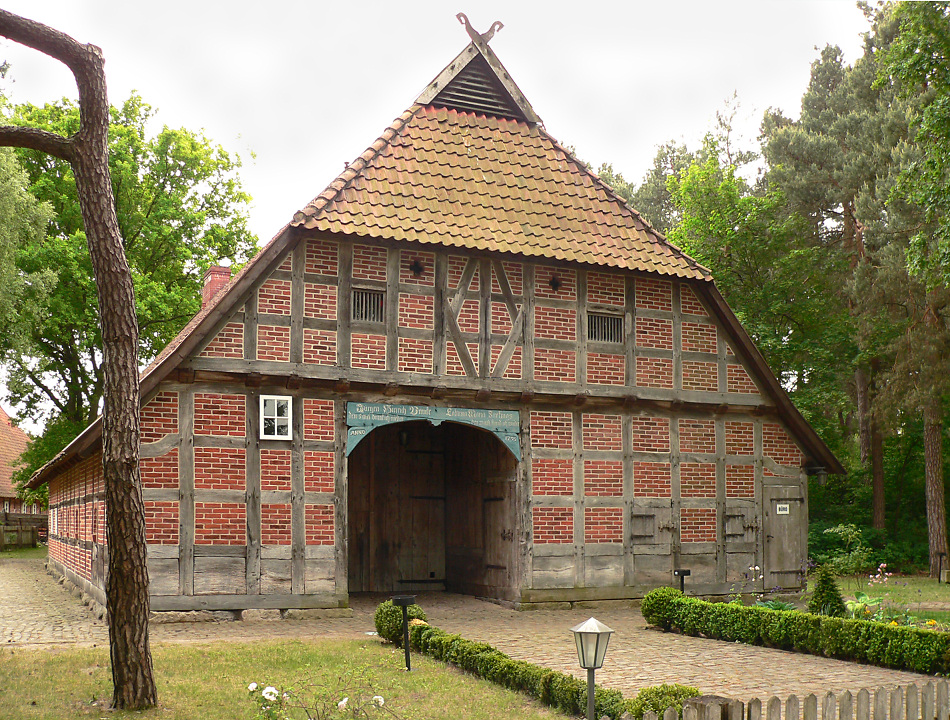
The Rischmannshof Heath Museum, a thatched Low German house with a hipped gable roof and carved horse's heads atop the gable

The Low German house[1] or Fachhallenhaus (German pronunciation: [ˈfaxhalənˌhaʊs]) is a type of timber-framed farmhouse found in northern Germany and the easternmost Netherlands, which combines living quarters, byre and barn under one roof.[2][need quotation to verify] It is built as a large hall with bays on the sides for livestock and storage and with the living accommodation at one end.

The Low German house appeared during the 13th to 15th centuries and was referred to as the Low Saxon house (Niedersachsenhaus) in early research works. Until its decline in the 19th century, this rural, agricultural farmhouse style was widely distributed through the North German Plain, all the way from the Lower Rhine to Mecklenburg. Even today, the Fachhallenhaus still characterises the appearance of many north German villages.

Name

[edit]

The German name, Fachhallenhaus, is a regional variation of the term Hallenhaus ("hall house", sometimes qualified as the "Low Saxon hall house"). In the academic definition of this type of house the word Fach does not refer to the Fachwerk or "timber-framing" of the walls, but to the large Gefach or "bay" between two pairs of the wooden posts (Ständer) supporting the ceiling of the hall and the roof which are spaced about 2.5 metres (8.2 ft) apart. This was also used as a measure of house size: the smallest only had 2 bays, the largest, with 10 bays, were about 25 metres (82 ft) long. The term Halle ("hall") refers to the large open threshing area or Diele (also Deele or Deel) formed by two rows of posts. The prefix Niederdeutsch ("Low German") refers to the region in which they were mainly found.[1] Because almost all timber-framed and hall-type farmhouses were divided into so-called Fache (bays), the prefix Fach appears superfluous.

The academic name for this type of house comes from the German words "Fach" (bay), describing the space (up to 2.5 metres (8.2 ft)) between trusses made of two rafters fixed to a tie beam and connected to two posts with braces and "Halle", meaning something like hall as in a hall house. The walls were usually timber-framed, made of posts and rails; the panels (Gefache) in between are filled with wattle and daub or bricks. One bay may be two or rarely three Gefache wide.

Alternative names

[edit]

In the past other names were commonly used for this type of farmhouse, derived either from their design or the region in which they were built:

  • Flett-Deelen-Haus (a Hallenhaus) with a very common floorplan including an open kitchen or Flett to the side of the Deele
  • Kübbungshaus (Hallenhaus of two-post construction, also called a Zweiständerhaus, named after the non-load-bearing side aisles or Kübbungen)
  • Niedersachsenhaus (Low Saxon house)
  • Sächsisches Haus (Saxon house)
  • Altsächsisches Bauernhaus (Old Saxon farmhouse)
  • Westfälisches Bauernhaus (Westphalian farmhouse)
  • Westfalenhaus (Westphalian house)

Niedersachsenhaus is the most widespread and commonly used term, even though it is not strictly correct from an academic point of view.

Other terms

[edit]

Because this type of farm combines living quarters, stalls and hay storage under one roof it is also described as an Einhaus ("single house" or "all-in-one house") and the attached farmyard as an Eindachhof ("single-roofed farmyard"). A special feature of the Low German house is its longitudinal division, also referred to as dreischiffige or "triple-aisled". This is considerably different from all-in-one farmhouses elsewhere in Germany and Europe which are built with traditional transverse divisions, as in the Ernhaus, not to mention other common farm layouts where the farm comprises several buildings with different functions, usually around a farmyard.

Early history

[edit]
Historic photo (c. 1895) of a thatched Fachhallenhaus in Ausbüttel near Gifhorn, built in 1779

The Low German house first emerged towards the end of the Middle Ages. Only a few years ago a Hallehuis was discovered in the Dutch province of Drenthe, the frame of which can be dated to 1386. In 2012 a "hallehuis" was discovered in Best, in the Dutch provincie of North Brabant, which dates back to 1262 and is still in use as a stable. The living part of the farm itself is built in recent times, in 1640 at the earliest, but probably around 1680. The farm is an official monument.[3] The oldest surviving houses of this type in Germany date to the late 15th century (e.g. in Schwinde, Winsen Elbe Marsh 1494/95). Regional differences arose due to the need to adapt to local farming and climatic conditions. The design also changed over time and was appropriate to its owner's social class. From the outset, and for a long time thereafter, people and animals were accommodated in different areas within a large room. Gradually the living quarters were separated from the working area and animals. The first improvements were separate sleeping quarters for the farmer and his family at the rear of the farmhouse. Sleeping accommodation for farmhands and maids was created above (in Westphalia) or next to (in Lower Saxony and Holstein) the livestock stalls at the sides. Finished linen, destined for sale, was also stored in a special room. As the demand for comfort and status increased, one or more rooms would be heated. Finally the stove was moved into an enclosed kitchen rather than being in a Flett or open hearth at the end of the hall.

Predecessors

[edit]

The Low German house is similar in construction to the Neolithic longhouse, although there is no evidence of a direct connection. The longhouse first appeared during the period of the Linear Pottery culture about 7,000 years ago and has been discovered during the course of archaeological excavations in widely differing regions across Europe, including the Ville ridge west of Cologne. The longhouse differed from later types of house in that it had a central row of posts under the roof ridge. It was therefore not three- but four-aisled. To start with, cattle were kept outside overnight in Hürden or pens. With the transition of agriculture to permanent fields the cattle were brought into the house, which then became a so-called Wohnstallhaus or byre-dwelling.

Later the centre posts were omitted to form a triple-aisled longhouse (dreischiffigen Langhaus, often a dreischiffigen Wohnstallhaus) that could be found in almost all of northwest Europe in the Early Middle Ages. Its roof structure rested as before on posts set into the ground and was therefore not very durable or weight-bearing. As a result, these houses already had rafters, but no loft to store the harvest. The outer walls were only made of wattle and daub (Flechtwerk).

By the Carolingian era, houses built for the nobility had their wooden, load-bearing posts set on foundations of wood or stone. Such uprights, called Ständer, were very strong and lasted several hundred years. These posts were first used for farmhouses in northern Germany from the 13th century, and enable them to be furnished with a load-bearing loft. In the 15th and 16th centuries the design of the timber-framing was further perfected.

Distribution

[edit]
Low German house with inscription, a typical Niedersachsenhaus in Büschel/Bakum

The Low German house had a wide distribution across an area almost 1,000 km long which roughly corresponds to the Low German language area. In the west it stretched into parts of the Netherlands where the height of gable and loft are usually lower, mirroring its development over time from self-sufficiency to market-oriented farming.

From the Lower Rhine region to western Mecklenburg the Low German house was the dominant type of farmhouse. Further east it was found as far as the Danzig Bay, but manor houses (Gutshaus) and farm workers houses were more common. In Schleswig-Holstein it was found mostly south of the Eider river, the old border with Denmark. In northern Sauerland and the Weser Uplands there was less of a sharp boundary and more of a gradual reduction in floor area as the terrain became hillier. In southern Lower Saxony the Hessian square farmstead (Vierkanthof) is found well inside the Low German language area. In east Lower Saxony the Niedersachsenhaus and the square farmstead are interspersed like a mosaic. In Saxony-Anhalt there are none in the Magdeburg Börde and only a few in the Altmark.

This style of house typically appears in the following regions:

The Low German house occurs more or less in the areas settled by the Germanic tribes of the Saxons, thus leading its popular name, Low Saxon House, or Niedersachsenhaus, which is based on the Old Saxon cultural region of Low Germany.

Regional features

[edit]
The 1533 Rieck’sches Haus in Hamburg-Bergedorf

Within northern Germany the Low German house has numerous regional variations, such as those in the Vierlande and marshes near Hamburg and in the Altes Land near Stade. On these, the gable facing the road were steeply pitched, made of coloured brickwork and is often projecting. In addition the facades were decorated with neoclassical and renaissance designs of the Gründerzeit which lasted to about 1871. Gable design and decorations go back to the area of Hamburg. Another particularly impressive regional variation is the Low German house is found in the Artland near Osnabrück.

Neighbouring farmhouse types

[edit]

On the southern boundary of the Low German house region, as well as the multi-sided farmsteads, there is the historical Ernhaus type of farm, also referred to as the Middle German house[1] (mitteldeutsches Haus) or Frankish farmstead.[1] (fränkisches Haus) A northern neighbour of the Fachhallenhaus in the immediate vicinity of the North Sea coast was the Gulf house (Gulfhaus) or Frisian farmstead[1] (Ostfriesenhaus) which is found in the marsh regions and, later, also on the geest areas of West Flanders, Frisia as far as Schleswig-Holstein (known there as a Haubarg). It had replaced the Old Frisian farmhouse in the 16th century. Another northern neighbour in the Southern Schleswig area is the Geesthardenhaus, which also occurs in the whole of Jutland and hence is also called the Cimbrian farmhouse.

Construction

[edit]
A Fachhallenhaus in Zeven-Brüttendorf 1905
Length: 27 m, Width: 13 m, Height: 12 m
-Side view through the Diele: stalls on the left, living quarters on the right,
-End view through the Flett, the open kitchen

Externally a Low German house is recognisable from the great gateway at the gable end, its timber framework and the vast roof that sweeps down to just above head height. Originally it would have been thatched with reed; the last remaining examples with that type of roof are usually protected as listed buildings today.

The most important feature of the farmhouse, albeit one which is not externally visible, is its internal, wooden, post-and-beam construction which supports the entire building. The frame was originally made of oak, which was very durable, but from the 18th century it was also made from cheaper pinewood. To protect it from damp, the wooden posts rest on a stone foundation about 50 cm high, often made of fieldstone. The non weight-bearing external walls were built as timber frames, the panels of which were originally filled in with willow wickerwork and clay (wattle and daub) and, later, with brick.

In damp moorland and marshy areas the weather-side of the many such buildings was faced with brick. In Westphalia, in addition to the usual timber-framed buildings, there are also hall farmhouses (mostly of the four-post type, see below) whose external walls are made of brick.

The two main forms of construction are the Zweiständerhaus (two-post farmhouse) and the Vierständerhaus (four-post farmhouse). The Dreiständerhaus (three-post farmhouse) is a transitional design.

Design of the
I.: two
II.: three- and
III.: four-post Fachhallenhaus

a) tragende Ständer (Hauptständerwerk)
b) Ständerwerk Traufe
c) Hauptbalkenlage
d) Hiehle
e) Sparren
f) Auflanger
g) Aufschiebling
A sculpture of a Low German Hallhouse framework in Neukirchen-Vluyn, Germany

Zweiständerhaus

[edit]
A Zweiständerhaus in Bremen's Blockland
A Vierständerhaus near Melle (Osnabrück Land)

Originally the Low German house took its simplest and basic form, the Zweiständerhaus or two-post farmhouse. This had two rows of uprights on which the ceiling joists rested. The two rows of posts ran the length of the building and created the great central threshing floor or Diele characteristic of this type of farmhouse.[1] On the outside of the rows of uprights, underneath the eaves, low side rooms or bays known as Kübbungen were often built with non load-bearing external walls. These Kübbungen acted as stables or stalls for the cattle[1] and gave this type of house its alternative name of Kübbungshaus. A classic feature of the Zweiständerhaus is that the loft is not supported by the outside walls but only by the two rows of uprights that form part of the hall sides or walls.

Dreiständerhaus

[edit]

The intermediate variant is the Dreiständerhaus or three-post farmhouse. This is an asymmetric version of the two- and four-post farmhouses, in which the roof ridge is located almost directly over one of the Deele walls. On this side the eaves are like those on the Vierständerhaus, often at the height of the Deele ceiling. On the other side the rafters are arranged like those of a Zweiständerhaus. Often the lower part of the roof is attached on both sides.

Vierständerhaus

[edit]

The design of the Vierständerhaus or four-post farmhouse is a more comfortable evolutionary development of the Zweiständerhaus built by well-to-do farmers. The building is supported by four rows of uprights arranged longitudinally, of which two form the sides of the Deele and two form the outer walls. So the outsider walls have a load-bearing function. In farmhouses of more affluent farmers there is also a clearer separation between living quarters and animal stalls.

Durchgangshaus

[edit]

In addition to the normal floor plan there are also farmhouses with a large gateway at both gable ends of the building in order to enable carts to be driven through from end to end. In such a Durchgangshaus or "through house" the layout of the rooms was necessarily different. Even the hearth was not located in the usual place. This variant of the Low German house is often found in Holstein and Mecklenburg-Vorpommern, but also occasionally in Westphalia too.

Roof shapes

[edit]

In Westphalia all these farmhouses have a gable roof. In parts of Lower Saxony and in Holstein there is a mix of farmhouses with gable and hipped-gable roofs, and in Mecklenburg almost all have hipped-gables. A pure hipped roof is rare.

Gable shapes

[edit]

The original location of the living accommodation in part of the Deele explains the very unusual layout of the Low German house. Whilst other 'all-in-one' farmhouses have their living quarters at the front, the Low German house across most of its native region has its main gateway at the front. The large gateway gable (colloquially: Grotdörgiebel) was very carefully made. The frame and especially the lintel of the Grote Dör (great door) were adorned with inscriptions and decorations. On simple houses the gable above is just filled in with vertical timber laths; on more complicated buildings the timber-framing of the steep gable extends almost to the roof ridge. In the Altes Land projecting gables are preferred. In Schaumburg Land and the area around Hanover the gable is topped by a roof section sloping at about 80°.

The stepped gable on the living room side was only decorated in a few cases, for example, in the Vierlande where it was on the road-facing side.

Internal layout

[edit]
General floor plan of a two-post Low German house

a) Einfahrtstor
b) Seitentor
c) Feuerstelle
d) Diele
e) Flett
f) Stall
g) Stube
h) Futter
i) Gesinde
k) tragender Holzständer

In the 18th century the Low German house was built ever larger, with a length of up to 50 m and width of 15 m. The farmhouse combined all the functions of life on the farm. In this way it was easy for the farmers to manage the whole of his livestock, family and farmhands.

Diele

[edit]

The largest and most important room in the Low German house was the great central threshing floor, the Diele (Low German: Deele, Del). This was usually entered via the great, rounded door at the gable end, known in Low German as the Grote Dör, Groot Dör or Grotendör ("great door"). The door was also the entrance for harvest wagons leading to the Diele which was like a cavernous hall, hence the alternative name for this type of farmhouse, the Hallenhaus ("hall house"). The Diele was formed by the space between the two rows of supporting uprights. With its tamped clay floor it was the working room of the farmhouse. It was here that the harvest was gathered before being stored in the hayloft above. It also provided protection from the weather for activities, such as the drying of farm implements, the breaking of flax, the spinning of textiles or the threshing of grain. Celebrations, too, were held in the hall and recently deceased members of the family were laid out here. To both sides of the Diele were the half-open stalls or stables (Kübbungen) for cattle or horses, as well as chambers for the maids and farmhands. Poultry would be kept near the entrance way at the edges of the hall. From the outset pigs were banished to separate sheds outside the building due to their smell. Only when living quarters and the Diele area were fully separated from one another could pigs also be encountered in the hall. The Diele opened out into the open eating and kitchen area, the so-called Flett.

Flett

[edit]
Painting by Hermann Daur (1902): Frelsdorf – interior of a Low Saxon farmhouse

Originally, at the end of the Diele near the back of the farmhouse, was the Flett, an open kitchen and dining area that took up the entire width of the house. The open fireplace, about 1.5 metres across, was located in the middle of the Flett and was ringed with fieldstones. It was not like a hearth in other regions. Many types of cooking were not possible in this environment (*). Pots had to be high enough, in effect cauldrons, and were hung over the fire with pothooks attached to a wooden frame (Rahmen) hanging over the fireplace, often decorated with horses heads. At night an iron grid was pulled over the fire to prevent sparks, a practice known by the English term curfew. Well-to-do families had a candle arch (Schwibbogen) of masonry instead of a wooden frame. Smoke escaped through an opening in the roof on the gable, the Uhlenloch (also Eulenloch, literally: "owl hole"). The open fireplace meant that such buildings were considered as a particular fire risk by early fire insurance firms. The open fire also provided some heat to the stalls and living quarters of the Hallenhaus. In this way, hay stored in the loft could be dried out and protected from vermin by the smoke. When the farmer's family and farm hands gathered for meal times, the best places were between the fireplace and the rooms. Because there was no partition between Diele and loft, winter temperatures in the Flett never rose above 12 °C.

A subsequent improvement was the extraction of smoke through a flue. Still later, a proper hearth would be added with a stone chimney. This made cooking easier and meant that the house was now free of smoke. On the down side, the hearth was no longer really a source of light and there was less energy for heating the house. Later still, one of the larger rooms would be built as a parlour with a separate stove heated from the Diele. When the division of rooms was fundamentally changed in the 19th century, a separate kitchen was established in the living accommodation at the back of the farmhouse. So the farmhouse, which had been divided longitudinally for such a long time, now had its different functions arranged transversely across the building.

(*) Bread was baked outside the farmhouse Hauses in an earth or stone oven. In northwest Germany this only had one chamber. It was first heated, then the embers were raked out and the loaves pushed inside, in order to be baked by the heat stored in the sides of the oven.

Living quarters

[edit]
A room with an alcove wall bed

Originally there were only open living areas at the back of the farmhouse on both sides of the fireplace. Here there were tables, chairs and wall beds and, of course, open contact with the animals. Not until after the Thirty Years War when the demand for living comfort grew, were separate rooms built at the back of the farmhouse, each the length of a bay (ca. 2.5 m) i.e. the space between the interior posts. This living space was called a Kammerfach from Kammer (room or chamber) and Fach (bay). One subsequent change was the addition of a cellar under the Kammerfach, but it was not very deep. The separate living quarters were raised above the level of the main hall as if on a plinth and in the larger four-post farmhouses (Vierständerhäuser) sometimes formed a sort of gallery.

Decoration

[edit]

The most eye-catching decoration of the otherwise drab Fachhallenhaus is found on the point of the gables and consists of carved wooden boards in the shape of (stylised) horses' heads. The boards do serve a constructional purpose in that they protect the edges of the roof from the wind. The horses' heads are attributed to the symbol of the Saxons, the Saxon Steed. Its distribution as decoration on roof ridges is also reflected in the coats of arms of several north Germany towns and villages. In some regions, e. g. in the Hanoverian Wendland, the gable points often have an artistically turned post instead, the so-called Wendenknüppel.

Other decorations or mottos are usually found as inscriptions over the entranceway. The lintel gives the name of the builder, the year the house was built and often another saying. Occasionally modest decorations are found on the timber framed, front gable. They are designed into the brickwork of the panels and portray, for example, windmills, trees or geometric figures

The lintels of Fachhallenhäuser in the Wedemark north of Hanover, with inscription and builder's details

Decline

[edit]

By the end of the 19th century this type of farmhouse was outmoded. What was once its greatest advantage – having everything under a single roof – now led to its decline. Rising standards of living meant that the smells, breath and manure from the animals was increasingly viewed as unhygienic. In addition the living quarters became too small for the needs of the occupants. Higher harvest returns and the use of farm machinery in the Gründerzeit led to the construction of modern buildings. The old stalls under the eaves were considered too small for today's cattle. Since the middle of the 19th century fewer and fewer of these farmhouses were built and some of the existing ones were converted to adapt to new circumstances. Often the old buildings were torn down in order to create space for new ones. In the original region where once the Low German house was common, it was increasingly replaced by the Ernhaus whose main characteristic was a separation of living quarters from the livestock sheds.

Present-day situation

[edit]

The Low German house is still found in great numbers in the countryside. Most of the existing buildings have, however, changed over the course of the centuries as modifications have been carried out. Those farmhouses that have survived in their original form are mainly to be found in open-air museums like the Detmold_Open-air_Museum (Westfälisches Freilichtmuseum Detmold) in Detmold and the Cloppenburg Museum Village (Museumsdorf Cloppenburg). The latter has set itself the task of uncovering rural historic buildings in Lower Saxony and documenting the most important examples accurately. For the state of Schleswig-Holstein the Schleswig-Holstein Open Air Museum (Schleswig-Holsteinisches Freilichtmuseum) in Kiel-Molfsee is the most important one with its large collection of Fachhallenhäuser and the like. Several of these buildings may also be found at the Kiekeberg Open Air Museum (Freilichtmuseum am Kiekeberg) and the Volksdorf Museum Village (Museumsdorf Volksdorf) in Hamburg; Examples from the eastern part of the Hallenhaus region are displayed in the Schwerin-Mueß Open Air Museum (Freilichtmuseum Schwerin-Mueß).

At the end of the 20th century old timber-framed houses, including the Low German house, were seen as increasingly valuable. As part of a renewed interest in the past, many buildings were restored and returned to residential use. In various towns and villages, such as Wolfsburg-Kästorf, Isernhagen and Dinklage, new timber-framed homes were built during the 1990s, whose architecture is reminiscent of the historic Hallenhäuser. The oldest still in use farm in North and Western Europe is the Armenhoef in the south of the Netherlands.

See also

[edit]

References

[edit]

Sources

[edit]
  • Richard Andree: Braunschweiger Volkskunde. Braunschweig 1901.
  • Karl Baumgarten: Das deutsche Bauernhaus, eine Einführung in seine Geschichte vom 9. bis zum 19. Jh. Berlin 1980, ISBN 3-529-02652-2
  • Karl Baumgarten: Das Bauernhaus in Mecklenburg. Akademie-Verlag, Berlin 1965, 1970 (Neuaufl. u. d. Titel „Hallenhäuser in Mecklenburg“.)
  • Karl Baumgarten: Landschaft und Bauernhaus in Mecklenburg. Berlin 1995, ISBN 3-345-00051-2
  • Konrad Bedal: Ländliche Ständerbauten des 15. bis 17. Jahrhunderts in Holstein und im südlichen Schleswig. Wachholtz, Neumünster 1977, ISBN 3-529-02450-3
  • Frank Braun, Manfred Schenkenberg: Ländliche Fachwerkbauten des 17. bis 19. Jahrhunderts im Kreis Herzogtum Lauenburg. Wachholtz, Neumünster 2001, ISBN 3-529-02597-6
  • Carl Ingwer Johannsen: Das Niederdeutsche Hallenhaus und seine Nebengebäude im Landkreis Lüchow-Dannenberg. Dissertation. Braunschweig 1973.
  • Horst Lehrke: Das niedersächsische Bauernhaus in Waldeck (Beiträge zur Volkskunde Hessens, Band 8). 2. Auflage, Marburg 1967
  • Werner Lindner: Das niedersächsische Bauernhaus. Hannover 1912.
  • Willi Pessler: Das altsächsische Bauernhaus. Braunschweig 1906.
  • Josef Schepers: Haus und Hof westfälischer Bauern. 7., neubearb. Auflage, Münster 1994.
[edit]
Revisions and contributorsEdit on WikipediaRead on Wikipedia
from Grokipedia
The Low German house, also known as the Hallenhaus or Fachhallenhaus, is a traditional timber-framed that integrates living quarters, animal stalls, and crop storage within a single large structure, emblematic of rural in and the . Its defining feature is an open central hall, or Diele, serving as a and communal space for humans and , typically arranged in a three-aisle layout supported by two or four rows of or posts, with low exterior walls of wattle-and-daub or and a massive hipped or gabled thatched with straw. This multifunctional design, often measuring around 12 by 24 meters for early variants like the Zweiständerhaus, facilitated efficient farming life by keeping , animals, and produce under one roof, while the Flett area provided a for cooking and living. Emerging in the medieval period, the Low German house first appeared between the 14th and 15th centuries, with the earliest archaeological evidence dating to the 14th century in the eastern Netherlands, reflecting influences from earlier Germanic longhouses. Surviving examples primarily date from the late 15th and early 16th centuries, when the form solidified in northern Germany, evolving from basic two-post (Zweiständerhaus) constructions around 500 years ago to more complex four-post (Vierständerhaus) designs by the 18th century, which included partitioned sleeping quarters and enclosed hearths. Construction continued into the late 19th century, though decorative timber carving and regional variations, such as gable-end gateways, became prominent in the 16th to 18th centuries before modernization led to smaller, separated spaces. Geographically concentrated in North Germany's coastal plains, particularly and , the Low German house was the predominant farmhouse type for independent farmers, often clustered in circular Rundling villages along German-Slavic borderlands. Its enduring legacy lies in its adaptation to marshy, agrarian landscapes, where the robust frame protected against the challenges of dampness and occasional flooding, and today many preserved examples serve as museums or restored homes, highlighting sustainable building techniques.

Overview and Terminology

Definition and Key Characteristics

The Low German house, also known as the Niederdeutsches Hallenhaus, is a traditional timber-framed that integrates living quarters, animal stalls, and storage spaces under a single, expansive roof, designed to support the demands of rural northern European economies. This multifunctional byre-dwelling structure emphasizes efficient resource use, allowing humans and livestock to share the benefits of collective shelter and heating in harsh climates. Key architectural characteristics include its half-timbered (Fachwerk) construction, featuring an open, hall-like interior framework supported by two to four rows of sturdy oak posts that divide the space into a three-aisled layout. At the core is the central hall, or (also called Diele), a wide, accessible passageway—often wagon-wide—that serves as the primary entry point from the gable end and functions as a multifunctional for grain processing while providing access to surrounding areas. Livestock stalls line the side aisles, with animals positioned heads inward toward the hall for feeding and warmth, while living areas are partitioned off, typically including a heated Flett (living kitchen) with an open . The low-set exterior walls, often built on a stone foundation, support a massive, steeply pitched with significant overhangs that protect the structure from weather, commonly thatched with reeds or covered in tiles. In terms of scale, these houses are typically elongated, measuring around 20-30 meters in length and 10-15 meters in width, accommodating the needs of a farming household and its produce without excessive sprawl. This compact yet versatile design facilitates weather protection for both inhabitants and animals, with the shared and internal partitions promoting through the animals' aiding in warming living spaces.

Names and Regional Terms

The Low German house, known in German as Niederdeutsches Haus, is associated with the northern German lowlands, the geographic region of the Low German (Plattdeutsch) language and culture, in contrast to the southern "high German" areas with different architectural traditions. Alternative names for this building type include Hallenhaus (hall house) and Fachhallenhaus (timber-framed hall house), with the latter emphasizing the characteristic timber-framing technique. The term Hallenhaus refers to the open central hall that serves as the core multifunctional space, distinguishing it from more compartmentalized structures. Another regional synonym is Niedersachsenhaus (Lower Saxon house), highlighting its prevalence in Lower Saxony and adjacent areas. In coastal variants, it is also known as Gulfhaus. In Fachhallenhaus, the prefix "Fach" derives from the timber-framed panels or compartments (Fachwerk), underscoring the construction method integral to the design. Similar farmhouse types combining living and agricultural functions exist in the eastern , where the architecture shares influences with northern German traditions. These terms collectively clarify the typology across sources, emphasizing its roots in the ' vernacular .

Historical Development

Origins and Predecessors

The origins of the Low German house lie in the rural architecture of northern during the 12th and 13th centuries, where it evolved from earlier medieval Saxon farmsteads that combined human living quarters with animal byres under a single roof. These structures built upon traditions of integrated farm buildings prevalent in the region since the (4th–6th centuries), as seen in archaeological excavations at sites like Flögeln in , which reveal single-aisled longhouses designed for both habitation and management. By the 7th–9th centuries, predecessors had transitioned to three-aisled longhouses in northern German settlements, such as those uncovered at Dalem (Flögeln) and Warendorf, incorporating post constructions to support larger communal spaces influenced by Saxon agricultural practices. The scarcity of local stone resources in the northern plains further reinforced reliance on for these wooden architectures, with only buildings typically using . By the late , this led to the adoption of more advanced post-and-beam techniques, marking the emergence of the basic Zweiständer form—characterized by two rows of supporting posts—with the earliest known example, the Armenhoef in , dated to 1263, followed by Germany's Hof Rottmann from 1428. Archaeological evidence from illustrates these early configurations, which adapted principles from regions like —featuring turf walls and integrated byres—into more stable timber frameworks suitable for the local marshy terrains. Key drivers included agricultural transformations, such as the introduction of three-field by the in nearby areas, which boosted yields and supported expanded operations, particularly ; this necessitated larger overhanging roofs for hay storage and broader interiors to accommodate growing herds.

Evolution and Chronological Phases

The Low German house underwent significant evolution during the , transitioning from simpler single-room structures with rear hearths to more complex multi-aisled designs to accommodate growing agricultural needs. By the 14th to 16th centuries, the shift to forms like the Dreiständerhaus, featuring three parallel rows of posts, allowed for expanded space to house larger herds of livestock, reflecting the increasing scale of farming operations in . This development built upon earlier predecessors such as longhouses but emphasized timber-framed halls with stone foundations for durability and grain storage in the attic. The prosperity of the during this period facilitated access to high-quality oak timber and other materials through extensive trade networks, enabling the construction of these robust, multi-functional farmhouses across the . In the early modern period from the 17th to 18th centuries, refinements addressed environmental challenges and functional demands, with adjustments to improving thatch drainage in rainy climates. Regional specialization emerged, such as steeper roofs in wetter coastal and lowland areas to prevent water accumulation and extend the lifespan of reed or coverings. The Dreiständerhaus served as a transitional type during this era, characterized by asymmetrical and raised side walls up to 3.5 meters, enhancing interior height and ventilation for both living and stabling areas. The (1618–1648) devastated many existing structures, prompting widespread rebuilding with more standardized plans that prioritized efficiency and repairability in post-conflict rural economies. The marked the peak of the house's adoption, with its design adapting to agricultural intensification and reforms that supported larger-scale management, necessitating integrated living, stabling, and storage under one vast roof spanning up to 50 meters in length. By this time, the Vierständerhaus variant, with four rows of posts, became prevalent for even larger operations, often incorporating pine timber and built-in hearths for improved heating. Around , a gradual transition from thatch to clay tiles began in some regions, driven by regulations and material availability, though thatch remained common in rural settings until later. This era solidified the house type's role as a hallmark of North German , with thousands constructed to support the region's agrarian expansion.

Geographical Distribution

Primary Regions and Spread

The Low German house, known as the Fachhallenhaus or Niederdeutsches Hallenhaus, is predominantly distributed across the , with its core areas spanning the federal states of , , and . In , it is particularly concentrated in marshland regions such as the Steinburger Elbmarschen, including the Wilstermarsch and Krempermarsch, where the flat terrain and agricultural needs favored its development as a combined living and working structure. Further east, in Westmecklenburg, the type dominates rural farmsteads, often accompanied by outbuildings like barns and bakehouses. This distribution reflects its adaptation to lowland farming landscapes, with high concentrations also noted in Oldenburg and within , where variants like the Gulf house prevail. The house type extends westward into the easternmost , particularly influencing designs in regions like and through shared cultural and agricultural exchanges. Its spread was driven by historical efforts beginning in the and intensified by Dutch and Frisian settler migrations from the onward, which introduced construction techniques suited to reclaimed marshlands and facilitated diffusion along trade and settlement routes. Originating from early medieval Saxon predecessors in , the form proliferated via farmer migrations after the 14th century, becoming the dominant rural dwelling in northern lowlands by the . Until the , the Low German house remained the prevalent type in these rural areas, integral to economies, though its use declined with industrialization and agricultural modernization. Numerous examples survive, with preserved structures in museums such as the Ostenfelder Bauernhaus in and others in Nordfriesland, reflecting ongoing efforts to maintain this . Its distribution is bounded by terrain, thriving in flat plains but absent in the hilly uplands of central and limited in wood-scarce southern marshlands, where alternative building types emerged due to resource constraints and .

Regional Variations and Adaptations

In northern coastal regions like and , Low German houses were adapted with steeper roof pitches to better shed heavy rainfall and snow, while providing enhanced insulation against harsh winters and . These modifications supported the economy of the area, where integrated and production required durable, weather-resistant structures under a single roof. Low side walls in some variants also facilitated wind flow through threshing areas, aiding traditional grain processing methods. In eastern areas such as , the Low German house evolved broader layouts following 18th-century , allowing for expanded storage spaces suited to grain-heavy and larger farmsteads. Local abundance of clay led to widespread use of for in timber frames, enhancing durability in the region's variable climate with its mix of winds and precipitation. Examples include quadrilateral farmsteads with arcaded porticos and decorative gables, reflecting both practical needs and cultural influences from settlers. Near the western Dutch border, hybrids of the Low German house incorporated higher s inspired by neighboring Dutch designs, improving ventilation and hay storage in the gable ends. In sandy soils of regions like Oldenburg, deeper foundations were employed to counter instability, adapting the structure to local while maintaining the core hall-based layout for multifunctional use. Socio-economic factors influenced scale and elaboration, with smaller, simpler versions built for tenant farms emphasizing basic functionality for limited , whereas grander estate houses for landowners featured extended bays and ornate detailing to accommodate larger operations and signify status.

Comparisons with Adjacent Farmhouse Types

The Low German house, with its unified structure combining living quarters, byre, and storage under a single massive roof, contrasts with the Westphalian in scale and functional integration. While both are timber-framed hall types prevalent in northwestern , the Westphalian variant is typically smaller and adapted to sandy soils, often employing higher walls that facilitate partial separation of human and animal spaces, unlike the Low German's seamless integration and lower profile for efficient manure collection in sunken stalls. In comparison to the Dutch longhouse (langhuis), particularly the northern Frisian subtype, the Low German house shares the multifunctional design but differs in layout and access. The Dutch Frisian farmhouse features narrower proportions with cattle tethered in pairs along exterior walls and side-entry double doors, emphasizing a linear "head-neck-body" arrangement, whereas the Low German employs a central passage for direct access to the and inward-facing stalls. Roofing also varies, with Low German houses favoring durable clay over the traditional thatch common in Dutch examples, reflecting regional material availability and climate adaptations. The Scandinavian stabbur, a traditional Norwegian storehouse, highlights stark functional and structural differences from the house. Elevated on to protect stored food from , , and fire, the compact, single-purpose stabbur serves primarily as a raised loft for provisions, contrasting with the expansive, ground-level hall house that integrates full residential, , and agricultural uses in a single, multi-aisled building. At border overlaps, such as with Hessian half-timbered houses in central , the design stands out through its characteristic massive roof overhang for weather protection and crop drying. Hessian Fachwerk houses, often built with a stone ground floor transitioning to above, prioritize verticality and decorative gables over the 's horizontal emphasis and overhanging , reflecting adaptations to more varied and less agrarian intensity.

Architectural Construction

Main Structural Variants

The Low German house, or Niederdeutsches Hallenhaus, features several primary structural variants distinguished by their post-and-beam frameworks, which determine load-bearing capacity and spatial organization. These timber-framed designs evolved to support expansive roofs over combined living and agricultural spaces, with oak posts typically resting on stone foundations to distribute weight independently of outer walls. The Zweiständerhaus represents the earliest and simplest variant, characterized by two parallel rows of vertical oak posts (Ständer) that form the core skeletal system. These posts, spaced to create modular bays (Gebinde) of approximately 2.5 meters, bear the primary load of the roof structure through horizontal tie beams and struts, enabling spans up to 14 meters without reliance on perimeter walls. Common before 1400, this configuration supported narrow builds with a central flanked by side bays, reflecting its origins in medieval predecessors. Examples include structures from 1428 in , where the posts facilitated basic compartmentalization for multifunctional use. The Dreiständerhaus advances the design with three rows of posts, providing an asymmetrical framework that allows for overall spans around 12 meters. The central and offset rows of posts, connected by longitudinal and cross beams, distribute loads more evenly while shifting the roof ridge toward one side, accommodating varied bay widths. This variant peaked in the 15th and 16th centuries, enabling clearer separation of human and animal zones through its enhanced structural stability. Historical examples, such as a 1590 building in , illustrate how the additional post row supported broader halls without compromising the hall's open character. For larger estates, the Vierständerhaus employs four parallel rows of posts, creating a robust, symmetrical skeleton with cross-aisles formed by intermediate beams. This configuration, which emerged prominently after 1600 in prosperous agricultural areas, supports spans around 12-14 meters and integrates higher outer walls into the load-bearing system alongside the posts, enhancing rigidity for expansive layouts. The design's fourfold post arrangement allowed for greater flexibility in spatial division, as seen in 18th- and 19th-century examples from regions like the , where it became the dominant form due to in farming. The Durchgangshaus is a specialized variant, typically based on the Vierständerhaus framework but elongated longitudinally to emphasize through-passage access via an extended central (hallway). Its skeletal design prioritizes robust longitudinal beams spanning multiple post rows, facilitating passage while maintaining load distribution across the four posts and tie beams for spans around 12-14 meters. Developed in the 16th and 17th centuries, particularly in northern and eastern areas, this type's structure underscores practical adaptations for farm traffic, with examples like those in Ostwestfalen from the mid-19th century highlighting its emphasis on connectivity over . Posts often rest on stone or pads elevated above marshy ground to prevent flooding.

Roof and Gable Configurations

The roof of the Low German house, or Niedersächsisches Hallenhaus, is a defining element, typically featuring a saddleback (Satteldach) form with a moderate pitch of 40–50 degrees to ensure effective water shedding from traditional thatch coverings, while supporting the structure's multifunctional use for living, livestock, and storage. This low pitch aids in distributing the weight of heavy thatch roofs evenly across the timber frame. In wind-exposed regions like coastal northern Germany and the Netherlands, half-hipped roofs (Krüppelwalmdach) predominate, where the hipped ends commence above the eaves level, enhancing wind resistance without fully enclosing the gable. A continuous roof overhang, often extending 1–2 meters or more, projects over the walls to shield the timber framing from rain and moisture, a critical adaptation in the region's humid climate. Gable configurations vary regionally, with straight s common on saddleback roofs, often accented by decorative bargeboards (Giebelbretter) that add visual rhythm to the facade. In areas influenced by Dutch , such as the eastern and adjacent German border regions, stepped gables (treppengiebel) appear, creating a terraced profile that emphasizes verticality and integrates with local building traditions. Curved gables provide aesthetic embellishment in certain variants, particularly in transitional zones. These gable forms integrate with the house's primary frame types, such as the Dreiständerhaus, by aligning with the internal post rows for structural harmony. Functionally, the roofs rely on massive rafter systems (Dachstuhl), comprising principal rafters (Hauptsparren) forming static triangles with ceiling beams, extended by auxiliary rafters (Aufsparren) to the eaves, capable of bearing the load of thick thatch or later tile coverings without intermediate supports. Ventilation is achieved through slits or small openings like the Eulenloch in the gable peaks, which promote airflow to mitigate rot and mold in the damp northern European environment, especially under thatch prone to moisture retention. Roof pitches evolved over time, with earlier examples (prevalent before the widespread adoption of tiles in the 19th century) often flatter to suit thatch, while later constructions trended steeper to accommodate clay tiles for improved durability.

Materials and Building Techniques

The primary structural material in Low German houses was oak timber, sourced from abundant nearby forests in northern Germany, which provided durable, straight-grained posts and beams essential for the load-bearing skeleton. These timbers were hand-hewn using adzes and drawknives to shape them precisely, with the widespread use of water-powered sawmills from the 16th and 17th centuries improving cutting efficiency and precision. Wall infills consisted of wattle-and-daub, where willow branches formed a woven lattice between the timber frame, packed with a of local clay, , and sometimes for insulation and stability; in regions with scarce timber, such as treeless coastal areas, adaptations included brick nogging using Frisian clays fired into for the panels. To enhance weather resistance, the clay surfaces were coated with limewash, a breathable made from slaked lime and water, applied in multiple layers to protect against moisture while allowing vapor permeability. Roofing typically employed reed thatch harvested from regional coastal marshes and riverine bogs, or straw from local fields, bundled and layered steeply to ensure longevity and water runoff; alternatively, were used in areas with pottery traditions. The timber frame was assembled using mortise-and-tenon secured with wooden pegs, eschewing nails to maintain flexibility and strength, often raised through communal efforts where neighbors collaborated in a single day to erect the structure. By the , these techniques evolved slightly with mechanized sawing, but the emphasis on local, sustainable materials persisted to minimize transport costs and environmental impact.

Interior Layout and Functionality

Central Spaces and Circulation

The central spaces of the Low German house, known as the Niederdeutsches Hallenhaus, revolve around the Diele, an unpartitioned central hall that serves as the primary organizational and circulatory element. Typically measuring 7 to 10 meters in width and up to 25 meters in length, the Diele functions as a through-passage for human and vehicular traffic, allowing wagons to enter directly via a large gate on the end for loading and unloading. Positioned at the front of the structure, it separates the byre ( area) from the living quarters, with narrow side bays or Kübbungen flanking it for animal stalls, thereby integrating agricultural workflows into the home's core. This open design facilitated and distribution, underscoring the house's role as a multifunctional rural space. Adjacent to the Diele lies the Flett, a heated entrance chamber that acts as a transitional zone between the utilitarian hall and more private areas. Often equipped with an open for cooking and warmth, the Flett, typically 2 to 4.5 meters deep, provided a space for daily family gatherings and light work, evolving from an originally undivided extension of the Diele into a distinct room by the through the addition of partition walls like the Scherwand. This chamber emphasized the house's communal character, serving as a hub where the could oversee activities in the adjacent Diele while maintaining functions. Circulation within the Low German house follows a linear pattern, flowing from the byre through the expansive Diele to the Flett and onward to kitchen and living areas, minimizing barriers to support efficient movement in a combined living-working environment. Access to upper lofts for storage was achieved via ladders positioned within the Diele, preserving the open without dedicated stairwells that could disrupt daily operations. External entry points, such as the Luchten doors and windows near the Flett, further integrated indoor-outdoor flow for ventilation and quick access. The Diele's multi-use nature extended beyond passage to include storage of tools and harvest goods, as well as hosting social events like communal meals or celebrations, which highlighted the communal aspects of rural life in and the . This versatility reflected the economic realities of agrarian households, where spaces adapted to seasonal demands without rigid divisions, fostering a sense of shared domesticity among family and workers.

Living, Working, and Storage Areas

In the Low German house, or Fachhallenhaus, living quarters were typically organized around the Flett, a central living space accessed via the Diele, featuring low ceilings and built-in benches along the walls for seating and daily activities. Adjacent Kammern served as bedrooms, often with similarly low ceilings and integrated benches or niches for storage and rest, providing private family spaces that evolved from earlier open bays by the . The , integrated into the Flett, centered on an open or smoke bay for cooking, where smoke rose to dry grains and meats while heating the living area to around 10-12°C in winter, aided by proximity to animal stalls. Working areas encompassed the byre, or stalls, positioned along the sides of the central Diele to accommodate 10-20 , with mangers aligned toward the open for feeding and built-in drainage channels to manage waste. These stalls integrated animal care directly into the house, allowing warmth from to radiate into living zones, while adjacent sections within the Diele provided for hay storage, tool organization, and like . This multifunctional setup reflected the self-sufficient agrarian lifestyle, where human and animal labor coexisted under one roof. Storage facilities included the Obergeschoss, or above the Diele, used for preservation and occasional sleeping, accessed via ladders or beams and benefiting from circulation to deter pests. Adaptations in the Low German house reflected divisions in household labor. By the late 18th century, around 1800, many houses evolved toward separation of functions, with stalls and barns relocated to outbuildings, transforming the main structure into dedicated living quarters.

Decorative and Cultural Elements

Ornamental Features and Styles

The ornamental features of houses, known as Niederdeutsches Hallenhaus, emphasize both functional and regional craftsmanship, particularly in the visible timber elements and infill spaces. Exterior decorations often include carved bargeboards and fronts, where intricate carvings feature geometric patterns, symbols such as six-pointed stars and sun wheels, and floral ornaments, as seen in the Torgebinde (decorative gate beams) of farmhouses in areas like Riemsloh from the . In , these elements extend to volutes and figurative carvings, such as the Wild Man figure on the of the Stertschultenhof built in 1769, combining inscriptions with elaborate woodwork to highlight the owner's status. Painted beams in the characteristic black-and-white scheme are prevalent, with dark-stained or painted timbers contrasting against white limewashed infill, a tradition rooted in northern German half-timbered construction for both protection and visual contrast. Interior ornamentation in Low German houses tends to be more subdued yet refined, especially in wealthier examples, featuring wooden paneling that incorporates inlaid motifs for added elegance. The Stertschultenhof exemplifies this with significant paneling alongside unique wall paintings, likely employing traditional techniques to create decorative surfaces within the living quarters. Stenciled walls with floral designs appear in preserved examples, drawing from regional to adorn spaces with repeating patterns of and rosettes, complementing the half-timbered framework. These interior elements often use natural earth pigments and lime-based washes derived from local materials, ensuring durability in the humid northern climate while maintaining a harmonious connection to the agricultural environment. Regional variations reflect local resources and influences, with Westphalian examples showcasing more elaborate volutes, sun wheels, and profiled beam brackets peaking during the 18th-century period under guild-trained carpenters. Craftsmanship reached its height in the 18th century through carpenter guilds, which standardized techniques for carvings and ensured the use of locally sourced woods and pigments from like woad for blues or for earth tones, preserving the style's authenticity across generations.

Symbolic and Social Significance

The Low German house functioned as the primary family seat in rural , embodying through its scale and features; larger variants with expansive halls and storage bays signified prosperous farmers who could sustain multi-generational households alongside substantial holdings. Communal building events for these structures strengthened village ties, as neighbors collaborated on and , sharing labor to erect the integrated dwellings essential to agrarian communities. Symbolic elements like roof finials shaped as horse heads served as protective talismans, linked to ancient Saxon tribal emblems and evoking fertility and warding off through their association with pagan horse sacrifices. Inscriptions of house blessings on structural beams further reinforced this symbolism, invoking divine safeguarding for the inhabitants and harvest, a tradition rooted in Protestant piety that emphasized moral and material protection within the home. As an icon of Low German cultural identity, the house reflected the and agrarian self-sufficiency, integrating living quarters, stalls, and storage under one to promote efficient, independent farming lifestyles that sustained families through seasonal cycles. This design influenced regional and literature, appearing in narratives that portrayed rural households as microcosms of communal resilience and familial duty, such as tales of "house fathers" managing and . Interior divisions marked gender roles and life stages, with the kammer serving as a private bridal chamber for newlyweds, symbolizing the transition to marital independence, while the overall structure facilitated customs by designating the as the core asset passed patrilineally to maintain continuity and land stewardship.

Decline and Preservation

Historical Decline Factors

The decline of the traditional Low German house, or Niederdeutsches Hallenhaus, accelerated in the mid- amid rapid industrialization, which prompted a shift toward specialized buildings separate from living quarters. Post-1850, urban migration and the growth of industrial centers drew rural labor away from , diminishing the need for integrated designs that combined human habitation, stalls, and storage under one . This Landflucht, or flight from the land, contributed to rural depopulation, with leaving villages for city opportunities, leaving aging populations unable to maintain expansive timber-framed structures. By the late , these houses no longer met the demands of modern , as noted in historical analyses of Mecklenburg's building traditions. Agricultural transformations further eroded the practicality of the Low German house design. Enclosure-like reforms, known as Agrarreformen in early 19th-century and northern states, promoted isolated Einzelhöfe (individual farms) that favored compact, single-purpose structures over the multifunctional hall houses. The potato blight of the 1840s, which ravaged crops across including , led to widespread livestock reductions due to shortages of potato-based feed, altering the scale of and reducing the space requirements for integrated stalls. during the Gründerzeit (1870s onward) introduced machinery that required dedicated outbuildings, rendering the traditional layout obsolete and halting new constructions by the late 19th century. Material preferences shifted decisively by 1900, as and became cheaper and more fire-resistant alternatives to scarce timber, leading to the infilling or replacement of fachwerk (timber-frame) elements with verklinkert (brick-faced) facades. World Wars exacerbated the decline; alone destroyed or damaged approximately 20% of Germany's total housing stock through Allied bombings and ground conflicts, with rural buildings in northern regions suffering from material shortages and neglect. In , post-1945 land reforms under Soviet occupation confiscated estates larger than 100 hectares, redistributing land to smallholders but accelerating abandonment of traditional structures amid collectivization pressures and economic disruption by the .

Modern Status and Conservation Efforts

As of 2025, Low German houses, a distinctive form of timber-framed farmsteads prevalent in , survive in significant numbers, primarily concentrated in rural areas of , , and . Many have been repurposed as private residences or integrated into , where they serve educational and touristic functions rather than active agricultural use. For instance, the LWL in houses several relocated Low German hall houses, including a 42-meter-long structure from the , reconstructed to preserve their original form and demonstrate historical rural life. Conservation efforts are bolstered by Germany's Denkmalpflege framework, which includes subsidies and grants from organizations like the Deutsche Stiftung Denkmalschutz for restoring threatened structures. These programs emphasize authentic materials and techniques, such as and thatch roofing, to maintain structural integrity. A notable example is the voluntary service in monument preservation, where participants learn traditional crafts to support restorations of half-timbered buildings, including variants. Additionally, UNESCO World Heritage recognition underscores the broader cultural value of half-timbered traditions and encourages protective measures. Contemporary adaptations highlight the versatility of Low German houses in modern contexts, often involving eco-friendly upgrades like enhanced insulation while retaining historical facades. Projects such as the conversion of an thatched farmhouse in into a sustainable family home demonstrate how these structures can incorporate energy-efficient features without compromising aesthetics. Others, like the Gutshof Güldenhof in , have been transformed into artist residences, blending original timber elements with minimalist interiors to support creative communities. These adaptive reuses promote eco-tourism, with sites drawing visitors to experience preserved examples amid rural landscapes. However, poses ongoing challenges, as increased humidity and warmer temperatures accelerate thatch rot, necessitating specialized maintenance to extend the lifespan of these roofs. Recent initiatives in the 2020s include EU-funded programs under Creative Europe and LEADER, which support rural heritage projects in Germany by financing digital documentation and community-led restorations. For example, 3D scanning efforts, such as the reconstruction of a Niederdeutsches Hallenhaus at the Museum of Molfsee near Kiel, enable virtual preservation of timber frames for future analysis and replication. These developments aim to safeguard Low German houses against urbanization and environmental threats, ensuring their role in sustainable rural economies.

References

Add your contribution
Related Hubs
User Avatar
No comments yet.