Hubbry Logo
Nendrum MonasteryNendrum MonasteryMain
Open search
Nendrum Monastery
Community hub
Nendrum Monastery
logo
8 pages, 0 posts
0 subscribers
Be the first to start a discussion here.
Nendrum Monastery
Nendrum Monastery
from Wikipedia

Nendrum Monastery (Irish: Naondroim[1]) was a Christian monastery on Mahee Island in Strangford Lough, County Down, Northern Ireland. Medieval records say it was founded in the 5th century, but this is uncertain. The monastery came to an end at some time between 974 and 1178, but its church served a parish until the site was abandoned in the 15th century. Some remains of the monastery can still be seen.

Key Information

History

[edit]

The island monastery of Nendrum was traditionally founded in the 5th century by Mochaoi, after whom Mahee Island is named, although a later date for the foundation has been suggested. Mo Chaoi, like the name of many Irish saints, is a pet name. His proper name was Caolán (Mochaoi) and according to tradition he was appointed by St. Patrick.[2][3] Dendrochronology has dated a tide mill on the island to the year 619, making this the oldest excavated tide mill anywhere in the world.[4][5] The monastic site included orchards, gardens, pastures, arable fields, and a guest-house.[6]

In his Ecclesiastical Antiquities of Down, Connor, and Dromore, William Reeves notes that several annals record the death of St Mochaoi of Nendrum at a variety of dates between 490 and 497. He considers that Nendrum was early chosen as the seat of a bishop, quoting the Annals of Tigernach and the Annals of Ulster, both of which describe Cronan (died c. 640) as "bishop of Nendrum".[7]

There are references to Nendrum in various sources, such as the Annals of the Four Masters, between the 7th century and the year 974, when the Four Masters record that "Sedna Ua Demain, Abbot of Nendrum, was consumed in his own house".[8] This is read as meaning that Sedna was burnt, perhaps during a Viking raid,[9] and is the last heard of Nendrum in the annals.[8] Reeves says –

Probably it was pillaged and demolished soon after by the Danes, whose ships were continually floating in Strangford Lough. When the name next occurs, it is as belonging to property of the see of Down, with which John de Courcy, in 1178, takes the liberty of making it over to the monks of an English abbey. It would seem, however, that long ere this it held some tributary relation to the see of Down...[8]

The English monks were Benedictines and founded a small cell on Mahee Island.[2] However, in 1306 Nendrum was recorded as a parish church, and during the 15th century it was abandoned for a new site at the village of Tullynakill. The location of Nendrum was then lost until it was rediscovered in 1844 by William Reeves, who visited the island searching for the church recorded in 1306 and recognized the remains of a round tower.[3][9]

Archaeology

[edit]

Since being excavated by H. C. Lawlor between 1922 and 1924, with the resulting finds now kept in the Ulster Museum, the site has been much restored.[3][9] The rectangular building yielded about 30 slate tablets bearing Celtic designs. These 'trial-pieces' are now in the Ulster Museum along with a bell and a stone with an inscription in runes also from the site.[10] Parts of the site were excavated later, by A. C. Thomas in 1954, by D. Waterman in the 1960s and by N. Brannon in 1979 and 1982.[3] Lawlor's work was the first extensive excavation of such a large ecclesiastical site, and his technique has been criticized by modern standards, but one of the reasons for Nendrum's importance to archaeologists is that it is still the only major site of its kind which has been the subject of published excavation reports.[11]

Features

[edit]
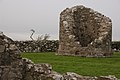
Nendrum Monastery, January 2011 (21)

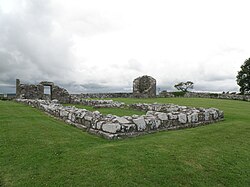
The principal monastic remains which can now be seen are three concentric cashels (enclosures) of dry stone walling, but these were substantially rebuilt by Lawlor in the 1920s. The central cashel has the round tower remains, a ruined church with a sun-dial, and a graveyard. The second cashel contains what is called a 'monastic school' or workshop and other burials.[3]

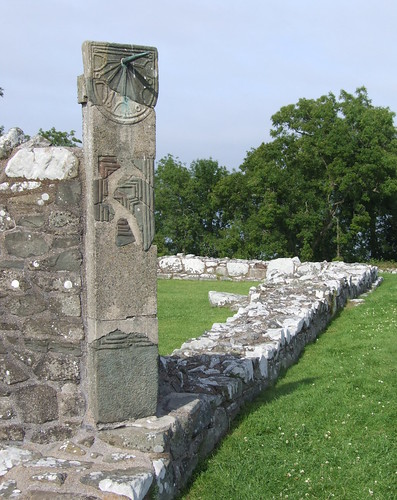
The canonical sundial now seen at one corner of the ruined church was reconstructed from fragments found during the excavation of the site in 1924 and has been dated to about the year 900.[12] One of only a few early medieval sun-dials known to exist,[2] it takes the form of a vertical stone pillar, 190 cm high, 40 cm wide and 15 cm thick, with the dial and gnomon on one face at the top.[12] However, because of the nature of the reconstruction, the original height of the pillar is conjectural.[13]

Mill

[edit]

The Nendrum Monastery mill (54°30′00″N 5°38′49″W / 54.500°N 5.647°W / 54.500; -5.647) was a tide mill on the island. It is the earliest excavated tide mill, dating from 787 AD. Its millstones are 830mm in diameter and the horizontal wheel is estimated to have produced 78 horsepower (0.65 kW) at its peak. Remains of an earlier mill dated at 619 AD were also found.

Ongoing spirituality

[edit]

Nendrum lies within the United Parish of Killinchy, Kilmood and Tullynakill. The current Rector of the parish, Rev. Dr. Stanley Gamble has spiritual authority and responsibility for the ancient site. On the Sunday after the summer solstice each year, the parish has an open-air service within the walls of the old church. On Sunday 25 June 2017, the first Christening service took place at the site since the monastery was dissolved.[14] An annual service is also held at the monastery by St. Mary's Parish, Comber, on Palm Sunday each year.[15]

Tourism

[edit]

Mahee Island is within Strangford Lough, a body of water which has been designated as an Area of Outstanding Natural Beauty. The island is approached by narrow roads and causeways leading from the A22 road south of Comber, which is the road to Downpatrick.

A cottage was built on the island in the early 20th century and is now used as a visitor centre.[9] The island is open daily from 10 am to 6 pm between Easter and 30 September, and from 12 pm to 4 pm on Sundays from October to Easter.[16]

[edit]

Bibliography

[edit]

See also

[edit]

References

[edit]

Further reading

[edit]
[edit]
Revisions and contributorsEdit on WikipediaRead on Wikipedia
from Grokipedia
Nendrum Monastery is an early medieval Christian monastic settlement located on Mahee Island in , , , renowned for its well-preserved pre-Norman structures and the world's earliest known tide mills. Founded in the late by Saint Mochaoi, who died around 496 AD, the monastery is associated with the early in Ireland, with later traditions linking it to . The site features three concentric dry-stone enclosures on a hill, enclosing a Romanesque church with an adjacent graveyard, the base of a , a possible schoolhouse or , and platforms for circular huts, reflecting typical early Irish monastic layout. A reconstructed on the church's west wall, dating to the 1920s based on an original fragment, highlights the site's astronomical interests. Archaeological excavations, notably those conducted by H.C. Lawlor between 1922 and 1924, uncovered significant artifacts including the Bell of Nendrum, now housed in the and Down County Museum. The monastery's most distinctive feature is its pair of tide mills, discovered in 1999 along the island's shoreline; the first, dated to AD 619–621 via , represents the earliest scientifically dated globally and the first horizontal-wheeled in Ireland, powered by the lough's due to the absence of local streams. A second mill, more advanced, was built around AD 787 and operated for over a century. The site's history includes documented clergy from the 7th century, a destructive fire in 976—possibly from a Viking raid—and a transition in the late 12th century to a Benedictine cell under the Diocese of Down, serving as a by 1302–1306 before abandonment by the 15th century. Today, managed by the Department for Communities, Nendrum stands as the finest surviving pre-Norman ecclesiastical complex in , offering insights into early medieval monastic life, technology, and economy.

Location and Setting

Mahee Island Geography

Mahee Island is situated in , , Northern Ireland, at coordinates 54°29′53″N 5°38′53″W, forming part of the lough's intricate network of over 70 islands and islets. As the largest island in the lough, it lies approximately 5 km southeast of and close to the western shore, within the parish of Tullynakill. The island's position in the northern reaches of the lough, a large shallow sea inlet spanning about 150 km² with a complex tidal regime, contributes to its distinctive environmental character. Mahee Island consists of two parallel ridges connected by a narrow , encompassing an area of approximately 80 hectares (198 acres). It connects to the mainland via a series of causeways, including a late 19th-century structure linking it to the adjacent Reagh Island, which in turn connects further to the shore. These causeways traverse the surrounding mudflats, which are extensive intertidal deposits characteristic of the lough's northern sector, covering up to 50 km² overall and exposing vast areas at . The mudflats and sea access played a key role in the island's strategic importance, offering natural barriers against land-based intruders while facilitating maritime provisioning and movement by boat. Geologically, Mahee Island exemplifies the lough's drowned landscape, shaped by glacial activity during the last Ice Age. The western ridge, where the Nendrum site is located, forms a classic —a streamlined mound of deposited by retreating sheets—with a core of unstratified glacial . These drumlins, elongated in the direction of flow, rise gently from the surrounding terrain and are partially submerged or fringed by tidal sediments. Tidal movements, with ranges exceeding 3.5 m, significantly influence accessibility; the mudflats become navigable or impassable depending on the , isolating the island at high water and rendering it approachable by foot or vehicle only during via the causeways. This tidal, marshy terrain, dominated by soft muds and bioturbated sediments around the , underscores the site's inherent defensibility and seclusion, qualities often sought in early monastic foundations for spiritual retreat.

Historical Context of Strangford Lough

, the largest sea inlet in the spanning approximately 150 square kilometers, is a drowned river valley formed post-Ice Age, featuring a narrow entrance at the Strangford Narrows and containing at least 70 main islands along with numerous smaller islets known as pladdies. This intricate landscape of bays, coves, and mudflats made it a vital navigation route, particularly for who renamed it "Strang Fjord" in the and established a base there, conducting raids and fighting a notable battle in 877 AD. The lough's position within the Lecale region of also fostered early Christian settlement patterns from the , with traditions linking the arrival of to its shores, enabling the spread of monastic communities along the coastal fringes. Human occupation in the area predates monastic foundations, with evidence of hunter-gatherers from around 6000 BC exploiting the lough's resources through flint scatters and shell middens along its shores. Neolithic activity intensified by 4000 BC, marked by significant burial sites such as the dual court tomb at Audleystown, containing multiple chambers and kerbstones, and the wedge tomb at Millin Bay, reflecting communal rituals and maritime mobility among early farmers who navigated the lough's waters. Bronze Age presence, though sparser around the lough compared to inland areas, includes ceremonial monuments like the and artifact finds on islands such as Sketrick, indicating continued use for ritual and resource gathering amid shifting coastal environments. The lough's ecological richness, characterized by diverse marine habitats supporting abundant , , and migratory birds, provided a foundation for self-sufficient communities, with intertidal zones enabling sustainable exploitation through fish traps and . From the onward, the interplay of powerful tidal patterns—a spring tidal range exceeding 3.5 funneling through —shaped by facilitating maritime access while posing navigational challenges. This dynamic environment supported early trade and cultural exchanges, as the inlet served as a conduit for goods and ideas between , Britain, and , underpinning the growth of coastal settlements in Lecale during the early Christian era.

History

Founding and Early Monastic Life

Nendrum Monastery was traditionally founded in the AD by St. Mochaoi (also known as Seganus or Moeliai), whose death is recorded in the Annals of Ulster at dates varying between 496 and 498, indicating an established ecclesiastical presence by the late 5th century. Hagiographical accounts from later sources link Mochaoi to St. Patrick as a disciple who was baptized by the saint and granted the site on Mahee Island for monastic use. These traditions underscore Nendrum's origins as a key early Celtic Christian foundation in the region of . The early monastic community at Nendrum followed Celtic Christian practices, blending eremitical solitude with communal worship in a manner characteristic of 5th- to 8th-century Irish monasticism. Monks lived in simple huts within protective enclosures, emphasizing ascetic discipline, prayer, and manual labor as paths to spiritual growth. Self-sufficiency was central to daily life, with the community sustaining itself through on the fertile island soil and in the surrounding lough waters, fostering a harmonious integration of labor and devotion. As a prominent ecclesiastical center, Nendrum functioned as a hub for learning and pilgrimage, evidenced by archaeological traces of a 'schoolhouse' workshop that suggests scriptural study and artisanal pursuits. The Annals of Ulster document ongoing activity through the 5th to 8th centuries, including the deaths of notable clergy such as Bishop Cronan in 642, Bishop Cummeni in 658, Bishop Ocgedchar in 734, and Abbot Sneithcheist in 754, reflecting a succession of abbots and bishops that elevated the site's regional influence. The surviving concentric enclosures represent remnants of this early layout, designed to delineate sacred spaces for communal monastic living.

Decline, Viking Influence, and Later Occupations

The decline of Nendrum Monastery began with a devastating Viking raid in 974 AD, during which Abbot Sedna Ua Demain was burned alive in his own house, as recorded in the Annals of the Four Masters. This violent event, interpreted by historians as a Norse incursion amid broader patterns of Viking attacks on Irish monastic sites, led to a significant reduction in the monastery's activity and prominence. No further annalistic mentions of Nendrum appear until the late 12th century, indicating a period of diminished monastic life between 974 and 1178, likely exacerbated by ongoing regional instability from Scandinavian raids and internal Irish conflicts. In 1178, following his conquest of eastern Ulster, Anglo-Norman lord granted the Nendrum site—specifically the church and two-thirds of Mahee Island—to Benedictine monks from in , establishing a small dependent cell as part of his broader ecclesiastical reforms in the region. This endowment introduced Norman influences to the Ards Peninsula's monastic landscape, aligning Nendrum with continental Benedictine practices and integrating it into de Courcy's administrative network of priories, including those at Ards and Black Abbey. The Benedictine presence revitalized the site temporarily, supporting its role in medieval ecclesiastical administration as a local religious center under Anglo-Norman oversight. By the early , Nendrum had transitioned from a to a , as evidenced by its inclusion in the 1306 papal taxation records as a vicarial in the of Down. The site's church continued to serve parish functions through the 14th and into the 15th centuries, reflecting its adaptation to post-Norman parochial structures in the . However, by the mid-15th century, the community fully abandoned Nendrum in favor of a new mainland at Tullynakill, leading to the site's eventual desolation amid shifting demographics and ecclesiastical priorities.

Rediscovery and 20th-Century Excavations

The location of Nendrum Monastery had been lost to historical record following its medieval abandonment, remaining in a state of overgrown ruin on Mahee Island during the , with only local knowledge of the ecclesiastical remains. In 1844, the Irish antiquarian and clergyman William Reeves rediscovered and identified the site as the ancient monastery based on medieval annals referencing a 1306 there. Reeves documented the ruins' condition, noting the surviving church walls, graveyard, and other fragmented structures amid dense vegetation, in his 1845 pamphlet A Description of Nendrum, Commonly Called Mahee Island. He expanded on this in his comprehensive 1847 work Ecclesiastical Antiquities of Down, Connor, and Dromore, providing the first scholarly attribution of the site to St. Mochaoi's foundation. Initial state conservation efforts began in the early under Northern Irish authorities, coinciding with systematic archaeological investigation to stabilize and reveal the site's layout. The primary excavations occurred from 1922 to 1924, led by Henry Cairnes Lawlor in collaboration with the Natural History and Philosophical Society. Lawlor's team cleared vegetation, mapped three irregularly oval concentric enclosures, and exposed the church foundations, including a rebuilt west wall and an adjacent graveyard. They also uncovered the base of a northwest of the church and fragments of a at the southwest corner, which was reconstructed during the work; the remnants of early hydraulic technology were noted near the shoreline. These efforts restored key walls and structures for preservation, with findings detailed in Lawlor's 1925 monograph The Monastery of Saint Mochaoi of Nendrum. Artifacts from the digs, such as the inscribed Nendrum Slab—a decorated stone fragment possibly bearing early Christian —provided insights into the site's . Subsequent investigations built on Lawlor's foundations, focusing on refinement and specific features. In 1954, archaeologist Charles conducted limited trenching at the site to examine monastic occupation layers and structural details, contributing to broader understanding of early Christian settlements . Conservation and survey work continued through the late , including underwater investigations in the that revealed a stone and medieval . In 1995–2001, excavations led by Thomas McErlean discovered the site's pair of tide mills along the shoreline, dated to the 7th and 8th centuries AD, representing a major advancement in understanding Nendrum's technological significance. These efforts transformed the obscured ruins into a recognized heritage site managed by the state.

Site Features and Archaeology

Concentric Enclosures and Layout

Nendrum Monastery's layout is defined by three concentric dry-stone cashels, irregularly oval in plan, which crown a glacial hill on Mahee Island and integrate seamlessly with the undulating terrain for both defensive advantage and spatial organization. The outermost cashel, measuring approximately 183 meters in diameter and enclosing about six acres, likely accommodated peripheral monastic activities such as dwellings, gardens, and industrial workshops, with gates and cross-walls further subdividing the space. The middle cashel, roughly half the size of the outer, preserved evidence of circular hut platforms and rectangular structures interpreted as workshops, while the innermost cashel, the smallest at around an acre, demarcated the core sacred area housing the church and graveyard. This annular design exemplifies early Irish monastic architecture, where multiple enclosures provided practical zoning for communal life—separating lay, productive, and clerical functions—while offering layered defense against Viking raids and other threats through the robust dry-stone walls. Symbolically, the concentric arrangement reflected a graduated of sanctity, with progressive enclosures moving from the profane outer ring to the holiest inner sanctum, a common feature in pre-Norman sites that underscored spiritual progression and territorial demarcation known as the termon. Today, the restored enclosure walls, rebuilt during H.C. Lawlor's excavations, remain visible up to 1.5 meters high in sections, though the outermost is faint and overgrown in places, blending into the island's rocky landscape and emphasizing the site's adaptation to its isolated, tidal setting in . The church lies within the inner enclosure, anchoring the overall .

Church, , and Other Structures

The ruined Romanesque church at Nendrum Monastery, located within the innermost of the three concentric enclosures, represents the site's primary ecclesiastical structure and dates to the 10th or 11th century. It features a simple rectangular layout with a nave and chancel, constructed from local stone in a style typical of early medieval Irish monastic architecture, though much of the original fabric has been lost to time and reuse. The west wall was extensively rebuilt during the 1920s excavations led by H.C. Lawlor to stabilize the structure and preserve its form, incorporating elements recovered from the site. Approximately 12 meters northwest of the church lies the low stump or base of a possible round tower, a characteristic feature of Irish monasteries serving as a bell tower, storage, or refuge; this remnant, also restored in the 1920s, suggests an original height of around 20-30 meters if complete, though only the foundation survives today. A prominent feature of the church is the canonical sundial mounted at its southwest corner, reconstructed from fragments discovered during Lawlor's 1922-1924 excavations and dated to around 900 . This vertical slate dial, standing about 1.8 meters high, is one of the earliest surviving sundials in the British Isles and was designed to divide the daylight hours into canonical periods for monastic prayer, work, and rest, reflecting the structured of early Christian communities. Its semicircular face bears incised lines and markings aligned with the sun's path, emphasizing the four "tides" of the monastic day rather than modern equinoctial hours, underscoring Nendrum's role in advancing timekeeping for religious observance. Adjoining the church is the monastic graveyard, a small containing early medieval burials marked by cross-inscribed slabs, many of which were uncovered during the excavations and represent some of the finest examples of local . These slabs, including the notable Nendrum Slab—a large, inscribed cross monument dated to shortly before 800 CE—feature geometric designs and Latin inscriptions evoking theological themes such as the "glory of creation," likely serving as grave markers or memorials for monks and pilgrims. Outside the church stands a leacht, a low stone platform interpreted as an open-air or , used in early Irish monastic rituals for offerings and , though its precise dating remains tied to the site's 8th-10th century phases. The graveyard and associated structures highlight the site's enduring function as a sacred burial ground amid the protective inner .

Tide Mill and Technological Innovations

The tide mill at Nendrum Monastery, situated approximately 200 meters northwest of the main monastic enclosures on Mahee Island in , , exemplifies early medieval hydraulic innovation. Constructed using oak timbers dated through to AD 619–621, it is the world's earliest excavated , predating other known examples by centuries and highlighting advanced engineering capabilities in a period often underestimated for technological prowess. The mill's structure featured a robust stone and timber dam forming a triangular millpond, approximately 110 meters long and 6 meters wide at its base, sealed with layers of clay, wattle, and boulders to retain tidal water. Sluice gates at the pond's inlet allowed filling during high tide, while a controlled outlet led to a penstock—a channeled conduit with a 15-degree incline—that directed water to a horizontal waterwheel within a two-storey wheelhouse. This wheel drove a vertical shaft upward to the millhouse, where twin quern-style millstones, each 830 millimeters in diameter, ground grain; the setup's estimated power output of 0.65 kilowatts derived from the controlled release of tidal flow, enabling efficient operation despite the site's modest tidal range of about 2.5 meters. Operationally, the mill filled its pond via open sluices on the incoming , then sealed to trap , which was released on the ebb to spin the wheel and millstones for several hours twice daily; this horizontal-wheeled , powered directly by tidal without gears, contrasted with later vertical-wheeled mills but demonstrated superior preservation in the anaerobic conditions of the lough's sediments. A second mill, dated to around AD 787, rebuilt and expanded the nearby, incorporating similar but with enhanced capacity. This technology supported the monastery's self-sufficiency by providing reliable processing for communal production, aligning with early Christian monastic ideals of labor and sustenance.

Cultural and Spiritual Significance

Artifacts and Historical Insights

Excavations conducted at Nendrum Monastery in the 1920s revealed a range of artifacts that illuminate the artistic, religious, and technological aspects of early medieval Irish . Approximately 30 tablets, discovered in a structure interpreted as a schoolhouse, feature intricate Celtic designs such as interlace patterns and animal motifs, serving as trial pieces for practicing techniques. These finds, now housed in the , indicate a structured environment for artistic and scribal training within the monastic community, reflecting the high level of craftsmanship associated with Celtic Christian art. A notable discovery was a bronze-coated iron handbell, known as the Nendrum Bell, unearthed near the outer enclosure; this artifact, also in the Ulster Museum, would have been used to summon monks for prayer or communal activities, underscoring the regimented daily routines central to monastic life. Fifteen cross-carved stone fragments, the largest assemblage from any early Christian site in Ireland, were recovered during the same digs, likely functioning as grave markers or devotional objects; their simple incised designs highlight the widespread use of cross symbolism in marking sacred spaces and commemorating the dead. An inscribed , initially identified as bearing runic script from the Viking era but later recognized as Insular display capitals, dates to shortly before 800 CE and is preserved in the ; its theological content, possibly evoking the "Glory of Creation," provides evidence of sophisticated scriptural and artistic expression amid potential Viking influences on the site. These artifacts collectively reveal insights into and cultural practices, with the tablets demonstrating iterative skill-building in decorative motifs that parallel illuminated manuscripts, suggesting Nendrum's role as a center for learning and artistic production in early medieval . The fragments and further attest to a vibrant religious life focused on commemoration and communal worship. The site's , reassembled from excavated fragments and dated around 900 CE, exemplifies advanced timekeeping in by dividing daylight into eight for liturgical observances, integrating astronomical knowledge into monastic discipline. Complementing this, the adjacent —dated precisely to AD 619–621 via —represents Europe's earliest verified example of utilization, employing a horizontal waterwheel to process grain efficiently and twice daily, which underscores the technological sophistication and economic self-sufficiency of the monastic settlement.

Ongoing Religious Practices

Nendrum Monastery is integrated into the United Parish of Killinchy, Kilmood, and Tullynakill within the Diocese of Down and Dromore of the , a union that traces its organizational roots to the when local parishes were consolidated for administrative and efficiency. The site's historical church ruins continue to serve as a venue for , facilitating a connection between ancient monastic traditions and contemporary Christian observance. Annual religious services are held at the monastery, including an open-air gathering on the following the summer solstice to commemorate St. Mahee's feast day, conducted within the remnants of the original church enclosure. Another service takes place on , organized by a local to mark the start of . These events draw participants from the surrounding community, emphasizing themes of renewal and continuity in faith. Revival efforts at Nendrum underscore its role in modern Irish , with interdenominational openness reflected in its use for rites while honoring its Celtic heritage. A notable example occurred in 2020, when the site hosted the of two presbyters—the first such ceremony there in at least 800 years—symbolizing the monastery's enduring spiritual legacy.

Preservation and Tourism

Conservation Efforts

The Nendrum Ecclesiastical Site has been under state care since 1924, managed by the Historic Environment Division (HED) of the Department for Communities, following excavations that initiated formal preservation activities. In the , archaeologist H.C. Lawlor led excavations from 1922 to 1924, during which enclosure walls, the church, and the were restored, marking the beginning of systematic conservation. The west wall of the church was rebuilt during this period, incorporating a reconstructed at the southwest corner from fragments uncovered in the digs. Modern conservation faces significant environmental challenges, including from tidal forces in , overgrowth of vegetation that threatens structural integrity, and broader climate change impacts such as rising sea levels and increased , which have led to inundation of features like the medieval stone jetty. These factors have necessitated ongoing monitoring and intervention to protect the site's pre-Norman enclosures and artifacts, with the outer cashel only partially under state care while the middle and inner enclosures are fully managed; access may be restricted due to works, and visitors should check before visiting. Post-2000 efforts have included structural stabilization surveys and maintenance as part of HED's five-year cyclical inspection program for all state care monuments, which assesses conditions and risks with more frequent checks for vulnerable coastal sites like Nendrum. Collaborative initiatives with organizations such as the Environment Agency (NIEA) and the Strangford and Lecale (AONB) Partnership have supported these activities through shared resources and regional heritage strategies.

Visitor Access and Modern Interpretation

Nendrum Monastic Site is accessible to visitors year-round via a and bridge from the mainland at Mahee Island, with free on-site parking available near the entrance. The grounds are open daily year-round, while the visitor centre operates seasonally: Thursday to Monday, 10:00 a.m. to 5:00 p.m. (last admission 4:30 p.m.), until mid-September; hours outside this period may vary, and visitors should check current information. Free admission is provided throughout, with no unaccompanied minors under 16 allowed. Guided tours are occasionally offered, enhancing the exploration of the site's enclosures and structures. The visitor centre features interactive and graphic displays, models of monastic buildings and the ancient tide mill, artefacts, and videos that illustrate daily life in the early Christian community and technological innovations like the mill. Interpretive panels scattered across the site provide context on the monastery's , including its pre-Norman layout, Viking-era interactions such as the 976 attack, and feats, helping visitors grasp the site's without delving into primary excavation details. These elements foster an educational experience, occasionally incorporating ongoing religious reflections as part of contemplative visits. As a key heritage attraction in Ards and North Down (formerly ), Nendrum contributes to the region's economy, which generated £1.1 billion in expenditure across in 2024, with local sites like this supporting and spending in rural areas. numbers at Nendrum have historically ranged from 5,000 to 7,500, aiding in the area. Efforts emphasize low-impact visitation, such as restricting unaccompanied minors under 16 and promoting eco-friendly practices aligned with the borough's initiatives to preserve the site's archaeological integrity.

References

Add your contribution
Related Hubs
User Avatar
No comments yet.