Hubbry Logo
MarinaledaMarinaledaMain
Open search
Marinaleda
Community hub
Marinaleda
logo
8 pages, 0 posts
0 subscribers
Be the first to start a discussion here.
Marinaleda
Marinaleda
from Wikipedia

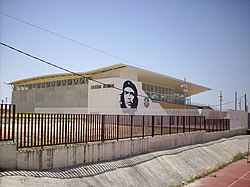
Municipal theatre

Key Information

View of a town road

Marinaleda (Spanish pronunciation: [maɾinaˈleða]) is a Spanish municipality of the province of Seville that belongs to the region of Sierra Sur, located in the basin of Genil, in the autonomous community of Andalusia. It has an area of 24.8 km2 (9.6 sq mi) and a population of 2,778 inhabitants according to the 2011 census, with a population density of 112.01 inhabitants per square kilometre (290.1/sq mi). It belongs to the judicial district of Estepa.

Marinaleda is a predominantly agricultural municipality and this makes up the bulk of its economy. It is noted for its left-leaning principles based on a leftist ideology led by Juan Manuel Sánchez Gordillo, mayor from 1979 to 2023 and a member of the Unitarian Candidacy of Workers (CUT). Local workers and peasants have achieved a high rate of development and practically full employment for its people. The development of an alternative economic mode has achieved notable results, even during the economic crisis that began in 2008.[3]

Critics claim that this economic and social progress is due in part to the fact that almost 66% of the income received by the City of Marinaleda is from administrative superiors such as the state, the autonomous community, and the Provincial Council of Seville.[4] In reality, Marinaleda receives less than the average remittance received by municipalities in Andalusia (in 2011 it received around 6.61% less than the regional average).[5]

Marinaleda is part of the "Network of Municipalities for the Third Republic" and the tricolor flag is present in civil buildings.

Geography

[edit]

The town is located at an altitude of 205 metres (673 ft) and lies 108 kilometres (67 mi) east of the provincial capital, Seville. Marinaleda belongs to the comarca of Estepa and is situated between this latter town and Écija, in the eastern part of the province of Seville, in the basin of the Genil river. Its geographical coordinates are 37°22′N 4°57′W / 37.367°N 4.950°W / 37.367; -4.950.

History

[edit]

The first indications of human settlement in the territory now covered by the Marinaleda municipality go back to the late Neolithic and Chalcolithic periods, about 5,000 years ago. Stone tools and traces of seeds and dwelling places have been found.

There was a major Roman presence, and some date the foundation of the village to this period. The Roman road connecting the villages of Astigi (present-day Écija) and Ostippo (Estepa) ran by Marinaleda, and there have been many discoveries from the period.

The Arab presence is visible in monuments such as the Towers of Gallape and the fortress of Alhonoz. The region was conquered by the Christian monarchs in the 13th century, and Marinaleda came under the rule of the religious Order of Santiago. Philip II granted the village to the first Marquess of Estepa, and it would remain under this ownership until manors were dissolved in the 19th century.

Marinaleda then grew as a population centre due to the influx of day labourers working for large landowners, especially the Marquesses of Estepa. There is evidence that, in 1751, there were 60 houses lived in by landless labourers, who earned two reals for a full day's work.

In the 18th century, Marinaleda had three clergymen and a shop belonging to the Marquess of Peñaflor, who lived in Écija. The main economic activity was rain-fed agriculture.

During the 19th century in Marinaleda and neighbouring territories, there were several groups of bandits involving residents of the municipality. Notable groups include those commanded by José María Hinojosa Cobacho, "El Tempranillo", Francisco Ríos González "El Pernales", and Juan Caballero.

In 1931, the population of Marinaleda was 2,318, of whom only 317 were entitled to vote. The elections of 12 April that year were won by monarchist supporters, whereas those of 31 May were won by republicans. The final elections of the Republican period, on 16 February 1936, were won by the Popular Front.

At the start of the Civil War, troops supporting the coup assassinated the mayor, Vicente Cejas Moreno, his son, and at least 30 other residents. In the postwar period, the population suffered great poverty, hunger, and repression. The poor survived by gleaning olives and acorns from the fields of the estates.

The industrialization of Spain beginning in the 1960s encouraged emigration from Marinaleda to industrial areas, especially Catalonia, as well as to other countries such as Germany, France, and Switzerland.

Upon the death of Francisco Franco in 1975, the dictatorship he had established in Spain gave way to a representative democracy. In 1977, the Sindicato de Obreros del Campo (Union of Farm Workers) was founded in Marinaleda. The following year, a struggle for land began with a two-day occupation of the Bocatinaja estate, between Osuna and Los Corrales.

The first post-Franco municipal elections were held in 1979. The Colectivo de Unidad de los Trabajadores (Workers' Unity Collective) won in Marinaleda, gaining 9 of the 11 council seats. The new council replaced street names associated with the victors of the Civil War by names of left-wing heroes. For example, Muñoz Grandes street became Che Guevara street, the Plaza of Spain became the People's Plaza, and the Plaza of Francisco Franco was renamed after Salvador Allende.

In 1980, 700 people staged a 13-day hunger strike, demanding better pay and stricter regulation of the old system of employment. The success of this action led to intensification of the land struggle, with further occupations of large landowners' estates under the slogan "Land to those who work on it". In 1984, the Cordobilla marsh was occupied for 30 days to demand irrigation for a farm called El Humoso, property of the Duke of Infantado, facilitating its later expropriation.[6]

In 1985, the occupation of estates increased in number by at least 100, as well as in length, extending to over 90 days. This led to many legal actions.[7]

In 1991, a 1,200-hectare (3,000-acre) tract of El Humoso farm was handed over to Marinaleda for the use of the population.[8] Demonstrations demanding a life of dignity increased between 1992 and 1994, with many occupations of government buildings and institutions.[7]

In 1997, irrigation was extended to the whole of the El Humoso, and the Marinaleda S.C.A. A cooperative was founded to cultivate the farm collectively. Three years later, a food processing plant was set up, supplied by the raw materials of the cooperative: piquillo pepper, beans, artichokes, and olives. An oil press was also built. Production continued to increase, and employment along with it.

During the euro area crisis, while 30% of the active population in Andalusia was without work, Marinaleda had full employment.

The social and political system that has been implemented in the community, and the good results obtained in terms of economic development and well-being of the inhabitants, has brought Marinaleda to the attention of the media in Spain and abroad.

The "Social Democracy" tab on the town's website states the following:[9]

And while we were struggling for land, for industry, for employment, we realised that there were other basic rights that had to be won. And the first necessity we identified was the lack of places to live, but we also realised that there was no place for our elders after so many years of hardship and troubles, nor was there a medical clinic, nor a day nursery, nor sports facilities, and the streets were unpaved and almost unlit.

By Social Democracy we mean unlimited access to all forms of well-being for the whole population of our village. We have always thought that liberty without equality is nothing, and that democracy without real well-being for real people is an empty word and a way to deceive people into believing they are part of a project when in fact they are not needed at all.

It seemed to us that in this principle there should be no limits; that the people should have a dream of collective welfare and that it should be realized by struggle, because no popular aspirations, no matter how unreachable they may seem, can be rejected either in thought or in action by a genuinely revolutionary Left.

In this way, we were able to win each and all of the things that we were clearly lacking.

In 2023, Juan Manuel Sánchez Gordillo, mayor of Marinaleda since 1979, retired due to ill health.[10] His successor is Sergio Gómez Reyes.[1]

Demographics

[edit]
Historical population of Marinaleda
(Source: National Statistics Institute)
Year1842185718601877188718971900191019201930194019501960197019811991200120112021
Population7961,3981,3131,3841,7021,7851,7531,8642,3182,5633,0703,3872,8792,4392,3172,5182,6502,7832,627

Local government

[edit]

For over 40 years, the mayor of Marinaleda has been Juan Manuel Sánchez Gordillo of the United Left Party. Gordillo has anointed Marinaleda a "utopia for peace", which has no municipal police (saving $350,000 a year). Additionally, political murals and revolutionary slogans adorn the town's whitewashed walls and streets are named after Latin American leftists. Every few weeks, the town hall declares a Red Sunday over a bullhorn and volunteers clean the streets or do odd jobs.[11]

They all thought that the market was God, who made everything work with his invisible hand. Before, it was a mortal sin to talk about the government having a role in the economy. Now, we see we have to put the economy at the service of man.

— Mayor Juan Manuel Sánchez Gordillo, May 2009 remarks about Spain's real estate bust and rampant unemployment.[11]

Marinaleda has a long tradition of sociopolitical struggle by agricultural labourers, which has decisively influenced the attainment of diverse political and social advances. Marinaleda was ruled by CUT-BAI (Collective for the Unity of Workers - Andalusian Left Bloc) from 1979 until 1986, when CUT-BAI joined United Left (IU), which has since been the ruling party, although most of the members of IU's local branch are basically members of CUT-BAI.

Local economy

[edit]

The town operates a farming cooperative with 2,650 workers. Marinaleda is surrounded by sloping olive groves and features a 3,000-acre (12 km2) farm. The farm is located seven miles (11 km) north of Marinaleda, and grows labour-intensive crops like artichokes, hot peppers, broccoli, and broad beans, as well as wheat.[11]

Town planning

[edit]

Marinaleda represents a local exception of the national housing crisis caused by real estate speculation. The municipality was the subject of national news when it became known that one could own a house in this town for no more than 15 euros per month through the self-building program.[11]

Self-building

[edit]

The Ayuntamiento (local government) of Marinaleda bought and expropriated thousands of square metres of land, now communal property, for the construction of new houses. Land, building materials, and architectural plans are provided to the self-builder through public grants. Free assistance from professional builders is also provided.[9] The hours spent by the resident on construction (if any) are deducted from the total cost. Prospective owners usually donate about 450 days of their work to the construction. Finally, a monthly payment of up to 15.52 euros is arranged with the contractors and the government for the resident to achieve ownership. To prevent speculation, citizens are prohibited from selling their homes.[11]

Layout

[edit]

Marinaleda's citizens reside in a colony of neat houses, each with three bedrooms, one bathroom, and a garden of 100 m2 (1,100 sq ft), allowing for future expansions. In recent years 350 single-family homes have been built according to this scheme, even though the town has fewer than 3,000 inhabitants.[9]

See also

[edit]

References

[edit]

Further reading

[edit]
[edit]
Revisions and contributorsEdit on WikipediaRead on Wikipedia
from Grokipedia

Marinaleda is a small agricultural municipality in the Province of Seville, Andalusia, Spain, covering 24.8 square kilometers and home to approximately 2,700 inhabitants engaged primarily in olive farming and olive oil production. The town is distinguished by its collective economic model, anchored in the El Humoso cooperative, a 1,200-hectare farm expropriated from private ownership by the regional government in 1991 after a decade of occupations, strikes, and protests organized by residents under the direction of Juan Manuel Sánchez Gordillo. Gordillo, a self-identified communist who served as mayor from 1979 until 2023, promoted participatory assemblies, worker-managed agriculture paying above minimum wage, and self-built housing programs that leveraged low-interest state loans and subsidies to enable residents to construct homes for nominal fees. These initiatives have yielded reported near-zero unemployment and social housing access, though the system's dependence on politically aligned regional interventions and public funding raises questions about its autonomy and replicability beyond a small-scale, state-supported context.

Location and Physical Setting

Geography

Marinaleda is a in the , within the autonomous community of , . It lies in the Sierra Sur region and the basin of the Genil River, encompassing an area of 24.82 square kilometers. The terrain features predominantly flat plains ideal for , situated in a shaped by the Genil basin and crossed by the Blanco. Surrounding hills from the Sierra Sur formation influence local microclimates, providing a varied topographic context despite the central flatlands. Positioned at an elevation of 205 meters above sea level, Marinaleda is approximately 103 kilometers southeast of , with nearby municipalities including (26 kilometers east) and (22 kilometers south).

Climate and Environment

Marinaleda experiences a (Köppen classification Csa), characterized by hot, dry summers and mild, wetter winters. Average high temperatures in and reach 35°C, with lows around 18°C, while sees average highs of 16°C and lows of 5°C. Annual averages 500 mm, predominantly falling between October and April, with summer months typically receiving less than 10 mm. The region faces heightened vulnerability to droughts and heatwaves, patterns amplified by broader Andalusian trends under . Reservoirs in , including those feeding the basin on which Marinaleda depends for , have operated at critically low levels, such as 21% capacity in early 2023, constraining agricultural viability absent supplementary . Heatwaves, with increasing frequency, exacerbate evaporation rates and deficits, directly impacting crop productivity in rain-fed systems. Ecologically, dominates the landscape, limiting through practices like olive cultivation, which reduce habitat diversity and native species abundance. Marinaleda lies within the river basin, providing essential surface and , but lacks designated protected natural areas, heightening reliance on basin-wide hydrological stability amid variable flows.

Historical Development

Early History and Franco Era

Marinaleda's territory exhibits traces of human habitation from the and periods, with archaeological evidence including settlements. By the , following the Christian reconquest of the region in century, the area developed into a modest agricultural enclave under the influence of the , comprising rudimentary huts occupied by jornaleros—seasonal day laborers—who toiled on expansive latifundios owned by feudal lords, such as the Marquisate of Estepa, perpetuating stark economic disparities between a landless and absentee proprietors. The disrupted this agrarian stasis; in 1936, Nationalist forces under executed between 25 and more than 30 residents accused of leftist affiliations, initiating a reign of repression that defined local life under the ensuing from 1939 to 1975. Marinaleda persisted as a quintessential Andalusian pueblo blanco tethered to latifundista , where on mechanized estates progressively displaced manual laborers, confining the population to intermittent jornales amid chronic often surpassing 60%, widespread , and recurrent food for the jornalero majority lacking personal land holdings. During the 1960s industrialization wave, significant emigration to urban centers like depleted the local workforce, yet simmering discontent among remaining braceros fueled incipient union activity and sporadic strikes across Andalusia's campi, including demands for fair wages and against exploitative conditions on the grandes fincas—precursors to broader mobilizations without yet altering the entrenched latifundio dominance.

Transition to Democracy and Initial Reforms

Following the in 1975 and Spain's subsequent , Marinaleda experienced significant local political reorganization amid chronic and exceeding 60 percent. In 1979, the Colectivo de Unidad de los Trabajadores (CUT), also known as the Workers' Unity Collective and aligned with the Andalusian Left Bloc, was established as a platform emphasizing and communal . This group secured a majority in the first post-Franco municipal elections held on April 3, 1979, winning nine of the eleven council seats with 1,298 votes from a of 1,564, thereby electing 30-year-old history Juan Manuel Sánchez Gordillo as mayor. Sánchez Gordillo's early administration prioritized through popular assemblies and protests to address joblessness, marking a departure from reliance on seasonal day-labor in surrounding estates. In 1980, approximately 700 residents participated in a nine-to-thirteen-day and road blockades, demanding increased employment opportunities and government intervention. These mobilizations pressured the emerging Andalusian regional authorities for funding, enabling initial projects such as improvements that began employing locals and gradually lowered unemployment rates from their late-1970s peak. The CUT's approach fostered community-driven governance, with assemblies serving as forums for decision-making on and labor demands, contrasting prior dependence on absentee landowners. This left-wing platform has retained electoral dominance since 1979, consistently securing absolute majorities in municipal votes, reflecting sustained local support for its mobilization strategies amid Andalusia's agrarian challenges.

Land Occupations and Cooperative Formation

In the 1980s, residents of Marinaleda initiated occupations of uncultivated estates owned by the of Infantado, targeting lands such as El Humoso that were left idle amid high local exceeding 60 percent. These actions included a 30-day occupation of the nearby Cordobilla marsh in 1984 to demand irrigation infrastructure for El Humoso, highlighting the disparity between underutilized aristocratic holdings—spanning over 17,000 hectares—and the lack of for villagers. By 1985, such occupations had proliferated, with reports of at least 100 instances across the region, often involving agricultural workers affiliated with the Sindicato de Obreros del Campo (SOC) union. The campaign for El Humoso intensified through sustained protests, including land occupations, hunger strikes, and demonstrations that spanned over a decade, resulting in multiple arrests and evictions of protesters by authorities. In 1991, following exhaustion from these persistent actions, the socialist-led Andalusian regional government (Junta de Andalucía) expropriated 1,200 hectares of El Humoso from the Duke of Infantado and ceded it to Marinaleda's residents for collective use, marking a key victory in the land struggle. This intervention resolved immediate legal clashes but stemmed from the pressure of non-violent rather than voluntary concession by the landowner. Irrigation systems were extended across the full El Humoso tract by 1997, enabling viable cultivation, after which the Marinaleda S.C.A. was formally established to manage the land collectively. The focused on labor-intensive crops including strawberries, olives, peppers, and artichokes, with members contributing initial unpaid labor to gain entry—structured to prioritize over individual profit distribution, as surpluses were reinvested to maintain guarantees for participants. This model emerged directly from the expropriated holdings, transforming previously terrain into a communal enterprise under SOC oversight.

Recent Developments (2000s–Present)

In response to the 2008–2013 global financial crisis, which exacerbated unemployment and poverty in , , mayor of Marinaleda, led members of the Andalusian Workers' Union (SAT) in expropriating goods from supermarkets in province on August 7 and 9, 2012, distributing food staples like milk, pasta, and sugar to needy families without payment. These actions, framed as solidarity protests against , resulted in charges of robbery and trespassing against Gordillo and other participants, though some cases were later acquitted or dismissed. Marinaleda's local authorities have sustained claims of 0% through its model, contrasting with Spain's national rate of 11.8% at the end of 2023; however, external observations in 2023 estimated the town's rate at around 8%, reflecting ongoing reliance on agricultural labor amid regional economic pressures. In spring 2023, Gordillo announced he would not seek re-election after 44 years as , citing health reasons, marking a significant transition; Sergio Gómez Reyes succeeded him as on June 17, 2023. This shift prompted discussions on the cooperative's future stability, including the relocation of a food firm in 2022 under disputed conditions, though core agricultural operations persisted.

Demographics and Society

Population Dynamics

As of January 1, 2023, Marinaleda had a population of 2,577 residents, per official figures from Spain's Instituto Nacional de Estadística (INE). By January 1, 2024, this number declined slightly to 2,555, reflecting a net loss of 22 inhabitants over the year. The municipality spans 24.82 km², yielding a low population density of about 104 inhabitants per km² in 2024. Demographic trends indicate stability since the early following modest post-1990s growth, with the population hovering between 2,500 and 2,700 after earlier peaks. This follows a historical nadir during the 1960s–1970s rural exodus in , when outmigration depopulated many small municipalities like Marinaleda amid widespread agricultural distress and limited local opportunities. Birth rates contribute to an aging profile, with fertility aligning below Spain's national total of 1.16 children per woman in 2022, exacerbating low natural increase in line with broader rural Spanish patterns. Net migration has provided a counterbalance to stagnation, with inflows from nearby rural Andalusian areas offsetting outflows, though overall growth remains minimal due to the town's small scale and selective residency tied to communal structures. Recent annual changes show slight declines, such as from 2,618 in 2021 to 2,555 in 2024, underscoring persistent demographic pressures without significant rebound.

Social Composition and Migration Patterns

Marinaleda's population exhibits a high degree of ethnic and cultural homogeneity, consisting almost entirely of native of n descent, with negligible foreign reflective of broader patterns in rural province municipalities. Official register statistics from the Instituto Nacional de Estadística (INE) show that the vast majority of residents were born in , underscoring limited external inflows and a stable local-born core. Socially, the community is predominantly working-class, with roots in agricultural labor and strong ties to organizations like the Sindicato de Obreros del Campo, founded in 1977 to advocate for and rural workers' rights in . Migration patterns historically featured significant outbound flows during economic crises, such as the strikes and documented in Marinaleda during the late 1970s and early , which prompted many residents to seek opportunities in urban or abroad. Following land occupations and formation in the and , internal return migration increased, drawing former emigrants back due to emerging employment stability and self-built programs. Local assessments indicate that outbound migration has since been curtailed, attributed to near-zero in the model, though Andalusian regional data highlight persistent risks of youth from rural areas amid limited diversification. Gender distribution in the municipal register remains approximately balanced, with INE data reporting comparable numbers of males and females across working-age cohorts as of recent years. However, labor participation in agricultural cooperatives skews male, aligning with traditional patterns of field work in Andalusian rural economies, where women often engage in complementary roles or non-agricultural sectors.

Governance and Political Structure

Local Administration

Marinaleda's local administration conforms to Spain's municipal governance framework, governed by the of the General Electoral Regime and local regime bases, which establish a selected by the town council from the party holding the majority and a unicameral council of eleven councillors elected every four years via in municipal elections. The council manages operations through specialized delegations, including those for finance (handling budget oversight), (addressing land use and development), and other functional areas such as ecology and services. Citizen participation integrates with formal processes via the General Assembly, designated as the town's supreme deliberative body for political and union-related decisions, including approvals on taxes, budgets, allocations, and strategies. These assemblies convene 25 to 30 times per year, drawing 400 to 600 participants, with frequency increasing to daily during periods of heightened community action. The annual municipal budget, amounting to €3,930,961 in 2024, depends substantially on intergovernmental transfers, which constitute 76% of total revenues (€2,990,728 from current and capital transfers), funding allocations for public services, infrastructure maintenance, and personnel costs.

Leadership Under Juan Manuel Sánchez Gordillo

Juan Manuel Sánchez Gordillo, a by profession, emerged as a local leader in Marinaleda during the late 1970s through his involvement in the Spanish Communist Party (PCE) and farm workers' unions, organizing laborers amid post-Franco rural poverty. He was first elected mayor on May 6, 1979, heading the anti-capitalist Unitarian Candidacy of Workers (CUT), which secured an absolute majority in the municipal council—a dominance the party has retained in every subsequent election through 2023. This electoral control enabled centralized decision-making, with Gordillo directing policies via the CUT's unchallenged authority over local governance. Gordillo's strategies emphasized non-violent , including training villagers in peaceful tactics inspired by Gandhian principles for repeated land occupations, such as those targeting the El Humoso estate starting in 1980, which pressured authorities without escalating to violence. He leveraged media exposure strategically, notably leading coordinated "expropriations" from in province in August 2012—where union members filled carts with food for the needy amid 25% national unemployment—to amplify demands for social aid and highlight Andalusian economic distress. These actions, involving around 200 participants across multiple sites, generated widespread press coverage that Gordillo cited as advancing public discourse on inequality. Throughout his tenure, Gordillo forwent his mayoral salary, redirecting it to causes, and maintained a modest lifestyle in a simple terraced home, aligning with his advocacy for egalitarian resource distribution. In March 2023, citing health issues, he announced he would not seek re-election after 44 years, ending his direct but leaving continuity through CUT-aligned successors who upheld the party's majority. This transition revealed a reliance on his personal influence, as the town's strategies had centered on his orchestration of union and media dynamics.

Political Controversies and Authoritarianism Claims

Juan Manuel Sánchez Gordillo served as mayor of Marinaleda from 1979 until 2023, a 44-year tenure achieved through repeated re-elections under the banner of his Unitarian Candidacy of Workers (CUT), with no successful challenge from opposing parties in local elections during that period. Spanish municipal law imposes no term limits on mayors, permitting such extended holds on power, though this has fueled accusations of one-party rule, as Gordillo's affiliated lists consistently secured absolute majorities—for instance, revalidating control in 2019 with sufficient votes to maintain dominance. Critics have alleged suppression of and of opponents, describing the political environment as stifling where nonconformity leads to . Salvador , who studied the town extensively, contended that is not tolerated and that critics are often branded as fascists to marginalize them. Such claims portray a concentration of under Gordillo, who exerted influence over assemblies by publicly criticizing non-participants, potentially discouraging independent voices despite formal participatory structures. Gordillo's involvement in extralegal actions beyond Marinaleda's borders has drawn charges of authoritarian overreach and . In August 2012, as leader of the Andalusian Workers' Union (SAT), he participated in raids on supermarkets in and , where union members filled shopping carts with food items—such as milk, sugar, and oil—without payment and distributed them to low-income families amid Spain's economic . Seven participants faced initial charges potentially carrying over 40 years in , while Gordillo was convicted in 2013 of serious disobedience by an Andalusian court, receiving a ; he defended the acts as non-violent "expropriations" symbolizing resistance to , but detractors condemned them as unlawful bypassing of democratic processes and judicial remedies. Allegations of electoral have surfaced regarding Gordillo's persistently high vote shares, often exceeding 60-70% in local contests, with some observers questioning whether social pressures in the tightly knit community—tied to employment and assembly participation—compel support to avoid exclusion. No formal probes have substantiated widespread manipulation, yet the absence of competitive opposition since and reports of autocratic decision-making styles have sustained debates over genuine pluralism.

Economic Framework

Cooperative Agriculture and Key Enterprises

The primary economic unit in Marinaleda is the El Humoso , encompassing 1,200 hectares of expropriated from a private estate in and collectively owned by the town's residents. Operational decisions for the , including selection and , are made through general assemblies where participating workers hold equal voting , emphasizing collective governance over hierarchical management. There is no private ownership of or production assets within the ; any generated surplus is reinvested into expansion, infrastructure, or community needs rather than distributed as individual dividends. Following its formation, El Humoso shifted from traditional olive cultivation to a mix of labor-intensive crops, including for oil production and high-value exports such as strawberries grown in greenhouses, to maximize opportunities while adapting to market demands. This diversification, initiated in the early 1990s, relied on initial state-backed loans to establish like systems and protected cultivation facilities, enabling a transition to more profitable, perishable goods suited to Andalusia's climate. Workers receive uniform compensation regardless of role, structured around daily rates for fixed hours, with assembly oversight ensuring equitable distribution aligned with the cooperative's egalitarian principles. Complementing agricultural operations, Marinaleda maintains municipal enterprises focused on and , which support local projects such as roads and facilities without private profit motives. These entities operate under similar principles, drawing on resident labor and reinvesting outputs into town development, though they remain secondary to El Humoso's scale.

Employment Metrics and Labor Practices

Marinaleda's municipal leadership has asserted zero since the 1990s, attributing this to job rotations in and supplementary public employment schemes that distribute labor across the town's roughly 2,570 residents. Independent analyses, however, document rates of 5-6% in the early and around 8% during the 2012 crisis, indicating low but not absolute amid Spain's economic downturns. These figures contrast sharply with Andalusia's regional , which averaged over 30% in the post-2008 period and 18.2% in 2023. Within the cooperative, which absorbs most employable adults, workers follow rotations to maximize participation and prevent specialization, alongside a standard distributed over six days, yielding daily earnings of approximately €47 as of 2016. Salaries remain equalized without performance differentials, fostering a flat devoid of traditional hierarchies. Efforts toward labor equality include women's incorporation into cooperative roles, though divisions persist with men predominant in fieldwork and women in packing and processing tasks. Training emphasizes community-oriented skills and non-violent through local assemblies and programs, though formal metrics on participation rates by remain scarce. Marinaleda's model sustains about 2,600 jobs in a under 3,000, yielding participation levels far exceeding Andalusia's rural norms—where often tops 20%—yet its intimate scale and reliance on land expropriation constrain broader replication. Skeptics note that "" claims overlook and migration outflows, with some residents commuting for higher-wage opportunities elsewhere.

Financial Dependencies and Sustainability Issues

Marinaleda's municipal finances exhibit a pronounced dependence on external subsidies from the , Spanish central government, and Andalusian regional authorities, which critics estimate constitute nearly 70% of the town's income, primarily funding public wages, infrastructure maintenance, and agricultural support programs. These transfers, including an annual of approximately €325,000 allocated to qualifying farmers, overshadow contributions from local sources such as cooperative revenues, which are largely reinvested into operations rather than distributed to municipal coffers. This structure has sustained low —around 8% during the 2012 peak of Spain's financial downturn, compared to regional rates exceeding 30%—but underscores vulnerabilities to fluctuations in national and supranational fiscal policies. Agricultural output from the , focused on labor-intensive crops like green peppers and olives, generates secondary profits that prioritize employment over surplus accumulation, limiting fiscal buffers against external shocks. Recurrent droughts in during the 2010s, which reduced olive yields by at least 10% regionally in 2022–2023 and compounded poor harvests in prior years, exemplify such risks, as Marinaleda's lacks diversification into non-agricultural sectors. Expropriations, such as the 1991 acquisition of the El Humoso estate facilitated by regional compensation to prior owners, have been financed through public aid rather than local revenues, with ongoing repayments tied to schemes where residents contribute nominal monthly fees toward material costs. An aging workforce, with limited youth influx and persistent reliance on manual labor, further strains productivity without evident strategies for sectoral expansion. The scarcity of independent financial audits hampers verification of sustainability, as public records emphasize over external scrutiny, potentially masking inefficiencies exposed during the post-2008 crisis when Spanish austerity measures curtailed transfers and forced reductions amid shortfalls. Without national bailouts, these constraints revealed the model's exposure to policy shifts, as subsidy-dependent operations struggled to maintain services absent alternative revenue streams. Empirical data gaps persist, with critiques attributing apparent stability more to aid than inherent resilience, questioning viability amid escalating pressures and fiscal tightening.

Urban and Social Planning

Self-Built Housing Initiatives

In Marinaleda, the self-build program, launched in 1982, enables eligible residents to construct modular homes through collective labor and subsidized materials provided by the local council and the Andalusian regional government. Participants must contribute approximately 700 to 1,000 hours of manual work per dwelling, often in brigades, while the supplies land at no cost and technical designs standardized for efficiency, typically featuring three-bedroom units with patios. Materials are financed via low-interest loans or subsidies from the regional authority, capping construction costs at around €25,000 to €36,000 per unit—far below market rates—after which ownership transfers to the beneficiary, though resale is prohibited to curb speculation. This model has resulted in roughly 350 units constructed by the mid-2010s, a significant portion of the town's 2,800 residents and contributing to claims of near-elimination of through prioritized access for low-income families tied to ongoing community participation. Post-construction, occupants pay a nominal rent of €15 per month to cover basic upkeep, with the retaining oversight to ensure alignment with collective goals. However, the system's viability depends heavily on recurring regional subsidies for materials and , as local revenues from the alone may not suffice for scaling or long-term maintenance without external support. Some reports note occasional lapses in formal certifications for units, potentially complicating access to utilities like , though these have not halted the program's expansion.

Town Layout and Public Infrastructure

Marinaleda's town layout consists of narrow streets winding through traditional residential areas, surrounded by extensive farmland including the 1,200-hectare El Humoso cooperative farm located several miles from the village center. Central public spaces, such as , feature prominent murals, including a depiction of on the town hall wall and another titled ", ." These elements emphasize ideological symbols integrated into the built environment, with additional murals like the Somonte artwork portraying figures such as , , and Zapata, accompanied by slogans promoting land recovery. Public infrastructure maintenance relies on collective voluntary labor through "Red Sundays," initiated in 1983, where residents participate in street repairs, landscaping, rubbish collection, and cleaning to keep costs low via minimal taxes. This self-managed system supports pedestrian-friendly streets enhanced by green spaces developed during these communal efforts. In the , the town expanded with the addition of a vegetable processing and on the village outskirts, alongside an olive oil processing plant, to bolster local production and integrate industrial facilities into the spatial organization without extensive commercial . These developments followed the 1991 acquisition and cultivation of El Humoso, extending the infrastructure to support cooperative agriculture while maintaining a compact urban core.

Community Security and Services

Marinaleda maintains community security without a municipal police force, relying instead on participatory mechanisms such as general assemblies and informal agents to address disputes. This approach, in place since at least the late 1970s, emphasizes collective responsibility and to prevent and mediate conflicts, with residents attributing the system's efficacy to high levels of . Official reports indicate low rates, including claims of no recorded violent incidents, though independent verification remains limited due to the town's small of approximately 2,800 and lack of centralized statistics. Social services in Marinaleda integrate national Spanish provisions with local enhancements funded partly through municipal budgets and revenues. Healthcare access is universal under Spain's public system, supplemented by initiatives to improve local medical facilities, though residents have noted degradation in service quality amid broader regional measures as of 2023. is provided free of charge through public and a local college, with additional subsidized amenities such as a school canteen at €20 per month and a nursery at €12 per child including meals. Subsidized food distribution occurs via the and occasional community actions, such as 2012 supermarket raids to stock food banks with staples like rice, milk, and . Elderly care emphasizes communal support, with the town hall renovating and constructing dedicated homes for seniors using cooperative labor and resources. Complementary services include a low-cost public (€1 monthly), free access to natural parks and children's play areas, and home help programs, all aimed at fostering welfare through self-management. However, these provisions depend heavily on regional and subsidies, raising sustainability concerns amid fluctuating external funding. Critics argue that the informal process, while reducing overt conflicts, may suppress underlying disputes through social pressure or exclusion from community structures, potentially underreporting tensions rather than resolving them empirically. For instance, long-term leadership has been accused of marginalizing dissenters, which could incentivize over transparent conflict handling, though no quantitative data on suppressed incidents exists. This contrasts with the town's self-reported success metrics, highlighting a gap between participatory ideals and verifiable outcomes independent of local influence.

Ideological and Cultural Dimensions

Core Principles and Assemblies

Marinaleda's foundational ideology draws from Marxist-Leninist influences, adapted to emphasize local and collective resource control, rejecting private ownership of land and housing in favor of communal stewardship to prioritize human needs over profit. This framework, shaped by mayor Juan Manuel Sánchez Gordillo's interpretations of figures like Marx, Lenin, and , positions the town as a site of class struggle resolved through worker-managed production and egalitarian distribution. Decision-making occurs via open general assemblies, serving as the core of where residents—often numbering in the hundreds—debate and approve budgets, agricultural policies, and infrastructure projects by majority vote, ensuring broad input on communal affairs. These assemblies, held regularly and open to all citizens, extend participation beyond electoral cycles to foster collective accountability, though attendance has reportedly declined over time amid longstanding leadership. Policies emerging from these forums mandate worker equality in cooperatives, with equal pay regardless of role, reinforcing ideological unity against market-driven hierarchies. While assemblies promote consensus on anti-capitalist tenets, such as land reform and mutual aid, their structure under Gordillo's influence has centralized authority, blending participatory rituals with de facto uniformity in outcomes aligned to the mayor's vision of sustained confrontation with capitalist structures. This localist adaptation of Marxist principles prioritizes assembly-driven policies over representative delegation, aiming to embed ideological principles in everyday governance without reliance on external state mechanisms.

Cultural Life and Education

Marinaleda's cultural activities center on traditional festivals, including processions and combined Peace Week observances, which draw local participation. The town hosts the annual Marinaleda Flamenco Festival, noted for its format limited to four artists emphasizing unadorned, authentic performances. Additionally, La Fiebre del Cante, held in May, features flamenco concerts, workshops, and discussions aimed at engaging new audiences. Despite occasional external interest in the town's model, is minimal, evidenced by fewer than 100 aggregated visitor reviews across platforms as of 2025. The primary educational facility is the public CEIP Encarnación Ruiz Porras, serving infant and primary levels for the municipality's approximately 2,700 residents. This school engages in European collaborative initiatives, such as eTwinning projects promoting learning communities and in rural settings. In September 2024, local authorities requested regional government support for a full of the school's to address maintenance needs. Educational outcomes align with Andalusian averages, where regional PISA scores in 2022 fell below the national mean in (472 vs. 473), reading (474 vs. 482), and science (485 vs. 485), reflecting standard performance without standout metrics for Marinaleda specifically. Community media consists of Radio Marinaleda and local television, used primarily for programming like direct lines for citizen updates on Saturdays. These outlets facilitate internal communication but limit integration with broader Spanish media landscapes.

Assessments and Broader Impact

Documented Achievements

Under the leadership of Mayor Juan Manuel Sánchez Gordillo since 1978, Marinaleda achieved a significant reduction in unemployment from over 60% in the late 1970s, when the village faced severe food shortages and landlessness, to virtually full employment by the early 2010s through the establishment of the cooperative farm El Humoso spanning 1,200 hectares. The cooperative prioritizes labor-intensive crops such as artichokes, peppers, and olives, providing year-round jobs to nearly all working-age residents and enabling equal daily wages of approximately €47. Housing initiatives have delivered self-built homes to residents at a of €15 per month, funded through municipal loans repaid over decades without interest or risk of , contrasting sharply with market-driven evictions elsewhere in during economic crises. This model, involving communal construction labor, has housed hundreds of families since the 1990s, eliminating and debt-related displacements in the village. The El Humoso cooperative processes and markets its produce, including extra virgin , generating sustainable local income that supports community reinvestment and has contributed to broader alleviation by distributing profits equitably among members rather than concentrating . These outcomes stem from direct expropriation in 1991 and collective management, fostering amid Andalusia's higher regional rates exceeding 25% in the same period.

Empirical Critiques and Data Gaps

Critiques of Marinaleda's economic model highlight its dependence on external subsidies, with approximately 70 percent of residents relying on funds from the , Spanish , or Andalusian authorities to sustain living standards and operations, which may conceal underlying shortfalls in the system. Agricultural output from the El Humoso , focused on labor-intensive crops such as olives, artichokes, and , lacks independent verification against regional benchmarks; while the model generates , available data do not confirm yields per matching or exceeding those of private, mechanized farms in , where over half of supports larger-scale production. This gap in comparative metrics underscores potential inefficiencies, as the prioritizes job creation over output maximization. Employment statistics report near-zero —around 6.5 percent in late 2016 amid regional rates exceeding 28 percent—but these figures derive primarily from municipal sources without third-party audits, raising questions about measurement rigor. Work in the operates via variable shifts tied to seasonal harvesting demands, which can result in underutilization of labor capacity and mask fuller by distributing limited hours across more participants rather than ensuring consistent full-time roles. Environmental claims of face scrutiny due to limited transparent data on resource use; while Marinaleda's farming avoids some regional extremes, the broader Andalusian context of intensive contributes to aquifer depletion through high water demands, with levels dropping up to 10 meters in affected areas, potentially applicable to practices despite emphasizing harmony with nature. Independent ecological assessments specific to Marinaleda's operations remain absent, highlighting a broader deficit in verifiable metrics beyond self-reported achievements.

Scalability Debates and External Influence

The Marinaleda model has elicited debates on its , with analysts attributing its localized success to unique historical factors, including the 1991 government concession of 1,200 hectares of following prolonged occupations, which enabled cooperative agriculture but proved non-replicable amid Spain's property rights framework. Critics, including economic commentators, highlight heavy dependence on public subsidies—estimated at over €1 million annually in the early for a under 3,000—as a core vulnerability, rendering the system unsustainable without ongoing state transfers that exceed local revenue generation from cooperatives like El Humoso. This fiscal reliance, coupled with the model's emphasis on collective decision-making, fosters coordination feasible only in small, ideologically homogeneous communities; larger applications risk free-rider issues and diluted , as evidenced by the absence of similar outcomes in proximate Andalusian municipalities despite shared agrarian challenges. Comparative data underscores non-exportability: while Marinaleda maintained unemployment below 10% during the 2008-2013 crisis—around 8% in 2012—neighboring areas in Seville province, such as Fuente Palmera, experienced rates exceeding 20% without equivalent land reforms or subsidies, perpetuating higher poverty amid regional averages over 30%. Attempts to emulate elements, like worker cooperatives, have faltered elsewhere in Spain due to insufficient political leverage for expropriations and market competition disadvantages for non-subsidized collectives. Externally, Marinaleda influenced protest rhetoric during Spain's 2011-2012 anti-austerity movements, with Gordillo's leadership in symbolic actions—such as the August 2012 supermarket "expropriations" distributing goods to the needy—amplifying calls for direct redistribution and inspiring elements of the 15M Indignados networks, though without translating to scalable policy shifts. These raids, involving unions like seizing €5,000-10,000 in products from chains like , provoked widespread condemnation for bypassing legal channels and faced judicial scrutiny, resulting in Gordillo's multiple arrests despite ; courts ruled them theft, limiting emulation. From conservative perspectives, the model exemplifies state-clientelism, where subsidized and bind residents to Gordillo's 40+ year tenure, stifling entrepreneurial incentives and in favor of paternalistic control, as internal reports suggest against critics erodes voluntary participation essential for broader viability. No major global or national adoptions have materialized, with observers attributing this to causal mismatches: the system's anti-market ethos discourages private investment, while dependency on and fiscal transfers undermines in diverse, scaled contexts.

References

Add your contribution
Related Hubs
User Avatar
No comments yet.