Recent from talks
Nothing was collected or created yet.
Masaka
View on Wikipedia

Key Information

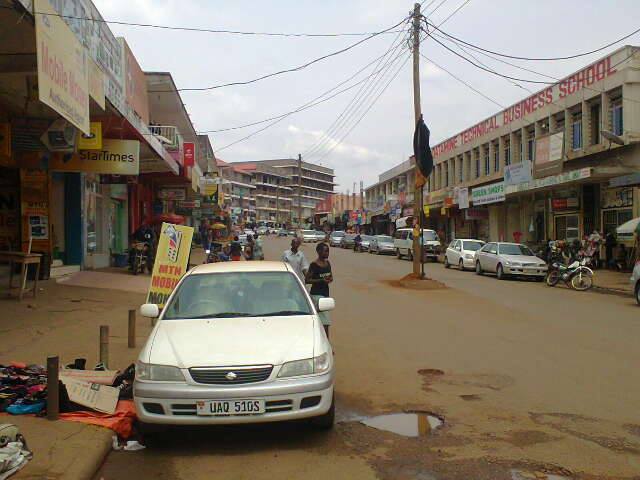
Masaka is a city in the Buganda Region in Uganda, west of Lake Victoria.[2] The city is the headquarters of Masaka District.[3]
Location
[edit]Masaka is approximately 132 kilometres (82 mi) to the south-west of Kampala on the highway to Mbarara.[4] The city is close to the Equator. The coordinates of Masaka are 0°20'28.0"S, 31°44'10.0"E (Latitude:-0.341111; Longitude:31.736111).[5] Masaka lies at an average elevation of 1,288 metres (4,226 ft) above sea level.[6]
History
[edit]Masaka was founded as a township in 1953. It became a town council in 1958 and a municipality in 1968.[7]
Masaka, being one of the most developed districts during the conflicts for power that occurred after Ugandan gained its independence, was a strategically important location during the Uganda–Tanzania War (1978–79), and was accordingly garrisoned by Uganda Army troops. These soldiers terrorized the local civilians, prompting most to flee the town. On 23–24 February 1979, the Tanzania People's Defence Force and allied Ugandan rebels attacked the settlement, resulting in the Battle of Masaka. The town was bombarded with artillery, and fell to the Tanzanian-led forces after light resistance. The Tanzanians subsequently levelled much of the town to take revenge for atrocities committed by the Uganda Army during its previous invasion of northwestern Tanzania.[8]
In course of the Ugandan Bush War, Masaka again suffered from fighting. The town was garrisoned by the Uganda National Liberation Army which served as Uganda's national army at the time. In late 1985, National Resistance Army rebels laid siege to the town. After heavy combat, Masaka's garrison surrendered on 10 December 1985.[9]
In 2019 the Cabinet of Uganda, resolved to award Masaka, city status effective July 2023.[2][10] In November of the same year, Cabinet revised the date of city status to 1 July 2020.[11]
As of June 2021, the city of Masaka occupied a total area in excess of 100 square kilometres (25,000 acres). Masaka City Council, with assistance from the Central Ugandan government and the World Bank is in the process of implementing major road and street improvements, as part of the Municipal Infrastructure Development (USMID) program. The city has a working budget of USh73 billion (approx. US$21 million), in the 2020/2021 financial year.[12]
Population
[edit]According to the 2002 national census, the population of Masaka was about 67,800. In 2010, the Uganda Bureau of Statistics (UBOS) estimated the population at 73,300. In 2011, UBOS estimated the mid-year population at 74,100.[13] In August 2014, the national population census put the population at 103,829.[14]
In 2020, UBOS estimated the mid-year population of Masaka City at 116,600 people. The population agency calculated the population growth rate of the town to average 2.11 percent, between 2014 and 2020.[15] The 2024 national census enumerated the people in Masaka City at 285,509.[1]
| Year | Pop. | ±% |
|---|---|---|
| 1969 | 12,987 | — |
| 1980 | 29,123 | +124.2% |
| 1991 | 49,585 | +70.3% |
| 2002 | 67,768 | +36.7% |
| 2014 | 103,227 | +52.3% |
| 2020 | 116,600 | +13.0% |
| 2024 | 285,509 | +144.9% |
| source:[15][1] | ||
Overview
[edit]


In 2016, before the metropolis attained city status, Masaka occupied 58 square kilometres (22 sq mi). It was divided into three administrative divisions, (a) Katwe-Butego (b) Kimaanya-Kyabakuza and (c) Nyendo-Mukungwe. It is further subdivided into 54 zones.[7]
The annual Uganda Marathon event takes place in June, the race route loops twice through the town and the funds generated support local employment and community development.[citation needed]
Points of interest
[edit]The following points of interest are located in Masaka or close to its borders: (a) the offices of Masaka City Council (b) Masaka central market (c) the headquarters of the Mechanized Brigade of the Uganda People's Defense Force[16] (d) the main campus of Muteesa I Royal University[17] (d) Western Campus of Kampala University (e) St. Henry's College Kitovu.[18]
Other points of interest include (f) the headquarters of the Roman Catholic Diocese of Masaka[19] (g) Lake Nabugabo, 20 kilometres (12 mi) to the east of downtown Masaka.[20] (h) Bukakkata, on the shores of Lake Victoria, about 36 kilometres (22 mi) east of Masaka.[21] (i) Masaka Regional Referral Hospital (j) Masaka Currency Center, a currency storage and processing facility owned and operated by the Bank of Uganda, Uganda's central bank.[22] (k) A branch of the National Social Security Fund, (l) The Office of 24 Tech Time (U) Ltd, (m) The Head Office of Mikando Chicken online restaurant, (o) City View Complex, (p) St. Paul's Cathedral - Kako which is the Headquarters of West Buganda Diocese under the Church of Uganda and (q) Radio Buddu FM.
Hamda Vocational and Social Institute
[edit]Hamda Vocational and Social Institute is an institute, Emirati women philanthropist Hamda Taryam was a well-known philanthropist in Masaka Uganda who initiated this charitable projects aims to qualify students professionally for the labour market. The foundation provides free training to orphan students, ensuring they qualify for the market, with proceeds going towards humanitarian and charitable projects sponsored by the Foundation[23][24][25]
Notable people
[edit]- Edward Ssekandi, Vice President of Uganda
- Herman Basudde late performing artist
- Charles Peter Mayiga Katikkiro of Buganda
- Erias Lukwago Lord Mayor Kampala City
- Mathias Mpuuga Former Leader of the Opposition in Parliament
- (Edrisa Musuuza), Performing Artist
- Wilson Bugembe musician
- Mukasa Mbidde politician and economist
- Dr. Owen Emmanuel Sseremba Scholar and Reseacher at Makerere University. Former Chairman Masaka District Land Board and President of the Alumni of St. Henry's College Kitovu.
See also
[edit]- List of cities and towns in Uganda
- Masaka Sports Stadium
- Kirimya Town: A town where bulking of labour at a huge camp was in teh 1940s and 1950s. This collection centre was used screen workers to be exported to sugar and tea plantations in the country such as Sangobay, Kinyara, Kakira, Fortportal and Namutamba.
Photos
[edit]References
[edit]- ^ a b c Farish Magembe (28 June 2024). "Masaka City Mayor Rejects Census Results". Nile Post Uganda. Kampala, Uganda. Retrieved 3 November 2024.
- ^ a b Franklin Draku (22 May 2019). "Cabinet Elevates 15 Municipalities To Cities". Daily Monitor. Kampala. Retrieved 1 June 2019.
- ^ Fields, Megan (December 2009). "Masaka: Big Shoes, Small Feet". Wordpress.com (Megan Fields Blog). Archived from the original on 18 April 2014. Retrieved 17 April 2014.
- ^ "Road Distance Between Kampala, Uganda And Masaka, Uganda" (Map). Google Maps. Retrieved 28 April 2021.
- ^ "Location of Masaka City At Google Maps" (Map). Google Maps. Retrieved 1 June 2019.
- ^ Floodmap (2018). "Elevation of Masaka, Uganda". Floodmap.net. Retrieved 3 June 2019.
- ^ a b Martins Ssekweyama (15 June 2016). "Masaka Town Expands To Get City Status". Daily Monitor. Kampala. Retrieved 1 June 2019.
- ^ Cooper & Fontanellaz 2015, pp. 30–31.
- ^ Cooper & Fontanellaz 2015, pp. 49–50.
- ^ Isa Aliga, and Al-Mahdi Ssenkabirwa (10 June 2019). "Kabaka Faults Government On Delayed Masaka City Status". Daily Monitor. Kampala. Retrieved 11 June 2019.
- ^ Kungu Al-Mahadi Adam (5 November 2019). "Cabinet Includes Masaka, Mbale Among New Cities To Be Operational In 2020". Kampala: SoftPower Uganda. Retrieved 6 November 2019.
- ^ Wilson Kutamba (17 June 2021). "Masaka USMID roads construction starts". Daily Monitor. Kampala. Retrieved 19 June 2021.
- ^ "Estimated Population of Masaka In 2002, 2010 & 2011" (PDF). Uganda Bureau of Statistics. Archived from the original (PDF) on 7 July 2014. Retrieved 17 April 2014.
- ^ UBOS (27 August 2014). "The Population of The Regions of the Republic of Uganda And All Cities And Towns of More Than 15,000 Inhabitants". Citypopulation.de Quoting Uganda Bureau of Statistics (UBOS). Retrieved 22 February 2015.
- ^ a b Uganda Bureau of Statistics (14 June 2020). "Masaka Population Statistics" (Citypopulation.de Quoting Uganda Bureau of Statistics). Citypopulation.de. Kampala. Retrieved 29 April 2021.
- ^ "Location of UPDF Mechanized Brigade Barracks" (Map). Google Maps. Retrieved 1 June 2019.
- ^ Campus Times Reporter (15 January 2014). "Courses offered at Muteesa I Royal University". Kampala: Campus Times Uganda. Retrieved 1 June 2019.
- ^ "Location of St. Henry's College Kitovu, Masaka, Uganda" (Map). Google Maps. Retrieved 1 June 2019.
- ^ David M. Cheney (June 2019). "About the Roman Catholic Diocese of Masaka". Kansas City: Catholic-Hierarchy.org. Retrieved 1 June 2019.
- ^ Lake Nabugabo Terrace View Beach (2014). "Location of Lake Nabugabo". Lake Nabugabo Terrace View Beach. Retrieved 1 June 2019.
- ^ Globefeed.com (1 June 2019). "Distance between Masaka, Uganda and Bukakata, Uganda". Globefeed.com. Retrieved 1 June 2019.
- ^ "Bank of Uganda Maintains A Currency Center In Masaka". Bank of Uganda. Archived from the original on 19 April 2014. Retrieved 17 April 2014.
- ^ "Emirati racer dies: Sharjah Ruler grants Dh1 million for Hamda Taryam's unfinished charity projects".
- ^ "Sharjah ruler allocates Rs 2 cr to complete Hamda Taryam's charitable projects". 29 January 2024.
- ^ "Tributes pour in for young Emirati drag racer Hamda Taryam". 30 January 2024.
Works cited
[edit]- Cooper, Tom; Fontanellaz, Adrien (2015). Wars and Insurgencies of Uganda 1971–1994. Solihull: Helion & Company Limited. ISBN 978-1-910294-55-0.
External links
[edit]Masaka
View on GrokipediaGeography
Location and Topography
Masaka is situated in the Central Region of Uganda, approximately 130 kilometers southwest of the capital city Kampala along the Kampala–Masaka Road, which connects to the Trans-African Highway extending toward Rwanda.[1][7] The city's geographic coordinates are roughly 0°20′S latitude and 31°44′E longitude.[8] Positioned west of Lake Victoria, Masaka serves as the headquarters of Masaka District.[9] The topography of Masaka features a rolling landscape with undulating hills and valleys, including swampy bottoms in lower areas.[9] The region is dotted with bare hills, and soils vary across red laterites, sandy loams, and loams, supporting agricultural activities.[9] The city lies at an average elevation of 1,288 meters above sea level, contributing to its temperate climate relative to lowland areas.[7] The surrounding Masaka District covers about 1,023.7 square kilometers of such terrain.[9]Climate and Environment
Masaka experiences a tropical rainforest climate (Köppen classification Af), characterized by high humidity, consistent warmth, and significant rainfall throughout the year. The average annual temperature is 21.1 °C (70.0 °F), with minimal seasonal variation due to its equatorial location.[10] Annual precipitation totals approximately 1,231 mm (48.5 inches), distributed across two wet seasons, typically from March to May and September to November.[10] [11] April is the wettest month, receiving an average of 156 mm (6.1 inches) of rain, while drier periods occur in June to August and December to February, though no month is entirely dry.[12] [11] The region sees about 243 rainy days per year, accounting for roughly 67% of the time, which supports lush vegetation but also contributes to occasional flooding in low-lying areas.[13] Environmentally, Masaka lies in Uganda's central region near Lake Victoria, featuring a landscape of wetlands, swamps, grasslands, and remnant tropical forests, particularly in areas like Sango Bay and Nabajjuzi Swamp.[14] [15] Nabajjuzi Wetland, a Ramsar-designated site, hosts diverse ecosystems including papyrus swamps that sustain threatened species such as the sitatunga antelope, shoebill stork, and papyrus gonolek.[15] [16] These habitats provide essential services like water purification, flood control, and grazing lands, integral to local livelihoods.[17] Biodiversity in the surrounding Masaka District includes tropical high forests and wetland-dependent flora and fauna, with conservation efforts like biodiversity offsetting credited for a 21% increase in forest cover in some protected areas through species restoration.[18] However, human pressures have led to environmental degradation, including wetland encroachment for agriculture and settlement.[19] Deforestation poses a significant challenge, with Masaka losing 18.6 thousand hectares of tree cover between 2001 and 2024, representing an 18% decline from 2000 levels and emitting 9.90 million tons of CO₂ equivalent.[20] This loss exacerbates soil erosion, land conflicts, and reduced carbon sequestration, compounded by broader Ugandan trends linked to population growth and agricultural expansion.[19] [21] Local initiatives in Masaka City address these issues through waste management, plastic reduction, noise control, and wetland restoration, led by municipal leadership to promote sustainability.[22]History
Pre-Colonial and Colonial Foundations
The territory encompassing modern Masaka formed part of Buddu, a county annexed by the Buganda Kingdom in the mid-18th century under Kabaka Jjunju during conflicts with Bunyoro, marking it as the last major acquisition before European contact.[23] Prior to incorporation, Buddu hosted Bantu clans engaged in subsistence agriculture, cattle herding, and ironworking, with its landscape of hills and lakes supporting banana cultivation and fishing communities.[24] Buddu held ritual significance in Buganda, serving as a site for royal shrines consulted by kabakas prior to military campaigns, reflecting the kingdom's centralized spiritual and political authority.[25] Buganda's expansion into Buddu integrated local polities into its hierarchical structure, governed by appointed chiefs under the kabaka's overlordship, with tribute systems emphasizing loyalty through land allocation and military service.[26] Pre-colonial society in the region emphasized clan-based organization, where extended families managed communal lands for staple crops like matooke (plantains), supplemented by trade in ivory and salt with neighboring kingdoms such as Ankole and Karagwe.[24] This era saw no permanent urban settlements, but nucleated villages clustered around chiefly courts, fostering a proto-state economy reliant on labor mobilization for raids and agriculture rather than monetized exchange. Under British rule, following the 1894 declaration of the Uganda Protectorate, Masaka emerged as an administrative outpost in southern Buganda, formalized through the 1900 Buganda Agreement that allocated mailo land estates to Ganda elites while reserving crown lands for colonial oversight.[27] Around 1900, Indian merchants, arriving via British-facilitated migration from East Africa, established Masaka as a trading center, leveraging its position on caravan routes to Tanzania for cotton, coffee, and groundnut exports; pioneers like Allidina Visram's networks laid the groundwork for dukas (shops) handling imported textiles and hardware.[28] Colonial infrastructure, including roads linking to Mbarara and the railway extension plans by the 1920s, transformed it into a cotton ginnery hub, with British administrators appointing county chiefs to enforce cash crop quotas amid resistance from subsistence farmers.[27] By the interwar period, Masaka's population swelled with Asian traders numbering in the hundreds, underpinning a dual economy of export agriculture and local barter, though ethnic tensions simmered over land access between Ganda landlords and immigrant laborers.[29]Post-Independence Developments
Masaka's administrative boundaries were expanded, and its status was upgraded from town council to municipality in 1968, incorporating areas such as Nyendo/Senyange and Kimaanya.[30] This change reflected the town's growing population and its increasing importance as a commercial and administrative center in southern Uganda, building on its pre-independence foundations as a township established in 1953.[2] The Masaka Cooperative Union, registered in 1951 to consolidate coffee farmers and enhance their bargaining power against middlemen, expanded operations in the post-independence era.[31] By the mid-1960s, it supported local production of cash crops like coffee and cotton, contributing to the region's integration into Uganda's export-oriented agricultural economy, which saw cooperative turnover rise from approximately £9 million in the early 1960s to higher levels by 1970 amid national growth policies.[32] These efforts empowered smallholder farmers in Masaka District, one of Uganda's 17 original districts at independence, through collective marketing and processing.[33] Political developments at the national level, including Buganda's initial federal autonomy under the 1962 independence constitution and its subsequent abolition in 1966 following Prime Minister Milton Obote's military actions against Kabaka Mutesa II, created regional tensions that indirectly influenced Masaka's governance as part of the Buganda sub-region.[34] Despite these shifts toward centralized control, local administrative functions in Masaka persisted without major disruptions until Idi Amin's 1971 coup.[35]Amin Dictatorship and the Battle of Masaka
Idi Amin seized power in Uganda through a military coup on 25 January 1971, rapidly consolidating control over key southern towns including Masaka, where his loyalist forces in approximately 27 trucks secured the local military post amid minimal opposition.[36] His regime, lasting until 1979, imposed brutal repression nationwide, with credible estimates attributing 300,000 to 500,000 deaths to state-sponsored killings, torture, and purges targeting perceived opponents, particularly from Acholi, Langi, and other ethnic groups.[37] In Masaka, a predominantly Baganda and Catholic area, repression manifested in targeted arrests, such as the detention of 54 Catholics in February 1978 amid broader campaigns against religious and political dissidents. Amin's "economic war" further devastated Masaka's commercial vitality; the August 1972 expulsion of around 70,000 Asians—many of whom dominated trade, retail, and manufacturing—led to widespread business collapses, supply shortages, and hyperinflation across Ugandan towns, including Masaka, where Asian enterprises had been central to the cotton and coffee-based economy.[38] [39] African Ugandans tasked with taking over these enterprises often lacked capital, skills, or infrastructure support, resulting in rapid asset deterioration and agricultural decline, with cotton production in the Masaka region—previously a key export—plummeting due to disrupted markets and forced relocations.[38] The regime's collapse accelerated during the Uganda–Tanzania War, triggered by Amin's invasion of Tanzania's Kagera Salient on 30 October 1978, which prompted a Tanzanian counteroffensive.[40] By early 1979, Tanzanian forces, supported by Ugandan exile groups like the Uganda National Liberation Army, advanced into southern Uganda. The Battle of Masaka unfolded around 22–24 February 1979, when Tanzanian troops encountered token resistance from Amin's demoralized and undersupplied army before capturing the town, approximately 130 kilometers southwest of Kampala.[41] This swift victory—facilitated by Ugandan defections and poor leadership under commanders like Isaac Maliyamungu—severed Amin's supply lines from Tanzania and signaled the disintegration of his southern defenses, paving the way for the liberation of Entebbe and Kampala by late April 1979.[42] The fall of Masaka underscored the regime's military fragility, with Amin's forces abandoning heavy equipment and fleeing northward, hastening his exile on 11 April 1979.[41]Post-Amin Recovery and Modern Era
Following the overthrow of Idi Amin's regime in April 1979, Masaka lay in near-total devastation from the Uganda-Tanzania War, with much of its infrastructure—including government offices, commercial buildings, homes, and the local economy—reduced to rubble after intense bombardment and abandonment as a ghost town.[43] [44] Recovery efforts under the subsequent Milton Obote II government (1980–1985) were limited amid national instability, exacerbated by the Ugandan Bush War; Masaka experienced further disruption, including a prolonged siege from September to December 1985 by National Resistance Army (NRA) forces against Uganda National Liberation Army holdouts.[45] [2] The accession of Yoweri Museveni's National Resistance Movement (NRM) to power in January 1986 marked a turning point, with targeted restoration initiatives under NRM development plans, including the 10- and 15-point programs and subsequent five-year plans, focusing on infrastructure rehabilitation, agricultural revival, and urban renewal to transform Masaka from wartime ruins into a functional regional center.[43] [44] These efforts rebuilt key sectors, such as the once-dominant cooperative movement exemplified by the Masaka Cooperative Union, which supported coffee and cash crop production central to the local economy.[45] However, reconstruction proceeded unevenly, with Masaka receiving comparatively less post-war aid than other war-affected areas like the north, leading to perceptions of prolonged neglect despite its historical sacrifices in national liberation struggles.[45] In the modern era since the 2000s, Masaka has evolved into a key commercial hub in southern Uganda, leveraging its proximity to Lake Victoria and fertile lands for agro-processing, trade, and small-scale industry, though challenges like uneven infrastructure investment persist.[46] The town achieved city status in July 2020 as part of Uganda's urbanization push, enabling expanded administrative capacity and attracting private enterprises that contribute to local GDP through services and manufacturing.[44] [47] Politically, Masaka remains a contested area with strong Buganda regional identity, influencing electoral dynamics, but sustained NRM governance has prioritized stability and incremental growth over rapid transformation.[45]Demographics
Population Trends
The population of Masaka municipality stood at 67,800 according to the 2002 national census conducted by the Uganda Bureau of Statistics (UBOS).[48] By the 2014 census, this had increased to 103,829 residents, reflecting an average annual growth rate of approximately 3.6% over the intervening period, driven by natural increase, rural-urban migration, and economic opportunities in agriculture and trade.[49] [50] Masaka was elevated to city status in July 2020, incorporating the former municipality along with adjacent areas such as Nyendo-Senyange Town Council and Kima, thereby expanding its administrative boundaries and population base.[1] The 2024 national census, with a reference night of May 9, enumerated Masaka City's population at 285,509, marking a substantial rise from the 2014 municipal figure, though direct comparability is limited due to the boundary changes.[51] This growth aligns with Uganda's national average annual rate of 2.9% between 2014 and 2024, influenced by high fertility rates, improved healthcare access, and influxes from surrounding rural districts.[52] Local authorities, including Masaka City Mayor Noah Mukiibi, have disputed the 2024 census results, arguing they underestimate the population by up to 73,918 compared to internal 2018 projections, potentially affecting resource allocation and revenue sharing.[51] Despite such contention, UBOS data indicate sustained urbanization trends, with projections prior to the census estimating around 211,591 residents based on 2014 benchmarks and national growth patterns.[1]| Census Year | Population | Administrative Unit | Annual Growth Rate (from prior census) |
|---|---|---|---|
| 2002 | 67,800 | Municipality | - |
| 2014 | 103,829 | Municipality | ~3.6% |
| 2024 | 285,509 | City | ~4.1% (adjusted for boundaries) |
