Hubbry Logo
Masirah IslandMasirah IslandMain
Open search
Masirah Island
Community hub
Masirah Island
logo
8 pages, 0 posts
0 subscribers
Be the first to start a discussion here.
Masirah Island
Masirah Island
from Wikipedia

Masirah Island (Arabic: جَزِيْرَة مَصِيْرَة, romanizedJazīrat Maṣīrah), also referred to as Mazeira Island, is an island off the east coast of mainland Oman in the Arabian Sea, and the largest island of the country. Administratively, it forms one of the five provinces (Wilayah, plural Wilayat) of the Ash Sharqiyah South Governorate, namely Wilāyat Maṣīrah (Arabic: وِلَايَة مَصِيْرَة); previously it was a province of the Ash Sharqiyah Region.

Key Information

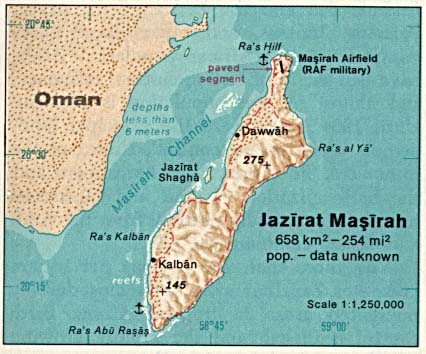
Masirah is 95 km (59 miles) long north–south, between 12 and 14 km (7.5 and 8.7 miles) wide, with an area of about 649 km2, and a population estimated at 12,000 in 12 villages mainly in the north of the island (9,292 as of the census of 2003, of which were 2,311 foreigners). It is divided from the mainland by the Masirah Channel. Most of the island's interior is deserted, with access to the island possible by ferry on National Ferries Company (NFC) or smaller privately owned ferries for cars and passengers. Salam Air also flies to Masirah weekly.

The principal village of Wilayat Masirah is Raʾs-Ḥilf (Arabic: رَأْس حِلْف) in the northern part of the island. It contains a Royal Air Force of Oman air base and a fish factory, as well as a few small towns. Previously, the BBC had a relay facility consisting of both HF and MF broadcasting transmitters stationed there. The main industries are fishing and traditional textile manufacturing. Formerly, traditional shipbuilding was important.

Geography

[edit]
A dhow with the island in the background
Masirah Lighthouse
Map
LocationMasirah Island, Oman Edit this at Wikidata
Coordinates20°10′17″N 58°38′23″E / 20.171333°N 58.639611°E / 20.171333; 58.639611
Tower
Constructed2014 Edit this on Wikidata
Constructionconcrete (foundation), fiberglass (tower) Edit this on Wikidata
Height10 m (33 ft) Edit this on Wikidata
Shapecylinder Edit this on Wikidata
MarkingsStripe (red and white, horizontal orientation) Edit this on Wikidata
Power sourcesolar power Edit this on Wikidata
Light
Focal height89 m (292 ft) Edit this on Wikidata
CharacteristicFl W 10s Edit this on Wikidata

Located about 19 km (12 miles) off the east side of Barr al Hikman, the island is generally hilly, especially on its east side. The hills along the east side of the island are separated from the island coast by a narrow sandy plain; they run nearly its entire length. A steep plateau stands in the middle of the range on the northeast side of the island. Along the west side of the island, there are a few low hills separated from the east range by an extensive sandy plain marked by several hillocks:[2]

  • Jabal Madrub, a 256 m (840 ft) high mountain, stands about 13 km (8.1 miles) south of the north end of the island.
  • Ras Abu Rasas, the south extremity of Al Masirah, is low and rocky. Jabal Suwayr (Jabal al Hilm), a conspicuous conical hill, rises to a height of 153 m (502 ft), about 3 km (1.9 miles) north-northeast of Ras Abu Rasas. It houses the Masirah lighthouse.[3]
  • Ras Kaydah, a small and rocky headland, has a conspicuous, conical hill about 20 m (66 ft) high nearby. There are small islets 600 m (2,000 ft) east and 4 km (2.5 miles) north of Ras Kayda.
  • The coast between Ras Kaydah and Ras Zafaranat, about 27 km (17 miles) to the northeast, is regular with a few small rounded projections and a low rocky beach. Haql (Hakkan), a small village in a grove of trees, lies close to the shore about eight km north of Ras Kaydah.
  • Ras Zafaranat is rocky with hills rising abruptly. Between Ras Abu Rasas and Ras Kaydah, about 18 km (11 miles) to the northeast, the coast is indented by small, sandy bays fringed by rocks.
  • Ras al-Ya, about 3 km (1.9 miles) northeast of Ras Zafaranat, is the east extremity of the island and consists of a prominent bluff rising to a ridge of hills which extend westward to the center of the island. A conspicuous peak, 99 m (325 ft) high, stands about 3 km (1.9 miles) west-northwest of Ras al-Ya.
  • Jabal Madrub rises about 5 km (3.1 miles) farther west-northwest.
  • Ras al-Jazirah, about six km north-northwest of Ras al-Ya, is rocky and well-marked by a black patch on its south side. A sharp peak, rising to a height of 95 m (312 ft), stands about 3 km (1.9 miles) west of this point.
  • Jazirat Thukhayr, a sandy islet close north of Ras al-Jazirah, lies on a drying reef connected to the shore. Drying rocks extend up to 300 m (980 ft) off the eastern extremity of the islet.
  • The coast between Ras al Jazirah and Ras Qudufah, the northeast extremity of the island, about 11 km (6.8 miles) further north-northwest, is indented by a bay. Ras Qudufah, consisting of two rocky projections about 800 m (2,600 ft) apart, rises to Jabal al-Jidufa, about 64 m (210 ft) high, a short distance inland. A cairn stands on a hill close south of Jabal al-Jidufa, and a small monument stands close southwest of Ras Qudufah.

Landscape

[edit]

The rugged terrain of the island and surrounding rough coastline has led to the appearance of many wrecked dhows on the beaches of the island, most of them well preserved by the salt water and intense heat. On 21 September 1835, the USS Peacock grounded on a coral reef.[4]

The ocean bottom environment surrounding Masirah is hostile as the majority of the area is covered in either sand or hard rock. There is a swift current flowing through the area with a very sharp halocline visible on the surface of the ocean. The water depth nearby is around 10 m and is not conducive to side-scan sonar searches due to the shallow water and choppy surface conditions. Despite the poor quality ocean bottom, the area is very productive with marine fisheries, and any hard objects (barrels, engines) are immediately colonised by local fauna.

During summer there is normally a constant strong wind which is ideal for kite and windsurfers. Big waves are a result of the wind on the sea side and is so also attractive for wave surfers. Kite and windsurfers can pick spots around the island according to their skill and what conditions they prefer.[5] On 5–6 June 2007, 7000 people on the island were forced to temporarily leave their homes due to the high storm waves produced by the powerful Cyclone Gonu, the strongest to hit the Persian Gulf region in 60 years.

Ecology

[edit]

The island is an important hatching ground for loggerhead sea turtles, similar in importance to the beaches at Ras al Hadd and nearby Ras al-Jinz as a hatching ground for green sea turtles.[6] A critically endangered local population of humpback whales also migrate in the waters surrounding the island and Masirah gulf.[7][8] The island has been designated an Important Bird Area (IBA) by BirdLife International because it supports many species of waders and seabirds, as well as Egyptian vultures.[9]

Climate

[edit]

Saiq has a hot desert climate (Köppen climate classification BWh) with hot summers and warm winters. Precipitation is low, and falls mainly from February to April as well as in the brief monsoon season from June to August.

Climate data for Masirah Island (1991–2020 normals, extremes 1980–2023)
Month Jan Feb Mar Apr May Jun Jul Aug Sep Oct Nov Dec Year
Record high °C (°F) 32.4
(90.3)
35.7
(96.3)
40.6
(105.1)
42.7
(108.9)
45.0
(113.0)
47.2
(117.0)
41.6
(106.9)
41.4
(106.5)
39.5
(103.1)
41.5
(106.7)
37.0
(98.6)
32.2
(90.0)
47.2
(117.0)
Mean daily maximum °C (°F) 26.6
(79.9)
27.7
(81.9)
30.4
(86.7)
34.1
(93.4)
36.0
(96.8)
34.9
(94.8)
32.1
(89.8)
31.1
(88.0)
31.5
(88.7)
32.6
(90.7)
30.3
(86.5)
27.8
(82.0)
31.3
(88.3)
Daily mean °C (°F) 23.0
(73.4)
23.6
(74.5)
26.1
(79.0)
29.7
(85.5)
31.6
(88.9)
30.8
(87.4)
28.3
(82.9)
27.5
(81.5)
27.8
(82.0)
28.3
(82.9)
26.8
(80.2)
24.3
(75.7)
27.3
(81.2)
Mean daily minimum °C (°F) 19.2
(66.6)
19.6
(67.3)
21.6
(70.9)
24.9
(76.8)
27.0
(80.6)
26.5
(79.7)
24.4
(75.9)
23.6
(74.5)
24.0
(75.2)
24.0
(75.2)
23.2
(73.8)
21.0
(69.8)
23.3
(73.9)
Record low °C (°F) 8.9
(48.0)
11.2
(52.2)
13.4
(56.1)
16.3
(61.3)
19.6
(67.3)
21.6
(70.9)
19.2
(66.6)
19.0
(66.2)
19.5
(67.1)
18.5
(65.3)
15.4
(59.7)
9.4
(48.9)
8.9
(48.0)
Average precipitation mm (inches) 7.5
(0.30)
16.3
(0.64)
12.5
(0.49)
10.2
(0.40)
1.5
(0.06)
21.1
(0.83)
11.6
(0.46)
9.9
(0.39)
0.4
(0.02)
0.0
(0.0)
1.2
(0.05)
6.9
(0.27)
99.1
(3.91)
Average relative humidity (%) 68 70 71 67 69 73 78 79 78 71 69 67 72
Mean monthly sunshine hours 287.2 259.1 297.3 311.2 346.6 268.6 238.1 248.0 283.6 317.9 299.5 288.9 3,446
Source 1: NOAA (precipitation, humidity and sun 1980-1990) [10]
Source 2: Starlings Roost Weather[11]

History

[edit]

Neolithic, Bronze Age and Iron Age archaeological sites are dotted over the island, with one study finding shell middens dating to 6000BC, stone axes from 3000BC and fish line sinkers from 4000BC[12] The Magan Civilization was present, with archaeological records from 2000-2700BC, Indus region pottery shards, and local copper mining in small quantities around 1500BC.

The Periplus of the Erythraean Sea, a periplus dated to between AD 40 and 70 describes Masirah island, then called Isle of Serapis:[13]

After sailing along it over open water for about 2000 stades from the Isles of Zenobios, you come to the Isle of Sarapis, as it is called, about 120 stades offshore. It is some 200 stades wide and 600 long and is populated by three villages and by holy men of the Ichthyophagi. They use the Arabic tongue and wear loincloths of palm leaves. The island has good supplies of fine-quality tortoise shell.

— Periplus of the Erythraean Sea, §33[14]

There was occupation by the Portuguese navy in the sixteenth century.[12] The modern history of the island is little researched, but it is known that the fishermen were accomplished sailors, constructed their own boats, and trade with the mainland was well advanced.[15] In the 1950s the sheikh lived on the East coast at Ra's al Ya.[16]

Military base

[edit]
The remains of the RAF fuel store on Masirah Island in 1984

The British established a military presence on Masirah in the 1930s. A small stone building, a fuel store for land based aircraft flying between Aden and Muscat, stood at the midpoint of the island on the west side, and had a stone above the door inscribed "RAF 1936".[17]

A dispute between British forces and the local inhabitants took place in 1942, led by one of two local sheikhs, who were eventually forced to flee the island.[18]

During WW II, The British paid the Sultan of Muscat a stipend of £18,000 per annum for affording British forces 'necessary facilities', which included Masirah. A Cabinet Office memorandum of 1945 recommended the acquisition of Masirah on a 99-year lease, US interests in the island notwithstanding (During World War II the United States also had a base on the island.). The Sultan was to be offered an annual payment of £3,750 with an initial premium of £7,500.[18] The base continued to expand into the 1970s, supporting British and Oman forces fighting insurgents during the Dhofar Rebellion and providing transit facilities for long-distance RAF flights.

The British military presence at RAF Masirah extended until 31 March 1977, when Sultan of Oman's Air Force (now the Royal Air Force of Oman) took over the base, which became first SOAF Masirah and then RAFO Masirah. In the 1970s, the base included a HF communications hub and a rear link to SAS units and British Royal Engineer Units based in Oman in support of the actions against rebels in the south of the country (RAF Salalah). United States' units used Masirah Island as a staging base in Operation Eagle Claw, the unsuccessful 1980 attempt to free US hostages then held in Iran. The island was subsequently used as a staging area for operations into Afghanistan in 2001.[17]

As of 2009, the American private military contractor DynCorp had a contract to staff and serve a US military storage-depot at this base.[19]

Radio Relay Station

[edit]

In 1966 Masirah took on a new role, it became the base for the British Middle East Relay Station. This was built by the British Diplomatic Wireless Service to be a relay station for the World Service of the BBC. The station had been previously based in Somalia and Perim called the East Africa Relay Station. These stations were both closed as the politics of the region changed. The station was badly damaged by a Hurricane in 1976 but was rebuilt and handed over to the BBC in 1985.[20]

Economy

[edit]

Historically, the island had copper ore mining dating back to the Bronze Age.[21] The fishing industry, building on a long tradition, is centered on the north coast, and includes a fish processing plant.[22]

Tourism

[edit]
Ferry preparing to sail for Masirah Island

Masirah Island opened for tourism in the 1990s.[23] One can still only get to the island by ferry, managed by the National Ferry Company, which runs six times a day between Shannah to Masirah.[24]

There are hotels and a kitesurfing camp. For kitesurfers, Masirah is an attractive spot in summer because of the monsoon winds which blow steadily at over 20 knots (37 km/h; 23 mph).[25] Rental cars are available on the island.

See also

[edit]

References

[edit]

Bibliography

[edit]
[edit]
Revisions and contributorsEdit on WikipediaRead on Wikipedia
from Grokipedia
Masirah Island is 's largest island, situated in the approximately 20 km off the eastern coast of the mainland near the southeastern . It extends 95 km north to south and measures 12 to 14 km in width, encompassing an area of about 649 km² with a of roughly 12,000 residents concentrated in 12 northern villages. The terrain consists of gently undulating desert plains interrupted by a central ridge of hills reaching up to 280 m, fringed by extensive sandy beaches and wadis that support sparse vegetation adapted to arid conditions. Inhabitants primarily sustain themselves through fishing, supplemented by employment at a longstanding airbase and nascent ventures. Ecologically, the island qualifies as a Key Area due to its mudflats, seagrass beds, and coral reefs that harbor diverse marine life, notably serving as a premier global nesting ground for loggerhead sea turtles and refuge for the , including a potentially unique Masirah identified through recent surveys. The strong, consistent winds also draw kitesurfers, positioning Masirah as an emerging destination for adventure sports amid its isolation and unspoiled natural features.

Geography

Location and Physical Features

Masirah Island lies in the , approximately 20 kilometers southeast of the Omani mainland coast near the town of Șūr. Centered at coordinates 20°17′ N and 58°42′ E , it forms part of Oman's . As the country's largest island, Masirah extends 95 kilometers north-south and varies from 12 to 14 kilometers in width, yielding a total land area of approximately 649 square kilometers. The island's terrain consists of gently undulating lowlands with a central of hills rising to a maximum of about 280 meters. Peripheral coastal plains border this spine, while the interior remains rugged and hilly overall. Average across the island measures roughly 11 meters above . Masirah features a 174-kilometer coastline blending sandy beaches with rocky cliffs and distinctive formations, such as the prominent Ras al-Ya on the eastern shore. These physical characteristics, including exposures of ophiolitic rock sequences indicative of ancient , shape the island's stark, arid landscape.

Climate

Masirah Island exhibits a hot desert climate (Köppen BWh), marked by consistently high temperatures, low variability, and scant . The annual average temperature stands at 26.3 °C (79.3 °F), with extremes rarely dipping below 17 °C (63 °F) or surpassing 38 °C (101 °F). totals approximately 99 mm (3.9 in) per year, distributed unevenly with negligible amounts in most months and a slight peak in due to peripheral Indian monsoon effects, though the island remains arid overall. Winters (December–February) are mild and mostly clear, featuring average highs of 27 °C (81 °F) and lows around 19 °C (66 °F), with minimal (under 10 mm monthly). Summers (May–September) intensify heat to highs over 35 °C (95 °F) in May–, coupled with skies, oppressive (muggy conditions persisting over 40% of days annually), and strong easterly winds averaging 17.4 mph (28 km/h) in .
MonthAvg. High (°C/°F)Avg. Low (°C/°F)Rainfall (mm/in)
Jan26/7918/658/0.3
Feb27/8019/6616/0.6
Mar30/8621/6913/0.5
Apr33/9224/7510/0.4
May35/9626/792/0.1
Jun35/9426/7821/0.8
Jul32/8924/7412/0.5
Aug31/8723/7310/0.4
Sep31/8723/730/0
Oct32/9023/730/0
Nov30/8622/711/0.04
Dec27/8120/687/0.3
The shamal winds occasionally exacerbate summer conditions, while the surrounding moderates extremes but contributes to year-round coastal humidity.

Natural Environment

Ecology and Geology

Masirah Island's is dominated by the Masirah Ophiolite, a Jurassic-aged oceanic crust obducted from the western during the late , forming the island's primary structural framework. This complex, dating to approximately 150 million years ago, comprises a classical sequence including serpentinites, gabbroic intrusions, an extensive sheeted dyke complex, pillow lavas, and associated sediments, with the igneous crust notably thin at 1.5–2.0 km and derived from (MORB)-type magmas. The formation exhibits two stacked nappes, is largely unmetamorphosed and faulted with folding, and represents a distinct geochemical signature from continental margin ophiolites like those in northern , indicating origin as Indian Ocean floor rather than supra-subduction zone crust. The island's ecology reflects a tropical desert environment shaped by its arid climate, with hot, windy summers influenced by the (reaching temperatures over 40°C and high humidity) and milder winters averaging 20–25°C, supporting sparse terrestrial dominated by drought-resistant shrubs and endemic adapted to sandy, rocky substrates. Coastal zones host biologically rich ecosystems, including fringing reefs, lagoons, and beaches critical for marine such as abundant , crustaceans, and mollusks. Masirah serves as a globally significant nesting site for loggerhead sea turtles (Caretta caretta), hosting one of the world's largest rookeries with long-term monitoring revealing population trends influenced by environmental pressures like predation and habitat disturbance. Terrestrial and avian includes over 298 bird species, many migratory, alongside mammals such as the vulnerable (Gazella arabica, formerly G. gazella) and the endemic subspecies of (Lepus capensis jefferyi), thriving in the island's semi-desert habitats amid low rainfall (under 100 mm annually) and saline soils. Human activities, including development and , pose threats to these ecosystems, prompting regeneration initiatives to preserve endemic flora and coastal features like turtle nesting beaches. The ophiolite's exposure influences , creating nutrient-poor, erosion-prone terrains that limit inland but enhance unique microhabitats for specialized .

Biodiversity and Wildlife

Masirah Island features arid coastal ecosystems supporting a range of marine and terrestrial , including significant populations of nesting s and migratory birds. The island's beaches serve as key nesting grounds for four : loggerhead (Caretta caretta), (Chelonia mydas), olive ridley (Lepidochelys olivacea), and hawksbill (Eretmochelys imbricata). Loggerhead turtles dominate, with estimates of up to 11,000 nesting females annually, making Masirah one of the world's largest sites for this . Olive ridley turtles nest uniquely alongside hawksbills on the same beaches, with females laying clutches of approximately 100-120 eggs. Nesting peaks from May to October, particularly June to August, though habitat pressures from coastal development and predation threaten populations. The island's fringing coral reefs harbor diverse , including , anemonefish, , and various corals, contributing to its biological richness. Terrestrial includes over 400 bird , many utilizing mudflats, beaches, wadis, and islets for resting, feeding, and nesting during migration. It qualifies as an due to congregations of waterbirds, with winter records of such as (Haematopus ostralegus, near-threatened), (Ciconia ciconia), (Circus aeruginosus), and (Pandion haliaetus, up to 58 individuals). Migratory shorebirds like greater sandplover, broad-billed sandpiper, and Terek sandpiper are notable, alongside terns such as bridled, great crested, Saunders's, and white-cheeked. Among mammals, the Masirah gazelle (, a ) persists as a key endemic component, with recent sightings during Oman's 2025 National Survey indicating population stability. Reptilian diversity includes snakes adapted to the island's scrubland. consists primarily of drought-resistant, salt-tolerant species, with some endemics in coastal zones, though overall remains sparse due to the hyper-arid . Conservation efforts, including habitat regeneration, aim to bolster these ecosystems amid threats from and human activity.

History

Pre-Colonial and Early Records

Archaeological surveys reveal human occupation on Masirah Island commencing in the period, with evidence of fisher-gatherer settlements established during the first half of the 6th millennium BCE. These early inhabitants arrived by boat, exploiting the island's coastal resources through maritime activities that included shellfish gathering and , as indicated by sites like Dah featuring shell middens and lithic tools. Such findings underscore Masirah's integration into broader networks, where black-painted pottery and artifacts suggest connections to mainland and beyond during this era. Subsequent periods show continuity of settlement, with and sites documenting expanded resource use and cultural developments. A 2012 survey along the island's 150 km coastline identified 127 archaeological locations, yielding artifacts from these eras, including ceramics and tools linked to and maritime economies. evidence, such as coastal shell middens in south-central including Masirah, points to specialized subsistence strategies focused on marine exploitation, with faunal remains dominated by gastropods and bivalves. German expeditions in the early further documented second-millennium BCE finds, including Wadi Suq period burials and settlements, reinforcing the island's role in regional trade routes. No textual records from ancient civilizations explicitly reference Masirah prior to Islamic times, with historical knowledge relying on archaeological data rather than written accounts from Mesopotamian, Egyptian, or classical sources. This paucity of epigraphic aligns with the island's peripheral position in early Near Eastern documentation, though its implies participation in the Magan polity's maritime exchanges. Pre-colonial habitation thus appears sustained by local adaptations to the arid environment and , without indications of large-scale or centralized until later periods.

British Colonial Period

The Royal Air Force's interest in Masirah Island arose in the late amid Britain's efforts to develop reliable air routes across its imperial territories, particularly linking to and . In 1929, the RAF established an unmanned staging post on the island to serve as a refueling and emergency landing site for aircraft traversing the . This initiative reflected Britain's strategic need to secure aerial supply lines without permanent garrisons, leveraging Oman's semi-autonomous status under the Sultanate of , where British influence was exerted through advisory roles and treaties rather than direct territorial control. In , RAF survey teams, including personnel under R. L. Ragg, conducted detailed assessments of Masirah's terrain and coastal features to evaluate its viability as a forward operating point. These expeditions focused on identifying suitable sites for runways, anchorage for flying boats, and fuel depots, resulting in the of rudimentary facilities such as a small stone building for seaplane fuel storage by the early . By 1933, operational use intensified, with squadrons deploying Westland Wapiti and Vickers Heyford bombers to a makeshift strip near the island's Sur area for training and route patrols. By 1935, Masirah featured among a network of stocked RAF landing grounds in , including sites at Umm Rasas on the island itself, supporting the Muscat-Aden air route with provisions for extended flights. These developments were enabled by agreements with Sultan Taimur bin Feisal, who granted access in exchange for financial stipends, underscoring Britain's pattern of informal empire-building through logistical footholds rather than outright . The island's isolation and harsh conditions limited civilian impact, confining British activities to infrastructure that enhanced regional and rapid deployment capabilities.

World War II and Post-War Developments

During , Masirah Island emerged as a key British outpost in the , supporting Allied operations against Axis naval threats. In 1943, the RAF constructed an airfield on the island, establishing No. 33 Staging Post to facilitate staging and logistics for aircraft transiting between the and . No. 244 Squadron of , formed that year, operated from Masirah, conducting nocturnal anti-submarine patrols to counter activity in the . The base also included an unit and hosted limited U.S. military elements for coordinated wartime efforts. Logistical challenges defined operations, as the barren island lacked , , or other resources, necessitating all supplies—, food, and equipment—to arrive by sea via Arab dhows or larger vessels. To address internal transport needs, the RAF erected a narrow-gauge in 1943, linking the harbor to the airfield and enabling efficient distribution of materiel across the rugged terrain. Postwar, Masirah retained its strategic value as a staging hub for repatriating Allied prisoners of war following Japan's surrender in 1945, with functions persisting amid efforts. The upgrades from the war era, including , proved enduring for supply chains reliant on maritime imports, underscoring the island's isolation. British forces maintained the base through the late 1940s and into the early , leveraging it for regional surveillance and transit amid shifting geopolitical priorities in the Gulf. By 1945, an RAF Marine Craft Unit had been formalized, enhancing maritime support capabilities.

Omani Independence and Recent History

Following the palace coup on 23 July 1970, in which Sultan deposed his father and initiated Oman's Renaissance era of modernization and economic diversification, Masirah Island remained under significant British military influence as RAF Masirah supported operations against Dhofar Rebellion insurgents until the conflict's resolution in 1976. The base, established as a key staging post, facilitated air operations and logistics for Omani and British forces, with expansions including a 9,000-foot asphalt runway completed in 1962 to accommodate heavy such as Vulcans. On 31 March 1977, the Royal formally handed over Masirah Air Base to the of 's (later the Royal of ), marking the end of direct British operational control and integrating the facility into Omani sovereignty amid broader post-colonial transitions in the region. This transfer aligned with Oman's growing self-reliance, though the island retained strategic value; in 1980, and Washington signed a facilities access agreement allowing U.S. military use of Masirah for a decade, reflecting its continued geopolitical importance during the . In subsequent decades, Masirah transitioned toward civilian and under administration, with investments including the establishment of Masirah Island Resort by the Oman Tourism Development Company (OMRAN) featuring 16 deluxe rooms, suites, and chalets to promote . Recent initiatives have focused on and sustainability, such as the groundbreaking on 8 February 2025 for the RO 72 million ($187 million) Masirah Island Interconnection Project, which includes a 132 kV subsea cable spanning 25 kilometers to link the island's grid to the mainland, alongside a new 57 MW power plant operational since at least 2025. Additionally, a 2025 pilot oyster farming project aims for 39 tons of initial production by year's end, supporting diversification, while proposals for renewables-based energy gateways underscore efforts to harness solar and wind resources.

Military Significance

RAF Masirah Establishment and Operations

The Royal Air Force first surveyed Masirah Island in for use as a staging post for military and civil aircraft en route between the and , establishing an initial unmanned emergency landing ground there by the mid-1930s. This early setup included stocked facilities at sites like Umm Rasas on the island, supporting refueling and limited land-based operations amid growing regional air routes. By , Masirah formed part of a network of RAF emergency landing grounds in , including Shinas, Mirbat, and , to facilitate long-distance flights in the absence of reliable infrastructure. Full establishment of RAF Masirah as a formal station occurred in 1943 during , when a new airfield was constructed to serve as No. 33 Staging Post for flights between and , with refueling as its primary function. The base supported maritime reconnaissance and anti-submarine patrols, hosting units such as No. 244 Squadron of , which operated from Masirah after formation in 1943 for patrols over the . Post-war, operations continued as a key refueling and transit point for aircraft bound for the , maintaining a modest of around 60 personnel in the 1950s focused on logistics and basic maintenance amid the island's remote desert conditions. Routine activities emphasized airfield maintenance, fuel storage, and emergency diversions, with upgrades including a concrete runway constructed between 1963 and 1964 to mitigate flooding risks and enable heavier operations. The station's strategic isolation—supplied largely by sea until later airlifts—underlined its role in sustaining RAF mobility across the and beyond, though it remained secondary to mainland bases until regional conflicts elevated its profile. By the 1970s, detachments of various RAF squadrons rotated through for training and staging, handling increased traffic from Vulcan bombers and other jets prior to the base's .

Strategic Role in Conflicts

During , the airfield on Masirah Island, established as No. 33 Staging Post in 1943, supported anti-submarine patrols, anti-shipping operations, and maritime reconnaissance across the and . These activities bolstered Allied efforts to secure maritime routes against Axis threats, leveraging the island's isolated position for surveillance and staging. In the Cold War era, RAF Masirah functioned as a critical staging post for British operations in , including air support during the Jebel Akhdar Campaign of 1957–1959 and the Dhofar War from 1963 to 1976, where it facilitated troop movements, refueling, and logistics against communist-backed insurgents. The base hosted Victor tanker aircraft for in-flight refueling, enabling extended-range missions that were pivotal in suppressing rebellions threatening Omani stability and British regional interests. Masirah's strategic value extended to broader conflicts, serving as a transit hub during the 1971 Indo-Pakistani War for transports evacuating civilians from shelled areas. In the 1991 , the island's facilities became a primary for coalition forces, handling logistics for deployments against and peaking at over 3,000 personnel on site. This role underscored its geographic advantage for projecting power into the and chokepoints.

Transition to Omani Control

The handover of RAF Masirah to Omani control occurred on 31 March 1977, following the British military's withdrawal from its last major staging post after the resolution of Oman's Dhofar insurgency in 1976. This transition aligned with Britain's broader post-colonial retrenchment from the , leaving Masirah as a key asset for the newly consolidated Sultanate under , who had ascended in 1970 and prioritized modernization of Omani defenses. The base, operational since 1943 as a facility, had served as a logistical hub for reconnaissance, transport, and combat support during regional conflicts, including operations against communist-backed rebels in Dhofar. Upon transfer, RAF Masirah was redesignated under the Sultan of 's Air Force (later the Royal Air Force of , or RAFO), with British personnel departing and Omani forces assuming full operational responsibility. The handover included infrastructure such as runways, hangars, and fuel depots, which had been expanded during the and to support fighters, transports, and search-and-rescue units amid the Aden withdrawal and Gulf tensions. No significant resistance or disputes marked the process, reflecting stabilized bilateral relations forged during joint efforts; however, a in June 1977 shortly afterward damaged non-essential facilities like the internal railway, which the RAFO opted not to restore. Post-transition, Masirah retained strategic value for , hosting RAFO training and occasional allied detachments while pursued independent defense policies. In 1975, prior to the , Qaboos had offered the island's facilities to the for potential access, culminating in a 1980 facilities agreement that allowed periodic U.S. overflights and logistics support without permanent basing, underscoring 's pivot toward diversified partnerships amid dynamics in the Gulf. This shift emphasized Omani sovereignty over the island, transforming it from a colonial-era outpost into a national military asset integral to maritime surveillance and regional deterrence.

Economy and Infrastructure

Traditional Sectors

has historically dominated the of Masirah Island, serving as the primary for its roughly 5,000 inhabitants, who are mostly concentrated in the northern settlements. Artisanal methods prevail, involving small wooden vessels such as houris ( canoes), shashas (plank-built boats), and skiffs deployed from coastal launches for nearshore and offshore capture of species like kingfish, , and sardines. These practices, which account for a substantial portion of Oman's traditional fisheries output—estimated at up to 80% of the national catch—rely on manual gear like gillnets, handlines, and traps, with catches often processed onsite through sun-drying or salting for local consumption and mainland trade. The island's maritime heritage extends to traditional boat construction, particularly of the badan—a robust and prevalent in mid-20th-century operations—which supported both subsistence fishing and inter-island commerce until mechanized alternatives emerged. Archaeological records reveal continuous exploitation of from prehistoric periods, with shell middens and implements indicating that coastal and formed the economic backbone for millennia, adapting to the island's rugged terrain and seasonal winds. Agriculture remains negligible due to the arid and sandy soils, limiting cultivation to sporadic plots of drought-resistant crops like dates or near oases, while involves small-scale herding for milk and meat, supplemented by byproducts. These sectors sustain household-level self-sufficiency but contribute minimally to broader , with 's primacy reinforced by the island's isolation and reliance on sea-based protein sources amid scarce freshwater.

Tourism Development

Masirah Island's tourism sector emerged in the following the island's gradual opening to international visitors, evolving from a remote military outpost into a niche destination emphasizing natural attractions over mass development. The island's appeal lies in its 40-kilometer coastline of white-sand beaches, consistent winds ideal for kitesurfing and , and hotspots including nesting grounds and over 328 recorded bird species, drawing adventure and eco-tourists while preserving its underdeveloped character. Access relies primarily on services operated by the National Ferry Company, which transported 122,699 passengers to and from the island in the first half of 2024, a 22% increase from 100,591 the prior year, facilitating both locals and visitors despite weather-dependent schedules. Accommodation remains modest, with the Masira Island Resort—managed by state-owned OMRAN Group—offering 16 deluxe rooms, two suites, and four chalets overlooking the , alongside eight to ten hotel apartments, private chalets, and informal camping sites scattered across the island. In , total tourist arrivals reached 15,189, reflecting limited scale compared to Oman's mainland sites, though the island's isolation contributes to its allure for low-impact travel. Tourism activities center on water sports, , and guided turtle tours, with minimal commercial infrastructure to avoid ecological disruption, aligning with Oman's emphasis on sustainable practices amid concerns over overdevelopment's environmental toll. Under Vision 2040, which targets as a pillar of economic diversification with $31 billion in planned s by 2040, Masirah is positioned for controlled growth through involvement and upgrades. In June 2025, Kuwait's United Real Estate Company (UREC) signed a via its Omani subsidiary for a 60,000-square-meter complex, marking a significant foreign amid from GCC states, , and . Complementary projects include a proposed multipurpose to enhance maritime connectivity and a locally led ecological regeneration initiative prioritizing restoration alongside , ensuring developments integrate with the island's fragile ecosystems. These efforts aim to establish Masirah as a year-round destination, leveraging its stable climate and untapped potential without replicating high-volume models seen elsewhere in .

Modern Projects and Investments

In February 2025, Electricity Transmission Company initiated a RO 72 million ($187 million) project to connect Masirah Island to the national electricity grid, marking the island's first integration with the mainland power network. The includes a 132/33 kV grid station on the island, a 25 km 132 kV subsea cable, 14 km of onshore cable, and a 27 km 132 kV , expanding capacity beyond 200 MW while improving reliability and reducing reliance on diesel generation. This development supports 's Vision 2040 goals for energy sustainability and carbon emission reductions, positioning the island for expanded economic activities including and industry. In September 2025, launched its first pilot operation on Masirah Island, a RO 5 million initiative spanning two hectares with 3,600 baskets across six sea lines. seedlings were imported to establish the site, aimed at enhancing , diversifying non-oil exports, and aligning with Vision 2040's emphasis on sustainable fisheries. The project builds on the island's marine resources, potentially scaling to commercial production to reduce import dependence on . A May 2025 ecological regeneration initiative, driven by local stakeholders, integrates restoration with regenerative to counter development pressures on Masirah's . Complementing these, Dutch firms proposed a renewables-based energy gateway in April 2025 to further transition from fuels, though implementation details remain pending. Plans for a multipurpose , announced in early 2025, seek to bolster and trade as part of economic diversification, enhancing connectivity for exports and . These investments reflect Oman's strategic push to leverage Masirah's location for growth while addressing infrastructure gaps.

Environmental Conservation and Challenges

Sea Turtle Nesting Sites

Masirah Island serves as a critical nesting habitat for four sea turtle species: the loggerhead (Caretta caretta), green (Chelonia mydas), olive ridley (Lepidochelys olivacea), and hawksbill (Eretmochelys imbricata). The island's extensive sandy beaches, spanning its 70-kilometer coastline, provide the primary nesting grounds, with the arid, low-disturbance environment supporting high-density aggregations. Loggerhead turtles dominate the nesting activity, forming one of the world's largest rookeries, with up to 11,000 females recorded annually in recent assessments. Historical surveys from the late estimated around 30,000 nesting females, underscoring the site's global significance for this , which migrates to the island's eastern and southern beaches for reproduction. Green turtles nest in smaller numbers, primarily along similar coastal stretches, while olive ridleys and hawksbills occur sporadically, often in lower densities. Nesting seasons vary by species: loggerheads from May to September, greens from July to December, hawksbills from January to May, and olive ridleys aligning with broader regional patterns but less documented on Masirah. Peak activity for loggerheads occurs between June and August, when females emerge nocturnally to excavate nests in the supralittoral zone, depositing clutches of 80–120 eggs before returning to the . The island's isolation and lack of dense preserve these sites' integrity, though monitoring since 1977 has tracked fluctuations in nesting success tied to oceanic conditions and predation.

Threats from Human Activity

Human activities on Masirah Island, including fisheries, coastal development, and waste generation, pose significant risks to its biodiversity, particularly the (Caretta caretta) nesting population, which has experienced a documented decline of over 80% in nesting females since the 1980s. in fishing gear represents a primary marine threat, with nesting turtles intersecting high-risk fishing zones in the , where artisanal and industrial operations inadvertently capture juveniles and adults, contributing to elevated mortality rates. Annual net removal campaigns by local conservation groups have removed thousands of discarded nets from beaches prior to nesting seasons to reduce entanglement risks for hatchlings and females. Coastal development for and exacerbates degradation, including of nesting beaches and displacement of terrestrial species like the (Gazella arabica), which faces from expanding settlements and roads. from growing human settlements disorients hatchlings, directing them inland rather than seaward, while construction alters dune structures critical for nesting. , including plastics and waste accumulating on shores, entangles turtles and contaminates foraging areas, with reports of escalating trash volumes linked to increased visitor numbers and inadequate . Unsustainable fishing practices, such as of nearshore resources, further strain the by depleting prey for and disrupting food webs, compounded by traffic from ports that heightens collision risks. These pressures, if unmitigated, threaten the island's role as a key rookery for the critically endangered Masirah loggerhead subpopulation, underscoring the need for integrated management to balance with ecological integrity.

Conservation Initiatives

The primary conservation efforts on Masirah Island target the protection of its globally significant nesting populations, particularly loggerhead turtles (Caretta caretta), which feature one of the world's largest aggregations with up to 11,000 nesting females annually. The Environment Society of Oman (ESO) conducts ongoing surveys to track trends, nesting activity, and environmental threats, employing residents to define and map key nesting habitats while mitigating disturbances such as artificial lighting and beachfront development. Complementing these, the Masirah Turtle Conservation Project, initiated in collaboration with Oman's Ministry of Environment and Climate Affairs (now Environment Authority), has expanded to include year-round monitoring of loggerhead, , hawksbill, and olive ridley turtles since the early 2000s, with telemetry tracking of nesting females beginning in 2006 to map post-nesting migrations and foraging grounds. Hands-on interventions include large-scale beach cleanups, such as the 2017 volunteer effort that removed over 38 tons of discarded nets—known as "ghost gear"—from nesting beaches, reducing entanglement risks for and hatchlings. The Omani government has proposed designating beaches within the Masirah Island to safeguard nesting sites from habitat degradation, supported by international funding like U.S. grants for and enforcement. Organizations such as the Olive Ridley Project contribute through capacity-building for local patrols and data collection, emphasizing community involvement to address and . Broader ecological initiatives address terrestrial and marine biodiversity beyond . A locally driven regeneration project, launched around 2024 and backed by the British Omani Society, focuses on restoring through regenerative practices that enhance , vegetation cover, and coastal resilience while countering and . For the island's endemic (Gazella arabica masirahensis), Omani law prohibits hunting and capture, but enforcement remains limited; recent national surveys employ satellite tracking and camera traps to monitor populations and advocate for expanded protected zones. These efforts align with Oman's stricter environmental policies, though challenges persist due to growth and impacts, necessitating sustained funding and local governance.

References

Add your contribution
Related Hubs
User Avatar
No comments yet.