Hubbry Logo
Maxwell Air Force BaseMaxwell Air Force BaseMain
Open search
Maxwell Air Force Base
Community hub
Maxwell Air Force Base
logo
8 pages, 0 posts
0 subscribers
Be the first to start a discussion here.
Maxwell Air Force Base
from Wikipedia

Maxwell Air Force Base (IATA: MXF, ICAO: KMXF, FAA LID: MXF), officially known as Maxwell-Gunter Air Force Base, is a United States Air Force (USAF) installation under the Air Education and Training Command (AETC). The installation is located in Montgomery, Alabama, United States. Occupying the site of the first Wright Flying School, it was named in honor of Second Lieutenant William C. Maxwell, a native of Atmore, Alabama.

Key Information

The base is the headquarters of Air University (AU), a major component of Air Education and Training Command (AETC), and is the U.S. Air Force's center for Joint Professional Military Education (PME). The host wing for Maxwell-Gunter is the 42d Air Base Wing (42 ABW).

The Air Force Reserve Command's 908th Flying Training Wing (formerly Airlift Wing) is a tenant unit and the only operational flying unit at Maxwell. The 908 FTW supervises the 703d Helicopter Squadron (703 HS). The wing used to operate eight C-130H Hercules aircraft for theater airlift worldwide. As an AFRC airlift unit, the 908th used to be operationally-gained by the Air Mobility Command (AMC).

Gunter Annex is a separate installation under the 42 ABW. Originally known as Gunter Field, it later became known as Gunter Air Force Station (Gunter AFS) when its runways were closed and its operational flying activity eliminated. It was later renamed Gunter Air Force Base (Gunter AFB) during the 1980s. As a hedge against future Base Realignment and Closure (BRAC) closure actions, Gunter AFB was consolidated under Maxwell AFB in March 1992 to create a combined installation known as Maxwell/Gunter AFB.

Maxwell AFB is also the site of Federal Prison Camp, Montgomery, a minimum security facility for male inmates.

History

[edit]

Origins

[edit]

Toward the end of February 1910, the Wright Brothers decided to open one of the world's earliest flying schools at the site that would subsequently become Maxwell AFB. The Wrights taught the principles of flying, including take-offs, balancing, turns, and landings. The Wright Flying School closed on 26 May 1910.[2]

The field served as a repair depot during World War I. In fact, the depot built the first plane made in Montgomery and exhibited it at the field on 20 September 1918. Repair activity at the depot was sharply curtailed at the end of the war.[citation needed]

Interwar years

[edit]

The Aviation Repair Depot's land was leased by the U.S. Army during World War I, and later purchased on 11 January 1920 for $34,327. Diminished postwar activity caused the U.S. War Department in 1919 to announce that it planned to close thirty-two facilities around the country, including the Aviation Repair Depot. In 1919, the Aviation Repair Depot had a $27,000 monthly civilian payroll, and was a vital part of the city's economy. The loss of the field would have been a serious blow to the local Montgomery economy. The field remained open into the early 1920s only because the War Department was slow in closing facilities. After this initial reprieve, the War Department announced in 1922 that facilities on the original closure list would indeed close in the very near future. City officials were not surprised to hear that Aviation Repair Depot remained on the list, because 350 civilian employees had been laid off in June 1921.[citation needed]

Second Lieutenant William C. Maxwell, for whom the base is named

On 8 November 1922, the War Department redesignated the depot as Maxwell Field in honor of Atmore, Alabama native, Second Lieutenant William C. Maxwell. On 12 August 1920, engine trouble forced Lieutenant Maxwell to attempt to land his DH-4 in a sugarcane field in the Philippines. Maneuvering to avoid a group of children playing below, he struck a flagpole hidden by the tall sugarcane and was killed instantly. On the recommendation of his former commanding officer, Major Roy C. Brown, the Montgomery Air Intermediate Depot, Montgomery, Alabama, was renamed Maxwell Field.[citation needed] In 1923, it was one of three U.S. Army Air Service aviation depots. Maxwell Field repaired aircraft engines in support of flying training missions such as those at Taylor Field, southeast of Montgomery.[citation needed]

Maxwell Field, as most Army air stations and depots developed during World War I, was on leased properties with temporary buildings being the mainstay of construction. These temporary buildings/shacks were built to last two to five years. By the mid-1920s, these dilapidated wartime buildings had become a national disgrace. Congressional investigations also showed that the manning strength of the U.S. Army's air arm was seriously deficient. These critical situations eventually led to the Air Corps Act of 1926 and the two major programs that dramatically transformed Army airfields. The Air Corps Act changed the name and status of the Army Air Service to the U.S. Army Air Corps and authorized a five-year expansion program. In the late 1920s and early 1930s, this program and its companion, the 1926 Army Housing Program, produced well-designed, substantial, permanent buildings and infrastructure at all Army airfields retained after World War I.[citation needed]

Taking up the cause of Maxwell Field was freshman Congressman J. Lister Hill, a World War I veteran who served with the 17th and 71st U.S. Infantry Regiments. He, as well as other Montgomery leaders, recognized the historical significance of the Wright Brother's first military flying school and the potential of Maxwell Field to the local economy. In 1925 Hill, a member of the House Military Affairs Committee, affixed an amendment to a military appropriations bill providing $200,000 for the construction of permanent buildings at Maxwell Field. This amendment did not have the approval of the War Department nor the Army Air Corps, but as a result of this massive spending on Maxwell Field, the War Department kept it open. Hill recognized that to keep Maxwell Field open, it needed to be fiscally or militarily valuable to the War Department.

In September 1927, Hill met with Major General Mason M. Patrick, chief of the Army Air Corps, and his assistant, Brigadier General James E. Fechet, to discuss the placement of an attack group at Maxwell Field. Both made it clear that Maxwell Field was too close to Montgomery and was not a suitable location for an attack group. In fact, they asked Hill as "a friend of the Air Corps" not to "embarrass" the Corps by asking that the group be placed there. They warned that if he persisted, they would "very much oppose" the effort. However, General Patrick not wanting to alienate the new and up and coming Congressman (who was also a member of the House Military Affairs Committee) sought to appease Hill by offering to create an observation squadron at Maxwell Field. Hill welcomed the gesture; however, the creation of an observation squadron fell short of the long term on-going mission sought by Hill for Maxwell Field.

Hill continued to argue for the attack group to be placed at Maxwell Field. He argued that because of the permanent buildings scheduled to be built, it would be fiscally advantageous for the placement of the attack group at Maxwell Field. Hill's arguments were an extension of ones that had been presented to him by Major Roy S. Brown, former commandant of Maxwell Field from 1922 to 1925. In 1927, Major Brown was the commander of the Air Corps Tactical School located at Langley Field, Virginia. Major Brown urged Hill to keep his name out of it because of the easily traceable insider information. Hill, frustrated with the lack of positive response from Generals Patrick and Fechet, moved up the chain of command and passed on the correspondence he had with General Fechet to Secretary of War Dwight Davis, Assistant Secretary of War for Air F. Trubee Davison, and Army Chief of Staff Charles P. Summerall. His request to them was given the answer: that they would give the matter "full consideration."

The depot's first official flying mission was carried out after that. Observation missions originated there in 1927–1929. Pilots from the field were also involved in completing the first leg of a test designed to establish an airmail route between the Gulf Coast and the northern Great Lakes area. The successful test played a major role in the eventual establishment of permanent airmail service in the Southeast.

By early 1928, the decision of basing a new Army Air Corps attack group had come down to Shreveport, Louisiana, and Montgomery. Both cities vied for the federal money to be spent in their respective local areas, but Shreveport the more economically developed city than its counterpart Montgomery won the day. In April 1928, Hill, via his contacts in the War Department, found out that Montgomery would not be getting the attack group. Flexing his congressional muscle, Hill persuaded Assistant Secretary Davidson and now chief of the Air Corps Major General Fechet to hold off the official announcement until Montgomery had a second look by the War Department. During the interim Montgomery leaders had set forth actions to acquire over 600 acres (2 km2) for Maxwell Field's expansion in hopes of wooing the War Department into placing the attack group in Montgomery.

In May 1928 General Benjamin Foulois, General Fechet's assistant, during an inspection visit with Third Army commander General Frank Parker to Maxwell Field mentioned that the Air Corps Tactical School would be moving from Langley Field to a still undecided location. During his stay General Foulois met with local Chamber of Commerce chairman Jesse Hearin and Maxwell Field post commandant, Major Walter R. Weaver. Hearin and Weaver touted the feasibility of Maxwell Field and the Montgomery area for the placement of the attack group at Maxwell Field. However, General Foulois guided the conversation towards the impending movement of the Air Corps Tactical School and he favored Maxwell Field for the new home. Hearin immediately worked up an option on another one thousand acres (4 km²) for the Air Corps Tactical School should Montgomery not be favored with the attack group.

In July 1928, word "via rumor" of the decision for the establishment of an attack group came out that Shreveport was indeed the victor of the final decision. In December 1928, after much debate and political maneuvering it was announced officially by the Assistant Secretary of War that Shreveport would be getting the attack group and that the Army Air Corps Tactical School (ACTS) would be coming to Maxwell Field. The move to Maxwell Field from Langley Field was initially expected to increase Maxwell Field's population by eighty officers and 300 enlisted. It was expected that the ACTS would be to the Army Air Corps what Fort Benning, Georgia was to the infantry.

On 15 January 1929, it was announced that the ACTS would be twice as large as originally planned. On 11 February, it was announced that $1,644,298 had been allowed for ACTS construction. This was not including an additional $324,000 the Secretary of War had approved previously for non-commissioned officer barracks and a school building after a conference with Congressman Hill. On 12 March, a conference between a Major Kennedy, Chief of Buildings and Grounds of the Army Air Corps and commandant of the ACTS, and Congressman Lister Hill to determine the locations of the buildings and types of construction. In March 1929, personnel at Maxwell provided flood relief to citizens of Montgomery. This was the first time at which food and supplies were airdropped by U.S. military forces during a major civilian emergency.

On 9 July 1929, Captain Walter J. Reed and a battery of attorneys checked titles for the land. The War Department also announced the same day that the plan had changed to where the ACTS would now be four times as large as originally planned with 200 officers and 1,000 enlisted men. At the time, this made Maxwell Field the largest (as far as personnel) Army Air Corps installation in the southeast. Approximately 300 signatures to the deed of the land occupied by the Air Corps Tactical School were signed, of which one was signed by a minor. Chairman of the Montgomery Chamber of Commerce James Hearin said, "...several cases had to be taken to court." Despite the obvious rush for signatures, by 5 October, deeds to the land were signed and mailed to the War Department.

On 17 December 1929, Congressman Lister Hill introduced a bill to appropriate $320,000 for the acquiring of 1,075 acres (4 km2) of land in Montgomery County as a part of an expansion program for Maxwell Field. This was a particularly bold move at the time by Hill because of the stock market crash. Effects of the crash had yet to take place; however, the panic caused by the crash had certainly captured Montgomery's attention.

Austin Hall was built in 1931 to serve as the Air Corps Tactical School's main building.

On 25 January 1930, President Herbert Hoover asked Congress to re-appropriate an additional $100,000 for the main school building at Maxwell Field. President Hoover's policy was to speed public works to offset unemployment. In February 1930, Congressman Hill's resolution was passed in the House of Representatives and 80 acres (320,000 m2) were to be added to Maxwell Field for expansion purposes. George B. Ford and Frederick Law Olmsted Jr., were hired by the Army Quartermaster Corps and they designed the overall layout of ACTS at Maxwell. Ford used an approach that clustered similar functions together. This technique provided plenty of open space and gave each cluster a distinct appearance.

On 17 September 1931, the first ACTS training occurred at Maxwell Field. Forty-one students met at 8:40 a.m. in the operations office conference room for general instruction. Classes were divided into sections, with some pilots sent on check flights, while others were sent out to become familiar with the surrounding countryside to become familiar with emergency landing field locations.

On the morning of 22 September 1931, opening exercises of the Air Corps Tactical School were held. On 24 September, the Air Corps Tactical School was officially launched. The address was made by Major General James E. Fechet, chief of the Army Air Corps also attending were Congressman Lister Hill and commandant of the Air Corps Tactical School, Major John F. Curry. General Fechet, along with announcing his impending retirement, declared that the forty-one student officers could be future generals of the Air Corps. At a later luncheon, General Fechet also lauded Montgomery's attitude toward the Air Corps.

Overhead Maxwell Field in 1937

The 1931-1932 faculty included Army Air Corps (AC), Army Infantry (Inf), Army Chemical Warfare Service (CWS), and Army Field Artillery (FA) instructors. Initially, the school's curriculum reflected the dominating influence of Brigadier General Billy Mitchell. Mitchell was a strong believer in the importance of gaining and maintaining air superiority during a conflict. He argued strongly for pursuit (e.g., "fighter") aircraft in combination with bombers and regarded enemy pursuit forces as the most serious threat to successful bombing operations and felt that the task of American pursuit was not necessarily to escort bombers, but to also seek out and attack enemy fighters. During the first five years of the school's operation, Mitchell's beliefs formed the basis for instruction at the tactical school. However, by the mid-1930s the school's emphasis had shifted from pursuit to bombardment aviation.

On 16 July 1933, Congressman Lister Hill secured approval from the War Department for $1,650,075 for immediate spending at Maxwell Field. Hill's request was justified by increased enrollment at the Air Corps Tactical School and the desperate need for employment for the local Montgomery population. At the start of October 1933 bids opened for four construction projects that were to start immediately; 1933-1934 construction at Maxwell Field later employed an average of more than 500 workers.

The Air Corps Tactical School opened 15 July 1931. The school evolved into the Army Air Corps (later, U.S. Air Force's) first tactical center until the imminence of American involvement in World War II forced a suspension of classes in June 1940 that resulted in permanent closure of the school. One of the school's notable achievements was its development of two aerial acrobatic teams: the "Three Men on a Flying Trapeze", put together by then-Captain Claire L. Chennault in 1932, and the Skylarks in 1935.

World War II

[edit]
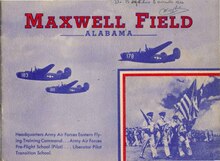
World War II Maxwell Field postcard

In 1940, it was announced that the installation was to be converted into a pilot-training center. On 8 July 1940 the Army Air Corps redesignated its training center at Maxwell Field, Alabama as the Southeast Air Corps Training Center. The Southeast Air Corps Training Center at Maxwell handled flying training (basic, primary and advanced) at airfields in the Eastern United States.

An Air Force Pilot School (preflight) was also activated which instructed Aviation Cadets in the mechanics and physics of flight and required the cadets to pass courses in mathematics and the hard sciences. Then the cadets were taught to apply their knowledge practically by teaching them aeronautics, deflection shooting, and thinking in three dimensions. In June 1941, the Army Air Corps became the U.S. Army Air Forces. On 8 January 1943, the War Department constituted and redesignated the school as the 74th Flying Training Wing handling pre-flight training.

During following years, Maxwell was home to six different schools that trained U.S. military aviators and their support teams for wartime service. As World War II progressed, the number of required pilot trainees declined, and the Army Air Forces decided not to send more aircrew trainees to Maxwell Field. The following known sub-bases and auxiliaries were constructed to support the flying school:

Maxwell Field 1943 photo pictorial

On 31 July 1943, the Southeast Air Corps Training Center was redesignated as the Eastern Flying Training Command. Also in July, the Army Air Forces announced a specialized school for pilots of four-engine aircraft. The first B-24 Liberator landed at the field later that month and in early 1945, B-29 Superfortress bomber training replaced the B-24 program.

Cold War

[edit]

Training at Maxwell continued until 15 December 1945, when the Eastern Flying Training Command was inactivated and was consolidated into the Central Flying Training Command at Randolph Field, Texas.

Air University, an institution providing continuing military education for Army Air Forces personnel, was established at Maxwell in 1946, prior to the U.S. Air Force becoming an independent service the following year. Today, it remains the main focus of base activities at Maxwell.

Maxwell Field was renamed Maxwell Air Force Base in September 1947 when the Air Force was created. [3]

In 1992, the 3800th Air Base Wing (3800 ABW) was disbanded and the 502d Air Base Wing (502 BW) took over as the host wing, which two years later gave way to the current 42d Air Base Wing.

As home of the Air University, Maxwell became the postgraduate academic center of the U.S. Air Force. Air University evolved first as an institution influenced by air power as shaped in World War II, then by the Cold War under the threat of nuclear annihilation, and by air power as applied during the Cold War's Korean and Vietnam conflicts. In the early twenty-first century, the emphasis shifted to air power's role in confronting international and transnational terrorism by both state-sponsored and non-state actors. AU grew materially from inadequate quarters, classrooms, and instructional technology into a campus that is as modern and up-to-date as those of any other in the U. S. armed forces. Construction of Maxwell's Academic Circle, Air University's primary education complex, began in the 1950s. Its centerpiece was the Air University Library, eventually one of several major libraries on a military installation.

Over the years, other activities were established or relocated to Maxwell AFB, to include Headquarters, Civil Air PatrolUSAF; the Air Force Reserve's 908th Tactical Air Support Group (908 TASG), which evolved into the present day 908th Airlift Wing; the Ira C. Eaker Center for Professional Development; the Air Force Financial Systems Operation office (SAF/FM); the Center for Aerospace Doctrine, Research and Education (CADRE); and the Air Force Historical Research Agency, a support organization and repository for air power scholars and AU students. In 1994, Air Force Officer Training School (OTS) was also relocated from Lackland AFB/Medina Annex, Texas to Maxwell AFB, joining the national headquarters of the Air Force's other non-Academy officer accession source, Air Force ROTC.[4]

Detachment 3 of the 58th Operations Group activated at Maxwell during January 2024 to train crews on the MH-139A Grey Wolf.[5]

Based units

[edit]

Flying and notable non-flying units based at Maxwell Air Force Base:[6][7][8]

United States Air Force

[edit]

Education

[edit]
Maxwell Air Force Base Elementary/Middle School

Maxwell Air Force Base is zoned to Department of Defense Education Activity (DoDEA) schools for grades K-8.[18] The DoDEA operates Maxwell Air Force Base Elementary/Middle School.[19] For high school Maxwell AFB residents are zoned to Montgomery Public Schools facilities: residents of the main base are zoned to George Washington Carver High School, while residents of the Gunter Annex are zoned to Dr. Percy L. Julian High School (formerly Robert E. Lee High School). Residents may attend magnet schools.[20][21] In May 2019, residents of the MaxWell FamCamp, previously only zoned to Montgomery Public Schools, now became allowed to send their children to the DoDEA school zone.[22] There was previously a policy that stated that FamCamp residents were not allowed to use the DoDEA school.[23]

By 2019, the Autauga County Schools and Elmore County Public School System began to allow Maxwell AFB on post families to send their children to their schools. In 2019 Pike Road Schools's board of trustees agreed to allow Maxwell AFB on-post families to send their children to Pike Road High School.[24]

In August 2019, of the children who were dependents of military families attached to Maxwell AFB who were enrolled in public schools, 32.43% attended Montgomery schools, 30.64% attended Autaga schools, 18.03% attended the DoDEA school, 11.31% attended Elmore schools, and 7.59% attended Pike Road schools.[22] In 2020 Trent Edwards, a former military commander, stated that issues in the public school systems in the area around the base threatened the base's existence.[25] Anthony Cotton, a lieutenant general, stated in 2018 that surveying of airmen who went to the war college who chose not to bring their families found that the most common reason why they made this choice was because of the perceived state of area schools. Over 56% of said airmen, around that time, did not have family members living with them.[26]

Future

[edit]

In November 2020, the Air Force announced that Maxwell AFB is its preferred choice for basing the MH-139A Grey Wolf Formal Training Unit. The Grey Wolf training mission will replace the 908th Airlift Wing's C-130H Hercules mission, with the first of the new aircraft expected to arrive during 2023.[27]

[edit]

Maxwell AFB appears in the video game Tom Clancy's EndWar as a possible battlefield.[28]

See also

[edit]

References

[edit]

Sources

[edit]
  • Manning, Thomas A. (2005), History of Air Education and Training Command, 1942–2002. Office of History and Research, Headquarters, AETC, Randolph AFB, Texas OCLC 71006954, 29991467
  • Shaw, Frederick J. (2004), Locating Air Force Base Sites, History's Legacy, Air Force History and Museums Program, United States Air Force, Washington DC. OCLC 57007862, 1050653629
[edit]
Revisions and contributorsEdit on WikipediaRead on Wikipedia
from Grokipedia
Maxwell Air Force Base, located in , is a installation that originated as the site of the ' first flying school in 1910 and was formally established as an Army airfield in 1922, named in honor of World War I aviator Lieutenant William C. Maxwell who died in a training accident. During , it functioned as the headquarters of the Army Air Forces Eastern Flying Training Command, overseeing more than 100 schools across the and graduating over 100,000 aviation cadets essential to the Allied air campaign. Renamed Maxwell Air Force Base in 1947 following the creation of the independent U.S. Air Force, it now hosts the as its primary operating unit, alongside the adjacent , and serves as the base for Air University, the Air Force's primary institution for officer professional military education and doctrine development. The base supports critical missions in airlift operations via the 908th Airlift Wing and sustains a of approximately 8,000 active-duty, reserve, , and contractor personnel contributing to national defense through education, logistics, and systems management. Historically, Maxwell's role evolved from early experimentation to a cornerstone of intellectual and operational readiness, with facilities like Austin Hall—site of seminal theory lectures—underscoring its enduring influence on . Its strategic location and infrastructure have enabled sustained contributions to and training commands, adapting from mass pilot production to modern amid evolving geopolitical demands.

Historical Development

Origins and Early Aviation Training (1910–1917)

In March 1910, aviation pioneers Wilbur and Orville Wright established the first civilian flying school in the United States on a 420-acre former cotton plantation owned by the Kohn family, located approximately five miles northeast of . The site was chosen for its flat, open terrain, absence of significant obstacles, and temperate climate conducive to year-round flying, which minimized weather-related disruptions compared to northern locations. Orville Wright initiated operations on March 19, training initial students in biplanes equipped with 30-horsepower engines capable of speeds up to 40 miles per hour. The school's inaugural powered flight in occurred on March 26, , when Orville piloted a Model B over the fields, demonstrating the practicality of controlled, powered flight in the region. Over the subsequent years until its closure in 1916, the facility trained more than 100 pilots, including several who later served as early military , using progressively refined aircraft such as the Wright Model C with enclosed fuselages for improved stability. Notable milestones included the first documented heavier-than-air night flights in history on May 25, , conducted under to test low-visibility operations, and the introduction of dual-control trainers to accelerate student proficiency, with typical courses lasting 2 to 3 months and requiring 40 to 60 minutes of solo flight time for certification. Following Wilbur 's death in 1912 and evolving commercial priorities, the school discontinued operations by late 1916, leaving the airfield largely unused. The U.S. entry into in April 1917 prompted the Army Signal Corps to acquire the property, designating it as the site for and Engine Repair Depot No. 3 under the Aviation Section. This initial military installation focused on maintenance and overhaul of aircraft and engines rather than pilot training, processing damaged planes from nearby fields and supporting logistical needs with a workforce that expanded to handle up to 50 aircraft simultaneously by mid-1918, though foundational infrastructure from the Wright era facilitated rapid adaptation for wartime demands.

World War I and Interwar Expansion (1917–1941)

Following the United States' entry into World War I in April 1917, the Army Air Service established Aircraft and Engine Repair Depot No. 3 at the former Wright flying field in Montgomery, Alabama, to support aviation maintenance needs. The federal government leased the site, previously used for early civilian flight training, as an engine and repair depot for the Army Air Service during the war. This facility focused on repairing aircraft and engines rather than conducting flight training, addressing logistical demands amid the rapid expansion of American air forces in Europe. In the immediate postwar period, local business leaders in Montgomery leased the field in 1918 to maintain its role as an aviation repair depot, preserving economic benefits from federal activity. Initially designated simply as the Aviation Repair Depot, the installation underwent a formal redesignation on November 8, 1922, when the War Department renamed it Maxwell Field in honor of William C. Maxwell, an native and early Army aviator killed in a 1920 training accident near Mobile. During the 1920s, Maxwell Field transitioned into an aerial operations base, hosting units such as the Twenty-Second Observation Squadron for and mapping missions. The interwar era saw significant expansion driven by educational and tactical developments in Army Air Corps doctrine. In 1931, the Air Corps Tactical School (ACTS)—the Army's advanced institution for air warfare tactics—was relocated from Langley Field, Virginia, to Maxwell Field, following advocacy by Alabama Congressman , who secured funding through a 1925 amendment highlighting the site's economic potential for flight operations. This move necessitated substantial infrastructure growth, including permanent barracks, classrooms, and hangars to accommodate ninety-nine faculty and staff, transforming Maxwell into a hub for strategic theory. The ACTS curriculum emphasized high-altitude and independent air operations, influencing pre-World War II air doctrine despite initial resource constraints. By the late , Maxwell's role expanded further in preparation for potential conflict. On July 8, 1940, the War Department designated Maxwell Field as headquarters for the Southeast Air Corps Training Center, coordinating basic and advanced across the region amid rising global tensions. This administrative shift supported the training of thousands of pilots and crew, with facilities upgraded to handle increased throughput. In the fall of , Maxwell initiated foreign programs, receiving 750 British trainees for flight instruction as part of cooperation, marking an early escalation in Allied air training efforts before U.S. entry into . These developments solidified Maxwell's infrastructure and personnel base, enabling its rapid mobilization post-Pearl Harbor.

World War II Contributions (1941–1945)

During , Maxwell Field served as the headquarters for the Southeast Air Corps Training Center (SEACTC), activated on July 8, 1940, which directed all U.S. Army Air Forces (AAF) flying training across the , encompassing primary, basic, and advanced phases at multiple auxiliary fields in , , Georgia, and the . The center oversaw the training of over 100,000 American and Allied aviation cadets, contributing significantly to the expansion of AAF combat aircrew capabilities amid the demands of global conflict. On September 6, 1941, the Air Corps Replacement Center opened at Maxwell, handling classification, preflight instruction, and initial processing for pilot, bombardier, and navigator candidates before assignment to specialized flight schools. Advanced single-engine pilot training operated directly at Maxwell starting in August 1940, while basic flying training, which began with a class of 120 cadets on September 9, 1940, shifted to Gunter Field (formerly Montgomery Municipal Airport) in November 1940 to accommodate surging enrollment. The SEACTC was redesignated the Army Air Forces Eastern Flying Training Command (AAFFTC) on August 23, 1943, reflecting broader AAF organizational changes, and continued operations until inactivation on December 15, 1945. To support operations, a four-engine pilot transition school opened in July 1943, training crews for B-24 Liberators and B-29 Superfortresses; by war's end, it had qualified 728 B-29 flight crews through 46,554 flight hours and 112,809 sorties without major accidents, necessitating runway extensions to 7,000 feet. Allied participation included the graduation of 4,360 cadets from June 1941 to February 1943 and 1,277 Free French cadets from June 1943 to November 1945, with over 8,000 total allied trainees from nations such as by late 1945. The command also supervised training for , producing over 900 African American pilots at three dedicated flight schools in , under segregated units including the 4th Aviation Squadron at Maxwell and the 22nd at Gunter Field. Women's integration advanced with the arrival of 156 Women's Army Auxiliary Corps members on April 27, 1943, and in December 1943, who ferried aircraft and towed targets. The Air Corps Tactical School, previously focused on , closed on October 9, 1942, reallocating resources to wartime training priorities. These efforts directly bolstered AAF combat readiness, enabling sustained air operations against Axis forces.

Cold War Evolution (1945–1991)

Following , Maxwell Field shifted from primary flight training to advanced professional military education, with the establishment of Air University as a major command on 12 March 1946 to consolidate doctrine development and officer training under a unified structure. This transition reflected the U.S. Air Force's need to prepare for prolonged strategic competition, emphasizing airpower's role in deterrence and potential conflict with the . The base was redesignated Maxwell Air Force Base in 1948, coinciding with the independent Air Force's formation. Air University's core schools drove this evolution: the Air Command and Staff School activated on 12 March 1946 for intermediate-level officers, followed by the Air War College on 22 December 1948 as the senior institution for . The Squadron Officer School, upgraded from earlier tactical programs in 1954, addressed junior officer development. During the (1950–1953), operations scaled back temporarily, but the 1950s saw near-doubling of personnel and facilities, including construction of the Academic Circle beginning in February 1954 to house major schools. The 502nd Air University Wing, activated in November 1947 and redesignated the 3800th Air University Wing in 1948, provided logistical support until 1992. Cold War curricula adapted to nuclear threats and limited wars; the added a two-week course in 1962, while Project Corona Harvest (1966–1975) analyzed air operations to refine tactics. Mid-1970s overhauls at the Air War College emphasized air warfare principles amid and SALT negotiations. The host , formed in 1953 from II-era bombardment squadrons, supported nuclear deterrence alerts and contributed personnel to operations including Arc Light, Linebacker I, and Linebacker II. Infrastructure enhancements included a 225-bed in May 1964, underground command post tunnels, and the Senior NCO Academy at in June 1972. By the 1980s, Air University regained major command status in 1983, establishing the Center for Doctrine, Research, and Education and the School of Advanced Studies in 1987 to integrate like precision-guided munitions. The Maxwell-Gunter Air Park opened in 1982 to preserve aviation heritage, displaying aircraft from Cold War-era conflicts. These developments positioned Maxwell as the intellectual center for strategic thought, training leaders for , proxy wars, and dynamics until the Soviet collapse.

Post-Cold War Realignment and Modernization (1991–Present)

Following the in 1991, Maxwell Base underwent significant realignments amid (BRAC) processes aimed at reducing excess infrastructure post-Cold War. In March 1992, Gunter Base was consolidated with Maxwell to form Maxwell-Gunter Base, a strategic measure to enhance and mitigate closure risks under BRAC recommendations. On October 1, 1992, the 3800th Air Base was inactivated and replaced by the 502nd Air Base as the host unit. This transition continued in 1994 when the 42nd Air Base activated on October 1, assuming host responsibilities and providing installation support for educational and training missions. Modernization efforts emphasized the base's role in professional military education through Air University, headquartered at Maxwell, which expanded programs to address evolving threats including great power competition with adversaries like . Facilities and infrastructure grew to accommodate Air University's annual graduation of over 50,000 resident students and 160,000 non-resident personnel as of 2025. The Officer Training School, under , commissions approximately 500-700 second lieutenants yearly via a nine-week program at Maxwell. Gunter Annex supports contemporary operations, hosting the Air Force Program Executive Office for Business and Enterprise Systems and the 26th Network Operations Squadron for cybersecurity and network management. The 908th Airlift Wing, a reserve unit equipped with C-130 aircraft, maintains capabilities from Maxwell, contributing to global mobility missions. These developments have solidified Maxwell-Gunter's strategic importance in developing air and space power doctrine and leadership amid shifting national defense priorities.

Mission and Strategic Importance

Core Functions in Air Force Education and Doctrine

Maxwell Base hosts (AU), established in March 1946 by Army s senior leaders to sustain doctrine development and professional military education (PME) missions originating from pre-World War II institutions like the Air Corps Tactical School. AU functions as the intellectual and leadership-development center for the U.S. and U.S. , delivering PME, , and graduate-level programs to officers, enlisted personnel, and Department of Defense civilians. These efforts emphasize leveraging air, space, and capabilities to support objectives, with programs conducted in residence at Maxwell and or via distance learning. A primary educational role involves officer accession and PME through schools such as Squadron Officer School, which introduced a dedicated U.S. Space Force track in January 2024 to cultivate space-oriented leadership and doctrine. The Air War College provides senior PME, focusing on strategic airpower application and joint operations. Enlisted PME is centralized under the Barnes Center for Enlisted Education, relocated to Maxwell's Chennault Circle in May 2025 as the headquarters for Air Force enlisted professional development, including foundational courses like Airman Leadership School that build leadership and profession-of-arms skills. In doctrine development, the Curtis E. LeMay Center for Doctrine Development and Education serves as the Air Force's principal organization for creating, assessing, and integrating , while advocating principles in and multinational contexts. It incorporates , concepts, and tactics into techniques, procedures, , and educational curricula; leads operational and strategic wargaming for the , AU, and partners; and disseminates doctrine through resident and distance learning to warfighters. Recent outputs include the January 2025 update to Air Force Doctrine Publication 3-0, Operations, which establishes foundational guidance for employing in lethal, resilient operations, and a 2025 doctrine note on to inform its integration into capabilities. The center also manages the Joint Integration Directorate for cross-service doctrine alignment and participates in committees, ensuring contributions to multi-domain operations.

Role in National Defense Strategy

Maxwell Base serves as the headquarters for Air University, the primary institution for advanced professional military education in the United States , directly aligning its operations with the National Defense Strategy (NDS) by developing warfighter expertise essential for integrated deterrence and multi-domain operations. Air University's explicit mission is to "access, train, educate, and develop Air and Space warfighters in support of the National Defense Strategy," focusing on producing leaders capable of addressing great power competition from adversaries like and through enhanced and doctrinal innovation. This role ensures that personnel are equipped to contribute to the NDS priorities of strengthening alliances, building capabilities, and maintaining readiness for high-end conflict scenarios. The Air War College, located at Maxwell, plays a central part in this strategic framework by educating senior officers—typically field-grade and above—to analyze future operating environments and formulate strategies that integrate with and forces. Graduates receive tools for strategic , emphasizing the security implications of and contested domains, which directly informs contributions to NDS objectives such as resilient basing and long-range strike capabilities. For instance, the college's curriculum has supported recent doctrinal updates, including the 2025 release of foundational publications that realign structure for lethality and resilience against peer competitors, as directed by Gen. David Allvin. Maxwell also facilitates high-level strategic dialogues through events like the annual National Security Forum, which in 2025 convened over 100 senior military leaders, foreign officers, and civic influencers to discuss NDS implementation and airpower's role in global stability. These forums foster interagency and international coordination, reinforcing the NDS emphasis on campaigning to deter aggression and build partner capacity. Additionally, Air University's research arms, such as the Center for Strategic Studies and the Maxwell Papers series, produce analyses on airpower doctrine that influence Department of Defense policy, tracing back to foundational works on strategic bombing and joint operations developed at the base since the 1930s. This ongoing doctrinal evolution ensures Maxwell's contributions remain adaptive to NDS revisions, prioritizing empirical assessments of airpower's causal effects in warfare over outdated paradigms.

Development of Air and Space Power Leadership

Air University, located at Maxwell Air Force Base, functions as the U.S. Air Force's center for professional military education, specializing in the development of leaders capable of employing air, space, and power to advance goals. Established to cultivate and joint warfighting proficiency, its programs target officers, enlisted personnel, and civilians across career phases, producing graduates who integrate multi-domain operations into broader . This leadership pipeline emphasizes empirical assessment of airpower's causal effects in , drawing on historical and simulations to train decision-makers in and under . The Squadron Officer School (SOS), a cornerstone of junior officer development, delivers primary professional military education to captains, focusing on foundational , ethical decision-making, and tactical application of air and space assets. With approximately 500-600 students per class cycle, SOS curricula incorporate case studies from real-world operations, such as precision strikes and satellite-enabled , to instill causal understanding of how influences ground outcomes. In August 2025, SOS unveiled a redesigned program reducing traditional classroom hours from 53 to prioritize instructor-facilitated, student-driven exercises, aiming to foster adaptive leaders responsive to peer adversaries' technological advances. To address emerging space domain needs, a dedicated track was introduced in January 2024, tailoring content for Guardian officers to build expertise in orbital warfare and . At the senior level, the Air War College (AWC) educates field-grade and equivalent leaders in strategic airpower employment, with a mission to produce air-minded joint warfighters adept at national-level policy integration. AWC's 10-month resident course, enrolling around 250 students annually, analyzes historical campaigns—like the 1991 Gulf War's air campaign that degraded Iraqi command structures by over 90% through targeted strikes—to derive principles for future conflicts involving hypersonic threats and contested space environments. Graduates, including select international officers, emerge equipped to advise on force structure decisions grounded in verifiable metrics of lethality and sustainment, countering institutional tendencies toward optimistic projections unsupported by combat data. Complementing these, the advances intermediate leaders' operational expertise, emphasizing campaign planning that leverages air and space superiority for joint force enablement. Annual outputs from Maxwell's schools exceed 2,000 PME graduates, directly contributing to the Air Force's leadership cadre amid evolving threats from state actors investing in anti-access/area-denial capabilities. Recent engagements, such as visits in January 2024, underscore AU's pivot toward multi-domain mastery, ensuring curricula reflect empirical shifts in space as a warfighting domain rather than ancillary support. This focus maintains Maxwell's role in producing leaders who prioritize outcomes over doctrinal orthodoxy, validated through simulating high-intensity scenarios.

Facilities and Infrastructure

Main Base Layout and Key Assets

The main base of Maxwell Air Force Base centers on its airfield infrastructure, which includes one primary operational , 15/33, measuring 8,008 feet long by 150 feet wide with an asphalt surface capable of supporting heavy operations. A secondary , 09/27, spans 3,015 feet by 60 feet, also asphalt-surfaced, accommodating lighter training and utility flights. The airfield encompasses approximately 880 acres of s, taxiways, and aprons, integrated with hangars that support missions, such as those conducted by the 908th Wing using C-130 Hercules . Administrative and educational assets dominate the non-airfield areas, with the core layout featuring clustered historic and modern buildings housing Air University components. Key structures include the , which oversees professional military education, and specialized facilities like Anderson Hall (Building 1401) at 325 Chennault Circle, serving as the primary site for the Air War College's resident programs. The base's infrastructure also incorporates support elements such as fuel storage, utilities, and logistics areas managed by the to sustain training and operational activities. Many buildings in the central area form a , reflecting early 20th-century architecture preserved for operational and cultural significance.

Gunter Annex and Support Facilities

, established as a subordinate installation to Maxwell Air Force Base in March 1992, primarily hosts (PME) programs under the Thomas N. Barnes Center for Enlisted Education, including the resident Air Force Senior Noncommissioned Officer Academy and the Instructor Course. These facilities support specialized training for noncommissioned officers, emphasizing through structured curricula delivered in dedicated classroom and administrative buildings on the annex grounds. Support infrastructure at includes the Gunter Fitness Center, which features a gymnasium, group exercise rooms, and courts, three courts, cardiovascular equipment, and daily-use locker rooms, accessible to active-duty personnel, dependents, retirees, and Department of Defense civilians. operations under University Inn extend to the annex, providing temporary accommodations as part of one of the largest such facilities in the U.S. , with on-site amenities supporting transient personnel for PME and other activities. A at 115 N. Turner Boulevard serves base populations with grocery and household essentials, complementing logistical sustainment functions. The 42d Medical Group, based at Maxwell, extends healthcare services to Gunter Annex tenants, including , occupational health, and preventive medicine for approximately 5,000 beneficiaries across both sites. Additional support encompasses the Military and Family Support Center, offering relocation assistance, confidential counseling, personal financial consultations, and deployment readiness programs to mitigate family stresses associated with PME attendance and base operations. These facilities collectively enable the 42d Wing to deliver combat support to Air University elements and other tenants, ensuring operational continuity for education-focused missions.

Technological and Logistical Capabilities

Maxwell Air Force Base incorporates advanced simulation technologies to enhance pilot and operational training. The 23rd Flying Training Squadron employs virtual reality systems to train pilots, enabling efficient skill acquisition without additional aircraft resources, as implemented since at least 2019. The Air University Library features a Pilot Training Next simulator, supporting immersive learning for aviation personnel. Research initiatives, such as the Adaptive Flight Training Study, utilize virtual reality with bio-metrics and eye-tracking to optimize learning efficiency, tested in collaboration with base entities. Innovation facilities at the base include the Maxwell Spaatz Fitness Research and Innovation Center (MSFRIC), equipped with 3D printers, for applications, and computing units to foster technological experimentation. The Air Force Institute of Technology's graduate programs have integrated metal additive manufacturing via capabilities since 2017, enabling expertise in advanced prototyping for defense applications. Digital tools extend to operational support, with the USAF Connect App providing mobile access to base services and information, launched to streamline communication as of 2025. Logistically, the delivers comprehensive support, including security, , and infrastructure maintenance for over a dozen tenant organizations at Maxwell and . The 908th Flying Training Wing, redesignated from Airlift Wing in September 2024, maintains aircraft operations with maintenance hangars supporting prior C-130 fleets and transitioning to MH-139A Grey Wolf helicopter , ensuring rapid capabilities. Its 25th Aerial Port Squadron handles cargo and personnel movement, conducting for expeditionary logistics in austere environments. The 908th Squadron supports facility renovations and emergency response, such as bridge repairs completed in 2025 and rotary-wing fire suppression . These elements collectively sustain a training throughput of thousands of personnel annually while adapting to evolving requirements.

Assigned Units and Operations

United States Air Force Components

The 42nd Air Base Wing (42 ABW) serves as the host unit at Maxwell Air Force Base, responsible for base operations, security, logistics, and support services for all tenant organizations. Activated on October 1, 1994, the wing traces its lineage to the World War II-era 42nd Bombardment Group and provides infrastructure and mission sustainment for Air University and other units, including airfield management, medical services via the 42nd Medical Group, and force support functions. Air University (AU), headquartered at Maxwell AFB, functions as the U.S. Air Force's center for professional military education and is a key component of (AETC). Established in 1946, AU oversees graduate-level programs, doctrine development, and leadership training through subordinate institutions such as the Air War College, , and Squadron Officer School, educating thousands of officers, enlisted personnel, and international partners annually. The 908th Flying Training Wing, an Air Force Reserve Command unit, operates as the primary flying component at the base, transitioning from airlift missions with C-130 Hercules aircraft to specialized flying training roles as of February 2024, marking the first active-duty associate flying training partnership at Maxwell since 1961. Previously designated the 908th Airlift Wing, it maintains operational aircraft and conducts training in support of reserve and active-duty integration. Additional USAF elements include the Civil Air Patrol-United States headquarters, which coordinates auxiliary support for , aerospace education, and cadet programs from Maxwell.

Joint and Interagency Tenants

The Montgomery Military Entrance Processing Station (MEPS), operated by the U.S. Military Entrance Processing Command (USMEPCOM), is a key joint tenant at , part of Maxwell-Gunter Base. Located at 705 McDonald Street, Building 1512, this facility processes enlistment applicants for all U.S. Armed Forces branches, including the , , , Marine Corps, , and . It conducts comprehensive evaluations encompassing medical examinations, aptitude testing via the Armed Services Vocational Aptitude Battery (ASVAB), assessments, and administrative processing to verify eligibility, , and suitability for service, handling thousands of recruits annually in the southeastern region. As a USMEPCOM entity under oversight but serving multi-service needs, the MEPS exemplifies joint operational integration at Maxwell, with liaison officers from various branches coordinating on-site activities. Beyond the MEPS, Maxwell hosts limited permanent interagency tenants, with primary emphasis on Air Force-led activities; however, Air University's professional military education programs routinely incorporate interagency participation through fellowships and seminars. These include civilian representatives from federal departments such as the Departments of State, Defense, , and Justice, who engage in curriculum on strategy, joint operations, and policy integration, fostering cross-agency collaboration without establishing dedicated organizational footprints. For example, the Air War College's (JPME) Phase II curriculum, accredited by the Chairman of the , draws interagency fellows to study strategic leadership and all-domain operations, enhancing causal linkages between military and civilian governance in defense planning. Joint service involvement extends to transient elements, such as officers from , , and Marine Corps attending resident courses at institutions like the , which delivers JPME Phase I accreditation. These programs, established under directives from the Goldwater-Nichols Department of Defense Reorganization Act of 1986, mandate education for and general officers, with Maxwell's facilities supporting approximately 20-25% non- students in select classes as of recent reporting. No large-scale commands or non-DoD agency headquarters are tenanted, reflecting Maxwell's specialized role in airpower doctrine and education rather than operational headquarters functions. This structure prioritizes empirical training outcomes over expansive multi-agency basing, aligning with efficiencies in resource allocation.

Personnel and Training Operations

Maxwell Air Force Base supports a of over 12,500 personnel, encompassing active-duty airmen, reservists, civilians, and contractors, who collectively enable the base's role as a hub for professional military education and . These individuals are primarily affiliated with Air University (AU), a key component of (AETC), headquartered at the base, which directs the development of airpower doctrine and educates personnel across ranks to enhance operational effectiveness. Training operations at Maxwell emphasize intermediate and senior-level professional military education (PME), with AU institutions annually preparing around 500 resident students and over 9,000 nonresident participants through programs like the (ACSC). The ACSC focuses on joint operations, strategy, and leadership for mid-career officers, integrating classroom instruction with practical exercises to foster decision-making in complex air, space, and cyber environments. Complementing this, the Officer Training School (OTS) at Maxwell develops entry-level officers, commissioning warfighters through rigorous leadership and tactical training curricula. Specialized enlisted and courses further bolster personnel readiness, including the Leadership Course (CLC), a 140-hour program at delivering advanced enlisted PME on command, , and organizational management. The Center for Development offers multi-disciplinary technical training and continuing education for and Department of Defense personnel, emphasizing adaptive skills for evolving threats. Recent expansions include the U.S. Training School, established to train technical specialists in and cyber domains, and a centralized Operational Support Team training center to streamline base-wide skill sustainment. Personnel operations integrate administrative support, such as casualty assistance and claims processing via the Staff Judge Advocate office, ensuring training continuity amid daily base functions. and squadrons conduct periodic and emergency response drills, involving base personnel to maintain operational resilience without disrupting core educational missions.

Environmental and Safety Considerations

PFAS Contamination History and Response

PFAS contamination at Maxwell Air Force Base stems primarily from the historical use of aqueous film-forming foam (AFFF), a agent containing per- and polyfluoroalkyl substances (PFAS), employed during exercises and responses to and fires over decades of base operations. AFFF, introduced widely in applications starting in the , was standard for suppressing Class B fires at air bases like Maxwell, leading to repeated releases into and during drills at designated areas. In 2019, environmental testing identified heavy PFAS contamination in training areas 1 and 2, with concentrations in groundwater and soil exceeding safe thresholds by orders of magnitude in hotspot locations, including perfluorooctanoic acid (PFOA) levels reported up to 21,000 times the U.S. Environmental Protection Agency's (EPA) advisory limit of 70 parts per trillion (ppt) for PFOA and perfluorooctane sulfonate (PFOS) combined, and PFOS up to 9,500 times higher. These findings aligned with broader Department of Defense (DoD) assessments initiated around 2015, which revealed PFAS releases at over 700 military installations nationwide due to similar AFFF practices. The U.S. 's response at Maxwell has integrated into the DoD's PFAS management program, encompassing preliminary assessments, site inspections, and remedial investigations under the Comprehensive Environmental Response, Compensation, and Liability Act (CERCLA). As of 2024, the continues sampling and monitoring efforts across affected sites, with commitments to interim cleanup actions where PFAS impacts or migration pathways, though specific remedial actions at Maxwell remain in investigative phases without completed feasibility studies publicly detailed. The DoD has phased out PFAS-containing AFFF DoD-wide by 2024, replacing it with fluorine-free alternatives to prevent further releases. This approach prioritizes risk-based remediation, focusing on plume delineation and treatment technologies like granular , amid ongoing federal regulatory evolution, including the EPA's 2024 national primary standard of 4 ppt for PFOA and PFOS individually.

Remediation Efforts and Regulatory Compliance

The Air Force Environmental Restoration Program (ERP) at Maxwell Air Force Base addresses historical contamination through site-specific investigations and remedial actions under the Comprehensive Environmental Response, Compensation, and Liability Act (CERCLA). As of 2018, Site SD-001—encompassing surface drainage areas with detections of semi-volatile organic compounds (SVOCs) and pesticides exceeding regulatory limits—underwent evaluation leading to a no-further-action determination, closing the site with unrestricted following confirmation sampling that verified risk reduction. Groundwater remediation efforts target volatile organic compounds such as (TCE) and (PCE) identified near the base's southern boundary at sites including SS-004, with monitoring and potential treatment aligned with (RCRA) corrective action requirements. The Department of the (DAF) integrates these into broader Installation Restoration Program (IRP) activities, prioritizing human health and environmental risks through phased assessments. For per- and polyfluoroalkyl substances (PFAS), remedial investigations are ongoing, including sampling and analysis conducted by contractors like Tanaq Environmental LLC, with remediation strategies overseen by the Environmental Protection Agency (EPA), Department of Defense (DoD), and Air Force Civil Engineer Center (AFCEC). The base participates in DoD-wide PFAS cleanup initiatives, which have obligated over $1 billion through fiscal year 2021 for site assessments and interim measures like treatment, though Maxwell-specific implementation details emphasize CERCLA-driven feasibility studies for long-term restoration. Regulatory compliance involves adherence to (NEPA) for project assessments, such as wastewater infrastructure upgrades that evaluate impacts on restored sites, and coordination with state agencies like the Department of Environmental Management. Annual reporting and , including Restoration Advisory Board (RAB) surveys, ensure transparency, with the base achieving closure or response complete status at multiple IRP sites while addressing emerging PFAS risks without halting operations.

Operational Trade-offs and Risk Management

The management of per- and polyfluoroalkyl substances (PFAS) contamination at Maxwell Air Force Base exemplifies operational trade-offs between sustaining core missions in air education, training, and airlift operations and mitigating environmental and health risks from legacy firefighting foam use. In 2019, sampling identified PFAS levels in training areas 1 and 2 exceeding U.S. Environmental Protection Agency lifetime health advisory thresholds of 70 parts per trillion for perfluorooctanoic acid (PFOA) and perfluorooctanesulfonic acid (PFOS), primarily from historical aqueous film-forming foam (AFFF) releases during drills. This prompted localized access restrictions and shifted some ground-based training to alternative sites, trading short-term tactical exercise flexibility for reduced exposure risks, while administrative and flight operations at the base's primary runways and facilities continued uninterrupted to preserve readiness for the 908th Airlift Wing and Air University programs. Risk management protocols follow Department of Defense directives emphasizing site-specific assessments under the Comprehensive Environmental Response, Compensation, and Liability Act (CERCLA), integrating human health risk evaluations with ecological impacts to inform remediation feasibility. monitoring wells installed post-2019 track plume migration toward off-base aquifers, with interim measures like potential granular filtration for affected water sources balancing immediate personnel safety against infrastructure upgrade costs estimated in millions annually across installations. The 's 2023 transition to fluorine-free foams nationwide mitigates future introductions, but legacy sites require ongoing trade-offs, such as phased excavation or in-situ that may temporarily limit range availability, prioritized via risk-based scoring to ensure no net degradation in overall base operational tempo. These strategies incorporate causal analysis of exposure pathways—dermal contact, ingestion via water, and inhalation during disturbances—drawing from epidemiological data linking PFAS to elevated risks of renal and testicular cancers, with base personnel offered voluntary blood serum testing and medical surveillance through the Department of . Regulatory compliance under the National Contingency Plan drives decisions, weighing remediation timelines (often 5-30 years) against mission imperatives, as evidenced by continued C-130 operations despite adjacent contamination zones, reflecting a pragmatic where empirical risk thresholds guide restrictions rather than precautionary halts.

Economic and Societal Impact

Contributions to Local Economy and Community

Maxwell Air Force Base, in conjunction with , generates an annual economic impact of approximately $2 billion on the Montgomery region through direct spending, payroll, and multiplier effects on local businesses. In 2024, the base's government payroll totaled $1.204 billion, supporting military, civilian, and contractor personnel, while annual expenditures reached $400.6 million on operations, contracts, and utilities. These activities sustain 26,706 jobs across the Maxwell-Gunter area, encompassing direct employment on base—such as roles in the and Air University—and indirect positions in regional supply chains, housing, retail, and services catering to base personnel. The base's presence stimulates local commerce by drawing transient students and permanent staff, with Air University's annual throughput exceeding 34,000 individuals who contribute to off-base spending on lodging, dining, and transportation. and maintenance projects, including $22 million in upgrades allocated in 2023 for facilities at Maxwell and Gunter, further bolster employment in contracting and skilled trades. In community involvement, Maxwell AFB personnel engage in volunteer efforts, such as partnering with on housing builds in Montgomery, with events documented as recently as May 2025 involving 42nd Contracting Squadron members. The base facilitates civic outreach through speaker programs, group tours, and K-12 educational support, enabling local schools and organizations to access expertise on and aviation. Air promotes ongoing ties with Montgomery via community events and honorary commander programs, where local leaders participate in base operations to strengthen civil- relations. Facilities like the on-base elementary and serve military families while exemplifying integrated educational resources that indirectly benefit regional schooling standards.

Long-term Legacy in Military Innovation

The Air Corps Tactical School, relocated to Maxwell Field in , played a pivotal role in developing the U.S. Army Air Corps' , emphasizing daylight precision attacks on enemy industrial and economic targets to achieve victory independent of ground forces. This "industrial web theory," refined through coursework and simulations at the school, argued that disrupting key nodes in an adversary's production system—such as oil refineries and transportation hubs—could collapse morale and logistics, influencing Allied air campaigns in , including the Eighth Air Force's efforts to secure air superiority over . The doctrine's emphasis on long-range bombers operating at high altitudes to evade defenses represented a departure from tactical support roles, laying foundational principles for airpower as a decisive strategic instrument that persisted into the U.S. Air Force's independent operations post-1947. Following , the establishment of at Maxwell Base in 1946 institutionalized advanced professional military , with the Air War College commencing operations in 1947 to cultivate strategic thinkers capable of integrating air, space, and joint domain operations. The university's curriculum evolved to address objectives through scenario-based planning and doctrinal analysis, producing over tens of thousands of senior leaders who shaped U.S. military across conflicts from the onward. By merging the Air Force Doctrine Center into Air University in 2007, Maxwell solidified its role in codifying evolving airpower tenets, such as and technology integration, ensuring doctrines like those in AFDP 1 adapted to multi-domain challenges without neglecting core principles of centralized control and decentralized execution. Maxwell's legacy endures through ongoing innovation via the Maxwell Papers series and Air University's emphasis on fostering doctrinal adaptability, as seen in publications advocating personnel-driven technological advances and critiques of historical neglect. This framework has influenced broader Department of Defense strategies, promoting air forces' role in rapid, decisive effects against peer competitors, while preserving archives that inform contemporary analyses of strategic bombardment's limitations and successes. The base's contributions underscore a causal link between rigorous and doctrinal evolution, prioritizing empirical lessons from past campaigns to mitigate risks in future high-end warfare.

Notable Figures and Historical Influences

Maxwell Air Force Base derives its name from William C. Maxwell, born November 9, 1892, in Natchez, , who enlisted in the U.S. Army Aviation Section in 1917 as a Reserve Military Aviator while attending the . Maxwell completed flight training at Eberts Field, , and was commissioned on December 18, 1917, subsequently serving as a pursuit pilot instructor at Rich Field, , and commanding the 46th Aero Squadron at Luke Field, , before his transfer to Mitchel Field, New York. On February 12, 1920, Maxwell perished in an aircraft collision near , during a test flight of a new pursuit plane, prompting the War Department to rename the adjacent airfield Maxwell Field in November 1922 to honor his contributions to early . The Air Corps Tactical School (ACTS), relocated to Maxwell Field in September 1931, exerted profound historical influence by formulating the foundational doctrine of U.S. strategic airpower, advocating for an independent air force capable of decisive, high-altitude daylight against enemy economic and industrial targets to achieve victory without ground invasion. This curriculum, developed amid interwar resource constraints and technological advancements in bombers like the Boeing B-9 and , prioritized air-centric operations over ground support, drawing on empirical analysis of aerial roles and simulations that demonstrated bombing's potential to cripple war production—principles validated in campaigns over Europe and the Pacific, where ACTS alumni directed operations that degraded Axis capabilities. Key doctrinal architects included instructors such as Major Harold L. George and Captain Haywood S. Hansell Jr., whose teachings emphasized causal linkages between targeted industrial disruption and national collapse, influencing the Army Air Forces' expansion and the establishment of Air University at Maxwell in 1946 as a successor institution for advanced education. Among notable figures shaped by Maxwell's institutions, Captain Claire Lee Chennault graduated from ACTS's inaugural 1931-1932 class, applying inverted aerial tactics theorized there to lead the —later the 14th Air Force—in , where innovative fighter doctrines downed over 296 Japanese aircraft with minimal losses between 1941 and 1945. Postwar, Air University's professional military education programs at Maxwell produced numerous flag officers, including 53 generals from the 1947-1948 Air War College class alone, such as Generals Gabriel P. Disosway, Kenneth B. Wolfe, and Hunter Harris Jr., who ascended to command roles like and leadership, perpetuating ACTS's emphasis on integrated air strategy amid nuclear deterrence demands. These alumni exemplified the base's enduring causal impact on leadership, with over 33 documented "Maxwell men" achieving four-star rank and applying doctrinal rigor to operational successes, underscoring Maxwell's role as the "Cradle of Airpower" in fostering empirically grounded, independent air forces.

Recent Developments and Future Outlook

Initiatives Since 2020

In response to evolving strategic priorities, Air University at Maxwell AFB initiated organizational realignments in March 2024 to streamline headquarters staff, consolidate in-resident professional education programs, and enhance focus on Competition requirements, aiming to develop Airmen as a "human weapon system." These changes included redesignating the Global College of Professional Education as the of Technology's counterpart for advanced integration. Further reforms occurred in August 2025, with Air University implementing additional realignments to improve integration across professional military education, reduce administrative redundancies, and align with Department of Defense operational demands. Concurrently, the Squadron Officer School launched a refocused in August 2025, emphasizing warfighting proficiency, joint operations, and multi-domain challenges after five months of revision to address contemporary threats. Training innovations advanced with the Air Education and Training Command's launch of immersive learning programs in April 2025, incorporating virtual reality and simulation tools to accelerate skill acquisition for Airmen, with ongoing calls for program submissions to expand adoption. Digital badging initiatives, rolled out under AETC oversight, enabled Airmen to credentialize force development skills for civilian transition, promoting verifiable accomplishments via platforms like resumes and social media. The 908th Airlift Wing updated its mission in May 2024 to "Deliver lethal combat to defeat America's enemies," developing new mission-vital tasks in preparation for a name and mission redesignation to emphasize over traditional roles. In June 2022, Secretary of the Frank Kendall approved Maxwell AFB as the basing location for the MH-139A Grey Wolf helicopter fleet, enhancing rotary-wing training capabilities for and . Well-being efforts included the Resiliency Task Force's expansion in January 2023 to foster community resilience among service members through skill-building for adversity coping and healthy interpersonal networks. Air University's Strategic Action Plan, released in February 2023 by Lt. Gen. Andrea Tullos, outlined prioritized lines of effort for institutional advancement amid fiscal and operational constraints.

Ongoing Modernization and Strategic Adaptations

In February 2023, Air University, headquartered at Maxwell Air Force Base, released a Strategic emphasizing four lines of effort: developing 21st-century warfighters capable of addressing evolving threats, enhancing force development delivery through innovative training methods, modernizing the with advanced technologies, and strengthening institutional foundations for sustained excellence. This plan aligns with the National Defense Strategy by prioritizing education that integrates joint operations, cyber domains, and competition dynamics into professional military education programs. Infrastructure modernization efforts include multiple construction projects initiated around 2024 to support the 908th Airlift Wing's operational evolution, such as a new academic building and facility, which were approximately 30 percent complete as of that year to enhance pilot training for C-130 aircraft. In July 2023, federal funding allocated nearly $22 million to Maxwell for upgrades, including specialized training facilities for F-35 crew integration and a new gate to bolster base security and operational readiness. Strategic adaptations in curricula, particularly at the Air War College, focus on cultivating senior leaders equipped for strategic decision-making in contested environments, with updates to the professional military education program accredited for Phase II as of July 2025. The School of Advanced Air and Space Studies similarly advances strategic to transform and thinking, incorporating emerging technologies and multi-domain operations to increase joint force lethality. These initiatives reflect a broader shift toward agile, technology-enabled force development amid fiscal constraints and geopolitical pressures.

References

Add your contribution
Related Hubs
User Avatar
No comments yet.