


Community hub
Recent from talks
Contribute something
Nothing was collected or created yet.
Laughlin Air Force Base
View on Wikipedia
Laughlin Air Force Base (IATA: DLF, ICAO: KDLF, FAA LID: DLF) is a facility of the United States Air Force located east of Del Rio, Texas.
Key Information


Overview
[edit]Laughlin AFB, the largest pilot training base in the US Air Force, is home to the 47th Flying Training Wing of the Air Education and Training Command and the 96th Flying Training Squadron of the Air Force Reserve Command. On weekdays, the airfield sees more takeoffs and landings than any other airport in the country.[citation needed]
History
[edit]Laughlin Army Air Field
[edit]
Laughlin AFB was originally named Laughlin Army Air Field on March 3, 1943, after Jack T. Laughlin, a B-17E Flying Fortress pilot. He was trained as a pilot and was actually co-pilot of B-17E, tail number 41-2476. On the day of his first bombing mission, he was bumped by the Group Commander Major Stanley K. Robinson (Robinson was co-pilot next to pilot Capt. Walter W. Sparks). Major Robinson brought along his own combat-experienced navigator, Lt. Richard Cease. Laughlin had no assigned position on the plane for the mission. He became Del Rio's first World War II casualty when the plane he was flying in (most likely as a waist gunner for the mission) was lost at sea, having succumbed to damage received over the Makassar Strait on 29 (or 28) January 1942. The damage occurred during two bombing runs against Japanese warships and transports in the Makassar Strait off the coast of Balikpapan, Borneo. The field became simply Laughlin Field on November 11, 1943, and later an U.S. Army Air Forces Auxiliary Field. During World War II, Laughlin's primary mission was the training of B-26 Marauder pilots and aircrews. It was closed in October 1945.
Laughlin Air Force Base
[edit]Laughlin Air Force Base reopened on May 1, 1952. In October 1952, ATC transferred the base to Crew Training Air Force (CREWTAF) and activated the 3645th Flying Training Wing (Fighter), as a combat crew replacement training facility for pilots headed for Korea. Training provided new pilots with basic bombing and gunnery combat skills in the F-80 Shooting Star, F-84 Thunderjet, and T-33 jet aircraft, but within short time crews used only the T-33. In September 1955, Laughlin came under the control of the Flying Training Air Force and switched missions with Williams Air Force Base, Arizona. Laughlin undertook single-engine pilot training, still using the T-33.
Strategic Air Command
[edit]The U.S. Air Force transferred jurisdiction of the base to the Strategic Air Command on April 1, 1957, and the 4080th Strategic Reconnaissance Wing (Light) moved there from Turner Air Force Base, Georgia. Following the graduation of the last class in March 1957, ATC inactivated the 3645th FTW. The 4080th Wing provided high-altitude reconnaissance and air sampling using the Lockheed U-2A and the RB-57D Canberra. The 4080th Strategic Reconnaissance Wing was redesignated as the 4080th Strategic Wing on June 15, 1960, and the RB-57 mission was phased out.
Laughlin U-2s were among the first to provide photographic evidence of Soviet missile installations in Cuba in 1962 when 4080th U-2 pilot major Steve Heyser flew his U-2C over Cuba after taking off from Edwards AFB, California. Heyser landed at McCoy AFB, Florida, following the mission, with McCoy becoming a U-2 operating location for the duration of the Cuban Missile Crisis. The film from Major Heyser's mission was developed, analyzed and the photos were shown to the United Nations Security Council on October 22, 1962, proving to the world, that offensive missiles were on the island of Cuba.
Another 4080th pilot, Major Rudolf Anderson, Jr., perished when his U-2 was hit by shrapnel from a Soviet-made SA-2 surface-to-air missile on October 22, 1962, while overflying Cuba from McCoy AFB. While the U-2 did not suffer a direct hit, Anderson was struck by fragments from the proximity fused warhead's explosion which penetrated and compromised his pressure suit (at altitude, unconsciousness and death came very quickly). His body was returned to the U.S. following the crisis, still clad in its pressure suit. Major Anderson posthumously became the first recipient of the Air Force Cross. Laughlin's primary operations training complex, Anderson Hall, is named in his honor.

Air Training Command
[edit]In 1961, Headquarters U.S. Air Force notified Laughlin officials their mission would expand to again include an Air Training Command undergraduate pilot training program. Plans called to transfer in about half the student load from Laredo Air Force Base, Texas. ATC reactivated the 3645th Pilot Training Wing (later redesignated 3646th Pilot Training Wing) at Laughlin in October 1961 to prepare for the phase-in of students and T-37 and T-33 trainers. The 4080th SW continued at Laughlin as a tenant organization until 1963.
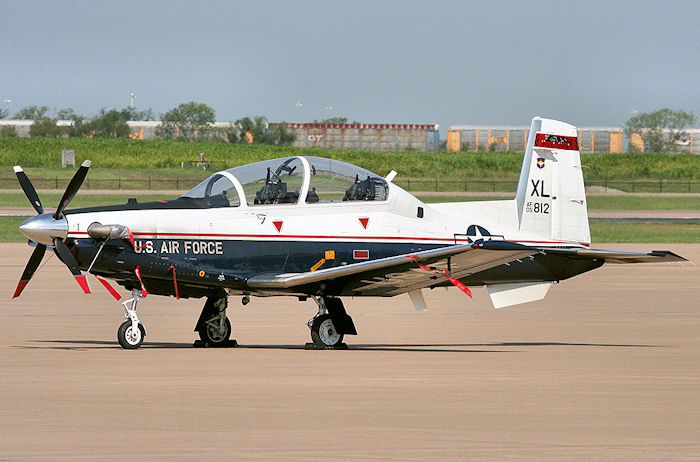
Today, aircraft flown at Laughlin include the T-6A Texan II, the T-38C Talon and T-1A Jayhawk. Fifteen classes of approximately 20–25 pilots graduate annually.
Based units
[edit]Flying and notable non-flying units based at Laughlin Air Force Base:[2][3]
United States Air Force
[edit]Air Education and Training Command (AETC)
- 47th Flying Training Wing
- 47th Comptroller Squadron
- 47th Operations Group
- 47th Operations Support Squadron
- 47th Student Squadron
- 85th Flying Training Squadron – T-6A Texan II
- 86th Flying Training Squadron – T-1A Jayhawk
- 87th Flying Training Squadron – T-38C Talon
- 434th Flying Training Squadron – T-6A Texan II
- 47th Medical Group
- 47th Medical Operations Squadron
- 47th Medical Support Squadron
- 47th Mission Support Group
- 47th Communications Squadron
- 47th Contracting Flight
- 47th Civil Engineering Squadron
- 47th Force Support Squadron
- 47th Logistics Readiness Flight
- 47th Security Forces Squadron
- Tenth Air Force
- 340th Flying Training Group
- 96th Flying Training Squadron (GSU) – T-1A Jayhawk, T-6A Texan II, T-38C Talon (GSU are Geographically Separate Units, which although based at Laughlin, are subordinate to a parent unit based at another location.)
- 340th Flying Training Group
Geography
[edit]According to the United States Census Bureau, the base has a total area of 5.9 square miles (15.3 km2), all land.
Demographics
[edit]| Census | Pop. | Note | %± |
|---|---|---|---|
| 1970 | 3,458 | — | |
| 1980 | 2,994 | −13.4% | |
| 1990 | 2,556 | −14.6% | |
| 2000 | 2,225 | −12.9% | |
| 2010 | 1,569 | −29.5% | |
| 2020 | 1,673 | 6.6% | |
| U.S. Decennial Census[4] 1850–1900[5] 1910[6] 1920[7] 1930[8] 1940[9] 1950[10] 1960[11] 1970[12] 1980[13] 1990[14] 2000[15] 2010[16] 2020[17] | |||
The U.S. Census Bureau counts the base as a census-designated place (Laughlin AFB CDP) with a population at the 2020 census of 1,673.[18] It first appeared as an unincorporated community in the 1970 U.S. census[12] and a census designated place in the 1980 United States census.[13]
| Race / Ethnicity (NH = Non-Hispanic) | Pop 1990[14] | Pop 2000[19] | Pop 2010[20] | Pop 2020[17] | % 1990 | % 2000 | % 2010 | % 2020 |
|---|---|---|---|---|---|---|---|---|
| White alone (NH) | 1,790 | 1,581 | 1,178 | 1,183 | 70.03% | 71.06% | 75.08% | 70.71% |
| Black or African American alone (NH) | 286 | 236 | 112 | 107 | 11.19% | 10.61% | 7.14% | 6.40% |
| Native American or Alaska Native alone (NH) | 16 | 5 | 8 | 2 | 0.63% | 0.22% | 0.51% | 0.12% |
| Asian alone (NH) | 97 | 61 | 40 | 63 | 3.79% | 2.74% | 2.55% | 3.77% |
| Pacific Islander alone (NH) | x | 1 | 5 | 5 | x | 0.04% | 0.32% | 0.30% |
| Other race alone (NH) | 2 | 12 | 0 | 5 | 0.08% | 0.54% | 0.00% | 0.30% |
| Mixed race or Multiracial (NH) | x | 55 | 54 | 55 | x | 2.47% | 3.44% | 3.29% |
| Hispanic or Latino (any race) | 365 | 274 | 172 | 253 | 14.28% | 12.31% | 10.96% | 15.12% |
| Total | 2,556 | 2,225 | 1,569 | 1,673 | 100.00% | 100.00% | 100.00% | 100.00% |
Education
[edit]Laughlin AFB is served by the San Felipe Del Rio Consolidated Independent School District. The school district operates an elementary school inside Laughlin AFB, the Roberto Barrera STEM Elementary Archived 2020-06-21 at the Wayback Machine school (K–5) (formerly known as Laughlin STEM elementary school).[21]
Park University[22] offers onsite and online classes on base. Its office is located at the Education Center and is open to military and civilian personnel.
See also
[edit]
References
[edit] This article incorporates public domain material from the Air Force Historical Research Agency
- Manning, Thomas A. (2005), History of Air Education and Training Command, 1942–2002. Office of History and Research, Headquarters, AETC, Randolph AFB, Texas OCLC 71006954, 29991467
- Shaw, Frederick J. (2004), Locating Air Force Base Sites, History’s Legacy, Air Force History and Museums Program, United States Air Force, Washington DC. OCLC 57007862, 1050653629
- FAA Airport Form 5010 for DLF PDF
- ^ "Airport Diagram – Laughlin AFB (KDLF)" (PDF). Federal Aviation Administration. 15 August 2019. Retrieved 16 August 2019.
- ^ "Units". Laughlin Air Force Base. US Air Force. Retrieved 16 August 2019.
- ^ "Aircraft and Squadrons of the US Air Force". United States Air Force Air Power Review 2018. Key Publishing: 96 and 97. 2018.
- ^ "Decennial Census by Decade". United States Census Bureau.
- ^ "1900 Census of Population - Population of Texas By Counties And Minor Civil Divisions" (PDF). United States Census Bureau.
- ^ "1910 Census of Population - Supplement for Texas" (PDF). United States Census Bureau. Archived from the original (PDF) on 2025-03-30. Retrieved 2024-07-13.
- ^ "1920 Census of Population - Number of Inhabitants - Texas" (PDF). United States Census Bureau.
- ^ "1930 Census of Population - Number of Inhabitants - Texas" (PDF). United States Census Bureau.
- ^ "1940 Census of Population - Number of Inhabitants - Texas" (PDF). United States Census Bureau.
- ^ "1950 Census of Population - Number of Inhabitants - Texas" (PDF). United States Census Bureau.
- ^ "1960 Census of Population - Number of Inhabitants - Texas" (PDF). United States Census Bureau.
- ^ a b "1970 Census of Population - Number of Inhabitants - Texas" (PDF). United States Census Bureau.
- ^ a b "1980 Census of Population - Number of Inhabitants - Texas" (PDF). United States Census Bureau.
- ^ a b "1990 Census of Population - Population and Housing Unit Counts - Texas" (PDF). United States Census Bureau.
- ^ "2000 Census of Population - Population and Housing Unit Counts - Texas" (PDF). United States Census Bureau.
- ^ "2010 Census of Population - Population and Housing Unit Counts - Texas" (PDF). United States Census Bureau.
- ^ a b "P2 HISPANIC OR LATINO, AND NOT HISPANIC OR LATINO BY RACE – 2020: DEC Redistricting Data (PL 94-171) – Laughlin AFB CDP, Texas". United States Census Bureau.
- ^ "Laughlin AFB CDP, Texas". United States Census Bureau. Retrieved May 14, 2022.
- ^ "P004 HISPANIC OR LATINO, AND NOT HISPANIC OR LATINO BY RACE – 2000: DEC Summary File 1 – Lackland AFB CDP, Texas". United States Census Bureau.
- ^ "P2 HISPANIC OR LATINO, AND NOT HISPANIC OR LATINO BY RACE – 2010: DEC Redistricting Data (PL 94-171) – Laughlin AFB CDP, Texas". United States Census Bureau.
- ^ "Laughlin AFB, Texas" (Archive). U.S. Department of Defense. Retrieved on August 13, 2015.
- ^ Park University
External links
[edit]
- Official website
- Resources for this U.S. military airport:
- FAA airport information for DLF
- AirNav airport information for KDLF
- ASN accident history for DLF
- NOAA/NWS latest weather observations
- SkyVector aeronautical chart for KDLF
- FAA Airport Diagram (PDF), effective October 30, 2025
| Leadership |  | ||||||||||
|---|---|---|---|---|---|---|---|---|---|---|---|
| Structure |
| ||||||||||
| Personnel and training | |||||||||||
| Uniforms and equipment | |||||||||||
| History and traditions |
| ||||||||||

| Air Forces |  | |
|---|---|---|
| Bases | ||
| Wings | ||
| Groups | ||
| Flying training |
|  | ||||
|---|---|---|---|---|---|---|
| Technical training | ||||||

Current military installations in Texas | |||||||||||
|---|---|---|---|---|---|---|---|---|---|---|---|
| Army |
|  | |||||||||
| Navy |
| ||||||||||
|
| ||||||||||
|
| ||||||||||
| International | |
|---|---|
| National | |

Laughlin Air Force Base
View on GrokipediaLaughlin Air Force Base is a United States Air Force installation situated near Del Rio, Texas, along the United States-Mexico border, serving as the primary site for specialized undergraduate pilot training under the Air Education and Training Command.[1][2] The base houses the 47th Flying Training Wing, which equips pilots for the U.S. Air Force, Air Force Reserve, Air National Guard, and allied nations using T-6A Texan II, T-38C Talon, and T-1A Jayhawk aircraft, producing approximately 400 new pilots each year through rigorous flight and leadership development programs.[2][1] Originally activated in 1943 as Laughlin Army Air Field during World War II and named in honor of local aviator Jack T. Laughlin, the facility supported early pilot training efforts before closing postwar and reopening in 1952 for advanced fighter operations.[1] The 47th Flying Training Wing assumed its current role on September 1, 1972, transitioning to undergraduate pilot training in 1993 with the introduction of specialized tracks, including airlifter-tanker variants in 1994.[1] Over nearly five decades, the wing has trained more than 15,000 pilots, logging over 80,000 flying hours and 51,000 sorties annually while sustaining a community of over 4,300 personnel and generating significant economic impact exceeding $234 million yearly.[1][2]
Overview
Location and Facilities
Laughlin Air Force Base is located in Val Verde County, Texas, approximately 7 miles east of Del Rio and near the United States-Mexico border along the Rio Grande. The base's coordinates place it at 29°21′57″N 100°46′39″W, facilitating its role in specialized undergraduate pilot training under clear skies and favorable weather conditions typical of the region.[3][4] The installation spans roughly 5,500 acres and includes an airfield with three runways: the primary runway 13C/31C measuring 8,852 feet by 150 feet surfaced with porous European mix (PEM), runway 13L/31R at 8,316 feet by 150 feet also PEM, and a shorter runway 17/35 at approximately 6,250 feet. Facilities support joint specialized undergraduate pilot training for the U.S. Air Force, Navy, Marines, and international partners, featuring aircraft maintenance hangars, academic classrooms, flight simulators, and operational support buildings maintained by the 47th Mission Support Group.[5][6][7] Additional infrastructure encompasses base housing for over 1,000 personnel, a medical clinic, commissary, fitness centers, and auxiliary landing fields such as Laughlin AFB Auxiliary No. 1 (T70) with a 6,001-foot runway used for training. The base's design emphasizes high-volume flight operations, exceeding 80,000 flying hours annually, with environmental and energy conservation measures integrated into facility management.[2][8][7]Primary Mission and Strategic Role
Laughlin Air Force Base, under the Air Education and Training Command (AETC), hosts the 47th Flying Training Wing, whose primary mission is to conduct specialized undergraduate pilot training (SUPT) for U.S. Air Force, Air Force Reserve, Air National Guard, and allied nation pilots.[2] The wing utilizes T-6A Texan II for primary training, T-38C Talon for advanced training, and T-1A Jayhawk for multi-engine qualification, delivering a 52-week curriculum that produces approximately 400 pilots annually.[2] This training exceeds 80,000 flying hours and 51,000 sorties per year, standardizing skills for subsequent specialized tracks in fighters, bombers, or transports.[2] Strategically, Laughlin contributes to AETC's overarching responsibility for developing combat-ready Airmen and leaders to deliver air power, supporting Air Force and combatant command requirements amid persistent demands for pilot production.[9] As one of AETC's key flying training installations, it bolsters U.S. air superiority by ensuring a steady pipeline of qualified aviators, with the 47th Operations Group overseeing standardization across squadrons like the 434th, 85th, and 86th Flying Training Squadrons.[10] The base's focus on high-volume, rigorous training addresses operational needs, having graduated over 15,000 pilots since the wing's reactivation on September 1, 1972.[11]History
World War II Era as Laughlin Army Air Field
Laughlin Army Air Field was established by the U.S. Army east of Del Rio, Texas, in 1942 to meet the urgent demand for trained pilots during World War II.[12] Construction of the airfield began in the summer and fall of 1942, with initial B-26 pilot transition training commencing in December 1942.[13] The facility was officially activated on March 3, 1943, and named in honor of 2nd Lt. Jack T. Laughlin, a Del Rio native and B-17 pilot killed in action on January 29, 1942, when his aircraft crashed over Java in the South Pacific, marking the first combat loss from the local area.[14][2] The primary mission of Laughlin Army Air Field was advanced pilot and bombardier training for the North American B-26 Marauder medium bomber, serving as the inaugural school dedicated to B-26 bombardier instruction under the Army Air Forces Training Command.[15] By February 1943, the field had initiated full pilot training operations, focusing on transitioning aviators to the demanding twin-engine B-26 platform, which required precise handling due to its high wing loading and speed.[16] Crews trained at the field contributed to combat operations in multiple theaters, with the B-26 proving effective in low-level attacks despite its reputation for being difficult to fly.[17] Operations continued through the war's duration, producing skilled aircrews until the airfield's inactivation in October 1945 following Japan's surrender, as surplus training needs diminished in the postwar demobilization.[18] During its active WWII period, the base supported the rapid expansion of U.S. air power, training hundreds of personnel amid the Army Air Forces' goal to field over 2.4 million personnel by 1945.[14]Post-War Closure and Cold War Reactivation
Following the end of World War II, Laughlin Army Air Field was inactivated and closed in October 1945, with its facilities downgraded from base to field and then auxiliary field status in the war's final years; the land was subsequently leased to local ranchers for sheep grazing.[14][19] Amid rising Cold War tensions and the outbreak of the Korean War in 1950, which necessitated expanded U.S. Air Force pilot training capacity, Laughlin was reactivated as Laughlin Air Force Base on May 1, 1952, under Air Training Command.[20][14][21] The reactivation focused on advanced jet pilot training, particularly transitioning combat crew to the Republic F-84 Thunderjet fighter, with Air Training Command personnel returning to the site in April 1952 to prepare facilities.[14][22] Initial operations emphasized proficiency in early jet aircraft, including the Lockheed F-80 Shooting Star, Republic F-84 Thunderjet, and Lockheed T-33 Shooting Star trainer, supporting the Air Force's shift to air superiority roles in potential conflicts.[19] By 1953, the training mission evolved to incorporate broader crew instruction, reflecting doctrinal adaptations to jet-era warfare demands.[22] This period marked Laughlin's transition from wartime bomber training to Cold War-era fighter proficiency, bolstering U.S. aerial readiness against Soviet threats.[21]Strategic Air Command Operations
Laughlin Air Force Base transitioned to Strategic Air Command (SAC) control in 1957, shifting its focus from fighter pilot training to high-altitude strategic reconnaissance amid escalating Cold War tensions.[14] The base hosted the 4080th Strategic Reconnaissance Wing, which relocated elements including U-2 and RB-57 aircraft from Turner Air Force Base, Georgia, beginning in April 1957.[23][24] This wing pioneered USAF operations with the Lockheed U-2 "Dragon Lady," conducting long-range photographic reconnaissance and meteorological data collection to monitor Soviet activities.[25] The remote location in southwest Texas provided ideal conditions for secretive overflights and testing, with the wing's RB-57s initially arriving on April 1, 1957, followed by U-2 transitions.[26] The 4080th SRW played a critical role in SAC's intelligence-gathering mission, including support for global surveillance operations. During the Cuban Missile Crisis in October 1962, U-2 pilots from Laughlin flew reconnaissance missions over Cuba, capturing aerial imagery that confirmed Soviet medium- and intermediate-range ballistic missile deployments, aiding U.S. decision-making.[23][27] These flights, conducted at altitudes exceeding 70,000 feet, underscored the wing's contributions to national security despite inherent risks, such as potential intercepts. President John F. Kennedy later recognized the unit's efforts with a commendation for its reconnaissance achievements.[28] SAC operations at Laughlin concluded in 1962 when the command transferred base jurisdiction back to Air Training Command, prompting the 4080th SRW's relocation to Davis-Monthan Air Force Base, Arizona, by mid-1963.[26] This five-year tenure represented a pivotal, albeit brief, chapter in the base's history, emphasizing SAC's emphasis on advanced reconnaissance capabilities over conventional training roles during the early Cold War.[23]Shift to Air Training Command
In June 1962, following the inactivation of the 4080th Strategic Reconnaissance Wing, Strategic Air Command transferred control of Laughlin Air Force Base to Air Training Command, shifting the installation's primary mission from high-altitude reconnaissance to undergraduate pilot training.[2][1] This transition occurred after the wing's involvement in critical operations, including U-2 reconnaissance flights during the Cuban Missile Crisis in October 1962, during which a U-2 was shot down over Cuba, resulting in the death of Major Rudolf Anderson Jr.[26] The 3646th Pilot Training Wing was established at Laughlin under Air Training Command to conduct the revived training mission, focusing on preparing pilots with aircraft such as the T-37 Tweet and T-38 Talon.[2] This marked a return to the base's aviation training roots from its World War II era, adapting facilities previously used for strategic operations to support structured flight instruction programs.[29] On September 1, 1972, the 47th Flying Training Wing was reactivated and redesignated, replacing the 3646th Pilot Training Wing and absorbing its resources to consolidate and enhance the pilot production pipeline at the base.[2][1] This organizational change under Air Training Command solidified Laughlin's role as a key undergraduate pilot training hub, producing combat-ready aviators for the U.S. Air Force and allied nations.[30]Post-Cold War Developments and Modern Era
Following the dissolution of the Soviet Union in 1991, Laughlin Air Force Base transitioned its focus entirely to undergraduate pilot training under Air Education and Training Command, emphasizing efficiency in producing combat-ready aviators amid reduced strategic bomber operations elsewhere in the Air Force.[14] The base adopted the Specialized Undergraduate Pilot Training (SUPT) program in November 1993, standardizing initial flight instruction across services with the T-37 Tweet for primary phases and introducing the T-1A Jayhawk in the mid-1990s for advanced multi-engine training; by January 17, 1995, the 86th Flying Training Squadron received its final T-1A, completing the fleet transition to support specialized tracks for jet, bomber, and tanker pilots.[31][32] In the 2000s, Laughlin integrated the T-6A Texan II as its primary trainer, replacing the aging T-37 fleet to enhance simulation-integrated curricula and reduce maintenance costs, while retaining T-38C Talons for supersonic advanced training.[2] The 47th Flying Training Wing, headquartered at the base, expanded to train approximately 400 pilots annually by the 2010s, including U.S. Air Force, Navy, Marine Corps, and international partners, positioning Laughlin as the largest SUPT site.[2][33] This growth addressed Air Force pilot shortages, with the 87th Flying Training Squadron marking 35 years of continuous operations by April 2025.[34] Recent initiatives have prioritized data-driven optimizations, such as competency mapping implemented by the 19th Air Force in 2025 to tailor training pipelines and accelerate throughput, contributing to projections of 367 graduates from Laughlin in the fiscal year and supporting Air Education and Training Command's target of 1,500 pilots service-wide.[35][36] Looking forward, the Department of the Air Force approved replacement of all T-38C aircraft with up to 79 T-7A Red Hawk trainers between 2030 and 2033, enabling advanced aerobatic and systems training in a next-generation platform designed for fifth-generation fighter transitions.[37][38] These upgrades ensure sustained relevance in an era of evolving aerial threats and technological integration.[39]Operations and Units
Pilot Training Programs
The 47th Flying Training Wing at Laughlin Air Force Base conducts Specialized Undergraduate Pilot Training (SUPT), the largest such program in the U.S. Air Force, producing approximately 400 military pilots annually from the United States and allied nations.[2][40] SUPT spans 52 weeks and encompasses over 500 classroom hours, 60 simulator hours, and roughly 200 flight hours, preparing students for operational aircraft through a structured curriculum emphasizing fundamentals of flight, navigation, formation, and instrument procedures.[40] SUPT divides into three primary phases: academics and initial flight screening, primary flying training, and advanced flying training. The initial phase includes ground school, simulator familiarization, and prerequisite assessments to ensure readiness, with students assigned to admissions flights for foundational success training.[41] Primary training occurs in the T-6A Texan II aircraft, managed by the 85th and 434th Flying Training Squadrons, covering contact, instrument, formation, low-level, navigation, and night operations, collectively known as the "T-6 Nation."[42][43] Advanced training follows in the T-38C Talon supersonic jet trainer, handled by the 87th Flying Training Squadron, focusing on fighter/bomber track skills such as high-performance aerobatics, advanced formation, and tactical maneuvers.[40] As of January 2025, the T-1A Jayhawk, previously used for airlift/tanker track training, has been fully retired at Laughlin, shifting emphasis to T-6A and T-38C platforms pending introduction of the T-7A Red Hawk.[44] The 96th Flying Training Squadron supports overall flight training with reserve instructor pilots, while the 47th Student Training Squadron oversees academics and simulators, and the 47th Operations Support Squadron manages airfield operations.[40] Recent enhancements include competency-based mapping to streamline the pipeline and data-driven optimizations for readiness, alongside support for instructor pilot training through deployment of First Assignment Instructor Pilots (FAIPs) to other bases.[35][45] Initial Pilot Training (IPT) supplements SUPT for select candidates via an FAA Part 141 syllabus prior to military-specific phases.[46]Assigned Aircraft and Squadrons
The 47th Flying Training Wing (47th FTW) at Laughlin Air Force Base assigns aircraft primarily for Specialized Undergraduate Pilot Training (SUPT), utilizing the T-6A Texan II for primary training, the T-38C Talon for advanced supersonic training, and the T-1A Jayhawk for multi-engine jet familiarization.[7] The 47th Operations Group oversees four flying training squadrons equipped with these aircraft, supporting the production of approximately 400 pilots annually.[2] As of recent operations, the base maintains a fleet comprising 103 T-6A Texan IIs, 59 T-38C Talons, and 13 T-1A Jayhawks.[47] The assigned squadrons and their primary aircraft are detailed as follows:| Squadron | Aircraft | Training Phase and Role |
|---|---|---|
| 85th Flying Training Squadron | T-6A Texan II | Primary flight training, focusing on basic airmanship, contact, and instrument skills.[42] |
| 434th Flying Training Squadron | T-6A Texan II | Primary flight training, emphasizing aerobatics, formation, and navigation procedures.[42] |
| 87th Flying Training Squadron | T-38C Talon | Advanced flight training in high-performance jet operations, including formation and low-level tactics.[48][10] |
| 86th Flying Training Squadron | T-1A Jayhawk | Phase III training for tanker and airlift track pilots, covering multi-engine handling and crew coordination.[49] |