Hubbry Logo
MemorareMemorareMain
Open search
Memorare
Community hub
Memorare
logo
8 pages, 0 posts
0 subscribers
Be the first to start a discussion here.
Memorare
Memorare
from Wikipedia
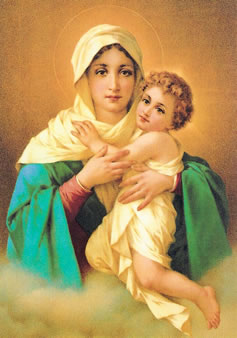
Refugium Peccatorum Madonna, an example of Marian art

Memorare ("Remember, O Most Gracious Virgin Mary") is a Catholic prayer seeking the intercession of the Blessed Virgin Mary.[1] It first appears as part of a longer 15th-century prayer, "Ad sanctitatis tuae pedes, dulcissima Virgo Maria." Memorare, from the Latin "Remember," is frequently misattributed to the 12th-century Cistercian monk Saint Bernard of Clairvaux, apparently due to confusion with its 17th-century popularizer, Father Claude Bernard, who stated that he learned it from his own father.

Modern version

[edit]

The modern version is taken from that indulgenced by Pope Pius IX in 1846, Raccolta, #339 (S. C. Ind., Dec. 11, 1846; S. P. Ap., Sept. 8, 1935) Encr. Ind. #32:

History of the prayer

[edit]

This prayer is originally from a longer prayer of the 15th century, "Ad sanctitatis tuae pedes, dulcissima Virgo Maria".[2]

Francis de Sales

[edit]

The de Sales family were members of the minor nobility and devout Catholics, but St. Francis de Sales fell victim to the religious turmoil of his age. The question of predestination, the hottest point of contention between Catholic and Calvinist theologians, tormented him while he was a student in Paris. In his distress over the uncertain fate of his soul he cried out to God, "Whatever happens, Lord, may I at least love you in this life if I cannot love you in eternity." At the age of 18, while studying at the Jesuit run Collège de Clermont at the University of Paris, according to the book The Spirit of St. Francis de Sales, by Jean-Pierre Camus:

The evil spirit was permitted by God to insinuate into his mind the terrible idea that he was one of the number of the damned. This delusion took such possession of his soul that he lost his appetite, was unable to sleep, and day by day grew more wasted and languid. His tutor and director noticing how his health was affected, and how pale, listless, and joyless he had become often questioned him as to the cause of his dejection and evident suffering, but his tormentor who had filled his mind with this delusion, being what is called a dumb devil, the poor youth could give no explanation.

For one whole month he suffered this mental torture, this agony of soul. He had lost all the sweetness of divine love, but not, happily, his fidelity to it. He looked back with happy tears to the happy time when he was, as it were, inebriated with that sweetness, nor did any ray of hope illumine the darkness of that night of despair. In late December, at last, led by a divine inspiration, he entered a church to pray that this agony might pass.

On his knees before a statue of the Blessed Virgin he implored the assistance of the Mother of Mercy with tears and sighs, and the most fervent devotion.[3]

According to De Sales' Selected Letters, the "torment of despair came to a sudden end" as he knelt in prayer before the statue of Our Lady of Good Deliverance (the Black Madonna) at the church of Saint-Étienne-des-Grès, Paris, saying the Memorare. Francis credited the Blessed Virgin with "saving him from falling into despair or heresy"; he "recited the Memorare day after day", and she "did not leave him unaided."[4]

Claude Bernard

[edit]

It was popularized in the 17th century by Fr. Claude Bernard (d. 1641), who learned it from his father. Bernard's devotion to Our Lady under the title Consolatrix Afflictorum (Comforter of the Afflicted) led him to promote recourse to her intercession among the poor and condemned prisoners.[5] According to the book Familiar Prayers: Their Origin and History written by Fr. Herbert Thurston S.J. in 1953:

Fr. Claude Bernard, known as the "Poor Priest", zealously dedicated himself to the preaching and aiding of prisoners and criminals condemned to death. Trusting his charges to the care and intercession of the Blessed Virgin Mary, Fr. Bernard employed the Memorare extensively in his work of evangelization to great effect. Many a criminal was reconciled to God through his efforts. At one time he had more than 200,000 leaflets printed with the Memorare in various languages so he could distribute the leaflets wherever he felt they would do some good. Part of the reason Fr. Claude Bernard held the prayer in such high regard was because he himself felt that he had been miraculously cured by its use. In a letter to Queen Anne of Austria, wife of Louis XIII, he wrote that he was deathly ill once. In fear of his life he recited the Memorare and immediately began to get well again. Feeling unworthy of such a miracle, he attributed the cure to some unknown natural cause. Sometime later, Brother Fiacre, a discalced Augustinian, came to call upon Fr. Bernard. The good brother begged Fr. Bernard's pardon for disturbing him, but he desired to know how Fr. Bernard was getting along. Brother Fiacre then went on to say that the Virgin Mary had appeared to him in a vision, told him of Fr. Bernard's illness, told him how she had cured Fr. Bernard of it, and that he was to assure Fr. Bernard of this fact. Fr. Bernard then goes on to write in his letter that he was ashamed of his ingratitude in attributing the cure to natural causes, and asked for God's forgiveness in the matter.

The "Memorare" played a part in the conversion of Marie-Alphonse Ratisbonne,[6] when upon the dare of a Catholic acquaintance he agreed to wear the Miraculous Medal and recite the prayer for a month.[7]

The prayer became popular in England by way of France, and appeared in the 1856 edition of Bishop Richard Challoner's The Garden of the Soul.[8] In a 1918 article published in the Month on the theme of Familiar Prayers, Herbert Thurston discussed the "Memorare" as one of the prayers he considered representative of English Catholic prayer. By "familiar", Thurston meant those prayers most of the faithful knew by heart.[9] There were at least five separate versions circulating at that time. Mary Heinman observes that the "Memorare" "...became an English Catholic favorite in the post-1850 period for reasons which had no direct connection to either papal directives or native tradition."[10]

William Fitzgerald notes, "Calling on Mary to 'remember' is an act of boldness, but it is boldness justified by tradition....Mary needs no reminder of her role in the realm of salvation. However, those who call upon her do require such reminders (if not specifically, then more generally) to remind them of their place as supplicants before the Virgin Mary."[11] Asking Mary to intercede as our Advocate before God does not guarantee that a supplicant's specific request will be granted, only that divine aid and assistance in the supplicant's best interest will be given through Mary's help.

Indulgence

[edit]

In the Roman Catholic Church, the Enchiridion Indulgentiarum of 2004 provides for partial indulgence for devoutly reciting the prayer under the normal conditions.[12]

See also

[edit]

Notes

[edit]
[edit]
Revisions and contributorsEdit on WikipediaRead on Wikipedia
from Grokipedia
The Memorare is a traditional Roman Catholic addressed to the Blessed Virgin Mary, seeking her powerful and expressing unwavering confidence that those who implore her aid are never abandoned. Originating as an excerpt from a longer 15th-century Marian titled Ad sanctitatis tuae pedes, dulcissima Virgo Maria, it has been widely used for centuries to Mary in times of need, distress, or spiritual trial. Although traditionally attributed to the 12th-century Cistercian and St. Bernard of Clairvaux, the prayer's authorship remains unknown, with its earliest known form appearing in a 15th-century . It gained widespread popularity in the through the efforts of French priest Father Claude Bernard, who, after crediting the prayer with his own miraculous recovery from a severe illness, printed and distributed over 200,000 leaflets containing it in French, English, and German across . This dissemination helped establish the Memorare as a staple of Catholic devotion, often recited for urgent intentions or as part of novenas. Its significance lies in its emphasis on Mary's role as a compassionate mediator and unfailing helper, a theme that has inspired numerous accounts of efficacy, including conversions, healings, and providential interventions. Saints such as St. Francis de Sales, who recited it daily, and St. Teresa of Calcutta (Mother Teresa), who employed a "Flying Novena" of nine Memorares for immediate crises—like clearing rain during a 1984 papal event in —have attested to its spiritual potency. Modern Catholic communities continue this tradition, organizing collective recitations for communal needs, such as enrollment growth at in 2006, where participants prayed over 1,200 Memorares each and saw a 200-student increase.

Text of the Prayer

Original Latin

The Memorare prayer, in its original Latin form as a standalone invocation derived from 15th-century sources, consists of a single continuous paragraph without structural divisions, emphasizing a direct appeal to the Virgin Mary.
MEMORARE, O piissima Virgo Maria, non esse auditum a saeculo, quemquam ad tua currentem praesidia, tua implorantem auxilia, tua petentem suffragia, esse derelictum. Ego tali animatus confidentia, ad te, Virgo Virginum, Mater, curro, ad te venio, coram te gemens peccator assisto. Noli, Mater Verbi, verba mea despicere; sed audi propitia et exaudi. Amen.
Key phrases underscore the prayer's themes of unwavering trust in Marian ; for instance, piissima Virgo Maria translates to "most gracious Virgin Mary," highlighting Mary's compassionate nature, while non esse auditum a saeculo means "it has never been heard from the beginning of the world," asserting the reliability of her aid based on . The structure builds from a declarative statement of Mary's proven protection to a personal , culminating in an Amen that seals the plea.

Modern English Translation

The standard modern English translation of the Memorare, widely used in contemporary Catholic devotional practices, is as follows:
Remember, O most gracious Virgin Mary,
that never was it known
that anyone who fled to thy ,
implored thy help, or sought thine
was left unaided.
Inspired by this , I fly unto thee,
O Virgin of virgins, my mother;
to thee do I come, before thee I stand, sinful and sorrowful.
O Mother of the Word Incarnate,
despise not my petitions,
but in thy mercy hear and answer me. Amen.
This version emphasizes the prayer's themes of trust and maternal care through straightforward, archaic English phrasing that retains a poetic suitable for , making it accessible for English-speaking Catholics in personal and communal settings. Minor variations appear in some English editions, particularly in translating the Latin piissima (translated as "most gracious" or alternatively "most compassionate"); for instance, "most gracious Virgin Mary" is common, while alternatives like "most compassionate Virgin Mary" convey a stronger sense of . In English-speaking contexts, the prayer is recited with standard American or British English pronunciation to aid memorization and fluency; for example, "Memorare" is typically pronounced as /ˈmɛmərɛər/ (MEM-uh-rair), "thine" as /ðaɪn/ (thyn), and "intercession" as /ˌɪntərˈsɛʃən/ (in-ter-SESS-shun), often guided by audio resources from Catholic publishers for rhythmic delivery during novenas or rosary devotions.

Historical Origins

Early 15th-Century Sources

The earliest documented appearances of the Memorare prayer occur within the longer 15th-century Latin composition titled Ad sanctitatis tuae pedes, dulcissima Virgo Maria, a supplicatory text addressed to the Virgin Mary. This extended , which encompasses the core lines of the Memorare as an embedded segment, first emerges in s and early printed works from the last quarter of the , reflecting the prayer's integration into contemporary devotional literature. Specific examples include its inclusion in the Hortulus Animae, a popular of prayers circulating in form during this period, and the Antidotarius Animae attributed to Nicholas de Saliceto, a Cistercian , as preserved in 15th-century copies and the 1518 edition. These sources situate the prayer's origin amid the burgeoning Marian piety of late medieval Europe, where devotion to the Virgin intensified through widespread practices such as pilgrimages, confraternities, and artistic representations that emphasized her role as intercessor. By the late 1400s, amid social upheavals like the and the Black Death's aftermath, such prayers proliferated in personal and communal worship, often appearing in French and Latin manuscripts produced in monastic and lay scriptoria across regions like and the . This context underscores the Memorare's emergence not as an isolated text but as part of a broader devotional surge, evidenced by the prayer's adaptation into vernacular prayer books that catered to diverse audiences seeking Mary's advocacy. By the early 16th century, the Memorare segment began to circulate independently, detached from its original longer framework, as seen in compilations like the Precationum piarum Enchiridion (ca. 1570) by Simon Verepaeus, which excerpts the familiar invocation while preserving its Marian focus. Historical prayer books from this transitional era, including printed editions from Paris and Strasbourg, demonstrate this evolution, with the standalone form gaining traction in both clerical and lay contexts before its wider dissemination later in the century. Although traditionally attributed to the 12th-century figure Bernard of Clairvaux, these 15th-century textual witnesses establish the prayer's actual composition well after his lifetime.

Traditional Attribution to Bernard of Clairvaux

The Memorare prayer has been traditionally attributed to Saint Bernard of Clairvaux (1090–1153), the influential Cistercian abbot, mystic, and Doctor of the Church, whose life and writings profoundly shaped medieval Marian devotion. According to longstanding legend, Bernard composed the prayer as an expression of his fervent trust in the Virgin Mary's intercessory power, drawing from his renowned sermons and treatises that extolled her role as mediatrix, such as his Homilies on the Song of Songs where he depicts Mary as a compassionate advocate for sinners. This association portrays the Memorare as a gem from Bernard's spiritual legacy, circulated orally and in manuscripts within Cistercian communities to inspire confidence in Mary's unfailing aid. The reasons for this attribution lie in perceived stylistic affinities between the Memorare's eloquent Latin prose—marked by rhythmic pleas and assurances of Mary's efficacy—and Bernard's own authentic prayers, which similarly blend scriptural echoes with themes of humble to the Mother of God. Additionally, oral traditions in monastic circles likely amplified the connection, as Bernard's reputation as "Mary's " made him a natural candidate for authorship of any potent Marian , even absent direct evidence. These factors fostered the legend's endurance, despite the prayer's actual emergence in 15th-century devotional texts. Modern scholarship, however, firmly debunks the link to Bernard, finding no trace of the Memorare in his extensive corpus of over 400 preserved sermons, letters, and treatises. The prayer postdates him by more than 300 years, with its earliest forms appearing as an excerpt from longer 15th-century compositions like the Ad sanctitatis tuae pedes, dulcissima Virgo Maria in works such as the Hortulus Animae (circa 1489) and the Antidotarius Animae (1518). This chronological discrepancy, coupled with the absence of any medieval attribution to Bernard in surviving manuscripts, was conclusively established through 20th-century liturgical and historical analyses, notably Herbert Thurston's Familiar Prayers: Their Origin and History (1953), which traces the misattribution to later confusions with the 17th-century promoter Father Claude Bernard.

Popularization and Spread

Claude Bernard's Role

Fr. Claude Bernard (1588–1641), a French Catholic known as the "Poor Priest," dedicated his ministry to serving the marginalized in early 17th-century . Born in and ordained after studying at the Jesuit College of Dole, Bernard moved to where he distributed his personal wealth—estimated at 400,000 livres—and inheritance to aid the poor, the sick, and prisoners. He founded the Seminary of Trente-Trois in to train indigent candidates for the priesthood, an institution that continues to operate today, and collaborated with figures like St. Vincent de Paul in charitable works. Bernard's deep devotion to the Blessed Virgin Mary under the title "Comforter of the Afflicted" led him to promote the Memorare as a powerful tool for spiritual consolation and conversion. He attributed his own miraculous recovery from a near-fatal illness to reciting the prayer, an event confirmed by a vision reported to him by Brother Fiacre, a Discalced Augustinian. Inspired by this experience, Bernard documented the miracle in a letter to Queen Anne of , wife of , emphasizing the prayer's efficacy in desperate situations. In his evangelization efforts, particularly among prisoners and those condemned to death, distributed the Memorare widely to foster and trust in Mary's intercession. He printed over 200,000 leaflets containing the in multiple languages, enabling him to share it in hospitals, prisons, and among the poor during a period of social upheaval in . These distributions supported his preaching, where he witnessed numerous conversions, crediting the 's role in bringing solace and turning hearts toward . Bernard adapted the Memorare by extracting its core invocation from longer medieval prayers to the Virgin, making it accessible and suitable for lay devotion without requiring elaborate rituals. This emphasis on the standalone facilitated its use by ordinary people in daily life, contributing significantly to its enduring popularity as a simple yet potent plea for Mary's aid.

Francis de Sales' Influence

St. (1567–1622), the Bishop of and a prominent figure in spirituality, frequently recited the Memorare during his spiritual direction of laypeople and clergy alike, viewing it as a powerful tool for invoking Mary's aid in times of trial. A notable account of his personal devotion appears in St. Alphonsus Liguori's The Glories of Mary (1750), which recounts how de Sales, at age 18 while studying in , endured a severe crisis of despair over fears of predestined damnation; kneeling before a statue of Our Lady of Good Deliverance in the Church of Saint-Étienne-des-Grès, he prayed the Memorare fervently and experienced immediate relief, marking a turning point in his spiritual life. This episode underscored his lifelong trust in the prayer's efficacy, leading him to share it as a remedy for spiritual anguish among his directees. De Sales incorporated recommendations for concise, heartfelt invocations to Mary into his writings, notably in Introduction to the Devout Life (1609), emphasizing their role in cultivating gentle confidence in for souls beset by distress. His endorsement extended its reach beyond monastic circles, embedding it in accessible devotional practices for the . Through de Sales' influence, the Memorare gained traction as a favored in personal piety during the era.

Theological Significance

Marian Intercession

The Memorare's core request echoes Catholic of the Blessed Virgin Mary as the "refuge of sinners," beseeching her to intercede and mediate with for those who seek her aid in times of spiritual distress or need. This central plea positions Mary as a compassionate who extends her maternal protection to humanity, aligning with longstanding Catholic veneration of her as a source of solace for the penitent. The prayer's emphasis on Mary's mediatory role finds scriptural grounding in the Wedding at Cana (John 2:1–11), where she notices the hosts' lack of wine and prompts to perform his first , demonstrating her attentive on behalf of others' needs. This biblical episode illustrates Mary's initiative in bringing human concerns to her Son, underscoring her function as a bridge between divine mercy and earthly supplication. Doctrinally, the Memorare resonates with the Second Vatican Council's teachings in (1964), which affirm that Mary, assumed into heaven, persists in her salvific mission through "manifold ," continually bestowing the gifts of eternal salvation and earning invocation as , Helper, Benefactress, and . This portrayal integrates Mary's supportive role within Christ's unique mediation, enhancing rather than competing with it. The prayer distinguishes itself among by its unwavering declaration that no one imploring her help has ever been forsaken, emphasizing the reliability of her intercessory efficacy rooted in Church tradition. This assurance cultivates profound trust in her unfailing maternal support.

Themes of Trust and Efficacy

The rhetorical structure of the Memorare centers on the invocation of memory to affirm Mary's unwavering aid, particularly through the key phrase "Never was it known that anyone who fled to thy , implored thy help, or sought thy , was left unaided." This formula appeals to the collective historical experience of the faithful, positioning Mary's assistance as a consistent that compels her continued intervention to uphold her reputation for . By appealing to her established role as , it cultivates filial trust, encouraging devotees to approach her with bold confidence rather than hesitation. This emphasis on assurance exerts a profound psychological impact on personal , transforming into resolute petitioning by reinforcing the in Mary's reliable as an extension of . The prayer's language instills a sense of security, prompting individuals to integrate it into daily spiritual life as a means of overcoming and fostering deeper reliance on Marian . The Memorare's proclamation of efficacy finds parallels in liturgical traditions such as the Litany of Loreto, where repeated invocations like "Refuge of sinners" and "Health of the sick, pray for us" similarly declare Mary's proven power to aid humanity, inviting communal affirmation of her supportive roles without reservation.

Indulgences and Devotional Practices

Papal Grants of Indulgences

In 1846, issued a rescript through the Sacred Congregation of Indulgences on , granting a partial of 300 days to all the faithful who devoutly recite the Memorare. This was extended to a plenary level once a month under the usual conditions—sacramental confession, reception of Holy Communion, for the Pope's intentions, and detachment from sin—for those who recite the daily throughout the month. The grant was incorporated into the Church's official collection of indulgenced prayers and works, known as the (entry #339), and renewed in subsequent editions during the 20th century. Under , the 1910 revision of the reaffirmed the partial of 300 days and the monthly plenary option, ensuring continued recognition of the prayer's devotional value. The was confirmed on September 8, 1935, under (S. P. Ap.). These historical grants align with the broader canonical framework for indulgences attached to Marian prayers, as codified in the Enchiridion Indulgentiarum. The current norms, revised in 1968 and 1999, provide a partial for the devout of the Memorare, emphasizing its role in fostering and remission of temporal punishment without specifying quantified days.

Usage in Liturgy and Private Devotion

The Memorare holds a prominent place in Catholic liturgical practices, particularly within such as and structured chaplets. It is frequently recited as part of the "Flying Novena," a rapid form of the traditional nine-day prayer where the Memorare is repeated nine consecutive times to seek immediate from the Blessed Virgin Mary during urgent needs; this practice was notably employed by St. of Calcutta for its efficacy in missionary work and personal trials. Another key liturgical application is the Chaplet of the Memorare, a 21st-century devotion originating in the in 2017 and revealed to a local visionary, consisting of seven decades of eleven Memorares each, accompanied by specific intentions for the Church, priests, and global peace, prayed using rosary-like beads. In private devotion, the Memorare is a go-to for individuals facing adversity, including illness, spiritual , or the need for conversion, often yielding reported instances of miraculous outcomes since the . For instance, 19th-century accounts from European Catholics describe sudden healings from grave sicknesses attributed to fervent recitation, while 20th-century testimonies, such as those from the Memorare Army at , highlight its role in communal campaigns for personal and institutional intentions, fostering trust in Mary's intercession. These anecdotes underscore its reputation for providing solace and resolution in moments of desperation, with conditions for partial indulgences briefly noted in devotional guides to encourage regular use. The prayer's widespread adoption is reflected in its inclusion in 19th- and 20th-century compilations like the Roman , a Vatican-approved collection of indulgenced prayers first published in 1807 and updated through 1952, where the Memorare was listed with a partial of 300 days for devout . In contemporary times, since the 2010s, digital platforms have further globalized its accessibility; apps such as offer guided audio sessions of the Memorare integrated with daily reflections, while Laudate provides multilingual texts for on-the-go private , enabling millions of users to incorporate it into modern spiritual routines.

References

Add your contribution
Related Hubs
User Avatar
No comments yet.