Hubbry Logo
Miniature snap-action switchMiniature snap-action switchMain
Open search
Miniature snap-action switch
Community hub
Miniature snap-action switch
logo
8 pages, 0 posts
0 subscribers
Be the first to start a discussion here.
Miniature snap-action switch
from Wikipedia
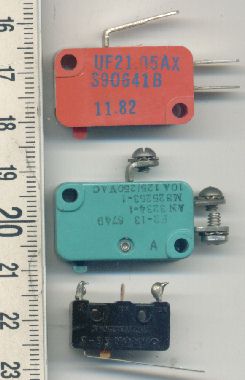
Comparison of some different switches

A miniature snap-action switch, also trademarked and frequently known as a micro switch or microswitch, is an electric switch that is actuated by very little physical force, through the use of a tipping-point mechanism, sometimes called an "over-center" mechanism.

The defining feature of micro switches is that a relatively small movement at the actuator button produces a relatively large movement at the electrical contacts, which occurs at high speed (regardless of the speed of actuation). Switching happens reliably at specific and repeatable positions of the actuator, which is not necessarily true of other mechanisms. Most successful designs also exhibit hysteresis, meaning that a small reversal of the actuator is insufficient to reverse the contacts; there must be a significant movement in the opposite direction. Both of these characteristics help to achieve a clean and reliable interruption to the switched circuit.

They are very common due to their low cost but high durability, greater than 1 million cycles, and up to 10 million cycles for heavy-duty models. This durability is a natural consequence of the design.

History

[edit]

The first micro switch was invented by Phillip Kenneth McGall in 1932 in Freeport, Illinois, under patent US1,960,020.[1] McGall was an employee of the Burgess Battery Company at the time. In 1937 W.B. Schulte,[2] McGall's employer, started the company MICRO SWITCH. The company and the Micro Switch trademark have been owned by Honeywell Sensing and Control since 1950.[3] The name has become a generic trademark for any snap-action switch. Companies other than Honeywell now manufacture miniature snap-action switches.

Construction and operation

[edit]
The internals of a micro switch. Contacts, from left to right, are common, normally open, and normally closed.

In one type of microswitch,[4] internally there are two conductive springs. A long flat spring is hinged at one end of the switch (the left, in the photograph) and has electrical contacts on the other. A small curved spring, preloaded (i.e., compressed during assembly) so it attempts to extend itself (at the top, just right of center in the photo), is connected between the flat spring near the contacts and a fulcrum near the midpoint of the flat spring. An actuator nub presses on the flat spring near its hinge point.

Because the flat spring is anchored and strong in tension the curved spring cannot move it to the right. The curved spring presses, or pulls, the flat spring upward, that is away, from the anchor point. Owing to the geometry, the upward force is proportional to the displacement which decreases as the flat spring moves downward. (Actually, the force is proportional to the sine of the angle, which is approximately proportional to the angle for small angles.)

As the actuator depresses it flexes the flat spring while the curved spring keeps the electrical contacts touching. When the flat spring is flexed enough it will provide sufficient force to compress the curved spring and the contacts will begin to move.

As the flat spring moves downward the upward force of the curved spring reduces causing the motion to accelerate even in the absence of further movement of the actuator until the flat spring impacts the normally-open contact. Even though the flat spring unflexes as it moves downward, the switch is designed so the net effect is acceleration. This "over-center" action produces a very distinctive clicking sound and a very crisp feel.

In the actuated position the curved spring provides some upward force. If the actuator is released this will move the flat spring upward. As the flat spring moves, the force from the curved spring increases. This results in acceleration until the normally-closed contacts are hit. Just as in the downward direction, the switch is designed so that the curved spring is strong enough to move the contacts, even if the flat spring must flex, because the actuator does not move during the changeover.

Applications

[edit]

Microswitches have two main areas of application:

  • Firstly, they are used when a low operating force with a clearly defined action is needed.
  • Secondly, they are used when long-term reliability is needed. This is a result of the internal mechanism and the independence of the closing force on the switch contacts from the operating force. Switch reliability is largely a question of the contact force: a force that is reliably adequate, but never excessive, encourages long life.

Common applications of micro switches include the door interlock on a microwave oven, leveling and safety switches in elevators, vending machines, arcade buttons, and to detect paper jams or other faults in photocopiers. Microswitches are commonly used in tamper switches on gate valves on fire sprinkler systems and other water pipe systems, where it is necessary to know if a valve has been opened or shut.

Micro switches are very widely used; among their applications are appliances, machinery, industrial controls, vehicles, convertible tops, and many other places for control of electrical circuits. They are usually rated to carry current in control circuits only, although some switches can be directly used to control small motors, solenoids, lamps, or other devices. Special low-force versions can sense coins in vending machines, or with a vane attached, airflow. Microswitches may be directly operated by a mechanism, or maybe packaged as part of a pressure, flow, or temperature switch, operated by a sensing mechanism such as a Bourdon tube. In these latter applications, the repeatability of the actuator position when switching happens is essential for long-term accuracy. A motor-driven cam (usually relatively slow-speed) and one or more micro switches form a timer mechanism. The snap-switch mechanism can be enclosed in a metal housing including actuating levers, plungers, or rollers, forming a limit switch useful for control of machine tools or electrically-driven machinery.

See also

[edit]

References

[edit]
[edit]
Revisions and contributorsEdit on WikipediaRead on Wikipedia
from Grokipedia
A miniature snap-action switch, commonly referred to as a microswitch, is a compact electromechanical device featuring a small contact gap and a snap-action mechanism that enables rapid, reliable switching of an electrical circuit when actuated by a minimal external force, typically enclosing the contacts in a protective case operated by an external or . Invented in 1932 by Philip K. McGall (known as Peter McGall) while working for C. F. Burgess Laboratories in Freeport, Illinois, the microswitch was patented under U.S. Patent No. 1,960,020 and initially designed for precise temperature control in chicken brooders, marking a significant advancement in compact switching technology. Its core structure includes an actuator for external input, a snap-action spring mechanism that provides the characteristic quick transfer of contacts independent of actuation speed, silver alloy contacts for low resistance and durability, a thermoplastic or metal case for environmental protection, and terminals for circuit integration. The operating principle relies on an "over-center" spring configuration, where a slight movement causes the spring to snap past a tipping point, abruptly closing or opening the contacts with a gap typically ranging from 0.25 mm for high-sensitivity models to 1.8 mm for those resistant to vibration and shock, ensuring minimal arcing and extending operational life to over 1 million cycles in many designs. Available in momentary or maintained contact types and various sizes—including subminiature, miniature, and standard—these switches support current ratings from microloads to 26 amps and operating temperatures from -40°C to +85°C, often with IP67 ratings for dust and water resistance. Miniature snap-action switches are widely applied in detection roles across industries, such as door interlocks in household appliances like microwaves, position sensing in automotive seat adjustments and industrial robotics, button mechanisms in computer mice, and safety controls in medical devices like monitors, valued for their precision, reliability, and ability to handle both low- and high-capacity loads.

Fundamentals

Definition and Basic Principles

A miniature snap-action switch is an electromechanical device designed to control electrical circuits by rapidly transitioning its internal contacts from an open to a closed state, or vice versa, in response to minimal physical actuation force, typically ranging from 10 to 500 grams. This quick transition is achieved through a tipping-point or over-center mechanism, where a spring-loaded assembly reaches an unstable equilibrium and suddenly flips to the opposite stable position, ensuring precise and instantaneous switching independent of the actuator's speed. At the heart of its operation lies a bistable spring system that stores during initial deflection and releases it abruptly upon crossing , propelling the movable contact to against the stationary one with high . This design minimizes contact bounce and arcing, promoting durability and reliable signal interruption in applications requiring clean on-off transitions. The mechanism's physics relies on the spring's nonlinear force-displacement curve, where the over-center configuration creates two stable equilibria separated by an energy barrier. A key principle distinguishing snap-action switches from gradual-action types is the incorporation of —the differential between the actuation point (where the switch turns on) and the release point (where it turns off), often manifesting as 0.1 to 1 of travel difference. This prevents oscillatory chattering near the threshold, ensuring stable and repeatable performance even under vibration or slight reversals in force. In contrast to gradual switches, which rely on proportional movement and may exhibit erratic behavior in low-force scenarios, the snap-action's decisive flip supports reliable operation in low-power circuits, commonly rated up to 15 A at 250 V AC. Conceptually, the bistable spring can be visualized as a bowed or mounted such that initial plunger depression compresses it against a fulcrum until the over-center point is surpassed, at which the spring's restoring force reverses direction, driving the contact arm to its alternate position with minimal delay—often under 1 . This elegant yet robust , invented in and patented in , underpins the switch's widespread utility in precision control systems.

Key Features and Specifications

Miniature snap-action switches are characterized by their compact size and reliable performance metrics, making them suitable for precision control in various devices. Typical dimensions range from 12.8 mm × 6.0 mm × 6.5 mm for ultra-miniature variants to approximately 22 mm × 10 mm × 6 mm for standard miniature models, allowing integration into space-constrained applications. In bulk quantities, these switches are cost-effective, often priced under $1 per unit, facilitating widespread use in consumer and industrial products. Key mechanical specifications include an operating force typically between 10 g and 500 g, which determines the actuation sensitivity, and pretravel distances of 0.2 mm to 6 mm, ensuring actuation occurs at a defined position for accurate detection tasks such as limit sensing. Release force, often comparable to operating force but slightly lower due to the snap mechanism, provides consistent reset, with manifested as differential travel of 0.1 mm to 2 mm to prevent chatter. Overtravel is generally 1 mm to 5 mm, accommodating variations in actuator movement without damage. Electrical ratings commonly support 5 A to 25 A at 125 V to 250 V , with configurations like SPDT for versatile circuit control. Durability is highlighted by a lifecycle of 1 million to 10 million operations, resistance up to 10 g at 500 Hz, and an operating temperature range of -40°C to 85°C, ensuring reliability in harsh environments.

Historical Development

Invention and Early Patents

The miniature snap-action switch was invented in 1932 by Philip Kenneth McGall, a employed by the C. F. Burgess Laboratories in . McGall developed the device to address the limitations of existing switches, such as those from the Scott Company, which suffered from unstable operating characteristics in precision applications like temperature controls for chicken brooders. His design introduced a novel snap-action mechanism using a cantilever-mounted thin , typically made of , combined with parallel compressed spring strips featuring S-shaped or bowed configurations to enable rapid over-center movement between contact stops. This innovation allowed for reliable switching with minimal actuation force, making it suitable for compact, space-constrained environments in early electrical appliances. McGall filed a patent application for his "snap switch" on March 29, 1933, which was granted as U.S. Patent 1,960,020 on May 22, 1934, and assigned to Burgess Laboratories, Inc. The patent detailed the dual-spring system, where the primary provides tension and the secondary strips facilitate the snap action, ensuring quick transitions to prevent issues like arcing during circuit interruption. Silver contacts were specified to further minimize arcing damage from slow separations, while the design's adjustability—through variations in spring gauge, width, or pivot positioning—enabled low-force actuation tailored to specific needs. Early prototypes, produced starting in 1933 in New York and later relocated to Freeport, were rigorously tested for appliance integration, demonstrating consistent performance in miniature form factors that fit tight spaces without sacrificing reliability. By 1937, the success of McGall's invention prompted the formation of the MICRO SWITCH Corporation on March 1 in , by Walter B. Schulte (McGall's employer), Arthur L. Riche, and Malcolm W. Eaton, with an initial staff of 37 employees dedicated to manufacturing these precision switches. This marked the transition from laboratory prototypes to structured production, solidifying the foundational role of McGall's 1932 conception in the evolution of snap-action technology up to the 1940s.

Commercialization and Industry Evolution

In 1937, MICRO SWITCH Inc. was established in , to commercialize the snap-action switch technology, beginning initial production focused on precision and reliability for industrial applications. The company rapidly expanded during , supplying switches for critical military uses such as bombsights, navigation equipment, and aircraft controls, which significantly boosted production capacity and established its reputation for durability in demanding conditions. The company's trajectory shifted in 1950 when it was acquired by (then Minneapolis-Honeywell Regulator Co.), integrating the technology into broader product lines like HVAC systems and enabling global manufacturing and distribution. This acquisition facilitated standardization of designs and propelled the "MICRO SWITCH" into a generic term for miniature snap-action switches worldwide, with Honeywell maintaining the brand for its premium offerings. Building on the foundational 1932 patent by Phillip Kenneth McGall, this period marked the transition from niche prototyping to mass production. Throughout the late , the industry evolved to meet emerging demands: in the , Honeywell introduced high-precision miniature variants amid the boom, supporting compact devices in consumer and industrial sectors; by the , adaptations emphasized lightweight designs for and integration, enhancing efficiency in machinery and appliances. In the , focus shifted toward sealed variants engineered for harsh environments, improving resistance to dust, moisture, and vibration for applications in and . From 2020 to 2025, the global miniature snap-action switch market experienced steady growth, valued at approximately $0.7 billion in and projected to expand at a (CAGR) of about 5.5%, driven by the proliferation of (IoT) devices and automotive requiring reliable, compact sensing solutions. No major technical breakthroughs emerged in this mature sector, but production increasingly shifted to , with key manufacturers in and scaling output to meet rising demand for cost-effective, high-volume supply chains.

Design and Components

Internal Construction

The internal construction of a miniature snap-action switch centers on a compact assembly of precision-engineered components that enable reliable bistable operation. Key elements include a flat spring, often referred to as the action reed, which provides fine control by transmitting applied force to the mechanism, and a curved snap spring that facilitates rapid action through its elastic deformation. These springs interact via an over-center linkage, creating two stable positions for the contacts and ensuring quick transitions without intermediate states. Electrical contacts form the core conductive pathway, typically consisting of a moving contact attached to the flat spring and fixed contacts within the assembly. These are commonly made from silver alloys for high conductivity and durability, or gold-plated versions for low-resistance applications in micro-load circuits, achieving initial values of 0.01–0.1 Ω. Contact types such as crossbar or rivet designs enhance reliability by maintaining consistent pressure and minimizing wear. The housing encases these components, typically constructed from thermoplastic resins like (PBT) for electrical insulation, mechanical strength, and environmental resistance, supporting protection levels from IP40 to IP67 against dust and moisture ingress. Terminals for wire or PCB mounting, such as , quick-connect, or PCB pins, are integrated into the assembly for secure electrical connections. Manufacturing involves precision processes to ensure , including metal stamping for the springs and contacts to achieve form accuracy, and injection molding for the housing to form intricate shapes. These methods allow for high-volume production while maintaining dimensional precision critical to the switch's performance.

Actuator and Housing Variants

Miniature snap-action switches feature a variety of actuator types tailored to different actuation methods and environmental interactions. The pin plunger actuator, consisting of a straight pin that moves linearly, is suited for direct push applications requiring precise, short-stroke operation with minimal pre-travel and over-travel. Hinge lever actuators enable angular motion, providing a longer lever arm for applications needing low operating force and extended stroke to enhance reliability in detecting positional changes. Roller actuators incorporate a rotating to facilitate smooth contact with sliding or moving objects, reducing during operation. For cost-effective alternatives, simulated roller actuators use a lever with a semi-circular tip to mimic roller functionality without the added complexity of a true rolling mechanism. Housing variants for these switches prioritize and integration based on application demands. Open-frame housings offer a basic, non-sealed suitable for controlled environments where cost and simplicity are key, lacking formal ingress ratings. Sealed housings, often incorporating rubber boots or gaskets, achieve IP67 ratings to shield against , , and temporary immersion, making them ideal for harsh conditions like outdoor or industrial settings. variants extend this for brief underwater exposure, relying on robust sealing to maintain functionality. Mounting styles allow flexible installation to accommodate diverse assembly needs. Panel mounting secures the switch directly to control panels or enclosures for accessible operation, often using clips or screws. PCB mounting options include (SMT) for compact, automated assembly on printed circuit boards and through-hole configurations for added mechanical stability via soldered pins. Threaded mounting employs a bushing or nut for adjustable positioning on panels or housings, enabling precise alignment. Customization enhances durability in demanding uses, such as long-life lever actuators fitted with rollers to minimize wear from repeated contact with moving parts. These modifications, often paired with internal springs for consistent performance, allow tailored solutions without altering core mechanics.

Operating Mechanism

Snap-Action Process

The snap-action process in a miniature snap-action switch relies on a bistable spring mechanism to achieve rapid state change with minimal displacement. When an external force is applied to the , it deflects a flat spring that transmits motion to a curved snap spring, building as the system approaches an unstable over-center equilibrium. Upon exceeding this point, the snap spring releases its stored energy abruptly, propelling the moving contact carrier to the opposite position and completing the mechanical transition in a of a . This over-center snapping ensures decisive action without gradual contact movement. The process unfolds in distinct stages defined by actuator travel. Pretravel represents the initial phase of force accumulation, where the actuator moves from its free position to the , typically requiring a gradual increase in applied to deflect the springs without triggering the snap. This is followed by the movement differential, a critical narrow zone (usually 0.05–0.5 mm) where the over-center occurs, causing the snap spring to invert and accelerate the contact assembly at high speeds for clean switching. Overtravel then allows additional actuator motion beyond the snap point, acting as a mechanical buffer to tolerate variations in application without stressing the components. This rapid transition generates an audible "click" from the spring's impact against the or internal stops, providing reliable user feedback on the switch state change. , inherent in the differential stage, maintains stability by creating a force gap between actuation and release, preventing unintended oscillations from minor vibrations. The force-displacement characteristic features an initial rising curve during pretravel, a peak at the , and a sudden drop post-snap, ensuring repeatable and predictable behavior across cycles.

Electrical and Mechanical Characteristics

Miniature snap-action switches exhibit low contact bounce times, typically less than 5 milliseconds, which reduces the risk of multiple unintended closures during actuation. This rapid snap-action process minimizes electrical arcing by accelerating contact separation and closure speeds, thereby enhancing reliability in switching operations. Electrical ratings for these switches commonly include up to 15 A for resistive loads at 125–250 V AC, while inductive load ratings are lower, often around 5 A under similar conditions, to account for higher inrush currents. Mechanically, these switches demonstrate high endurance, with operating lives reaching up to 10 million cycles under typical loads and forces around 100 g. They offer robust shock resistance, enduring up to 50 g accelerations without malfunction, and provide precise in actuation points, with tolerances as tight as ±0.1 mm. Common failure modes include spring fatigue, which can degrade performance after exceeding 10 million cycles, and contact welding, particularly under high inrush currents that surpass rated inductive limits. Testing metrics emphasize safety and isolation, with rated at a minimum of 1000 V AC between terminals and insulation resistance exceeding 100 MΩ at 500 V DC.

Variants and Types

Size and Contact Configurations

Miniature snap-action switches are classified into three primary size categories based on their physical dimensions, which directly influence their suitability for different applications. Subminiature switches typically measure around 12.8 mm in length, 6.5 mm in width, and 5.8 mm in height, making them ideal for compact devices such as wearables and small where is severely limited. Miniature switches are somewhat larger, with dimensions such as 22.2 mm by 10.3 mm, positioning them as a standard choice for appliances and control panels that require a balance of compactness and reliability. Standard switches, often around 27.8 mm long, 10.3 mm wide, and 15.9 mm high, are designed for heavy-duty uses in industrial equipment, offering greater robustness at the cost of increased footprint. Contact configurations in these switches vary to accommodate different circuit needs, with single pole double throw (SPDT) being the most prevalent due to its ability to transfer a connection between two circuits, enabling versatile on-off-on functionality. Single pole single throw normally open (SPST-NO) or normally closed (SPST-NC) configurations provide simpler single-action switching for basic open or closed states, while double pole single throw (DPST) setups handle dual independent circuits simultaneously, often used in applications requiring parallel control. Electrical ratings scale with size; for instance, subminiature models are generally limited to 3 A at 125 VAC, whereas miniature variants can reach up to 25 A at 250 VAC, and standard ones support similar or higher loads for demanding environments. Representative examples illustrate these classifications effectively. The V7 series exemplifies miniature SPDT switches, featuring a compact 22.2 mm by 10.3 mm body with ratings up to 25 A AC, suitable for appliance integration. For subminiature precision, the Honeywell Z series offers SPDT configurations in a subminiature package with 3 A ratings, emphasizing high repeat accuracy in tight spaces. DPST examples, such as certain C&K A series models, provide dual-circuit capability with ratings up to 30 A at 277 VAC, though less common in smaller sizes. A key trade-off in size selection is the inverse relationship between physical scale and performance capacity: smaller subminiature and miniature switches facilitate easier integration into space-constrained designs but exhibit reduced operating tolerance (e.g., as low as 0.15 ) and lower current-handling limits compared to standard models, which can manage forces up to 4 and higher loads for heavy-duty reliability.

Specialized and Sealed Variants

Sealed variants of miniature snap-action switches are engineered to withstand harsh environmental conditions, including exposure to dust, moisture, and corrosive elements. Hermetically sealed types, such as Honeywell's HM series, utilize glass-to-metal and metal-to-metal sealing within a housing to provide complete protection against gases, liquids, and pressure differentials, operating reliably from -184°C to 260°C and suitable for atmospheres in and applications. These switches feature bifurcated gold or silver contacts rated up to 3 A resistive at 28 VDC or 1 A at 115 VAC 400 Hz, with MIL-PRF-8805 qualification ensuring performance in or pressurized environments like deep equipment. Environmentally sealed variants, including those with IP67 or IP68 ratings, protect against dust ingress and temporary immersion in water, making them ideal for marine and industrial uses. For instance, Honeywell's EN series employs construction with seals compliant to MIL-PRF-8805, offering 1 A to 15 A resistive ratings in SPDT or DPDT configurations for and off-road equipment in . Dust-proof designs often incorporate boots over the , as seen in C&K's 2HB series, which achieves IP65 protection against water splashes and particulates while maintaining snap-action reliability. Waterproof models for marine applications, like those in Honeywell's SE series, provide hermetic sealing for position indication in naval vessels, with enhanced corrosion resistance. Specialized variants address niche functional requirements beyond standard environmental protection. Low-force actuation models, requiring as little as 150 gf for pin operation, are tailored for sensitive devices, with C&K's ZMV series offering IP67 sealing and 100,000-cycle durability at 3 A loads for precise control in healthcare equipment. High-temperature variants, such as those in the HM series, can endure up to 260°C for applications requiring thermal resilience. Hazardous-location certified models, such as R. STAHL's explosion-protected microswitches, feature flameproof enclosures and ATEX Category 1 compliance for -60°C to +60°C operation in safety circuits of petrochemical plants. Snap-action switches in these specialized forms support momentary, maintained, and latching contact configurations to suit diverse operational needs. Momentary variants return to their default state upon release of the , ideal for transient signaling, while maintained types hold the contact position until reversed, as offered in TE Connectivity's subminiature to standard styles for sustained circuit control. Latching variants incorporate a mechanical hold mechanism for position retention without continuous power, enabling efficient state memory in compact devices like Honeywell's sealed microswitches. Eaton's EDSX series exemplifies hazardous-rated latching options with factory sealing for Class I Division 2 environments, ensuring safe in explosive settings.

Applications

Consumer and Appliance Uses

Miniature snap-action switches play a critical role in household appliances by providing reliable detection and control mechanisms for everyday operations. In microwave ovens, these switches function as door interlocks, activating a safety cut-off that halts power to the heating elements when the door is ajar, thereby preventing exposure to microwaves and potential burns. Similarly, in washing machines, lid switches ensure the machine pauses agitation or spinning cycles if the lid is opened, avoiding risks to users reaching inside during operation. Vending machines employ these switches in dispensers to confirm product release and validation, enabling precise transaction completion without mechanical jams. In , miniature snap-action switches enhance functionality and fault detection in devices like photocopiers, where they monitor paper paths to identify jams and trigger alerts or halts, minimizing and paper . They also underpin tactile feedback in keyboard keys, delivering a crisp actuation for responsive typing in computers and peripherals. In gaming peripherals, such as computer mice, the audible clicking sound produced by these switches provides satisfying mechanical feedback that enhances precision during intense gameplay for some users, enabling more accurate actions and combos in eSports; however, the sound can be perceived as loud and irritating by others, particularly during rapid presses or in noise-sensitive environments. Certain remote controls incorporate these switches for button presses, providing durable, snap-responsive inputs in portable devices. These switches are integral to user safety in consumer settings, as they enforce interlocks that prohibit hazardous operations without proper enclosure, such as running a with an . Failures in these mechanisms have led to significant incidents, including a 2007 recall of over 92,000 microwave combo wall ovens due to door switches overheating and igniting internal components, resulting in fire hazards. Their low cost, typically under $1 per unit, combined with high reliability—often exceeding 1 million cycles—drives massive adoption in white goods. Global production of miniature snap-action switches for consumer appliances reaches billions of units annually, fueled by demand in electronics and home devices, with the overall micro switch market valued at $0.7 billion in 2022, approximately $0.8 billion as of 2024, and projected to reach $1.2 billion by 2032 due to their ubiquity in safety-critical applications.

Industrial and Automotive Applications

Miniature snap-action switches serve critical roles in industrial automation, where they function as limit switches in computer (CNC) machines to detect axis positions and prevent overtravel, ensuring precise operation and machine protection. In systems, these switches provide position sensing for car and detection, interfacing with control systems to maintain safe travel limits and emergency stops. For robotic applications, snap-action switches enable in end-effectors, triggering immediate halts to avoid damage during assembly or tasks. In automotive contexts, miniature snap-action switches detect seatbelt buckle engagement, activating reminder systems to alert unbuckled occupants and enhance passenger safety. They also trigger brake light activation upon pedal depression, providing reliable signaling for prevention. In electric vehicles (EVs), these switches form part of battery interlock systems, ensuring high-voltage disconnection during service or faults to protect technicians and users. Vibration-resistant variants, designed to withstand up to 80g shocks, are essential for these durable automotive deployments. Aerospace applications utilize snap-action switches for flap position indication, monitoring states to confirm deployment or retraction during flight phases. These switches often comply with for environmental durability, including vibration and temperature extremes, to meet rigorous aviation standards. In emerging technologies, sealed miniature snap-action switches provide feedback in advanced driver-assistance systems (ADAS) for autonomous vehicles, supporting integration for real-time position and monitoring.

Advantages, Limitations, and Standards

Benefits and Drawbacks

Miniature snap-action switches provide high reliability, with mechanical lifespans of up to 10 million cycles in high-quality designs. They are cost-effective, with typical unit prices ranging from $0.10 to $2 in bulk quantities, making them economical for . Their compact form factor enables versatility in tight spaces where larger switches cannot fit. Additionally, they deliver fast response times, typically under 20 milliseconds, ensuring quick circuit actuation. However, these switches suffer from mechanical wear that limits lifespan in high-cycle applications, as repeated actuation causes material fatigue and eventual failure. Without sealing, they are sensitive to from dust or , which can degrade contact performance and lead to unreliable operation. The inherent snap-action produces audible clicking noise, which provides satisfying mechanical feedback that enhances precision in intense gaming scenarios, such as executing rapid combos in eSports, but can be considered loud and irritating by some users, particularly during rapid presses or in shared or noise-sensitive spaces; many adapt over time or use headphones to mitigate. Moreover, the fixed cannot be adjusted, potentially reducing precision in applications requiring fine differential control. Compared to alternatives, miniature snap-action switches outperform reed switches in force tolerance, as their robust mechanical design withstands physical impacts better than magnetically actuated reeds. Yet, they fall short of solid-state switches, which provide essentially infinite operational life without mechanical components. One effective mitigation for corrosion-related issues is the use of gold-plated contacts, which offer superior resistance to oxidation and environmental degradation compared to silver alternatives.

Regulatory Standards and Certifications

Miniature snap-action switches must comply with international standards to ensure safety, reliability, and interoperability in low-voltage applications. The IEC/EN 60947-5-1 standard (2024 edition) governs low-voltage switchgear and controlgear, including control circuit devices like snap-action switches, specifying requirements for construction, performance, and testing under normal and abnormal conditions. In , UL 508 outlines safety requirements for industrial control equipment, encompassing snap-action switches used in control panels, with provisions for enclosure, wiring, and fault protection. Complementing this, the CSA C22.2 series, particularly No. 111 for general-use snap switches and No. 55 for special-use variants, establishes equivalent Canadian standards for construction, marking, and performance in hazardous or general environments. Certifications further validate compliance for specific markets and uses. The ENEC mark, administered under European Norms Electrical Certification, confirms that switches meet relevant EN standards, including endurance testing for operational cycles and environmental stresses, facilitating market access across . For hazardous locations, ATEX certification ensures switches are suitable for potentially explosive atmospheres, with explosion-proof designs tested for ignition risk prevention in zones 0, 1, or 2. Environmental compliance is addressed through RoHS directives, restricting hazardous substances like lead and mercury in switch materials to promote recyclability and reduce ecological impact. Testing protocols under these standards include mechanical endurance assessments, typically requiring 1 million or more operating cycles to verify contact reliability without degradation. tests apply high voltages, such as 2000 V, to confirm insulation integrity against breakdown. IP rating verification, per IEC 60529, evaluates dust and water ingress protection levels, such as IP67 for sealed variants in harsh conditions. (second edition, 2018) for automotive includes requirements for electrical/electronic systems in vehicles, including EV components in high-voltage systems, emphasizing fault-tolerant design to mitigate risks in ASIL-rated applications. These standards and certifications collectively ensure that miniature snap-action switches maintain safety and performance in diverse products, from household appliances to industrial machinery, enabling seamless integration and regulatory approval worldwide.

References

Add your contribution
Related Hubs
User Avatar
No comments yet.