


Community hub
Recent from talks
Contribute something
Nothing was collected or created yet.
Milwaukee Mitchell International Airport
View on Wikipedia
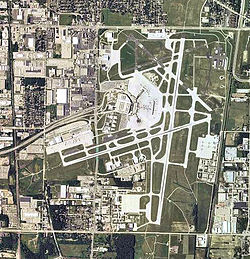
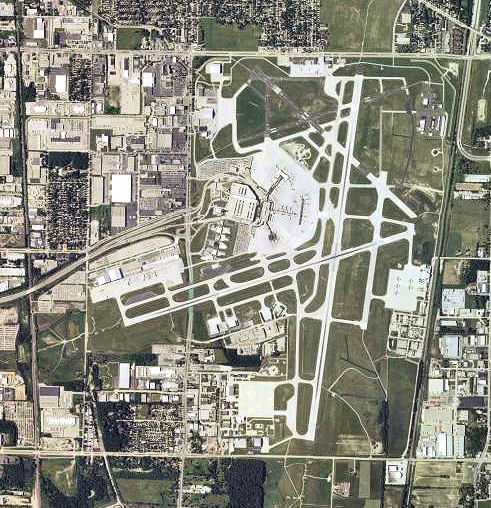
Milwaukee Mitchell International Airport (IATA: MKE, ICAO: KMKE, FAA LID: MKE) is a civil–military airport 5 nautical miles (9.3 km; 5.8 mi) south of downtown Milwaukee, Wisconsin, United States.[2] It is included in the Federal Aviation Administration (FAA) National Plan of Integrated Airport Systems for 2025–2029, in which it is categorized as a medium-hub primary commercial service facility.[3] Milwaukee Mitchell International Airport covers 2,314 acres (936 ha) and has five asphalt and concrete runways.[4]
Key Information


The airport is named in honor of United States Army General Billy Mitchell, who was raised in Milwaukee and is often regarded as the father of the United States Air Force.[5][6] Along with being the primary airport for Milwaukee, Mitchell International is also used by travelers throughout Southern and Eastern Wisconsin and Northern Illinois.[7] Since March 1941, the airport's weather station has been used as the official point for Milwaukee weather observations and records by the National Weather Service, whose area office is located in Sullivan.[8]
History
[edit]The original airfield was established in 1920 as Hamilton Airport by local business owner and aviator, Thomas F. Hamilton. Milwaukee County purchased the land on October 19, 1926, and renamed the airport Milwaukee County Airport.[6] The first airport terminal there, the Hirschbuehl Farmhouse, opened in July 1927. That month, Northwest Airlines, Inc., began air service from Milwaukee to Chicago and Minneapolis/St. Paul. In August 1927, world-renowned aviator Charles Lindbergh visited the Milwaukee airport. Kohler Aviation Corporation began providing passenger service across Lake Michigan on August 31, 1929.
During the late depression years (1938–July 1940), a new two-story passenger terminal building was constructed by the Works Progress Administration. On March 17, 1941, the airport was renamed General Mitchell Field after Milwaukee native and air power advocate Brigadier General William "Billy" Mitchell.[9] On January 4, 1945, Mitchell Field was leased to the War Department for use as a World War II prisoner-of-war camp. Over 3,000 prisoners and 250 enlisted men stayed at the work camp. Escaped German prisoners were often surprised to find a large German American population just beyond the fence.[10]

The present terminal opened on July 20, 1955, and was designed by Leigh Fisher and Associates.[11] It was renovated and expanded in 1985, designed by Miller, Meier, Kenyon, Cooper Architects and Planners Inc.[12] The "hammerhead" section of the D concourse was added in 1990.
On June 19, 1986, the Milwaukee County Board of Supervisors renamed the airport General Mitchell International Airport.[9] The airport was formerly a hub for AirTran Airways, Frontier Airlines, Midwest Airlines and North Central Airlines. The airport is owned and operated by Milwaukee County, but some Milwaukee business leaders and politicians have advocated privatization or leasing it to a third party for financial reasons.[13]
In February 2019, the airport was renamed from "General Mitchell International Airport" to "Milwaukee Mitchell International Airport," a rebranding meant to highlight the airport's location;[14][15][16][17] the old name is still used by the FAA and US government.
In March 2023, the airport was recognized by the Airports Council International as one of the best airports in the world, marking the second consecutive year the airport received this recognition. It was one of only 10 airports of any size in the U.S. to earn a 2022 ASQ "Best Airport" award.[18]
Expansion
[edit]Mitchell International expanded the runway safety area at the end of the runways after an accident on January 21, 2007, when Northwest Airlines Flight 1726 skidded off the runway following an aborted takeoff. According to the FAA, most airports are encouraged to have a runway safety area no shorter than 1,000 feet (305 m), though many airports do not. Construction of the runway safety areas began at the end of summer 2009 and was completed in fall 2012.
There was also a "Master Plan" idea to increase the terminal area by stretching the existing terminal (in some cases, to almost double the size) or begin construction of a separate terminal. Nearly all cases would involve major reconstruction on the airport itself, and would have a huge impact on the airport's traffic.[19] These plans were, however, drafted before Mitchell saw a significant reduction in carriers and flights. More recently, in 2012, there were discussions of closing one concourse as a cost-cutting move.[20]
The approved 2018 Milwaukee County Budget contained initial funding for replacement of the now-closed Concourse E with a new International Terminal. It would replace the current International Arrivals Terminal (IAT) which has limited capacity and is not connected to the main terminal building.[21] The new terminal was planned to open in 2020 after the demolition of Concourse E was completed.[22] During October 2018, airport and Milwaukee County officials set a timeline for design, construction and completion of the new International terminal. Pre-design work and bidding concluded in November 2018, with construction set to begin in early 2021 and likely concluding in mid-2022.[23] In May 2020, Milwaukee County announced with the COVID-19 pandemic severely reducing the airport's operations and de facto ending international service temporarily, that the start of the project had been postponed.[24]
As of September 2025[update], work has started on the redevelopment of Concourse E to build a new international concourse. This will allow the closure of the existing International Arrivals building, which is currently separate from the main terminal. Airport officials are expecting to conclude the project in 2027.[25][26][27][28]
Facilities
[edit]
Terminal
[edit]Milwaukee Mitchell International Airport has one terminal with two concourses and 38 gates.[29] All international arrivals lacking border pre-clearance must pass through the International Arrivals Building. Concourse C houses Southwest Airlines and United Airlines; and Concourse D houses the remaining airlines at the airport. There is also a Delta Sky Club in Concourse D.
The terminal houses the Mitchell Gallery of Flight (a non-profit museum) and a USO room on the concession level, along with the usual retail outlets, including a small food court and a branch of Renaissance Books which is believed to be the world's first used book store in an airport.[30] There are play areas for children throughout the facility.[31] On-site enrollment for TSA PreCheck is available without an appointment at CLEAR kiosks in the main terminal seven days a week.[32] An observation lot along the northern edge of the airport is open to the public and tower communications are rebroadcast using a low-power FM transmitter for visitors to tune in on their car radios. There is also a new lot on 6th Street, with a Wisconsin historical marker giving the airport's history.[33] Previously located inside the security perimeter of a domestic concourse was a large clay "peace mural" from Leningrad, now Saint Petersburg in Russia. Created by Soviet citizens, it was exchanged for an equivalent clay mural made by Americans. The Milwaukee mural was covered up during the 2022 Russian invasion of Ukraine[34] and subsequently moved to the customs screening area of the International Arrivals Building in 2024.
In April 2017, all airlines housed in Concourse E began moving to Concourse C. This would allow the airport to remodel the concourse and move International Arrivals processing into the terminal. Following redevelopment of Concourse E, the current International Arrivals Building just north of the main terminals will close. Airport officials have begun work on the project as of September 2025. The redeveloped concourse is designed to have between 2-5 gates per the airport's Implementation Plan, and is expected to be completed in 2027.[35] [36][37][38][28]
Ground transportation
[edit]
Milwaukee Mitchell International Airport is accessible from I-41/I-94 and WIS 38 via WIS 119.
Local transit:
- MCTS Green Line offers service to downtown and north shore suburbs. Route 80 serves the Airport from Oak Creek, downtown, and the Milwaukee's north side.[39]
Intercity transit:
- Badger Coaches has frequent trips between Mitchell Airport, Downtown Milwaukee, Johnson Creek, Goerkes Corners, and Madison.[40]
- Airport Connection serves the airport, Sheboygan, and the Fox Valley Area.[41]
- Amtrak's Milwaukee Airport Rail Station is served by the Hiawatha and the Borealis.[42] The station is 3/4 of a mile from the airport. Free shuttle buses go between the train station and the baggage claim. Service mostly runs to Chicago or downtown Milwaukee, with one daily departure on the Borealis to Saint Paul.
- Amtrak Thruway bus service runs from the airport to Fond du Lac, Oshkosh, Appleton, and Green Bay.[43]
- Wisconsin Coach Lines, as Airport Express, operates frequently to O'Hare Airport (ORD) in Chicago and from Waukesha, Milwaukee (Downtown and the Amtrak/Greyhound Station), Racine and Kenosha.[44]
- Lamers Connect, operates daily service to/from Wausau with stops in Milwaukee (Intermodal Station), Fond du Lac, Oshkosh, Appleton, Waupaca and Stevens Point.[45]
U.S. Air Force
[edit]The airport also hosts the General Mitchell Air National Guard Base on the eastern area of the airport property, home to the 128th Air Refueling Wing (128 ARW), an Air Mobility Command (AMC)-gained unit of the Wisconsin Air National Guard flying the Boeing KC-135R Stratotanker. The wing performs both Federal and State missions and consists of approximately 1000 Air National Guard personnel, both full-time Active Guard and Reserve (AGR) and Air Reserve Technicians (ART), as well as traditional part-time guardsmen, available for worldwide deployment. The wing also maintains a KC-135 flight simulator, providing training proficiency for its own crews, as well as other KC-135 flight crews in other air refueling wings and air mobility wings in the Regular U.S. Air Force, the Air Force Reserve Command and the Air National Guard.
Prior to 2007, a second military installation on the southwestern portion of the airport property was known as "General Mitchell Air Reserve Station" and was home to the 440th Airlift Wing (440 AW), an Air Mobility Command (AMC)-gained unit of the Air Force Reserve Command (AFRC) flying the C-130H Hercules. While based at General Mitchell ARS, the 440 AW numbered in excess of 1500 full-time AGR, ART and part-time traditional reservists. Pursuant to 2005 Base Realignment and Closure Commission (BRAC) action, the 440 AW relocated to Pope AFB, North Carolina, in 2007 and the former AFRC facilities were turned over to the Air National Guard, resulting in the installation's renaming.
Aircraft maintenance
[edit]In 2018, SkyWest Airlines established a maintenance base at the airport, bringing its total to 12 across the US.[46][47]
Airlines and destinations
[edit]Passenger
[edit]Destinations maps
[edit]


Cargo
[edit]
Statistics
[edit]Airline market share
[edit]| Rank | Airline | Passengers | Share |
|---|---|---|---|
| 1 | Southwest | 2,269,000 | 38.98% |
| 2 | Delta | 999,000 | 17.15% |
| 3 | American | 632,000 | 10.86% |
| 4 | SkyWest | 586,000 | 10.06% |
| 5 | Republic | 232,000 | 3.99% |
| Other | 1,104,000 | 18.96% |
Top destinations
[edit]| Rank | Airport | Passengers | Carriers |
|---|---|---|---|
| 1 |  Atlanta, Georgia Atlanta, Georgia
|
329,110 | Delta |
| 2 |  Denver, Colorado Denver, Colorado
|
279,920 | Frontier, Southwest, United |
| 3 |  Orlando, Florida Orlando, Florida
|
199,800 | Frontier, Southwest, Spirit, Sun Country |
| 4 |  Chicago–O'Hare, Illinois Chicago–O'Hare, Illinois
|
198,410 | American, United |
| 5 |  Phoenix–Sky Harbor, Arizona Phoenix–Sky Harbor, Arizona
|
193,210 | American, Southwest, Sun Country |
| 6 |  Las Vegas, Nevada Las Vegas, Nevada
|
161,010 | Southwest, Spirit, Sun Country |
| 7 |  Minneapolis/St. Paul, Minnesota Minneapolis/St. Paul, Minnesota
|
151,300 | Delta, Sun Country |
| 8 |  Dallas/Fort Worth, Texas Dallas/Fort Worth, Texas
|
146,820 | American |
| 9 |  Charlotte, North Carolina Charlotte, North Carolina
|
117,980 | American |
| 10 |  Detroit, Michigan Detroit, Michigan
|
116,620 | Delta, Spirit |
Passenger numbers
[edit]Annual traffic
[edit]| Year | Passengers | Year | Passengers | Year | Passengers | Year | Passengers | Year | Passengers | Year | Passengers |
|---|---|---|---|---|---|---|---|---|---|---|---|
| 1974 | 2,143,071 | 1984 | 2,573,239 | 1994 | 5,179,872 | 2004 | 6,661,105 | 2014 | 6,548,960 | 2024 | 6,316,245 |
| 1975 | 2,241,745 | 1985 | 3,062,954 | 1995 | 5,221,705 | 2005 | 7,268,000 | 2015 | 6,545,938 | 2025 | |
| 1976 | 2,556,720 | 1986 | 3,384,664 | 1996 | 5,452,645 | 2006 | 7,299,294 | 2016 | 6,753,929 | 2026 | |
| 1977 | 2,803,138 | 1987 | 3,570,340 | 1997 | 5,598,971 | 2007 | 7,712,535 | 2017 | 6,899,845 | 2027 | |
| 1978 | 2,991,750 | 1988 | 4,029,746 | 1998 | 5,535,921 | 2008 | 7,956,968 | 2018 | 7,091,766 | 2028 | |
| 1979 | 3,460,441 | 1989 | 4,308,295 | 1999 | 5,825,670 | 2009 | 7,935,124 | 2019 | 6,889,448 | 2029 | |
| 1980 | 3,295,509 | 1990 | 4,488,304 | 2000 | 6,076,628 | 2010 | 9,848,377 | 2020 | 2,625,295 | 2030 | |
| 1981 | 3,117,883 | 1991 | 4,114,051 | 2001 | 5,600,060 | 2011 | 9,522,456 | 2021 | 4,524,345 | 2031 | |
| 1982 | 3,285,884 | 1992 | 4,422,089 | 2002 | 5,589,127 | 2012 | 7,502,309 | 2022 | 5,439,055 | 2032 | |
| 1983 | 2,923,641 | 1993 | 4,521,872 | 2003 | 6,142,124 | 2013 | 6,520,515 | 2023 | 6,015,731 | 2033 |
- From 1944 through 2024, 291,421,492 passengers (enplaned+depaned) have passed through Milwaukee Mitchell Int'l Airport, an annual average of 3,597,796 passengers per year.
Accidents and incidents
[edit]- On December 17, 1954, a Miller Brewing Company plane, a converted twin-engine Lockheed Ventura bound for Winnipeg on a Friday evening, had trouble with both engines and crashed shortly after takeoff from Mitchell Field.[74][75] All four on board were killed, which included company president Fred Miller and his oldest son, 20-year-old Fred Jr.,[76] and the two company pilots, brothers Joseph and Paul Laird.[77][78]
- On August 4, 1968, a Convair CV-580, flying as North Central Airlines Flight 261, collided in mid-air with a rented Cessna 150F 11.5 miles (19 km) southwest of the airport. The Cessna was destroyed, but its cabin remained embedded in the Convair's forward baggage compartment; the Cessna's three occupants were killed. The Convair made a safe emergency landing at Milwaukee. The Cessna was on a VFR flight from Lombard, Illinois to Sheboygan County Memorial Airport in Sheboygan Falls. It was determined that the inability of the Convair 580 flight crew to detect the Cessna 150 visually in sufficient time to take evasive action, despite having been provided with three radar traffic advisories, caused the crash. Visual detection capabilities were reduced by the heavy accumulation of insect smears on the windows of the Convair. Visibility was further reduced by haze, smoke and sunglare, and by the inconspicuous color and lack of relative motion of the Cessna.[79]
- On January 29, 1969, a Boeing KC-97, operated by the Wisconsin Air National Guard, crashed just short of the runway on final approach. The weather was foggy with a visibility of a half mile. Four of the 11 people on board were killed, and the plane was damaged beyond repair.[80]
- On January 22, 1971, Northwest Airlines Flight 433 was hijacked after taking off from Milwaukee to Detroit, Michigan. The hijacker demanded to be taken to Algeria, but landed in Cuba.[81]
- On July 27, 1974, a USMC Hawker Siddeley AV-8A Harrier crashed during a hover maneuver at as part of an air show demonstration flight. The impact of the crash initiated the firing of the pilot's ejection seat and the pilot survived.[82]
- On September 6, 1985, Midwest Express Flight 105, Midwest's first and only fatal accident, crashed upon takeoff from Milwaukee. One of the airline's Douglas DC-9s crashed while taking off, bound for Atlanta's Hartsfield International Airport. According to NTSB reports, the crash was caused by improper pilot reaction when the plane's right engine failed due to stress corrosion cracking. The improper flight control inputs caused an uncommanded roll and accelerated stall. The 31 people on board died.[83]
- On December 10, 1993, a Wisconsin Air National Guard KC-135 blew up on the ground. Six maintenance personnel died.[84]
- In early August 1997, an SR-71 declared an in-air emergency prior to a fly-by at the Oshkosh Airshow and diverted to General Mitchell International Airport. No one was hurt in the incident.[85]
- On September 11, 2001, Midwest Express Flight 7, a DC-9 from MKE to LGA came within 30 feet of United Airlines flight 175 and had to do two steep dives, injuring two flight attendants and two passengers who were not in their seats.
- On January 21, 2007, a Northwest Airlines DC-9, Northwest Airlines Flight 1726 skidded 400 feet (120 m) off the end of a snowy runway at Milwaukee International Airport. The accident was due to an explosion in one of the engines, forcing the pilot to abort takeoff. The aircraft was headed for Detroit Metropolitan Wayne County Airport and was to continue on to Buffalo Niagara International Airport. Amongst the 104 people aboard, only one back injury was reported.[86][87]
- On January 23, 2007, two Freight Runners Express cargo planes collided and burned on a taxiway. Both pilots were able to escape without injury. The planes were a Cessna 402 and a Beech 99.[88] An NTSB investigation determined both pilots and air traffic control were at fault for the accident.
- On June 4, 2007, a Cessna Citation II crashed after reporting a runaway trim tab. The pilot issued a distress signal within five minutes after taking off. The plane then crashed into Lake Michigan two miles (3 km) off shore. The plane was carrying an organ transplant team from the University of Michigan back to Willow Run Airport. There was a crew of two and four passengers aboard. All six died.[89]
- On December 4, 2023, a DHL 737 operated by Swift Air burst a tire while landing. No one was injured, and flights resumed within the hour.
See also
[edit]

References
[edit] This article incorporates public domain material from the Air Force Historical Research Agency
- ^ "MKE Airport Statistics for 2024" (PDF). mitchellairport.com. Retrieved February 4, 2025.
- ^ FAA Airport Form 5010 for MKE PDF, effective April 17, 2025.
- ^ "NPIAS Report 2025-2029 Appendix A" (PDF). Federal Aviation Administration. October 28, 2024. Retrieved November 11, 2024.
- ^ "MKE airport data at skyvector.com". skyvector.com. FAA data effective April 17, 2025.
- ^ Jones, Meg. "Milwaukee's Billy Mitchell predicted Pearl Harbor attack". Retrieved July 24, 2020.
- ^ a b Dorcey, John (February 16, 2011). "Milwaukee's First Airport". Archived from the original on June 8, 2021. Retrieved July 18, 2020.
- ^ "Mitchell airport attracting more passengers from northern Illinois". Retrieved July 31, 2020.
- ^ "Threaded Extremes". Threadex.rcc-acis.org. Retrieved June 26, 2017.
- ^ a b "Historic Markers – General Mitchell Field WI221". Milwaukee County Historical Society. 1978. Archived from the original on September 28, 2007. Retrieved October 4, 2006.
- ^ Cowley, Betty (2002). Stalag Wisconsin: Inside WW II prisoner-of-war camps. Oregon, Wisconsin: Badger Books. ISBN 1-878569-83-X. OCLC 48998212.
- ^ "Here's the Program". Milwaukee Journal. July 21, 1955. Retrieved June 16, 2012.
- ^ Jesen, Dean (July 25, 1985). "Airport Terminal to Open Sunday". The Milwaukee Sentinel. Retrieved June 16, 2012.
- ^ Kirchen, Rich (September 21, 2008). "Lubar: Sell Airport to Eliminate Milwaukee County Deficit". Milwaukee Business Journal. Bizjournals.com. Retrieved October 9, 2009.
- ^ Klopf, Rebecca (February 5, 2019). "Milwaukee airport quietly changes its name". NBC26. Retrieved February 6, 2019.
- ^ "Mitchell International Airport drops 'General' from name, adds Milwaukee". FOX6 News (via NBC 15). February 5, 2019. Retrieved November 14, 2022.
- ^ ""General" dropped from airport's name, now "Milwaukee Mitchell International Airport"". CBS58. February 5, 2019. Retrieved February 6, 2019.
- ^ Leary, Patrick. "MKE rebranding to Milwaukee Mitchell International Airport, dropping 'General'". Milwaukee Business Journal. Retrieved February 6, 2019.
- ^ "Milwaukee Mitchell International Airport named one of the best in the world".
- ^ "Master Plan Update". General Mitchell International Airport. July 28, 2006. Archived from the original (PDF) on April 14, 2012. Retrieved February 11, 2008.
- ^ "Mitchell proposes closing one concourse". Milwaukee Business Journal. October 5, 2012. Retrieved September 13, 2014.
- ^ "Milwaukee County's 2018 budget includes $25 million for new terminal at Mitchell International Airport". jsonline.com. Retrieved November 27, 2017.
- ^ "5040-Airport Budget Report" (PDF). p. 5. Retrieved May 2, 2018.
- ^ Leary, Patrick (October 16, 2018). "Process to turn shuttered Mitchell airport concourse into new international terminal begins". Milwaukee Business Journal. Retrieved September 10, 2019.
- ^ Naczek, Margaret. "Mitchell airport reports 96% drop in passengers in April". Milwaukee Business Journal. Retrieved June 8, 2020.
The airport recently reported that as a result of the drastic passenger traffic declines, it had to postpone the start of its E Concourse construction, which would transform the concourse into an international terminal.
- ^ https://onmilwaukee.com/articles/mitchell-airport-concourse-e
- ^ "Milwaukee airport seeking bids for potential international concourse".
- ^ Salgado, Beck Andrew (March 6, 2023). "Mitchell Airport receives $5.1 million from FAA; will be used to renovate concourse roof". Milwaukee Journal Sentinel. Retrieved April 12, 2023.
- ^ a b Spice, Linda (April 29, 2025). "Price tag jumps as Milwaukee airport restarts international terminal project". www.bizjournals.com. Retrieved May 12, 2025.
- ^ "INTERACTIVE TERMINAL GUIDE". Retrieved July 18, 2020.
- ^ "The Challenge of Airport Bookselling", Publishers Weekly, July 13, 1984
- ^ Snyder, Molly (May 21, 2015). "Mitchell airport boasts world's only "recombobulation area" signs". Retrieved April 15, 2018.
- ^ "TSA PreCheck Enrollment Now Available Seven Days a Week at MKE" (PDF). Milwaukee Mitchell International Airport. June 5, 2024. Retrieved October 9, 2025.
- ^ "State Historical marker #221" (PDF). Wisconsin History. Archived from the original (PDF) on August 7, 2012. Retrieved September 27, 2008.
- ^ Horne, Michael. "Plenty of Horne: Airport's Soviet Peace Mural Covered Up". Urban Milwaukee. Retrieved March 22, 2022.
- ^ https://onmilwaukee.com/articles/mitchell-airport-concourse-e
- ^ "New$95.2M Milwaukee Airport International Terminal Readies for Take-Off | Engineering News-Record". www.enr.com. Retrieved August 12, 2025.
- ^ "Milwaukee airport to get new international terminal". Milwaukee WI: WISN. WISN News. July 15, 2016. Retrieved July 28, 2016.
United Airlines and Air Canada, both of which currently operate from Concourse E, will move to Concourse C
- ^ Ricondo & Associates, Inc. (June 2022). "Master Plan Update" (PDF). Milwaukee Mitchell International Airport. Retrieved September 29, 2023.
- ^ "MCTS". Milwaukee County Transit System. Retrieved September 15, 2012.
- ^ "Wisconsin Bus Charters". Badger Coaches. Archived from the original on September 28, 2008. Retrieved September 27, 2008.
- ^ "MKE Airport Connection". Airport Connection. Retrieved September 27, 2008.
- ^ "Milwaukee Airport Station". Wisconsin Department of Transportation (WISDOT). Archived from the original on September 12, 2008. Retrieved September 27, 2008.
- ^ "Amtrak Thruway I-41 Bus Service". Wisconsin Department of Transportation (WISDOT).
- ^ "Wisconsin Coach service". Coach USA. Archived from the original on September 16, 2008. Retrieved September 27, 2008.
- ^ "Lamers Connect". Lamers Bus Lines. Retrieved September 15, 2012.
- ^ Taschler, Joe. "SkyWest brings new life to long-vacant former Midwest hangars at Mitchell". Journal Sentinel. Retrieved November 6, 2024.
- ^ "MKE Selected for New SkyWest Maintenance Facility". Aviation Pros. January 11, 2018. Retrieved November 6, 2024.
- ^ "Flight Timetable". Archived from the original on February 2, 2017. Retrieved January 29, 2017.
- ^ a b "Flight schedules and notifications". Archived from the original on February 2, 2017. Retrieved January 7, 2017.
- ^ "American Airlines non-stop flights from Milwaukee to Washington, DC starting Oct. 5, 2023". June 19, 2023.
- ^ a b "FLIGHT SCHEDULES". Archived from the original on June 21, 2015. Retrieved January 7, 2017.
- ^ "Frontier Airlines NW25 Further Network Expansion". Aeroroutes. Retrieved September 6, 2025.
- ^ "Frontier Airlines 1Q25 Various Network Resumptions". Aeroroutes. Retrieved November 20, 2024.
- ^ "Frontier". Archived from the original on September 12, 2017. Retrieved June 23, 2024.
- ^ "JetBlue NW24 Network Changes – 24JUL24". Aeroroutes. Retrieved July 25, 2024.
- ^ "JetBlue Flight Schedule". Retrieved October 25, 2021.
- ^ "Southwest Airlines announces direct flights from Austin to Reno and Milwaukee". CBS Austin. August 22, 2024. Retrieved August 27, 2024.
- ^ "Southwest Airlines is introducing a twice-daily, Milwaukee-to-Chicago route in 2026".
- ^ "Southwest Airlines Oct 2025 – Apr 2026 Domestic Network Additions". Aeroroutes. Retrieved September 15, 2025.
- ^ "Southwest Airlines - Check Flight Schedules". Retrieved October 25, 2021.
- ^ "Where can you fly with Spirit Airlines? New routes coming this spring for Michigan fliers".
- ^ "Spirit Airlines NW24 Domestic Network Additions". Aeroroutes. Retrieved September 4, 2024.
- ^ "Spirit Airlines adding two flights to Florida from Milwaukee". January 9, 2025.
- ^ "Spirit Airlines March 2024 Tampa Network Expansion". Aeroroutes. Retrieved February 5, 2024.
- ^ "Spirit Airlines Route Map". Retrieved October 25, 2021.
- ^ "Departing Milwaukee to Cancun". Sun Country Airlines.
- ^ a b "Sun Country Airlines will offer nonstop flights from Milwaukee to two Caribbean countries". May 21, 2024. Retrieved May 21, 2024.
- ^ "Sun Country December 2023 Milwaukee Network Additions". Aeroroutes. Retrieved May 26, 2023.
- ^ "Sun Country Website".
- ^ a b "Timetable". Archived from the original on January 28, 2017. Retrieved June 23, 2024.
- ^ a b "Milwaukee International (MKE) Summary Statistics". www.transtats.bts.gov. Bureau Of Transportation Statistics. July 2025. Retrieved October 11, 2025.
- ^ "MKE Airport Historical Passenger Activity 1974-Present" (PDF). mitchellairport.com. Retrieved June 10, 2024.
- ^ "MKE Historical Passenger Data 2012-Present" (PDF). mitchellairport.com. Retrieved February 13, 2025.
- ^ "Fred Miller, son die in fiery plane crash". Milwaukee Sentinel. December 18, 1954. p. 1.[permanent dead link]
- ^ "Fred C. Miller, son killed in air crash". Milwaukee Journal. December 18, 1954. p. 1.[permanent dead link]
- ^ "Fred Miller, Jr., versatile athlete". Milwaukee Sentinel. December 18, 1954. p. 2.
- ^ "Pilots buried side by side". Milwaukee Journal. December 20, 1954. p. 2.[permanent dead link]
- ^ "CAB findings in Miller crash". Milwaukee Sentinel. March 18, 1955. p. 1, part 2.
- ^ "Accident description for N4634S from Aviation Safety Network". aviationsafetynetwork.org. Retrieved July 26, 2024.
- ^ "Aircraft Accident Boeing KC-97". Aviation Safety Network. Retrieved May 14, 2015.
- ^ Hijacking description at the Aviation Safety Network
- ^ "Accident description for 158971". aviation-safety.net. Retrieved June 11, 2024.
- ^ "Midwest Express Airlines Flight 105". National Transportation Safety Board (NTSB). Retrieved September 27, 2008.
- ^ "Accident description for 57-1470 at Aviation Safety Network". aviationsafetynetwork.org. Retrieved July 26, 2024.
- ^ Francey, Dave (February 21, 2019). "Stories of Oshkosh - Dave Francey". Inspire EAA. Retrieved February 26, 2019.
- ^ Johnson, Mark; Kissinger, Meg (January 22, 2007). "Scared to Death". Milwaukee Journal-Sentinel. Archived from the original on February 10, 2007. Retrieved September 28, 2008.
- ^ Sandler, Larry (January 22, 2007). "Safety Won't Come Easy – 3 Mitchell Runways Don't Meet Federal Standards, but Compliance by 2015 Means Navigating Multiple Obstacles". Milwaukee Journal-Sentinel. Archived from the original on January 5, 2009. Retrieved September 28, 2008. (republished by Hall & Associates)
- ^ "Cargo Planes Collide, Burn at Milwaukee Airport". Fox News. January 24, 2007. Archived from the original on October 22, 2012. Retrieved September 28, 2008.
- ^ "Accident description for N550BP at Aviation Safety Network". aviationsafetynetwork.org. Retrieved July 26, 2024.
Further reading
[edit]- Tascher, Joe. "Can't find a nonstop flight from Mitchell International? Check again." Milwaukee Journal-Sentinel. July 16, 2013.
External links
[edit]
- Official website
- Milwaukee County Fire Department
- Milwaukee Airport Railroad Station
- FAA Airport Diagram (PDF), effective October 2, 2025
- Resources for this airport:
- AirNav airport information for KMKE
- ASN accident history for MKE
- FlightAware airport information and live flight tracker
- NOAA/NWS weather observations: current, past three days
- SkyVector aeronautical chart for KMKE
- FAA current MKE delay information
Civil aviation in Wisconsin | ||
|---|---|---|
| Primary airports |  | |
| Airlines | ||
| Museums | ||
| Aviation related | ||
| People | ||
| International | |
|---|---|
| National | |

Milwaukee Mitchell International Airport
View on GrokipediaHistory
Founding and Early Operations (1919-1941)
Milwaukee County's initial foray into public aviation began with the establishment of Butler Airport on July 3, 1919, as one of the earliest municipally owned airfields in the United States, located on approximately 90 acres in the northwest part of the county near what is now Currie Park.[8] This site primarily hosted exhibition flights, early aviation experiments, and limited airmail operations starting in 1926, but its rudimentary facilities—lacking extensive runways or hangars—constrained sustained commercial development amid the era's technological limitations on aircraft range and reliability.[9] Recognizing these constraints, Milwaukee County shifted focus to a more viable lakeside location in the southeast, acquiring 163 acres from aviator Thomas Hamilton on October 19, 1926, for $150,000; this former private Hamilton Airfield became the foundation for the airport now known as Milwaukee Mitchell International.[10] The county repurposed the existing Hirschbuehl Farmhouse as the first terminal, opening it in July 1927, alongside construction of initial hangars to support growing aviation manufacturing and operations.[4] That same month, Northwest Airways launched the area's first scheduled passenger service on July 5, 1927, operating biplanes to Chicago and Minneapolis-St. Paul, marking the transition from sporadic flights to regular commercial routes despite ongoing infrastructural challenges like unpaved runways prone to weather disruptions.[11] By the late 1920s and into the 1930s, operations expanded modestly with additions like Kohler Aviation's seaplane service across Lake Michigan starting August 31, 1929, yet annual passenger volumes remained under 10,000, reflecting causal bottlenecks from limited airline capacity, economic depression effects, and basic facilities that prioritized mail and freight over mass transit.[12] Hangar developments facilitated local aircraft production, including Hamilton's all-metal passenger planes, but traffic grew slowly until pre-war infrastructure improvements, underscoring how early aviation's dependence on short-haul props and minimal ground support inherently capped scalability at such nascent fields.[13]World War II Era and Renaming (1941-1960s)
On March 17, 1941, Milwaukee County Airport was renamed Billy Mitchell Field to honor Brigadier General William "Billy" Mitchell, a Milwaukee native renowned for his advocacy of military aviation and air power independence.[4] The renaming coincided with heightened military preparations, as the facility expanded to accommodate U.S. Army Air Forces operations, including training flights and support for propeller-driven aircraft such as the B-25 Mitchell bomber, named in his honor.[4] During World War II, Billy Mitchell Field served as a key regional asset for military aviation, hosting increased flight operations amid national defense needs, though primary pilot training occurred at dedicated bases elsewhere in Wisconsin.[4] Postwar demilitarization began in 1945, transitioning the airfield back to civilian control and enabling commercial resurgence, with passenger traffic rising from 235,069 total enplaned and deplaned passengers in 1950 to 758,000 by 1960 amid growing demand for air travel.[12] Congestion at the existing Layton Avenue terminal prompted construction of a new $3.2 million facility on Howell Avenue, featuring three concourses, two levels, and capacity for 23 aircraft gates across 1,530 acres; it opened on July 19, 1955.[4] To prepare for the jet age and larger aircraft, runway extensions were undertaken in the 1960s, including southward lengthening of Runway 1-19R to enhance operational capabilities.[14] These improvements supported steady enplanement growth, reflecting the airport's evolution into a busier commercial hub by the late 1960s.[15]Major Expansions and Hub Development (1970s-2000s)
In the late 1970s, airline deregulation under the Airline Deregulation Act of 1978 spurred passenger traffic growth at the airport, prompting a $44 million expansion project centered on renovating the existing terminal building to handle increased demand and larger facilities for shops and baggage claim.[4][16] This initiative addressed the surge in operations, with total enplaned and deplaned passengers reaching approximately 3 million in 1978.[17] On June 19, 1986, the Milwaukee County Board of Supervisors renamed the facility General Mitchell International Airport, coinciding with the addition of a U.S. Customs station to support international arrivals.[10] That year, Northwest Airlines established a mini-hub following its merger with Republic Airlines, enhancing connectivity through additional flights until the operation was scaled back in 1992.[18] The hub status contributed to operational growth, though it reflected a temporary consolidation rather than a primary focus for the carrier. Into the 1990s, infrastructure developments included the December 14, 1990, opening of a 16-gate expansion to Concourse D, featuring a distinctive rotunda design, alongside a 2,250-space parking garage addition to accommodate rising passenger volumes estimated at 4-5 million annually by mid-decade.[10] These projects were financed through airport revenue bonds, maintaining the facility's self-sustaining model without dependence on property taxes.[19] The decline of Northwest's presence after 1992 shifted reliance toward other carriers like Midwest Express, while post-9/11 federal mandates in the early 2000s necessitated security enhancements, including expanded screening areas aligned with Transportation Security Administration protocols, further supported by bond-financed improvements.[20] This era marked a transition from hub-driven expansion to more stable, diversified operations amid industry consolidation.Recent Infrastructure Projects (2010s-2025)
In the aftermath of the 2008 financial recession, Milwaukee Mitchell International Airport pursued targeted renovations to bolster operational efficiency and passenger appeal amid declining traffic. A pivotal upgrade involved the baggage handling system, funded in part by a $20.3 million Transportation Security Administration grant awarded in September 2010, which implemented an automated in-line system to streamline screening and remove explosive detection devices from the public ticketing area.[19] Complementing this, a $25 million baggage claim renovation commenced in September 2013, installing five new stainless-steel carousels, expanded conveyor infrastructure, and modernized architectural elements to accommodate growing volumes from low-cost carriers.[21] [22] These efforts aligned with strategic incentives to counter regional competition, including a 2013 proposal offering airlines up to $125,000 annually for new routes—particularly international ones—to stimulate service expansion and reinforce the airport's reliance on Southwest Airlines, which captured over 50% market share by mid-decade through aggressive domestic growth.[23] Such measures directly addressed post-recession enplanement dips, fostering recovery by prioritizing cost-effective infrastructure that supported low-fare competition without legacy hub dependencies. Advancing into the 2020s, amid pandemic-induced disruptions and subsequent rebound, the airport initiated major capital projects to expand capacity for international and cargo operations. In September 2025, groundbreaking occurred for the $95.2 million Concourse E redevelopment, demolishing the outdated structure to build a modern pier-style terminal extending southwest from the main building; this will triple international arrivals processing via dedicated federal inspection areas, enhanced amenities, sustainable features like green roofs, and improved domestic-international connectivity, with completion slated for late 2027 and funding from airport revenue bonds.[24] [25] [26] Concurrently, a $80 million public-private air cargo facility broke ground in February 2025 on the former 440th Airlift Wing site, encompassing 337,000 square feet of warehouse space capable of handling five Boeing 747-400 freighters, alongside $10.5 million in taxiway rehabilitations to divert shipments from Chicago-area hubs and capitalize on southeastern Wisconsin's manufacturing base, targeting operational readiness in 2026.[27] [28] [29] These undertakings underpin empirical passenger gains, including 6,316,245 enplanements in 2024—a 5% year-over-year increase—and position the airport to pursue non-stop international links beyond seasonal or connecting services, countering constraints from limited European carrier commitments.[3] [30]Facilities and Infrastructure
Passenger Terminal and Concourses
Milwaukee Mitchell International Airport operates a single passenger terminal with four concourses designated A through D, serving domestic flights via centralized TSA security checkpoints located in the main terminal building. These concourses collectively provide 36 gates equipped primarily with jet bridges, though some support ground boarding to accommodate low-cost carriers like Southwest Airlines, which dominates operations with point-to-point routes rather than legacy hub connections.[31][32] Concourse E, shuttered since 2017 after serving international arrivals, entered redevelopment on September 16, 2025, as a $95.2 million project to construct a 55,700-square-foot facility with two flexible domestic/international gates. The upgraded concourse will triple international processing capacity to 400 passengers per hour through integrated arrivals handling and modern infrastructure, with completion slated for late 2027; it incorporates sustainable features like a green roof and solar shading.[24][33][34] Post-security amenities emphasize family-friendly and local dining experiences, including options like Miller Brewhouse for regional brews and Nonna Bartolina's for Italian cuisine across concourses. In March 2025, Concourses C and D received remodeled Make-A-Wish Kids Zones with updated play equipment, custom Lake Michigan-themed carpeting, and enhanced décor to support traveling families.[35][36]Airfield, Runways, and Taxiways
Milwaukee Mitchell International Airport (MKE) operates with five runways configured in two parallel sets oriented north-south (1/19) and east-west (7/25), supplemented by a crosswind runway (13/31), enabling flexible operations accommodating prevailing winds and traffic demands.[37] The airfield supports instrument approaches on multiple runways, with parallel configurations allowing simultaneous independent departures and arrivals under visual flight rules or certain instrument conditions, enhancing throughput during peak periods.[38] The primary runways include 01L/19R, measuring 9,990 feet by 200 feet, surfaced in grooved asphalt/concrete suitable for heavy commercial jets and long-haul flights; 07R/25L at 8,300 feet by 150 feet; and crosswind 13/31 at 5,537 feet by 150 feet, all maintained to FAA standards with regular inspections confirming structural integrity and no significant decay-related incidents.[38][39] Shorter auxiliary runways, 01R/19L (4,182 feet by 150 feet) and 07L/25R (4,797 feet by 100 feet), primarily serve general aviation and provide parallel options for smaller aircraft, though commercial operations predominantly utilize the longer pavements.[40]| Runway | Length (ft) | Width (ft) | Surface | Primary Use |
|---|---|---|---|---|
| 01L/19R | 9,990 | 200 | Asphalt/Concrete (grooved) | Commercial, long-haul |
| 07R/25L | 8,300 | 150 | Asphalt/Concrete (grooved) | Commercial, parallel ops |
| 13/31 | 5,537 | 150 | Asphalt/Concrete | Crosswind relief |
| 01R/19L | 4,182 | 150 | Asphalt/Concrete | General aviation |
| 07L/25R | 4,797 | 100 | Asphalt/Concrete | General aviation, parallel |
Ground Transportation and Parking
Milwaukee Mitchell International Airport provides direct access from Interstate 94 via Exit 318, facilitating convenient road entry for private vehicles approximately 8 miles south of downtown Milwaukee.[43] The airport features extensive onsite parking across multiple facilities, including a covered garage with hourly and daily rates starting at $2 per hour and $18 per day, surface lots accommodating taller vehicles, economy saver lots at $11 per day with shuttle service, and valet options at $28 per day.[44] These parking revenues, alongside other user fees, fully fund airport operations and capital improvements without reliance on property taxes.[45] A rental car center operates onsite with providers such as Alamo, Avis, Budget, Enterprise, Hertz, National, and Sixt, subject to a maximum vehicle clearance of 6 feet 11 inches in garage areas.[6] Taxis queue at designated stations outside baggage claim, while ride-sharing services like Uber and Lyft pick up near carousel 2; hotel shuttles from nearby properties are also available for pre-arranged transport.[6] Public transportation includes Milwaukee County Transit System (MCTS) bus routes: the GreenLine connecting to Bayshore Town Center via downtown and Route 80 linking to downtown and MATC-South Campus, with stops at terminal curbs.[6] An onsite Amtrak station serves Hiawatha and Borealis trains to Chicago and beyond, with free shuttle service to the terminal operating daily.[6] Coach buses from carriers like Badger Coaches and FlixBus, plus door-to-door shuttles via GO Riteway, provide additional regional connectivity.[6]Cargo, Maintenance, and Military Facilities
Milwaukee Mitchell International Airport features dedicated cargo operations segregated from passenger areas to minimize operational interference, primarily on the south side of the airfield. In February 2025, the airport broke ground on a new 337,000-square-foot public-private air cargo facility developed by Crow Holdings on the site of the former 440th Airlift Wing, now part of the MKE Regional Business Park.[27][46] The project, designed and built by ARCO/Murray, includes a specialized cargo building and taxiway enhancements to support large freighters, with capacity for up to five Boeing 747-400 aircraft simultaneously, and is slated for completion in 2026 to expand freight handling and attract shipments from nearby hubs like Chicago.[47][48] Maintenance, repair, and overhaul (MRO) facilities at the airport serve both commercial and general aviation needs, located in hangars separate from terminal concourses. Textron Aviation operates a service center at MKE certified for Citation, King Air, and Hawker aircraft, providing routine inspections, repairs, and modifications; the facility marked 35 years of operations in 2025.[49][50] Jet Aviation maintains a base for business jets, offering line and heavy maintenance, while SkyWest Airlines established its largest network maintenance hangar at the airport in 2018 for regional jets.[51][52] Military facilities are hosted at General Mitchell Air National Guard Base, co-located on the airport's east end, housing the Wisconsin Air National Guard's 128th Air Refueling Wing. The wing operates KC-135 Stratotankers for aerial refueling missions and maintains a cooperative relationship with Milwaukee County for emergency response to both military and civilian aircraft incidents since the 1990s.[53][54] These installations ensure secure, independent access routes that do not overlap with commercial cargo or passenger flows.Airlines and Destinations
Passenger Airlines and Services
Milwaukee Mitchell International Airport (MKE) is served by a mix of low-cost, ultra-low-cost, and legacy passenger airlines, with operations centered on scheduled domestic flights. Southwest Airlines dominates the market, carrying 2.28 million passengers between June 2024 and May 2025 for a 38.69% share.[55] Delta Air Lines and United Airlines provide legacy carrier services, emphasizing hub connections for broader network access.[2] Other active carriers include Alaska Airlines, American Airlines, Frontier Airlines, Spirit Airlines, and Sun Country Airlines, offering a range of economy-focused options.[2] The airport's passenger services are predominantly domestic, with airlines operating point-to-point routes alongside feeder flights to major hubs. Limited seasonal charter services supplement scheduled operations, particularly for leisure travel to warm-weather destinations during winter months.[56] In 2025, Spirit Airlines expanded its presence by launching nonstop service to Los Angeles, enhancing ultra-low-cost options from MKE.[57] Codeshare agreements among carriers, such as those involving Delta's partners and American's alliances, enable seamless connections for passengers originating at MKE.[58] Competition from ultra-low-cost carriers like Spirit and Frontier has empirically reduced average airfares, with third-quarter 2023 fares at MKE averaging $376.24, below prior-year levels exceeding $400.[59] This trend aligns with U.S. Department of Transportation observations of competitive pressures lowering itinerary costs in secondary markets.[60]Key Destinations and Route Maps
Milwaukee Mitchell International Airport's primary nonstop routes connect to major domestic hubs, including Chicago O'Hare (ORD), Denver International (DEN), and Hartsfield-Jackson Atlanta (ATL), which serve as gateways for onward connections across the United States.[7][61] These links underscore the airport's role in facilitating regional access to national networks, with additional frequent services to Dallas/Fort Worth (DFW), Charlotte (CLT), and other legacy carrier bases.[7] The overall route pattern emphasizes a Midwest orientation, featuring nonstop flights to nearby centers like Minneapolis-Saint Paul, Detroit, and Kansas City, alongside leisure destinations such as Las Vegas (LAS) and Phoenix (PHX).[7] Seasonal routes predominate for sun-seeking travel, including winter services to Florida cities like Fort Myers (RSW), Orlando (MCO), Sarasota (SRQ), and Tampa (TPA), as well as Phoenix, driven by demand from cold-weather climates.[7][62] International nonstops remain scarce, limited to seasonal charters to Cancún (CUN) in Mexico, with no direct transatlantic services.[7] Historically, the airport supported a Northwest Airlines mini-hub in the 1990s, enabling connecting traffic through dedicated facilities like Concourse E, but operations have since pivoted to an origin-and-destination model without major hub functions.[12][16] This shift aligns with the predominance of point-to-point domestic travel, as evidenced by the network's focus on direct regional and leisure links rather than feeder patterns.[7]Cargo Airlines and Operations
Milwaukee Mitchell International Airport serves as a regional hub for air cargo operations, primarily handling express parcel services and time-sensitive freight. Major operators include FedEx, which maintains an air freight center at 201 Air Cargo Way for shipments exceeding 150 pounds, and UPS, both supporting limited weekly flights from existing facilities.[63][48] Additional cargo charter services are provided by DHL, the United States Postal Service, and smaller carriers such as Air Cargo Carriers—headquartered at MKE and operating Shorts aircraft under contract for DHL and UPS—and Freight Runners Express, a Milwaukee-based airline focused on scheduled and ad-hoc cargo flights.[64][65] Annual air freight volume at the airport reached approximately 129.7 million pounds in 2023, driven by exports from Wisconsin's manufacturing industries, including machinery, metal products, and pharmaceuticals that require rapid air transport for perishable or high-value goods.[66] These operations utilize dedicated cargo handling areas to process parcels efficiently, with express carriers like FedEx and UPS prioritizing overnight and next-day deliveries amid rising e-commerce demand. To support expansion and reduce operational conflicts, the airport initiated construction in early 2025 on a $80 million South Air Cargo facility, developed by Crow Holdings, featuring 337,000 square feet of on-tarmac warehouse space, enhanced taxiways, and a separate apron designed to isolate cargo aircraft movements from passenger runways and gates.[67][48] This infrastructure, projected for completion in 2026, aims to attract additional direct cargo flights by minimizing ground delays and improving access for wide-body freighters, while complementing the existing northside setup.[27] A concurrent $10.5 million taxiway redevelopment project further bolsters cargo apron capacity without impacting passenger traffic flows.[29]Traffic Statistics and Economic Impact
Passenger Volume and Trends
Milwaukee Mitchell International Airport (MKE) recorded its peak annual passenger traffic of 6,894,894 in 2019, prior to the COVID-19 pandemic.[68] Traffic plummeted to 2,625,295 passengers in 2020 amid global travel restrictions and lockdowns.[68] Subsequent recovery saw enplanements rise to 4,524,345 in 2021, 5,439,055 in 2022, 6,015,731 in 2023, and 6,316,245 in 2024, marking four consecutive years of growth and approaching pre-pandemic levels.[68] [3]| Year | Passengers |
|---|---|
| 2019 | 6,894,894 [68] |
| 2020 | 2,625,295 [68] |
| 2021 | 4,524,345 [68] |
| 2022 | 5,439,055 [68] |
| 2023 | 6,015,731 [68] |
| 2024 | 6,316,245 [68] |