Hubbry Logo
Modu ChanyuModu ChanyuMain
Open search
Modu Chanyu
Community hub
Modu Chanyu
logo
7 pages, 0 posts
0 subscribers
Be the first to start a discussion here.
Contribute something
Modu Chanyu
Modu Chanyu
from Wikipedia

Modu (c. 234–174 BCE) was the son of Touman and the founder of the empire of the Xiongnu. He came to power by ordering his men to kill his father in 209 BCE.[2][3]

Key Information

Modu ruled from 209 to 174 BCE. He was a military leader under his father Touman and later chanyu of the Xiongnu Empire, based on the Mongolian Plateau. He secured the throne and established a powerful Xiongnu Empire by successfully unifying the tribes of the Mongolian–Manchurian grassland in response to the loss of Xiongnu pasture lands to invading Qin forces commanded by Meng Tian in 215 BCE.

While Modu rode and then furthered the wave of militarization and effectively centralized Xiongnu power, the Qin quickly fell into disarray with the death of the first emperor in 210 BCE, leaving Modu a free hand to expand his empire into one of the largest of his time.[4]

The eastern border stretched as far as the Liao River, the western borders of the empire reached the Pamir Mountains, whilst the northern border reached Lake Baikal. Modu's raids into China resulted in the dynasty agreeing to pay an annual tribute alongside other goods such as silk, grain and rice. Modu was succeeded by his son Laoshang.

Name

[edit]

His name is reconstructed as *mǝk-tuənC in Later Han Chinese[5] and mək-twən in Middle Chinese.[a][6] The name's Old Chinese pronunciation might have represented the pronunciation of the foreign word *baɣtur, a relative of the later attested Central Eurasian culture word baɣatur "hero".[6] According to Gerard Clauson, bağatur, transcribed by Chinese with -n for foreign -r, was by origin almost certainly a "Hunnic" (Xiongnu) proper name.[7][b]

His name was also read as MC mək-tuənH (墨頓; following Sima Zhen's commentary on Shiji) and MC mək-duok (墨毒; following Song Qi's commentary on Hanshu), the latter of which, according to Pulleyblank (1999), "does not make sense" phonologically.[8]

Origins and rise to power

[edit]

According to Sima Qian, Modu was a gifted child but his father Touman wanted the son of another of his wives to succeed him.[3] To eliminate Modu as a competitor to his chosen heir, Touman sent the young Modu to the Yuezhi as a hostage; then he attacked the Yuezhi in the hope that they would kill Modu as retribution.[3] However, Modu escaped by stealing a fast horse and returned to the Xiongnu, who welcomed him as a hero.[3] As reward for this show of bravery, his father appointed him the commander of 10,000 horsemen.[3]

Due to his reputation for bravery, Modu began to gather a group of extremely loyal warriors.[2] He invented a signaling arrow that made a whistling sound in flight and trained his men to shoot in the direction of the sound in synchrony. To be sure of his men's loyalty, Modu commanded the warriors to shoot his favourite horse; any who refused to do so were summarily executed.[2] He later repeated this test of loyalty, but with one of his favourite wives, and once again executed those who hesitated to carry out his order. Only when he was convinced of the absolute loyalty of his remaining warriors did he order them to shoot his father during a hunting trip, killing him in a shower of arrows. With none of his followers failing to shoot at his command and with the removal of his father, Modu proclaimed himself chanyu of the Xiongnu.[9]

After his self-proclaimed ascension as chanyu, Modu began to eliminate those who would prove a threat to his newly acquired power. Thus, he proceeded to execute his rival half-brother, his step-mother and other Xiongnu officials who refused to support his rule.[3]

Rise of the Xiongnu Empire

[edit]
Domain and influence of the Xiongnu under Modu at the start of his rule

Modu's Xiongnu Empire aggressively protected and expanded their territory. When their eastern neighbors, the Donghu, expressed desire to occupy uninhabited land between them, Modu reacted by attacking them. By 208 BCE, the Donghu had been defeated and their remnants split into the Xianbei and Wuhuan tribes. Modun went on to subdue the Dingling and other peoples to the north, and defeat the Yuezhi in 203 BCE. After these conquests, all Xiongnu lords submitted to him.[2]

With these victories, he was able to gain control of the important trade routes, which later supplied the Xiongnu with a large income.

War with the Han dynasty

[edit]

In 200 BCE, Xin, King of Han, surrendered to the Xiongnu at Mayi, Shuofang, Dai Commandery, and joined them in raiding Han territory. Emperor Gaozu of Han led an army against them and scattered their forces, defeating them several times before they retreated. Later Xin set up Zhao Li as King of Zhao and marched south against Gaozu. They too were defeated. Seeing the influence the Xiongnu had on his vassals, Gaozu marched north with a 320,000 strong army to confront them. However his men suffered due to inadequate clothing to ward off the cold and a lack of supplies, so Gaozu left them behind and advanced to Pingcheng with only 40,000 men. Modu Chanyu saw his chance to turn the tide and immediately surrounded the city with only 40,000 cavalry, cutting the emperor off from the rest of his army. For unclear reasons, the Chanyu eventually withdrew some of his men. Sima Qian suggests his consort persuaded him to let the Emperor escape. However a prolonged siege would have been impractical anyway since Xin's infantry didn't make it on time. Seeing the Chanyu's thinned lines, Gaozu sortied out and broke the siege. When Han reinforcements arrived, the Xiongnu withdrew. This came to be known as the Battle of Baideng. Gaozu's narrow escape from capture by the Xiongnu convinced him to make peace. He sent a "princess" to the Chanyu (heqin, marriage alliance) and offered him silk, wine, and food stuffs. The Chanyu accepted the offer and restricted himself to minor raids throughout the duration of Gaozu's reign.[10][3][11] The Han dynasty sent commoner women falsely labeled as "princesses" and members of the Han imperial family multiple times when they were practicing heqin marriage alliances with the Xiongnu in order to avoid sending the emperor's daughters.[12][13][14][15][16]

After his Chinese campaign, Modu forced the Yuezhi and the Wusun to become vassals of the Xiongnu.[2]

In 195 BCE, Lu Wan King of Yan, fled to the Xiongnu after he was defeated by the Han general Zhou Bo.[17]

In 178 BCE, the Xiongnu overran the Yuezhi and Wusun in Gansu and the Tarim Basin.[18]

Modu died in 174 BCE and was succeeded by his son, Jiyu, who became Laoshang Chanyu.[19]

Marriage proposal to Empress Lü Zhi

[edit]

In 192 BCE Empress Dowager Lü Zhi (widow of Emperor Gaozu of Han) received a marriage proposal from Modu, who wrote as follows in a letter meant to intimidate and mock her:

I'm a lonesome ruler born in marshes and raised in plains populated by livestock. I've visited your border numerous times and wanted to tour China. Your Majesty is now alone and living in solitude. Since both of us are not happy and have nothing to entertain ourselves, I'm willing to use what I possess to exchange for what you lack.[20]

Lü Zhi was infuriated at the rude proposition, and in a heated court session, her generals advised her to rally an army and exterminate the Xiongnu immediately. As she was about to declare war, an outspoken attendant named Ji Bu pointed out that the Xiongnu army was much more powerful than the Chinese. At Ji Bu's words, the court immediately fell into a fearful silence.[21] Rethinking her plans, Lü Zhi rejected Modu's proposition humbly, as follows:

Your Lordship does not forget our land and writes a letter to us, we fear. I retreat to preserve myself. I'm old and frail, I'm losing hair and teeth, and I struggle to maintain balance when I move. Your Lordship has heard wrongly, you shouldn't defile yourself. Our people did not offend you, and should be pardoned. We've two imperial carriages and eight fine steeds, which we graciously offer to Your Lordship.[22]

However she continued implementing the heqin policy of marrying so called "princesses" to Xiongnu chieftains and paying tribute to the Xiongnu in exchange for peace between both sides.[23]

Analysis of the Xiongnu's rise

[edit]

As Nicola Di Cosmo summarizes the sequence of events, the Qin invasion of the Ordos Plateau (the area within the bend of the Yellow River) came at the same time as a leadership crisis within the loose Xiongnu confederation. Modu took advantage of the Xiongnu militarization process that came in response to the Qin invasion, and ably created a newly centralized political structure that made his empire possible. He was aided by the rapid fall of Qin and the fact that the Han initially set up independent "kingdoms", whose leaders, like Xin, King of Han, were as likely to ally with Xiongnu and attack Han as the other way around. Han weakness meant that it supplied Modu and his successors with a steady flow of luxury and staple tribute they could pass down to the aristocracy supporting them. Without that tribute, the Xiongnu might not have been able to expand and maintain control.[24]

Later legends

[edit]

Christopher I. Beckwith has pointed out that the story of the young Modu resembles a widespread class of folk tales in which a young hero is abandoned, goes on a quest, proves his worth, gains a group of trusted companions, returns to his home country, slays a powerful figure and becomes a king.[25]

The name Modu has been associated with Oghuz Khagan, a legendary ancestor of Oghuz Turks. The reason for that is a striking similarity of the Oghuz Khagan biography in the Turco-Persian tradition (Rashid-al-Din Hamadani, Husayni Isfahani, Abu al-Ghazi Bahadur) with the Modu biography in the Chinese sources (feud between the father and son and murder of the former, the direction and sequence of conquests, etc.), which was first noticed by Hyacinth (Compilation of reports, pp. 56–57).[26][27]

Another suggestion connects it with the name of the Magyar royal tribe of the Hungarians and with their distant relatives the Mators, now extinct.[28] Modu has been linked with the name вихтунь mentioned in the Nominalia of the Bulgarian Khans, corresponding to the Old Chinese pronunciation of his name 冒頓 (*mək-tuən), and his clan Dulo with the Xiongnu ruling house 屠各 Tuge (in Old Chinese d'o-klâk).[29] It has been suggested that his name, as Beztur, appears in the genealogy as the ancestor of Attila, in the Chronica Hungarorum of Johannes de Thurocz.[30]

Legacy

[edit]

Modu Chanyu is also known as Mete Khan (particularly, Mete Han in Turkish)[31][32] across a number of Turkic languages.

The Turkish Land Forces claims the beginning of his reign in 209 BCE as its symbolic founding date.[33]

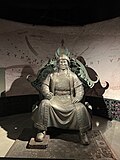
Sculptures

[edit]

See also

[edit]

Notes

[edit]

References

[edit]
[edit]
Revisions and contributorsEdit on WikipediaRead on Wikipedia
from Grokipedia
Modu Chanyu (Chinese: 冒頓單于; r. 209–174 BCE) was the founder and first supreme ruler, or , of the Empire, a vast nomadic confederation that dominated the eastern Eurasian s. Born as the son of the previous chanyu , Modu seized power in 209 BCE through a calculated coup, employing a whistling arrow to test and enforce the loyalty of his followers before directing it against his father and rivals. This act enabled him to consolidate control over fractious tribes, forging a unified through relentless and conquests that subdued the Donghu to the east and the to the west, thereby establishing the Xiongnu as a centralized steppe power capable of projecting force across . His most notable military achievement came in 200 BCE at the Battle of Baideng, where Xiongnu forces encircled and besieged the Han emperor Gaozu, compelling the Chinese court to sue for peace and initiate a policy of tribute payments and matrimonial alliances that acknowledged Xiongnu supremacy for decades. Modu's innovations in cavalry tactics, hierarchical organization, and merit-based command structures laid the groundwork for enduring nomadic imperial traditions, though accounts of his reign derive primarily from historiography, which may reflect adversarial biases in depicting steppe governance and customs. ![Hsiung-nu-Empire.png][center]

Name and Identity

Etymology and Transcription

The name Modu represents a romanization of the 冒頓 (Mòdú in ), as preserved in ancient historical records such as Sima Qian's Shiji (Records of the Grand Historian), compiled around 100 BCE. Alternative transcriptions in English scholarship include Maodun, Mode, or Màodùn, reflecting variations in interpreting phonology, which approximated the original pronunciation as something like *mək-tuən or *mûh-tûn. The full designation Modu combines this personal name with the title Chanyu (單于 in Chinese, Chányú), denoting the supreme ruler of the confederation; the title's remains obscure but is interpreted as a phonetic rendering of a native Xiongnu term for "heavenly emperor" or overlord, possibly linked to Central Asian nomadic linguistic roots without direct attestation in Xiongnu script, as the confederation lacked indigenous writing. Etymological proposals for Modu are speculative due to the absence of Xiongnu linguistic records, but one hypothesis traces it to an or Mongolic honorific bagatur (modern Mongolian baatar), meaning "" or "," suggesting the name connoted prowess fitting for a chieftain who unified nomadic tribes through conquest. This interpretation aligns with later Central Asian traditions equating Modu with figures like the Turkish Mete Han or Mongolian Modun , though direct equivalence relies on reconstructed proto-languages rather than contemporary evidence. Other suggestions, such as Iranian influences like baγ ("" or ""), have been advanced but lack consensus and are contested due to uncertainties in ethnolinguistic origins, which blend possible Altaic, Iranian, and indigenous elements. No primary Xiongnu source confirms these derivations, underscoring that all interpretations stem from Chinese transliterations prone to phonetic distortion.

Titles and Self-Designation

Modu proclaimed himself (單于 in Chinese transcription) immediately following the assassination of his father in 209 BCE, establishing the title as the preeminent designation for the supreme ruler of the unified confederation. This self-designation marked a consolidation of authority, transforming a loose tribal into a centralized under his command, with the positioned as the apex of a decimal-based and administrative . The of Chanyu remains debated among scholars, as it derives from an unattested language, but it is widely interpreted as connoting "vast" or "universal ruler," evoking a mandate from heaven analogous to the Han emperor's self-conception as Tianzi (). Primary accounts in Sima Qian's Shiji portray Modu invoking celestial origins in his proclamations, asserting dominion over the as divinely ordained, thereby legitimizing his rule through claims of heavenly support rather than mere heredity. In diplomatic exchanges with the , Modu employed grandiose self-references, such as styling himself the "great born of Heaven," to demand parity with Gaozu, whom he addressed as a fraternal equal rather than subordinate. Archaeological evidence, including Han-era roof tiles (wadang) inscribed with " ," corroborates this self-aggrandizing rhetoric, likely originating from Modu's era or shortly thereafter to project imperial legitimacy. These titles underscored a deliberate emulation of Chinese imperial ideology, adapted to nomadic imperial ambitions, without subordinating sovereignty.

Early Life and Ascension

Family Background and Youth

Modu was the eldest son of , the who ruled the early confederation from approximately 220 BCE until his death in 209 BCE, and a consort of relatively low standing in the royal household. had initially designated Modu as , but after the birth of a younger son to a favored , he sought to disinherit Modu in favor of the junior sibling, reflecting common practices of succession influenced by maternal status and political alliances. This familial dynamic, recorded in Sima Qian's Shiji, positioned Modu as a potential rival within the nomadic , where depended on prowess and tribal loyalty rather than alone. Born circa 234 BCE amid the Xiongnu's ongoing raids and consolidations on the Mongolian steppe, Modu grew up in an environment of constant warfare against neighboring groups such as the Yuezhi and Donghu. As a youth, he exhibited notable courage and aptitude for archery and cavalry tactics, skills honed through hunting expeditions and military drills that were integral to Xiongnu upbringing for elite males. To sideline him further, Touman dispatched the young Modu—likely in his late teens—as a hostage to the Yuezhi around 210 BCE, coinciding with plans to invade their territory in hopes that conflict would eliminate the perceived threat to succession. Despite this peril, Modu survived the ensuing Yuezhi retreat and returned to the Xiongnu, leveraging his early experiences to build personal loyalties among warriors.

Coup Against Touman

, the chieftain of the tribes, favored a younger son born to a lesser consort over Modu, his eldest son by the primary wife, and sought to eliminate Modu as a rival for succession. To this end, dispatched Modu as a to the , a neighboring nomadic group, around the early 210s BCE; when the mobilized against the , refused to intervene or ransom him, effectively abandoning Modu to his fate. Modu evaded execution by the , rejoined his father's forces, and began cultivating a core of loyal followers through rigorous discipline. Modu trained this elite unit using specially crafted whistling arrows, issuing commands during exercises where subordinates were ordered to shoot only at his designated target; any who hesitated or fired elsewhere were immediately executed, weeding out the disloyal and instilling absolute obedience—first demonstrated by ordering the killing of his own prized , then his stepmother's son, and subsequently the stepmother herself along with her kin. These acts, drawn from Sima Qian's Records of the Grand Historian (Shiji), purged potential threats within the inner circle and solidified Modu's command over approximately 10,000 riders by demonstrating unyielding authority. In 209 BCE, during a hunt, Modu directed an arrow toward under the guise of targeting game; his followers, conditioned to obey without question, unleashed a volley that killed the and ensured no opposition arose. Following the , Modu executed the favored younger brother to eliminate succession rivals and proclaimed himself (supreme leader), thereby founding the centralized Empire through this patricidal coup, which portrays as a calculated consolidation of power amid tribal fragmentation. The event marked a shift from loose tribal alliances under to Modu's hierarchical structure, though sources like the Shiji may emphasize barbaric ruthlessness to contrast with imperial Confucian ideals, potentially biasing portrayals of governance as inherently violent rather than strategically adaptive to nomadic realities.

Unification of the Xiongnu

Conquests of Neighboring Tribes

Following his ascension as Chanyu in 209 BCE, Modu Chanyu launched rapid campaigns against neighboring nomadic confederations to consolidate Xiongnu dominance across the Eurasian steppe. His forces first targeted the Donghu, a powerful eastern tribal group that had previously extracted tribute from Modu's father Touman. The Donghu, comprising left and right divisions under separate kings, underestimated the Xiongnu's newfound unity and military discipline; Modu exploited this by launching a surprise assault with approximately 140,000 cavalry, annihilating their leadership and scattering their warriors. Remnants of the Donghu fled northward, eventually forming the Wuhuan and Xianbei tribes. Turning westward, Modu assaulted the Yuezhi, a formidable Indo-European nomadic power that had long dominated the western steppes and despised the Xiongnu as inferiors. In decisive engagements around 208–207 BCE, Xiongnu armies overwhelmed Yuezhi forces, killing or capturing vast numbers and compelling the survivors to migrate en masse toward the Ili River valley and eventually Bactria. This expulsion disrupted Yuezhi control over the Tarim Basin oases, incorporating their territories into the Xiongnu sphere and securing western flanks. Modu later reinforced this subjugation with follow-up campaigns, culminating in a final crusade against Yuezhi holdouts in 177–176 BCE. With eastern and western rivals subdued, Modu subdued northern tribes including the Hunyu, Queshe, Dingling, Gekun, and Xinli, who submitted after witnessing the Yuezhi's fate. The Dingling, inhabiting southern Siberia near the Lena River, were among the first to yield, providing tribute and auxiliary troops. These conquests, achieved through swift cavalry maneuvers and enforced loyalty oaths, expanded Xiongnu territory from the Altai Mountains to the Korean frontier, forming a confederation of over 24 subordinate tribes by the mid-2nd century BCE. The Wusun were also compelled to vassalage, further solidifying Modu's imperial structure.

Internal Consolidation

Following his conquests of neighboring tribes such as the Yuezhi and Donghu around 208–207 BCE, Modu Chanyu focused on solidifying control over the newly unified Xiongnu confederation by centralizing authority and enforcing rigorous discipline. He reorganized the Xiongnu populace and military into a decimal-based hierarchy, comprising units of ten (called ), one hundred (qūn), one thousand, and ten thousand, which allowed for efficient mobilization, surveillance, and suppression of dissent among the diverse tribal components. This structure, drawn from pastoral nomadic traditions but systematized under Modu, bound followers through collective responsibility, where disobedience in one unit implicated the entire chain of command, thereby minimizing internal fragmentation in a multiethnic empire spanning from the Baikal region to the Ordos. To ensure loyalty, Modu employed punitive measures against potential rivals, including the execution of disloyal subordinates and the integration of conquered elites into subordinate roles under close oversight, preventing autonomous power bases. Primary accounts indicate he redistributed conquest spoils—such as and from the defeated tribes—to reward adherents and foster economic interdependence, transforming loosely allied groups into a cohesive dependent on the Chanyu's . This internal stabilization enabled sustained expansion without immediate revolts, though succession tensions persisted, as evidenced by Modu's designation of his son as heir in the late 170s BCE.

Military Campaigns and Reforms

Tactics and Technological Innovations

Modu Chanyu implemented rigorous training regimens to instill discipline and coordination in his , most notably through the use of whistling arrows as signaling devices. These specially crafted arrows, which emitted a distinct during flight, served to direct volleys by indicating the target direction; troops were commanded to shoot synchronously toward the sound, with severe penalties—including execution—for or disobedience. This was tested internally: Modu first targeted his own favorite , then his stepmother, eliminating any wavering followers and ensuring absolute loyalty before applying it against external threats, such as in the coup against his father around 209 BCE. The Xiongnu's core tactical doctrine under Modu centered on highly mobile horse-archer units, exploiting the steppe's vast terrain for rapid maneuvers, feigned retreats, and enveloping attacks that disrupted enemy formations. Riders, trained from youth in horsemanship, favored hit-and-run raids and coordinated strikes to avoid prolonged engagements, leveraging superior speed to outpace infantry-heavy Han armies and target supply lines. This approach proved effective in unifying nomadic tribes through conquests, such as the subjugation of the by 177 BCE, where sudden, overwhelming assaults capitalized on surprise and numerical concentration. Technologically, Modu's forces advanced the nomadic tradition of the composite , a laminated weapon of wood, horn, and sinew that delivered greater draw weight and range—up to 300 meters—than contemporary Chinese crossbows when fired from horseback. This bow's compact design facilitated rapid shooting (up to 10 arrows per minute) during gallops, enabling sustained barrages that pierced armor at distance. While the bow predated Modu, his emphasis on standardized training and scaled its battlefield impact, transforming disparate tribal warriors into a unified striking force capable of challenging settled empires. Organizationally, Modu reformed the military hierarchy into a structure—units of 10, 100, 1,000, and 10,000 horsemen—enhancing scalability and command efficiency for campaigns involving tens of thousands. This , implemented circa 209 BCE following his ascension, allowed for delegated authority among loyal chieftains while maintaining centralized control, facilitating the empire's rapid expansion from the Ordos region to the .

Wars Against the Han Dynasty

Modu Chanyu initiated raids on border commanderies shortly after assuming power in 209 BC, exploiting the instability following the Qin Dynasty's collapse to seize lands south of the Great Wall, including areas near Gaoque. These incursions involved forces numbering up to 300,000, including specialized units, repeatedly defeating Han garrisons and capturing or killing soldiers in the tens and hundreds per engagement, rendering Han troops unable to mount effective counteroffensives. In response, Emperor Gaozu mobilized over 200,000 troops in 200 BC for a punitive expedition against the , advancing into their territory near Pingcheng (modern , ). Advised by general Chen Ping, Gaozu underestimated Modu's mobility, leading to an at Baideng Mountain where cavalry surrounded the Han army for seven days, cutting off supplies and isolating the emperor. The Han force, hampered by terrain and numerical disadvantage against the 's swift horsemen, suffered heavy attrition before Chen Ping negotiated the siege's lifting through bribes to Modu's consort Yan Zhi, who influenced the to withdraw. The Baideng debacle compelled the Han to abandon offensive operations, with Modu maintaining border pressure through sporadic raids into the 190s BC, though no large-scale battles ensued as the leveraged their superiority to evade pitched engagements. Han chronicles attribute the 's edge to disciplined and feigned retreats, contrasting with Han infantry vulnerabilities in open terrain. This period marked the 's tactical dominance, forcing the Han into a defensive posture reliant on fortifications rather than conquest.

Diplomacy and Statecraft

Heqin Agreements and Tribute

The agreements, initiated after the Han dynasty's defeat at the Battle of Baideng in 200 BC, marked a policy of diplomatic toward the under Modu Chanyu. In 198 BC, Gaozu formalized the first such , under which the Han committed to annual tribute payments to the in the form of , wine, grain, rice, and other foodstuffs, alongside the marriage of a Han princess—designated as a relative of the emperor—to Modu as a symbolic alliance. The agreement stipulated mutual recognition of the Han emperor and chanyu as "brothers," with the pledging to refrain from border incursions, though violations occurred periodically as Han sources record raids despite renewals. Exact tribute quantities for Modu's era remain unspecified in surviving records, but the deliveries represented a significant economic inflow to the , subsidizing their nomadic confederation amid resource scarcity. These arrangements persisted through Modu's reign (209–174 BC), renewed multiple times as a pragmatic Han response to Xiongnu military dominance, which had unified steppe tribes and overwhelmed Han forces earlier. Following Gaozu's death in 195 BC, during Empress Lü's regency, the Han upheld tribute obligations while proposing further marriage alliances, which Modu accepted in principle for continued material benefits but handled selectively to maintain Xiongnu autonomy. The heqin framework, framed in Han historiography as equitable kinship, effectively functioned as coerced tribute extraction enabled by Xiongnu cavalry superiority and Han internal recovery needs post-Qin collapse, providing Modu with leverage to consolidate power without full-scale war. Chinese records, primarily from Sima Qian's Shiji, emphasize Han generosity but understate the tributary dynamic's asymmetry, reflecting a Sinocentric bias that portrayed nomads as dependents rather than equals in bargaining power.

Marriage Proposal to Empress Lü

In 192 BCE, Modu Chanyu dispatched an envoy to the Han court with a letter proposing marriage to Empress Dowager Lü Zhi, the widow of Emperor Gaozu and regent during the minority of Emperor Hui. In the message, Modu portrayed himself as a solitary ruler without a consort, noting that the young Han emperor had died, leaving the "beautiful" empress without a husband, and suggested they unite to provide mutual comfort in their advancing years. This overture, drawn from accounts in Sima Qian's Shiji, was interpreted by Han officials as a deliberate provocation, leveraging the Xiongnu's military superiority to humiliate the dynasty amid its internal instability following Gaozu's death in 195 BCE. The proposal incited outrage at the Han court, where initially favored a retaliatory , supported by hawkish generals who viewed it as an affront to imperial dignity. Advisors, including the minister Ji Bu, cautioned against military action, citing the Han army's recent defeats—such as Emperor Gaozu's narrow escape from encirclement at Pingcheng in 200 BCE—and the empire's exhaustion from prior campaigns. Heeding this counsel, Lü opted for , dispatching a self-deprecating reply that emphasized her advanced age, physical unattractiveness (describing herself as haggard with "pendulous breasts reaching to her stomach"), and unsuitability as a , while imploring Modu's forbearance toward the Han. Modu accepted the refusal without immediate retaliation, as the were then engaged in western campaigns against the , but the incident exacerbated mutual distrust and foreshadowed intensified border raids. It underscored the 's strategic use of matrimonial to assert dominance, contrasting with Han efforts to preserve face through alliances that typically involved sending royal surrogates rather than the herself. The exchange, preserved primarily in Han records, highlights the cultural chasm between sedentary imperial protocol and nomadic , where such proposals served as tests of resolve rather than genuine overtures.

Administration and Empire Structure

Hierarchical Organization

The Xiongnu Empire under Modu Chanyu (r. 209–174 BCE) featured a centralized hierarchical structure that integrated tribal with military discipline, primarily described in Han Chinese records such as the Shiji. At the apex stood the , the supreme ruler vested with absolute authority over military, judicial, and diplomatic affairs, a title Modu assumed after assassinating his father in 209 BCE to unify disparate nomadic groups. This position was hereditary within the royal clan, with Modu designating his eldest son Jizhu as and Left Tuqi King, establishing a pattern of succession to prevent fragmentation. Subordinate to the Chanyu were the Left and Right Tuqi Kings (or Yizhixie), who governed the empire's eastern and western wings, respectively, as semi-autonomous viceroys responsible for regional administration, tribute collection, and mobilization of forces. The Left Tuqi, often the designated successor, oversaw the more prestigious eastern territories closer to Han borders, while the Right Tuqi managed the western flanks; these roles were typically filled by royal kin to ensure loyalty, as Modu reformed the system to curb the independence of pre-unification chieftains. Beneath them operated 24 great divisions or guli (dukes), aristocratic leaders of subordinate tribes integrated through conquest or alliance, who commanded smaller appanages and owed to the wings. This layered nobility reflected Modu's consolidation efforts, transforming loose tribal alliances into a cohesive sustained by oaths of and shared plunder distribution. Administrative and military organization adhered to a decimal system, dividing the populace into units of 10 (), 100 (hundred), 1,000 (thousand), and (tumen), which facilitated rapid assembly—up to 300,000 warriors—and census-like control over nomadic households for taxation in and labor. Modu implemented this reform post-unification to enforce discipline, executing disloyal units en masse during drills, as per Shiji accounts, thereby embedding hierarchy in everyday pastoral mobility and warfare. While Chinese sources emphasize this rigidity, archaeological evidence of elite burials with status markers supports a stratified society, though the system's reliance on personal loyalty to the introduced vulnerabilities to succession disputes after Modu's death.

Economic Foundations

The Xiongnu economy under Modu Chanyu (r. 209–174 BCE) relied fundamentally on , centered on the of , sheep, , and other livestock across the and adjacent steppes. This system provided essential resources such as meat, dairy, hides, and wool for daily needs, while served as both economic assets and enablers, supporting mobility and warfare essential to expansion. Archaeological evidence from sites, including animal bone assemblages dominated by ovicaprids and equids, confirms as the core productive activity, with seasonal migrations optimizing grazing lands. Modu's unification of disparate tribes after 209 BCE transformed this decentralized base into a structured system, where subordinate chieftains—organized into units of tens, hundreds, and thousands—were obligated to deliver portions of their herds, slaves captured in raids, and labor services to the central authority. This hierarchy, enforced through and oaths of loyalty, centralized surplus production and mitigated intra-tribal competition over pastures, fostering stability amid environmental variability like droughts. records, such as the Shiji, describe this as a merit-based where loyalty yielded economic rewards, though these accounts likely exaggerate dependence on plunder to justify defenses. Intermittent trade and raids augmented pastoral revenues, with Xiongnu control over routes facilitating barter of horses and furs for Han s, grains, and iron tools, items critical for supplementing arid-zone shortages. By 198 BCE, following the Han defeat at Baideng, Modu extracted formal tribute from Emperor Gaozu, including 40,000 catties of annually and foodstuffs to sustain herds during famines, marking a reversal where the nomadic confederation imposed dependency on agrarian . Raids targeted not just plunder but strategic acquisition of agricultural goods, underscoring the symbiotic yet coercive economic interplay between pastoralists and farmers, as evidenced in Han annals cross-verified by artifacts showing Chinese imports.

Later Reign and Succession

Final Expansions and Challenges

In the closing years of his reign, Modu Chanyu oversaw the Xiongnu's major westward expansion by defeating the confederation, a rival nomadic power controlling fertile pastures in the region. Chinese historical records attribute to Modu the decisive strike that killed the king and scattered their forces, compelling the survivors to migrate toward around 177–176 BCE. This victory incorporated territories into the Xiongnu domain, enhancing access to resources and trade corridors while eliminating a key threat on the western flank. Concomitantly, forces subjugated the tribe, whose lands bordered the , through military pressure that enforced vassalage and integrated their into the empire's structure by circa 178 BCE. These conquests represented the apex of Modu's territorial ambitions, stretching hegemony from the eastern steppes to the Tarim Basin's fringes and solidifying a buffer against potential incursions from diverse pastoral groups. Challenges in these final phases stemmed primarily from integrating fractious subjugated populations and sustaining logistical demands across an enlarged domain reliant on mobile horse-archer armies. While no large-scale rebellions are recorded under Modu, the incorporation of and elements required vigilant enforcement of hierarchical loyalties, as nomadic confederations often harbored latent rivalries. Diplomatic frictions with the Han persisted, exemplified by correspondence in which Modu rebuffed Emperor Wen's overtures for deeper submission, underscoring the tension between nominal peace via tribute and assertions of supremacy.

Death and Immediate Aftermath

Modu Chanyu died in 174 BCE, as recorded in the Shiji (Records of the Grand Historian) by Sima Qian, the primary Chinese historical source on Xiongnu affairs, which exhibits a Han-centric bias portraying nomads as perennial threats but offers the most detailed contemporaneous narrative available. No specific cause of death is mentioned in surviving records, though the timing followed a period of relative stability after major conquests against the Yuezhi and others. He was succeeded without apparent disruption by his son Jiyu (also rendered Jizhu), who assumed the title Laoshang Chanyu, maintaining the centralized chanyu system Modu had established. The immediate aftermath saw continuity in Xiongnu-Han relations, with the Han court dispatching a princess as part of the ongoing marriage alliance to the new , signaling recognition of the regime's enduring power and the perceived need to avert renewed invasions. Laoshang promptly reaffirmed supremacy by subordinating tributary states and launching probes into Han border regions, though no large-scale war erupted in the transition year. This smooth handover underscores the effectiveness of Modu's merit-based military hierarchy in ensuring loyal elite support for hereditary succession, despite the absence of independent written records to verify Han accounts.

Historical Assessment

Reliability of Chinese Sources

The primary sources for Modu Chanyu's reign derive from histories, with Sima Qian's Shiji (completed circa 91 BCE) providing the most detailed account in its "Treatise on the ," based on earlier Qin and Western Han records, diplomatic reports, and informant testimonies from defectors. These texts outline key events, including Modu's unification of tribes in 209 BCE, the defeat of the around 177 BCE, and treaties with the Han from 198 BCE onward, with specifics such as tribute demands of 10,000 bolts of silk and wine shipments recorded in archival style. Their chronological framework is generally deemed reliable for major milestones, as cross-referenced with Han economic ledgers and inscriptions indirectly attesting to interactions during the period. However, these sources exhibit pronounced ethnocentric biases, systematically portraying the —and Modu in particular—as ruthless barbarians to legitimize Han expansionism and cultural superiority, a pattern evident in anecdotes like Modu's bow test for executing non-compliant subjects or his to seize power, which may serve propagandistic ends rather than factual precision. Han chroniclers, operating under imperial patronage, compiled materials selectively, often inflating military numbers (e.g., claims of 300,000+ ) or attributing exaggerated savagery to justify resource-intensive defenses, such as the early Great Wall extensions post-215 BCE. This bias stems from the adversarial context of Han- wars and tribute extractions, compounded by limited direct access to internal affairs, leading scholars to the narratives for conflating Han fears with reality. Archaeological evidence partially validates the Chinese records' core assertions, with sites like Noin-Ula and Ordos burials from the 2nd century BCE revealing hierarchical elite with Han-style imports (silks, ) consistent with flows and Modu's described administrative reach, yet discrepancies arise in unverified details like exact succession rituals or clan structures, which may reflect Han projections onto nomadic societies. Later compilations, such as Ban Gu's Hanshu (111 CE), amplify Shiji motifs under Eastern Han retrospection, introducing hindsight biases from renewed conflicts, thus requiring modern to prioritize interdisciplinary checks—genetic studies linking remains to multi-ethnic populations, for instance—over unfiltered textual acceptance. Systemic Han institutional incentives, including historiographical norms favoring dynastic glorification, underscore the need for toward moral characterizations while affirming the sources' utility for reconstructing causal sequences of empire-building.

Factors Enabling Rise

Modu's rise to the position of in 209 BCE stemmed primarily from Chanyu's favoritism toward a younger son by a noblewoman, which marginalized Modu and created an opening for usurpation. Sent as a to the Yuezhi, Modu returned amid his father's campaigns against them, subsequently assembling a cadre of loyal warriors amid the fractious tribal politics of the eastern . A pivotal innovation was Modu's development of whistling arrows, which emitted a audible signal in flight to enforce synchronized obedience among his troops; he progressively tested this by ordering shots at his father's prized horse, then his own steed, and an attendant, executing any who hesitated, before directing the fatal volley at Touman himself during a hunt. This method not only purged disloyal elements but instilled iron discipline in a nomadic cavalry reliant on rapid, coordinated maneuvers, transforming a personal retinue into a reliable strike force. Post-coup, Modu swiftly executed his and half-brother to neutralize succession threats, then compelled from wavering tribes through punitive raids, leveraging the Xiongnu's traditional advantages in and mobility to integrate fragmented groups previously dominated by rivals like the Donghu. The Qin Empire's collapse in 206 BCE further aided consolidation, as the nascent contended with internal rebellions and lacked capacity for northern intervention, enabling Modu to vanquish the Donghu in 208 BCE and drive the westward by 207 BCE without significant opposition. These factors—familial betrayal, enforced via tactical , intra-steppe disunity, and a temporary Chinese —interacted causally to elevate Modu from to architect of the first expansive Inner Asian , as detailed in Sima Qian's Shiji, a Han-era chronicle drawing on court records and envoys' reports despite its tendency to portray steppe leaders as ruthless to underscore Han superiority.

Legacy

Influence on Successor States

Modu Chanyu's unification of the tribes into a cohesive introduced organizational innovations that profoundly shaped subsequent nomadic polities on the . His implementation of a decimal-based military hierarchy—dividing forces into units of 10, 100, 1,000, and 10,000 warriors selected by merit rather than kinship ties—enabled scalable command and loyalty to the over tribal affiliations, a system that persisted in later confederations. This structure facilitated the 's dominance until fragmentation around 48 CE, after which Northern remnants migrated westward, while Southern groups integrated into Han territories, influencing entities like the dynasty (386–535 CE) through adopted administrative practices from elites. The confederation, emerging in the 2nd century CE to fill the power vacuum in after decline, replicated Modu's model of centralized authority under a supreme leader, using similar meritocratic appointments and tribute extraction from sedentary neighbors to consolidate control over diverse tribes. This approach allowed the to expand influence across , establishing states like the that blended steppe hierarchy with Chinese bureaucracy. Successor khaganates, including the Rouran (c. 402–555 CE), further entrenched these principles, maintaining a dualistic political organization evolved from precedents to manage vast, multiethnic territories. The Göktürk Empire (552–744 CE), which overthrew the Rouran, inherited and refined the framework, employing decimal divisions for cavalry armies and demanding heqin-style diplomacy (marriage alliances and tribute) from , echoing Modu's 198 BCE treaty with Gaozu. The title "kagan" linguistically derives from or parallels "," underscoring institutional continuity in leadership. Genghis Khan's (1206–1368 CE) culminated this lineage, with its niru (units of 100) and tumen (10,000) directly mirroring organization, enabling conquests that integrated tribes through conquest and alliance in a manner paralleling Modu's subjugation of the Donghu and . Genetic analyses of burials reveal a multiethnic composition incorporating conquered groups, a strategy that foreshadowed the ' expansive inclusivity and underscores the empire's role as a foundational prototype for imperium.

Archaeological and Cultural Evidence

Archaeological excavations in have uncovered elite burial sites dating to the 3rd–2nd centuries BCE, coinciding with Modu Chanyu's unification and expansion of the confederation from approximately 209 to 174 BCE. These include large tumuli containing wooden coffins, horse sacrifices, and such as weapons, ornaments, and imported Chinese artifacts like mirrors, reflecting the nomadic elite's wealth and interactions with neighboring sedentary societies. High-status burials often feature multiple satellite graves, indicating hierarchical social structures consistent with the centralized authority Modu established over diverse tribes. In the Noin-Ula and related regions of northern , tombs attributed to aristocrats of Modu Chanyu's bloodline have yielded artifacts including finely crafted metalwork with animal motifs, such as gold tiger plaques emblematic of nomadic artistry, distinct from contemporaneous Chinese styles in their emphasis on mobility and symbolism. An enormous complex discovered in 2018 near these sites further highlights the scale of elite interments, with chambers preserving textiles, jewelry, and ritual items that underscore cultural exchanges via or during Modu's campaigns. analysis from these burials reveals a multiethnic composition, with from eastern Eurasian, western , and southern populations, supporting the confederative empire Modu forged rather than a monolithic ethnic group. Cultural evidence extends to preserved rituals, such as the deliberate breakage of imported bronze mirrors in graves—possibly symbolizing the transition to the afterlife or rejection of foreign spiritual influences—evident in artifacts from Mongolian museums housing Xiongnu-period finds. These objects, including felt carpets and caftan-style clothing remnants, illustrate a hybrid material culture blending local pastoral traditions with acquired technologies, without direct epigraphic ties to Modu but aligning temporally with his era's documented raids and diplomacy. No confirmed tomb of Modu himself has been identified, limiting personalized archaeological attribution, though the proliferation of such elite sites post-209 BCE corroborates the empire's rapid consolidation under his leadership.

References

Add your contribution
Related Hubs
Contribute something
User Avatar
No comments yet.