Hubbry Logo
Moll FlandersMoll FlandersMain
Open search
Moll Flanders
Community hub
Moll Flanders
logo
8 pages, 0 posts
0 subscribers
Be the first to start a discussion here.
Moll Flanders
Moll Flanders
from Wikipedia

Moll Flanders[a] is a novel by Daniel Defoe, first published in 1722. It purports to be the true account of the life of the eponymous Moll, detailing her exploits from birth until old age.

Key Information

By 1721, Defoe had become a recognised novelist, with the success of Robinson Crusoe in 1719. His political work was tapering off at this point, due to the fall of both Whig and Tory party leaders with whom he had been associated. Robert Walpole was beginning his rise, and Defoe was never fully at home with Walpole's group. Defoe's Whig views are evident in the story of Moll, and the novel's full title gives some insight into this and the outline of the plot.[1]

It is usually assumed that the novel was written by Daniel Defoe, and his name is commonly given as the author in modern printings of the novel. However, the original printing did not have an author, as it was an apparent autobiography.[2] The attribution of Moll Flanders to Defoe was made by bookseller Francis Noble in 1770, after Defoe's death in 1731.[3] The novel is based partially on the life of Moll King, a London criminal whom Defoe met while visiting Newgate Prison.

Historically, the book was occasionally the subject of police censorship.[4]

Plot

[edit]
An illustration from an 18th-century chapbook.

Moll's mother is a convict in Newgate Prison in London who is given a reprieve by "pleading her belly," a reference to the custom of postponing the executions of pregnant criminals. Her mother is eventually transported to British America. Moll Flanders is raised from the age of three until adolescence by a kindly foster mother. Moll Flanders is not her birth name, she emphasises, taking care not to reveal it.

She gets attached to a household as a servant where she is loved by both sons, the elder of whom convinces her to "act like they were married" in bed. Unwilling to marry her, he persuades her to marry his younger brother. After five years of marriage, she then is widowed, leaves her children in the care of in-laws, and begins honing the skill of passing herself off as a fortuned widow to attract a man who will marry her and provide her with security.

The first time she does this, her "gentleman-tradesman" spendthrift husband goes bankrupt and flees to mainland Europe, leaving her on her own with his blessing to do the best she can to forget him. They had one child together, but "it was buried." The second time, she makes a match that leads her to Virginia Colony with a kindly man who introduces her to his mother.

After three children, with one dying, Moll learns that her mother-in-law is actually her biological mother, which makes her husband her half-brother. She dissolves their marriage and after continuing to live with her brother for three years, travels back to England, leaving her two children behind. Moll goes to live in Bath to seek a new husband.

Again she returns to her con skills and develops a relationship with a man in Bath, whose wife is elsewhere confined due to insanity. Their relationship is at first platonic, but eventually develops into Moll becoming something of a "kept woman" in Hammersmith, London. They have three children, with one surviving. After a severe illness Moll's partner repents, breaks off the arrangement, and commits to his wife. He assures Moll that their son will be well cared for, so she leaves yet another child behind.

Moll, now 42, resorts to another beau, a bank clerk, who while still married to an adulterous wife (a "whore"), proposes to Moll after she entrusts him with her financial holdings. While waiting for the banker to divorce, Moll pretends to have a great fortune to attract another wealthy husband in Lancashire, assisted by a new female acquaintance who attests to Moll's fictitious social standing. The ruse is successful, and she marries Jemmy, a supposedly rich man who claims to own property in Ireland.

They each quickly realise that they were both conned and manipulated by the acquaintance. He discharges her from the marriage, telling her that she should inherit any money he might ever get. After enjoying each other's company for about a month, they part ways, but Moll soon discovers that she is pregnant. She gives birth and the midwife gives a tripartite scale of the costs of bearing a child, with one value level per social class. She continues to correspond with the bank clerk, hoping he will still have her.

Moll leaves her newborn in the care of a countrywoman in exchange for the sum of £5 a year. Moll marries the banker, but realises "what an abominable creature I am! and how this innocent gentleman is going to be abused by me!". They live in happiness for five years before he becomes bankrupt and dies of despair, the fate of their two children left unstated.

Truly desperate now, Moll begins a career of artful thievery, which, by employing her wits, beauty, charm, and femininity, as well as hard-heartedness and wickedness, brings her the financial security she has always sought. She becomes well known among those "in the trade," and is given the name Moll Flanders. She is helped throughout her career as a thief by her Governess, who also acts as receiver. During this time she briefly becomes the mistress of a man she robbed. Moll is finally caught by two maids while trying to steal from a house.

In Newgate she is led to her repentance. At the same time, she reunites with her soulmate, her "Lancashire husband", who is also jailed for his robberies, before and after they first met, he acknowledges. Moll is found guilty of felony, but not burglary, the second charge. The sentence is death. Moll convinces a minister of her repentance, and together with her Lancashire husband is transported to the Colonies to avoid hanging, where they live happily together. She even talks the ship's captain into letting them stay in his quarters, apart from the other convicts, who are sold on arrival. Once in the colonies, Moll learns her mother has left her a plantation and that her own son, by her brother, is alive, as is her husband/brother.

Moll carefully introduces herself to her brother and their son, in disguise. With the help of a Quaker, the two found a farm with 50 servants in Maryland. Moll reveals herself now to her son in Virginia and he gives her her mother's inheritance, a farm for which he will now be her steward, providing £100 a year income for her. She makes him her heir, and gives him a stolen gold watch.

At last, her life of conniving and desperation seems to be over. After her husband/brother dies, Moll tells her Lancashire husband the entire story and he is "perfectly easy on that account... For, said he, it was no fault of yours, nor of his; it was a mistake impossible to be prevented." Aged 69 in 1683, the two return to England to live "in sincere penitence for the wicked lives we have lived."

Gender roles

[edit]

According to Swaminathan (2003), Moll Flanders provides a window into women’s ways of being that do not reflect 18th century gender norms. Moll is reliant on alliances and friendships with women, many of whom fall outside of the gendered expectations of the era, she marries five times, and she has sexual relationships outside of marriage.[5]

One of Defoe’s notable contributions to 18th century ideas of female empowerment rests on the notion of women as agents of their own wealth. As Kuhlisch notes, “From the beginning, [Moll] does not believe that she is naturally poor but considers herself entitled to a more affluent life… [and she] defines her identity through her social position, which results from the material effects of her economic activities" (341).[6] That said, it may also be Defoe's “antipathy for England's commoners” that contributed to Moll's socioeconomic ascension (p. 99).[7]

Spiritual autobiography

[edit]

One of the major themes within the book, and a popular area of scholarly research regarding its writer Daniel Defoe, is that of spiritual autobiography. Spiritual autobiography is defined as "a genre of non-fiction prose that dominated Protestant writing during the seventeenth century, particularly in England, particularly that of dissenters". Books within this genre follow a pattern of shallow repentances, followed by a fall back into sin, and eventually culminating in a conversion experience that has a profound impact on the course of their life from that point. The two scholars first to analyze the pattern of spiritual autobiography in Defoe's works, publishing within the same year, were George A. Starr and J. Paul Hunter.

George Starr's book, titled Defoe and Spiritual Autobiography, analyses the pattern of spiritual autobiography, and how it is found in Defoe's books. His focus in the book is primarily on Robinson Crusoe, as that is Defoe's book that follows the clearest pattern of spiritual autobiography. He discusses Moll Flanders at length, stating that the disconnectedness of the events in the book can be attributed to the book's spiritual autobiographical nature. He examines the pattern of spiritual autobiography in these events, with the beginning of her fall into sin being a direct results of her vanity prevailing over her virtue.[8]

Moll's "abortive repentances" are highlighted, such as her "repentance" after marrying the bank clerk. Moll is unable to break the pattern of sin that she falls into, one of habitual sin, in which one sin leads to another. Starr describes this gradual process as "hardening", and points to it as what makes up the basic pattern of her spiritual development. In examining her conversion experience, Starr highlights her motive as being "the reunion with her Lancashire husband, and the news that she is to be tried at the next Session, caused her 'wretched boldness of spirit' to abate. 'I began to think,’ she says, 'and to think indeed is one real advance from hell to heaven" (157).[9]

The culmination of her repentance comes the morning after this moment, when reflecting on the words of the minister that she confessed her sins to. Starr's main criticism of the book as a work of spiritual autobiography stems from the fact that only part, and not all, of Moll's actions contain spiritual significance. The overall pattern is consistent, but does not cover all sections, with some of those other sections focusing in more on social issues/social commentary.[10]

Film, television, or theatrical adaptations

[edit]

Notes

[edit]

References

[edit]

Bibliography

[edit]
[edit]
Revisions and contributorsEdit on WikipediaRead on Wikipedia
from Grokipedia
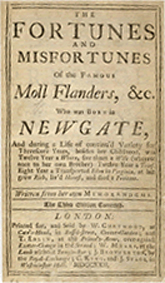
Moll Flanders is a by the English writer , first published anonymously in 1722. It purports to be the of its eponymous , a woman born in whose tumultuous life spans for twelve years, five marriages (including one unknowingly to her own brother), twelve years as a thief, eight years as a transported felon, and a belated religious leading to her death as a penitent. The full title, The Fortunes and Misfortunes of the Famous Moll Flanders, &c. Who was Born in , and during a Life of continu'd Variety for Threescore Years, besides her Childhood, was Twelve Year a Whore, five times a Wife (whereof once to her own Brother), Twelve Year a Thief, Eight Year a Transported Felon in , &c. Lastly having turn'd Penitent under the Direction of Bishop Mejnott and the rest of the Clergy, learn'd the Way to Heaven in the Space of one single Day, encapsulates the narrative's episodic structure and moral arc. Narrated in the first person, the work follows Moll from her orphaned infancy, through schemes for social ascent via marriage and crime in England and the American colonies, to her eventual reform under clerical influence. Defoe's novel is notable as his first with a female protagonist and for its raw depiction of economic desperation driving moral compromise in Restoration-era society. Often classified as picaresque for its rogue-heroine adventures and satirical edge on class and virtue, Moll Flanders exemplifies early prose fiction's blend of realism and didacticism, influencing later explorations of individualism and criminal autobiography in English literature. Despite its sensational elements, the text underscores causal links between poverty, opportunity, and ethical lapses, presenting Moll's survival strategies as pragmatic responses to systemic constraints rather than mere vice.

Publication and Historical Context

Authorship and Publication Details

, commonly known as Moll Flanders, was first published anonymously on 27 January 1722 in London. The work appeared as a purported first-person autobiography detailing the protagonist's life of vice, transportation, and redemption, with no author named on the title page, consistent with Defoe's practice for several of his prose fictions to enhance verisimilitude. Two additional editions followed later in 1722, reflecting immediate commercial interest amid the burgeoning market for criminal biographies and picaresque narratives. Authorship is attributed to (c. 1660–1731), the prolific English trader, , and whose earlier success with (1719) established his reputation in fictional realism. While Defoe never publicly claimed the work, and early attributions were absent, 18th-century booksellers like Francis Noble linked it to him by the 1770s based on stylistic and thematic parallels with his acknowledged writings, such as recurring motifs of economic survival and moral reckoning. Modern scholarship reinforces this through linguistic analysis and contextual evidence tying the novel to Defoe's interests in figures and colonial transportation, though debates persist in attribution studies questioning the definitiveness of such evidence for borderline cases in his vast output. The consensus among literary historians, however, treats Moll Flanders as Defoe's, distinguishing it from dubiously attributed pamphlets via its novelistic form and integration into his core canon.

Socioeconomic Conditions in Early 18th-Century

's population stood at approximately 5.1 million in , growing modestly to around 5.8 million by 1730, with much of the increase concentrated in urban centers like , which housed about 600,000 residents at the century's start. This slow demographic expansion reflected stable birth and death rates amid periodic crises such as harvest failures and disease outbreaks, though overall mortality declined slightly due to improved yields. remained the economic foundation, employing the majority of the workforce, while trade—bolstered by mercantilist policies and colonial ventures—drove exports from £6.5 million in , fostering growth in ports and commerce. However, the period preceded rapid industrialization, with real GDP advancing gradually at rates below 0.5% annually, constrained by limited technological diffusion and reliance on manual labor. Social stratification was rigid, dominated by a small and controlling land and political power, an emerging of merchants, professionals, and yeomen comprising about 15% of the population, and a vast of laborers, servants, and paupers. The and merchants benefited from expanding Atlantic , including slave-based commodities, which enriched urban elites but widened inequalities. Rural economies faced pressures from early enclosures, where landowners consolidated commons for private parks and hunting grounds, displacing smallholders and contributing to as customary rights eroded. Events like the South Sea Bubble of 1720 exposed speculative risks, bankrupting many middle-tier investors and underscoring economic volatility for those outside landed wealth. Poverty afflicted a significant portion of the populace, viewed less as a fixed state than a precarious risk from illness, , or misfortune, affecting urban migrants and rural displaced alike. The Elizabethan Poor Laws, codified in 1598 and administered via overseers, provided through local taxes funding outdoor aid, apprenticeships for children, and emerging workhouses, though implementation varied and often stigmatized recipients as idle. In , where 10% of England's wealth concentrated amid squalor, vagrancy laws criminalized begging, driving the destitute toward petty crime or transportation; by the 1720s, es supported thousands via rates equivalent to 1-2% of national income. Women, comprising half the cases, faced acute vulnerabilities without male breadwinners, highlighting gender-specific barriers in a patrilineal system.

Narrative Structure and Style

Plot Summary

Moll Flanders, born in to a mother convicted of and subsequently transported to the American colonies, is left in the care of a nurse in , , where she grows up aspiring to independence as a "gentlewoman" rather than a servant. At age eight, after brief stints with gypsies and parish relief, she is taken in by a pious woman who educates her in reading, , and spinning; by fourteen, following her benefactor's death, Moll enters service with a local family, where her beauty and accomplishments draw the attention of the eldest son, leading to a prolonged affair under promises of marriage that he fails to honor. To avoid , Moll marries the family's younger son, known as Robin, in secret despite familial opposition; the union lasts five years and produces several children, but Robin's death leaves her a with an of approximately £1,200, enabling modest comfort until her brother-in-law's continued advances prompt her departure to . In , she weds a prosperous draper who soon reveals , forcing them to separate after three children (two of whom die in infancy); destitute, Moll then marries a , with whom she has two more children before his death leaves her unsupported. Seeking fortune, Moll emigrates to , where she marries a wealthy planter unaware that he is her half-brother from her mother's earlier life; the yields three children and , but the discovery of their incestuous relation drives her to flee back to , abandoning the children but retaining some funds. In , repeated misfortunes—including a failed to a seemingly affluent banker who absconds after financial ruin—plunge her into , compelling her to turn to as a "gentlewoman pickpocket" for twelve years, during which she amasses wealth through , , and opportunistic crimes, such as stealing silverware, , and jewelry from homes and fires. Her criminal career ends with arrest for stealing lace valued at £40; convicted at the Old Bailey and sentenced to death, Moll receives a reprieve for transportation to , where she reunites with her grown son from the incestuous marriage, who gifts her a yielding £300 annually. On the voyage, she marries a fellow convict, a reformed ; after serving their terms, the couple settles in , prospers as planters, and returns to wealthy, where Moll lives out her later years in repentance and comfort, reflecting on her life's vicissitudes.

Genre Conventions: Picaresque Elements and Fictional Autobiography

Moll Flanders adheres to picaresque conventions through its depiction of a low-born who survives by , , and opportunistic exploits amid a panorama of early 18th-century . The unfolds episodically, tracing Moll's progression from orphaned child to thief, prostitute, and transported , with each phase involving schemes for financial gain, such as marrying for or silk petticoats, reflecting the 's emphasis on a rogue's varied adventures and through cunning rather than virtue. Unlike classical Spanish picaresque tales like , which often end in resigned cynicism, Defoe structures Moll's story with underlying cohesion: difficulties prompt reinvention (e.g., assuming new identities via false marriages), temporary aid enables schemes, and recurring moral crises build toward redemption, integrating didactic Protestant ethics into the rogue's amoral escapades. The novel also employs fictional autobiography conventions, presenting Moll's account as an authentic edited by an anonymous hand from her "private history," a device common in Defoe's era to confer on improbable events and critique societal norms through purported . This first-person retrospective narration mimics spiritual autobiographies like those of , with Moll reinterpreting youthful sins—seductions, incestuous unions, and felonies—as steps toward conversion, yet exposes the genre's limitations by revealing persistent self-delusion and unreliable self-knowledge, as her professed repentance clashes with ongoing greed and rationalizations. Defoe draws on criminal biography traditions, prevalent in publications like the Newgate Calendar, to blend confessional realism with moral ambiguity, questioning autobiographical objectivity while using the form to explore themes of identity and causality in personal downfall. This hybrid approach elevates the picaresque rogue tale into a proto-novelistic examination of individual agency, where factual-seeming details (e.g., specific theft yields of £40 or transportation to in 1690s) ground the fiction in empirical plausibility.

Core Themes and Moral Framework

Economic Pragmatism and the Consequences of Vice

In Moll Flanders, the protagonist exemplifies economic pragmatism by subordinating moral considerations to the imperatives of financial survival in an era of limited opportunities for women without inheritance or patronage. Orphaned early and raised in a household of modest means, Moll pursues marriage as a primary economic strategy, entering into five unions motivated chiefly by prospects of wealth and security rather than affection or propriety. For instance, she accepts a £500 settlement from her elder brother to wed the younger sibling Robin, framing the arrangement as a pragmatic transaction amid societal constraints that render spinsterhood tantamount to destitution. This calculus extends to her rationalization of illicit relations, including an incestuous liaison with her biological brother, justified retrospectively as a means to avoid beggary in the competitive urban economy of Restoration England. Faced with widowhood and depleted resources, Moll escalates her pragmatism into outright vice, turning to prostitution and systematic theft as calculated responses to poverty's immediacy. She engages in sex work during periods of desperation, later boasting of amassing £1,200 as a widow through such endeavors, while her thievery—targeting households and shops—becomes a refined "trade" honed for efficiency and minimal risk. A specific instance involves pilfering childbed linens valued at 18s. 6d., which she euphemizes as a "favor" to the victim rather than predation, reflecting a worldview where economic necessity overrides ethical prohibitions and where virtue yields insufficient returns in a class-stratified society. These acts, while enabling short-term accumulation, reveal vice's inherent logic: initial survival tactics devolve into habitual greed, eroding distinctions between necessity and avarice. The consequences of this vice-oriented unfold as a cascade of psychological torment and providential perils, underscoring the novel's causal realism in linking immoral expediency to personal ruin despite material gains. Moll endures chronic anxiety during her criminal phase, gripped by fears of apprehension and the gallows, compounded by sporadic guilt that disrupts her prosperity—evident in thefts amid chaos, such as from a burning house, where terror overrides calculation. Imprisonment in precipitates a shallow initial focused more on evading punishment than atoning for , yet repeated brushes with execution catalyze deeper , culminating in to the American colonies and a reformed union with her husband Jemmy. Thus, Defoe illustrates that while economic sustains physical existence, unbridled exacts an inexorable toll on and longevity, rendering redemption the sole path to enduring stability.

Repentance, Redemption, and Protestant Ethics

In Moll Flanders, the protagonist's occurs during her imprisonment in in 1690, where she confronts the prospect of execution for theft and experiences profound spiritual terror, a state akin to the Calvinist precursor to conversion known as the "terrors of the ." A prison minister counsels her, prompting a detailed of her life's sins—including multiple adulterous marriages, , and larcenies—which she recounts with evident , leading to her assurance of divine forgiveness through faith rather than penitential works. This internal transformation aligns with Protestant emphases on personal and unmediated access to , eschewing Catholic in favor of self-examination and reliance on grace, as Moll vows to restore stolen property and live penitently thereafter. Defoe, a with Presbyterian roots, embeds this arc within a framework of providential , where Moll's redemption manifests through practical restitution—returning £200 in goods via intermediaries—and relocation to in 1696, symbolizing rebirth under divine oversight rather than mere punishment. Her narrative reflects Calvinist doctrines of and perseverance, portraying Moll as one of the "elect" whose predestined emerges from habitual sin only after exhaustive worldly failure, underscoring that true demands total surrender to God's sovereignty over human agency. Unlike opportunistic moralizing, Moll's post-conversion life prioritizes ethical industriousness, amassing a fortune legally while aiding her wayward son, thus embodying Protestant ideals of sanctified labor as evidence of regeneration. Scholars interpret this as Defoe's didactic endorsement of spiritual autobiography conventions, akin to those in Puritan conversion narratives, where redemption hinges on authentic rather than societal reform; however, debates persist on Moll's , with some viewing her turnaround as pragmatic timed to her age and infirmity, though textual evidence of her doctrinal grasp—invoking justification by —supports its theological authenticity within Defoe's ethic. This resolution critiques vice's temporal consequences while affirming Protestant realism: is individual, unearned, and verifiable through reformed conduct, not institutional mediation or .

Individual Agency versus Societal Constraints

Moll Flanders, born in to a mother convicted and transported for , exemplifies individual agency forged amid the socioeconomic constraints of early 18th-century , where women of low birth faced limited legal protections and economic dependence on men. Lacking or family networks, she rejects domestic servitude—viewing it as perpetual subjugation—and pursues upward mobility through calculated marriages to brothers of varying status, leveraging her perceived gentility and adaptability to secure temporary . This "unwearied industry," as Defoe terms her persistent resourcefulness, enables Moll to navigate patriarchal norms that confined women to roles of or vulnerability, yet her options remain circumscribed by class hierarchies and the absence of independent property rights for females. As widowhood and misfortune erode her gains, Moll turns to theft and prostitution not from innate vice but economic necessity, demonstrating agency through strategic, risk-assessed crimes such as pickpocketing in crowded markets, which allow her to accumulate autonomously. These acts defy societal standards equating with passivity, positioning her as a self-reliant in a capitalist that rewarded cunning over for the marginalized. However, the punitive legal system—enforcing harsh penalties like transportation or execution for property crimes—imposes severe constraints, highlighting how individual initiative operates precariously within a framework that disproportionately penalized the poor and unprotected, often treating women's survival tactics as threats to . Moll's narrative arc culminates in following , where she confronts mortality and relocates to the colonies, reconciling with her planter son to achieve material security and moral reckoning under Protestant ethics. This shift underscores her capacity for volitional moral choice, transcending deterministic poverty through disciplined reform, though facilitated by colonial opportunities unavailable in and the very that earlier constrained her. Defoe, through Moll, critiques societal inequities—such as exploitative dynamics and inadequate support for the destitute—while affirming that personal agency, tempered by , prevails over environmental , as her vices enter "at the door of necessity, not at the door of inclination."

Interpretations and Controversies

Traditional Readings: Didactic Moral Tale

Traditional interpretations of Moll Flanders emphasize its role as a didactic tale, structured as a confessional narrative that warns readers of the temporal perils of and the redemptive power of sincere . , influenced by his Puritan background, presents Moll's life as a cautionary exemplar, where her descent into , , and —driven by economic desperation—illustrates the corrosive effects of unchecked and compromise. The novel's first-person retrospection, framed by an editorial claiming to derive from a "private gentleman's" , positions the story as a spiritual autobiography akin to Puritan conversion narratives, intended to edify by depicting sin's inevitable consequences and the necessity of for reform. Central to this reading is the theme of , which recurs throughout but achieves authenticity only in Moll's later years, after cycles of superficial fail to halt her criminality. Critics like G.A. Starr highlight how Defoe employs this progression to underscore : initial lapses into "indifferent" reflect human frailty, but ultimate —prompted by fear of execution and transportation—leads to ethical renewal and material success in . This arc affirms that true virtue emerges from introspection and submission to providence, rather than mere , teaching that worldly gains from are illusory and probationary. Moll's prosperity post- serves not as endorsement of but as evidence of God's toward the penitent, aligning with Defoe's view of economic achievement as aligned with moral rectitude when grounded in . Such readings prioritize the novel's overt moral commentary over potential irony, interpreting Defoe's detailed accounts of Moll's exploits as negative exemplars designed to deter emulation. The narrative's focus on consequences—imprisonment, familial separation, and spiritual torment—reinforces a conduct-book for readers, particularly women, cautioning against , idleness, and defiance of social norms. Early and traditional thus views Moll Flanders as of redemption, where the protagonist's "wicked youth" is condemned by her elder self to promote ethical living and reliance on providence, reflecting Defoe's intent to instruct amid 18th-century societal vices.

Modern Critiques: Challenging Feminist and Victimhood Narratives

Critics engaging with Defoe's Moll Flanders have contested feminist readings that recast the as a victim of patriarchal or , emphasizing instead her deliberate exercise of agency in pursuing vice for . Such interpretations, prevalent in late 20th-century scholarship, often prioritize Moll's survival strategies amid limited female opportunities, framing her , , and thefts as adaptive responses to systemic exclusion rather than choices warranting . However, detractors argue this overlooks the novel's , where Moll repeatedly acknowledges her volition—such as her calculated decision to steal "not out of necessity, but out of and a desire to have more than ordinary"—revealing a of rationalized that Defoe critiques through ironic undertones. Central to these challenges is the "irony debate" among Defoe scholars, which posits that the author's distance from Moll's self-exculpatory voice undermines victimhood narratives by highlighting her evasion of . For instance, while Moll attributes her misfortunes to "ill luck" or societal pressures, critics like those examining Defoe's moral philosophy contend that her successes in crime stem from cunning , not helpless circumstance, and her belated underscores personal accountability under Protestant . This view counters proto-feminist appropriations by insisting the text judges human nature's propensity for as rooted in willful deviation from ethical norms, as evidenced by Moll's internal conflicts and turn to religious reform. Recent analyses, such as those exploring Defoe's ethic codification, further note that Moll's arc rejects domestic conformity not as but as a cautionary rejection of , with her wealth accumulated through leading to isolation until moral reckoning intervenes. These critiques also address potential biases in interpretive traditions, observing that feminist frameworks, dominant in academic literary studies since the , tend to privilege structural over individual , sometimes aligning with broader institutional tendencies to downplay personal agency in favor of collective victim narratives. In contrast, textually grounded readings affirm Defoe's Dissenting background, where redemption demands confronting one's sins—evident in Moll's explicit for "the particular steps by which I arrived at my wickedness"—rather than blaming externalities. This approach restores the novel's didactic intent, portraying Moll's life as a realistic caution against unchecked ambition, with her agency both enabling ruin and facilitating reform.

Reception and Cultural Impact

Initial and Long-Term Critical Reception

Upon its anonymous publication on January 27, 1722, Moll Flanders enjoyed rapid commercial success, with second and third editions—functionally identical to the first—appearing later that year, followed by a shortened one-shilling version in 1723. Presented as the authentic "memorandums" of a real criminal, the novel was largely received by contemporaries as a factual criminal biography rather than deliberate fiction, aligning with Defoe's strategy of verisimilitude to enhance credibility and sales. This approach fueled its popularity amid public fascination with rogue literature, though the explicit accounts of prostitution, theft, and equivocal repentance drew accusations of immorality, with some viewing it as a subversive influence on readers despite its ostensible Protestant didacticism. Throughout the , the work sustained appeal through at least seven official editions and numerous unauthorized abridgments that emphasized sensational elements for mass audiences, reflecting its status as accessible popular fiction. By the century's close, critics such as , James Beattie, and Sir began attributing it to Defoe and classifying it among early novels, marking a gradual shift from presumed history to recognized imaginative , though moral unease persisted over its ambiguous endorsement of economic survivalism. In the , Victorian moral standards amplified condemnations of the novel's candor, portraying Moll's pragmatic agency and as antithetical to ideals of feminine propriety, which rendered her autonomous survival strategies largely "unthinkable" in an era prioritizing domestic virtue over individualistic realism. This led to selective reprints and bowdlerized versions, subordinating it to in Defoe's canon. The rehabilitated Moll Flanders as a literary milestone, with Ian Watt's The Rise of the Novel () crediting it with pioneering formal realism through first-person immediacy and bourgeois particularity, elevating its critical fortunes amid broader recognition of Defoe's stylistic innovations. Post-1900 scholarship expanded to psychological, economic, and ethical analyses, debating its as genuine Protestant redemption versus ironic , while attribution studies and feminist readings—often emphasizing Moll's of patriarchal constraints—proliferated, though traditionalists maintained its core as a against . By the late , it secured canonical endurance, with ongoing interpretations balancing its empirical depiction of social causality against ideological overlays in academia.

Adaptations and Enduring Influence

The novel Moll Flanders has been adapted into several films and television productions, often emphasizing its themes of survival, crime, and redemption while varying in fidelity to Defoe's original text. A 1965 British comedy film, The Amorous Adventures of Moll Flanders, directed by Terence Young and starring Kim Novak as the titular character, portrayed Moll's exploits with a focus on romantic and comedic entanglements amid 18th-century England. This adaptation, released on June 23, 1965, highlighted her amorous adventures over the novel's economic and moral dimensions, grossing modestly but receiving mixed reviews for its lighthearted tone. In 1996, two major adaptations appeared: a Moll Flanders, directed by and starring in the lead role alongside as a narrator figure, which framed the story through Moll's diary and emphasized her journey from poverty to prosperity and back. Released on June 14, 1996, the film altered elements for dramatic pacing, such as condensing her criminal career, and earned a 6.4/10 rating on from over 4,600 user votes. Concurrently, the miniseries The Fortunes and Misfortunes of Moll Flanders, a four-part production scripted by Andrew Davies and starring as Moll with in a supporting role, aired from January 14 to February 4, 1996, and adhered more closely to the novel's episodic structure and dialogue, achieving a 7.6/10 rating from 1,554 votes for its faithful yet energetic interpretation. Theatrical adaptations include Midnight and Moll Flanders, a stage play by Laura E. Garrido that reimagines the story beginning on the eve of Moll's execution at , where she recounts her life to a minister, blending Defoe's with dramatic ; it premiered in productions emphasizing her resilience amid vice. These adaptations collectively underscore the novel's adaptability to visual media, though critics have noted deviations that sometimes prioritize spectacle over Defoe's pragmatic moralism. Moll Flanders has exerted enduring influence on English literature by pioneering the fictional in , blending picaresque with introspective first-person to explore individual agency against socioeconomic barriers, a technique that prefigured later character-driven works in the realist tradition. Its portrayal of a resourceful navigating crime, marriage, and repentance as survival strategies in a harsh mercantile contributed to the rogue-romance , influencing depictions of antiheroes in subsequent novels that critiqued class rigidity and economic opportunism. The work's innovative style—combining didactic elements with vivid, episodic realism—had immediate social resonance upon its 1722 publication, shaping 18th-century fiction's shift toward personal testimony over and inspiring modern retellings that highlight themes of redemption without romanticizing vice. Culturally, Moll's as a symbol of pragmatic resilience amid persists in discussions of early capitalist and roles, though interpretations vary, with some emphasizing its Protestant framework over later victim-centered readings.

References

Add your contribution
Related Hubs
User Avatar
No comments yet.