

Community hub
Recent from talks
Contribute something
Nothing was collected or created yet.
Mount Sharp
View on Wikipedia
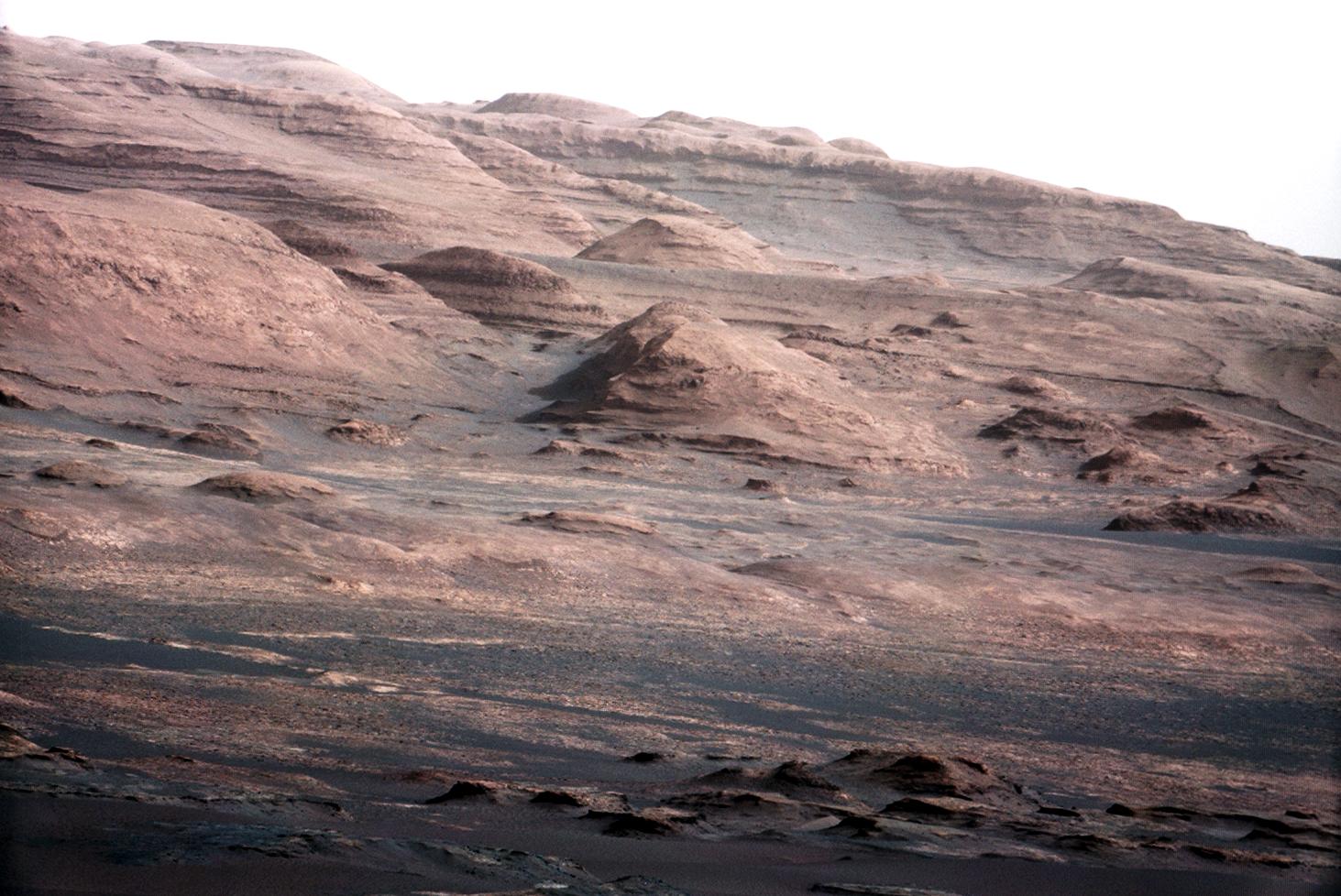
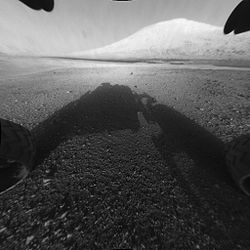
 The rover Curiosity landed on August 6, 2012, near the base of Aeolis Mons. | |
| Location | Gale crater on Mars |
|---|---|
| Coordinates | 5°05′S 137°51′E / 5.08°S 137.85°E |
| Peak | Aeolis Mons – 5.5 km (3.4 mi) 18,045 ft (5,500 m)[1] |
| Discoverer | NASA in the 1970s |
| Eponym | Aeolis Mons – Aeolis albedo feature Mount Sharp – Robert P. Sharp (1911–2004) |
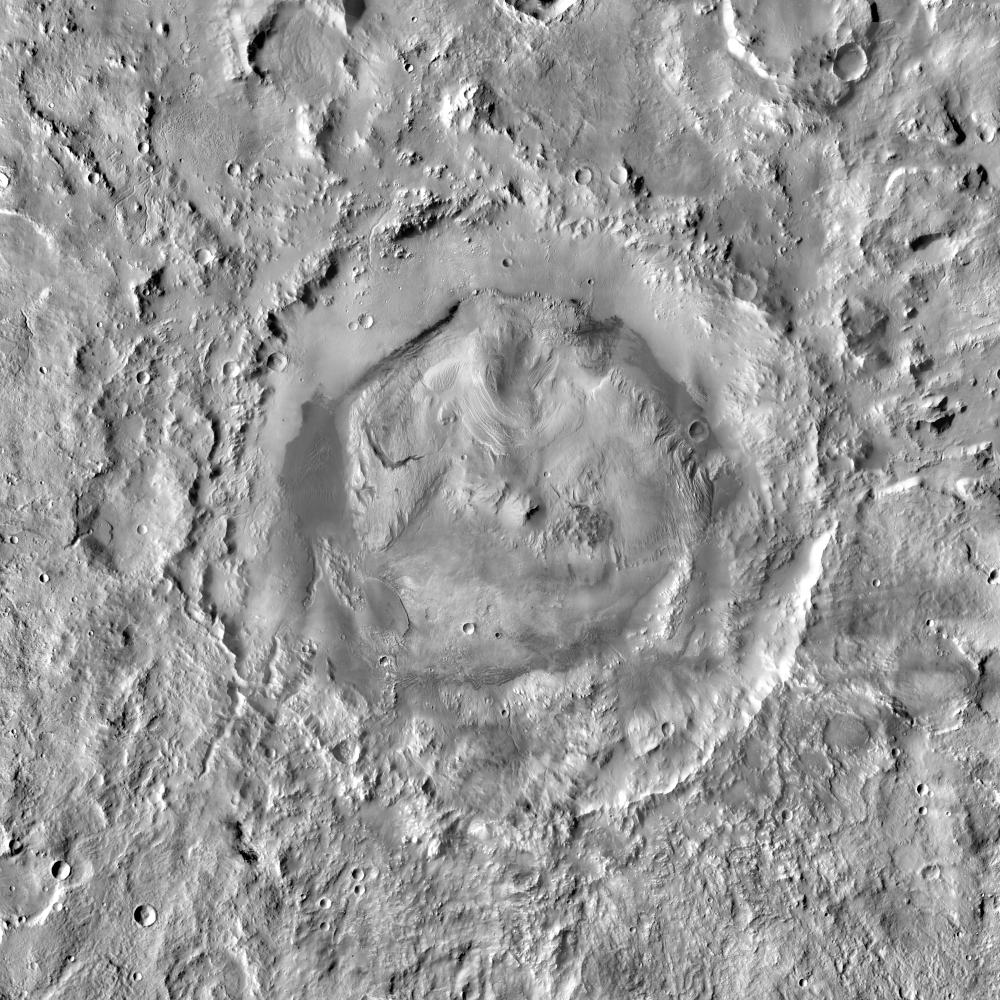
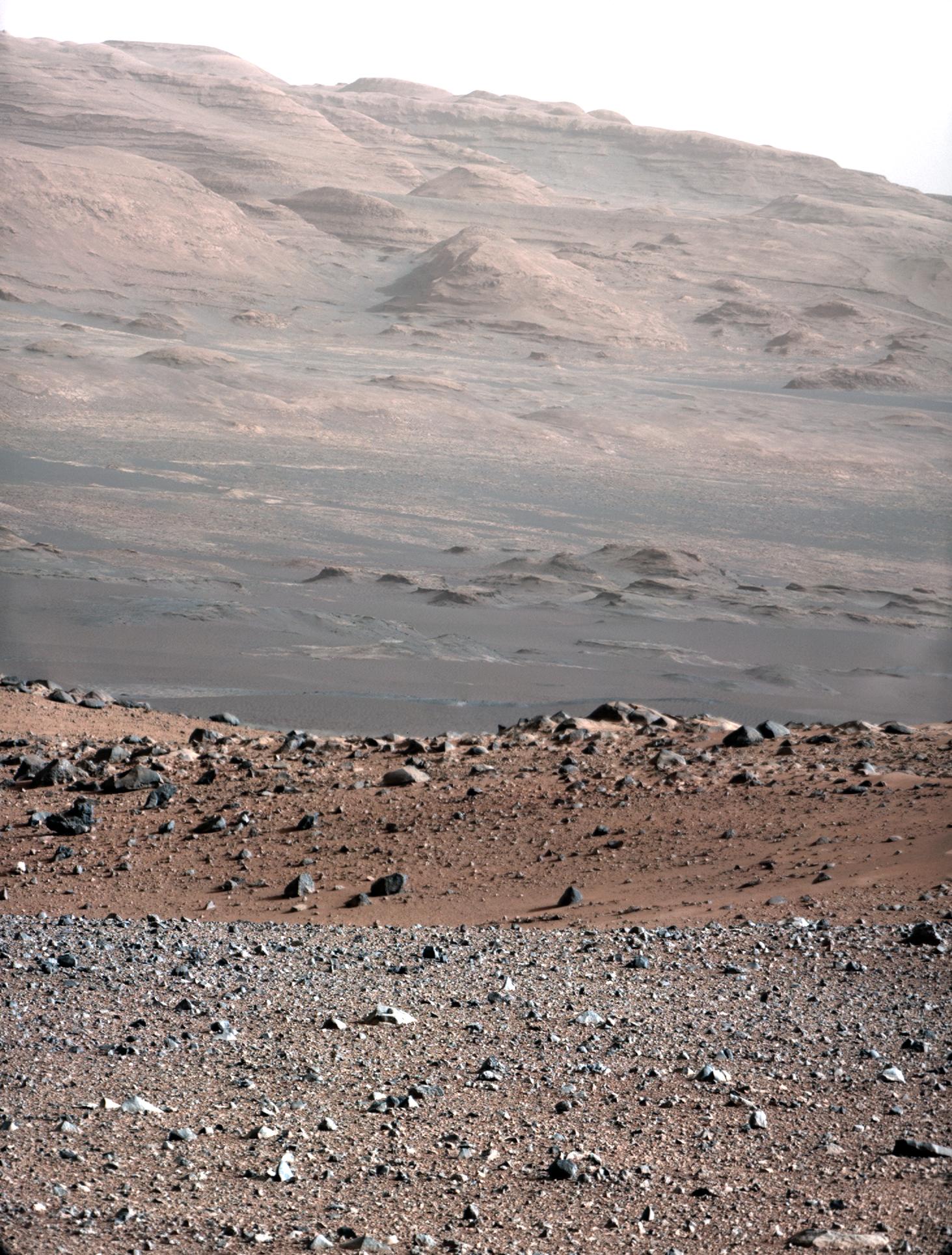
Mount Sharp, officially Aeolis Mons (/ˈiːəlɪs mɒnz/), is a mountain on Mars. It forms the central peak within Gale crater and is located around 5°05′S 137°51′E / 5.08°S 137.85°E, rising 5.5 km (18,000 ft) high from the valley floor. Its ID in the United States Geological Survey's Gazetteer of Planetary Nomenclature is 15000.[2]
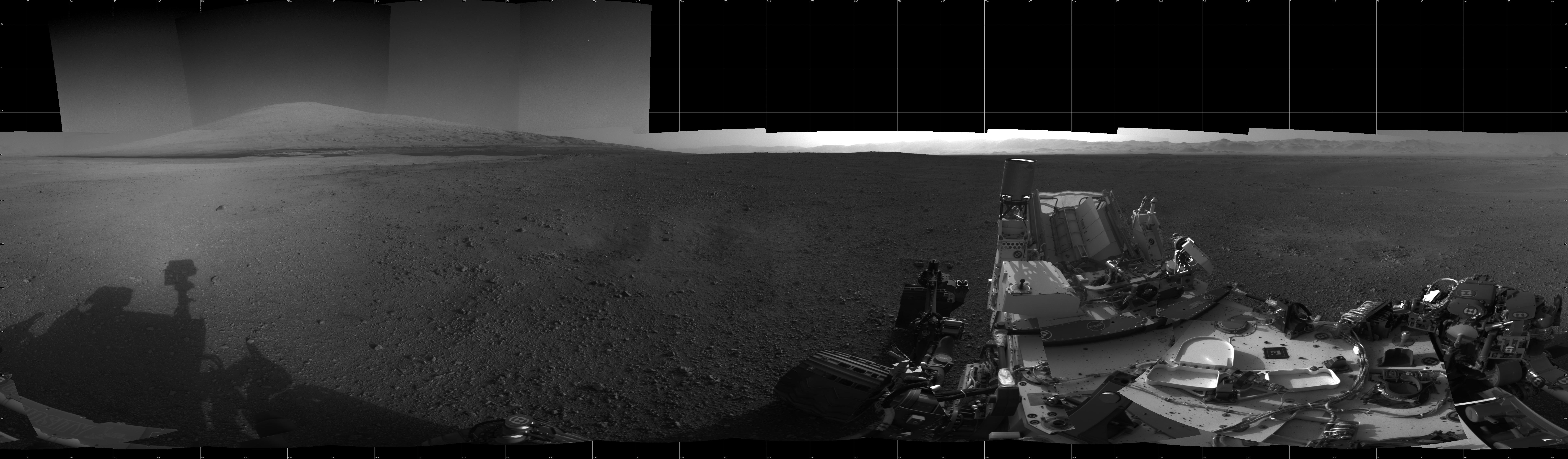
On August 6, 2012, Curiosity (the Mars Science Laboratory rover) landed in "Yellowknife" Quad 51[3][4][5][6] of Aeolis Palus,[7] next to the mountain. NASA named the landing site Bradbury Landing on August 22, 2012.[8] Aeolis Mons is a primary goal for scientific study.[9] On June 5, 2013, NASA announced that Curiosity would begin an 8 km (5.0 mi) journey from the Glenelg area to the base of Aeolis Mons. On November 13, 2013, NASA announced that an entryway the rover would traverse on its way to Aeolis Mons was to be named "Murray Buttes", in honor of planetary scientist Bruce C. Murray (1931–2013).[10] The trip was expected to take about a year and would include stops along the way to study the local terrain.[11][12][13]
On September 11, 2014, NASA announced that Curiosity had reached Aeolis Mons, the rover mission's long-term prime destination.[14][15] Possible recurrent slope lineae, wet brine flows, were reported on Mount Sharp near Curiosity in 2015.[16] In June 2017, NASA reported that an ancient striated lake had existed in Gale crater that could have been favorable for microbial life.[17][18][19]
Formation
[edit]The mountain appears to be an enormous mound of eroded sedimentary layers sitting on the central peak of Gale. It rises 5.5 km (18,000 ft) above the northern crater floor and 4.5 km (15,000 ft) above the southern crater floor, higher than the southern crater rim. The sediments may have been laid down over an interval of 2 billion years,[20] and may have once completely filled the crater. Some of the lower sediment layers may have originally been deposited on a lake bed,[20] while observations of possibly cross-bedded strata in the upper mound suggest aeolian processes.[21] However, this issue is debated,[22][23] and the origin of the lower layers remains unclear.[21] If katabatic wind deposition played the predominant role in the emplacement of the sediments, as suggested by reported 3 degree radial slopes of the mound's layers, erosion would have come into play largely to place an upper limit on the mound's growth.[24][25]
On December 8, 2014, a panel of NASA scientists discussed (archive 62:03) the latest observations of Curiosity about how water may have helped shape the landscape of Mars, including Aeolis Mons, and had a climate long ago that could have produced long-lasting lakes at many Martian locations.[26][27][28]
On October 8, 2015, NASA confirmed that lakes and streams existed in Gale crater 3.3 - 3.8 billion years ago delivering sediments to build up the lower layers of Mount Sharp.[29][30]
On February 1, 2019, NASA scientists reported that Curiosity had determined, for the first time, the density of Mount Sharp in Gale crater, thereby establishing a clearer understanding of how the mountain was formed.[31][32]
Size comparisons
[edit]
| Mountain | km high |
|---|---|
| Aeolis | 5.5 |
| Huygens | 5.5 |
| Denali | 5.5 (btp) |
| Blanc | 4.8 (asl) |
| Uhuru | 4.6 (btp) |
| Fuji | 3.8 (asl) |
| Zugspitze | 3 |
Aeolis Mons is 5.5 km (18,000 ft) high, about the same height as Mons Huygens, the tallest lunar mountain, and taller than Mons Hadley visited by Apollo 15. The tallest mountain known in the Solar System is in Rheasilvia crater on the asteroid Vesta, which contains a central mound that rises 22 km (14 mi; 72,000 ft) high; Olympus Mons on Mars is nearly the same height, at 21.9 km (13.6 mi; 72,000 ft) high.
In comparison, Mount Everest rises to 8.8 km (29,000 ft) altitude above sea level (asl), but is only 4.6 km (15,000 ft) (base-to-peak) (btp).[34] Africa's Mount Kilimanjaro is about 5.9 km (19,000 ft) altitude above sea level to the Uhuru peak;[35] also 4.6 km base-to-peak.[36] America's Denali, also known as Mount McKinley, has a base-to-peak of 5.5 km (18,000 ft).[37] The Franco-Italian Mont Blanc/Monte Bianco is 4.8 km (16,000 ft) in altitude above sea level,[38][39] Mount Fuji, which overlooks Tokyo, Japan, is about 3.8 km (12,000 ft) altitude. Compared to the Andes, Aeolis Mons would rank outside the hundred tallest peaks, being roughly the same height as Argentina's Cerro Pajonal; the peak is higher than any above sea level in Oceania, but base-to peak it is considerably shorter than Hawaii's Mauna Kea and its neighbors.
Name
[edit]Discovered in the 1970s,[citation needed] the mountain remained unnamed for several decades. When Gale crater became a candidate landing site, the mountain was given various labels e.g. in 2010 a NASA photo caption called it "Gale crater mound".[40] In March 2012, NASA unofficially named it "Mount Sharp", after American geologist Robert P. Sharp.[1][41]

Since 1919 the International Astronomical Union (IAU) has been the official body responsible for planetary nomenclature. Under its long-established rules for naming features on Mars, mountains are named after the classical albedo feature in which they are located, not after people. In May 2012 the IAU officially named the mountain Aeolis Mons after the Aeolis albedo feature.[42] It also gave the name Aeolis Palus to the plain located on the crater floor between the northern wall of Gale and the northern foothills of the mountain.[1][43][44][45] The IAU's choice of name is supported by the United States Geological Survey.[44] Martian craters are named after deceased scientists, so in recognition of NASA and Sharp, at the same time the IAU named "Robert Sharp", a large crater (150 km (93 mi) diameter) located about 260 km (160 mi) west of Gale.[46]
NASA and the European Space Agency[47] continue to refer to the mountain as "Mount Sharp" in press conferences and press releases. This is similar to their use of other informal names, such as the Columbia Hills near one of the Mars Exploration Rover landing sites.
In August 2012, the magazine Sky & Telescope ran an article explaining the rationale of the two names and held an informal poll to determine which one was preferred by their readers. Over 2700 people voted, with Aeolis Mons winning by 57% to Mount Sharp's 43%.[41]
Spacecraft exploration
[edit]

On December 16, 2014, NASA reported detecting, based on measurements by the Curiosity rover, an unusual increase, then decrease, in the amounts of methane in the atmosphere of the planet Mars; as well as, detecting Martian organic chemicals in powder drilled from a rock by the rover. Also, based on deuterium to hydrogen ratio studies, much of the water at Gale Crater on Mars was found to have been lost during ancient times, before the lakebed in the crater was formed; afterwards, large amounts of water continued to be lost.[48][49][50]
On June 1, 2017, NASA reported that the Curiosity rover provided evidence of an ancient lake in Gale crater on Mars that could have been favorable for microbial life; the ancient lake was stratified, with shallows rich in oxidants and depths poor in oxidants; and, the ancient lake provided many different types of microbe-friendly environments at the same time. NASA further reported that the Curiosity rover will continue to explore higher and younger layers of Mount Sharp in order to determine how the lake environment in ancient times on Mars became the drier environment in more modern times.[17][18][19]
On August 5, 2017, NASA celebrated the fifth anniversary of the Curiosity landing, and related exploratory accomplishments, on the planet Mars.[51][52] (Videos: Curiosity's First Five Years (02:07); Curiosity's POV: Five Years Driving (05:49); Curiosity's Discoveries About Gale Crater (02:54))
On April 11, 2019, NASA announced that Curiosity had drilled into, and closely studied, a "clay-bearing unit" which, according to the rover Project Manager, is a "major milestone" in Curiosity's journey up Mount Sharp.[53]

In January 2023, Curiosity viewed and studied the "Cacao" meteorite.

In August 2023, Curiosity explored the upper Gediz Vallis Ridge.[54][55] A panoramic view of the ridge is here, and a 3D rendered view is here.

Curiosity mission
[edit]| Curiosity at Mount Sharp |
|---|

Self-portrait of Curiosity at the Mojave site (January 31, 2015).
|
As of November 1, 2025, Curiosity has been on the planet Mars for 4706 sols (4834 total days) since landing on August 6, 2012. Since September 11, 2014, Curiosity has been exploring the slopes of Mount Sharp,[14][15] where more information about the history of Mars is expected to be found.[56] As of January 26, 2021, the rover has traveled over 24.15 km (15.01 mi) and climbed over 327 m (1,073 ft) in elevation[57][58][59] to, and around, the mountain base since landing at "Bradbury Landing" in August 2012.[57][58]

(February 18, 2014/Sol 547).

(March 3, 2020/Sol 2692).


Gallery
[edit]Mount Sharp - related Images
|
|---|
|


!["Murray Buttes" knobs - Aeolis Mons slopes (November 13, 2013).[10]](https://en.wikipedia.org/wiki/File:PIA17587-MarsCuriosityRover-MurrayButtes-20131113.jpg)




![Curiosity drilled into a "clay-bearing unit".[53] (April 11, 2019)](https://en.wikipedia.org/wiki/File:PIA23138-MarsCuriosityRover-Drills-ClayBearingUnit-20190406.gif)


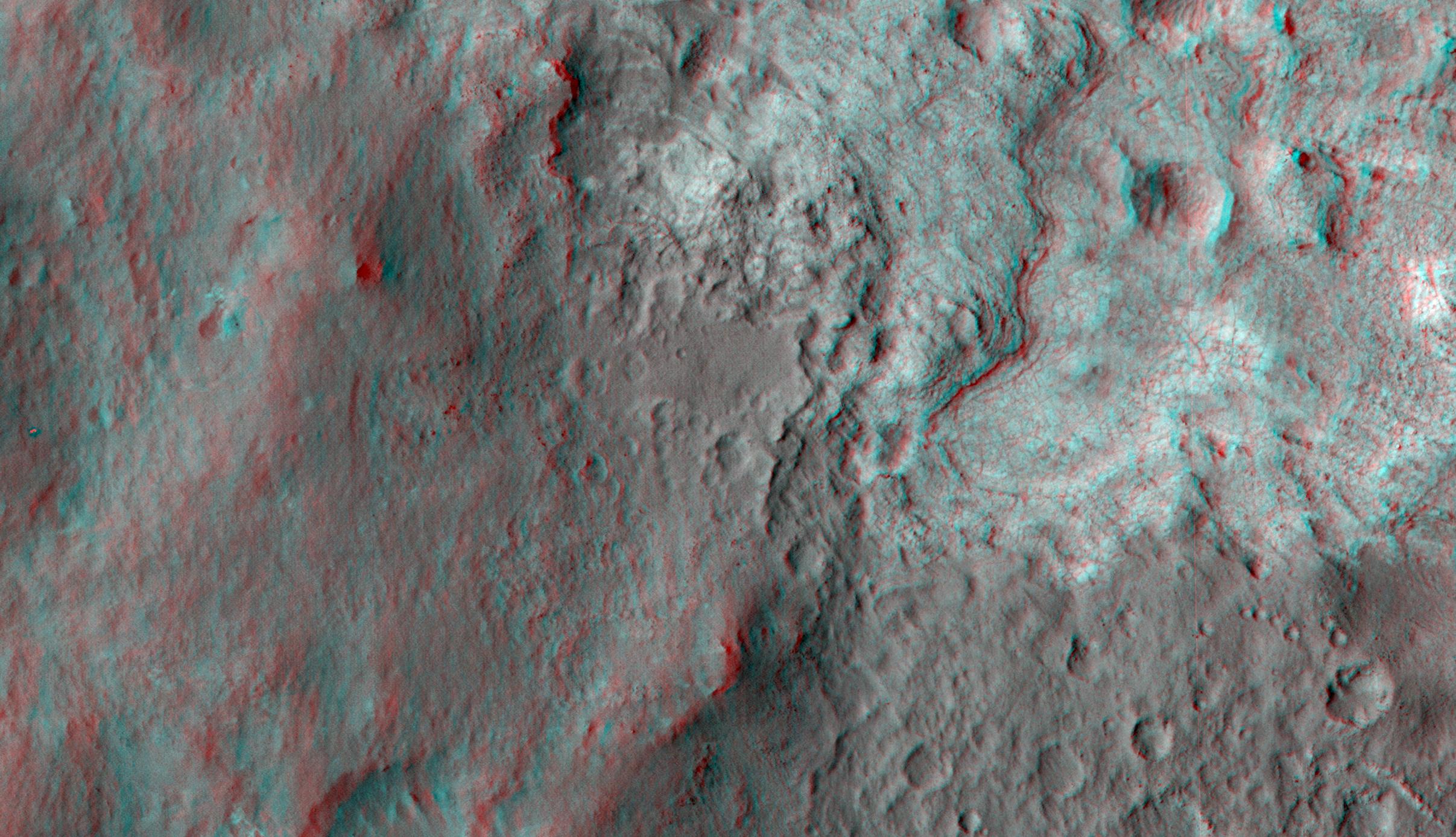
![MSL debris field viewed by HiRISE on August 17, 2012 - parachute is 615 m (2,018 ft) from Curiosity.[60] (3-D: rover & parachute)](https://en.wikipedia.org/wiki/File:PIA15696-HiRISE-MSL-Sol11_2_-br2.jpg)


See also
[edit]- Aeolis quadrangle#Gale Crater – One of a series of 30 quadrangle maps of Mars
- Composition of Mars – Branch of the geology of Mars
- Geology of Mars – Scientific study of the surface, crust, and interior of the planet Mars
- List of craters on Mars
- List of mountains on Mars – Named mountains of Mars
- List of rocks on Mars – Alphabetical list of named rocks and meteorites found on Mars
- List of tallest mountains in the Solar System
References
[edit]- ^ a b c ""Mount Sharp" on Mars Compared to Three Big Mountains on Earth". NASA. March 27, 2012. Retrieved March 31, 2012.
- ^ Aeolis Mons
- ^ NASA Staff (August 10, 2012). "Curiosity's Quad – IMAGE". NASA. Retrieved August 11, 2012.
- ^ Agle, DC; Webster, Guy; Brown, Dwayne (August 9, 2012). "NASA's Curiosity Beams Back a Color 360 of Gale Crate". NASA. Retrieved August 11, 2012.
- ^ Amos, Jonathan (August 9, 2012). "Mars rover makes first colour panorama". BBC News. Retrieved August 9, 2012.
- ^ Halvorson, Todd (August 9, 2012). "Quad 51: Name of Mars base evokes rich parallels on Earth". USA Today. Retrieved August 12, 2012.
- ^ NASA Staff (August 6, 2012). "NASA Lands Car-Size Rover Beside Martian Mountain". NASA. Archived from the original on August 14, 2012. Retrieved August 6, 2012.
- ^ Brown, Dwayne; Cole, Steve; Webster, Guy; Agle, D.C. (August 22, 2012). "NASA Mars Rover Begins Driving at Bradbury Landing". NASA. Retrieved August 22, 2012.
- ^ NASA Staff (August 6, 2012). "NASA Lands Car-Size Rover Beside Martian Mountain". NASA/JPL. Archived from the original on August 14, 2012. Retrieved August 7, 2012.
- ^ a b Webster, Guy; Brown, Dwayne (November 13, 2013). "Mars Rover Teams Dub Sites In Memory of Bruce Murray". NASA. Retrieved November 14, 2013.
- ^ "From 'Glenelg' to Mount Sharp". NASA. June 5, 2013. Retrieved June 6, 2013.
- ^ Chang, Alicia (June 5, 2013). "Curiosity rover to head toward Mars mountain soon". AP News. Retrieved June 7, 2013.
- ^ Chang, Kenneth (June 7, 2013). "Martian Rock Another Clue to a Once Water-Rich Planet". New York Times. Retrieved June 7, 2013.
- ^ a b c Webster, Guy; Agle, DC; Brown, Dwayne (September 11, 2014). "NASA's Mars Curiosity Rover Arrives at Martian Mountain". NASA. Retrieved September 10, 2014.
- ^ a b c Chang, Kenneth (September 11, 2014). "After a Two-Year Trek, NASA's Mars Rover Reaches Its Mountain Lab". New York Times. Retrieved September 12, 2014.
- ^ Chang, Kenneth (October 5, 2015). "Mars Is Pretty Clean. Her Job at NASA Is to Keep It That Way". New York Times. Retrieved October 6, 2015.
- ^ a b Webster, Guy; Mullane, Laura; Cantillo, Laurie; Brown, Dwayne (May 31, 2017). "High-Silica 'Halos' Shed Light on Wet Ancient Mars". NASA. Retrieved June 1, 2017.
- ^ a b Webster, Guy; Filiano, Gregory; Perkins, Robert; Cantillo, Laurie; Brown, Dwayne (June 1, 2017). "Curiosity Peels Back Layers on Ancient Martian Lake". NASA. Retrieved June 1, 2017.
- ^ a b Hurowitz, J.A.; et al. (June 2, 2017). "Redox stratification of an ancient lake in Gale crater, Mars". Science. 356 (6341) eaah6849. Bibcode:2017Sci...356.6849H. doi:10.1126/science.aah6849. hdl:10044/1/53715. PMID 28572336.
- ^ a b "Gale Crater's History Book". Arizona State University. Retrieved December 7, 2012.
- ^ a b Anderson, R. B.; Bell III, J. F. (2010). "Geologic mapping and characterization of Gale Crater and implications for its potential as a Mars Science Laboratory landing site". International Journal of Mars Science and Exploration. 5: 76–128. Bibcode:2010IJMSE...5...76A. doi:10.1555/mars.2010.0004.
- ^ Cabrol, N. A.; et al. (1999). "Hydrogeologic evolution of Gale Crater and its relevance in the exobiological exploration of Mars" (PDF). Icarus. 139 (2): 235–245. Bibcode:1999Icar..139..235C. doi:10.1006/icar.1999.6099. Archived from the original (PDF) on October 29, 2013.
- ^ Irwin, R. P.; Howard, A. D.; Craddock, R. A.; Moore, J. M. (2005). "An intense terminal epoch of widespread fluvial activity on early Mars: 2. Increased runoff and paleolake development". Journal of Geophysical Research. 110 (E12): E12S15. Bibcode:2005JGRE..11012S15I. doi:10.1029/2005JE002460.
- ^ Wall, M. (May 6, 2013). "Bizarre Mars Mountain Possibly Built by Wind, Not Water". Space.com. Retrieved May 13, 2013.
- ^ Kite, E. S.; Lewis, K. W.; Lamb, M. P.; Newman, C. E.; Richardson, M. I. (2013). "Growth and form of the mound in Gale Crater, Mars: Slope wind enhanced erosion and transport". Geology. 41 (5): 543–546. arXiv:1205.6840. Bibcode:2013Geo....41..543K. doi:10.1130/G33909.1. ISSN 0091-7613. S2CID 119249853.
- ^ Brown, Dwayne; Webster, Guy (December 8, 2014). "Release 14-326 – NASA's Curiosity Rover Finds Clues to How Water Helped Shape Martian Landscape". NASA. Retrieved December 8, 2014.
- ^ Kaufmann, Marc (December 8, 2014). "(Stronger) Signs of Life on Mars". New York Times. Retrieved December 8, 2014.
- ^ Chang, Kenneth (December 8, 2014). "Curiosity Rover's Quest for Clues on Mars". New York Times. Retrieved December 9, 2014.
- ^ Clavin, Whitney (October 8, 2015). "NASA's Curiosity Rover Team Confirms Ancient Lakes on Mars". NASA. Retrieved October 9, 2015.
- ^ Grotzinger, J.P.; et al. (October 9, 2015). "Deposition, exhumation, and paleoclimate of an ancient lake deposit, Gale crater, Mars". Science. 350 (6257) aac7575. Bibcode:2015Sci...350.7575G. doi:10.1126/science.aac7575. PMID 26450214. S2CID 586848.
- ^ Chang, Kenneth (January 31, 2019). "How NASA's Curiosity Rover Weighed a Mountain on Mars - With a bit of technical improvisation, scientists worked out that the bedrock of Mount Sharp appeared to be less dense than had been expected". The New York Times. Retrieved February 1, 2019.
- ^ Lewis, Kevin W. (February 1, 2019). "A surface gravity traverse on Mars indicates low bedrock density at Gale crater". Science. 363 (6426): 535–537. Bibcode:2019Sci...363..535L. doi:10.1126/science.aat0738. PMID 30705193. S2CID 59567599.
- ^ Fred W. Price (1988). The Moon observer's handbook. London: Cambridge University Press. ISBN 978-0-521-33500-3.
- ^ Mount Everest (1:50,000 scale map), prepared under the direction of Bradford Washburn for the Boston Museum of Science, the Swiss Foundation for Alpine Research, and the National Geographic Society, 1991, ISBN 3-85515-105-9
- ^ "Kilimajaro Guide—Kilimanjaro 2010 Precise Height Measurement Expedition". Retrieved May 16, 2009.
- ^ "S. Green – Kilimanjaro: Highest Mountain in Africa – About.com". Archived from the original on November 9, 2012. Retrieved August 12, 2012.
- ^ Adam Helman, 2005. The Finest Peaks : Prominence and Other Mountain Measures, p. 9: "the base to peak rise of Mount McKinley is the largest of any mountain that lies entirely above sea level, some 18000 feet"
- ^ Sumitpostorg – Zugspitze
- ^ "Mont Blanc shrinks by 45cm in two years". Sydney Morning Herald. November 6, 2009.
- ^ NASA – Layers in Lower Formation of Gale Crater Mound
- ^ a b "Mount Sharp or Aeolis Mons?". Sky & Telescope. August 14, 2012. Archived from the original on March 28, 2013. Retrieved August 18, 2012.
- ^ "Planetary Names: Mons, montes: Aeolis Mons on Mars". Gazetteer of Planetary Nomenclature. International Astronomical Union. Retrieved May 30, 2018.
Approval Date: May 16, 2012. Origin: Classical albedo feature name
- ^ Space.com staff (March 29, 2012). "NASA's New Mars Rover Will Explore Towering "Mount Sharp"". Space.com. Retrieved March 30, 2012.
- ^ a b Blue, J. (May 16, 2012). "Three New Names Approved for Features on Mars". US Geological Survey. Archived from the original on July 28, 2012. Retrieved May 28, 2012.
- ^ Agle, D. C. (March 28, 2012). "'Mount Sharp' On Mars Links Geology's Past and Future". NASA. Retrieved March 31, 2012.
- ^ "Planetary Names: Crater, craters: Robert Sharp on Mars". Gazetteer of Planetary Nomenclature. International Astronomical Union. Retrieved May 30, 2018.
Approval Date: May 16, 2012. Origin: Robert Phillip; American geologist (1911-2004)
- ^ ESA – Mars Express marks the spot for Curiosity landing
- ^ Webster, Guy; Neal-Jones, Nancy; Brown, Dwayne (December 16, 2014). "NASA Rover Finds Active and Ancient Organic Chemistry on Mars". NASA. Retrieved December 16, 2014.
- ^ Chang, Kenneth (December 16, 2014). "'A Great Moment': Rover Finds Clue That Mars May Harbor Life". New York Times. Retrieved December 16, 2014.
- ^ Mahaffy, P.R.; et al. (December 16, 2014). "Mars Atmosphere – The imprint of atmospheric evolution in the D/H of Hesperian clay minerals on Mars". Science. 347 (6220): 412–414. Bibcode:2015Sci...347..412M. doi:10.1126/science.1260291. PMID 25515119. S2CID 37075396.
- ^ Webster, Guy; Cantillo, Laurie; Brown, Dwayne (August 2, 2017). "Five Years Ago and 154 Million Miles Away: Touchdown!". NASA. Retrieved August 8, 2017.
- ^ Wall, Mike (August 5, 2017). "After 5 Years on Mars, NASA's Curiosity Rover Is Still Making Big Discoveries". Space.com. Retrieved August 8, 2017.
- ^ a b Good, Andrew (April 11, 2019). "Curiosity Tastes First Sample in 'Clay-Bearing Unit'". NASA. Retrieved April 12, 2019.
- ^ Deborah Padgett (August 21, 2023). "Sols 3923-3925: Approaching the Ridgetop – "Bermuda Triangle" Ahead!". NASA Mars Exploration. Retrieved September 16, 2023.
- ^ Emma Harris (August 29, 2023). "Sols 3930-3931: Wrapping up at the Ridge". NASA Mars Exploration. Retrieved September 16, 2023.
- ^ Webster, Guy (August 6, 2013). "Mars Curiosity Landing: Relive the Excitement". NASA. Archived from the original on March 5, 2016. Retrieved August 7, 2013.
- ^ a b Staff (January 19, 2017). "PIA17355: Curiosity's Progress on Route from 'Glenelg' to Mount Sharp". NASA. Retrieved January 22, 2017.
- ^ a b Staff (December 13, 2016). "PIA21145: Curiosity Rover's Martian Mission, Exaggerated Cross Section". NASA. Retrieved December 15, 2016.
- ^ Staff (January 30, 2018). "Wide-Angle Panorama from Ridge in Mars' Gale Crater". NASA. Retrieved January 31, 2018.
- ^ Mars Science Laboratory: Multimedia-Images
- ^ Chang, Kenneth (June 22, 2017). "High Above Mars, a NASA Orbiter Spies the Curiosity Rover". NASA. Retrieved June 23, 2017.
- ^ Staff (August 5, 2015). "PIA19803 - Image Annotations - Curiosity rover - Mars Science Laboratory - NASA's Journey to Mars" (PDF). NASA. Retrieved August 8, 2015.
Further reading
[edit]- Jürgen Blunck – Mars and its Satellites, A Detailed Commentary on the Nomenclature, 2nd edition. 1982.
External links
[edit]

- Google Mars scrollable map – centered on Aeolis Mons.
- Aeolis Mons – Curiosity Rover "StreetView" (Sol 2 – 08/08/2012) – NASA/JPL – 360° Panorama
- Aeolis Mons – Curiosity Rover Mission Summary – Video (02:37)
- Aeolis Mons – HiRise (South side of mountain)
- Aeolis Mons – "Mount Sharp" Oblique (19,663px × 1,452px)
- Aeolis Mons – Gale crater – Image/THEMIS VIS 18m/px Mosaic (Zoomable) (small)
- Aeolis Mons – Gale crater – image/HRSCview Archived August 7, 2017, at the Wayback Machine
- Aeolis Mons – HRSCview Archived August 5, 2016, at the Wayback Machine (oblique view looking east)
- Aeolis Mons – 7,703px × 2,253px black & white panorama
- Aeolis Mons – Color Panorama by Damien Bouic
- Images – PIA16105 PIA16104 Color view
- High-resolution overflight videos: #1; #2; #3; #4 (based on HiRISE data) of the lower slopes of Mt. Sharp by Seán Doran (see album for more)
- Video (04:32) – Evidence: Water "Vigorously" Flowed On Mars (September 2012) on YouTube
- Video (66:00) – Gale Crater History (May 26, 2015) on YouTube
- Video (02:54) – Gale Crater Guide (August 2, 2017) on YouTube
| General |  | |
|---|---|---|
| Instruments | ||
| Features | ||
| Sites | ||
| Rocks | ||
| Related | ||