Hubbry Logo
Spinning muleSpinning muleMain
Open search
Spinning mule
Community hub
Spinning mule
logo
8 pages, 0 posts
0 subscribers
Be the first to start a discussion here.
Spinning mule
Spinning mule
from Wikipedia

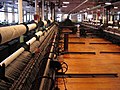
A working mule spinning machine at Quarry Bank Mill
The only surviving example of a spinning mule built by the inventor Samuel Crompton

The spinning mule is a machine used to spin cotton and other fibres. They were used extensively from the late 18th to the early 20th century in the mills of Lancashire and elsewhere. Mules were worked in pairs by a minder, with the help of two boys: the little piecer and the big or side piecer. The carriage carried up to 1,320 spindles and could be 150 feet (46 m) long, and would move forward and back a distance of 5 feet (1.5 m) four times a minute.[1]

It was invented between 1775 and 1779 by Samuel Crompton. The self-acting (automatic) mule was patented by Richard Roberts in 1825. At its peak, there were 5,000,000 mule spindles in Lancashire alone. Modern versions are still in production and are used to spin woollen yarns from noble fibres such as cashmere, ultra-fine merino and alpaca for the knitted textile market. [2][3]

The spinning mule spins textile fibres into yarn by an intermittent process.[4] In the draw stroke, the roving is pulled through rollers and twisted; on the return it is wrapped onto the spindle. Its rival, the throstle frame or ring frame, uses a continuous process, where the roving is drawn, twisted and wrapped in one action. The mule was the most common spinning machine from 1790 until about 1900 and was still used for fine yarns until the early 1980s. In 1890, a typical cotton mill would have over 60 mules, each with 1,320 spindles,[5] which would operate four times a minute for 56 hours a week.

History

[edit]

Before the 1770s, textile production was a cottage industry using flax and wool. Weaving was a family activity. The children and women would card the fibre – break up and clean the disorganised fluff into long bundles. The women would then spin these rough rovings into yarn wound onto a spindle. The male weaver would use a frame loom to weave this into cloth. This was then tentered in the sun to bleach it. The invention by John Kay of the flying shuttle made the loom twice as productive, causing the demand for cotton yarn to vastly exceed what traditional spinners could supply.

There were two types of spinning wheel: the simple wheel, which uses an intermittent process, and the more refined Saxony wheel, which drives a differential spindle and flyer with a heck (an apparatus that guides the thread to the reels) in a continuous process. These two wheels became the starting point of technological development. Businessmen such as Richard Arkwright employed inventors to find solutions that would increase the amount of yarn spun, then took out the relevant patents.

The spinning jenny allowed a group of eight spindles to be operated together. It mirrored the simple wheel; the rovings were clamped, and a frame moved forward stretching and thinning the roving. A wheel was rapidly turned as the frame was pushed back, and the spindles rotated, twisting the rovings into yarn and collecting it on the spindles. The spinning jenny was effective and could be operated by hand, but it produced weaker thread that could be used only for the weft part of the cloth. (Because the side-to-side weft does not have to be stretched on a loom in the way that the warp is, it can generally be less strong.)

The throstle and the later water frame pulled the rovings through a set of attenuating rollers. Spinning at differing speeds, these pulled the thread continuously while other parts twisted it as it wound onto the heavy spindles. This produced thread suitable for warp, but the multiple rollers required much more energy input and demanded that the device be driven by a water wheel. The early water frame, however, had only a single spindle. Combining ideas from these two system inspired the spinning mule.

The increased supply of muslin inspired developments in loom design such as Edmund Cartwright's power loom. Some spinners and handloom weavers opposed the perceived threat to their livelihood: there were frame-breaking riots and, in 1811–13, the Luddite riots. The preparatory and associated tasks allowed many children to be employed until this was regulated.

Development over the next century and a half led to an automatic mule and to finer and stronger yarn. The ring frame, originating in New England in the 1820s, was little used in Lancashire until the 1890s. It required more energy and could not produce the finest counts.[6]

The first mule

[edit]
An early spinning mule: showing the gearing in the headstock

Samuel Crompton invented the spinning mule in 1779, so called because it is a hybrid of Arkwright's water frame and James Hargreaves's spinning jenny in the same way that a mule is the product of crossbreeding a female horse with a male donkey. The spinning mule has a fixed frame with a creel of cylindrical bobbins to hold the roving, connected through the headstock to a parallel carriage with the spindles. On the outward motion, the rovings are paid out through attenuating rollers and twisted. On the return, the roving is clamped and the spindles are reversed to take up the newly spun thread.

Crompton built his mule from wood. Although he used Hargreaves' ideas of spinning multiple threads and of attenuating the roving with rollers, it was he who put the spindles on the carriage and fixed a creel of roving bobbins on the frame. Both the rollers and the outward motion of the carriage remove irregularities from the rove before it is wound on the spindle. When Arkwright's patents expired, the mule was developed by several manufacturers.[7] Crompton's first mule had 48 spindles and could produce 1 pound (0.45 kg) of 60s thread a day. This demanded a spindle speed of 1,700  rpm, and a power input of 116 horsepower (47 W).[8]

The mule produced strong, thin yarn, suitable for any kind of textile, warp or weft. It was first used to spin cotton, then other fibres.

Samuel Crompton could not afford to patent his invention. He sold the rights to David Dale and returned to weaving. Dale patented the mule and profited from it.

Improvements

[edit]

Crompton's machine was largely built of wood, using bands and pulleys for the driving motions. After his machine was public, he had little to do with its development. Henry Stones, a mechanic from Horwich, constructed a mule using toothed gearing and, importantly, metal rollers.[7] Baker of Bury worked on drums,[9] and Hargreaves used parallel scrolling to achieve smoother acceleration and deceleration.[10]

In 1790, William Kelly of Glasgow used a new method to assist the draw stroke.[10] First animals, and then water, was used as the prime mover. Wright of Manchester moved the headstock to the centre of the machine, allowing twice as many spindles; a squaring band was added to ensure the spindles came out in a straight line.[11] He was in conversation with John Kennedy about the possibility of a self-acting mule. Kennedy, a partner in McConnell & Kennedy machine makers in Ancoats, was concerned with building ever larger mules. McConnell & Kennedy ventured into spinning when they were left with two unpaid-for mules;[12] their firm prospered and eventually merged into the Fine Spinners & Doublers Association. In 1793, John Kennedy addressed the problem of fine counts. With these counts, the spindles on the return traverse needed to rotate faster than on the outward traverse. He attached gears and a clutch to implement this motion.[13]

William Eaton, in 1818, improved the winding of the thread by using two faller wires and performing a backing off at the end of the outward traverse.[14] All these mules had been worked by the strength of the operatives. The next improvement was a fully automatic mule.

Roberts' self-acting mule

[edit]
A Roberts self-acting spinning mule: 1835 diagram showing the gearing in the headstock

Richard Roberts took out his first patent in 1825 and a second in 1830. The task he had set himself was to design a self-actor, a self-acting or automatic spinning mule. Roberts is also known for the Roberts Loom, which was widely adopted because of its reliability. The mule in 1820 still needed manual assistance to spin a consistent thread; a self-acting mule would need:

  • A reversing mechanism that would unwind a spiral of yarn on the top of each spindle, before commencing the winding of a new stretch
  • A faller wire that would ensure the yarn was wound into a predefined form such as a cop
  • An appliance to vary the speed of revolution of the spindle, in accordance with the diameter of thread on that spindle

A counter faller under the thread was made to rise to take in the slack caused by backing off. This could be used with the top faller wire to guide the yarn to the correct place on the cop. These were controlled by levers and cams and an inclined plane called the shaper. The spindle speed was controlled by a drum and weighted ropes, as the headstock moved the ropes twisted the drum, which using a tooth wheel turned the spindles. None of this would have been possible using the technology of Crompton's time, fifty years earlier.[15]

With the invention of the self actor, the hand-operated mule was increasingly referred to as a mule-jenny.[16]

Oldham counts

[edit]

Oldham counts refers to the medium thickness cotton that was used for general purpose cloth. Roberts did not profit from his self-acting spinning mule, but on the expiry of the patent other firms took forward the development, and the mule was adapted for the counts it spun. Initially Roberts' self-actor was used for coarse counts (Oldham Counts), but the mule-jenny continued to be used for the very finest counts (Bolton counts) until the 1890s and beyond.[16]

Bolton counts

[edit]

Bolton specialised in fine count cotton, and its mules ran more slowly to put in the extra twist. The mule jenny allowed for this gentler action but in the 20th century additional mechanisms were added to make the motion more gentle, leading to mules that used two or even three driving speeds. Fine counts needed a softer action on the winding, and relied on manual adjustment to wind the chase or top of the perfect cop.[17]

Woollen mules

[edit]

Spinning wool is a different process as the variable lengths of the individual fibres means that they are unsuitable for attenuation by roller drafting. For this reason, woolen fibres are carded using condenser cards which rub the carded fibres together rather than drafting them. They are then spun on mule-type machines which have no roller drafting, but create the draft by the spindles receding from the delivery rollers whilst that latter, having paid out a short length of roving, are held stationary. Such mules are often complex involving multiple spindles speeds, receding motions, etc. to ensure optimum treatment of the yarn.[18]

Condenser spinning

[edit]
A pair of condenser spinning mules. These have 748 spindles and are believed to be the longest surviving cotton mules. They worked at Field Mill Ramsbottom, Lancashire until that mill closed in 1988 at which time they were the last such machines at work in the cotton industry probably in the world. These mules were built by Asa Lees and Company Ltd, of Oldham in 1906.

Condenser spinning was developed to enable the short fibres produced as waste from the combing of fine cottons, to be spun into a soft, coarse yarns suitable for sheeting, blankets etc. Only approximately 2% of the mule spindles in Lancashire were condenser spindles, but many more condenser mules survive today as these were the last spindles regularly at work., and the mules are similar.[19] Helmshore Mills was a cotton waste mule spinning mill.

Current usage

[edit]

Mules are still in use for spinning woolen and alpaca, and being produced across the world. In Italy for example by Bigagli[2] and Cormatex.[3]

Operation of a mule

[edit]
Taylor, Lang & Co selfactor mule headstock
Running spinning mule, built 1897, Mueller Cloth Mill

Mule spindles rest on a carriage that travels on a track a distance of 60 inches (1.5 m), while drawing out and spinning the yarn. On the return trip, known as putting up,[20] as the carriage moves back to its original position, the newly spun yarn is wound onto the spindle in the form of a cone-shaped cop. As the mule spindle travels on its carriage, the roving which it spins is fed to it through rollers geared to revolve at different speeds to draw out the yarn.

Marsden in 1885 described the processes of setting up and operating a mule. Here is his description, edited slightly.

The creel holds bobbins containing rovings. The rovings are passed through small guide-wires, and between the three pairs of drawing-rollers.

  • The first pair takes hold of the roving, to draw the roving or sliver from the bobbin, and deliver it to the next pair.
  • The motion of the middle pair is slightly quicker than the first, but only sufficiently so to keep the roving uniformly tense
  • The front pair, running much more quickly, draws out (attenuates) the roving so it is equal throughout.

Connection is then established between the attenuated rovings and the spindles. When the latter are bare, as in a new mule, the spindle-driving motion is put into gear, and the attendants wind upon each spindle a short length of yarn from a cop held in the hand. The drawing-roller motion is placed in gear, and the rollers soon present lengths of attenuated roving. These are attached to the threads on the spindles, by simply placing the threads in contact with the un-twisted roving. The different parts of the machine are next simultaneously started, when the whole works in harmony together.

The back rollers pull the sliver from the bobbins, and passing it to the succeeding pairs, whose differential speeds attenuate it to the required degree of fineness. As it is delivered in front, the spindles, revolving at a rate of 6,000–9,000 rpm twist the hitherto loose fibres together, thus forming a thread.

Whilst this is going on, the spindle carriage is being drawn away from the rollers, at a pace very slightly exceeding the rate at which the roving is coming forth. This is called the gain of the carriage, its purpose being to eliminate all irregularities in the fineness of the thread. Should a thick place in the roving come through the rollers, it would resist the efforts of the spindle to twist it; and, if passed in this condition, it would seriously deteriorate the quality of the yarn, and impede subsequent operations. As, however, the twist, spreading itself over the level thread, gives firmness to this portion, the thick and untwisted part yields to the draught of the spindle, and, as it approaches the tenuity of the remainder, it receives the twist it had hitherto refused to take. The carriage, which is borne upon wheels, continues its outward progress, until it reaches the extremity of its traverse, which is 63 inches (160 cm) from the roller beam. The revolution of the spindles cease, the drawing rollers stop.

Backing-off commences. This process is the unwinding of the several turns of the yarn, extending from the top of the cop in process of formation to the summit of the spindle. As this proceeds, the faller- wire, which is placed over and guides the threads upon the cop, is depressed; the counter-faller at the same time rising, the slack unwound from the spindles is taken up, and the threads are prevented from running into snarls. Backing-off is completed.

The carriage commences to run inwards; that is, towards the rollerbeam. This is called putting up. The spindles wind on the yarn at a uniform rate. The speed of revolution of the spindle must vary, as the faller is guiding the thread upon the larger or smaller diameter of the cone of the cop. Immediately the winding is finished, the depressed faller rises, the counter-faller is put down.

These movements are repeated until the cops on each spindle are perfectly formed: the set is completed. A stop-motion paralyses every action of the machine, rendering it necessary to doff or strip the spindles, and to commence anew.

Doffing is performed by the piercers thrutching, that is raising, the cops partially up the spindles, whilst the carriage is out. The minder then depressing the faller, so far as to guide the threads upon the bare spindle below. A few turns are wound onto the spindle, to fix the threads to the bare spindles for a new set. The cops are removed and collected into cans or baskets, and subsequently delivered to the warehouse. The remainder of the "draw" or "stretch," as the length of spun yarn is called when the carriage is out, is then wound upon the spindles as the carriage is run up to the roller beam. Work then commences anew. [21][22] The doffing took only a few minutes, the piecers would run the length of the mule gate thrutching five spindles a time, and the doffing involved lifting four cops from the spindles with the right hand and piling them on the left forearm and hand. To get a firm cop bottom, the minder would whip the first few layers of yarn. After the first few draws the minder would stop the mule at the start of an inward run and take it in slowly depressing and releasing the faller wire several times. Alternatively, a starch paste could be skilfully applied to the first few layers of yarn by the piecers – and later a small paper tube was dropped over spindle – this slowed down the doffing operation and extra payment was negotiated by the minders.[23]

Duties of the operatives

[edit]

A pair of mules would be manned by a person called the minder and two boys called the side piecer and the little piecer. They worked barefoot in humid temperatures; the minder and the little piecer worked the minder half of the mule. The minder would make minor adjustments to his mules to the extent that each mule worked differently. They were specialists in spinning, and were answerable only to the gaffer and under-gaffer who were in charge of the floor and with it the quantity and quality of the yarn that was produced. Bobbins of rovings came from the carder in the blowing room delivered by a bobbin carrier who was part of the carder's staff, and yarn was hoisted down to the warehouse by the warehouseman's staff. Delineation of jobs was rigid and communication would be through the means of coloured slips of paper written on in indelible pencil.

Mule-spinning room

Creeling involved replacing the rovings bobbins in a section of the mule without stopping the mule. On very coarse counts a bobbin lasted two days but on fine count it could last for 3 weeks. To creel, the creeler stood behind the mule, placing new bobbins on the shelf above the creel. As the bobbin ran empty he would pick it off its skewer in the creel unreeling 30 cm or so of roving, and drop it into a skip. With his left hand, he would place on the new bobbin onto the skewer from above and with his right hand twist in the new roving into the tail of the last.[24]

Piecing involved repairing sporadic yarn breakages. At the rollers, the broken yarn would be caught on the underclearer (or fluker rod on Bolton mules), while at the spindle it would knot itself into a whorl on the spindle tip. If the break happened on the winding stroke the spindle might have to be stopped while the thread was found. The number of yarn breakages was dependent on the quality of the roving, and quality cotton led to fewer breakages. Typical 1,200 spindle mules of the 1920s would experience 5 to 6 breakages a minute. The two piecers would thus need to repair the thread within 15 to 20 seconds while the mule was in motion but once they had the thread it took under three seconds. The repair actually involved a slight rolling of the forefinger against the thumb.[25]

Doffing has already been described.

Cleaning was important and until a formal ritual had been devised it was a dangerous operation. The vibration in a mule threw a lot of short fibres (or fly) into the air. It tended to accumulate on the carriage behind the spindles and in the region of the drafting rollers. Piking the stick meant placing the hand though the yarnsheet, and unclipping two sticks of underclearer rollers from beneath the drafting rollers, drawing them through the 1+14-inch (3.2 cm) gap between two ends, stripping them of fly and replacing them on the next inward run. Cleaning the carriage top was far more dangerous. The minder would stop the mule on the outward run, and raise his hands above his head. The piecers would enter under the yarn sheet with a scavenger cloth on the carriage spindle rail and a brush on the roller beam, and run bent double the entire length of the mule, avoiding the rails and draw bands, and not letting themselves touch the yarn sheet. When they had finished they would run to agreed positions of safety where the minder could see both of them, and the minder would unclip the stang and start the mule. Before this ritual was devised, boys had been crushed. The mule was 130 feet (40 m) long, the minder's eyesight might not have been good, the air in the mill was clouded with fly and another minder's boys might have been mistaken for his. The ritual became encoded in law.[26]

Key components

[edit]
A mule jenny 1892
  • Drawing rollers
  • Faller and counter faller
  • Quadrant

Terminology

[edit]

Social and economic impact

[edit]
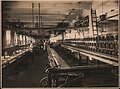
Mules operating in a cotton mill.

The spinning inventions were significant in enabling a great expansion to occur in the production of textiles, particularly cotton ones. Cotton and iron were leading sectors in the Industrial Revolution. Both industries underwent a great expansion at about the same time, which can be used to identify the start of the Industrial Revolution.

The 1790 mule was operated by brute force: the spinner drawing and pushing the frame while attending to each spindle. Home spinning was the occupation of women and girls, but the strength needed to operate a mule caused it to be the activity of men. Hand loom weaving, however, had been a man's occupation but in the mill it could and was done by girls and women. Spinners were the bare-foot aristocrats of the factory system.[27] It replaced decentralised cottage industries with centralised factory jobs, driving economic upheaval and urbanisation.

Mule spinners were the leaders in unionism within the cotton industry; the pressure to develop the self-actor or self-acting mule was partly to open the trade to women. It was in 1870 that the first national union was formed.

The wool industry was divided into woollen and worsted. It lagged behind cotton in adopting new technology. Worsted tended to adopt Arkwright water frames which could be operated by young girls, and woollen adopted the mule.[27]

Mule-spinners' cancer

[edit]

Circa 1900 there was a high incidence of scrotal cancer detected in former mule spinners. It was limited to cotton mule spinners and did not affect woollen or condenser mule spinners. The cause was attributed to the blend of vegetable and mineral oils used to lubricate the spindles. The spindles, when running, threw out a mist of oil at crotch height, that was captured by the clothing of anyone piecing an end. In the 1920s much attention was given to this problem. Mules had used this mixture since the 1880s, and cotton mules ran faster and hotter than the other mules, and needed more frequent oiling. The solution was to make it a statutory requirement to use only vegetable oil or white mineral oils, which were believed to be non-carcinogenic. By then cotton mules had been superseded by the ring frame and the industry was contracting, so it was never established whether these measures were effective.[28]

See also

[edit]

References

[edit]

Bibliography

[edit]
[edit]
Revisions and contributorsEdit on WikipediaRead on Wikipedia
from Grokipedia
The spinning mule is a multiple-spindle machine invented by in 1779 that combined the intermittent carriage draw of James Hargreaves's with the continuous roller drafting of Richard Arkwright's to spin fine, strong yarn. This hybrid design enabled the production of softer, higher-quality threads suitable for lightweight fabrics like muslins, surpassing the limitations of earlier devices that could only create coarser yarns. Initially hand-operated in domestic settings with fewer spindles, the mule was adapted for factories by the , incorporating steam power and scaling to hundreds of spindles per machine, which vastly multiplied output and supported the concentration of in . Crompton developed the device secretly in his attic to evade destruction by machine opponents, reflecting early tensions over technological displacement of labor. The spinning mule's efficiency fueled a fivefold increase in regional textile production, bolstering Britain's exports and the growth of mechanized factories during the , though it contributed to unemployment that sparked protests like Luddism. Despite its transformative role, Crompton patented neither the invention nor profited substantially, receiving only parliamentary compensation later in life while dying in relative poverty. Later refinements, such as Richard Roberts's self-acting mule in the 1820s, automated operations further, extending the machine's dominance in spinning until the .

Invention and Early Development

Samuel Crompton's Hybrid Design (1779)

, born on December 3, 1753, at Firwood Fold near , , was a self-taught mechanic who began spinning cotton yarn at age five to support his family following his father's death in 1758. Working primarily on 's , Crompton observed its production of fine but weak, uneven yarn unsuitable for warp threads, while 's yielded stronger but coarser results limited to weft. Motivated by the demand for high-quality requiring both fineness and strength, he pursued a hybrid machine over five years, funding his efforts partly as a violinist in theaters. By 1779, Crompton completed a in secrecy at Hall i' th' Wood, concealing it behind screens in a dedicated "conjuring room" to evade local curiosity, machine-breaking unrest, and potential infringement claims under Arkwright's patent. Lacking funds for patenting—estimated at £1,000—and wary of legal battles with the wealthy Arkwright, he filed no formal protection, allowing informal copying by manufacturers after they glimpsed the device and compensated him minimally with £60. The core innovation lay in an intermittent drafting and twisting mechanism synthesizing elements from prior inventions: rollers from the water frame for controlled attenuation of roving, paired with a sliding carriage bearing multiple spindles akin to the jenny for drawing out and imparting twist. In operation, the carriage extended outward as faller wires and differential-speed rollers drafted the roving, simultaneously twisting it around stationary spindles; on the return stroke, the roving clamped while spindles counter-rotated to wind the yarn, enabling continuous, strong, fine threads suitable for muslin weft. This hybrid addressed the jenny's lack of uniform drafting and the water frame's coarse output, producing yarn of superior quality on a machine with initially around 60 spindles.

Initial Challenges and Adoption

Despite lacking a , Samuel disclosed details of his spinning mule design around 1780 to address personal financial difficulties, enabling manufacturers to replicate the machine without compensating him. This led to widespread entrepreneurial copying, as firms secretly examined prototypes and produced unauthorized versions for commercial use. Early mules operated manually via a hand-cranked for spindle rotation and operator-controlled movement, permitting initial domestic and small-scale workshop deployment but constraining productivity due to the labor-intensive process. Transition to water power occurred in larger settings by the mid-1780s, powering the forward draw while the return remained manual, which limited mule lengths to about 20-30 yards and hindered further scaling until later modifications. These technical hurdles notwithstanding, adoption accelerated in Lancashire's mills, where the mule's capacity for finer, stronger yarns supplanted jennies for high-count threads. By 1812, an estimated 4 to 5 million mule spindles were operational across Britain, reflecting explosive proliferation driven by demand for superior quality. This regional concentration in facilitated production of delicate muslins, spurring export growth as British goods flooded markets, with output increasing fivefold in the late . Crompton's unpatented innovation thus catalyzed industrial expansion despite his personal economic marginalization, as parliamentary recognition came only later with a £5,000 grant in 1812.

Technical Improvements and Variations

Richard Roberts' Self-Acting Mule (1825)

Richard Roberts, an engineer based in , developed the self-acting spinning mule to address the inefficiencies of manual mules, where operators had to physically push the carriage back after the outward traverse. He patented the invention on March 20, 1825 (British Patent No. 5081), incorporating cams, , and a reversing mechanism to automate the and regulate tension through faller wires and drafting controls. This mechanization enabled unattended operation during the stretching and initial spinning phases, minimizing reliance on skilled manual intervention while replicating the precise control needed for fine production. The self-acting design supported higher spindle capacities, expanding from typical manual mule limits of 400 spindles to over 1,000 per machine by the late , with further increases to 1,300 or more in subsequent builds. Cycle times accelerated due to powered , yielding gains where a spinner's output reached approximately eight times that of manual mule operations through reduced and consistent drafting. These enhancements preserved the mule's hallmark quality—strong, fine, and twisted—for fibers, without compromising the hybrid drafting-roving process. Roberts refined the mechanism in a 1830 patent, solidifying its viability after early adoption hurdles. By the , self-acting mules dominated Lancashire's mills, supplanting manual variants as standard equipment and scaling to a peak of around 50 million spindles across the industry by the early 1900s. This shift underscored the invention's role in labor-efficient scaling, though operators still oversaw piecing and doffing.

Adaptations for Wool and Condenser Spinning

The was adapted for woollen spinning to accommodate shorter, bulkier fibers with inherent crimp, which differ from 's longer, straighter staple length, requiring modifications in drafting and twisting mechanisms to produce coarser, low-twist yarns suitable for woollen fabrics. mules typically operated at lower spindle speeds—often below the 15,000–26,000 rpm range used for —to prevent excessive breakage of crimped fibers, while incorporating wider roller gauges and adjusted traverses for bulkier slivers. These changes allowed the intermittent and twisting to handle wool's elasticity without uniform , yielding yarns with greater for applications like blankets. Condenser mules represented a specialized for spinning fibers, including low-grade or byproducts from , into coarse, yarns for utility fabrics such as towels or dusters. Developed in the late , these machines processed short-staple condenser slivers—loose, unparallelized masses of —through modified faller wires and slower spindle revolutions to minimize fiber damage and incorporate nep or content up to 50%, producing yarns in counts as low as to Ne. Unlike standard cotton mules, condenser versions emphasized blending vegetable matter or , extending the technology's utility in waste-recovery mills into the mid-20th century. Lubrication differences further distinguished wool adaptations, with woollen mules employing vegetable or animal-based oils (such as emulsions) rather than the mineral oils prevalent in spinning, which reduced contamination risks and correlated with markedly lower incidences of scrotal epithelioma among operatives. Empirical records indicate mule spinners' cancer was predominantly confined to mills, with sector cases rare before 1920, attributable to the non-carcinogenic properties of natural lubricants that did not penetrate or as aggressively as petroleum-derived alternatives under high-speed conditions. This causal factor, verified through occupational health cohorts, preserved operative health in -focused operations while maintaining mule efficiency for low-count yarns. These fiber-specific tweaks prolonged the spinning mule's relevance in woollen and condenser sectors beyond its decline in fine cotton production, sustaining use in specialized mills for blanket yarns and coarse blends until ring frames dominated finer synthetics post-1940s.

Regional Counts and Specifications

In , spinning mules were configured for "Oldham counts," medium-thickness yarns suited to general-purpose cloths, typically ranging from 20s to 40s Ne (English cotton count), where the machine's stretching mechanism effectively applied high twist to shorter-staple American upland s for durable, even output. These s optimized mule performance by balancing draft and twist insertion, yielding yarns with consistent strength for regional demands. Bolton mills, by contrast, adapted mules for finer "Bolton counts," often 60s to 100s Ne, leveraging precise carriage attenuation for high-twist yarns from longer-staple Sea Island or Egyptian cottons, which required minimal fiber slippage to achieve superior and uniformity in luxury fabrics. This regional specialization reflected empirical adjustments to local blends, with setups prioritizing delicacy over volume. Spindle gauges—the center-to-center distance between spindles—varied regionally to accommodate roving thickness, generally narrower (around 2.25 to 2.75 inches) in Oldham for coarser counts to manage bulkier inputs without overlap, and wider (up to 3 inches) in finer districts like Bolton to allow clear twist propagation. Draft ratios, empirically set at 1.2–1.5 in preparatory zones augmented by the mule's 4–6 fold stretch during outward carriage travel, were tuned to fiber characteristics, enabling reliable production in the 40s–100s Ne range where mules outperformed alternatives in yarn evenness and twist liveliness.

Principles of Operation

Core Mechanical Components

The core of the spinning mule lies in its , a fixed assembly featuring pairs of drafting rollers that initially grip and attenuate the incoming roving by applying controlled pressure and speed differentials, thereby establishing the foundational alignment and elongation prior to further . This connects via belts or gearing to the parallel movable , which supports the row of spindles—typically numbering 600 to 1,300 per machine—responsible for imparting twist to the drafted fibers and winding the resultant onto bobbins. Faller wires, mounted on a reciprocating frame atop the , consist of thin metal wires with clips that sequentially grip sections of the attenuated roving, enabling additional drafting through frictional drag as the extends, which spatially separates the fibers to achieve finer without breakage. The mechanical interdependence ensures that roller-induced drafting feeds directly into faller , with spindles then consolidating the structure via torsion, as misalignment in any component would disrupt uniform formation due to uneven tension propagation. Power transmission in self-acting mules derives from overhead line shafts via leather belts driving the headstock rollers and carriage mechanisms, supplemented by internal gears for spindle rotation and synchronization, where precise timing prevents slippage-induced inconsistencies in draw and twist ratios. Lubrication, applied to spindle bearings and sliding carriage rails, mitigates frictional heat and wear during high-speed operations exceeding 10,000 revolutions per minute on finer counts, as inadequate oiling leads to vibrational instability and fiber abrasion. Machines typically spanned 100 to 150 feet in length to accommodate the spindle array, scaling capacity with industrial demands for parallel production.

Step-by-Step Spinning Process

The spinning mule produces through an intermittent divided into outward and inward traverses of the , enabling precise control over drafting, twisting, and winding that results in superior yarn uniformity and strength. During the outward traverse, the carriage moves away from the drafting rollers, drawing the roving through successive pairs of rollers operating at increasing speeds—typically back rollers at lower , followed by intermediate and front rollers—to attenuate the fibers via controlled draft ratios, often around 8:1 between key pairs. Simultaneously, the spindles rotate at a higher speed than the front rollers, inserting twist into the drafted roving as it elongates, with spindle revolutions reaching thousands per minute to achieve the desired twists per inch, such as approximately 21 for certain counts. This phase, governed by the intermittent motion, prevents over-tensioning by allowing twist to propagate from the spindle tip along the yarn length under controlled stretch. On the inward return, the carriage reverses direction toward the rollers, winding the twisted onto the spindles while additional twist may be inserted, but at a reduced spindle speed to facilitate buildup. In self-acting variants, the loose boss on each spindle permits slippage relative to the , automatically adjusting for varying cop diameters to maintain even tension and prevent uneven winding or yarn breakage during the layering process. The intermittent halting between phases ensures the twist stabilizes and tension equalizes, yielding a strong, uniform thread from the combined effects of roller drafting and mule-specific twisting. A complete cycle typically spans four mechanical periods, with the full outward-inward draw lasting about 20 seconds in standard operations, though fine yarns demand slower paces of 1-2 minutes per draw for optimal twist penetration and alignment.

Operative Duties and Terminology

![Mule-spinning_room_in_Chace_Cotton_Mill.Raoul_Julien_a%22back-roping_boy.%22_Has_been_here_2_years.Burlington%252C_Vt.-NARA-_523189.jpg][float-right] Operatives managing the spinning mule divided labor between s and piecers, with the minder supervising the machine's automated cycles on self-acting models introduced from onward. The minder handled doffing full spindles, adjusting controls for twist insertion via the quadrant nut, and applying to bearings and moving parts to prevent friction damage. Piecers, frequently children selected for small size and manual dexterity, repaired thread breaks by splicing roving ends and re-threading spindles, often requiring them to crawl beneath the traversing carriage during operation. Key terminology distinguished operational phases and components, such as "mule stretch," denoting the linear draft ratio by which roving elongated during the outward carriage travel, typically ranging from 20:1 to 40:1 depending on count. Yarn wound initially onto plain bobbins during stretching, then rewound into tapered cops—conical packages on tubes—for efficient storage and subsequent use. Input roving derived from preparatory machines, including the scutcher, which beat and cleaned raw laps to form even sliver feeds upstream in the process. Mule spinning demanded precise expertise in tension and twist regulation, surpassing requirements for jenny or operation, which translated to wage premiums for skilled minders over general spinners, with adult male mule operatives earning 20-50% more due to physical demands of larger machines. This reinforced male dominance in mule tending, as larger self-acting mules from the 1830s necessitated strength for manual interventions despite automation.

Technical Advantages and Limitations

Yarn Quality and Productivity Superiority

The spinning mule produced yarns of superior and strength relative to earlier discontinuous spinning methods, achieving cotton counts up to Ne 80 or more, which facilitated the manufacture of lightweight, high-thread-count fabrics such as muslins. This stemmed from the machine's capacity for extended drafting during the outward carriage stroke, elongating fibers under precise control before twist insertion, yielding threads with reduced variability in diameter and enhanced tensile properties suitable for both . In terms of productivity, a single operator could manage a mule equipped with over 1,000 spindles, generating output volumes that surpassed the combined efforts of numerous hand spinners by enabling continuous cycles of , twisting, and winding multiple strands simultaneously. The intermittent operational cycle—alternating between extension and retraction—preserved integrity by applying twist incrementally after drafting, thereby lowering breakage rates and achieving greater uniformity compared to processes imposing unrelenting tension on fibers. This mechanical fidelity to hand-spinning dynamics, where fibers are held firmly during and then consolidated, contributed to fewer defects and consistent quality across batches. The mule's adjustable speed and spindle synchronization allowed for deliberate variations in twist per unit length, producing specialized yarns like soft, lofty varieties for shawls or tightly twisted ones for laces and fine voiles, broadening versatility without compromising structural integrity. Such adaptability in twist profiling ensured yarns met diverse end-use requirements, from drapable fillings to durable warps, while maintaining empirical advantages in evenness and elongation under stress.

Comparisons to Jenny, Water Frame, and Ring Spinning

The spinning mule integrated features of the spinning jenny and water frame to overcome their limitations in yarn quality and versatility. The jenny, developed by James Hargreaves around 1764, used a sliding carriage with multiple spindles to draw and twist roving but lacked roller drafting, resulting in weak, uneven yarn suitable only for weft. In contrast, the mule employed drafting rollers akin to the water frame—invented by Richard Arkwright in 1769—to align fibers under tension, producing stronger, more uniform yarn capable of serving as both warp and weft while achieving finer counts. Compared to the water frame, which generated continuous but coarser yarns through steady roller feed and limited draft, the mule's intermittent carriage extension enabled greater stretch and twist insertion, facilitating production of high-count yarns exceeding 100s Ne. This hybrid design allowed the mule to dominate fine yarn manufacture, where the water frame's rigidity constrained fineness despite its strength advantages for medium counts. Against ring spinning, commercialized from the 1830s, the mule offered niche superiority in fine yarn production, particularly in Lancashire where mills specialized in counts above 40s Ne. Ring frames achieved higher speeds—approximately twice that of mules for coarse yarns—via simultaneous continuous twisting and winding without return strokes, but mules delivered better evenness and twist uniformity for finer counts through phased drafting and relaxation. This quality edge sustained mule use for premium yarns into the 20th century, even as rings captured coarser segments.

Inherent Drawbacks and Efficiency Trade-offs

The spinning mule's core operational , involving outward traversal for drafting and twisting followed by inward return for winding, necessitated pauses between phases, inherently reducing production speed and elevating mechanical on components like rails and compared to uninterrupted processes. This stop-start cycle amplified wear on the assembly, where repeated linear accelerations and decelerations over distances up to 50 yards in typical setups demanded rigorous , including frequent re-alignment and reaming of guides to mitigate friction-induced degradation. Even in self-acting variants post-1825, residual semi-manual tasks such as piecing broken yarns and adjusting tensions persisted, prolonging cycle durations and contributing to operational , as the automated return did not fully eliminate oversight for precision. The machine's extended linear footprint, often exceeding 40 yards for handling finer counts, constrained mill layouts by requiring dedicated longitudinal space, thereby hindering efficient floor utilization in multi-machine configurations. Lubrication demands for the wheels, spindles, and traverse mechanisms relied heavily on application, which, while essential for smooth motion, introduced hazards to the through splashing or dripping, necessitating vigilant protocols to avert defects and quality inconsistencies. These causalities capped , confining the to intermittent batch spinning that resisted seamless integration into fully automated, high-throughput workflows despite incremental self-acting refinements.

Economic and Technological Impact

Catalyst for Mass Production and Industrial Scale

The spinning mule catalyzed the transition from domestic cottage spinning to centralized factory production by requiring dedicated mill infrastructure for its operation, including substantial space for extended carriage traverses and reliable power from water wheels or steam engines, which domestic setups could not provide. This shift concentrated labor and machinery, enabling entrepreneurs to secure capital investments for scaling operations, as the mule's capacity for fine, strong yarn production justified the high fixed costs of factory construction and mechanization. By the 1830s, self-acting mules, automated via Richard Roberts' innovations around 1825–1830, proliferated with up to 1,300 spindles per machine, vastly amplifying output per operative compared to earlier hand-operated versions limited to fewer spindles. In , the epicenter of spinning, mule spindles dominated the industry, driving spindle counts from modest numbers in the to millions by mid-century, which mechanized volume production and reduced unit costs through . This proliferation standardized large-scale mill layouts, with typical facilities housing dozens of mules synchronized for continuous operation. The mule's mechanical efficiency underpinned exponential growth in cotton processing, as evidenced by British raw cotton imports surging from 56 million pounds in to approximately 1 billion pounds by , reflecting the capacity for mass output enabled by mule-centric factories. Unlike prior discontinuous technologies, the mule's intermittent drafting and twisting process optimized yarn quality while accommodating high spindle densities, causally linking its adoption to the factory system's ability to handle vast rovings feeds and produce uniform thread at industrial volumes.

Contributions to Cotton Textile Dominance and Global Trade

The spinning mule's ability to spin finer and stronger yarns than preceding machines enabled British mills to produce high-quality lightweight fabrics, including muslins and calicos, which competed directly with Indian handloom varieties long dominant in Asian markets. Mule-spun yarns, capable of counts exceeding 100s, supported warp threads suitable for sheer, durable cloths previously imported from or produced locally via artisanal methods. This quality advantage shifted competitive dynamics, as British exports of such fabrics began undercutting handloom prices in and by the early , leveraging mechanized consistency over variable hand-spun outputs. Complementing the power loom's adoption after , mule output provided the fine yarns essential for automated , accelerating the transition from batch to and amplifying export volumes. By the , this synergy had integrated spinning and weaving in factories, propelling cotton goods into global markets where demand for affordable, uniform fabrics outpaced traditional suppliers. Britain's share of world textile trade peaked in the mid-19th century, with mechanized output—driven by mule technology—accounting for the majority of exported machine-made cloth worldwide. The mule's innovations spurred downstream advancements, such as improved dyeing and finishing, further enhancing fabric appeal and market penetration in regions like India, where British calico imports rose from negligible volumes in 1800 to dominating local consumption by 1850. Cotton textiles comprised nearly 40% of UK exports by 1860, valued at £52 million amid total exports of £136 million, reflecting the sector's role in establishing Britain as the preeminent cotton goods exporter. This trade dominance, rooted in mule-enabled yarn superiority, sustained high export ratios—often exceeding 30% of total UK shipments through 1870—bolstering national economic leverage via raw cotton imports and finished goods outflows.

Long-Term Productivity Gains and Cost Reductions

The 's mechanical innovations enabled sustained enhancements in cotton production, with output per scaling from initial configurations of around 60 spindles in the to over 1,000 in self-acting variants by the . This progression amplified labor , as a single operative could oversee operations equivalent to dozens of pre-mule spinners, yielding effective gains of at least tenfold per worker when accounting for auxiliary roles like piecing. Such increases stemmed from the mule's intermittent drafting and twisting , which optimized alignment for finer counts while minimizing , as documented in contemporaneous assessments. These efficiency improvements drove profound cost reductions, with cotton yarn prices plummeting approximately 90% between and due to expanded mechanized capacity and in mill operations. The causal mechanism involved not only higher throughput but also the mule's standardization of yarn twist and strength, which curtailed production variability and supported reliable downstream , thereby attracting fixed investments in power infrastructure and larger facilities. Economic analyses confirm that these dynamics lowered unit costs independently of fluctuations, fostering a virtuous cycle of reinvestment and further refinement. Over the long term, the mule's contributions to output abundance underpinned real wage growth in sectors by the mid-19th century, as surplus production depressed prices and elevated for consumers and workers alike. Empirical reconstructions of labor trajectories attribute a significant share of industry's aggregate gains—up to 0.46 percentage points annually in modernized segments—to mule-based advancements, enabling broader access to affordable fabrics and stimulating ancillary economic activity without reliance on dependencies. This internal cascade exemplified how technological converted variable artisanal outputs into predictable industrial flows, yielding enduring reductions in consumer goods costs.

Social and Health Consequences

Labor Dynamics and Skill Requirements

The operation of the spinning mule established a hierarchical division of labor within cotton mills, centered on an adult male minder who controlled the machine's carriage movements, twist adjustments, and overall production, supported by two or more piecers—typically adolescent boys—who mended broken yarns, doffed full bobbins, and cleared waste during the spinning cycle. This structure persisted from the machine's early adoption in the 1780s through the 19th century, with minders handling the skilled tasks requiring strength to manually initiate the carriage on pre-self-acting models and precise timing to avoid yarn defects. Minders commanded wage premiums reflecting their expertise, earning approximately 25 shillings per week in the 1820s, roughly 2 to 3 times the pay of piecers or other unskilled mill hands who received 6 to 12 shillings for similar hours. Piecers, starting as low-paid apprentices, often progressed to minder roles after years of on-the-job learning, gaining the necessary mechanical knowledge and physical capability to independently manage mules. The mule's intermittent action and partial automation, especially in self-acting variants introduced around 1830, lessened direct physical exertion compared to continuous hand spinning, as power sources drove the spindle rotation and drawing, leaving operators to focus on monitoring and interventions rather than constant manual input. Mills typically ran 12 to 14-hour shifts six days a week, with mule teams coordinating to sustain high-volume output without full 24-hour cycles in most 19th-century operations. Mule minders' specialized proficiency fostered craft unions, such as those formed in Lancashire and Fall River by the mid-19th century, enabling collective bargaining for wage lists and work rules based on their irreplaceable role in fine yarn production. These organizations leveraged the skill barrier to entry, distinguishing spinners from less-trained operatives and securing piece-rate agreements tied to output quality.

Mule-Spinners' Cancer: Empirical Incidence and Causal Factors

Mule-spinners' cancer manifested as scrotal epithelioma among workers, with empirical data indicating a stark occupational disparity. From 1911 to 1938, records document over 500 fatalities from scrotal cancer in mule spinners, contrasted against merely three such deaths in wool mule spinners over the same interval, underscoring the role of industry-specific exposures rather than generalized work. This incidence peaked around 1927, approximately 70 years following the mid-19th-century adoption of shale-derived mineral oils for spindle lubrication. Causation traces to prolonged dermal contact with unrefined oils, which generated an aerosol mist during mule operation, saturating workers' trousers and concentrating in the groin via and gravitational seepage, particularly during the manual piecing phase when spinners leaned over the extending . Prior to the shift from non-carcinogenic vegetable and animal fats to these polycyclic aromatic hydrocarbon-laden variants, no analogous scrotal cancers appeared in mule spinners, evidencing the oils' etiological primacy over machine mechanics. Latency followed a dose-response , with onset typically after 15–25 years of cumulative exposure, aligning with chronic irritation and thresholds from repeated oil permeation through fabric to . The pathology's specificity reinforces causal attribution: elevated rates confined to piecing operators in mules, absent in non-contact mill roles or sectors using refined or alternative lubricants, and unreported in ring spinners despite comparable productivity demands, where enclosed mechanisms minimized oil mist and manual intervention. piecers, performing identical tasks but shielded by layered undergarments, exhibited zero labial cancer cases, further isolating direct skin-oil interface as the vector. This contact-dependent mechanism, rather than inherent machinery flaws or airborne particulates alone, delineates the hazard's boundaries.

Regulatory Responses and Hazard Mitigation

In response to the identification of unrefined mineral oils—particularly those derived from —as the primary in mule spinners' scrotal cancer, the Home Office appointed a Departmental in 1925, which reported in confirming the causal link and recommending research into safer lubricants through refining processes to eliminate aromatic hydrocarbons. Industry-led adaptations followed, with cotton mills increasingly adopting highly refined "white" mineral oils by the late 1920s, which possessed lower concentrations of polycyclic aromatic compounds responsible for tumor induction. These technical refinements, driven by liability concerns and compensation claims under the extended Workmen’s Compensation Act of 1927, preceded mandatory interventions and correlated with a marked decline in new cases post-1927 peak. Practical mitigations emerged organically in mills, including enhanced ventilation to disperse oil mists and promotion of protective aprons or belts to reduce dermal exposure during carriage traversal, measures that gained traction as incidence highlighted risks to spinners' groins and thighs. By the 1930s, such adaptations, alongside selective use of vegetable where feasible, had substantially curbed exposure without disrupting production, as evidenced by slower case accrual compared to earlier decades. The wool spinning sector's reliance on non-mineral vegetable lubricants from the outset, resulting in near-absent cases, informed these cotton industry shifts toward hybrid lubrication strategies rather than wholesale prohibitions. Statutory reinforcement arrived later with 1953 Factories Act regulations, which prohibited carcinogenic oils and mandated technical white oils or equivalents for mule spindles, formalizing industry practices amid ongoing mule obsolescence. This sequence underscores technological and market-driven hazard abatement— and substitution—outpacing comprehensive state mandates, with empirical reductions in ulceration reports by the mid-20th century validating the efficacy of targeted oil quality controls over broader operational overhauls.

Decline and Legacy

Transition to Ring Spinning in the 20th Century

The adoption of ring spinning accelerated in the late 19th and early 20th centuries due to its continuous drafting and twisting motion, which enabled production speeds approximately twice that of mules for medium yarn counts through elimination of the mule's intermittent carriage traverse. In the United States, ring frames dominated early, comprising 90 percent of spindles by 1913, driven by higher labor costs that favored the lower supervision requirements of rings over mule minders. This disparity pressured British mills, where mules held sway for finer counts and cheap skilled labor, to incrementally adopt rings post-1890s, reaching only 25 percent ring spindles by 1913 as firms balanced profitability against entrenched mule efficiency for high-count yarns. Mule phase-out in the intensified after , as electrification and modernization programs prioritized compact ring frames that integrated better with automated power transmission and required fewer operators per spindle, reducing amid rising wages and union demands. By the , modernization plans targeted over 12 million mule-equivalent spindles—about 30 percent of the remaining total—reflecting a sharp contraction from pre-war dominance, with ring conversions accelerating due to mules' incompatibility with high-speed electric drives and bulkier footprints. Overall, mules fell below 10 percent of active spindles by the late in most sectors, supplanted by rings' scalability for mass output. Residual mule use persisted into the 1960s primarily for fine and specialty yarns, where mules' stretch drafting produced superior evenness unattainable by early rings without doffing interruptions, but broader obsolescence stemmed from automation mismatches, as self-acting mules resisted full compared to rings' steady-state operation. Global competition from ring-dominant producers further eroded mule viability, rendering them uneconomic for standard counts by mid-century.

Preservation Efforts and Historical Assessment

Preservation efforts for the spinning mule center on operational museums in the , particularly in historic textile regions. Helmshore Mills Textile Museum in maintains working examples of , including mules, integrated with water-powered systems to demonstrate 19th-century production processes. These exhibits allow public interaction with restored equipment, illustrating the mule's mechanical sequence of drafting, twisting, and winding. Similarly, Leeds Industrial Museum at Mills features demonstrations of operational spinning mules, preserving the machine's intermittent motion for educational purposes. The Collection holds a 1927 mule from Elk Mill, operational until 1974, underscoring the device's longevity in fine production. Historical assessment positions the spinning mule as a foundational hybrid innovation, merging the spinning jenny's multiple spindles with the water frame's roller drafting to achieve superior quality and output. Invented by in , it enabled the production of finer, stronger threads at scale, directly catalyzing the expansion of Britain's industry during the by increasing spinning efficiency over prior methods. This technological synthesis proved the efficacy of intermittent-action systems for twist-dependent fibers like , providing causal leverage for 19th-century growth that sustained productivity until ring frames emerged. The mule's legacy lies in its empirical demonstration of engineering modularity, where combining discontinuous stretching with controlled tension yielded outputs unattainable by uniform-motion alternatives, thereby accelerating mechanized abundance. Without its contributions to versatility—spinning counts from coarse to 100s fine—the industrial base for global would have lagged, delaying subsequent innovations like self-acting variants by Richard Roberts in 1825. Though no direct modern analogs persist due to ring spinning's continuous operation, the mule's principles of phased twisting and inform contemporary advanced fiber processing in composites and synthetics, affirming its net positive role in elevating material prosperity through cost-effective fabric supply.

References

Add your contribution
Related Hubs
User Avatar
No comments yet.