


Community hub
Recent from talks
Contribute something
Nothing was collected or created yet.
Figure (music)
View on Wikipedia | This article needs additional citations for verification. (October 2025) |

A musical figure or figuration is the shortest idea in music; a short succession of notes, often recurring. It may have melodic pitch, harmonic progression, and rhythmic meter. The 1964 Grove's Dictionary defines the figure as "the exact counterpart of the German 'motiv' and the French 'motif'": it produces a "single complete and distinct impression".[2] To the self-taught Roger Scruton,[3] however, a figure is distinguished from a motif in that a figure is background while a motif is foreground:
A figure resembles a moulding in architecture: it is 'open at both ends', so as to be endlessly repeatable. In hearing a phrase as a figure, rather than a motif, we are at the same time placing it in the background, even if it is ... strong and melodious[4]
— Roger Scruton, The Aesthetics of Music
Allen Forte describes the term figuration as being applied to two distinct things:
If the term is used alone it usually refers to instrumental figurations such as [Alberti bass and a measured trill]... The term figuration is also used to describe the general process of melodic embellishment. Thus, we often read of "figurated" melody or of chorale "figuration." ... Figuration has nothing to do with figured bass, except insofar as numerals often designate embellishing notes.[5]
— Allen Forte, Tonal Harmony in Concept and Practice
A phrase originally presented or heard as a motif may become a figure that accompanies another melody, such as in the second movement of Claude Debussy's String Quartet. It is perhaps best to view a figure as a motif when it has special importance in a piece. According to White, motives are, "significant in the structure of the work," while figures or figurations are not and, "may often occur in accompaniment passages or in transitional or connective material designed to link two sections together," with the former being more common.[1]
Minimalist music may be constructed entirely from figures. Scruton describes music by Philip Glass such as Akhnaten as "nothing but figures...endless daisy-chains".[6]
A basic figure is known as a riff in American popular music.
Importance of figures
[edit]
Figures play a most important part in instrumental music, in which it is necessary that a strong and definite impression should be produced to answer the purpose of words, and convey the sense of vitality to the otherwise incoherent succession of sounds. In pure vocal music, this is not the case, as on the one hand, the words assist the audience to follow and understand what they hear, and on the other, the quality of voices in combination is such as to render strong characteristic features somewhat inappropriate. But without strongly marked figures, the very reason of existence of instrumental movements can hardly be perceived, and the success of a movement of any dimensions must ultimately depend, to a very large extent, on the appropriate development of the figures which are contained in the chief subjects. The common expression that a subject is very 'workable,' merely means that it contains well-marked figures; though it must be observed on the other hand, that there are not a few instances in which masterly treatment has invested with powerful interest a figure which at first sight would seem altogether deficient in character.
Examples
[edit]As clear an instance as could be given of the breaking up of a subject into its constituent figures for the purpose of development, is the treatment of the first subject of Beethoven's Pastoral Symphony, which he breaks up into three figures corresponding to the first three bars.
![{ \override Score.TimeSignature #'stencil = ##f \key f \major \time 2/4 \relative c'' { r8^\markup { (a) } a([ bes) d-.] | c(^\markup { (b) } bes16 a) g8-. c,-. | f(^\markup { (c) } g a bes16 a) | g2 | } }](http://upload.wikimedia.org/score/7/9/79ohtgj9giymrq4azorfw6tbdl0rnj8/79ohtgj9.png)
As an example of his treatment of (a) may be taken—
![{ \override Score.TimeSignature #'stencil = ##f \key f \major \time 2/4 \relative c' { f8-.[ f( g) bes-.] | a-.[ a( bes) d-.] | c-.[ c( d) f-.] | ees-.[ d( ees) g-.] | s4_\markup { &c.;} } }](http://upload.wikimedia.org/score/3/a/3axdyglmz25xihrq9zn22ra8kr58hs0/3axdyglm.png)
(b) is twice repeated no less than thirty-six times successively in the development of the movement; and (c) appears at the close as follows:
![{ \override Score.TimeSignature #'stencil = ##f \key f \major \time 2/4 \relative c' { f8-. g-. a( bes16 a) | g8-. a-. bes( c16 bes) | a8-. bes-. c( d16 c) | bes8-.[ c-. d-. e-.] | f-. g-. a( bes16 a) | g8-. a-. bes( c16 bes) | a8-. bes-. c( d16 c) | bes8-.[ c-. d-. e-.] | f s } }](http://upload.wikimedia.org/score/g/c/gcd3uoogkgaq6yxzgxu037mnikxsr6z/gcd3uoog.png)
Examples of this kind of treatment of the figures contained in subjects are very numerous in classical instrumental music, in various degrees of refinement and ingenuity; as in the 1st movement of Mozart's G minor Symphony; in the same movement of Beethoven's 8th Symphony; and in a large number of Bach's fugues, as for instance Nos. 2, 7, 16, of the Wohltemperirte Klavier. The beautiful little musical poem, the 18th fugue of that series, contains as happy a specimen of this device as could be cited.
In music of an ideally high order, everything should be recognizable as having a meaning; or, in other words, every part of the music should be capable of being analyzed into figures, so that even the most insignificant instrument in the orchestra should not be merely making sounds to fill up the mass of the harmony, but should be playing something which is worth playing in itself. It is of course impossible for any but the highest genius to carry this out consistently, but in proportion as music approaches to this ideal, it is of a high order as a work of art, and in the measure in which it recedes from it, it approaches more nearly to the mass of base, slovenly, or false contrivances which lie at the other extreme, and are not works of art at all. This will be very well recognized by a comparison of Schubert a method of treating the accompaniment of his songs and the method adopted in the large proportion of the thousands of 'popular' songs which annually make their appearance in this country. For even when the figure is as simple as in Wohin, Mein, or Ave Maria, the figure is there, and is clearly recognized, and is as different from mere sound or stuffing to support the voice as a living creature is from dead and inert clay.
Bach and Beethoven
[edit]Bach and Beethoven were the great masters in the use of figures, and both were content at times to make a short figure of three or four notes the basis of a whole movement. As examples of this may be quoted the truly famous rhythmic figure of the C minor Symphony (d), the figure of the Scherzo of the 9th Symphony (e), and the figure of the first movement of the last Sonata, in C minor (f). As a beautiful example from Bach may be quoted the Adagio from the Toccata in D minor (g), but it must be said that examples in his works are almost innumerable, and will meet the student at every turn.
![{ \override Score.TimeSignature #'stencil = ##f \key c \minor \time 2/4 { r8\ff^\markup { (d) } g'[ g' g'] | ees'2\fermata \bar "||" \set Staff.printKeyCancellation = ##f \key d \minor \time 3/4 d'''4.^\markup { (e) } d''8 d''4 | r2. | a''4. a'8 a'4 \bar "||" \set Staff.printKeyCancellation = ##f \key c \minor \clef bass \time 7/4 c4-.^\markup { (f) } ees-. b,4.\sf\fermata \bar "||" \set Staff.printKeyCancellation = ##f \key d \minor \time 7/4 \clef treble r8^\markup { (g) } ees''16([ c'')] c''8.[ c''16] c''-.[\< c''\!( ees''\> c'')]\! c''8 \bar "||" } }](http://upload.wikimedia.org/score/s/8/s86wc6b8ve1zhw65blnnngcsgezq7jb/s86wc6b8.png)
A very peculiar use which Bach occasionally makes of figures, is to use one as the bond of connection running through a whole movement by constant repetition, as in Prelude No. 10 of the Wohltemperirte Klavier, and in the slow movement of the Italian Concerto, where it serves as accompaniment to an impassioned recitative. In this case the figure is not identical on each repetition, but is freely modified, in such a way however that it is always recognized as the same, partly by the rhythm and partly by the relative positions of the successive notes. This manner of modifying a given figure shows a tendency in the direction of a mode of treatment which has become a feature in modern music: namely, the practice of transforming figures in order to show different aspects of the same thought, or to establish a connection between one thought and another by bringing out the characteristics they possess in common. As a simple specimen of this kind of transformation, may be quoted a passage from the first movement of Brahms's P.F. Quintet in F minor. The figure stands at first as at (h), then by transposition as at (i). Its first stage of transformation is (j); further (k) (l) (m) are progressive modifications towards the stage (n),
![{ \override Score.TimeSignature #'stencil = ##f \key f \minor \time 4/4 \relative c'' { r8.^\markup { (h) } ges16(\< f8.[\! ees16)]\> ees8\! r16 f16(\< ees8.[\! \override Hairpin #'to-barline = ##f des16)]\> | des8\! \bar "||" s } }](http://upload.wikimedia.org/score/2/3/23ktyqhlekj7ciy8ko2o05c17a1gph6/23ktyqhl.png)
![{ \override Score.TimeSignature #'stencil = ##f \key f \minor \time 4/4 \relative c'' { r8.^\markup { (i) } bes16(\< aes8.[\! ges16)]\> ges8\! r16 aes16(\< ges8.[\! \override Hairpin #'to-barline = ##f f16)]\> | f8\! \bar "||" s } }](http://upload.wikimedia.org/score/o/l/olxvjj6jzre2u3urq55avvut8y7kcfg/olxvjj6j.png)
![{ \override Score.TimeSignature #'stencil = ##f \key f \minor \time 4/4 \relative c'' { r8^\markup { (j) } ges([ f ees)] f([ ees des)] ees([ | des ces)] \bar "||" s_\markup { \smaller etc. } } }](http://upload.wikimedia.org/score/d/k/dkpr4nxgjxlxmtl3zm7886oh3pcdyxl/dkpr4nxg.png)
![{ \override Score.TimeSignature #'stencil = ##f \key f \minor \time 4/4 \relative c''' { r8^\markup { (k) } des([ ces beses)] des([^\markup { (l) } beses aes)] des([^\markup { (m) } | aes g!)] des'4(^\markup { (n) } aes g) \bar "||" } }](http://upload.wikimedia.org/score/f/t/ft4696mdt8o86wv5m8ah4hwphwbd7bp/ft4696md.png)
which, having been repeated twice in different positions, appears finally as the figure immediately attached to the Cadence in D♭, thus—
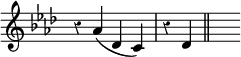
A similar very fine example—too familiar to need quotation here—is at the close of Beethoven's Overture to Coriolan.
The use which Wagner makes of strongly marked figures is very important, as he establishes a consistent connection between the characters and situations and the music by using appropriate figures (Leitmotive), which appear whenever the ideas or characters to which they belong come prominently forward.
That figures vary in intensity to an immense degree hardly requires to be pointed out; and it will also be obvious that figures of accompaniment do not require to be so marked as figures which occupy positions of individual importance. With regard to the latter it may be remarked that there is hardly any department in music in which true feeling and inspiration are more absolutely indispensable, since no amount of ingenuity or perseverance can produce such figures as that which opens the C-minor Symphony, or such soul-moving figures as those in the death march of Siegfried in Wagner's 'Götterdammerung.'
As the common notion that music chiefly consists of pleasant tunes grows weaker, the importance of figures becomes proportionately greater. A succession of isolated tunes is always more or less inconsequent, however deftly they may be connected together, but by the appropriate use of figures and groups of figures, such as real musicians only can invent, and the gradual unfolding of all their latent possibilities, continuous and logical works of art may be constructed; such as will not merely tickle the hearer's fancy, but arouse profound interest, and raise him mentally and morally to a higher standard.
See also
[edit]
References
[edit]- ^ a b c White 1976, pp. 31–34.
- ^ Grove 1908, p. 35.
- ^ Scruton & Dooley 2016, pp. 25–26.
- ^ The Aesthetics of Music. 1997. p. 61. Cited in Nattiez 1990.
- ^ Forte 1979, pp. 392–393.
- ^ Scruton 1997, p. 63.
- ^ Scruton 1997, pp. 61–63.
Bibliography
[edit]- Forte, Allen (1979). Tonal Harmony in Concept and Practice (3rd ed.). Holt, Rinehart and Winston. ISBN 0-03-020756-8.
- Grove, Sir George (1908). "Figure". Dictionary of Music and Musicians. Vol. 2. New York: Macmillan Publishers. pp. 35–37.
- Nattiez, Jean-Jacques (1990). Music and Discourse: Toward a Semiology of Music (Musicologie générale et sémiologue, 1987). Translated by Abbate, Carolyn. Princeton University Press. ISBN 0-691-02714-5.
- Scruton, Roger (1997). The Aesthetics of Music. Oxford: Oxford University Press (published 1999). ISBN 978-0-19-816727-3.
- Scruton, Roger; Dooley, Mark (2016). Conversations with Roger Scruton. London: Bloomsbury Continuum. ISBN 978-1-4729-1711-9.
- White, John D. (1976). The Analysis of Music. Englewood Cliffs, New Jersey: Prentice-Hall. ISBN 978-0-13-033233-2.
Attribution
[edit] This article incorporates text from this source, which is in the public domain: Grove, Sir George (1908). Grove's Dictionary of Music and Musicians. Vol. 2. New York: Macmillan.
| Musical instruments |  | |
|---|---|---|
| Techniques and styles | ||
| Music ensembles | ||


Figure (music)
View on GrokipediaDefinition and Terminology
Core Definition
In music theory, a musical figure is defined as a short succession of notes, either melodic or comprising a group of chords, that produces a single, complete, and distinct impression.[5] This elemental unit integrates melodic pitch with harmonic progression and rhythmic meter, forming a cohesive gesture within a composition.[5] Regarded as the shortest complete idea in music, the figure serves as a foundational building block for constructing larger structures such as phrases, themes, and entire movements.[5] Its recurrence and development contribute to the coherence and progression of musical discourse, often underpinning more prominent elements like motifs.Distinction from Related Concepts
In music theory, a figure, defined as a short succession of notes, is distinguished from a motif primarily by its role in the musical texture. While a motif serves as a foreground element with structural significance, often developing into larger thematic ideas, a figure functions as a repeatable background pattern that supports the primary material without drawing primary attention. Philosopher Roger Scruton articulates this contrast, noting that a figure is "open at both ends, so as to be endlessly repeatable," akin to an architectural molding, whereas a motif presents a more bounded and complete entity in the foreground.[6] Note that in some modern music theory contexts, the terms 'figure' and 'motif' may overlap or be used interchangeably, depending on the analytical approach.[7] Figures also differ from riffs, which are prevalent in popular and jazz genres. A riff constitutes a short, repeated melodic or rhythmic pattern, typically prominent and genre-specific, such as the iconic guitar lines in rock music that drive the harmonic progression. In contrast, figures are more abstract and applicable across musical styles, particularly in classical contexts, emphasizing supportive repetition over foreground emphasis or stylistic specificity.[8] Relative to phrases, figures are briefer and lack the sense of completion that defines a phrase as a self-contained musical unit, analogous to a sentence in language. A phrase typically encompasses multiple motives or figures, providing closure through cadence or rhythmic resolution, whereas a figure remains an incomplete fragment designed for integration into larger structures.[9]Characteristics
Melodic Aspects
In music theory, melodic figures represent short, recognizable patterns of pitches that form the building blocks of larger melodic lines, distinguished by their specific contour—the overall trajectory of rising, falling, or undulating pitch directions.[2] These contours provide a sense of direction and shape, enabling listeners to perceive the melody's flow as a coherent entity rather than isolated notes.[10] Intervallic patterns within melodic figures further define their character, encompassing both conjunct motion, where pitches move by small steps (typically seconds), and disjunct motion, involving leaps of thirds or larger intervals.[11] Stepwise motion creates smooth, connected lines that evoke continuity and lyricism, while leaps introduce contrast, energy, or emphasis, often outlining structural pitches.[12] Common shapes include linear patterns with repeated or adjacent notes, circular arcs of gentle stepwise curves, and angular forms marked by abrupt intervallic jumps.[12] The recurrence of these melodic shapes across a composition fosters cohesion, as repeated or varied iterations of a figure reinforce thematic unity without relying on exact duplication.[13] This repetition at different pitch levels or in sequence helps bind disparate sections, creating a sense of development and familiarity.[14] Simple melodic figures, such as ascending scales, exemplify foundational stepwise contours that build tension through gradual ascent, while arpeggios demonstrate disjunct patterns by leaping between chord tones in succession.[15] These examples serve as versatile units, adaptable to various musical contexts while maintaining their core intervallic identity.[16]Rhythmic and Harmonic Elements
Rhythmic patterns form a core component of musical figures, providing the temporal structure that renders them distinctive and suitable for repetition within a composition. Common examples include dotted rhythms, where a note's duration is extended by half its value (e.g., a dotted quarter note equaling a quarter plus an eighth), which creates a characteristic lilt or emphasis, and syncopation, which displaces accents to off-beats for a sense of forward momentum.[17] These patterns, often comprising 3-5 notes, combine with other elements to form repeatable units that enhance musical cohesion.[18] One prominent rhythmic pattern in figures is the Alberti bass, an arpeggiated accompaniment featuring a "low-high-middle-high" sequence that breaks up chords into a flowing, repetitive motion rather than linear ascent or descent.[19] This pattern not only establishes a steady pulse but also contributes to the figure's recognizability through its consistent rhythmic profile, often applied across multiple chord changes to maintain drive in the texture. Harmonic implications arise as figures delineate underlying chord progressions, such as the common I-IV-V sequence, by emphasizing chord tones in their note selections.[20] For instance, arpeggiated figures like Alberti bass outline triadic harmony, with the bass note anchoring the root, the higher notes filling in the third and fifth, thereby reinforcing tonal stability and progression without explicit block chords.[19] This vertical dimension ensures figures support the overall harmonic framework, often implying resolutions like V7 to I. The integration of rhythm and harmony in background figurations propels the music forward by combining repetitive temporal motifs with chordal outlines, creating a layered texture that sustains energy beneath primary lines.[19] Such figurations, as short repetitive patterns, enhance propulsion while occasionally incorporating subtle melodic shapes tied to the harmonic rhythm.[20]Historical Development
Origins in Baroque Music
The concept of the musical figure emerged from the expressive practices of Renaissance polyphony, where composers employed short, recurring melodic and rhythmic motifs to depict textual imagery and emotions, as seen in the madrigals of late 16th-century Italian and German schools. These early patterns, often tied to word painting, laid the groundwork for a more systematic approach in the transition to the Baroque era, influenced by humanistic ideals that equated music with rhetoric and poetry.[21] In early Baroque treatises, the doctrine of figures—known as Figurenlehre—crystallized as a theoretical framework, with Joachim Burmeister's Musica poetica (1606) marking a pivotal moment by cataloging 27 musical-rhetorical figures analogous to classical oratorical devices, such as the suspiratio (a sigh represented by a brief rest or descending interval) to evoke pathos.[22] This work, rooted in Renaissance musica poetica, prescribed figures for illustrating affects in polyphonic composition, emphasizing their role in aligning music with textual meaning. Later, Johann Joseph Fux's Gradus ad Parnassum (1725) incorporated figures into counterpoint instruction, using them as building blocks for species-based exercises that balanced structural rigor with emotional expression, thereby bridging theoretical foundations with compositional practice.[23] Figures found practical application in Baroque instrumental music, particularly for ornamentation and affective conveyance in keyboard and string genres. In keyboard works, such as Girolamo Frescobaldi's toccatas (c. 1615–1627), diminutions and repetitive motifs served as ornamental figures to heighten dramatic tension and mimic rhetorical delivery, allowing performers to improvise expressive embellishments. Similarly, in string music, composers like Biagio Marini employed figures in violin sonatas (c. 1620s) to articulate passions through idiomatic patterns, such as rapid scalar runs for agitation, extending vocal rhetorical techniques to instrumental idioms.[24] Central to this development was the influence of affective doctrines, which posited that standardized musical figures could reliably stir specific emotions, drawing from René Descartes' Les Passions de l'âme (1649) and classical rhetoric to create a lexicon of patterns—like ascending major thirds for joy or dissonant suspensions for grief—for evoking affections in listeners. This rhetorical integration, prominent in German Baroque theory, transformed figures from mere decorative elements into essential tools for emotional persuasion in composition.[25]Evolution in Classical and Romantic Periods
In the Classical period, musical figures transitioned from the more ornamental roles of the preceding era to serve highly structured functions within sonata form and symphonic compositions, providing motivic development, transitions, and textural contrast. Composers such as Joseph Haydn and Wolfgang Amadeus Mozart employed figures—short melodic or rhythmic patterns—to articulate formal boundaries, generate momentum in development sections, and enhance polyphonic interplay, often through imitation and counterpoint that underscored tonal instability.[26][27] For instance, in Haydn's string quartets, figures in transitions and developments frequently featured asynchronous onsets to create forward drive, distinguishing them from the more homophonic expositions.[27] Mozart similarly integrated figures to link thematic groups, using them to propel the narrative arc of symphonies like his Symphony No. 40, where recurring scalar or arpeggiated patterns facilitated seamless formal progression.[26] During the Romantic period, figures expanded beyond formal utility to convey heightened emotional expression, incorporating chromaticism and idiomatic piano writing in genres like lieder, where accompaniments became integral to dramatic and psychological depth. Franz Schubert exemplified this evolution in his song cycles, using repetitive, chromatic figuration in piano parts to evoke vivid imagery and inner turmoil, as seen in "Erlkönig" (D. 328), where relentless triplet figures mimic a galloping horse while underscoring the narrative's tension.[28] In "Gretchen am Spinnrade" (D. 118), whirling sixteenth-note patterns in the accompaniment simulate a spinning wheel, their chromatic inflections intensifying Gretchen's obsessive despair and marking a shift toward accompaniments as expressive equals to the vocal line.[28] These motifs often fragmented, interrupted, or varied in frequency to mirror textual shifts, unifying the song's outer and inner worlds in a distinctly Romantic manner.[28] Theoretical advancements in the late 19th and early 20th centuries further illuminated figures' role in Classical and Romantic music through Heinrich Schenker's analytical framework, which positioned them as surface-level embellishments elaborating the deeper Urlinie—the fundamental melodic line rooted in the tonic triad.[29] In Schenkerian theory, figures such as diminutions, arpeggios, and turns unfold the Urlinie via concealed repetition across hierarchical levels, revealing motivic parallelisms and voice-leading prolongations in works by Haydn, Mozart, Beethoven, and Schubert.[29] For example, analyses of Beethoven's Piano Sonata Op. 110 demonstrate how opening figures contract and expand to derive from the Urlinie, while Schubert's chromatic accompaniments in lieder prolong dominant-seventh structures, connecting foreground details to background tonal coherence.[29] This approach emphasized figures' organic contribution to tonal unity, influencing modern interpretations of period repertoire.[29]Types and Functions
Accompaniment Figures
Accompaniment figures are short, recurring musical patterns designed to provide harmonic support and rhythmic continuity beneath a primary melody in homophonic textures, ensuring the accompaniment remains subordinate to the foreground material. These figures typically emphasize steady pulse and chordal progression, such as through arpeggiation or repeated notes, to drive the harmony forward without introducing melodic complexity that could compete with the main line. In classical music theory, they form a key element of tonal structure, often aligning with standard progressions like the circle of fifths to reinforce key centers and cadences.[30] A prominent example is the Alberti bass, a broken-chord pattern named after the 18th-century Italian composer and keyboardist Domenico Alberti (c. 1710–1740), though its invention is not definitively his. This figure arranges the notes of a triad in the sequence lowest-highest-middle-highest (e.g., for a C major chord: C-G-E-G), creating a flowing, perpetual motion in the bass line that sustains harmonic interest. Commonly employed in Classical-era keyboard sonatas, it appears frequently in works by composers like Mozart and Haydn, where it underpins lyrical melodies with unobtrusive energy.[31][30] The primary function of accompaniment figures is to deliver rhythmic steadiness and harmonic propulsion, fostering a sense of forward momentum while maintaining textural balance; for instance, they often limit rhythmic variety to quarter or eighth notes, avoiding syncopation that might draw focus. In piano contexts, these patterns are typically executed in the left hand to separate the bass from the right-hand melody, as seen in Mendelssohn's Songs Without Words, op. 62, no. 1, where arpeggiated figures provide subtle support. Orchestral variations adapt this role for ensemble balance, such as strings employing pizzicato or sustained pedal tones, or woodwinds contributing light arpeggios to reinforce the harmony without overwhelming solo lines. These adaptations ensure the figure integrates seamlessly across instrumental textures, prioritizing clarity and propulsion over prominence.[30]Embellishment Figures
Embellishment figures in music refer to short ornamental patterns added to a melody to enhance its expressivity and aesthetic appeal, often performed spontaneously by musicians during the Baroque era. These figures include trills, which involve rapid alternations between a principal note and an auxiliary note above or below it, typically starting on the auxiliary for added tension and release; mordents, consisting of brief oscillations such as a lower mordent (principal note, lower neighbor, principal) or upper variant; and scalar runs, known as divisions, which extend melodic lines through quick stepwise passages or diminutions.[32] Such figures decorate underlying melodic aspects, providing rhythmic vitality and emotional depth without altering the core structure.[32] In chorale harmonizations, embellishment figures play a key role in transforming plain hymn tunes into more vivid expressions, as seen in Johann Sebastian Bach's ornamented chorale preludes where the soprano melody receives elaborate trills, mordents, and runs to heighten devotional intensity.[33] Similarly, in vocal lines, these figures add agility and pathos, with singers employing trills and scalar embellishments to convey affective nuances, a practice rooted in Baroque conventions where performers were expected to improvise such details for interpretive variety.[34] Carl Philipp Emanuel Bach emphasized their use to infuse melodies with life, distinguishing essential ornamentation that supports expressivity from excessive additions that obscure the line.[32] Unlike thoroughbass realizations, which involve improvising harmonic accompaniments from figured bass notations to support the overall chordal framework, embellishment figures focus exclusively on melodic decoration in the upper voices, performed independently by soloists or lead lines rather than by continuo players.[32] This separation allowed Baroque ensembles to layer expressive melodic flourishes atop stable harmonic foundations, with thoroughbass providing the structural chords while embellishments enriched the surface.[32]Role in Composition
In Counterpoint and Polyphony
In counterpoint, musical figures—short melodic or rhythmic patterns—serve as foundational elements that underpin motives enabling imitation and inversion across multiple voices, creating cohesive polyphonic textures. In fugues, the principal subject often consists of compact figures that form a motive imitated sequentially by entering voices, with subsequent statements potentially inverted to reverse intervallic directions, thereby enhancing structural variety without disrupting harmonic progression.[35] Similarly, in two-voice inventions, figures contribute to motives employed for immediate imitation between parts, where one voice presents a motive and the other echoes it at a different pitch or in inverted form, fostering dialogic interplay. These techniques rely on the inherent rhythmic and melodic brevity of figures to facilitate smooth voice entries and maintain contrapuntal momentum. Johann Joseph Fux's Gradus ad Parnassum (1725) systematizes the integration of short melodic and rhythmic patterns within species counterpoint, particularly in the advanced fifth species, known as florid counterpoint. Here, such patterns are incorporated through combinations of note-against-note motion, syncopations, and varied rhythmic values, allowing for "liveliness of movement and beauty and variety of form" while adhering to rules of consonance and smooth voice leading.[36] Fux emphasizes that these elements must avoid parallel perfect intervals and prioritize contrary or oblique motion to preserve voice independence, with imitation occasionally permitting minor parallelisms if dictated by the cantus firmus.[36] This approach builds progressively from simpler species, where patterns emerge in the second and third species via half- and quarter-note divisions, culminating in the fifth species' free use of ligatures and mixed rhythms to emulate natural, singable lines.[37] The strategic deployment of figures in polyphony significantly contributes to textural density and voice autonomy by filling inner parts with active, non-parallel motion that contrasts with the cantus firmus. In multi-voice settings, figural elements in imitation and inversion generate rhythmic complexity, as each voice articulates distinct patterns—often in augmentation, diminution, or inversion—resulting in a "wonderful variety" that obscures hidden octaves or fifths while ensuring perceptual separation of lines.[36] Fux's rules underscore this by mandating that such elements enhance overall fluency, with oblique and contrary motions preventing convergence and thereby sustaining the independence essential to contrapuntal integrity.[36] Such density not only enriches the harmonic fabric but also supports extended imitative passages, as seen in the layered entries of fugal expositions.[38]In Thematic Development
In thematic development, musical figures serve as foundational elements that are fragmented into smaller components and recombined to construct larger motives or themes, providing structural coherence within a composition.[39] This process allows composers to derive extended melodic material from concise patterns, often using figures as components of motives, which represent slightly larger, more prominent units than figures.[40] By breaking down a figure—such as isolating rhythmic or intervallic segments—and reassembling them in novel configurations, thematic material gains variety while maintaining motivic unity, a technique essential for sustaining interest across movements.[39] Within sonata-allegro form, figures play a pivotal role in the development section through techniques like sequence and augmentation, which expand and transform initial thematic ideas.[41] Sequence involves repeating a figure at successively higher or lower pitch levels, creating a sense of progression and harmonic exploration that propels the music forward.[42] Augmentation, conversely, lengthens the durations of notes within the figure—typically by doubling rhythmic values—resulting in a slower, more expansive iteration that contrasts with the original and contributes to the section's dramatic tension.[42] These methods, applied iteratively, facilitate the evolution of figures into fully realized themes, bridging expository and recapitulatory functions.[41] The broader role of figures in motivic development ensures unity in extended works by permeating various sections, allowing a single pattern to underpin diverse musical ideas without overt repetition.[40] This approach fosters organic growth, where fragmented and recombined elements reinforce the composition's overarching identity, particularly in symphonic or sonata structures where thematic integrity is paramount.[39] Through such development, figures transcend their brevity to become the connective tissue that unifies the whole.[41]Examples in Works
Baroque Examples
In Johann Sebastian Bach's The Well-Tempered Clavier, Book I, the Fugue in C minor (BWV 847) exemplifies the use of a figural subject in contrapuntal writing. The subject itself consists of a compact, rhythmic motif featuring ascending and descending scalar figures interspersed with leaps, which fragments into smaller motivic units—such as the "head" motive of repeated notes and the "tail" of a descending line—for development throughout the exposition and episodes. This figural construction allows the subject to interlock seamlessly with countersubjects, which themselves employ sequential figurations in semiquavers, creating a dense polyphonic texture that drives the fugue's energetic momentum.[43] Antonio Vivaldi's violin concertos frequently incorporate ritornello figures combined with elaborate violin figurations to highlight the contrast between ensemble and solo sections. In works from L'estro armonico (Op. 3, 1711), such as the Concerto in D major for four violins (RV 549), the opening ritornello presents a bold, fanfare-like figure in the strings, characterized by quick repeated notes and arpeggiated patterns that evoke trumpet signals, establishing the tonic key and rhythmic drive. The solo violin episodes then respond with virtuosic figurations, including rapid scalar runs and broken-chord patterns that extend and vary the ritornello material, emphasizing the soloist's technical prowess while maintaining structural unity through motivic recall. This interplay of figures underscores the Baroque concerto's dialogic nature, where short, repeatable motifs propel the form forward.[44][45] George Frideric Handel's oratorios employ choral figures to heighten dramatic emphasis, often drawing on rhetorical devices to evoke emotional intensity. In Messiah (HWV 56, 1741), choruses like "For unto us a child is born" feature layered figural writing, where the sopranos introduce a lilting, melismatic figure on "born" that cascades through voices in imitative entries, building tension through rhythmic syncopation and sequential repetition. These figures, rooted in Baroque rhetorical figures such as pathopoeia for pathos, amplify textual drama by mirroring narrative urgency—such as the prophetic proclamation—while the full chorus converges in homophonic bursts for climactic resolution. Handel's approach integrates such motifs to transform sacred texts into vivid, theatrical expressions, prioritizing communal force over individual lines.[46][47]Classical and Later Examples
In Ludwig van Beethoven's Symphony No. 6 in F major, Op. 68, known as the "Pastoral" Symphony, the second movement, "Scene by the Brook," employs vivid programmatic figures to depict natural elements within the orchestral texture. The flowing brook is represented by undulating string figures, often in compound meter with scalar patterns and arpeggios that mimic water's gentle movement, while bird calls are evoked through trills and short, staccato motifs in the woodwinds—specifically, the nightingale by a flute trill, the quail by an oboe figure, and the cuckoo by clarinet calls—layered over the brook's continuous motion to create a layered, imitative soundscape.[48][49] Johannes Brahms's Piano Quintet in F minor, Op. 34, second movement ("Andante, un poco adagio"), structured as a theme followed by five variations in A-flat major, showcases evolving accompaniment figures that enhance textural depth and rhythmic variety. The piano's right hand introduces the serene, hymn-like theme against a simple string accompaniment, but in subsequent variations, figural elements intensify: the first variation adds triplet figures in the piano for a lilting flow, the second incorporates hemiola and contrapuntal string lines weaving around the melody, and later ones feature broken-chord patterns and oscillating motifs in the lower strings and piano bass, transforming the accompaniment into a dynamic, supportive web that underscores melodic elaboration without overpowering it.[50][51] Richard Wagner's Der Ring des Nibelungen employs leitmotif-like figures—concise, recurring melodic, harmonic, or rhythmic motifs tied to characters, objects, or concepts—as integral dramatic tools, evolving beyond mere accompaniment into narrative drivers. In the cycle, examples include the "Rhinegold" motif, a rising arpeggio symbolizing the river's gold, and the "Siegfried" horn call, a bold, ascending figure representing the hero, which recur and transform across the tetralogy to propel the plot and emotional arc.[52] In contemporary minimalism, Philip Glass's opera Akhnaten (1983) utilizes repetitive figures such as undulating arpeggios and ostinati in the orchestra and chorus to evoke ancient Egyptian ritual, building hypnotic, layered textures that mirror the pharaoh's monotheistic vision, as seen in the "Hymn to the Aten" where cycling piano and string patterns underpin vocal lines.[53]References
- https://en.wikisource.org/wiki/A_Dictionary_of_Music_and_Musicians/Figure