


Community hub
Recent from talks
Contribute something
Nothing was collected or created yet.
NASA AD-1
View on Wikipedia
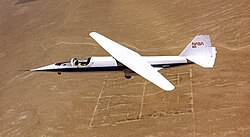
The NASA AD-1 is both an aircraft and an associated flight test program conducted between 1979 and 1982 at the NASA Dryden Flight Research Center, Edwards California, which successfully demonstrated an aircraft wing that could be pivoted obliquely from zero to 60 degrees during flight.
Key Information


The unique oblique wing was demonstrated on a small, subsonic jet-powered research aircraft called the AD-1 (Ames-Dryden-1). The aircraft was flown 79 times during the research program, which evaluated the basic pivot-wing concept and gathered information on handling qualities and aerodynamics at various speeds and degrees of pivot.
Project background
[edit]
The first known oblique wing design was the Blohm & Voss P.202, proposed by Richard Vogt in 1942.[1] The oblique wing concept was later promoted by Robert T. Jones, an aeronautical engineer at NASA's Ames Research Center, Moffett Field, California. Analytical and wind tunnel studies Jones initiated at Ames indicated that a transport-size oblique-wing aircraft, flying at speeds up to Mach 1.4, would have substantially better aerodynamic performance than aircraft with more conventional wings. At high speeds, both subsonic and supersonic, the wing would be pivoted at up to 60 degrees to the aircraft's fuselage for better high-speed performance. The studies showed these angles would decrease aerodynamic drag, permitting increased speed and longer range with the same fuel expenditure. At lower speeds, during takeoffs and landings, the wing would be perpendicular to the fuselage like a conventional wing to provide maximum lift and control qualities. As the aircraft gained speed, the wing would be pivoted to increase the oblique angle, thereby reducing the drag and decreasing fuel consumption. The wing could only be swept in one direction, with the right wingtip moving forward.[citation needed]
Aircraft
[edit]
The AD-1 aircraft was delivered to Dryden in February 1979. The Ames Industrial Co., Bohemia, New York, constructed it, under a US$240,000 fixed-price contract. NASA specified the overall vehicle design using a geometric configuration studied by Boeing Commercial Airplanes, Seattle, Washington. The Rutan Aircraft Factory, Mojave, California, provided the detailed design and load analysis for the intentionally low-speed, low-cost aircraft (there, the aircraft was known internally as the Model 35). The low speed and cost, of course, limited the complexity of the vehicle and the scope of its technical objectives.
Piloting the aircraft on its first flight December 21, 1979, was NASA research pilot Thomas C. McMurtry, who was also the pilot on the final flight August 7, 1982. Another well-known test pilot involved in the project was Pete Knight.
The AD-1 was powered by two small Microturbo TRS18-046 turbojet engines, each producing 220 pounds-force (0.98 kN) of static thrust at sea level. These were essentially the same engines used in the BD-5J. The aircraft was limited for reasons of safety to a speed of about 170 mph (270 km/h).
The AD-1 was 38.8 feet (11.8 m) in length and had a wingspan of 32.3 feet (9.8 m) unswept. It was constructed of plastic reinforced with fiberglass, in a sandwich with the skin separated by a rigid foam core. It had a gross weight of 2,145 pounds (973 kg), and an empty weight of 1,450 pounds (660 kg).
A fixed tricycle landing gear, mounted close to the fuselage to lessen aerodynamic drag, gave the aircraft a very "squatty" appearance on the ground. It was only 6.75 feet (2.06 m) high. The wing was pivoted by an electrically-driven gear mechanism located inside the fuselage, just forward of the engines.
Flight research
[edit]
The research program to validate the oblique wing concept was typical of any NASA high-risk project — to advance through each test element and expand the operating envelope, methodically and carefully. The basic purpose of the AD-1 project was to investigate the low-speed characteristics of an oblique-wing configuration.
The AD-1 made its first flight late in 1979. The wing was pivoted incrementally over the next 18 months until the full 60-degree angle was reached in mid-1981. The aircraft continued to be flown for another year, obtaining data at various speeds and wing-pivot angles until the final flight in August 1982.
The final flight of the AD-1 did not occur at Dryden, however, but at the Experimental Aircraft Association's (EAA) annual exhibition at Oshkosh, Wisconsin, where it was flown eight times to demonstrate its unique configuration.
Following the flight research, Jones still considered the oblique wing as a viable lift concept for large transoceanic or transcontinental transports. This particular low-speed, low-cost research vehicle, however, exhibited aeroelastic and pitch-roll-coupling effects that contributed to poor handling qualities at sweep angles above 45 degrees. The fiberglass structure limited wing stiffness that would have improved the aircraft's handling qualities, as an improved (and thus more expensive) control system would also have done.

Thus, although the AD-1 structure allowed completion of the program's technical objectives, there was still a need for a transonic oblique-wing research aircraft to assess the effects of compressibility, evaluate a more representative structure, and analyze flight performance at transonic speeds (those on either side of the speed of sound).
After completion of the test program, the AD-1 was retired and is now on exhibit in the Hiller Aviation Museum in San Carlos, California.[2]
Specifications
[edit]Data from Linehan 2011[3]
General characteristics
- Crew: 1 (pilot)
- Length: 38 ft 10 in (11.83 m)
- Wingspan: 32 ft 4 in (9.85 m) unswept
- Swept wingspan: 16 ft 2 in (4.93 m) swept 60° sweep angle
- Height: 6 ft 9 in (2.06 m)
- Wing area: 93 sq ft (8.6 m2)
- Airfoil: NACA 3612-02, 40[4]
- Empty weight: 1,450 lb (658 kg)
- Gross weight: 2,145 lb (973 kg)
- Fuel capacity: 80 US gallons (300 L)
- Powerplant: 2 × Microturbo TRS 18 turbojets, 220 lbf (0.98 kN) thrust each
Performance
- Maximum speed: 200 mph (320 km/h, 170 kn)
- Service ceiling: 12,000 ft (3,700 m)
See also
[edit]Aircraft of comparable role, configuration, and era
Related lists
References
[edit]Citations
[edit] This article incorporates public domain material from websites or documents of the National Aeronautics and Space Administration.
- ^ A Summary Of A Half-Century of Oblique Wing Research www.obliqueflyingwing.com
- ^ "Hiller Aviation Museum Briefing" (PDF). www.hiller.org. Archived from the original (PDF) on October 25, 2006. Retrieved October 27, 2006.
- ^ Linehan 2011, p.59.
- ^ Lednicer, David (September 15, 2010). "The Incomplete Guide to Airfoil Usage". Urbana, IL: University of Illinois at Urbana-Champaign. Archived from the original on April 20, 2010. Retrieved October 21, 2011.
Bibliography
[edit]- AD-1 Construction Completed, Dryden X-Press, February 23, 1979, p. 2.
- Robert E. Curry and Alex G. Sim, In-Flight Total Forces, Moments, and Static Aeroelastic Characteristics of an Oblique-Wing Research Airplane (Edwards, CA: NASA TP-2224, 197
4)
- Robert E. Curry and Alexander G. Sim, The Unique Aerodynamic Characteristics of the AD-1 Oblique-Wing Research Airplane, AIAA paper 82-1329 presented at the AIAA 9th Atmospheric Flight Mechanics Conference, Aug. 9–11, 1982, San Diego, CA
- Flight logs for the AD-1 in the NASA Dryden Historical Reference Collection.
- Thomas C. McMurtry, A. G. Sim, and W. H. Andrews, AD-1 Oblique Wing Aircraft Program, AIAA paper 81-2354 presented at the AIAA/SETP/SFTE/ASE/ITEA/IEEE 1st Flight Testing Conference, Nov. 11–13, 1981, Las Vegas, NV.
- Alex G. Sim and Robert E. Curry, Flight Characteristics of the AD-1 Oblique-Wing Research Airplane, (Edwards, CA: NASA TP-2223, 1985)
- Alex G. Sim and Robert E. Curry, Flight-Determined Aerodynamic Derivatives of the AD-1 Oblique-Wing Research Aircraft (Edwards, CA: NASA TP-2222, 1984)
- Bruce I. Larrimer, Thinking Obliquely: Robert T. Jones, the Oblique Wing, NASA's AD-1 Demonstrator, and its legacy
- Linehan, Dan (2011). Burt Rutan's Race to Space: The Magician of Mojave and His Flying Innovations. Minneapolis, MN: Zenith Press. ISBN 978-0-7603-3815-5. Retrieved October 21, 2011.
- Taylor, John W. R. Jane's All The World's Aircraft 1980-81. London:Jane's Publishing, 1980. ISBN 0-7106-0705-9.
External links
[edit]
NASA AD-1
View on GrokipediaDevelopment
Concept origins
The oblique flying wing concept, which underpins the NASA AD-1 aircraft, originated in the early 1940s amid efforts to optimize aerodynamics for high-speed flight. German engineer Richard Vogt first proposed the idea in 1942 as part of his P 202 design, envisioning a straight wing that could pivot obliquely around a central fuselage point to sweep backward at supersonic speeds while maintaining efficiency at subsonic regimes.[5] This approach drew from contemporary swept-wing theories, including Adolf Busemann's work on reducing drag through wing sweep and Max Munk's slender body theory, aiming to minimize wave drag without the structural complexities of symmetric variable-geometry wings.[5] Similar concepts appeared in Messerschmitt and Blohm und Voss designs during World War II, but they remained theoretical due to wartime constraints and technological limitations.[5] NASA aeronautical engineer Robert T. Jones independently revived and advanced the oblique wing concept in 1945, shortly after the war, through initial experiments with balsa wood models that demonstrated reduced drag via antisymmetric wing positioning.[6] Jones, who had earlier contributed to swept-wing research at NACA (NASA's predecessor), built on foundational principles like Theodore von Kármán and Wallace D. Hayes' theorems on fore-aft symmetry for minimum drag, proposing that an obliquely pivoted wing could achieve optimal lift-to-drag ratios across a wide speed range by aligning the wing's leading edge with local airflow.[5] His early wind tunnel tests, conducted with John P. Campbell at NACA Langley in 1945 and published in 1947 (NACA TN 1208), validated the idea's potential for transonic and supersonic applications, showing up to 20% improvements in aerodynamic efficiency compared to fixed swept wings.[5] Jones later filed refinements including dual-fuselage (filed 1971, granted 1973) and single-fuselage variants (filed 1974, granted 1976 as US Patent 3,971,535).[6] By the 1950s and 1960s, Jones' work at NASA Ames Research Center evolved the concept through extensive testing in facilities like the 11-foot Transonic Wind Tunnel, where models confirmed stability and control benefits from the single-pivot mechanism, eliminating the "kink" issues of symmetric designs.[1] He presented key findings at the 1958 International Congress of Aeronautical Sciences in Madrid and published seminal papers, including a 1971 analysis on wave drag reduction and a 1972 AIAA Journal article detailing theoretical foundations for oblique wings in high-speed transports.[5] These studies highlighted the concept's promise for fuel-efficient supersonic aircraft, influencing NASA programs and industry interest from Boeing and Lockheed in the 1970s.[5] The AD-1 project directly stemmed from this foundation, initiated in 1975 as a low-cost demonstrator to flight-test Jones' theories, with a feasibility study by Burt Rutan confirming viability for a subsonic research aircraft.[1]Project execution
The NASA AD-1 project execution began following the completion of a feasibility study by aircraft designer Burt Rutan in December 1975, which confirmed the viability of a small, subsonic oblique-wing demonstrator aircraft under NASA's Advanced Design Program. The design was finalized in September 1976 at the NASA Ames Research Center, emphasizing a lightweight composite structure to validate Robert T. Jones's oblique-wing concept through low-cost flight testing. Project management was led initially by William Andrews, later succeeded by Weneth D. Painter, with collaboration between Ames and the Dryden Flight Research Center (now Armstrong) to handle aerodynamic research and flight operations, respectively. The total program cost was approximately 15,120) and fabrication ($239,930), funded through NASA's aeronautics budget without major external partnerships beyond contractor support.[5] Construction commenced in November 1977 by Ames Industrial Corporation (AIC), utilizing fiberglass-on-foam sandwich composites for the airframe to achieve a gross weight of under 2,150 pounds and a wingspan of 32.3 feet. The build progressed steadily, reaching 40-45% completion by May 1978 and 80% by September 1978, incorporating two Microturbo TRS-18-046 turbojet engines mounted at the wing tips and a hydraulic pivot system for wing skew up to 60 degrees. Key structural elements, such as the wing-attach plates and pivot bearing, were installed by late 1978, with aeroelastic design contributions from Ronald C. Smith ensuring stability against asymmetry-induced vibrations. Challenges during fabrication included managing the low structural damping of the oblique configuration, which was addressed through iterative ground vibration testing and the addition of an aileron damper to mitigate aeroelastic flutter risks. The aircraft rolled out on February 22, 1979, and was delivered to Dryden on March 11, 1979, under the oversight of crew chief Walter Vendolosky.[5] Pre-flight preparations at Dryden involved extensive ground testing, including engine runs, high-speed taxi tests, and proof-load assessments of the wing pivot to verify structural integrity under skewed conditions. These efforts confirmed the aircraft's baseline stability in the unswept configuration, drawing on prior wind tunnel data from Ames and historical NACA tests (TN 1208) to predict handling qualities. Minor issues, such as exhaust plume impingement on control surfaces and generator power drop-offs, were resolved through design tweaks before clearance for flight. The execution phase culminated in the program's transition to flight testing, validating the oblique-wing's feasibility while informing subsequent efforts like the canceled F-8 Oblique Wing Research Aircraft (OWRA). Overall, the project's disciplined, iterative approach—combining theoretical modeling, composite fabrication, and rigorous ground validation—demonstrated NASA's capability for innovative, low-budget aeronautics research.[5]Design
Airframe and structure
The NASA AD-1 featured a unique airframe designed specifically to accommodate an oblique flying wing, consisting of a single continuous wing that pivoted at a central midspan point attached to the top of a compact fuselage. This configuration allowed the wing to rotate from a straight (0°) position for low-speed flight to oblique angles of up to 60° for higher speeds, blending elements of both swept and forward-swept wing designs to optimize aerodynamic efficiency. The overall structure emphasized lightness and simplicity to facilitate research into aeroelastic behavior and structural loads, with the airframe built as a small, piloted research vehicle powered by twin Microturbo TRS-18-046 turbojet engines mounted on the fuselage sides.[5] The primary structural materials included graphite-epoxy honeycomb composites for the wing, fuselage, and vertical tail surfaces, providing high strength-to-weight ratios essential for withstanding the asymmetric loads induced by wing pivoting. The wing itself employed a fiberglass-reinforced-plastic sandwich construction with a rigid foam core, featuring 17 plies of material at the root tapering to 4 plies at the tip to balance stiffness and flexibility; this design was later noted for limiting overall wing rigidity, which influenced handling characteristics during testing. The central pivot mechanism, constructed from titanium, was integrated at approximately 40% of the wing's root chord and incorporated a 14-inch-diameter roller bearing to transfer bending moments while ensuring structural continuity across the wing even in the event of bearing failure. The fuselage adopted a cylindrical shape for aerodynamic and structural efficiency, constructed from similar composite materials with integral fuel cells (40 gallons forward and 32 gallons aft) embedded within.[5][7] Construction of the airframe was handled by Ames Industrial Corporation, with the wing assembly involving tapered foam cores, fiberglass lay-up, and the installation of wing-attach plates and the pivot bearing completed by late 1978 before delivery to NASA's Dryden Flight Research Center in March 1979. Fixed tricycle landing gear with epoxy-fiberglass struts supported the structure, using 5.00x5 wheels on the main gear and a steerable nose gear (±20°). Ground testing validated the airframe's integrity, including proof-load tests up to 4.7g and vibration assessments at 0° and 45° sweep angles, confirming the wing was 10-15% stiffer in bending than initially predicted while exhibiting expected torsional rigidity at lower loads. Key dimensions included an unswept wingspan of 32.3 feet, wing area of 93 square feet (aspect ratio of 11.2), overall length of 38.8 feet, height of 6.75 feet, empty weight of 1,450 pounds, and gross weight of 2,145 pounds, all optimized for subsonic research flights up to 15,000 feet and 175 knots.[5][7]| Parameter | Value | Notes |
|---|---|---|
| Wingspan (unswept) | 32.3 ft | Straight configuration |
| Wing area | 93 sq ft | NACA 36-012 airfoil |
| Fuselage length | 38.8 ft | Includes cockpit and engine mounts |
| Empty weight | 1,450 lb | Composite construction |
| Gross weight | 2,145 lb | Maximum takeoff weight |
| G-load limit | ±6 g | Design structural limit |
| Pivot G-load capacity | ±25 g | Titanium pivot withstands asymmetric loads |
Wing pivot system and controls
The NASA AD-1's wing pivot system centered on a single, unswept oblique wing that could rotate about a central pivot point located at approximately 40% of the root chord, allowing the wing to skew from 0° (perpendicular to the fuselage) to a maximum of 60° with the right wingtip forward.[7] This mechanism was actuated by an electrically driven gear system housed within the fuselage just forward of the engines, enabling in-flight adjustments to optimize aerodynamic efficiency across different speeds.[2] At low speeds, such as during takeoff and landing, the wing remained at 0° to maximize lift and provide conventional handling characteristics; as speed increased, pilots could pivot the wing to reduce drag, potentially doubling fuel efficiency compared to traditional swept-wing designs.[1] Flight controls for the AD-1 integrated the pivot system with standard aerodynamic surfaces to manage the unique challenges of oblique wing asymmetry, which introduced strong pitch-to-roll and roll-to-yaw couplings, particularly at higher sweep angles. Primary control surfaces included aileron-flaps on the wing for roll control, a horizontal stabilizer (split into left and right sections for differential deflection) for pitch and supplementary roll, and a rudder for yaw.[8] These surfaces operated via mechanical linkages using cables and torque tubes, without hydraulic assistance, to ensure precise response despite the wing's changing geometry.[9] The pivot itself was controlled by the pilot through a dedicated switch on the instrument panel for incremental adjustments, or via a trigger on the center control stick for rapid return to the unswept position in emergencies.[9] Sensors monitored wing sweep angle, along with pitch, roll, and yaw rates, feeding data to onboard recorders for post-flight analysis.[2] At sweep angles beyond 45°, the system exhibited increased lateral-directional instability, necessitating careful pilot inputs to counteract tendencies like rolling toward the forward-swept wingtip during pitch maneuvers.[10] Overall, the design prioritized simplicity and testability, gathering critical data on handling qualities across the full pivot range during 79 research flights from 1979 to 1982.[1]Flight testing
Program overview
The NASA AD-1 flight testing program, conducted jointly by the Ames Research Center and the Dryden Flight Research Center (now Armstrong Flight Research Center), evaluated the stability, control, and handling qualities of an oblique-wing aircraft at subsonic speeds.[11] The program aimed to verify the oblique wing concept's feasibility for improving fuel efficiency and reducing drag in future aircraft designs, particularly for supersonic transports, by allowing the wing to pivot from 0° to 60° sweep during flight.[1] It also assessed the flight control system's performance without augmentation, aeroelastic stability, and alignment of flight data with pre-test predictions.[7] Testing began with the aircraft's delivery in February 1979, followed by its maiden flight on December 21, 1979, from Edwards Air Force Base, California.[2] Over the course of the program, which concluded with the final flight on August 7, 1982, at the EAA AirVenture Oshkosh event in Wisconsin, the AD-1 completed 79 research flights totaling 106 hours and 10 minutes of flight time.[1][5] The flight envelope expanded progressively to include altitudes up to 12,500 feet (3,800 meters), indicated airspeeds from 60 to 170 knots, and full wing sweep angles up to 60°, achieved by mid-1981.[7][5] Two primary NASA research pilots handled envelope expansion, supported by guest pilots for evaluations, using pilot ratings, comments, and telemetry data to assess performance.[7] The program demonstrated the oblique wing's operational viability, with satisfactory handling qualities at sweep angles up to 30°, though characteristics degraded noticeably between 45° and 60°, exacerbated by light turbulence and requiring rate feedback augmentation for improvement.[7] Overall, the tests confirmed the wing pivot mechanism's reliability and provided valuable aerodynamic data, though the aircraft's unconventional flying traits at high sweeps limited its immediate adoption for larger-scale applications.[1]Key flights and milestones
The NASA AD-1 flight test program encompassed 79 flights conducted between December 21, 1979, and August 7, 1982, at the Dryden Flight Research Center (now Armstrong Flight Research Center) in Edwards, California.[5][2] These tests systematically evaluated the oblique-wing concept's handling qualities, stability, and control across varying sweep angles, from 0° to the maximum 60°, providing critical data on aerodynamic efficiency at subsonic speeds up to approximately 170 knots.[5] Primary pilot Thomas C. McMurtry flew 49 missions, with support from co-pilots like Fitzhugh L. Fulton Jr. (15 flights) and several guest pilots, including Richard E. Gray and Einar K. Enevoldson.[5] The program's inaugural flight occurred on December 21, 1979, when McMurtry executed an unplanned 5-minute high-speed taxi that transitioned into an airborne excursion at 0° wing sweep, marking the world's first piloted oblique-wing flight.[5] Later that day, the official checkout flight lasted 45 minutes, confirming basic aircraft systems and zero-sweep performance.[5] Incremental testing followed, with the first intentional wing sweep to 15° achieved on April 2, 1980, during a 65-minute flight that assessed initial oblique handling.[5] By April 25, 1980 (Flight 13), the wing reached 20° sweep, focusing on flutter clearance, while May 28, 1980 (Flight 14) advanced to 45° in a 90-minute mission that further validated aeroelastic stability.[5] A major milestone came on April 24, 1981, when McMurtry piloted the first full 60° wing sweep at 170 knots, realizing the design goal and demonstrating the concept's viability for high-speed efficiency without significant control issues.[5] This was reinforced on July 1, 1981 (Flight 30), with another 60° sweep flight emphasizing stability and control evaluations.[5] The program concluded publicly on August 7, 1982, with McMurtry's final flight at the Experimental Aircraft Association's Oshkosh air show, featuring a demonstration of the 60° sweep before eight total exhibition flights that year.[5][2] These milestones collectively proved the oblique wing's potential, informing subsequent research like the F-8 Oblique Wing Research Aircraft program.[5]| Milestone Flight | Date | Wing Sweep | Pilot | Duration | Key Achievement |
|---|---|---|---|---|---|
| First airborne excursion | December 21, 1979 | 0° | Thomas C. McMurtry | 5 minutes | Unplanned initial flight, confirming basic systems. |
| Official first flight | December 21, 1979 | 0° | Thomas C. McMurtry | 45 minutes | Checkout of zero-sweep performance. |
| First 15° sweep | April 2, 1980 | 15° | Thomas C. McMurtry | 65 minutes | Initial oblique handling assessment. |
| First 45° sweep | May 28, 1980 | 45° | Thomas C. McMurtry | 90 minutes | Aeroelastic stability validation. |
| First 60° sweep | April 24, 1981 | 60° | Thomas C. McMurtry | 90 minutes | Achievement of maximum design sweep at 170 knots. |
| Final flight | August 7, 1982 | 60° (demonstration) | Thomas C. McMurtry | Not specified | Public showcase at Oshkosh, program conclusion. |
Research outcomes
Aerodynamic and performance findings
The flight tests of the NASA AD-1 oblique-wing research aircraft revealed that the lift coefficient increased with angle of attack in a manner consistent with linear theory up to moderate angles, though actual values exceeded wind tunnel predictions at higher angles due to viscous flow separation and spanwise vortex formation. At sweep angles of 45° and 60°, vortex lift became prominent above 12° angle of attack, enhancing the maximum lift capability beyond expectations from inviscid models. The lift slope remained accurate in the linear regime across sweep angles from 0° to 60°, but overall lift decreased with increasing sweep, approximating classical swept-wing theory while benefiting from the oblique configuration's high effective aspect ratio at low sweeps.[12] Drag coefficients measured in flight were higher than wind tunnel data, attributed to configuration differences such as engine inlets and wing-fuselage gaps, with drag incrementally increasing with wing sweep due to reduced span efficiency and higher induced drag components. The maximum lift-to-drag ratio, a key performance metric, decreased at higher sweep angles (e.g., notable degradation between 45° and 60°), reflecting trade-offs in the oblique design where low-speed efficiency at 0° sweep gave way to potential transonic benefits not fully realized in the subsonic AD-1 envelope. Sideforce coefficients exhibited a constant negative bias of approximately -0.018 at 0° sweep, stemming from inherent airframe asymmetry, which required trim adjustments like banking or sideslip at oblique angles.[12][7][5] Aeroelastic tailoring of the composite wing proved effective, with the structure deflecting as designed to minimize rolling moments at the 60° sweep design point (lift coefficient of 0.3, approximately 4° angle of attack), achieving near-zero roll trim without significant sideslip. Rolling moment coefficients peaked at intermediate sweeps around 30°, necessitating about 9.6° of bank for trim at 60° sweep under nominal conditions, while yawing moments remained small but showed poor correlation with wind tunnel results due to unmodeled asymmetries. The aerodynamic center shift was minimized across sweep changes, reducing trim drag compared to symmetric variable-sweep wings, though overall performance highlighted the oblique wing's promise for efficiency gains at the cost of increased drag penalties at high obliquity.[12][5][13]| Sweep Angle (°) | Key Performance Observation | Quantitative Insight |
|---|---|---|
| 0 | High lift-to-drag efficiency | L/D up to ~31 at low Mach (conceptual baseline, subsonic)[5] |
| 30 | Peak rolling moment | Maximum roll trim requirement observed[12] |
| 45–60 | Vortex lift dominant; drag rise | L/D decrease; CL > wind tunnel at α >12°; minimal roll at 60° (CL=0.3)[12][7] |
Handling and stability characteristics
The AD-1 demonstrated generally satisfactory handling qualities at low wing sweep angles below 30°, where pilots reported effective control and stability during takeoff, cruise, and landing maneuvers. However, handling degraded progressively as sweep increased to 45° and beyond, with increased pilot workload due to reduced roll control authority and the need for continuous trim adjustments in all axes. Pilot ratings averaged 2-3 on the Cooper-Harper scale for most tasks at low sweeps, but rose to 5-6 during single-engine operations and further worsened in turbulence, indicating moderate to significant handling challenges at higher oblique angles.[7] Stability characteristics were influenced markedly by the oblique wing configuration, exhibiting low directional stability (Cnβ) that led to yaw "wandering" tendencies, particularly at 60° sweep, where up to 10° sideslip and 7° bank angles were required for trim at 140 knots. The aircraft displayed slight spiral instability owing to positive effective dihedral (Cℓβ) and reduced roll damping with increasing sweep, compounded by adverse aileron yaw that further challenged lateral control. Stall behavior initiated at the trailing wingtip at low speeds, progressing inboard and causing a characteristic left roll-off due to asymmetric lift loss.[7] Aeroelastic stability analyses revealed potential vulnerabilities, with the unswept wing prone to bending-torsion-aileron flutter at approximately 152 m/s (296 KIAS) and 34.2 Hz, while higher sweeps introduced low-frequency (4 Hz) bending-rigid-body roll coupling flutter critical at around 163 m/s (317 KIAS) for angles above 25°. These modes were mitigated through structural stiffening, such as increasing the shear modulus, which raised flutter speeds by up to 50%, ensuring the AD-1 remained stable within its flight envelope up to 60° sweep and Mach 0.7. Pitch-roll coupling arose from the high product of inertia (Ixy), though its effects were minimal due to the low ratio of roll to pitch moments of inertia (Ix/Iy ≈ 0.3). Simulator studies confirmed that rate-command attitude-hold augmentation improved handling at high sweeps by enhancing roll response and reducing sensitivity to sweep-induced asymmetries.[11][7]Specifications
General characteristics
The NASA AD-1 (Ames-Dryden Oblique Wing) research aircraft was a twin-engine experimental vehicle designed to evaluate oblique wing technology.[2] It featured a crew of one pilot and was constructed primarily from fiberglass composite materials for lightweight durability.[14] The airframe incorporated fixed tricycle landing gear mounted close to the fuselage to accommodate the variable wing sweep.[2] Key dimensions included a fuselage length of 38.8 feet (11.8 meters) and a height of 6.75 feet (2.06 meters).[14] The unswept wingspan measured 32.3 feet (9.85 meters), with a swept wingspan of 16.2 feet (4.9 meters) at 60° obliquity, and a wing area of 93 square feet (8.6 square meters) using a NACA 3612-02 airfoil section.[14] The wing could pivot obliquely from 0° to 60° via an electrically driven gear mechanism located inside the fuselage at the 40% root chord position.[14][2]| Characteristic | Value |
|---|---|
| Empty weight | 1,450 pounds (658 kg) |
| Gross weight | 2,145 pounds (973 kg) |
| Fuel capacity | 400 pounds (72 gallons) in two fuselage tanks |
| Powerplant | 2 × Microturbo TRS-18 turbojets, 220 lbf (980 N) thrust each at sea level |