Hubbry Logo
New EveNew EveMain
Open search
New Eve
Community hub
New Eve
logo
8 pages, 0 posts
0 subscribers
Be the first to start a discussion here.
New Eve
New Eve
from Wikipedia
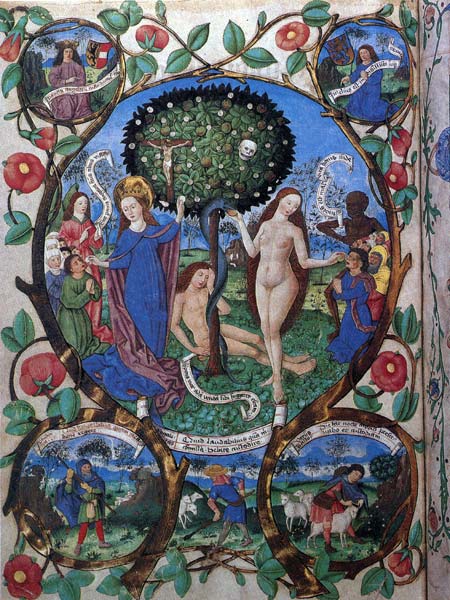
Baum des Todes und des Lebens
The tree of death and of life in the Salzburg Missal: Eve gives the representatives of the old covenant the fruit that brings sin and death from the tree of paradise. Mary, on the other hand, gives the faith hosts, the bread of life.

The New Eve (Latin: Nova Eva) is a devotional title for Mary, the mother of Jesus. Since the second century, numerous Eastern and Western Church Fathers have expressed this doctrinal idea of the new Eve as an analogy to the biblical concept of the New Adam in Jesus. The belief that Mary has a unique and necessary participation in the economy of salvation is expressed in the doctrine, particularly her faith at the annunciation of the archangel Gabriel, which facilitates the incarnation of Jesus Christ and human redemption.[1]

Early Church Fathers

[edit]

The forefathers of the early church looked to Paul's Letter to the Galatians 4:4-5: "But when the fullness of time had come, God sent his Son, born of a woman, born under the law, to ransom those under the law, so that we might receive adoption", and related this to the woman spoken of in the Protoevangelium of Genesis 3:15: "I will put enmity between you and the woman, and between your offspring and hers; They will strike at your head, while you strike at their heel." The church father Irenaeus of Lyons in his Against Heresies (5.21.1), followed by several other fathers of the church, interpreted the verse as a reference to Christ.[2]

Justin Martyr was among the first to draw a parallel between Eve and Mary. This derives from his comparison of Adam and Jesus. In his Dialogue with Trypho, written sometime between 155–167,[3] he explains:

He became man by the Virgin, in order that the disobedience which proceeded from the serpent might receive its destruction in the same manner in which it derived its origin. For Eve, who was a virgin and undefiled, having conceived the word of the serpent, brought forth disobedience and death. But the Virgin Mary received faith and joy, when the angel Gabriel announced the good tidings to her that the Spirit of the Lord would come upon her, and the power of the Highest would overshadow her: wherefore also the Holy Thing begotten of her is the Son of God; and she replied, 'Be it unto me according to thy word." And by her has He been born, to whom we have proved so many scriptures refer, and by whom God destroys both the serpent and those angels and men who are like him; but works deliverance from death to those who repent of their wickedness and believe upon Him.[4]

Irenaeus, bishop of Lugdunum, also takes this up in Against Heresies, written about the year 182:[5]

In accordance with this design, Mary the Virgin is found obedient, saying: 'Behold the handmaid of the Lord; be it unto me according to your word.' Luke 1:38 But Eve was disobedient, for she did not obey when as yet she was a virgin ... having become disobedient, was made the cause of death, both to herself and to the entire human race; so also did Mary, having a man betrothed [to her], and being nevertheless a virgin, by yielding obedience, become the cause of salvation, both to herself and the whole human race. And on this account does the law term a woman betrothed to a man, the wife of him who had betrothed her, although she was as yet a virgin; thus indicating the back-reference from Mary to Eve ... For the Lord, having been born 'the First-begotten of the dead', Revelation 1:5 and receiving into His bosom the ancient fathers, has regenerated them into the life of God, He having been made Himself the beginning of those that live, as Adam became the beginning of those who die. 1 Corinthians 15:20-22 Wherefore also Luke, commencing the genealogy with the Lord, carried it back to Adam, indicating that it was He who regenerated them into the Gospel of life, and not they Him. And thus also it was that the knot of Eve's disobedience was loosed by the obedience of Mary. For what the virgin Eve had bound fast through unbelief, this did the virgin Mary set free through faith.[6]

Tertullian and Origen wrote about the Eve-Mary parallel as well. Given that Justin Martyr was possibly taught by pupils of the apostles, or at least by people of the apostolic age, and that the theme seems to have been a widespread basic teaching among early Christians, it is possible that it comes from the apostolic tradition rather than being Justin Martyr's creation, according to Serafim Seppälä.[7]

Medieval period

[edit]

The early medieval period reflected an increased devotion to Mary after the Council of Ephesus which declared Mary Theotokos, which in the West was rendered "Mother of God". The rise of monasticism preserved the works of the early fathers. According to Luigi Gambero, sermons tended to follow a standard form: "... the sin of our first parents, the Eve-Mary parallel, the angel's annunciation to Mary and the incarnation of the son of God, the birth of Christ ..."[8]

Modern period

[edit]

In the 1854 apostolic constitution, Ineffabilis Deus, promulgating the dogma of the Immaculate Conception, Pope Pius IX referred to the opinion of the Fathers:

Hence, to demonstrate the original innocence and sanctity of the Mother of God, not only did they frequently compare her to Eve while yet a virgin, while yet innocence, while yet incorrupt, while not yet deceived by the deadly snares of the most treacherous serpent; but they have also exalted her above Eve with a wonderful variety of expressions. Eve listened to the serpent with lamentable consequences; she fell from original innocence and became his slave. The most Blessed Virgin, on the contrary, ever increased her original gift, and not only never lent an ear to the serpent, but by divinely given power she utterly destroyed the force and dominion of the evil one.[9]

In the 1974 Apostolic Exhortation Marialis Cultus, Pope Paul VI saw Mary as the second Eve standing alongside and subordinated to Christ, the second Adam. As the second Eve, she is the new woman, the definitive expression of what it is to be human. In Mary we see what God intends for his people as a whole. "She is given to us as a pledge and guarantee that God's plan in Christ has already been realized in a creature."[10]

The Roman Breviary contains the Mass of the Blessed Virgin Mary, in which she is described as the new Eve: "Glorious are you, holy Mary, the new Eve. From you the new Adam, Christ Jesus, was born."[11]

Alongside the theogical concept of Mary as Co-Redemptrix, Eve is seen to be co-peccatrix (co-sinner), because it was Eve who freely gave the "instrument" of The Fall of Man. It is Eve who gave the "forbidden fruit" to Adam, the peccator (sinner) whose sin as father of the human race led to the loss of grace for the human race.

Amphilochius of Iconium says: "... O Mary, O Mary, the Maker of all things was your firstborn Son! O humanity, who became the bodily substance of the Word and for that reason became more honorable than the spiritual virtues of heaven! For Christ did not want to clothe himself in the form of archangels or in the form of the immaterial figures of the principalities, virtues, and powers; rather, through you, he clothed himself in your form, which had fallen and become like that of the brute animals ... but where now is that hostile and bewildered dragon? Where is that cursed and execrable dragon, who had claimed that this throne would be raised to the heights of heaven?[12][failed verification]

Caelius Sedulius writes:

Because of one man, all his descendants perished;
And all are saved because of one man.
Because of one woman, the deadly door opened;
And life returned, because of one woman.[13]

See also

[edit]

References

[edit]
Revisions and contributorsEdit on WikipediaRead on Wikipedia
from Grokipedia
The New Eve (Latin: Nova Eva) is a longstanding devotional title in , particularly within Catholicism and , referring to the Virgin Mary as the spiritual counterpart to the biblical , whose obedience to reversed the disobedience that introduced original sin into the world. This concept emphasizes Mary's role in salvation history, portraying her as the mother of Jesus Christ—the New Adam—and highlighting her ("let it be done") in response to the angel Gabriel's annunciation as the antidote to Eve's acceptance of the serpent's temptation in the . The parallel draws from Genesis 3:15, the protoevangelium, which prophesies enmity between the serpent and the woman, her offspring crushing the serpent's head—a promise fulfilled through Mary's motherhood of the Redeemer. The doctrine of Mary as the New Eve emerged in the early Church, with roots traceable to the second century through the writings of prominent such as (c. 150 AD), of Lyons (c. 180 AD), and (c. 200 AD), who contrasted the Fall and the , portraying Mary's obedience as reversing Eve's disobedience and cooperating with Christ's redemptive work. These patristic insights, grounded in scriptural parallels such as Romans 5:12–21 and 1 Corinthians 15:21–22 (contrasting Adam's sin with Christ's obedience), underscore Mary's active participation in reversing the effects of the Fall. Biblically, the New Eve motif is evident in New Testament scenes that echo Genesis, such as Jesus addressing Mary as "woman" at the Wedding at Cana (John 2:1–11) and from the cross (John 19:26–27), evoking the "woman" of Genesis 3:15 and symbolizing her role as the new mother of the living and spiritual . The formalizes this teaching in paragraphs 511 and 975, affirming Mary as the New Eve whose "yes" to God made possible the and her ongoing intercessory role as advocate for humanity. This typology has influenced Marian devotion, (e.g., in the Roman Office of Readings during Advent), and art throughout Christian history, emphasizing themes of redemption, femininity, and divine reversal.

Theological Foundations

Biblical Parallels

The concept of the New Eve draws foundational parallels from Scripture, particularly in how Mary's role in redemption mirrors and reverses Eve's involvement in the Fall. Genesis 3:15, often termed the protoevangelium or "first ," establishes this enmity: "I will put enmity between you and the woman, and between your offspring and hers; he will crush your head, and you will strike his heel." In this verse, the Hebrew term 'ēbâ denotes an irreconcilable hostility between the serpent (symbolizing ) and the woman, with her zera' (seed, interpreted individually as the ) ultimately destroying the serpent's power through a decisive victory over . The woman's identity extends beyond Eve to Mary, as the total enmity and triumph are fulfilled in Christ's redemptive work, where Mary stands as the of the victorious offspring. The Septuagint's use of the masculine autos for the seed reinforces this messianic focus, foreshadowing Mary's cooperative role in salvation history. This scriptural groundwork is further illuminated in Galatians 4:4-5: "But when the set time had fully come, God sent his Son, born of a woman, born under the law, to redeem those under the law, that we might receive adoption to sonship." Here, the phrase "born of a woman" echoes Genesis 3:15, positioning Mary as the woman through whom God intervenes for humanity's redemption, contrasting Eve's role in introducing sin. Mary's fiat in Luke 1:38—"Behold, I am the handmaid of the Lord; let it be to me according to your word"—exemplifies this reversal, as her obedient consent enables the Incarnation and the sending of the Son, directly countering Eve's disobedience in yielding to temptation. Romans 5:12-21 extends these parallels through a typology of recapitulation, contrasting Adam's transgression with Christ's obedience: "Therefore, just as sin entered the world through one man, and death through sin... so also through one man righteousness came to all... resulting in justification that brings life." While the passage centers on Adam and Christ as federal heads—Adam bringing condemnation and death, Christ grace and life—Mary's role as the New Eve complements this by recapitulating Eve's position, cooperating in the new creation through her fiat and motherhood of the Redeemer. This cooperative aspect underscores Mary's integral participation in undoing the effects of the Fall, aligning with the broader theme of reversal in salvation. Linguistically and thematically, these parallels highlight contrasts in : Eve's affirmative response to the serpent's leads to disobedience, while Mary's "yes" to the affirms God's will. The term "" ('iššâ in Hebrew for in Genesis 2:23 and 3:15) signifies her foundational role as mother of the living, yet tied to the curse; in Greek, gynē (vocative gynai) addresses Mary at key moments, such as the wedding at Cana (:4) and the cross (:26). This usage is not derogatory but . These verses provided early interpretive lenses for patristic .

Conceptual Origins

The title "New Eve" (Latin: Nova Eva) designates the Virgin Mary as the figure whose obedience to God reverses the disobedience of the first , thereby facilitating the course of salvation history through her consent to the . This concept draws briefly from scriptural roots, such as the protoevangelium in Genesis 3:15 and Paul's reference to Christ born of a woman in Galatians 4:4, portraying Mary as integral to the reversal of humanity's fall. Central to this theology is the principle of recapitulation, whereby Mary functions as the second , recapitulating and undoing the effects of the original 's disobedience, just as Christ, the New Adam, recapitulates all creation to restore it to . Through her —"Let it be done to me according to your word" (Luke 1:38)—Mary actively consents to divine will, enabling the redemptive work of her Son and positioning her as the cause of salvation for humanity alongside her own. Mary's sinlessness, affirmed in the dogma of the , undergirds her role as New Eve, preserving her from from the first moment of her existence to ensure her perfect cooperation with the Redeemer. This preservation allows her obedience of faith to fully untie the knot of Eve's unbelief, making her the "new Eve, mother of the living" in the order of grace. In , the New Eve concept highlights Mary's subordinate yet essential cooperative role in redemption, emphasizing her maternal participation in Christ's salvific mission without implying equality or a separate mediatory power. This participation, rooted in her faith, hope, and charity, distinguishes her unique association with the New Adam from notions of co-redemption that could obscure Christ's sole mediatorship.

Historical Development

Patristic Interpretations

The patristic interpretation of Mary as the New Eve emerged in the second and third centuries as employed typological to counter heresies and affirm core Christian doctrines, paralleling Eve's role in introducing with Mary's role in the . This typology, rooted in scriptural contrasts between the first and second Adam (Romans 5:12–21), positioned Mary as the obedient counterpart to Eve, facilitating redemption through her fiat at the . Justin Martyr, writing around 155–167 AD, provided the earliest explicit parallel in his Dialogue with Trypho (chapter 100), where he contrasts Eve's virginal state with her seduction by the serpent's word, leading to disobedience and death, against Mary's virginal reception of the angel Gabriel's announcement, which brought faith, joy, and life through Christ. Justin emphasizes that just as Eve, a virgin undefiled, conceived the serpent's deceptive word and bore disobedience, Mary, also a virgin, conceived the Word of God and bore salvation, thereby inverting the primordial fall. This comparison served Justin's apologetic aim against Jewish objections, underscoring Christ's recapitulation of Adam's story through Mary's cooperation. Irenaeus of Lyons developed this theme extensively around 182 AD in Against Heresies, particularly in Book V, chapter 19, where he articulates Mary's obedience as the remedy for 's transgression within his doctrine of recapitulation. He states: "And thus also it was that the knot of Eve’s disobedience was loosed by the obedience of Mary. For what the virgin had bound fast through unbelief, this did the virgin Mary set free through faith." portrays Mary as the "cause of " for humanity, balancing 's "virginal disobedience" with her own "virginal obedience," thereby enabling the second Adam, Christ, to restore what the first lost. A similar formulation appears in Book III, chapter 22, reinforcing that Mary's unbound faith at the angel's tidings directly counters 's bond of unbelief. Directed against Gnostic dualism, ' exegesis integrates Mary into the economy of as an active participant in reversing the effects of . Tertullian, in the early third century (c. 210 AD), advanced the typology in On the Flesh of Christ (chapter 17) to defend the reality of Christ's against Docetist denials of his humanity. He writes that the Word of God entered "into a virgin’s soul" to rebuild the "fabric of life" ruined by "this virgin ," with Mary as the restorative virgin whose receptivity parallels but inverts 's seduction by the angel's deceptive word. Tertullian highlights Mary's perpetual as a to 's fall through sensual , affirming that required a virgin's to match the manner of the fall. This argument bolstered Tertullian's emphasis on the material reality of Christ's body, drawn from Mary's flesh. In the fourth century, Ephrem the Syrian further elaborated the New Eve typology in his Syriac hymns, such as the Hymns on the Nativity, portraying Mary as the uncorrupted virgin whose obedience to Gabriel crushed the serpent's head, reversing Eve's fall and bringing life to humanity through the Incarnation. Collectively, these patristic writings from the second to fourth centuries established the New Eve typology as a foundational anti-heretical tool, with Justin's dialogue (c. 155 AD), Irenaeus' refutations (c. 182 AD), Tertullian's defenses (c. 210 AD), and Ephrem's hymns (c. 350 AD) weaving Mary's obedience into the narrative of redemption to affirm orthodox Christology against Jewish, Gnostic, and Docetist challenges. This consensus, evidenced in primary texts like Dialogue with Trypho (ch. 100), Against Heresies (Books III.22 and V.19), On the Flesh of Christ (ch. 17), and Ephrem's Hymns on the Nativity, solidified the motif's role in early Christian soteriology without implying later medieval elaborations.

Medieval Elaborations

The affirmation of Mary as at the in 431 AD marked a pivotal moment in the development of Marian theology, as it reinforced her integral role in the and thereby intensified the use of the Eve-Mary typology in subsequent sermons, homilies, and liturgical hymns across both Eastern and Western traditions. This doctrinal emphasis portrayed Mary not merely as a passive vessel but as the obedient counterpart to , whose reversed the primordial disobedience, a theme that gained prominence in post-conciliar preaching and poetry as a means to elucidate salvation history. In the early medieval period, figures such as Amphilochius of Iconium (c. 340–395, with works influential into the 5th century) elaborated on this typology in his orations, celebrating the divine strategy wherein the world, fallen through a virgin's disobedience (), was redeemed through another's obedience (Mary), thus framing her as the New Eve in direct reversal of the Fall. Similarly, the 5th-century poet Caelius Sedulius, in his Carmen Paschale, poetically linked Mary to Eve's atonement, describing how the "blessed Mary, springing from the root of ," restored what the first woman had marred through , integrating the motif into Latin Christian verse that influenced later devotional literature. During the high medieval era, scholastic theologians further systematized the New Eve concept within discussions of Marian privileges, particularly her sinlessness. This integration appeared in broader reflections on Mary's sanctification in the womb, positioning her as immaculately prepared for her redemptive role without direct inheritance of Eve's fault. The devotional expansion of the New Eve motif became evident in the growth of Marian feasts and sequences from the 9th to 15th centuries, where contrasts between Eve's fall and Mary's exaltation enriched liturgical texts and popular piety. For instance, sequences in the Roman rite for feasts like the Assumption drew on the typology to highlight Mary's victory over sin, while the 11th-century antiphon Salve Regina indirectly evoked her as the gate of heaven undoing Eve's exile from paradise through pleas for mercy and life. In hagiographical compilations such as Jacobus de Voragine's Golden Legend (c. 1260), narratives of Mary's life, including her Nativity and Annunciation, employed Eve-Mary contrasts to illustrate her purity and intercessory power, portraying her as the woman who crushes the serpent's head foretold in Genesis. A notable surge in preaching during the 12th and 13th centuries further popularized the New Eve imagery, particularly in debates surrounding the , as like the and Dominicans incorporated it into sermons to affirm Mary's exemption from from her conception. Theologians such as (d. 1245) and (d. 1274) leveraged the typology in their treatises, arguing that as New Eve, Mary must have been created free of sin to perfectly cooperate in the New Adam's redemptive work, influencing public devotion and feast celebrations amid growing theological controversy.

Reformation and Counter-Reformation Views

During the Protestant Reformation, the concept of Mary as the New Eve faced significant contestation, as reformers emphasized sola scriptura and sought to curtail what they viewed as excessive Marian devotion derived from tradition rather than explicit biblical warrant. Martin Luther initially accepted the New Eve typology, drawing on patristic parallels to highlight Mary's obedience at the Annunciation as reversing Eve's disobedience in Genesis 3:6, as seen in his 1522 sermon where he described Mary as the "New Eve" who, through her fiat, cooperated in humanity's redemption alongside Christ as the New Adam. However, Luther later minimized such Marian titles in his mature writings, such as the 1539 Large Catechism, prioritizing Christ's sole mediatorship and warning against titles that could elevate Mary to a quasi-divine status, thereby reducing the typological emphasis to avoid perceived idolatry. John Calvin more decisively rejected the Eve-Mary typology as an unbiblical excess, arguing in his Commentary on Genesis (1554) that while Genesis 3:15 prophetically points to Christ crushing the serpent, any extension to Mary as a co-operative "New Eve" in redemption lacks scriptural foundation and stems from unwarranted patristic speculation. In Anglican and Reformed traditions, the New Eve concept received limited liturgical use, with Mary portrayed primarily as an exemplary figure of and rather than possessing a redemptive role akin to Eve's in the Fall. The 1549 , influenced by Reformed theology, includes the but omits explicit New Eve references, focusing instead on Mary's blessedness as a model for believers without attributing salvific typology. Reformed confessions like the Westminster Confession (1646) similarly view Mary as highly favored but reject any co-redemptive interpretation of the New Eve motif, emphasizing her role as a vessel of subordinate to Scripture's portrayal of Christ's exclusive . The Catholic responded by reaffirming Marian doctrines, including implicit support for the New Eve typology through defenses of traditional authority against Protestant critiques. The (1545–1563), in its Session XXV on the invocation of saints, upheld the veneration of Mary as lawful and beneficial, grounding it in both Scripture (e.g., Luke 1:28, 42) and , which implicitly endorsed the patristic Eve-Mary parallel as essential to understanding her role in salvation history. This stance countered reductions by affirming that such typologies, rooted in early like , were not excesses but integral to the . of Loyola's (1548), composed amid Counter-Reformation fervor, incorporated parallels of Mary's obedience—meditating on her fiat in the (Week 1, contemplation 63) as a model for the exercitant's submission to God, echoing the New Eve's reversal of disobedience without explicit nomenclature but through vivid imaginative prayer. In the 17th and 18th centuries, Catholic theologians renewed emphasis on the New Eve concept to defend against ongoing Protestant challenges. , in his Mysteries of the Life of Christ (posthumously published 1630s from earlier works), systematically elaborated the typology, citing and to argue that Mary's virginal consent undid Eve's fault, positioning her as the New Eve in the of redemption while integrating it with Thomistic to refute claims of unbiblical innovation. Suárez's approach, influential in Jesuit circles, balanced scriptural with , portraying the New Eve as a harmonious development of revelation rather than a medieval elaboration targeted by reformers. These Reformation-era debates profoundly influenced Mariology by sharpening the distinction between scriptural and traditional authority, compelling Catholic thinkers to demonstrate the New Eve typology's biblical roots (e.g., Genesis 3:15 and Romans 5:12–21) while defending tradition's interpretive role. Protestants' insistence on sola scriptura marginalized the motif in their theology, viewing it as extraneous, whereas Catholics, through Trent and subsequent works, integrated it more rigorously into soteriology, fostering a Mariology that privileged patristic consensus as complementary to Scripture. This tension ultimately reinforced Catholic commitments to the unity of Scripture and Tradition in articulating Mary's role.

Modern and Contemporary Perspectives

19th and 20th Century Papal Teachings

In 1854, Pope Pius IX issued the apostolic constitution Ineffabilis Deus, defining the dogma of the Immaculate Conception and explicitly linking Mary's preservation from original sin to the New Eve typology. The document contrasts Eve's disobedience, which introduced sin and death through yielding to the serpent, with Mary's perfect obedience and innocence, portraying her as the one who repelled the ancient foe and cooperated in humanity's redemption. This teaching draws on patristic precedents to affirm that Mary's sinless state from conception enabled her to undo the effects of Eve's fall, establishing her as the "new Eve" in the order of grace. Pope further developed this theme in his late 19th-century encyclicals, emphasizing Mary's active role in redemption through the parallel with . In documents such as Iucunda Semper Expectatione (1894), he described how the Virgin Mary loosened by her what the virgin bound through her unbelief, invoking the protoevangelium (Genesis 3:15) to highlight her victory over sin alongside Christ, the New Adam, thus reinforcing her as the New Eve who shares in the restoration of humanity. 's teachings consolidated the New Eve motif as integral to Marian mediation, portraying her fiat as reversing Eve's no to God and facilitating the flow of redemptive graces to the faithful. In 1950, proclaimed the dogma of the Assumption in Munificentissimus Deus, tying the New Eve typology to Mary's eschatological fulfillment. The constitution cites the ' designation of Mary as the "new Eve," intimately associated with the New Adam in the struggle against , culminating in her bodily assumption as a sign of the resurrection promised to the Church. This doctrine presents Mary's glorification as the ultimate victory over death inherited from , prefiguring the renewal of creation and underscoring her role in the protoevangelium's promise. Pope Paul VI's 1974 Marialis Cultus renewed the New Eve typology for contemporary devotion, describing Mary as the obedient virgin whose welcomed God's word for salvation. The document celebrates her as the "new Eve" in liturgical contexts, emphasizing her faith as a model that counters Eve's disobedience and fosters renewal in the Church's worship. Paul VI further emphasizes Mary's virtues of humility and service as a model for the redeemed humanity that believers are called to imitate. The Second Vatican Council's , particularly Chapter 8 (1964), integrates the New Eve into through themes of obedience and maternal mediation. The constitution states that by her belief and obedience, overshadowed by the , Mary "as the new Eve... brought forth on earth the very Son of the Father," freely cooperating in without prior merit but as its cause for humanity. This portrayal positions Mary within the mystery of Christ and the Church, where her unties Eve's knot of unbelief, making her the mother of the new people of God in faith and grace.

Ecumenical and Contemporary Theology

In , the concept of Mary as the New has persisted as a foundational typological interpretation rooted in patristic tradition, emphasizing her role in reversing the consequences of the primordial fall through her fiat at the . Twentieth-century Orthodox theologian , in his seminal work Byzantine Theology, highlighted this parallel by tracing its origins to early like [Justin Martyr](/page/Justin Martyr) and , portraying Mary as the obedient counterpart to whose consent enabled the and inaugurated history. This understanding continues to inform Orthodox liturgy, where hymns such as those in the praise Mary as the "unwedded Bride" who restores humanity's communion with God, and , depicting her alongside Christ as the in scenes evoking . Among Protestant theologians in the twentieth century, reevaluations of Mary as the New Eve emerged cautiously, acknowledging its typological value while rejecting dogmatic elevation. , in his , recognized the Eve-Mary parallelism as a legitimate scriptural motif illustrating 's recapitulation of humanity—where Eve's disobedience contrasts with Mary's obedience—but subordinated it to , viewing excessive Marian focus as an unbiblical "excrescence" that distracts from the sole mediatorship of . Post-2000 evangelical scholarship has built on this, with figures like Timothy George advocating for a recovery of Mary's biblical significance, including her New Eve role as a model of faithful response to , to enrich Protestant devotion without compromising . Ecumenical dialogues in the late twentieth and early twenty-first centuries have indirectly engaged the New Eve typology through discussions of Mary's obedience as a shared exemplar of faith. The 2005 Anglican-Roman Catholic International Commission (ARCIC II) statement Mary: Grace and Hope in Christ affirms Mary as "a model of holiness, obedience and faith for all Christians," echoing the patristic contrast between her assent and Eve's refusal, while avoiding divisive dogmas to foster unity on her discipleship. This approach serves as a baseline for broader Catholic-influenced ecumenism, promoting Mary as a figure of collaborative redemption across denominational lines. Feminist theologians have both critiqued and appropriated the New Eve motif to address gender dynamics in salvation narratives. In her 2003 work Truly Our Sister: A Theology of Mary in the Communion of Saints, Elizabeth A. Johnson reimagines Mary not as a subservient foil to Eve's agency but as an empowered disciple whose obedience embodies liberated human response to God, challenging traditional interpretations that reinforce women's subordination by pitting "sinful Eve" against "perfect Mary." Johnson's analysis draws on post-Vatican II scholarship to highlight Mary's prophetic role in fostering women's empowerment, transforming the typology into a symbol of mutual flourishing rather than hierarchical correction. Twenty-first-century theological developments, particularly in post-Vatican II contexts, have revitalized the New Eve theme through papal reflections and interfaith explorations. , in homilies such as his 2016 address on "Mary, Undoer of Knots," explicitly invoked the parallel, stating that "Eve's disobedience was untied by the obedience of Mary; what the virgin Eve bound by her unbelief, the Virgin Mary loosened by her faith," positioning Mary as a model of humble fidelity amid modern challenges. As of 2025, this motif continues in Francis's teachings, such as in (2013), where Mary's exemplifies joyful obedience in evangelization. Interfaith scholarship has drawn parallels between this Christian typology and Islamic veneration of Maryam (Mary) in the , where she is exalted as the most righteous woman (Quran 3:42) and chosen for the virgin birth, suggesting her as a bridge for dialogue on feminine exemplars of divine submission without direct equivalence to the Eve motif.

Cultural and Liturgical Expressions

In Art and Iconography

In early Christian catacomb art from the 3rd and 4th centuries, depictions of Mary nursing the infant Jesus appear in frescoes, as seen in the Catacombs of Priscilla in Rome, emphasizing her role in the Incarnation. Byzantine icons from the 6th to 15th centuries often portrayed the Annunciation with undertones of the New Eve motif, placing Mary in paradisiacal settings reminiscent of Eden to highlight her obedience in contrast to Eve's temptation. A notable example is the Virgin of the Passion icon type, which emerged in the late Byzantine period and depicts Mary holding the crucified Christ against her cheek, symbolizing her co-redemptive sorrow and triumph over the primordial curse. In medieval Western art, particularly Gothic altarpieces and from the 13th to 15th centuries, Mary is frequently shown crushing the serpent's head, directly referencing Genesis 3:15 and her identity as the New Eve who fulfills the protoevangelium. The north rose window at , dedicated to the Virgin, integrates Marian themes with typology in its luminous glass narratives. During the Renaissance and Baroque periods, artists like Peter Paul Rubens depicted Mary as the triumphant New Eve in compositions of the Immaculate Conception, where she stands on a globe or crescent moon, subduing the serpent beneath her feet to emphasize her sinless purity and victory over original sin. Rubens's 1628-1629 painting in the Prado Museum captures this dynamism, with Mary elevated amid angels and cosmic elements, her foot on the snake underscoring the redemptive antithesis to Eve. In 20th- and 21st-century works, the New Eve theme appears in mystical and ecumenical contexts through various Marian artworks blending traditional typology with modern styles. Contemporary icons, like the 2023 digital print Mary the New Eve by Theophilia Catholic Artwork, portray Mary before the Tree of Knowledge, offering her womb as the fruit of in a style bridging traditional with modern accessibility. Similarly, Sister Grace Remington's 2004 Mary Consoles Eve visually unites the two figures, with Mary tenderly embracing a remorseful , their intertwined forms symbolizing reconciliation and the New Eve's restorative grace in ecumenical devotion. For instance, has referenced Mary as the New Eve in his 2015 Laudato Si' (no. 241), linking her role to themes of redemption and care for creation.

In Liturgy and Devotion

The concept of Mary as the New Eve has been woven into Christian liturgical practices from the early Church onward, emphasizing her obedience as a counterpoint to Eve's disobedience and her role in salvation history. In the fourth century, hymns by St. Ephrem the Syrian, such as those in his Hymns on the Nativity, portray Mary as trampling the serpent underfoot, reversing Eve's fall through her faithful response to God's word, with lines like "The foot of Mary has trod him down, who bruised Eve with his heel." Eastern antiphons for the Annunciation feast, influenced by patristic theology, similarly highlight themes of obedience, presenting Mary as the one whose "yes" brings life where Eve's doubt introduced death. During the medieval period, the New Eve motif appeared in popular devotions such as the Hours of the Virgin, a core element of that structured daily prayer around Marian themes. These texts often contrasted Eve's role in the Fall with Mary's redemptive obedience, incorporating , hymns, and readings that invoked her as the "new mother of the living" to foster personal piety among and . The feast of the , with roots in Eastern celebrations from the seventh century and widespread adoption in by the twelfth century, further integrated this imagery, portraying Mary as preserved from to serve as the sinless counterpart to ; though dogmatically defined in 1854, its medieval liturgical observances in monastic and diocesan calendars emphasized her purity as essential to her New Eve vocation. In the , revised after the but drawing on earlier traditions, specific prayers explicitly name Mary as the "new Eve" who gives birth to the "new ," Christ. For instance, in the office for the Solemnity of the (March 25), collects and antiphons invoke her as undoing the knot of Eve's disobedience, with texts stating that "the holy Fathers present the Virgin Mary as the new Eve, most closely associated with the new in the work of salvation." Similar language appears in the Assumption feast (August 15), where responsories describe her as the obedient virgin whose cooperation in redemption fulfills Genesis 3:15, linking her Assumption to the victory over sin shared with Christ. Following the , devotional practices like the expanded the New Eve theme, particularly in the Joyful Mysteries. The first mystery, the , is meditated upon as the pivotal moment of Mary's obedience, where her consent to the reverses Eve's refusal, as encouraged in post-Tridentine catechisms and papal instructions that promoted the as a scriptural of salvation history. In contemporary , the Second Vatican Council's reforms, as outlined in (no. 56), reinforced Mary's New Eve role by integrating patristic typology into worship, portraying her obedience as freely cooperating in redemption. The post-conciliar ties this to Marian feasts, such as the pairing Genesis 3:9-15, 20 (the protoevangelium promising enmity between the serpent and the ) with Luke's account of the (:26-38), highlighting Mary as the fulfillment of the "woman" who crushes sin through her Son. Global devotions, including meditations, draw on this imagery; for example, during the 2008 Sydney event, referenced Mary as the "new Eve" offering redemption to the "new Adam" in a , inspiring youth reflections on her as a model for modern discipleship. Papal teachings, such as Paul VI's Marialis Cultus (1974), endorse these devotional uses by affirming the as a feast celebrating the "new Eve" in liturgical renewal.

References

Add your contribution
Related Hubs
User Avatar
No comments yet.