


Community hub
Recent from talks
Contribute something
Nothing was collected or created yet.
News broadcasting
View on Wikipedia | This article includes a list of general references, but it lacks sufficient corresponding inline citations. (October 2017) |
 | It has been suggested that this article be merged with Broadcast journalism. (Discuss) Proposed since October 2025. |

.jpg)

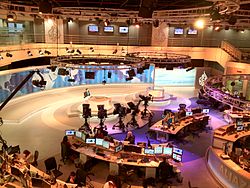
News broadcasting is the medium of broadcasting various news events and other information via television, radio, or the internet in the field of broadcast journalism. The content is usually either produced locally in a radio studio or television studio newsroom, or by a broadcast network. A news broadcast may include material such as sports coverage, weather forecasts, traffic reports, political commentary, expert opinions, editorial content, and other material that the broadcaster feels is relevant to their audience. An individual news program is typically reported in a series of individual stories that are presented by one or more anchors. A frequent inclusion is live or recorded interviews by field reporters.
Structure, content, and style
[edit] | This section needs additional citations for verification. (May 2024) |
Television
[edit]Television news programs inform and discuss current events via the medium of television. A "news bulletin" or a "newscast" are television programs lasting from seconds to hours that provide updates on events. Programs can vary their focus; some newscasts discuss largely international or national matters, while others will focus on regional and local news events.
Example providers of generalist broadcast news shows focusing on national and international matters include BBC News, NBC News, CNN, Fox News Channel, CNA, ANC, and Al Jazeera. In addition to general news outlets, there are many specialized news outlets. ESPNews, Fox Sports, and Eurosport News cover sports journalism topics; CNBC, Bloomberg Television, and Fox Business Network are examples that cover business news. Local programming covers the many examples of smaller stations with a regional focus.
Newscasts, also known as bulletins or news program(me)s, differ in content, tone, and presentation style depending on the format of the channel/station on which they appear, and their timeslot. In most parts of the world, national television networks will have bulletins featuring national and international news. The top-rated shows will often air in the evening during "prime time", but there are also morning newscasts of two to three hours in length. Rolling news channels broadcast news content 24 hours a day. The advent of the internet has allowed the regular 24-hour-a-day presentation of many video and audio news reports, which are updated when additional information becomes available; many television broadcasters provide content originally provided on-air as well as exclusive or supplementary news content on their websites. Local news may be presented by standalone local television stations, stations affiliated with national networks or by local studios which "opt-out" of national network programming at specified points. Different news programming may be aimed at different audiences, depending on age, socio-economic group, or those from particular sections of society. "Magazine-style" television shows (or newsmagazines) may mix news coverage with topical lifestyle issues, debates, or entertainment content. Public affairs programs provide analysis of and interviews about political, social, and economic issues.
News programs feature one or two (sometimes, three) anchors (or presenters, the terminology varies around the world) segueing into news stories filed by a reporter (or correspondent) by describing the story to be shown; however, some stories within the broadcast are read by the presenter themselves; in the former case, the anchor "tosses" to the reporter to introduce the featured story; likewise, the reporter "tosses" back to the anchor once the taped report has concluded and the reporter provides additional information. Often in situations necessitating long-form reporting on a story (usually during breaking news situations), the reporter is interviewed by the anchor, known as a 'two-way', or a guest involved in or offering analysis on the story is interviewed by a reporter or anchor. There may also be breaking news stories which will present live rolling coverage.
Television news organizations employ several anchors and reporters to provide reports (as many as ten anchors, and up to 20 reporters for local news operations or up to 30 for national news organizations). They may also employ specialty reporters that focus on reporting certain types of news content (such as traffic or entertainment), meteorologists or weather anchors (the latter term often refers to weather presenters that do not have degrees in meteorology earned at an educational institution) who provide weather forecasts – more common in local news and on network morning programs – and sports presenters that report on ongoing, concluded, or upcoming Packages will usually be filmed at a relevant location and edited in an editing suite in a newsroom or a remote contribution edit suite in a location some distance from the newsroom. They may also be edited in mobile editing vans, or satellite vans or trucks (such as electronic news gathering vehicles), and transmitted back to the newsroom. Live coverage will be broadcast from a relevant location and sent back to the newsroom via fixed cable links, microwave radio, production truck, satellite truck, or via online streaming. Roles associated with television news include a technical director, floor director audio technician, and a television crew of operators running character graphics (CG), teleprompters, and professional video cameras. Most news shows are broadcast live.
Radio
[edit]Radio news is transmitted through the medium of radio, meaning it is audio-only. It was a dominant form of information dissemination to households from the 1910s–1940s before home televisions became cheap and common. Radio news has persisted, often with short updates at certain intervals on the hour, although the medium of radio has generally shifted toward people doing something else such as driving, working or waking up, compared to television.
Radio news broadcasts can range from as little as one minute to as much as the station's entire schedule, such as the case of all-news radio, or talk radio. Stations that use a "wheel" format tend to keep to a set schedule of certain programming at certain specific minutes on the hour, and one of these segments is frequently a news bulletin. These short bulletins will provide overviews of any breaking news of interest, and may include local concerns such as weather forecasts or traffic reports.[1]
Internet
[edit]The vast majority of professionally produced video or audio news on the Internet tends to be attached to existing news organizations. Radio stations will upload their news reports as streamable podcasts and television networks will sometimes make their broadcasts available over Internet video. Print newspapers will sometimes feature video on their websites for breaking news events and for long-form video journalism. The usual focus on the Internet tends to be a la carte, however – rather than a recap show of the issues of the day like a TV or radio show, Internet news sites will usually allow the browser to find the one story they are interested in and watch a video strictly on that, even if said video might have been a segment of a larger show. Internet native news shows do exist such as Vice News, but they tend to seep elsewhere: Vice News ran a broadcast on HBO for a few years despite starting as a YouTube channel, for example, eventually transferring the show to their own network called Viceland and later Vice On TV.[2]
Outside the realm of traditional news organizations with paid journalists are citizen journalists, independents who report on their own and use sites such as YouTube to display their content. Independents also heavily cover commentary on news: while most independents cannot originally report on anything other than local issues due to budgetary concerns, opinions are cheaper. As such, Internet journalism has many video broadcasts & podcasts of opinion closer to the talk radio model. Hyper-local news is also more feasible on the Internet: issues such as school board meetings streamed on video, town parades, and so on.[3]
History
[edit]Silent news films were shown in cinemas from the late 19th century.[4] In 1909 Pathé started producing weekly newsreels in Europe.[4] Pathé began producing newsreels for the UK in 1910 and the US in 1911.[4]
News broadcasts in the United States were initially transmitted over the radio. NBC began broadcasts in November 1926, with CBS entering production on September 25, 1927.[5] Both initially discussed similar topics, such as election results, presidential inaugurations, and other matters of concern to the general public. However, NBC soon emerged as the dominant force for entertainment talent. In response, CBS President William S Paley focused on giving CBS Radio an upscale reputation with better news as well as commentary programs with well-regarded hosts such as Lowell Thomas.[6] Both broadcasters faced stiff competition from the newspapers. The outbreak of World War II led to a great increase in the quantity of news programming, consuming as much as 20% of the schedules of the major networks.[6] Chief among these reporters was Edward R. Murrow, whose reports from London kept the American public focused on a war far from home.[7] Also, the eventual "big three" were complete in 1945; the FCC forced a sale of NBC Blue due to anti-trust concerns, and the newly independent unit was renamed ABC (American Broadcasting Company).
A general shift over time happened in the style of the evening newscasts in most countries. In the 1950s, television was novel enough that it was considered entertainment. In the 1960s and 70s, television newscasts tended to be unusually "serious" by later standards, featuring more "hard news" and less light entertainment mixed in.[8] The CBS Evening News with Walter Cronkite is one famous example, although similar styles took place on the BBC in the United Kingdom, on shows in the Eastern Bloc, and so on, with high viewership concentrated in just a few prestige newscasts. This was something of an artifact of both technology and media culture: few channels were available, and those that did tended to take news casting seriously, even if lighter news could potentially have gotten more viewers.[8] Government regulation also affected the news landscape: in the United States, the Federal Communications Commission forced networks to abide by strict public-interest requirements that required broadcasting news, while television in the Soviet Union was strictly regulated by the government which looked on frivolous topics with disfavor. In the 1980s and 90s, this tended to fall away as a consequence of cable and satellite technology allowing a more fragmented market and government reluctance to interfere as closely. Increased choice in channels led to viewers declining to watch overly serious newscasts; successful network news shows tended to be ones that either focused on entertainment or at least mixed it in, such as morning talk shows or news magazines such as Today and 60 Minutes.[9] Audiences that prefer more serious news have migrated to news-focused stations such as CNN, Fox News, and MSNBC for American examples.[9] These changes have been criticized as having effects on larger society. An example from television in Italy is a study of Mediaset's rollout in Italy in the 1980s found that Mediaset's programming was slanted against news and educational content than its competitor RAI (Radiotelevisione italiana). A study in 2019 found that individuals in regions with an earlier rollout of Mediaset were more susceptible to populist appeals and less interested in "sophisticated" political arguments.[10] The study said the effect included populist parties in general that offered simple slogans and easy cure-alls, including non-Berlusconi populist parties such as the Five Star Movement.[11]
From 2000 to 2010, overall viewership of television broadcast news continued to decline. Some news-adjacent cable programs gained fame and success in this era (such as the comedy-focused The Daily Show With Jon Stewart and the commentary-focused The O'Reilly Factor). However, their gains did not offset the continuing steep decline in viewership of mainline network news.[12] This era saw diversification and fragmentation proceed even further as new niche networks gained prominence such as the business-focused CNBC, Bloomberg Television, and Fox Business. Instead, people used the Internet for news rather than television broadcasts, both in mainline sites such as ones runs by newspapers as well as independent blogs and message boards with other Internet-users sharing opinions and news[12] Internet news, while a competitor, tended not to use live broadcast as a style, except when streaming existing television programs. Another change in news broadcasts in the 2000s, at least in the United States, was a rediscovered interest in health news and consumer news – areas of special interest to women that had traditionally been written off as too minor for the evening newscasts, but proved to be steady sources of viewer curiosity and ratings.[12]
News broadcasting by country
[edit] | The examples and perspective in this section deal primarily with North America and Israel and do not represent a worldwide view of the subject. (December 2021) |
Canada
[edit]Terrestrial television
[edit]Unlike in the United States, most Canadian television stations have license requirements (enforced by the Canadian Radio-Television and Telecommunications Commission) to offer locally produced newscasts (or any local programming, for that matter) in some form. Educational television stations are exempt from these requirements as are multicultural television stations, however some stations licensed as multicultural outlets do produce local newscasts in varied languages (such as the Omni Television station group). Canadian television stations normally broadcast newscasts between two and four times a day: usually at noon, 5:00, 5:30, and 6:00, and 11:00 p.m. (there are some variations to this: stations affiliated with CTV usually air their late evening newscasts at 11:30 pm, due to the scheduling of the network's national evening news program CTV National News at 11:00 p.m. in all time zones; most CBC Television-owned stations formerly carried a 10-minute newscast at 10:55 pm, following The National, these were expanded to a half-hour and moved to 11:00 p.m. during the fall of 2012).[citation needed]
Some stations carry morning newscasts (usually starting at 5:30 or 6:00 am, and ending at 9:00 am). Unlike in the United States, primetime newscasts in the 10:00 p.m. timeslot are relatively uncommon (three Global owned-and-operated stations in Manitoba and Saskatchewan – CKND-DT, CFSK-DT, and CFRE-DT – and Victoria, British Columbia independent station CHEK-DT are the only television stations in the country carrying a primetime newscast); conversely, pre-5:00 a.m. local newscasts do not exist in Canada.[citation needed]
Like with U.S. television, many stations use varied titles for their newscasts; this is particularly true with owned-and-operated stations of Global and City (Global's stations use titles based on daypart such as News Hour for the noon and early evening newscasts and News Final for 11:00 p.m. newscasts, while all six City-owned broadcast stations produce morning news/talk programs under the umbrella title Breakfast Television and its flagship station CITY-DT/Toronto's evening newscasts are titled CityNews). Overall umbrella titles for news programming use the titling schemes "(Network or system name) News" for network-owned stations or "(Callsign) News" for affiliates not directly owned by a network or television system (although the latter title scheme was used on some network-owned stations prior to the early 2000s).[citation needed]
CBC Television, Global, and CTV each produce national evening newscasts (The National, Global National and CTV National News, respectively), which unlike the American network newscasts do not compete with one another in a common timeslot; while Global National airs at the same early evening time slot as the American evening network newscasts, The National's 10:00 p.m. Eastern Time slot competes against primetime entertainment programming on the private broadcast networks, while CTV National News airs against locally produced 11:00 p.m. newscasts on other stations. The National, which has aired on CBC Television since 1954, is the longest-running national network newscast in Canada. All three networks also produce weekly newsmagazines: CBC's The Fifth Estate (aired since 1975), Global's 16x9 (aired since 2008), and CTV's W5 (aired since 1966 and currently the longest-running network newsmagazine in Canada).[citation needed]
CTV's Your Morning is the sole national morning news program on broadcast television in Canada, and replaced Canada AM, which aired since 1975. Most CTV owned-and-operated stations west of the Ontario-Manitoba border dropped the program during the summer and fall of 2011 in favor of locally produced morning newscasts. The Sunday morning talk show is relatively uncommon on Canadian television; for many years, the closest program having similarities to the format was CTV's news and interview series Question Period; Global would eventually debut the political affairs show The West Block in November 2011.
Specialty television
[edit]Canada is host to several 24-hour news channels on specialty television, including CBC News Network and CTV News Channel in English, and Ici RDI and Le Canal Nouvelles (LCN) in French. BNN Bloomberg operates as a financial news channel, while Sun News Network briefly operated from 2011 to 2015 as a conservative-leaning competitor to the other national news channels. There are also a handful of regional news channels, such as CP24 (which covers the Greater Toronto Area), and Global News: BC 1, which covers Vancouver. CityNews Channel formerly operated as a competitor to CP24, although that channel shut down after a year and a half of operation in May 2013
The U.S. CNN, Fox News, HLN, and MSNBC, as well as a number of other international news channels (such as, most commonly, Al Jazeera English and BBC World News) are authorized for distribution by Canadian television providers by the CRTC.
United States
[edit]Broadcast television
[edit]Local newscasts
[edit]Local TV stations in the United States normally broadcast local news three to four times a day on average: commonly airing at 4:30, 5:00, 5:30, or 6:00 a.m.; noon; 5:00 and 6:00 p.m. in the early evening; and 10:00 or 11:00 p.m. Some stations carry morning newscasts at 4:00, 7:00, 8:00, or 9:00 a.m., midday newscasts at 11:00 or 11:30 a.m., late afternoon newscasts at 4:00 or 4:30 p.m., or early evening newscasts at 5:00 or 6:00 p.m. Many Fox affiliates, affiliates of minor networks (such as The CW and MyNetworkTV), and independent stations air newscasts in the final hour of primetime (i.e., 10:00 p.m. in the Eastern and Pacific time zones or 9:00 p.m. in the Mountain and Central time zones in the U.S.). Stations that produce local newscasts typically broadcast as little as one to as much over twelve hours of local news on weekdays and as little as one hour to as much as seven hours on weekends; news programming on weekends are typically limited to morning and evening newscasts as the variable scheduling of network sports programming (if a station is affiliated with a network with a sports division) usually prevents most stations from carrying midday newscasts (however a few stations located in the Eastern and Pacific time zones do produce weekend midday newscasts).[citation needed]
From the 1940s to the 1960s, broadcast television stations typically provided local news programs only one to two times each evening for 15 minutes (the normal length for many locally produced programs at the time); usually these programs aired as supplements to network-supplied evening news programs or leadouts for primetime programming. Reports featured on local and national television newscasts during this time were generally provided via film or still photography; eventually, videotape began to be used to provide live coverage of news events. The 1950s also saw the first use of airborne newsgathering; most notably, in 1958, Los Angeles television station KTLA began operating the "Telecopter", a helicopter equipped for newsgathering use that was the most advanced airborne television broadcast device of its time.[citation needed]
The modern-day coverage of major breaking news events came to fruition following the assassination of John F. Kennedy on November 22, 1963; the news of Kennedy's death was first announced by Eddie Barker, the news director at KRLD-TV (now KDFW) in Dallas, who passed along word from an official at Parkland Hospital; Barker's scoop appeared live simultaneously on CBS and ABC as a result of a local press pool arrangement. Many local and national news organizations such as Dallas station WFAA-TV and CBS News provided continuous coverage of the events and aftermath for five days. The November 24, 1963, assassination of Kennedy's accused killer Lee Harvey Oswald by Jack Ruby was fed to NBC by a remote unit on loan to its Dallas affiliate WBAP-TV (now KXAS-TV) from competitor KTVT, and was the first murder to have been witnessed live on U.S. network television. The coverage provided by the local stations eventually led to further investments and technological developments to provide real-time news; newsgathering vehicles equipped with satellites began to be used on the local and national levels beginning in the 1970s. During the 1960s and 1970s, many stations began to provide additional news programming, beginning with midday news programs; in the late 1970s, the first local morning news programs debuted.[citation needed]
Additional changes in local news content came during the 1980s and 1990s; in January 1989, WSVN in Miami became the first to adopt a news-intensive programming format; rather than fill its schedule with syndicated content as other Fox stations did at the time it joined that network, Ed Ansin (owner of WSVN parent Sunbeam Television) chose instead to heavily invest in the station's news department, and replace national newscasts and late-prime time network programs vacated as a result of losing its NBC affiliation (the byproduct of an affiliation switch caused by CBS and WSVN's former network partner NBC buying other stations in the market) with additional newscasts. This model was eventually replicated by many other stations affiliated with the post-1986 television networks as well as some news-producing independent stations (beginning with Fox's 1994 deals with New World Communications and SF Broadcasting that saw several major network stations change their affiliations), and also resulted in even NBC, CBS, and ABC affiliates adopting similar scheduling formats (tweaked to account for the larger amount of network programming that those networks carry). In 1990, WEWS-TV in Cleveland conceived a concept known as the "24-Hour News Source" (which has its origins in a news format used by short-lived Boston independent station WXPO-TV when it signed on in 1969), in which supplementary 30-second long news updates were produced at or near the top of each hour outside regular long-form newscasts during local commercial break inserts shown within network and syndicated programming. The format spread to other U.S. television stations (most notably, WISH-TV in Indianapolis, one of the few remaining users of the concept), most of which eventually disposed of the hourly update format by the early 2000s.[citation needed]
Since the early 1990s, independent stations and stations affiliated with a non-Big Three network have entered into "news share agreements", in which news production is outsourced to a major network station (usually an affiliate of ABC, NBC, or CBS), often to avoid shouldering the cost of starting a news department from scratch or because of a lack of studio space. These commonly involve Fox, CW, and MyNetworkTV affiliates (and previously affiliate stations of the now-defunct predecessors of the latter two networks, The WB and UPN) and in some cases, independent stations; however such agreements exist in certain markets between two co-owned/co-managed Big Three affiliates. News share agreements are most common with stations co-owned with a larger network affiliate or whose operations are jointly managed through a shared service or local marketing agreement. In cases where a station with an existing news department enters into a news share agreement, it will result either the two departments merging or the outright conversion of newscast production from in-house to outsourced production. Minor network affiliates involved in news share agreements will often carry far fewer hours of local newscasts than would be conceivable with an in-house news department to avoid competition with the outsourcing partner's own newscasts, as a result, minor network affiliates involved in these NSAs often will carry a morning newscast from 7:00 to 9:00 a.m. (in competition with the national network newscasts instead of airing competing with the Big Three affiliates' newscasts) or a primetime newscast at 10:00 pm. Eastern and Pacific or 9:00 pm. Central and Mountain Time, with limited to no newscasts in other traditional news time periods (midday, late afternoon, or early evening).[citation needed]
Because of the increased presence of duopolies and outsourcing agreements since the early 2000s, the number of minor network affiliates and independent stations that produce their own newscasts has markedly decreased compared to when duopolies were barred under Federal Communications Commission rules prior to 2000 (as of 2013, there are at least 15 minor network affiliates or independent stations that produce their own local newscasts, most are located within the 20 largest U.S. media markets). Duopolies and outsourcing agreements have also affected Fox stations in a similar manner; although Fox is considered to be a major network on the same level as NBC, ABC, and CBS and has urged its affiliates since the early 1990s to broadcast local news, about half of its stations broadcast local news programming through news share agreements with many of the remainder operating their own news departments. Several stations affiliated with Spanish-language networks (such as Univision, Telemundo, and UniMás) or also broadcast their own newscasts, these stations often produce a substantially lower weekly newscast output compared to its English-language counterparts (usually limited to half-hour broadcasts in the evening, and often airing only on weeknights).[citation needed]
Unlike international broadcast stations which tend to brand under uniform newscast titles based solely on network affiliation, U.S. television stations tend to use varying umbrella titles for their newscasts; some title their newscasts using the station's on-air branding (such as combining the network affiliation and channel number with the word "News"), others use franchised brand names (like Eyewitness News, Action News and NewsChannel) for their news programming. Conversely, the naming conventions for a station's newscast are sometimes used as a universal on-air branding for the station itself, and may be used for general promotional purposes, even used in promoting syndicated and network programming (such as KFOR-TV in Oklahoma City, Oklahoma, which uses the uniform news and general branding NewsChannel 4). Many stations title their newscasts with catchy names like Daybreak, Good Morning (city or region name), First at Four, Live at Five, Eleven @ 11:00, or Nightcast. These names are intended to set one station apart from the rest, especially for viewers who are chosen for audience measurement surveys. If the respondent was unable to provide a channel number or call letters, the newscast title is often enough for the appropriate station to receive Nielsen ratings credit.[citation needed]
Network world news programs
[edit]The Big Three broadcast television networks produce morning and evening national newscasts. These newscasts are focused on world news, national news, and sometimes local news items that have some national significance. (Good Morning America First Look, Good Morning America, and ABC World News are broadcast by ABC, CBS broadcasts the CBS News Mornings, CBS Mornings, and the CBS Evening News, and NBC produces Early Today, Today, and NBC Nightly News) as well as weekly newsmagazine series (NBC's Dateline; ABC's 20/20 and Nightline; and CBS's CBS News Sunday Morning, 48 Hours, and 60 Minutes).[citation needed]
Network morning newscasts usually air at 7:00 a.m. (English-language network morning shows air live in the Eastern Time Zone and tape delayed for the remaining time zones, while the Spanish-language morning shows air live in the Eastern, Central, and Mountain time zones and are tape delayed in the Pacific Time Zone); network evening newscasts usually are broadcast live twice, at 6:30 p.m. Eastern time/5:30 p.m. Central time for the East Coast before another "Western Edition" live broadcast at 6:30 p.m. Pacific time/7:30 p.m. Mountain time. Today was the first morning news program to be broadcast on American television and in the world, when it debuted on January 14, 1952; the earliest national evening news program was The Walter Compton News, a short-lived 15-minute newscast that aired on the DuMont Television Network from 1947 to 1948.[citation needed]
All four major English networks and the two largest Spanish networks also carry political talk programs on Sunday mornings (NBC's Meet the Press, ABC's This Week, CBS' Face the Nation, Fox's sole news program Fox News Sunday, Univision's Al Punto, and Telemundo's Enfoque); of these programs, Meet the Press holds the distinction of being the longest-running American television program as it has aired since November 6, 1947. The U.S. is one of the few countries in which broadcast networks provide overnight or early morning national news programs, in addition to those airing in the morning and early evening. CBS and ABC are currently the only networks that produce overnight news programs on weeknights in the form of Up to the Minute and World News Now, respectively; NBC previously produced overnight newscasts at different times, both of which have since been cancelled: NBC News Overnight from 1982 to 1983, and NBC Nightside from 1991 to 1998 (NBC currently does not offer a late night newscast, although the network currently airs rebroadcasts of the fourth hour of Today, and sister network CNBC's Mad Money on weeknights).[citation needed]
Spanish-language news programs are provided by Univision, which produces early and late evening editions of its flagship evening news program Noticiero Univision seven nights a week (and was the only nightly newscast on the major Spanish networks until Telemundo resumed its weekend newscasts in October 2014), along with weekday afternoon newsmagazine Primer Impacto and weekday morning program Despierta America; Telemundo, which has a daily flagship evening newscast Noticias Telemundo, along with weekday morning program Hoy Día (which replaced Un Nuevo Día in 2021) and weekday afternoon newsmagazine Al Rojo Vivo; Estrella TV, which produces the weekday-only flagship news program Noticiero Estrella TV and the primetime newscast Cierre de Edición; and Azteca América, which produces morning, early and late evening newscasts on weekdays under the umbrella title Hechos. In the cases of Univision and Telemundo, both of their evening news programs compete with national evening news programs on their English-language competitors.[citation needed]
Fox, The CW, and MyNetworkTV do not produce national morning and evening news programs (although Fox made a brief attempt at a morning program from 1996 to 1997 with Fox After Breakfast; many CW and MyNetworkTV affiliates and independent stations air the syndicated news program The Daily Buzz, while some Tribune Broadcasting-owned CW and MyNetworkTV stations air a similar program called EyeOpener).[citation needed]
Cable television
[edit]24-hour news channels are devoted to current events around the clock. They are often referred to as cable news channels. The format was originated by the cable television channel CNN (Cable News Network), which was established in 1980.[13] Many other television channels have since been established, including what has become known as the Big Three; CNN, Fox News, and MSNBC.[14]
Conversely, several cable news channels exist that carry news reports specifically geared toward a particular metropolitan area, region, or state such as New York City's NY1 (which focuses on the entire New York metropolitan area) and News 12 Networks (which serves portions of the area outside Manhattan), Orlando's News 13 (which is also carried in areas surrounding Greater Orlando), Tampa, Florida's Bay News 9, and Washington, D.C.'s NewsChannel 8. These channels are usually owned by a local cable operator and are distributed solely through cable television and IPTV system operators. Some broadcast television stations also operate cable channels (some of which are repeated through digital multicasting) that air the station's local newscasts in the form of live simulcasts from the television station, with rebroadcasts of the newscasts airing in time periods between the live broadcasts.[citation needed]
A term which has entered common parlance to differentiate cable news from traditional news broadcasts is network news, in reference to the traditional television networks on which such broadcasts air. A classic example is the cable news channel MSNBC, which overlaps with (and, in the case of very significant breaking news events, pre-empts) its network counterpart NBC News; in some cases, viewers may have trouble differentiating between the cable channel and either a counterpart network news organization or a local news operation, such as is the case with Fox News Channel and the Fox network's owned-and-operated stations and affiliates (most of which use the Fox (channel #) News brand for their newscasts), due to the network's controversially perceived conservative-leaning political content that differs from the Fox broadcast stations' independent and generally nonpartisan reporting. Most U.S. cable news networks do not air news programming 24 hours a day, often filling late afternoon, primetime, and late night hours with news-based talk programs, documentaries, and other specialty programming.[citation needed]
Radio
[edit]More often, AM radio stations will air a 6½-minute newscast at the top of the hour, which can be either a local report, a national report from a radio network such as CBS Radio, CNN Radio, NPR, Fox News Radio, or ABC News Radio, or a mix of both local and national content, including weather and traffic reports. Some stations also air a two-minute report at the bottom of the hour.[citation needed]
FM stations, unless they feature a talk radio format, usually only air an abbreviated weather forecast. Some also air minute-long news capsules featuring a quick review of events, and usually only in drive time periods or in critical emergencies, since FM stations usually focus more on playing music. Traffic reports also air on FM stations, depending on the market.[citation needed]
In some countries, radio news content may be syndicated by a website or company to many stations in a particular region or even the entire country. A notable example is Israel, where there are groups of radio stations that broadcast the same hourly news capsule by an Israeli news website and television station. There are currently two groups of local Israeli stations: one broadcasts news from YNET, the other broadcasts them from Channel 10. Israeli Army Radio general public stations broadcast the same news capsule every hour, and IBA's Kol Israel stations broadcast theirs.[citation needed]
See also
[edit]
- 24-hour television news channels
- Broadcast Journalism
- Current affairs (news format)
- Electronic field production (EFP)
- Electronic news-gathering (ENG)
- List of news presenters
- List of news channels
- Livestreamed news
- Newsroom
- Outside broadcast
- Television news music
- Television news screen layout
- Television presenter
References
[edit]- ^ Sterling, Christopher. Encyclopedia of Radio Archived March 26, 2023, at the Wayback Machine p. 1097.
- ^ Sutton, Kelsey (February 7, 2020). "An Expanded Vice News Tonight Will Air on Vice TV". www.adweek.com. Archived from the original on August 20, 2021. Retrieved August 20, 2021.
- ^ Miller, Claire Cain; Stone, Brad (April 12, 2009). "Hyperlocal Web Sites Deliver News Without Newspapers". The New York Times. Archived from the original on July 13, 2019. Retrieved August 20, 2021.
- ^ a b c Fielding, Raymond (2015). The American Newsreel A Complete History, 1911–1967 2d Edition. McFarland Incorporated. pp. 44–46. ISBN 9780786466108.
- ^ "The Museum of Broadcast Communications – Encyclopedia of Television – News Network". www.museum.tv. Archived from the original on July 12, 2018. Retrieved October 21, 2018.
- ^ a b Ponce de Leon 2015, pp. 23–25.
- ^ "A Brief Look at the History of Broadcast Journalism". Student Resources. April 1, 2015. Archived from the original on July 24, 2020. Retrieved October 21, 2018.
- ^ a b Ponce de Leon 2015, pp. 7–12.
- ^ a b Ponce de Leon 2015, pp. 12–14.
- ^ Tesei, Andrea; Pinotti, Paolo; Durante, Ruben (2019). "The Political Legacy of Entertainment TV". American Economic Review. 109 (7): 2497–2530. doi:10.1257/aer.20150958. hdl:10419/130776. ISSN 0002-8282.
- ^ "How trashy TV made children dumber and enabled a wave of populist leaders". The Washington Post. July 20, 2019. Archived from the original on May 26, 2023.
- ^ a b c Ponce de Leon 2015, pp. 259–263.
- ^ Hughes, Lain. "CNN". New Georgia Encyclopedia. Archived from the original on August 24, 2021. Retrieved August 24, 2021.
- ^ Barr, Jeremy (May 24, 2021). "Can cable news win over young viewers? At MSNBC, a 40-year-old new president is going to try". The Washington Post. Archived from the original on June 17, 2021. Retrieved August 24, 2021.
Bibliography
[edit]- Ponce de Leon, Charles (2015). That's the Way It Is: A History of Television News in America. University of Chicago Press. ISBN 978-0-226-25609-2.
Further reading
[edit]

- Kierstead, Phillip. "News, Network". Encyclopedia of Television. The Museum of Broadcast Communications. Archived from the original on November 23, 2015.
- "A Brief Look at the History of Broadcast Journalism". Student Resources. New York Film Academy. April 1, 2015. Archived from the original on December 16, 2023. Retrieved May 25, 2024.
| International | |
|---|---|
| National | |
| Other | |

News broadcasting
View on GrokipediaFundamentals
Definition and Core Principles
News broadcasting constitutes the electronic transmission of factual reports on current events, developments, and public interest matters to mass audiences primarily through radio and television, though increasingly via digital streaming. It involves structured formats such as newscasts, where anchors deliver scripted summaries, often augmented by on-location footage, interviews, or graphics to convey information rapidly and accessibly. Unlike print media, broadcast news leverages audio and visual elements to engage viewers aurally and visually, enabling real-time dissemination that prioritizes brevity due to airtime limitations.[10][11] The core principles of news broadcasting stem from established journalistic standards, emphasizing empirical verification and public accountability to foster informed citizenship. Foremost among these is accuracy, requiring rigorous fact-checking and correction of errors promptly, as unverified claims can mislead large audiences instantaneously.[12] The Society of Professional Journalists (SPJ) Code of Ethics, a benchmark for the field since its 2014 revision, mandates that journalists "seek truth and report it" by testing information against multiple sources and distinguishing news from opinion.[12] Complementing this is fairness, which demands balanced presentation of perspectives on contentious issues, historically reinforced in the U.S. by the Federal Communications Commission's (FCC) Fairness Doctrine (1949–1987), obligating broadcasters to air contrasting viewpoints to prevent one-sided dominance amid limited spectrum resources.[13] The doctrine's repeal in 1987 stemmed from First Amendment concerns over governmental content oversight, shifting reliance to self-regulation.[14] Additional principles include independence, insulating reporting from commercial, political, or ideological influences to maintain credibility, and minimizing harm, weighing the public right to know against potential damage from sensationalism or privacy invasions.[12] Accountability requires transparency in sourcing and methods, enabling audience scrutiny. These tenets, while aspirational, confront practical challenges in broadcasting, where production pressures and institutional incentives—such as advertiser dependencies or editorial gatekeeping—can introduce selection biases, as evidenced by content analyses revealing disproportionate emphasis on certain narratives over others.[15] Broadcasters also adhere to a public interest obligation, rooted in FCC licensing since the Radio Act of 1927, mandating service to community informational needs rather than mere entertainment or profit. In aggregate, these principles aim to prioritize causal fidelity to events over narrative conformity, though empirical deviations underscore the tension between ideals and execution in a competitive media landscape.Objectives and Ethical Standards
The primary objectives of news broadcasting are to deliver accurate, timely, and comprehensive information about current events to enable public understanding, informed decision-making, and effective civic participation in democratic societies.[16] This includes reporting facts from local communities to global developments, prioritizing reliability and objectivity to distinguish news from opinion or entertainment.[17] Broadcasters aim to educate audiences on verifiable events, allowing individuals to form their own assessments rather than prescribing narratives.[18] Ethical standards in news broadcasting are guided by professional codes emphasizing truth-seeking, fairness, and independence. The Society of Professional Journalists (SPJ) Code of Ethics, revised in 2014, outlines four core principles: seek truth and report it by testing information accuracy and providing context; minimize harm by balancing public interest against potential damage to individuals; act independently by avoiding conflicts of interest and undue influence from advertisers or governments; and be accountable by correcting errors promptly and transparently explaining sourcing decisions.[12] Similarly, the Radio Television Digital News Association (RTDNA) stresses owning mistakes with prominent corrections and rejecting commercial endorsements that could compromise editorial integrity.[19] These standards require journalists to verify facts rigorously, attribute information clearly, and resist pressures that prioritize speed or sensationalism over precision, such as in breaking news scenarios where unconfirmed reports can mislead audiences.[20] In practice, adherence to these standards faces challenges from commercial imperatives, where audience metrics incentivize clickbait or exaggerated coverage, and from institutional biases that skew selection and framing of stories. Empirical analyses, including content audits of major outlets, reveal patterns of disproportionate emphasis on certain ideological perspectives, often aligning with prevailing views in journalistic institutions, which undermines claims of neutrality.[21] For instance, studies of U.S. broadcast coverage during election cycles have documented underrepresentation of dissenting economic or policy critiques, attributing this to homogeneity in newsroom demographics and sourcing networks.[22] Broadcasters are thus ethically obligated to disclose potential biases and diversify viewpoints, though self-regulation remains limited by the absence of enforceable mechanisms beyond voluntary codes.[23] Violations, such as fabricating details or suppressing exculpatory evidence, erode public trust, as evidenced by declining confidence in media institutions reported in longitudinal surveys from 2020 to 2025.[24]Formats and Delivery Mediums
Television News Formats
Television news formats encompass structured presentations of current events, typically combining anchor narration, video footage, and graphics to convey information visually and audibly. These formats evolved from radio-style readings in the mid-20th century to more dynamic, viewer-engaging structures driven by competition for audiences and technological advances in live reporting.[25] Standard newscasts, often aired in fixed slots such as evening bulletins, summarize key events in a linear sequence: lead stories followed by national, international, local reports, weather, and sports. These programs usually run 22 to 30 minutes within a half-hour broadcast, allocating time for commercials, with anchors delivering scripted intros over b-roll footage or correspondent packages.[11] A news bulletin, a concise variant, delivers organized selections of stories at regular intervals, sometimes incorporating live updates or financial data, prioritizing brevity for frequent airings throughout the day.[26] The news magazine format shifts toward depth over immediacy, featuring self-contained segments on investigations, profiles, or analyses, often with correspondent-led narratives and interviews. CBS's 60 Minutes, debuting on September 24, 1968, pioneered this approach by blending journalistic rigor with dramatic storytelling, running multiple unrelated features per episode to appeal to primetime viewers.[27][28] This format, which combines elements of documentaries and soft news, gained popularity for its ability to explore complexities beyond surface-level reporting, influencing subsequent programs like Dateline NBC and Frontline.[29] Local television news adopted energetic, visual-heavy formats in the late 1960s and 1970s to differentiate from network broadcasts and capture regional audiences. Action News, launched by Philadelphia's WPVI-TV on April 6, 1970, emphasized rapid story turnover, on-location videography, and conversational anchor "happy talk" to foster familiarity and urgency, significantly boosting ratings in competitive markets.[30] Similarly, Eyewitness News formats, emerging around the same era, prioritized eyewitness accounts and community-oriented visuals to humanize stories, replacing static studio delivery with mobile reporting units.[31] Breaking news and special reports interrupt regular programming for unfolding events, relying on live feeds, expert commentary, and ticker updates to provide real-time coverage, a practice intensified by 24-hour cable channels post-1980. Morning news hybrids integrate hard news bulletins with lifestyle segments, interviews, and performances, as seen in programs extending from early local wakes to national shows blending information with entertainment for extended runtimes. Across formats, production prioritizes verifiable sourcing and timeliness, though audience metrics have driven shifts toward sensational elements in some outlets, potentially diluting analytical depth.[25][32]Radio News Broadcasting
Radio news broadcasting transmits news content exclusively through audio signals via radio waves, relying on verbal narration, interviews, and ambient sounds to convey events without visual elements. This medium prioritizes concise scripting adapted for auditory consumption, where reporters craft stories optimized for the ear, often incorporating "actuality"—recorded clips from the scene—to enhance immediacy and authenticity.[33] Pioneered in the United States, the first commercial radio news broadcast occurred on November 2, 1920, when KDKA in Pittsburgh aired live results of the Harding-Cox presidential election, marking the inception of regular news dissemination over the airwaves.[34] Formats in radio news vary from brief hourly bulletins summarizing top stories to extended newscasts featuring in-depth analysis and listener call-ins, particularly in news-talk hybrids. Bulletins typically last 2-5 minutes, delivering headlines and updates in a fast-paced, phonetic style to accommodate natural speech patterns, while longer programs integrate expert commentary and field reports. During crises, such as the December 7, 1941, broadcast of the Pearl Harbor attack, radio's real-time capability allowed stations to interrupt programming for urgent bulletins, outpacing print media in speed.[35] News-talk formats, which blend reporting with opinion, proliferated after the 1987 repeal of the FCC's Fairness Doctrine, enabling hosts to express partisan views without mandated counterpoints, a shift that critics attribute to the rise of ideologically driven content challenging perceived establishment narratives in other media.[36] Delivery methods evolved from analog AM and FM transmissions to digital enhancements, including HD Radio for improved clarity and satellite distribution for national syndication. Modern radio news increasingly streams online via apps and integrates with podcasts, allowing on-demand access; for instance, U.S. stations produced an average of 2.4 podcasts per outlet in 2024, extending reach beyond traditional tuners. Advantages include portability—listeners can tune in via car radios or mobiles—and cost-effectiveness for broad audiences, with weekly U.S. listenership at 83% as of 2020, sustaining relevance amid digital competition.[37] [38] Challenges persist due to the absence of visuals, which constrains coverage of spatially complex or data-heavy stories, necessitating descriptive language that risks listener disengagement if overly verbose. Measurement of impact lags behind digital metrics, complicating advertiser appeal, though radio's local focus fosters community ties and emergency alert efficacy, as demonstrated in disaster reporting where audio cuts through visual overload.[39] Despite fragmentation from streaming platforms, radio news maintains utility in regions with limited broadband, underscoring its resilience rooted in accessible, voice-driven immediacy over spectacle.[40]Digital and Streaming Platforms
Digital platforms have transformed news broadcasting by enabling on-demand access, live streaming, and personalized delivery through websites, mobile apps, and over-the-top (OTT) services, decoupling content from traditional broadcast schedules. This shift accelerated with widespread broadband adoption and smartphone penetration, allowing broadcasters to extend reach beyond linear television and radio. By May 2025, streaming accounted for 44.8% of total U.S. TV usage, exceeding the combined share of broadcast (20.1%) and cable (24.1%), reflecting broader migration to digital formats.[41][42] Major news organizations operate dedicated streaming channels and apps, such as Fox News' Fox Nation and YouTube live streams, which captured significant viewership amid cord-cutting trends. For instance, Fox News led cable news ratings in October 2025 with 390,000 total day viewers, bolstered by digital extensions that integrate video clips and full broadcasts. Platforms like YouTube dominate streaming video, contributing to news consumption where live streams from outlets like BBC News and Al Jazeera reach global audiences without geographic cable restrictions. Social media platforms, including X (formerly Twitter) and TikTok, have overtaken television as the primary U.S. news source by mid-2025, with algorithms prioritizing viral content over editorial curation.[43][44][45] Technologically, adaptive bitrate streaming and content delivery networks ensure low-latency delivery for live events, such as election coverage or breaking news, rivaling traditional broadcasts in quality. However, this proliferation fragments audiences across niche platforms, reducing the shared national experience of events like 9/11-era TV viewership and fostering selective exposure to ideologically aligned sources. Digital platforms exacerbate this via recommendation algorithms that amplify partisan content, contributing to polarized information ecosystems, as evidenced by studies showing increased niche media consumption over mass outlets.[46][47] Economically, news streaming relies on a mix of advertising, subscriptions, and freemium models, with ad-supported video-on-demand (AVOD) growing at a 14.1% CAGR through 2029 amid slowing subscription revenue. Traditional broadcasters face revenue declines from cord-cutting, prompting hybrids like Paramount+ integrating CBS News or Warner Bros. Discovery's Max with CNN content. Yet, challenges persist: digital platforms enable rapid misinformation spread, unverified user-generated content, and dependency on third-party algorithms that prioritize engagement over factual accuracy, undermining journalistic standards without the gatekeeping of legacy media.[48][49]Production Processes
News Gathering and Reporting
News gathering in broadcast journalism encompasses the systematic collection of raw information from diverse sources, including on-the-scene reporting, wire services, official statements, and digital monitoring, to form the basis for audio-visual news segments. Reporters and correspondents, often deployed in the field, conduct interviews with eyewitnesses, officials, and experts while capturing video footage or audio recordings using portable electronic equipment, a practice formalized as electronic news gathering (ENG) since the adoption of lightweight video cameras in the 1970s.[50] This process prioritizes timeliness, with assignment desks in newsrooms triaging tips from police scanners, press releases, and international bureaus to dispatch teams efficiently.[51] In television broadcasting, field reporters utilize satellite news gathering (SNG) trucks or backpack units equipped with microwave transmitters to relay live feeds from remote locations, enabling real-time transmission of events such as disasters or political rallies; for instance, during the 2024 U.S. presidential election coverage, networks like CNN deployed over 100 embedded reporters across battleground states using such mobile satellite uplinks. Radio news gathering, by contrast, relies more heavily on audio-focused tools like digital recorders and phone lines for voice reports, emphasizing concise eyewitness accounts and ambient sound to convey urgency without visuals.[52] Both mediums increasingly incorporate user-generated content from social media platforms, where videos or posts from citizens serve as initial leads, though broadcasters must cross-verify to mitigate misinformation risks.[53] Verification remains a core step, guided by ethical codes such as the Society of Professional Journalists' principles, which mandate honesty and courage in sourcing while minimizing harm through fact-checking against multiple independent outlets.[12] Broadcasters employ tools like reverse image searches and database cross-references to authenticate footage, as unverified reports can propagate errors rapidly in 24-hour cycles; a 2023 Reuters Institute study noted that 68% of newsrooms now use automated verification software to scan for deepfakes in submitted videos. Challenges persist, including source access restrictions in authoritarian regimes and the pressure of "first on air" incentives, which can favor speed over depth and introduce selection biases toward sensational or ideologically aligned narratives.[54] Modern technologies have transformed gathering efficiency, with mobile journalism (mojo) allowing single reporters to produce content via smartphones integrated with 5G for high-quality uploads; by 2025, over 70% of U.S. local TV stations reported using drone footage for aerial perspectives in breaking stories like wildfires.[55] Artificial intelligence aids in monitoring vast data streams from social media and public records, flagging potential stories, but human oversight is essential to avoid algorithmic biases that amplify unrepresentative viral content.[56] In radio, apps for remote audio editing enable rapid compilation of contributor clips, reducing reliance on studio-bound production.[57] Despite these advances, empirical analyses reveal persistent institutional pressures, such as advertiser influence or editorial gatekeeping, that can skew source diversity toward elite or compliant voices, underscoring the need for transparent sourcing to uphold causal accountability in reporting.[58]Editing, Presentation, and Dissemination
In news broadcasting, the editing phase transforms raw gathered material into a coherent broadcast package, involving scriptwriting, video and audio trimming, and integration of graphics or B-roll footage to enhance narrative flow and viewer engagement. Editors prioritize brevity and clarity, often adhering to standards like the Associated Press style for factual precision, while removing extraneous elements to fit time constraints typical of 30-90 second segments.[59] Fact-checking occurs rigorously during this stage, with editorial teams verifying claims against primary sources, data, and eyewitness accounts to mitigate errors, as internal quality control models recommend cross-referencing before final approval.[60][61] Presentation techniques emphasize professional delivery to convey authority and neutrality, with anchors employing teleprompters for scripted reads, maintaining consistent pacing at around 150-160 words per minute, and modulating tone to match story gravity—serious for conflicts, measured for economic reports. Reporters on location use natural gestures and direct camera eye contact to build rapport, while studios incorporate lower-thirds for identifications and chyrons for key facts, ensuring visual hierarchy that guides viewer attention without overwhelming content.[62][63] Dissemination follows approval, deploying content via over-the-air terrestrial signals, cable/satellite feeds, or digital streams to reach audiences, with live broadcasts enabling real-time delivery and recorded packages archived for rebroadcast or on-demand access. In television, formats are optimized for multiple resolutions (e.g., 1080p HD to 4K) and aspect ratios to suit distribution platforms, while radio relies on audio syndication to affiliates. Modern workflows increasingly include simultaneous online uploads to apps and websites, expanding reach beyond traditional signals.[64][65]Historical Evolution
Origins and Early Adoption (Pre-1950)
The origins of news broadcasting trace to the advent of radio in the early 20th century, where wireless technology enabled the dissemination of information to mass audiences beyond print or telegraph limitations. One of the earliest scheduled radio services, PCGG in Rotterdam, Netherlands, began operations on November 6, 1919, marking an initial step toward regular broadcasts that included news content.[66] In the United States, station WWJ in Detroit aired what is recognized as the first radio news program on August 31, 1920, reading headlines from local papers.[67] This was swiftly followed by KDKA in Pittsburgh, which on November 2, 1920, transmitted live returns from the Harding-Cox presidential election, operated by Westinghouse Electric and Manufacturing Company as the first commercial broadcast, reaching an estimated audience via amateur receivers.[34][68] Early adoption in the U.S. accelerated throughout the 1920s, with radio stations proliferating from five in 1921 to over 600 by the end of the decade, many incorporating news bulletins sourced from wire services like the Associated Press.[69] Networks formed to extend reach: the National Broadcasting Company (NBC) launched in 1926, followed by the Columbia Broadcasting System (CBS) in 1927, enabling coast-to-coast news relays, such as NBC's coverage of the 1927 Tunney-Dempsey heavyweight fight, which demonstrated radio's capacity for real-time event reporting.[70] By the 1930s, radio news evolved with on-site reporting and commentators, though initial formats relied heavily on scripted readings from print sources due to technical constraints like live transmission limitations. In Europe, adoption paralleled U.S. developments but emphasized public service models. The British Broadcasting Company (later Corporation) commenced daily transmissions from its 2LO station in London on November 14, 1922, with the inaugural program featuring a news bulletin supplied by agencies, establishing a pattern of scheduled evening updates.[71] France's Radio Paris offered daily newscasts by 1924, amid growing private and state-supported stations.[72] These efforts laid groundwork for continent-wide expansion, though regulatory and technical hurdles delayed widespread penetration compared to the U.S. Pre-1950 news broadcasting matured during the interwar period and World War II, when radio became indispensable for timely war updates, morale boosting, and propaganda. In the U.S. and Allied nations, stations provided real-time alerts, such as the September 3, 1939, broadcasts of Britain and France's war declarations, fostering national cohesion through shared listening.[73] Wartime censorship and resource rationing curtailed some programming, yet radio's immediacy—evident in live accounts of events like Pearl Harbor on December 7, 1941—solidified its role over print media. Early television experiments, such as NBC's W2XBS newscasts in 1940, introduced visual elements but remained marginal due to high costs, limited receivers (fewer than 8,000 U.S. households by 1941), and wartime shutdowns, deferring TV news dominance.[74] Overall, radio's pre-1950 era established broadcasting as a direct, audible conduit for factual reporting, prioritizing speed and accessibility amid technological infancy.Post-War Expansion and Television Dominance (1950-1990)
Following World War II, television broadcasting in the United States experienced explosive growth, driven by pent-up consumer demand and technological availability, with the percentage of households owning at least one set rising from 9% in 1950 to 65% by 1955 and 93% by 1965.[75] This expansion facilitated the shift from radio-dominated news delivery to visual formats, as networks invested in dedicated news programming to capitalize on the medium's immediacy. By the mid-1950s, major U.S. networks had established evening newscasts: NBC's Huntley-Brinkley Report, anchored by Chet Huntley and David Brinkley starting in 1956, drew audiences through its split-location format and straightforward reporting style, while CBS featured Walter Cronkite on its Evening News, which expanded from 15 to 30 minutes in 1963 amid coverage of events like the Kennedy assassination.[76] These programs supplanted radio's primacy for national news, as television's visual element—evident in live broadcasts of civil rights marches and the Vietnam War—provided causal immediacy that audio alone could not, leading to network news reaching over 90% of U.S. audiences by the 1970s.[77] Technological innovations further entrenched television's dominance. The adoption of color broadcasting, standardized in the U.S. via NTSC in 1953 though initially limited to entertainment, extended to news by the late 1960s, enhancing viewer engagement with events like space missions.[78] Satellite technology, exemplified by Telstar's 1962 transatlantic relay, enabled real-time international feeds, while electronic news gathering (ENG) in the mid-1970s replaced film with portable videotape cameras and microwave transmission, allowing faster turnaround for field reports and reducing costs.[79] In Europe, parallel developments occurred, with the BBC launching daily television news bulletins on July 5, 1954, initially using film but transitioning to live formats; color news followed in 1967 under the PAL system, coinciding with public service expansions in nations like West Germany.[80] [81] These advancements prioritized empirical visual evidence over narrative summaries, fostering a realism that radio bulletins lacked. By the 1980s, television's hegemony peaked with the advent of 24-hour cable news. CNN, launched on June 1, 1980, by Ted Turner, pioneered continuous coverage using satellites for live global events, such as the 1986 Challenger disaster, initially reaching 1.7 million subscribers but expanding to challenge broadcast networks' scheduled model.[82] This period marked television's causal supremacy in news dissemination, as empirical data from audience metrics showed evening newscasts commanding 30-50 million nightly U.S. viewers, far outstripping print or radio, though early cable penetration remained modest at under 20% of households by 1990.[83] The era's reliance on verifiable footage and on-scene reporting elevated television as the primary medium for public understanding of unfolding events, undiluted by intermediaries.[84]Digital Transformation and Fragmentation (1990-Present)
The advent of the internet in the 1990s marked a pivotal shift in news broadcasting, enabling real-time digital dissemination and eroding the monopoly of traditional broadcast mediums. Early experiments included Knight-Ridder's Viewtron service in 1983, an interactive cable-based system for news delivery, though it ceased operations after two years due to low adoption.[85] By the mid-1990s, major outlets launched websites: The New York Times debuted NYTimes.com on January 22, 1996, providing daily web access to articles previously limited to print.[86] This coincided with the World Wide Web's public accessibility following CERN's release of its technology into the public domain on April 30, 1993.[87] Broadband internet expansion in the late 1990s and early 2000s facilitated video streaming, with platforms like YouTube launching in 2005 and enabling user-generated news content alongside professional broadcasts.[88] Digital platforms accelerated fragmentation by allowing audiences to select niche, ideologically aligned sources over unified broadcasts, diminishing shared national narratives. Pew Research Center data indicate that U.S. traditional TV news audiences declined steadily: the share of adults often watching cable news fell from 2016 levels, with overall linear TV usage dropping below 50% of total viewing time by July 2023 as streaming rose.[89][90] Local TV news regular viewership among U.S. adults plummeted from 46% in 2016 to 29% in 2022, reflecting migration to on-demand digital alternatives.[91] Social media exacerbated this: by 2025, 53% of U.S. adults reported getting news from such platforms at least sometimes, with algorithms prioritizing personalized feeds that reinforce selective exposure.[92] In 2025, social media overtook television as the primary news source for Americans, splintering consumption across video-based networks and reducing cross-audience overlap.[45] This transformation introduced efficiencies like instantaneous global reach but also challenges, including rapid spread of unverified information amid declining gatekeeping by established broadcasters. The proliferation of smartphones and apps in the 2010s further fragmented attention, with mobile news consumption surging: by 2023, U.S. adults averaged under three hours daily on traditional TV, skewed toward older demographics, while digital platforms captured younger users.[93] Reuters Institute analysis of 2025 data highlights six dominant video networks driving further balkanization, where audiences cluster in echo chambers rather than engaging broadly.[94] Despite high duplication across outlets—indicating some residual overlap—structural incentives favor sensationalism over depth, as digital metrics prioritize engagement over accuracy.[95] Mainstream broadcasters, facing revenue losses to ad-supported digital rivals, adapted via hybrid models, yet audience trust eroded as alternatives exposed institutional biases previously insulated by broadcast scarcity.[96]Global and Regional Variations
Regulatory Frameworks and State Influence
Regulatory frameworks for news broadcasting encompass licensing requirements, ownership restrictions, content standards, and spectrum allocation, varying by national political context to balance public interest with operational freedom. In democratic systems, independent agencies like the U.S. Federal Communications Commission (FCC) allocate frequencies, enforce ownership limits to prevent monopolies, and impose public interest obligations on licensees, including local news provision, though commercial broadcasters dominate without direct state funding.[97] Similarly, the UK's Ofcom oversees impartiality, accuracy, and harm avoidance in broadcast news, applying these standards to both private outlets and the publicly funded BBC, with fines or license revocations for breaches such as deliberate misinformation.[98] State influence in democracies often occurs indirectly via funding for public service broadcasters, which rely on taxpayer-supported mechanisms like license fees or appropriations, potentially compromising independence despite statutory safeguards. The BBC, funded primarily through a compulsory TV license fee collecting over £3.7 billion annually as of 2023, operates under a royal charter mandating editorial autonomy, yet faces accusations of systemic bias favoring progressive viewpoints, prompting government reviews and threats of defunding.[99] In the U.S., the Corporation for Public Broadcasting (CPB) distributed about $535 million in federal funds in fiscal year 2024 to NPR and PBS affiliates, but a May 2025 executive order under President Trump terminated such subsidies, arguing they propped up ideologically slanted content misaligned with diverse public views.[100] These interventions highlight causal tensions where state financial leverage can subtly shape narratives, even in frameworks designed for pluralism. In contrast, authoritarian regimes exert direct control through centralized agencies that prioritize regime loyalty over journalistic standards, treating broadcasting as an extension of state power. China's Cyberspace Administration and National Radio and Television Administration mandate pre-publication censorship, blocking foreign signals and requiring state approval for all content, resulting in outlets like CCTV aligning uniformly with Communist Party directives on events such as the 2022 COVID-19 policies.[101] Russia’s Roskomnadzor similarly licenses broadcasters and enforces "sovereign internet" laws, enabling swift shutdowns of independent voices; state channels like Rossiya 1 propagate Kremlin lines on the Ukraine conflict, with leaked documents from 2023 revealing technical collaborations with China to refine censorship tools for suppressing dissent.[102] Such systems, rooted in causal imperatives of maintaining power, suppress empirical reporting that challenges official accounts, as evidenced by the dominance of state media in shaping public perception in hybrid regimes.[103] These divergent approaches yield stark outcomes: democratic regulations foster competition but invite regulatory capture or funding-driven tilts, while state-dominated models in non-democracies ensure narrative conformity at the expense of factual accuracy, underscoring how institutional design directly causally determines broadcast reliability and diversity.[104]Practices in Western Democracies
In Western democracies, news broadcasting features a dual structure of public service and commercial outlets, shaped by regulatory frameworks emphasizing press freedom alongside requirements for accuracy and, in public models, impartiality. Public service broadcasters, prevalent in Europe and Canada, receive funding through license fees or public budgets and are mandated to serve diverse audiences with balanced coverage. For instance, the BBC in the United Kingdom operates under editorial guidelines that define impartiality as refraining from favoring one viewpoint and ensuring due balance appropriate to the content's subject and audience.[105] These outlets collaborate via networks like the European Broadcasting Union, which has promoted free-to-air news delivery across member states for a century.[106] Empirical analyses across 16 Western democracies show public service broadcasters allocate greater airtime to hard news—factual reporting on politics, economics, and international affairs—than commercial counterparts, fostering informed public discourse.[107] Commercial broadcasting dominates in the United States, where outlets rely on advertising revenue and ratings, with minimal federal content regulation beyond prohibitions on indecency and deliberate distortion. The Federal Communications Commission maintains a policy against news distortion in over-the-air broadcasts, in effect for over 50 years, targeting intentional falsification rather than errors of judgment or opinion.[108] Absent requirements for viewpoint diversity since the 1980s, U.S. practices permit distinct editorial slants, often segmented into straight news and commentary, influencing presentation styles toward viewer retention. In contrast, the United Kingdom's commercial sector, regulated by Ofcom, faces stricter impartiality mandates akin to public broadcasters, though enforcement varies by program type.[105] Common practices include rapid news gathering via wire services, on-site reporting, and studio-led dissemination, prioritizing timeliness while adhering to verification protocols to mitigate errors. Recent governmental reviews, such as the UK's 2024 mid-term assessment of the BBC, have prompted reforms to enhance impartiality mechanisms, including streamlined complaints processes, amid concerns over perceived biases in coverage.[109] Despite these standards, operational challenges persist, with public service models in Europe facing funding pressures and competition from digital platforms, yet retaining central roles in delivering structured, fact-based news to citizens.[110]
Practices in Non-Western Contexts
In China, news broadcasting operates under stringent state control enforced by the Chinese Communist Party (CCP), with all major outlets like China Central Television (CCTV) serving as instruments of propaganda rather than independent journalism.[111] The government employs comprehensive censorship mechanisms, including content filtering, journalist surveillance, and restrictions on foreign media rebroadcasting, ensuring alignment with official narratives on domestic and international events.[112] This system prioritizes legitimacy-building through local governance-focused reporting while suppressing dissenting views, as evidenced by tightened oversight on even state media staff.[113][114] Russia's news broadcasting landscape features dominant state influence over television, the primary news source for nearly two-thirds of the population, through ownership of key channels and laws penalizing coverage contradicting government positions.[115] Mechanisms such as control over 80% of newsprint production extend to broadcast media, enabling narrative shaping on events like the Ukraine conflict via outlets like state-funded RT.[116] Post-2022 legislation has further consolidated this by criminalizing alternative reporting, reducing foreign influence and enforcing alignment with Kremlin directives.[117] In the Middle East, practices vary but often reflect governmental funding and strategic interests; Al Jazeera, launched in 1996 and partially funded by Qatar's government, positions itself as an independent Arab-world voice yet advances Qatari foreign policy through selective coverage.[118][119] In Iran, the Islamic Republic of Iran Broadcasting (IRIB) dominates as a state entity under direct regime oversight, subjecting content to heavy censorship, arbitrary arrests of journalists, and suppression of opposition narratives, particularly during conflicts.[120][121] India maintains a hybrid system where state broadcaster Doordarshan coexists with private channels regulated by the Ministry of Information and Broadcasting, imposing content standards via licensing but allowing criticism within limits.[122] Private FM radio remains barred from news broadcasting as of 2024, confining such content to state-owned All India Radio to mitigate perceived risks of misinformation.[123] Government influence manifests through regulatory proposals and enforcement, balancing commercial growth with national security concerns.[124] Across Sub-Saharan Africa, state dominance prevails with 96% of 137 media outlets government-controlled or influenced as of 2025, fostering self-censorship and limited independent reporting amid declining public trust due to bias perceptions.[125] External actors like China amplify this via content-sharing and training, embedding favorable narratives in local broadcasts.[126] In Latin America, government leverage through state advertising allocation often coerces private media alignment, functioning as indirect censorship without transparent regulations.[127] So-called public media frequently operates as de facto government tools for propaganda, intertwined with elite family and political controls that prioritize economic interests over impartiality.[128][129] Television remains central, with practices reflecting neopopulist influences and reduced autonomy in coverage of governance issues.[130]Biases, Objectivity, and Criticisms
Evidence of Ideological Bias in Mainstream Outlets
A quantitative analysis by economists Tim Groseclose and Jeffrey Milyo assessed media bias by examining citations of think tanks in news stories from outlets including ABC, CBS, NBC, The New York Times, and USA Today, finding their ideological scores aligned more closely with the median Democratic member of Congress than the overall political spectrum, indicating a left-leaning slant in source selection and framing.[6] This approach revealed, for example, that The New York Times cited liberal-leaning sources 71% more frequently than conservative ones relative to congressional citation patterns.[6] Content analyses of headlines and reporting further demonstrate growing ideological divergence. A 2023 study of 1.8 million U.S. news headlines from 2014 to 2022 found that coverage of domestic politics and social issues polarized along liberal-conservative lines, with mainstream outlets exhibiting increased negative framing of conservative positions and amplification of progressive narratives on topics like immigration and climate policy.[8] Journalist demographics contribute to this pattern, as surveys consistently show a left-liberal skew in the profession. In the U.S., a 2021 analysis of Western media professionals reported that left-leaning journalists outnumber right-leaning ones by ratios exceeding 5:1 in outlets like The New York Times and CNN, with similar imbalances in the U.K. and Canada; this disparity correlates with biased story selection, such as underreporting scandals involving progressive figures while emphasizing those on the right.[131] Independent bias rating systems corroborate these findings through blind surveys and editorial reviews. AllSides classifies major mainstream outlets as follows: CNN and MSNBC as "Left," ABC News and The Washington Post as "Lean Left," and NPR as "Lean Left," based on aggregated public and expert assessments of thousands of articles, highlighting consistent favoritism toward liberal viewpoints in issue framing and omission of counterarguments.[132][133] The Media Research Center's examinations of broadcast coverage provide event-specific evidence; for instance, a review of 125 stories on the 2020 U.S. election found 44% exhibited liberal slant versus 22% conservative, with networks like ABC, CBS, and NBC devoting disproportionate airtime to narratives critical of Republican policies while downplaying Democratic equivalents.[134] Pew Research data on trust gaps reinforces this, showing that outlets like NPR and The Atlantic—rated left-leaning—are trusted by 70-80% of Democrats but only 10-20% of Republicans, reflecting perceived ideological alignment that influences audience perceptions of objectivity.[135] Such biases manifest in coverage asymmetries, including minimal scrutiny of left-wing policy failures (e.g., urban crime spikes under progressive governance) contrasted with intensive focus on conservative rhetoric, as documented in longitudinal content audits spanning 2020-2024.[136] While some academic studies attribute perceived bias to audience polarization rather than content slant, empirical citation and framing metrics from non-partisan methodologies consistently indicate a systemic leftward pull in mainstream news dissemination.[137]Key Controversies and Scandals
In September 2004, CBS News anchor Dan Rather presented a 60 Minutes II segment alleging that President George W. Bush had received preferential treatment in the Texas Air National Guard during the Vietnam War era, based on documents purportedly from Lt. Col. Jerry Killian's files. The documents were quickly debunked as modern forgeries by experts citing inconsistencies in fonts, superscripts, and proportional spacing not feasible with 1970s typewriters.[138] CBS initially defended the story but later admitted failures in authentication, leading to the resignations of Rather, producer Mary Mapes, and three executives, as well as a $5.6 million internal investigation that criticized rushed reporting and lack of source verification.[139] The BBC faced severe backlash in 2012 following revelations that it had ignored multiple allegations of sexual abuse by presenter Jimmy Savile over decades, despite internal complaints dating back to the 1970s. An independent police inquiry, Operation Yewtree, confirmed Savile abused at least 72 victims, including children as young as eight, at BBC premises and hospitals where he volunteered.[140] The scandal intensified when the BBC shelved a Newsnight investigation into Savile shortly before his death in 2011, then aired a flawed follow-up report exonerating the corporation, prompting Director-General George Entwistle's resignation after 54 days and a £3 million Janet Smith review that found the BBC's culture enabled Savile's predatory behavior through deference to celebrities.[141][142] NBC News drew criticism in 2012 for editing a 911 call from George Zimmerman, the neighborhood watch volunteer involved in the Trayvon Martin shooting, to imply racial profiling by rearranging phrases so Zimmerman appeared to volunteer Martin's race unprompted by the dispatcher. The full tape showed the dispatcher asking about race.[143] This led to the firings of producer Lilia Luciano and two others, an on-air apology from NBC, and a defamation lawsuit by Zimmerman settled out of court in 2016, highlighting editorial manipulation to fit a narrative of racial bias.[144][145] CNN retracted a June 2017 story claiming Trump ally Anthony Scaramucci was linked to a Russian investment fund under Senate investigation, admitting the fund was not probed for sanctions violations as reported, which prompted three journalists' resignations. Broader scrutiny of CNN's Russia-Trump coverage emerged in 2021 with assessments discrediting key Steele dossier claims aired extensively, including unverified allegations of Trump-Russia coordination that fueled two years of reporting later undermined by investigations finding no evidence of campaign collusion.[146][147][148] Fox News settled a $787.5 million defamation lawsuit with Dominion Voting Systems in April 2023, the largest media settlement in U.S. history, after airing unsubstantiated claims that Dominion's machines rigged the 2020 election against Donald Trump, despite internal communications showing hosts and executives doubting the allegations but prioritizing audience preferences. Court filings revealed Fox promoted guest assertions of widespread fraud without evidence, leading to the settlement days before trial and highlighting tensions between commercial incentives and factual reporting.[149][150] NBC anchor Brian Williams was suspended for six months without pay in 2015 after admitting to embellishing stories, including claiming his helicopter was hit by RPG fire in Iraq in 2003—a detail contradicted by eyewitness accounts and his own prior reports—amid a pattern of inconsistencies exposed by military bloggers and peers. This eroded trust in his reporting on Hurricane Katrina and other events, resulting in his demotion to MSNBC.[151]Attempts at Reform and Alternative Models
In response to documented ideological biases in mainstream news broadcasting, some outlets have pursued internal reforms aimed at enhancing objectivity and balance. For instance, proponents argue that diversifying newsroom staff ideologically, beyond demographic factors, could mitigate uniform perspectives prevalent in elite journalism circles, where surveys indicate over 90% of journalists identify as left-leaning or progressive.[152] However, empirical assessments reveal limited efficacy, as such initiatives often prioritize cultural alignment over viewpoint pluralism, perpetuating coverage skewed toward progressive narratives on issues like immigration and economic policy.[153] A notable case involved National Public Radio (NPR), where senior editor Uri Berliner publicly critiqued in April 2024 the network's shift from impartial reporting to advocacy, citing failures in covering stories such as the Hunter Biden laptop and COVID-19 origins due to internal ideological conformity.[154] NPR's subsequent suspension of Berliner underscored resistance to self-correction within publicly funded broadcasters.[154] Regulatory efforts have also sought to enforce balance, though with mixed results. The repeal of the U.S. Fairness Doctrine in 1987, which required broadcasters to present contrasting viewpoints, initially aimed to foster freer speech but correlated with increased partisan fragmentation, as stations polarized audiences for ratings.[155] Post-repeal attempts at voluntary codes, such as those from the Society of Professional Journalists emphasizing "seek truth and report it" without bias, have proven aspirational rather than binding, with compliance varying by outlet ownership—corporate conglomerates showing less adherence than independent stations.[156] In Europe, public broadcasters like the BBC face periodic charter reviews mandating impartiality; the 2022 review reinforced editorial guidelines but critics noted persistent underrepresentation of conservative viewpoints, as evidenced by internal leaks revealing staff discomfort with challenging progressive orthodoxies.[157] Parallel to these reforms, alternative models have emerged, leveraging digital platforms to bypass traditional broadcasting gatekeepers and prioritize audience-driven verification. Independent journalism via podcasts and video streams has surged, with platforms like YouTube and Rumble enabling direct monetization through subscriptions and ads, free from advertiser pressures that incentivize sensationalism in legacy TV.[158] By 2024, alternative voices and influencers on social networks garnered more citations in U.S. news consumption samples than traditional media brands, reflecting declining trust in institutional outlets—only 32% of Americans expressed high confidence in TV news per Gallup polls.[159] [160] Crowdfunded and membership-based outlets exemplify viable alternatives, funding investigative reporting without reliance on corporate sponsorships that align incentives with elite consensus. Outlets such as The Free Press, founded by Bari Weiss in 2021, and Breaking Points have attracted millions of subscribers by committing to empirical scrutiny over narrative conformity, often highlighting underreported stories dismissed by mainstream broadcasters.[161] A 2025 Reuters Institute report documented this shift, noting that structural declines in legacy revenue—U.S. broadcast ad spending fell 15% from 2020 to 2024—accelerated adoption of these models, where creators like Joe Rogan reach 11 million weekly listeners via Spotify, dwarfing many cable news audiences.[162] [159] These platforms foster causal transparency by linking claims to primary data, contrasting with broadcast summaries prone to editorial filtering, though challenges persist in scaling verification amid algorithmic amplification.[163]Societal and Cultural Impacts
Shaping Public Perception and Opinion
News broadcasting exerts influence on public perception through mechanisms such as agenda-setting, where the prominence of issues in coverage determines their perceived importance among audiences. Empirical analysis from the 1968 Chapel Hill study by McCombs and Shaw demonstrated a strong correlation (r=0.97) between the salience of topics in media agendas and public opinion surveys during the U.S. presidential election, establishing that media do not dictate what people think but rather what they think about.[164] Subsequent cross-national studies, including those across 20 countries, have replicated this effect, showing moderate to high correlations (up to 0.80) between media emphasis and public priorities, though the strength varies by media system freedom and audience reliance on outlets.[165] Framing effects further shape interpretation by selecting and emphasizing specific attributes of issues, altering audience attitudes without changing underlying facts. Experimental studies indicate that subtle shifts in news descriptions—such as portraying economic policies as "tax relief" versus "giveaways"—can produce significant changes in public support, with effect sizes up to 10-15 percentage points in randomized trials.[166] In broadcasting, repetitive framing of social protests as either "disruptive chaos" or "legitimate dissent" has been shown to sway viewer sympathy, with television news frames influencing short-term opinion shifts by 5-20% in controlled exposure experiments.[167] Cultivation theory posits that sustained exposure to broadcast content cultivates distorted worldviews, particularly among heavy viewers. George Gerbner's research found that individuals watching over four hours of television daily overestimated societal violence rates by 10-15% compared to light viewers, perceiving the world as more dangerous due to disproportionate crime depictions (78% of programs featured violence, despite real-world rates under 1%).[168] This effect compounds with ideological biases in mainstream outlets, where systematic underreporting of certain perspectives—evident in partisan slant analyses showing left-leaning coverage in 70-80% of U.S. network stories on policy debates—fosters skewed collective perceptions, as confirmed by content audits correlating bias metrics with audience belief shifts.[169] In electoral contexts, news coverage directly impacts voter perceptions, with studies linking positive candidate airtime to 2-5% swings in poll intentions. For instance, expansion of Fox News reach from 1999-2010 correlated with a 0.4-0.7% Republican vote share increase per channel in local markets, driven by altered views on issues like immigration and welfare.[170] Conversely, dominant mainstream narratives during crises, such as uneven emphasis on policy failures versus successes, have amplified misperceptions, with survey data showing media consumers overestimating opposing viewpoints by 15-20% during polarized events like the 2020 U.S. election.[171] These dynamics highlight broadcasting's causal role in opinion formation, often reinforcing echo chambers where source credibility—undermined by institutional biases—exacerbates divergence from empirical reality.[172]Contributions to Informed Citizenship
News broadcasting facilitates informed citizenship by delivering real-time information on public affairs, enabling individuals to monitor government actions, evaluate policies, and participate in democratic processes.[173] In democratic societies, broadcast outlets serve as a primary channel for disseminating factual reports on elections, legislative changes, and international developments, which equip citizens with the knowledge needed for voting and civic engagement.[174] For instance, public service broadcasters like the BBC mandate impartial coverage under charters established in 1927 and refined through subsequent regulations, prioritizing public enlightenment over commercial interests. Empirical studies demonstrate a positive association between television news consumption and political knowledge, with exposure to TV news correlating with higher levels of factual recall about current events and increased participation in activities such as voting and community involvement.[173] Research across multiple countries indicates that viewers of public broadcasting systems place greater value on democratic principles and report more favorable assessments of governance efficacy compared to non-viewers.[175] A cross-national analysis of 33 democracies found that robust public media funding—often channeled through broadcast platforms—correlates with higher democratic health metrics, including citizen trust in institutions and electoral turnout rates averaging 5-10% above those in low-funding environments.[176] Beyond knowledge acquisition, news broadcasting contributes through mechanisms like investigative segments that expose corruption, as seen in programs such as CBS's 60 Minutes, which has prompted congressional inquiries into scandals like the 1970s banking fraud cases, fostering public accountability. Broadcast formats also host debates and expert analyses, providing diverse viewpoints that aid in policy deliberation; for example, U.S. network coverage of the 2020 presidential debates reached over 60 million viewers, correlating with informed voter turnout in subsequent analyses. In regions with limited digital access, radio broadcasting remains vital, delivering emergency alerts and policy updates to rural populations, thereby sustaining civic responsiveness during crises like the 2010 Haiti earthquake, where stations coordinated relief efforts reaching 80% of affected areas.[177] These functions underscore broadcasting's role in bridging information gaps, though effectiveness depends on adherence to factual standards amid commercial pressures.[178]Negative Externalities and Polarization
News broadcasting, particularly through partisan cable networks, contributes to political polarization by reinforcing ideological silos and persuading viewers toward extreme positions. Empirical analysis of U.S. cable news from 1997 to 2012 demonstrates that slanted content on channels like Fox News and MSNBC exerts persuasive effects, with Fox shifting viewer ideology rightward by an estimated 0.5 to 1 standard deviation in Republican voting probability for every additional 25 minutes of weekly viewership, while MSNBC has analogous leftward effects on its audience.[179] [180] This persuasion arises from endogenous audience tastes for like-minded news, amplifying division as viewers self-select into echo chambers that minimize counter-attitudinal exposure.[181] Longitudinal data from 2012 to 2022 reveal increasing partisan divergence among major outlets, with Fox News and MSNBC exhibiting greater ideological bias in talk shows compared to broadcast networks like ABC or NBC, fostering affective polarization where partisan animus intensifies independent of policy differences.[9] [182] Studies indicate cable news exerts a stronger polarizing influence than social media, as its older, more loyal audiences consume narrower content diets, leading to heightened out-group hostility and reduced cross-partisan trust; for instance, partisan TV viewers are less likely to venture beyond preferred channels than online users.[183] This dynamic has measurable electoral impacts, with Fox News exposure correlating to a 0.4 to 0.7 percentage point increase in Republican vote shares in presidential elections from 2000 to 2008.[170] Beyond polarization, the 24-hour news cycle generates negative externalities through sensationalism and negativity bias, distorting public risk perception and eroding societal cohesion. Negative framing in headlines boosts consumption rates by up to 2.3 times compared to neutral or positive equivalents, prioritizing outrage over substantive reporting and contributing to widespread anxiety, with 99.6% of surveyed therapists reporting that news exposure negatively affects client mental health via chronic stress and doomscrolling-like behaviors.[184] [185] Such patterns exacerbate distrust in institutions, as polarized coverage amplifies perceived threats from out-groups, correlating with declines in social capital and interpersonal tolerance; for example, heavy partisan news consumers exhibit 20-30% higher levels of affective polarization than light consumers.[186] These effects persist despite media firms' profit motives, as audience fragmentation sustains revenue from ideologically captive viewers rather than broad consensus-building.[187]Contemporary Challenges and Future Directions
Economic Declines and Revenue Shifts
The news broadcasting industry, particularly cable and linear television segments, has experienced significant revenue erosion since the mid-2010s, driven primarily by widespread cord-cutting and the migration of advertising dollars to digital platforms. In 2024, the traditional TV sector, which includes major news networks, recorded a net revenue loss of $12 billion, with subscription revenues falling 12% to $69 billion amid accelerating subscriber churn. An estimated 5.7 million pay-TV subscribers dropped their services in the first three quarters of 2024 alone, exacerbating the decline in carriage fees that form a core revenue stream for networks like CNN, Fox News, and MSNBC.[188][189] Profitability metrics underscore the severity of these declines. Cable news outlets saw total profits drop between 2021 and 2022, with CNN experiencing a 5% decrease, Fox News a similar 5% reduction, and MSNBC steeper losses, reflecting broader trends in eroding ad and affiliate revenues. By 2024, TV news operations reported a nearly six-point drop in overall profitability, falling below 50% for the first time in surveyed history, as advertising expenditures shifted away from linear TV. Cord-cutting projections indicate further strain, with cable networks potentially losing up to 20 million subscribers by 2029, translating to annual distribution revenue declines of approximately 5.4%.[190][191][192]| Network | Primetime Viewers (2024 Avg., Millions) | Year-over-Year Change |
|---|---|---|
| Fox News | 2.38 | +30% |
| MSNBC | 1.22 | +1% |
| CNN | <1.0 (est.) | Decline |