


Community hub
Recent from talks
Contribute something
Nothing was collected or created yet.
OHB SE
View on Wikipedia
Key Information


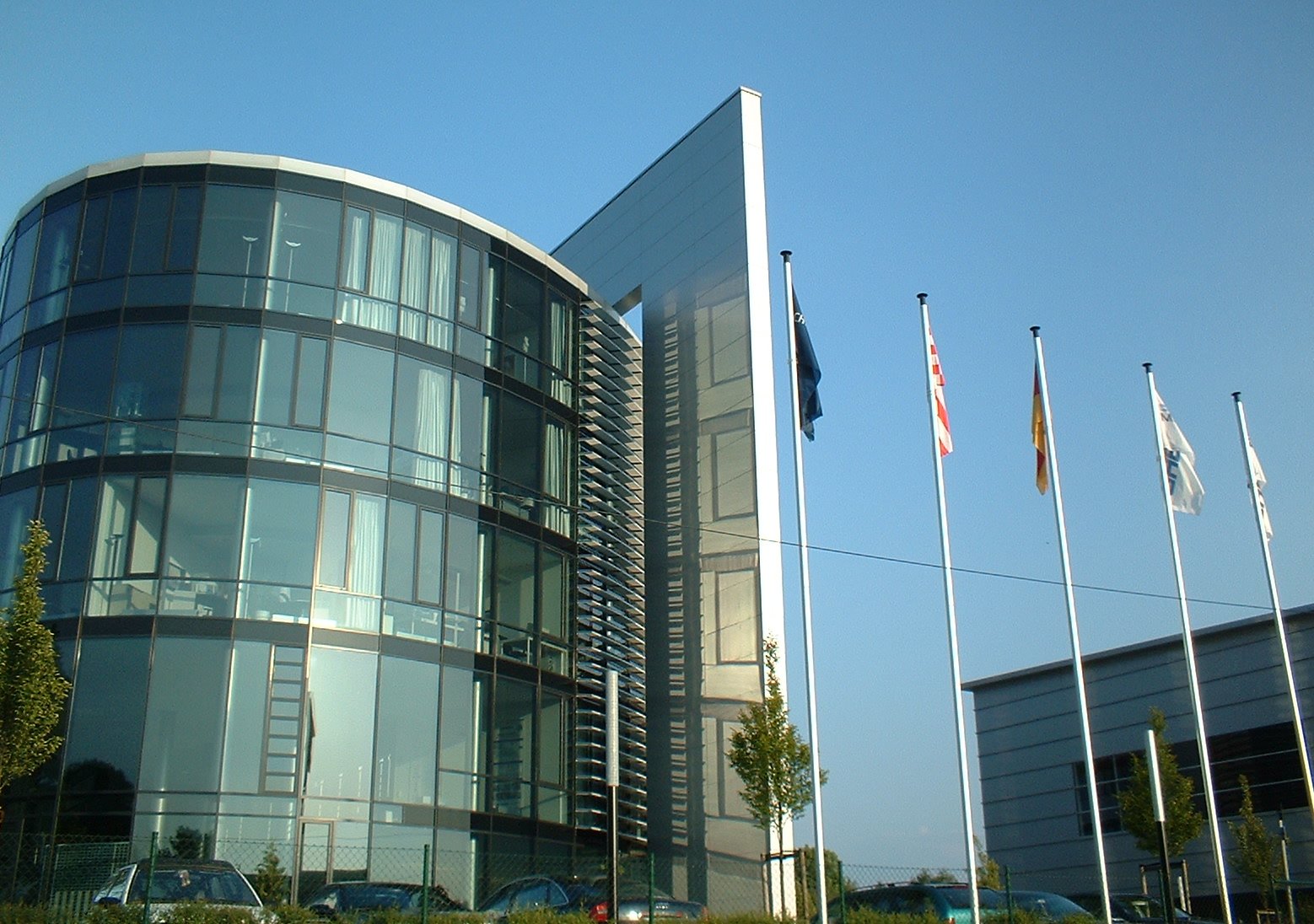
OHB SE, headquartered in Bremen, is a European space and technology group specializing in the development and implementation of complete space systems, the production of components for various launcher programs as well as the operation of satellite systems and the processing and provision of the data collected. The company employs over 3,000 people at 15 locations in ten countries, most of them in Europe. Subsidiaries include OHB Sweden operating from Kista.
Since 2023 US Kohlberg Kravis Roberts holds shares on OHB. The majority owner is the family around the founders Fuchs.
Corporate history
[edit]In 1981, Christa Fuchs took over Otto Hydraulik Bremen GmbH. Founded in 1958, the Hemelingen-based company had five employees at the time and was engaged in the construction and repair of electrical and hydraulic ship systems for the German Federal Armed Forces. Together with MBB-ERNO as project leader and the Sarstedt shipyard, OHB won the contract for the construction of the MPOSS (Multi-Purpose Oil Skimming System) lead ship in 1984. Manfred Fuchs, then director of space flight at MBB-ERNO, had the idea of entering the space industry with OHB as well. In 1985, he therefore moved to his wife's company. Among the first space contracts was the Mikroba project (microgravity with balloon), a project sponsored by the German Federal Ministry of Education and Research and the DFVLR (now the German Aerospace Center), which involved experiments in free fall. Furthermore, OHB developed a space-qualified centrifuge for the Spacelab space laboratory for testing blood and urine samples.
As the number of employees grew, the premises at Hemelinger Hafendamm became too small. OHB built a new headquarters near the University of Bremen, which was opened in October 1988. Manfred Fuchs' vision was to develop smaller and thus less expensive satellites; this was also one reason for renaming the company Orbital- und Hydrotechnologie Bremen-System GmbH in 1991. Together with the Center of Applied Space Technology and Microgravity (ZARM) at the University of Bremen, OHB developed BremSat, one of the first German small satellites. It was launched into space on board the Discovery on February 3, 1994. A further milestone was the SAFIR (Satellite for Information Relay) satellite series for position determination and object tracking, which also marked OHB's entry into the telecommunications market. As early as 1993, OHB Teledata GmbH was established for this purpose, specializing in telematics systems. In the same year, OHB built the COLUMBUS integration hall on its premises for the construction and integration of the satellites. With the acquisition of further major projects such as ABRIXAS and the growing number of employees, the company's headquarters soon became too small. Directly adjacent to the existing buildings, the new headquarters at Universitätsallee 29 were inaugurated in 1995. In 2001, a further building was constructed in what was then Karl-Ferdinand-Braun-Straße (now Manfred-Fuchs-Platz) together with a modern clean room hall.
OHB subsequently took the lead in the development of the major SAR-Lupe project, a satellite reconnaissance system on behalf of the Bundeswehr. In addition, the company was selected as a supplier for the International Space Station (ISS) and for the European Columbus station module. Meanwhile, OHB System AG and OHB Teledata AG, which had been listed on the stock exchange since the previous year, were merged to form OHB Technology AG in 2002.[2] Over the next few years, further acquisitions and the establishment of various subsidiaries followed. Among other things, OHB acquired the MAN subsidiary MAN Technologie AG (now MT Aerospace) in 2005.[3] In 2008, an attempt to acquire the three German Airbus plants in Nordenham, Varel and Augsburg failed. According to a report in Manager Magazin, the plan was to create a new listed aviation Group. Under the leadership of OHB, a company with 6,700 employees and sales of around one billion euros was to be created.[4] In 2009, OHB acquired the Italian aerospace company Carlo Gavazzi Space (founded in 1981, now OHB Italia).[5]
In January 2010, the company was awarded a contract for the construction of 14 satellites for the Galileo navigation system. The contract was worth EUR 566 million.[6][7] A year later, Berry Smutny, the CEO of OHB-System AG, was dismissed after WikiLeaks published details of a conversation Smutny had with American embassy officials. Smutny reportedly called Galileo a "stupid idea" that wasted European taxpayers' money.[8] Later in the year, the company acquired Thales Alenia Space Antwerp, which has since operated as Antwerp Space.[9] At the beginning of 2011, the previous five business segments were combined to form the two segments Space Systems and Aerospace + Industrial Products. In May of this year, the annual general meeting resolved to rename OHB Technology AG into OHB AG.[10] In addition, OHB acquired the "Space Systems Division" of Swedish Space Corporation in the same year, which was renamed OHB Sweden in the process.[11]
In addition, the company developed the modular SmallGEO satellite platform, which serves as the basis for further major projects such as the H36W-1 communications satellite of the Spanish operator Hispasat and the third generation of Meteosat weather satellites. In 2013, the company was awarded a prime contract to develop and deliver a successor to the SAR-Lupe satellite reconnaissance system.
At the beginning of September 2014, the two largest subsidiaries, Bremen-based OHB System AG and Munich-based Kayser-Threde GmbH, merged to form OHB System AG with facilities in Bremen and Munich.[12] This was followed in December 2015 by the relocation of the Munich site to a new building in Oberpfaffenhofen.[13] OHB has been registered as a European Company (Societas Europaea) in the commercial register since March 2015.[14]
With its investment in Rocket Factory Augsburg AG, the company has been participating in the development of a small launch vehicle (microlauncher) since 2018.[15]
In 2020, the restructuring of the business segments was announced. All service activities arising from space technologies and data have since been combined in the third segment DIGITAL.
In 2023 OHB was taking the US financial investing company Kohlberg Kravis Roberts on board and withdrawed from the stock exchange. The Fuchs family still holds almost 70 percent of the shares, didn´t sold any shares and will therefore remain the majority owner.[16]
Business segments
[edit]
Space Systems
[edit]This segment focuses on the development and production of near-Earth and geostationary satellites for navigation, science, communications, Earth and weather observation and reconnaissance, including scientific payloads. In the exploration area, concepts are developed for the exploration of the Solar System. In astronautical space flight, the focus lies on equipping and operating the International Space Station (ISS) and the future lunar station Gateway.
Aerospace
[edit]The segment focuses on the production and development of products such as large load-bearing, weight-optimized structures, booster housings as well as cryogenic and satellite tanks for the aerospace industry. Among other things, OHB is the largest German supplier for the Ariane program[17] as well as an established manufacturer of components for satellite platforms, launch vehicles and aircraft such as SmallGEO, NASA's Space Launch System and the civil aircraft division of Airbus.
The participation Rocket Factory Augsburg AG is currently developing its own small launch vehicle (microlauncher) as a system supplier.
Digital
[edit]This segment brings together all services and solutions associated with space systems and their utilization. These include satellite operations, ground systems, antennas, optical and radio telescopes, and applications for transportation and mobility.
Other important components in this segment are downstream applications, i.e. the development and sale of software products for the use of space-based data from the areas of Earth observation, ship tracking (AIS) and navigation, infrastructure services for Deutsche Bahn's rail network, and IT services.
Projects
[edit]The company has been working on numerous German, European and international projects related to small satellites, crewed space flight as well as security and reconnaissance technologies.
- Examples of OHB satellite missions for telecommunication, earth observation and reconnaissance are Small GEO (Hispasat AG1), BREMSAT, SAFIR 1&2, BIRD/RUBIN, ABRIXAS and the first German reconnaissance satellite system, SAR-Lupe.
- Examples of OHB microgravity facilities are the International Space Station racks Fluid Science Laboratory and European Physiology Modules.
- Projects OHB demonstrated at the 2006 Berlin Air Show included CONDOR/ARDS, an airborne modular reconnaissance system, and Mona Lisa, a study for planning and implementing a lunar exploration program.
- On 7 January 2010, the European Commission announced that the contract to build the first 14 operational satellites for the Galileo Global Satellite Navigation System was awarded to OHB System and Surrey Satellite Technology Limited (SSTL). Fourteen satellites will be built at a cost of €566m.[6]
- In February 2012, an additional order of eight satellites was awarded to OHB System AG for €250M, after outbidding EADS Astrium tender offer. Thus bringing the total to 22 FOC satellites.[18]
- In 2014/2015, OHB was in talks with OneWeb as part of a potential joint venture to open a new facility for manufacturing approximately 900 200 kg (440 lb)-small Internet-delivery satellites. OHB is just one of five European and US manufacturers competing to build these sub-US$500,000 satellites.[19][20]
- In 2018 the ESA NEOSTEL ("Flyeye") telescope was under construction, due for completion in 2019, ready for installation in Sicily in 2020 by the Italian Space Agency.[21][22][23][24]
- In 2018, the Institut Laue–Langevin and European Synchrotron Radiation Facility announce a new partnership between the two research centers and OHB SE.[25]
- In 2018, OHB SE spun-off the start-up company Rocket Factory Augsburg AG (RFA).[26] RFA's goal is the development of a highly reliable, low-cost small-satellite launcher.[27]
- In 2019 MT Mechatronics (subsidiary of OHB SE), together with Illinois-based Ingersoll Machine Tools signed a contract to build the support structure of the Giant Magellan Telescope. The total value of the contract is $135 million. The structure is expected to be delivered to Chile at the end of 2025.[28]
Litigation
[edit]On 20 January 2021, the European Commission announced that it had awarded a €1.47 billion contract to Thales Alenia Space (TAS) and Airbus Defence and Space for 6 spacecraft by each manufacturer.[29] The signing of the contracts to Thales Alenia Space and Airbus Defence and Space, scheduled on 29 January 2021, was suspended by the European Court of Justice following a protest filed by OHB SE, the losing bidder. The OHB protest at the ECJ's General Court is based on “allegations of theft of trade secrets”, and seeks both a suspension of the contract signatures and the cancellation of the contract award. In May 2021 ESA reported it signed the contracts to design and build the first batch of Galileo Second Generation (G2G) satellites with Thales Alenia Space and Airbus Defence and Space.[30][31]
Further reading
[edit]- Rietz, Frank-Erhardt (2006). Danela Sell (ed.). 25 Jahre OHB : eine Zeitreise (in German). Bremen: OHB. ISBN 978-3-000-20410-4.
- Sell, Danela; Thaeter, Joachim (2018). Marco Fuchs (ed.). Ein Pionier der Raumfahrt: Manfred Fuchs - Die Biografie (in German). Bremen: Schünemann, Carl Verlag. ISBN 978-3-960-47038-0.
References
[edit]- ^ a b "Annual Report 2022" (PDF). Retrieved 6 September 2023.
- ^ "9-Month Report 2002" (PDF). Retrieved 2023-09-06.
- ^ "OHB - Formale Übernahme der MT Aerospace". FinanzNachrichten.de (in German). Retrieved 2023-09-06.
- ^ "Börsenpläne für Airbus-Werke". Manager Magazin (in German). 8 February 2008. Retrieved 2023-09-06.
- ^ Horntrich, Markus. "OHB Technology kauft Carlo Gavazzi Space". www.deraktionaer.de (in German). Retrieved 2023-09-06.
- ^ a b "Contracts for Galileo sat-nav". 2010-01-07. Retrieved 2023-09-06.
- ^ "OHB and SSTL selected for the construction of 14 Galileo navigation satellites. - OHB System ENG". www.ohb-system.de. Retrieved 2023-09-06.
- ^ "22.10.2009: OHB-SYSTEM CEO CALLS GALILEO A WASTE OF GERMAN TAX PAYER MONEY". www.aftenposten.no (in Norwegian Bokmål). 2011-01-13. Retrieved 2023-09-06.
- ^ "Nine-Month Report 2010" (PDF). Retrieved 2023-09-06.
- ^ "Six-month report 2011" (PDF). Retrieved 2023-09-06.
- ^ Selding, Peter B. de (2011-06-24). "OHB Purchases SSC's Space Systems Division". SpaceNews. Retrieved 2023-09-06.
- ^ "Merger of OHB System AG and Erwin Kayser-Threde GmbH now completed - OHB System ENG". www.ohb-system.de. Retrieved 2023-09-06.
- ^ "Annual Report 2015" (PDF). Retrieved 2023-09-06.
- ^ "OHB AG converted into OHB SE". OHB SE. Retrieved 2023-09-06.
- ^ "ABOUT". Rocket Factory Augsburg. Retrieved 2023-09-06.
- ^ manager (2023-08-07). "OHB mit Kurssprung: Finanzinvestor KKR steigt bei Bremer Raumfahrtfirma ein, Familie von Marco Fuchs behält Mehrheit". www.manager-magazin.de (in German). Retrieved 2025-02-11.
- ^ "DLR - Raumfahrtagentur - Ariane 5 - Europas Zugang zum All". www.dlr.de (in German). Retrieved 2023-09-06.
- ^ Dunmore, Charlie (1 February 2012). "UPDATE 1-OHB beats EADS to Galileo satellite contract -sources". Reuters.
- ^ de Selding, Peter B. (2015-03-19). "Competition To Build OneWeb Constellation Draws 2 U.S., 3 European Companies". Space News. Retrieved 20 March 2015.
- ^ Messier, Doug (2014-11-11). "WorldVu Satellites Issues RFP for 640 Satellites". Parabolic Arc. Archived from the original on 2014-11-29. Retrieved 20 March 2015.
- ^ Flyeye: the bug-eyed telescope monitoring our skies on YouTube
- ^ "Flyeye Telescope". ESA. European Space Agency. Retrieved 10 December 2018.
- ^ Cibin, L; Chiarini, M; Bernardi, F; Ragazzoni, R; Salinari, P (2016). "NEOSTEL: the telescope detail design program for the ESA optical ground network dedicated to NEO discovery and tracking". Memorie della Societa Astronomica Italiana. 87: 197. Bibcode:2016MmSAI..87..197C.
- ^ "Optical and testing elements for the NEOSTEL telescope" (PDF). TOPTEC Research Centre for Special Optics and Optoelectronic Systems. Institute of Plasma Physics of the Czech Academy of Sciences. Retrieved 11 December 2018.
- ^ "Institut Laue-Langevin (ILL) and ESRF collaborate on space technologies". scitecheuropa.eu. 8 August 2018. Retrieved 16 August 2018.
- ^ "OHB annual report 2018" (PDF). 31 December 2018. Retrieved 23 March 2021.
- ^ "OHB: Konzentration führt zu Wachstum". OHB SE (in German). Retrieved 2021-03-23.
- ^ "Giant Magellan Telescope signs contract for telescope structure | Giant Magellan Telescope". 30 October 2019. Retrieved 2020-01-05.
- ^ Hill, Jeffrey (20 January 2021). "Thales Alenia Space, Airbus Win Second-Generation Galileo Satellite Contract". Satellite Today. Archived from the original on 2021-01-26. Retrieved 2021-01-27.
- ^ "ESA signs contract for new generation of Galileo". ESA. 28 May 2021. Retrieved 5 December 2021.
- ^ "ESA signs contract for new generation of Galileo". Airbus. 16 June 2021. Retrieved 12 December 2021.
External links
[edit]OHB SE
View on GrokipediaHistory
Founding and Early Development
OHB was founded in 1981 in the Bremen suburb of Hemelingen, Germany, as Otto Hydraulik Bremen (OHB) by Christa Fuchs, with her husband Manfred Fuchs as co-founder and key technical leader.[2][5] The company initially operated as a small hydraulics firm with five employees, specializing in the repair and development of electrical and hydraulic systems for marine applications, particularly for the German Federal Armed Forces.[2][6] Manfred Fuchs, an engineer with prior experience in European space initiatives including the Ariane launcher and Columbus programme through his role at ERNO in the 1960s, provided foundational expertise that later facilitated diversification.[5] In its early years, OHB focused on practical maritime projects, including work on oil skimming ships such as MPOSS and Knechtsand during the 1980s, while hiring initial engineers to build technical capacity.[2] Adhering to a strategy of producing "smaller, cheaper, and better" systems, the firm expanded operations and relocated to its own facilities at the Bremen technology estate near the university in 1988, enhancing proximity to research institutions and supporting steady growth.[2] This period marked the transition from a workshop-based operation to a more structured enterprise, laying the groundwork for entry into high-tech sectors. By the mid-1980s, OHB began pivoting toward space technology, contributing to the MIKROBA drop capsule project in 1985 for weightlessness experiments, which represented its first foray into aerospace applications.[2] This shift built on Manfred Fuchs's background in space systems and positioned the company for further advancements, including contributions of 14 research units to the MIR 92 mission in 1992.[2]Expansion into Space Sector
In 1985, OHB transitioned from its initial focus on hydraulic systems for marine and military applications to space technology, developing the MIKROBA drop capsule for microgravity experiments and contributing 14 research units to the MIR '92 space mission.[2] This shift established OHB as a supplier of specialized components and subsystems for space projects, leveraging Bremen’s emerging aerospace ecosystem. The company's early space efforts emphasized practical experimentation, aligning with Germany's growing involvement in European Space Agency (ESA) initiatives. By the mid-1990s, OHB expanded into full satellite development, launching Brem-Sat in 1994 as its first independently built microsatellite for technology demonstration and Earth observation.[2] Concurrently, OHB pursued telecommunications applications through the SAFIR satellite program and founded OHB Teledata in 1994 to handle ground-based data services and satellite operations. These milestones transformed OHB from a niche component provider into a systems integrator, securing initial contracts for reconnaissance and environmental monitoring technologies. This phase of growth was driven by founder Manfred Fuchs and his son Marco, who steered investments toward high-value space contracts, culminating in the €320 million SAR-Lupe program in 2001 for five German military reconnaissance satellites.[2] OHB's strategic pivot capitalized on public-private partnerships, particularly with the German Aerospace Center (DLR) and ESA, enabling scalable production capabilities and positioning the firm for larger-scale satellite constellations in the 2000s.Key Milestones and Acquisitions
OHB SE achieved a pivotal expansion in 2005 through the acquisition of MAN Neue Technologie, which included MT Aerospace AG and MT Mechatronics, thereby strengthening its manufacturing base for aerospace structures and propulsion systems.[2] This was followed in 2007 by the purchase of Kayser-Threde GmbH, renamed OHB System Oberpfaffenhofen, which added advanced expertise in space vehicle assembly and testing.[2] Further international growth occurred in 2009 with the integration of Carlo Gavazzi Space into OHB Italia, expanding satellite payload and small satellite capabilities.[2] In 2010, OHB acquired the Belgian operations of Thales Alenia Space, rebranded as Antwerp Space, enhancing radio frequency and payload technologies.[2] The following year, 2011, saw the acquisition of the Swedish Space Corporation's space systems division, establishing OHB Sweden and bolstering small satellite and formation flying expertise.[2] Key contractual milestones included the 2001 award of a €320 million contract for the German SAR-Lupe radar reconnaissance satellite system, marking OHB's entry into defense-related space projects.[2] In 2010, OHB secured a €566 million contract from the European Space Agency (ESA) to build 14 Full Operational Capability (FOC) satellites for the Galileo navigation system, later expanded to 34 satellites by 2017.[2] The 2013 SARah radar satellite contract further solidified its Earth observation portfolio.[2] Significant launches underscored operational successes: the 2016 arrival of the ExoMars Trace Gas Orbiter at Mars, the 2017 deployment of the H36W1 SmallGEO telecommunications satellite, and the 2019 launches of PRISMA (for autonomous satellite formation) and EDRS-C (European Data Relay System).[2] Revenue reached €1 billion in 2019, reflecting scaled operations.[2] More recent achievements include the 2022 launches of EnMAP (hyperspectral Earth observation) and MTG-I1 (Meteosat Third Generation imaging satellite), alongside the 2023 deployment of the Heinrich Hertz communications satellite.[2] In 2022, OHB acquired GEOSYSTEMS GmbH, a geo-information technology specialist, to augment digital services in Earth observation data processing.[3] The company also pursued strategic investments, such as agreeing in 2024 to acquire a stake in Deutsche Aircraft Holdings alongside AFK Enterprise, targeting aviation sector synergies.[7] Concurrently, KKR's 2023 minority investment of up to €338 million via a takeover offer and capital increase provided capital for further expansion.[7]Recent Strategic Shifts
In August 2023, OHB SE entered into an investment agreement with KKR, under which KKR launched a voluntary public tender offer for all outstanding shares at €44 per share, valuing the company at approximately €768 million, to strengthen its capital base and support the implementation of its growth strategy while the Fuchs family retained long-term majority control as a strategic minority investor.[8][9] This included a 10% capital increase of €77 million at the offer price, completed shortly thereafter, aimed at funding expansion in core space systems and digital services amid increasing European demand for satellite technologies.[10] The arrangement facilitated a potential delisting from the stock exchange, though OHB remained publicly traded into 2025, with management citing opportunities from competitors' consolidations, such as the Airbus-Thales-Leonardo space units merger, to maintain flexibility.[11] Following the KKR partnership, OHB initiated a comprehensive transformation program in late 2023, emphasizing operational efficiency, project profitability, digitalization, automation, and intelligence capabilities across its segments to address execution risks and adapt to a competitive landscape driven by geopolitical tensions and EU autonomy goals.[12][13] This shift built on a strategy update presented in 2023—reiterated in 2024—shifting focus from legacy aerospace dependencies toward high-growth areas like small satellites and Earth observation, evidenced by a July 2023 memorandum of understanding with Satellogic for joint EO applications.[14] The program also incorporated a new ESG framework adopted in 2024, setting KPIs and targets through 2030 for sustainability in operations and supply chains.[15] These initiatives yielded a record order intake of €1.67 billion in 2024, surpassing prior years and supporting revenue guidance of 16.5% growth in 2025 and an additional 25% by 2027, primarily from European government contracts in secure communications and exploration systems.[12][16] Leadership adjustments, including the appointment of Dr. Tim Tecklenburg as CFO in September 2025, further aligned with efficiency goals.[17] Despite project-related provisions impacting 2024 profitability, the shifts positioned OHB to capitalize on rising defense and space budgets while mitigating risks from supply chain disruptions.[18]Business Segments
Space Systems
The Space Systems segment of OHB SE, primarily managed by its subsidiary OHB System AG based in Bremen, Germany, focuses on the end-to-end development, manufacturing, integration, testing, and operation of satellite systems. This includes low Earth orbit (LEO) and geostationary (GEO) small to medium-sized satellites for applications in Earth observation, navigation, telecommunications, scientific missions, and security.[19] OHB System AG, with additional facilities in Oberpfaffenhofen for Earth observation and navigation technologies, provides turnkey solutions encompassing payloads, subsystems, and ground support infrastructure.[19] Key capabilities extend to reconnaissance and security systems, such as synthetic aperture radar (SAR) satellites for military intelligence, and exploration technologies, including platforms for lunar orbiters developed under contracts like the 2007 Small Geo/Luxor initiative. The segment also supports human spaceflight through scientific instruments and payloads for the International Space Station (ISS) and the Columbus laboratory module, where OHB holds the distinction as the sole European provider across all such modules' laboratories and experiments.[19] Broadband communication and hyperspectral imaging systems further highlight its technological scope, enabling data relay and environmental monitoring missions.[20] Subsidiaries such as OHB Sweden enhance the segment's expertise in spacecraft subsystems and complete mission execution, contributing to over 30 years of satellite heritage. This division serves as the primary growth engine for OHB SE, underpinning contracts with agencies like the European Space Agency (ESA) and national defense entities for navigation constellations and hyperspectral satellites.[19]Aerospace
OHB SE's Aerospace segment focuses on the engineering, manufacturing, and supply of structural components for aviation and space launch vehicles, leveraging expertise in lightweight metallic and composite materials. The segment operates primarily through subsidiaries MT Aerospace AG and MT Mechatronics, with MT Aerospace serving as the core entity responsible for high-precision production of fuel tanks, boosters, and structural elements. Acquired by OHB SE in 2005 from MAN AG, MT Aerospace employs around 600 staff across sites in Augsburg and Munich, Germany, and has established itself as a key European supplier in propulsion and structural technologies.[21][22] A cornerstone of the segment's activities is its longstanding involvement in the Ariane rocket family, spanning over 40 years and encompassing six generations of launchers. MT Aerospace holds the position of Germany's largest supplier to Ariane 5, delivering cryogenic fuel tanks and metallic structures essential for the vehicle's performance. For the successor Ariane 6, the company secured a 10% work share as main contractor, concentrating on the design and fabrication of upper-stage fuel tanks and associated metallic components to support Europe's independent access to space. The segment also contributes to infrastructure at the Guiana Space Centre in Kourou, French Guiana, including facilities for Ariane and Soyuz launches.[21][23] Beyond launchers, the Aerospace segment produces components for commercial aviation, such as turbine parts from nickel-based alloys and titanium alloys for aircraft engines, emphasizing heat-resistant and high-strength materials. It extends into mechatronic systems for electronic data transmission in global logistics and transport management. Recent advancements include collaborations like the 2021 extension of additive manufacturing processes with Boeing for space exploration hardware, involving precision machining and heat treatment, and a 2023 joint project with MTU Aero Engines to develop fuel systems for liquid hydrogen applications in sustainable propulsion. These efforts underscore the segment's pivot toward innovative manufacturing techniques, including 3D printing standards for space-grade components.[21][24][25]Digital Services
OHB SE's Digital segment applies space-derived capabilities to satellite operations, ground infrastructure, and data services, while facilitating technology transfer to sectors such as transportation, navigation, and life sciences. This includes end-to-end solutions for satellite ground systems, secure data transmission through encryption and software, and processing of satellite imagery for applications in climate monitoring and security.[26] The segment ensures post-launch mission success by providing antennas, mechatronic systems for telescopes, and cybersecurity for space infrastructure.[26][27] A core component is OHB Digital Connect GmbH, the segment's largest subsidiary with approximately 300 employees across sites in Bremen and Mainz, Germany. It specializes in establishing ground-to-space connections, deploying turnkey ground stations and antenna systems using precision steel construction and mechatronics, and conducting mission operations with dedicated teams of 6 to 12 specialists.[28] The subsidiary processes satellite data via advanced sensor technology to deliver insights for policy areas like climate change, and operates facilities such as the Mission Management and Control Center (MMCC).[28] Additional subsidiaries extend the segment's scope: OHB Digital Services GmbH provides IT consulting, software development, geospatial solutions, and cyber-security services including penetration testing, with applications in projects like EO4Ports, which uses satellite data for automated port operations focused on efficiency and sustainability.[26][29] OHB Digital Solutions GmbH offers GNSS quality assurance, signal simulation, and navigation products such as GIDAS and XPLORA.[26] OHB Teledata GmbH handles digital command/control systems and automation for rail power and interlocking.[26] OHB Information Technology Services GmbH supports group-wide IT infrastructure, data analytics, and digitalization.[26] The segment also encompasses OHB Chile SpA for observatory and telescope design, OHB Orbital Access GmbH for rocket launch procurement, and ventures like Blue Horizon for space-to-Earth life science applications.[26] Recent advancements include AI-driven enhancements to weather data resolution, announced on July 3, 2025, and concept studies for AI and image processing in defense applications, contracted by the German Armed Forces on September 11, 2024.[30][31] As of March 31, 2025, the Digital segment held an order book contribution of €160 million within OHB SE's total.[32]Key Projects and Technologies
Satellite Development and Operations
OHB System AG, the primary satellite development arm of OHB SE, designs and manufactures satellite platforms for medium-sized satellites in low, medium, and geostationary Earth orbits, with expertise in navigation, Earth observation, and meteorological systems. The company serves as prime contractor for the European Union's Galileo global navigation satellite system, building the platforms for 34 Full Operational Capability (FOC) satellites under contracts awarded by the European Space Agency (ESA) on behalf of the EU, while Surrey Satellite Technology Ltd provides the payloads.[33] Initial contracts in January 2010 covered the first 14 FOC satellites, with production expanding to include reserves for constellation reliability.[34] Multiple OHB-built Galileo satellites have been launched since 2011, including pairs in April and later 2024, supporting the system's medium Earth orbit deployment for precise positioning, navigation, and timing services.[35] [36] In Earth observation and reconnaissance, OHB has developed the EnMAP hyperspectral satellite for the German Aerospace Center (DLR), featuring over 200 spectral channels for environmental mapping and launched via SpaceX Falcon 9 in April 2022, achieving routine operations by November 2022 with high-quality data acquisition from a 650 km Sun-synchronous orbit.[37] [33] For military applications, OHB delivered the SAR-Lupe radar reconnaissance constellation to the German Federal Ministry of Defence starting in 2007 and leads the SARah successor system, including two reflector satellites launched in December 2023 to enhance synthetic aperture radar imaging capabilities.[33] [38] Additional projects include platforms for the Meteosat Third Generation (MTG) weather satellites, with OHB responsible for six units as subcontractor to Thales Alenia Space, the first launching in December 2022 for EUMETSAT's meteorological imaging and sounding missions, and the SmallGEO modular geostationary platform, with its inaugural satellite deployed in 2017 for Hispasat communications.[33] In October 2024, OHB secured a €280 million ESA contract to develop two Harmony mission satellites for interferometric radar Earth observation, complementing Copernicus Sentinel-1 capabilities.[39] OHB supports satellite operations through its Digital segment, particularly OHB Digital Connect GmbH, which delivers modular ground segments, mission control systems, and end-to-end operational services for various satellite profiles, including secure data downlink and post-launch management.[26] [40] This includes handling ground station infrastructure, cybersecurity for data transmission, and AI-enabled image analysis tied to satellite missions. OHB Sweden extends operational capabilities for small satellites, providing onsite mission control, testing, and in-orbit management with heritage from magnetospheric research platforms.[41] These services ensure reliable constellation maintenance, as demonstrated in ongoing Galileo support and SARah activation, where initial operational use began in October 2023 despite launch delays for subsequent units.[42]Exploration and Security Systems
OHB SE engages in space exploration through its participation in European Space Agency (ESA) missions aimed at advancing planetary science, astrophysics, and asteroid defense technologies. As a prime contractor or subsystem supplier, the company contributes to spacecraft development, including propulsion, navigation, and scientific instruments for deep-space probes. These efforts support objectives such as detecting exoplanets, studying solar system bodies, and demonstrating deflection techniques against near-Earth objects.[43] A flagship project is the Hera mission, for which OHB System AG serves as prime contractor in an ESA-NASA collaboration to characterize the Dimorphos asteroid following NASA's DART impact in 2022. Launched on October 7, 2024, via Ariane 5 from Kourou, French Guiana, Hera employs kinetic impact validation and CubeSat deployment to assess planetary defense efficacy, arriving at the target in late 2026. The mission incorporates advanced guidance, navigation, and control (GNC) systems, with OHB conducting self-financed studies to refine resource exploitation and technology demonstrations for future exploration.[43][44] OHB also supplies components for several ESA-led exploration initiatives, including the PLATO mission to detect transiting exoplanets via photometry, with launch targeted for 2026; ExoMars for subsurface Mars exploration and biosignature detection; EnVision for Venus atmospheric and geological analysis, planned for the 2030s; and Comet Interceptor to rendezvous with a pristine comet nucleus. These roles leverage OHB's expertise in high-precision instruments and thermal control systems, derived from over four decades in space hardware. In 2022, OHB partnered with The Exploration Company to test GNC technologies under lunar simulation conditions, accelerating reusable spacecraft development for European lunar missions.[43][45] In security and reconnaissance, OHB develops radar-based satellite systems for persistent surveillance, emphasizing synthetic aperture radar (SAR) imaging and secure data transmission for defense applications. With more than 25 years of experience, the company integrates broadband radio relays for near-real-time image downlink, enabling reconnaissance in all weather conditions. Core technologies include modular airborne systems like ARDS for high-resolution data compression and transmission with minimal loss.[46] Key projects include the SAR-Lupe constellation, Germany's inaugural SAR reconnaissance system comprising five X-band satellites launched from 2006 to 2008 by the German Aerospace Center (DLR), for which OHB provides operational management and image processing. The successor SARah system, contracted in 2010 and comprising three active SAR satellites plus ground infrastructure developed by OHB System AG, enhances resolution to 0.25 meters and supports military intelligence; its satellites achieved operational status following launches starting in 2022. In September 2024, OHB Digital Connect led a technology demonstrator for multi-dimensional reconnaissance under German Armed Forces auspices, incorporating AI-driven sensor fusion with partners like MBDA Deutschland. Additionally, a January 2024 consortium headed by OHB secured an ESA contract to study pan-European SAR capabilities, focusing on interoperability and sovereign technology frameworks. These systems prioritize electromagnetic compatibility and encryption to meet stringent security standards.[46][47][38][48][49]Telematics and Ground Infrastructure
OHB SE's Digital segment encompasses telematics applications and ground infrastructure solutions, leveraging space-derived technologies for terrestrial and satellite-related services. Through subsidiaries such as OHB Digital Connect GmbH and OHB Digital Services GmbH, the company develops systems for satellite ground segments, data connectivity, and asset tracking, integrating expertise in software, cybersecurity, and mechatronics.[26][28] Ground infrastructure capabilities are primarily managed by OHB Digital Connect GmbH, which employs approximately 300 staff across locations in Bremen, Mainz, and Chile to design, build, and operate modular satellite ground segments. This includes turnkey antenna systems, ground stations, and precision-engineered structures for satellite communication and data transmission, ensuring secure connectivity between space assets and end users. The subsidiary supports full mission operations with dedicated teams of 6 to 12 specialists, handling post-launch data processing and nominal satellite performance. Notable projects include the coordination of the IMEoS initiative, launched in 2023, which demonstrates near-real-time global monitoring of critical infrastructures using space-based technologies, and enhancements to ground control stations for military satellite communications, such as the 2019 upgrade for the German Federal Armed Forces' system.[28][50][51] Telematics offerings, historically rooted in commercial traffic management since the early 2000s, focus on global positioning and monitoring of mobile assets including vehicles, goods, ships, and wildlife. OHB Digital Services GmbH, rebranded from megatel GmbH in August 2017, develops wireless sensor networks and software for real-time tracking; for instance, its container tracking system enables location and status monitoring of freight via machine-to-machine communication. In 2018, OHB supplied 5,000 Visioboxx tracking units to Egyptian government organizations to improve transport logistics efficiency and safety. Additional applications include Vessel Performance Monitoring (VPM) software, which tracks sailing activities, fuel consumption, and weather data for maritime optimization, and solutions from OHB Teledata GmbH for rail vehicle power automation and asset management in energy distribution.[2][52][53][54][55][26]Leadership and Ownership
Founding Family Influence
OHB SE originated from Otto Hydraulik Bremen GmbH, a small hydraulics and marine systems firm established in 1958 with five employees by the time Christa Fuchs acquired it in 1981.[2][56] Christa Fuchs, alongside her husband Manfred Fuchs who joined the leadership in 1985, redirected the company's focus toward space technology, leveraging Manfred's prior experience in aerospace engineering at firms like Messerschmitt-Bölkow-Blohm to develop payloads and satellite subsystems starting in the early 1980s.[57][56] This pivot transformed the family-controlled entity into a key player in European space systems, with the Fuchs family retaining operational and strategic oversight through direct involvement in management and board roles.[58] Their son, Marco Fuchs, entered the business in 1995 as an authorized signatory and assumed the CEO position at OHB SE in 2000, continuing the family's hands-on influence by steering expansion into satellite manufacturing, orbital infrastructure, and international partnerships.[59] Christa Fuchs served as chair of the supervisory board at subsidiaries like OHB System AG until her departure in 2024, underscoring the intergenerational continuity in governance.[60][61] The family's control has emphasized long-term stability over short-term gains, as evidenced by their establishment of the Fuchs Family Foundation in October 2022, to which Marco and Christa Fuchs transferred their direct and indirect holdings, explicitly aiming to safeguard the company's independent, family-oriented ownership structure.[62] Despite a 2023 minority investment by Kohlberg Kravis Roberts (KKR), which acquired approximately 28.64% of shares to bolster capital for strategic growth, the Fuchs family preserved majority ownership—holding around 38.76% directly via Marco Fuchs and additional stakes through the foundation—ensuring veto power over major decisions and continuity under Marco Fuchs's CEO leadership.[9][63] This arrangement has allowed the family to maintain strategic autonomy, prioritizing investments in core competencies like satellite development amid partnerships with entities such as the European Space Agency, while resisting full externalization of control.[64] The family's enduring stake, exceeding 70% prior to the KKR deal, has been credited with fostering resilience and innovation in a capital-intensive sector prone to volatility.[65]Current Executive Team
Marco R. Fuchs has served as Chairman of the Management Board and Chief Executive Officer of OHB SE since 2000. Born in 1962, Fuchs oversees the company's overall strategy and operations in space systems and related sectors.[66] Dr. Tim Tecklenburg was appointed Chief Financial Officer and member of the Management Board effective September 1, 2025. Prior to joining OHB SE, Tecklenburg held the CFO position at Aebi Schmidt Holding AG in Switzerland, along with management roles at RUAG Space in Zurich and Rheinmetall Defence Electronics in Bremen; he studied business administration and obtained a doctorate from the University of Münster.[67] Kurt Melching remains a member of the Management Board after transitioning from the CFO role, now concentrating on strategic initiatives in the defense sector as of September 2025. He joined the board in April 2018 and contributed to financial oversight during his prior tenure as CFO. Born in 1962, Melching facilitated the handover to Tecklenburg.[66][67] Additional board members include Daniela Schmidt, appointed to expand the board's expertise in operational areas, and Dr. Markus Moeller, who joined focusing on technical and project management responsibilities; born in 1973, Moeller supports the company's engineering and systems integration efforts.[68][66]Corporate Governance Structure
OHB SE operates under a two-tier governance structure typical of German corporations, comprising a Management Board (Vorstand) responsible for day-to-day operations, strategy execution, and representing the company externally, and a Supervisory Board (Aufsichtsrat) tasked with oversight, advising the Management Board, and appointing/dismissing its members.[69] The Supervisory Board convenes regularly, with six meetings held in 2024, and conducts annual self-assessments to evaluate its effectiveness.[70] Both boards adhere to the German Corporate Governance Code (version April 28, 2022), with a Declaration of Conformity issued on December 19, 2024, disclosing deviations such as no fixed age limits for board members to prioritize qualifications over arbitrary restrictions, equal weighting of short- and long-term variable compensation rather than long-term emphasis, and ongoing integration of sustainability targets into risk management systems.[71] The Management Board, coordinated by its Chairman and CEO Marco Fuchs (in office since 2000), manages the company independently while reporting quarterly to the Supervisory Board on risks, planning, and strategy.[66] [70] Current members include Fuchs; Dr. Tim Tecklenburg, appointed CFO effective September 1, 2025, succeeding Kurt Melching; Daniela Schmidt, responsible for general management areas; and Klaus Hofmann, handling human resources since November 2015.[72] [68] The Supervisory Board, chaired by independent member Robert Wethmar, consists of members including Deputy Chairman Ingo Kramer, Dr. Hans-Jörg Königsmann, Raimund Wulf, Claire Wellby, and others elected at the annual general meeting, such as re-elections of Wethmar and Königsmann approved on June 12, 2025.[73] [74] It operates through committees: Audit (chaired by Kramer, including Wellby, Wethmar, and Wulf); Personnel (chaired by Wethmar, with Königsmann); Technology (chaired by Königsmann); and ESG, Corporate Governance, and Nomination (including Wethmar, Königsmann, and Wulf).[70] OHB SE emphasizes diversity in board composition, targeting 20% female representation on both boards by December 31, 2026—a goal achieved in 2024—alongside considerations for qualifications, international experience, and age balance in succession planning.[70] A Code of Conduct governs ethical standards, compliance, and anti-discrimination across the group, supported by internal guidelines and risk management integrated into strategy.[70]Financial Overview
Revenue Growth and Segments Contribution
OHB SE recorded total revenues of €1,001.3 million in 2022, increasing to €1,182.8 million in 2023—a growth of 18.1% driven primarily by heightened demand for satellite systems and space projects.[75] Revenues declined to €1,030.2 million in 2024, reflecting project timing and completion variances in major contracts, though adjusted EBITDA improved 28% to €111 million amid cost efficiencies.[18] Early 2025 indicators showed recovery, with first-half revenues reaching €563.5 million, up 20% year-over-year, supported by order intake exceeding €1.6 billion in 2024.[76][77]| Fiscal Year | Total Revenues (€ million) | Year-over-Year Growth (%) |
|---|---|---|
| 2022 | 1,001.3 | - |
| 2023 | 1,182.8 | +18.1 |
| 2024 | 1,030.2 | -12.9 |