Hubbry Logo
Omohyoid muscleOmohyoid muscleMain
Open search
Omohyoid muscle
Community hub
Omohyoid muscle
logo
8 pages, 0 posts
0 subscribers
Be the first to start a discussion here.
Omohyoid muscle
Omohyoid muscle
from Wikipedia
Omohyoid muscle
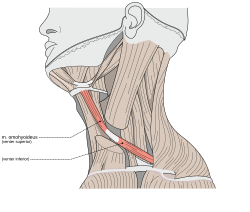
The omohyoid muscle, highlighted.
Muscles of the neck. Anterior view. Omohyoid is labeled on both sides.
Details
OriginUpper border of the scapula (inferior belly), intermediate tendon (superior belly)
InsertionIntermediate tendon (inferior belly), hyoid bone (superior belly)
ArteryBranches from the inferior thyroid artery (ITA)
Nerve Ansa cervicalis (C1-C3)
ActionsDepresses the larynx and hyoid bone. Also carries hyoid bone backward and to the side.
Identifiers
Latinmusculus omohyoideus
TA98A04.2.04.003
TA22169
FMA13342
Anatomical terms of muscle

The omohyoid muscle is a muscle in the neck. It is one of the infrahyoid muscles. It consists of two bellies separated by an intermediate tendon. Its inferior belly is attached to the scapula; its superior belly is attached to the hyoid bone. Its intermediate tendon is anchored to the clavicle and first rib by a fascial sling. The omohyoid is innervated by the ansa cervicalis of the cervical plexus. It acts to depress the hyoid bone.

Anatomy

[edit]

Structure

[edit]

The omohyoid muscle consists of muscle bellies that meet at an angle at the muscle's intermediate tendon.[1]

Inferior belly

[edit]

The inferior belly is narrow and flat band.[1]

It arises from the superior border of scapula (near the scapular notch). It sometimes also arises from the superior transverse scapular ligament.[1]

It is directed anteriorly and somewhat superiorly from its origin, extending across the inferior portion of the neck. It passes posterior to the sternocleidomastoid muscle to insert at the intermediate tendon.[1]

Superior belly

[edit]

The superior belly arises at the intermediate tendon. It extends nearly vertically superior-ward close to the lateral border of sternocleidomastoid muscle to insert at the inferior border of the body of hyoid bone (its site of insertion is lateral to that of the sternohyoid muscle).[1]

Intermediate tendon

[edit]

The intermediate tendon is variable in length and form, and contains a variable amount of muscle tissue. It is anchored inferiorly to the clavicle and first rib by a band of deep cervical fascia that surrounds the intermediate tendon; this fascial fixation maintains the angle of the muscle.[1]

It is typically situated at the level of the arch of cricoid cartilage, adjacent to the internal jugular vein.[1]

Innervation

[edit]

The omohyoid is innervated by the ansa cervicalis of the cervical plexus.[2] The inferior belly is innervated by the ansa cervicalis itself (which is derived from cervical spinal nerves C1-C3), and the superior belly is innervated by the superior root of ansa cervicalis (which is derived from the first cervical spinal nerve (C1)).[1]

Relations

[edit]

The inferior belly of the omohyoid divides the posterior triangle of the neck into a occipital triangle (above) and a subclavian triangle (below).[3][verification needed]

Its superior belly divides the anterior triangle into an carotid triangle (above) and a muscular triangle (below).[3][4][verification needed] Its superior belly serves as the most lateral member of the infrahyoid muscles, located lateral to both the sternothyroid muscles and the thyrohyoid muscles.[5][verification needed]

The tendon is related to the internal jugular vein and can be used as a landmark for this vein during surgery.[citation needed]

Variation

[edit]

The omohyoid muscle may be doubled or completely absent in some people.[citation needed] Either belly may be doubled or absent.[6]

The inferior belly may be attached to the clavicle directly (rather than by fascia).[7]

The superior belly may be fused with the sternohyoid muscle.[8]

Actions/movements

[edit]

The muscle depresses the hyoid bone when the bone is in an elevated position.[1]

A putative action of the muscle is tension of the inferior portion of deep cervical fascia to prevent soft tissues from collapsing inward into the upper airway during deep inspiration.[1]

Etymology

[edit]

The name "omohyoid" derives from the Greek "omos" meaning shoulder, giving one of its attachments, and "hyoid", giving the other attachment – the hyoid bone.[citation needed]

See also

[edit]

References

[edit]
[edit]
Revisions and contributorsEdit on WikipediaRead on Wikipedia
from Grokipedia
The omohyoid muscle is a long, thin infrahyoid muscle in the anterior , characterized by two distinct bellies—an inferior belly and a superior belly—connected by an intermediate that is restrained by a fascial sling to the , allowing it to run obliquely across the lateral cervical region.

Anatomy

The inferior belly originates from the superior border of the near the , specifically from the transverse scapular ligament and the medial aspect of the , and extends superiorly and medially to join the intermediate . The superior belly arises from this tendon and inserts into the lower border of the , lying superficial to the sternohyoid muscle in the anterior . It is innervated by the deep branch of the (spinal nerve roots C1–C3 from the ) and receives its blood supply primarily from muscular branches of the , which arises from the of the .

Function

The omohyoid muscle primarily depresses the , working in concert with other like the sternohyoid and thyrohyoid to facilitate and speech by stabilizing or lowering the hyoid and . Additionally, its contraction tenses the , aiding venous return in the by maintaining low intraluminal pressure, and it serves as an important anatomical landmark in neck surgeries, such as for identifying level III and IV during dissections for metastases.

Clinical Significance

Variations in the omohyoid muscle's morphology, such as unusual origins from the or absences of one belly, have been documented, which can impact surgical approaches in the region, including thyroidectomies and excisions. Its position overlying the also makes it relevant in procedures involving vascular access or compression risks.

Anatomy

Structure and Attachments

The omohyoid muscle is a slender, digastric infrahyoid muscle composed of two distinct bellies—an inferior belly and a superior belly—joined by an intermediate , giving it a narrow, flat morphology similar to the of the floor of the mouth. The inferior belly originates from the superior border of the , medial to the , with some fibers occasionally arising from the transverse scapular ligament; it then courses superiorly and medially across the posterior cervical triangle to insert into the intermediate at approximately the level of the . The superior belly arises from the intermediate tendon and extends superiorly to attach at the inferior border of the hyoid bone's body, positioned lateral to the insertion of the sternohyoid muscle; its course runs inferiorly and laterally from the hyoid. The intermediate tendon is a flat, fibrous structure that connects the two bellies, ensheathed by the deep cervical fascia and anchored to the via a fascial , which provides stability. Overall, the muscle exhibits an oblique orientation, extending from the scapular region toward the , with the inferior belly attaching to the via its tendinous origin.

Innervation and Vascular Supply

The omohyoid muscle receives its motor innervation from the , a neural loop derived from the anterior rami of spinal nerves C1–C3 via the . The superior belly is innervated by the superior root of the , which consists primarily of fibers from C1 and travels inferiorly alongside the (cranial nerve XII) before branching off to the muscle. In contrast, the inferior belly is supplied by the inferior root, incorporating fibers from C2–C3 (with occasional contributions from C1) that arise directly from the loops. This dual innervation pattern reflects the muscle's digastric-like morphology, ensuring coordinated control across its two bellies and intermediate . Arterial blood supply to the omohyoid muscle varies by belly, with the superior portion primarily vascularized by branches of the , a direct branch of the . The inferior belly draws its arterial supply from muscular branches of the inferior thyroid artery, which originates from the off the . Venous drainage parallels the arterial pattern, with blood from the superior belly draining via the superior thyroid vein and from the inferior belly via the inferior thyroid vein, ultimately converging into the ; the muscle's attachment to the further facilitates low-pressure venous return in this system. Lymphatic vessels from the omohyoid muscle drain to the , which form chains along the and receive efferents from infrahyoid structures in the . This drainage pathway integrates with the broader jugular trunk, supporting clearance from the anterior cervical region.

Anatomical Relations

The omohyoid muscle traverses the lateral aspect of the , dividing the posterior cervical triangle into the superior occipital triangle and the inferior . The inferior belly forms the boundary between these subdivisions, running superficially across the posterior triangle. In the posterior cervical , the inferior belly of the omohyoid muscle crosses superficially over the , , and as it extends from its origin on the toward the intermediate tendon. This positioning places it deep to the but anterior to these neurovascular structures. Within the anterior cervical , the superior belly lies superficial to the sternohyoid muscle and deep to the , converging toward its insertion on the . It also forms the anteroinferior border of the . The intermediate tendon is positioned within or adjacent to the , lying anterior to the and , which often course posterior to or in close approximation with it. This tendon is anchored by fascial connections to the and first . Superficially, the omohyoid muscle is covered by the and the investing layer of the deep cervical fascia throughout its course in the neck. Deeply, the superior belly is adjacent to the near its hyoid insertion, while the muscle as a whole relates to the enclosing adjacent strap muscles.

Anatomical Variations

The omohyoid muscle exhibits anatomical variations in approximately 5-15% of individuals, based on cadaveric studies, with deviations primarily affecting the origins, insertions, bellies, and intermediate tendon. These variations can alter the muscle's morphology from its typical digastric structure, potentially impacting its role as a surgical landmark in the neck. Common variations include duplication of the muscle bellies, where an extra inferior or superior belly arises, observed in about 2.86% of cases in one bilateral cadaveric analysis of 35 specimens. For instance, a duplicated omohyoid may feature two inferior bellies originating from the superior border of the , with one connecting via the intermediate to the superior belly and the other fusing directly with the sternohyoid muscle, as reported in a rare cadaveric case. Another frequent anomaly involves the inferior belly originating from the rather than the , with prevalence rates ranging from 3% to 8.57% across studies; this shift can occur unilaterally, such as on the left side, 2.2 cm lateral to the sternoclavicular joint. Additionally, the superior belly may merge with the sternohyoid muscle, noted in 5.71% of examined cadavers. Tendon variations are less common but significant, including the absence of the intermediate , which results in a single continuous muscle band; this has been documented bilaterally with clavicular origins of the inferior belly, measuring 3.3-3.6 cm in length without the typical tendinous sling. In some instances, the superior belly may lack a distinct and fuse directly with adjacent , further blurring the standard digastric configuration. Multiple intermediate tendons or accessory slips from the have also been reported sporadically, occurring in about 2.86% of cases. These morphological differences are often unilateral and may show a tendency for left-sided predominance in certain anomalies due to asymmetric vascular and fascial influences, though comprehensive bilateral comparisons remain limited. Such variations underscore the need for preoperative in procedures to avoid inadvertent to nearby neurovascular structures.

Function

Muscle Actions

The primary action of the omohyoid muscle is the depression of the and , which facilitates by lowering the hyoid to allow passage of the bolus and supports respiration by reopening the laryngeal inlet after swallowing. This depression occurs through coordinated contraction of its two bellies, with the inferior belly originating from the superior border of the pulling the intermediate downward and medially toward the , thereby tensioning the and enabling the superior belly—arising from the and inserting on the hyoid—to draw the hyoid inferiorly. The muscle works in concert with other , such as the sternohyoid and sternothyroid, to achieve this collective depressive force on the hyoid and . Secondary actions include retraction of the in a posterior direction due to the oblique orientation of the muscle bellies, which draws the hyoid medially and posteriorly during contraction. Additionally, the omohyoid tensions its intermediate tendon and the surrounding deep cervical , stabilizing the during by counteracting excessive elevation and maintaining laryngeal position for vocal fold vibration. This tensioning also opposes the elevating actions of the , such as the mylohyoid and geniohyoid, ensuring balanced hyoid mobility. In terms of broader movement contributions, the omohyoid indirectly assists in lowering the by depressing the hyoid, which provides a stable base for to pull the downward during mouth opening. Electromyographic studies reveal activity in the superior belly of the omohyoid during deglutition, with bursts coinciding with hyoid depression to coordinate bolus , and during forced inspiration, where it helps maintain upper airway patency by tensing the cervical and preventing soft tissue collapse.

Physiological Role

The omohyoid muscle plays a key role in by depressing and retracting the after its elevation by , thereby facilitating the coordinated movement of the hyolaryngeal complex and supporting the opening of the upper esophageal sphincter. This action stabilizes the hyoid to enable efficient propulsion of the bolus while coordinating with pharyngeal constrictors to ensure smooth pharyngeal transit and minimize the risk of aspiration by maintaining laryngeal positioning during the swallow sequence. In respiration, the omohyoid contributes by depressing the hyoid and post-swallowing to reopen the upper airway, aiding in the restoration of normal breathing patterns after deglutition. It also supports respiratory mechanics indirectly by enhancing venous return from the head and neck via tension on the , which helps maintain low intrajugular pressure during inspiration and prevents vascular compression in the cervical region. During , the omohyoid provides supportive stabilization to the , preventing excessive upward displacement of the and allowing for controlled vocal fold adduction and essential to voice production. This stabilizing function integrates with the broader actions of the infrahyoid group to maintain laryngeal height and tension for sustained vocalization. In upright posture, the omohyoid helps maintain cervical tension by continuously influencing positioning and dynamics, contributing to overall stability and minor assistance in head flexion through its depressor effect on the hyoid. It interacts synergistically with the sternohyoid and thyrohyoid muscles to achieve balanced control of hyoid depression and elevation, ensuring coordinated hyolaryngeal excursion across physiological demands like and speech.

Clinical Significance

Surgical Anatomy

The omohyoid muscle serves as a critical landmark in neck dissection procedures, particularly in radical and selective neck dissections for head and neck cancers. Its inferior belly delineates the posterior border of the posterior triangle of the neck, aiding surgeons in identifying and accessing lymph node levels III and IV, where metastases commonly occur. This positioning facilitates precise removal of involved nodes while minimizing damage to surrounding structures, and the muscle is typically preserved unless its sacrifice improves exposure of level IV. In supraclavicular approaches, the inferior belly overlies the trunks of the brachial plexus, requiring careful retraction to avoid nerve injury during explorations for tumors or trauma. The intermediate tendon of the omohyoid muscle provides a reliable guide for internal jugular vein (IJV) ligation during neck surgeries, as it crosses superficially over the lower third of the vein, often in close association with the sternocleidomastoid muscle. This relationship necessitates meticulous dissection to prevent inadvertent injury to carotid sheath contents, including the IJV, common carotid artery, and vagus nerve, which lie immediately deep to the muscle. In thyroidectomy, the omohyoid is generally preserved to maintain neck contour and function, serving as an identifiable landmark for locating adjacent vessels and strap muscles. During tracheostomy, retraction of the sternocleidomastoid often involves mobilizing the omohyoid to expose the trachea safely, reducing the risk of vascular complications. Anatomical variations of the omohyoid, such as duplication, can complicate surgical navigation by obscuring the IJV or altering expected landmarks, potentially prolonging operative time and increasing the risk of vascular injury. For instance, a duplicated inferior belly passing deep to the IJV may lead to unexpected if not anticipated during .

Pathologies and Disorders

The omohyoid muscle is susceptible to laceration in penetrating injuries, where breach of the platysma often involves transection of this infrahyoid structure, potentially contributing to formation from associated vascular damage or airway compromise due to proximity to the trachea and . Surgical repair typically involves approximation of the muscle with absorbable sutures to restore integrity and prevent complications such as formation when interposed between repaired esophageal or arterial sites. Iatrogenic injury to the omohyoid muscle can arise during neck procedures, including insertion into the —where anatomical variations increase risk of inadvertent transection—or biopsy, leading to and subsequent muscle . Such damage disrupts the muscle's role in stabilizing the , potentially exacerbating postoperative neck swelling or functional deficits. Rare disorders affecting the omohyoid muscle include or , which can manifest as acquired with hyperactivity resembling spasmodic features, alongside functional from impaired hyoid depression during . Duplicate or anomalous may also cause progressive and even dyspnea by mechanically obstructing the pharyngeal space. These conditions often present with lateral bulging or discomfort, distinguishing them from more common cervical dystonias. In oncologic contexts, the omohyoid muscle serves as a landmark for metastatic neck affecting levels III and IV from head and neck cancers; resection or sacrifice during selective is common to ensure complete nodal clearance, though it may lead to minor functional alterations in hyoid mobility. This approach is standard in supraomohyoid dissections for oral cavity , balancing oncologic efficacy with preservation of non-lymphatic structures. Post-denervation weakness of the omohyoid muscle, often resulting from injury during trauma or , can impair hyoid depression and stabilization, contributing to deglutition difficulties such as delayed bolus clearance or aspiration risk in affected patients. This deficit is particularly notable in coordinated phases, where the muscle's depressive action supports laryngeal closure. Diagnostic imaging plays a key role in identifying omohyoid pathologies; high-frequency reveals muscle thickening or abnormal contraction in syndromes like omohyoid muscle , while also detecting variation-related compression of adjacent vessels such as the . MRI is effective for assessing , , or , showing signal changes indicative of or in cases of or . These modalities help differentiate benign variants from malignant involvement without invasive .

Development and Terminology

Embryology

The omohyoid muscle originates from the of the cervical myotomes, setting it apart from many other neck muscles that derive from the associated with the branchial arches. This somitic origin is shared with the other , but the omohyoid exhibits a unique developmental pattern involving a common in the anterior cervical that divides into superficial and deep layers. The superficial layer contributes to the splenius muscles, with an external extension migrating to form the omohyoid, while the deep layer gives rise to the sternohyoid. The digastric structure of the omohyoid arises from distinct embryological contributions to its superior and inferior bellies. The superior belly develops as a true infrahyoid muscle from the deep cervical , whereas the inferior belly shares an origin with the primordium of the , reflecting a more lateral migration pattern. This dual origin explains the muscle's characteristic morphology and its functional role in hyoid depression. During early fetal development, the omohyoid muscle appears as a single long, undifferentiated belly around 7 weeks of , oriented in a straight supero-inferior direction, and remains so until approximately 15 weeks. At 15 weeks, the intermediate forms as a short plate-like condensation of along the medial margin, influenced by mechanical stress from the bending muscle, the expanding , and shoulder girdle development. Differentiation into distinct superior and inferior bellies occurs after 15 weeks, with the tendon maturing through transition of muscle fibers to collagenous tissue by around 20 weeks. Innervation via the is established by the 10th to 12th week, coinciding with the maturation of cervical branches. Embryological variations in the omohyoid often stem from incomplete migration of its primordia, leading to duplications, ectopic attachments, or absence of one belly, frequently linked to persistent elements of the splenius muscle primordia. For instance, failure of the external splenius extension to fully separate can result in accessory bellies or altered tendon positions. In comparative embryology, the omohyoid parallels other infrahyoid muscles in its somitic derivation but stands out due to this dual primordium involvement, contributing to its higher incidence of anatomical variability compared to strap muscles like the sternohyoid.

Etymology

The name "omohyoid" derives from the Ancient Greek word ōmos (ὦμος), meaning "shoulder," which refers to the muscle's origin at the superior border of the scapula, combined with "hyoid," from the Greek hyoeidēs (ὑοειδής), meaning "U-shaped" or "hyoid-shaped," alluding to its insertion on the hyoid bone. This composite term highlights the muscle's distinctive bimanual attachments spanning from the shoulder girdle to the hyoid apparatus. In modern anatomical , the muscle is designated as musculus omohyoideus in Latin, following the standardized established by the Federative International Programme on Anatomical Terminologies. This Latin form preserves the Greek roots while adapting them to binomial for muscles, emphasizing precision in scientific . As part of the infrahyoid muscle group, the omohyoid is distinguished by its digastric structure—comprising superior and inferior bellies linked by an intermediate tendon—unlike the single-bellied muscles in the group, such as the sternohyoid; its name specifically underscores these dual attachments rather than action or location alone. This naming reflects a broader convention where terms denote morphological features to differentiate structures within functional groups. The of the omohyoid muscle exemplifies the classical Greek and Latin traditions in anatomical nomenclature, rooted in the works of ancient physicians like (c. 129–c. 216 CE), who drew from everyday objects and body landmarks to describe structures, a practice continued by anatomists to create a universal lexicon for medical science.

References

Add your contribution
Related Hubs
User Avatar
No comments yet.