Hubbry Logo
Hyoid boneHyoid boneMain
Open search
Hyoid bone
Community hub
Hyoid bone
logo
8 pages, 0 posts
0 subscribers
Be the first to start a discussion here.
Hyoid bone
Hyoid bone
from Wikipedia
Hyoid
The hyoid bone, present at the front of the neck, has a body and two sets of horns
Details
PrecursorSecond and third branchial arch[1]
Identifiers
Latinos hyoideum
MeSHD006928
TA98A02.1.16.001
TA2876
FMA52749
Anatomical terms of bone

The hyoid bone (lingual bone or tongue-bone) (/ˈhɔɪd/[2][3]) is a horseshoe-shaped bone situated in the anterior midline of the neck between the chin and the thyroid cartilage. At rest, it lies between the base of the mandible and the third cervical vertebra.

Unlike other bones, the hyoid is only distantly articulated to other bones by muscles or ligaments. It is the only bone in the human body that is not connected to any other bones. The hyoid is anchored by muscles from the anterior, posterior and inferior directions, and aids in tongue movement and swallowing. The hyoid bone provides attachment to the muscles of the floor of the mouth and the tongue above, the larynx below, and the epiglottis and pharynx behind.[citation needed]

Its name is derived from Greek hyoeides 'shaped like the letter upsilon (υ)'.[4][5]

Structure

[edit]
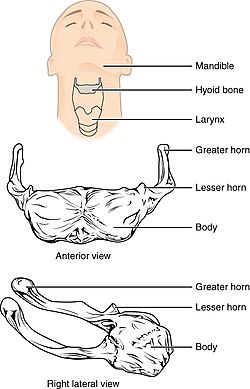
Left: Position of hyoid bone (shown in red). Right: Shape of hyoid bone.
Hyoid bone

The hyoid bone is classed as an irregular bone and consists of a central part called the body, and two pairs of horns, the greater and lesser horns.

Body

[edit]

The body of the hyoid bone is the central part of the hyoid bone.[clarification needed]

  • At the front, the body is convex and directed forward and upward.
  • It is crossed in its upper half by a well-marked transverse ridge with a slight downward convexity, and in many cases a vertical median ridge divides it into two lateral halves.
  • The portion of the vertical ridge above the transverse line is present in a majority of specimens, but the lower portion is evident only in rare cases.[clarification needed]
  • The anterior surface gives insertion to the geniohyoid muscle in the greater part of its extent both above and below the transverse ridge; a portion of the origin of the hyoglossus notches the lateral margin of the geniohyoid attachment.
  • Below the transverse ridge the mylohyoid, sternohyoid, and omohyoid are inserted.
  • At the back, the bone is smooth, concave, directed backward and downward, and separated from the epiglottis by the hyothyroid membrane and a quantity of loose areolar tissue; a bursa intervenes between it and the hyothyroid membrane.
  • Above, the body is rounded, and gives attachment to the hyothyroid membrane and some aponeurotic fibers of the genioglossus.
  • Below, the body affords insertion medially to the sternohyoid and laterally to the omohyoid and occasionally a portion of the thyrohyoid. It also gives attachment to the Levator glandulae thyreoideae, when this muscle is present.

Horns

[edit]
The lesser and greater horns of the hyoid

The greater and lesser horns (Latin: cornua) are two sections of bone that project from each side of the hyoid.

Greater horns

[edit]

The greater horns project backward from the outer borders of the body; they are flattened from above downward and taper to their end, which is a bony tubercle connecting to the lateral thyrohyoid ligament. The upper surface of the greater horns are rough and close to its lateral border, and facilitates muscular attachment. The largest of muscles that attach to the upper surface of the greater horns are the hyoglossus and the middle pharyngeal constrictor, which extend along the whole length of the horns; the digastric muscle and stylohyoid muscle have small insertions in front of these near the junction of the body with the horns. To the medial border, the thyrohyoid membrane is attached, while the anterior half of the lateral border gives insertion to the thyrohyoid muscle.[citation needed]

Lesser horns

[edit]

The lesser horns are two small, conical eminences, attached by their bases to the angles of junction between the body and greater horns of the hyoid bone. They are connected to the body of the bone by fibrous tissue, and occasionally to the greater horns by distinct diarthrodial joints, which usually persist throughout life, but occasionally become ankylosed. The lesser horns are situated in the line of the transverse ridge on the body and appear to be continuations of it. The apex of each horn gives attachment to the stylohyoid ligament; the chondroglossus rises from the medial side of the base.[citation needed]

Development

[edit]

The second pharyngeal arch, also called the hyoid arch, gives rise to the lesser cornu of the hyoid and the upper part of the body of the hyoid. The cartilage of the third pharyngeal arch forms the greater cornu of the hyoid and the lower portion of the body of the hyoid.

The hyoid is ossified from six centers: two for the body, and one for each cornu. Ossification commences in the greater cornua toward the end of fetal development, in the hyoid body shortly afterward, and in the lesser cornua during the first or second year after birth. Until middle age, the connection between the body and greater cornu is fibrous.

In early life, the outer borders of the body are connected to the greater horns by synchondroses; after middle life, usually by bony union.

Blood supply

[edit]

Blood is supplied to the hyoid bone via the lingual artery, which runs down from the tongue to the greater horns of the bone. The suprahyoid branch of the lingual artery runs along the upper border of the hyoid bone and supplies blood to the attached muscles.

Function

[edit]
The hyoid bone sits above the thyroid cartilage.

The hyoid bone is present in many mammals. It allows a wider range of tongue, pharyngeal and laryngeal movements by bracing these structures alongside each other in order to produce variation.[6] Its descent in living creatures is not unique to Homo sapiens,[7] and does not allow the production of a wide range of sounds: with a lower larynx, men do not produce a wider range of sounds than women and two-year-old babies. Moreover, the larynx position of Neanderthals was not a handicap to producing speech sounds.[8] The discovery of a modern-looking hyoid bone of a Neanderthal man in the Kebara Cave in Israel led its discoverers to argue that the Neanderthals had a descended larynx, and thus human-like speech capabilities.[9] However, other researchers have claimed that the morphology of the hyoid is not indicative of the larynx's position. Recent research has indicated that the hyoid bone may have significant involvement in the ability to swallow. It has been hypothesized that the mammalian hyoid bone evolved in conjunction with the development of lactation, thus allowing babies to suckle milk.[10] It is necessary to take into consideration the skull base, the mandible and the cervical vertebrae and a cranial reference plane.[11][12]

Muscle attachments

[edit]

A large number of muscles attach to the hyoid:[13]

Clinical significance

[edit]

The hyoid bone is important to a number of physiological functions, including breathing, swallowing and speech. It is also thought to play a key role in keeping the upper airway open during sleep,[14][15] and as such, the development and treatment of obstructive sleep apnea (OSA; characterized by repetitive collapse of the upper airway during sleep). A mechanistic involvement of the hyoid bone in OSA is supported by numerous studies demonstrating that a more inferiorly positioned hyoid bone is strongly associated with the presence and severity of the disorder.[16][17] Movement of the hyoid bone is also thought to be important in modifying upper airway properties, which was recently demonstrated in computer model simulations.[18] A surgical procedure that aims to potentially increase and improve the airway is called hyoid suspension.

Due to its position, the hyoid bone is not easily susceptible to fracture. In a suspected case of murder of an adult, a fractured hyoid strongly indicates strangulation. However, in children and adolescents, where the hyoid bone is still flexible as ossification is yet to be completed, strangulation is less likely to fracture the hyoid.

Other animals

[edit]

The hyoid bone is derived from the lower half of the second gill arch in fish, which separates the first gill slit from the spiracle, and is often called the hyoid arch. In many vertebrates, it also incorporates elements of other gill arches, and has a correspondingly greater number of cornua. Amphibians and non-avian reptiles may have many cornua, while mammals (including humans) have two pairs, and birds only one. In birds, and some reptiles, the body of the hyoid is greatly extended forward, creating a solid bony support for the tongue.[19] The howler monkey Alouatta has a pneumatized hyoid bone, one of the few cases of postcranial pneumatization of bones outside Saurischia.

In woodpeckers, the hyoid bone is elongated, with the horns wrapping around the back of the skull. This is part of the system that keeps the brain cushioned and undamaged by the pecking action.

In mammals, the hyoid often determines whether one can roar. If the hyoid is incompletely ossified (for example: lions), it allows the animal to roar, but not purr. If the hyoid is completely ossified (for example: cheetahs), it does not allow the animal to roar, but instead will allow the animal to purr and meow, as seen in house cats (lions, cheetahs and house cats all belong to the family Felidae).[20]

In veterinary anatomy, the term hyoid apparatus is the collective term used to refer to the bones of the tongue—a pair of stylohyoidea, a pair of thyrohyoidea, and unpaired basihyoideum[21]—and associated, upper-gular connective tissues.[22] In humans, the single hyoid bone is an equivalent of the hyoid apparatus.[23]

See also

[edit]

References

[edit]
[edit]
Revisions and contributorsEdit on WikipediaRead on Wikipedia
from Grokipedia
The hyoid bone is a small, U-shaped located in the anterior aspect of the at the level of the third cervical , uniquely positioned as the only in the that does not articulate directly with any other bones, instead being suspended by muscles and ligaments to support essential functions such as , speech, and respiration. Structurally, it consists of a central body, two greater horns projecting posteriorly from the body, and two superior lesser horns, with the greater and lesser horns sometimes connected to the body by fibrous tissue or synovial joints rather than . The body forms the anterior curve of the U-shape, while the greater horns extend backward toward the styloid processes, and the lesser horns ascend toward the ; occurs from multiple centers, beginning in the late fetal period and completing postnatally. In terms of attachments, the hyoid serves as an anchor for suprahyoid muscles (including the digastric, stylohyoid, mylohyoid, and geniohyoid) that elevate it during swallowing and tongue movement, as well as infrahyoid muscles (such as the sternohyoid, sternothyroid, omohyoid, and thyrohyoid) that depress it to facilitate airway opening. Additional connections include ligaments like the stylohyoid ligament linking the lesser horns to the styloid processes, the thyrohyoid membrane to the thyroid cartilage, and muscles of the tongue and pharynx such as the genioglossus, hyoglossus, and middle pharyngeal constrictor. Functionally, the hyoid bone plays a critical role in maintaining airway patency, enabling and mastication, and coordinating the movements of the and during deglutition and respiration, thereby contributing to overall oropharyngeal dynamics. Embryologically, it derives from the second and third pharyngeal arches, with the lesser horns and upper body from the second arch's cartilage and the greater horns and lower body from the third, alongside contributions from the hypobranchial eminence for the body itself. Clinically, the hyoid's mobility makes fractures uncommon outside of high-impact trauma or strangulation, where it can serve as a forensic indicator, and it is implicated in conditions like hyoid bone causing or in surgical interventions for .

Anatomy

Body

The body of the hyoid constitutes the central quadrilateral portion, forming the foundational U-shaped or horseshoe-shaped structure of the bone overall. In adults, it measures approximately 25 mm transversely, 15 mm anteroposteriorly, and 5-8 mm in thickness. The superior surface is smooth and traversed by a well-marked transverse ridge with slight downward convexity, which divides the surface into two shallow depressions serving as attachment sites for the hyoglossus muscle. The inferior surface features a median longitudinal ridge that separates two lateral depressions, providing insertion points for the sternohyoid and omohyoid muscles. The anterior surface is convex and directed forward and upward, marked by a transverse ridge in its upper half that accommodates attachments of the digastric muscles. The posterior surface is smooth and concave, directed backward and downward, and forms the base from which the lesser horns arise. The superior border is rounded and affords attachment to the and aponeurotic fibers of the muscle, while the inferior border provides insertion for the sternohyoid and omohyoid muscles. The lateral borders connect to the bases of the greater and lesser horns, typically via synchondroses in youth that ossify to bony unions in adulthood.

Greater horns

The greater horns, also known as the cornu majus, are the elongated lateral projections of the hyoid bone that extend posteriorly from its body, forming the posterior limbs of the characteristic U-shaped structure. These horns are longer and more robust than the lesser horns, measuring approximately 3 cm in length on average (right: 31.4 ± 2.6 mm; left: 31.0 ± 2.5 mm), with a slender, tapering form that curves superiorly and posteriorly. Their surfaces are roughened to facilitate attachments, and they are positioned at the level of the third cervical vertebra, superior to the . At their proximal ends, the greater horns articulate with the lateral angles of the hyoid body through either fibrous tissue or a small synovial joint, which often undergoes progressive ankylosis (fusion) with advancing age, influenced by factors such as ethnicity, sex, and individual variation. The distal ends of the horns lie in close proximity to the styloid processes of the temporal bones but do not form direct bony connections; instead, they contribute to neck stability via muscular and ligamentous associations. Key muscular attachments include the stylohyoid muscle, which inserts at the junction of the body and greater horn after its tendon splits around the intermediate tendon of the digastric muscle; the thyrohyoid muscle, inserting on the inferior aspect to facilitate hyoid elevation and depression during swallowing; the hyoglossus muscle, originating from the anterior surface of the greater horn and body to retract and depress the tongue; and the middle pharyngeal constrictor muscle, arising from the greater and lesser horns as well as the stylohyoid ligament to aid in pharyngeal constriction. Additionally, the lateral thyrohyoid ligament extends from the tip of the greater horn to the superior horn of the thyroid cartilage, providing further suspension and support. Developmentally, the greater horns derive from the third , with centers appearing in the late fetal period from the thyrohyal elements. Fusion with the body typically occurs between ages 20 and 25, though this process can be incomplete or delayed, leading to persistent cartilaginous junctions in some adults. Variations in the greater horns are common, including in length and shape, bifid configurations at the tips, and rare cases of elongation or partial aplasia, which may impact surgical landmarks or forensic assessments of trauma. rates increase with age, potentially affecting the bone's mobility and susceptibility to .

Lesser horns

The lesser horns, also known as the lesser cornua, are paired small, conical bony projections that extend superiorly from the superolateral angles of the hyoid bone's body, near the junction with the greater horns. These structures typically measure approximately 1 cm in length, with a mean of 1.0 cm and a range of 0.8 to 1.2 cm reported in anatomical studies. They project superoposteriorly toward the , contributing to the hyoid's overall U-shaped configuration alongside the greater horns. Morphologically, the lesser horns are slender and connected to the body of the hyoid bone by fibrous tissue or, less commonly, a . Their inferior ends may fuse with the body through synostosis in adulthood, though this fusion is not universal and can vary. The superior ends, or apices, serve as attachment points for ligaments, lacking direct muscular origins in most descriptions but occasionally noted for minor contributions to tongue depressor muscles like the chondroglossus. The primary ligamentous attachment is the stylohyoid ligament, which extends from the tip of each lesser horn to the styloid process of the , providing a fibrous connection to the base. This ligament may calcify or ossify, potentially leading to elongated lesser horns. Developmentally, the lesser horns originate from the cartilage of the second during embryogenesis and ossify from independent centers during fetal development, with centers appearing around 14-16 weeks . Fusion with the body often occurs later, around puberty or into adulthood. Anatomical variations in the lesser horns are common and include unilateral or bilateral absence, (rudimentary forms), (elongated or enlarged), and , influenced by factors such as age, , and . These variations can result in with the body or of the stylohyoid ligament, forming a continuous bony chain in some individuals.

Ligaments

The hyoid bone lacks direct articulations with other bones and is instead suspended within the by a network of ligaments that connect it to surrounding structures, providing stability and flexibility during and speech. These ligaments include the stylohyoid ligaments superiorly, the inferiorly, and the hyoepiglottic ligament anteriorly, collectively anchoring the bone without rigid bony connections. The stylohyoid ligament is a slender, fibrous cord that extends from the tip of the styloid process of the to the tip of the lesser horn of the hyoid bone, measuring approximately 2-3 cm in length. It represents an ossified remnant of the second from embryonic development and forms part of the stylohyoid apparatus, which can sometimes calcify and contribute to clinical symptoms. The is a thin, fibroelastic sheet that connects the superior border of the to the inferior aspect of the hyoid bone's body and greater horns. This membrane contains central and lateral portions, with the lateral thyrohyoid ligaments serving as thickenings that provide additional tensile strength and allow passage for the superior laryngeal vessels and nerve. The hyoepiglottic is an elastic, median fibrous band that extends from the upper border of the hyoid bone's body to the anterior surface of the , facilitating coordinated movement during deglutition. It lies within the pre-epiglottic space and helps position the to protect the airway. These ligaments afford the hyoid bone considerable mobility but render it susceptible to traction injuries from neck trauma, such as whiplash or surgical manipulation, potentially leading to , , or dysfunction in .

Development and ossification

Embryonic development

The hyoid bone derives from mesenchymal tissues associated with the second and third pharyngeal (branchial) arches, which begin forming during weeks 4 to 5 of as neural crest-derived cells migrate into the pharyngeal region. These arches provide the foundational for the hyoid's precursors, with the second arch primarily contributing the lesser horns and the stylohyoid via its cartilaginous bar known as Reichert's cartilage. Traditionally, the third arch supplies the greater horns and portions of the body (particularly its lower portion) through a distinct cartilaginous element; however, modern studies indicate the body originates from a solitary midline mesenchymal in the hypobranchial eminence, independent of direct contributions from the arch cartilages. Reichert's cartilage emerges as a mesenchymal in the second arch around week 6, undergoing chondrification by weeks 7 to 8, during which its caudal segment directly integrates with the developing hyoid structure to form the lesser horns. Midline mesenchymal in the hypobranchial eminence appear between weeks 5 and 7, progressing to formation by week 7; these elements fuse to outline the hyoid body's initial shape. cells from rhombomeres 4 and possibly others populate these sites, ensuring proper segmentation and positioning of the hyoid precursors amid surrounding pharyngeal structures. Genetic regulation of hyoid formation involves , which pattern the anterior-posterior identity of the pharyngeal arches and direct migration to specific skeletal fates. signaling further modulates dorsoventral patterning within the arches, promoting ventral mesenchymal differentiation essential for hyoid development and preventing malformations in the visceral . These molecular pathways ensure coordinated growth, setting the stage for later while maintaining the hyoid's unique suspension in the neck.

Postnatal ossification

The postnatal of the hyoid bone proceeds via from multiple centers derived from the branchial arches and midline mesenchymal condensations. At birth, the hyoid consists of five distinct elements—a central body and bilateral pairs of greater and lesser horns—connected by or fibrous tissue, with ossification centers already present in the body and greater horns but not yet fused. The body ossifies from two primary centers shortly after birth, achieving complete ossification by approximately 4 months of age in most cases. The greater horns develop separate ossification centers near the end of gestation or at birth, but fusion with the body typically begins around age 25 and progresses irregularly thereafter, with complete bilateral fusion observed in about 16-27% of individuals by their 30s to 40s, often earlier in females (mean age ~37-45 years) than males (mean age ~40-56 years). The lesser horns, derived from the cartilage of the second pharyngeal arch, begin ossification around age 14 during and fuse with the body or greater horns variably, with no fusion evident until at least age 35 in males or 40 in females, reaching maximum incidence (55-67%) only after age 61. Full ossification and fusion are generally achieved by early adulthood, though the process may extend into later decades. Variations in this process include incomplete fusion, resulting in persistent pseudarthroses characterized by diarthrodial (synovial-like) gaps at the horn-body junctions, which occur in up to 16% of older adults and can influence bone stability. Hormonal factors, such as and sex steroids, regulate generally during postnatal growth, while mechanical stresses from repeated may contribute to progressive fusion in the hyoid.

Vascular supply and innervation

Blood supply

The arterial supply to the hyoid bone arises primarily from branches of the , ensuring nourishment to this unique floating bone in the anterior neck. The , originating from the external carotid near the greater horn of the hyoid, provides key contributions via its suprahyoid branch, which runs along the superior border of the bone to supply both the hyoid and associated suprahyoid musculature. Additionally, the , a direct branch of the external carotid, participates in vascularizing the hyoid region, with the facial artery's submental branch specifically targeting the greater horns. The infrahyoid branch of the supplies the inferior border of the hyoid bone via the . The submental artery, arising from the at the level of the hyoid, extends inferiorly to perfuse the greater horns and adjacent suprahyoid structures. Venous drainage from the hyoid bone follows the arterial pathways, emptying into the primarily via the lingual and veins, which accompany their respective arteries. Small also traverse the hyoid's ligaments, facilitating direct drainage into the regional venous network. A rich anastomotic network interconnects these external carotid branches around the hyoid, promoting redundancy and collateral circulation to maintain supply during potential occlusions. Anatomical variations may include contributions from the occipital artery, particularly when its origin is atypically low near the hyoid level, altering the standard carotid-dominated supply.

Innervation

The hyoid bone itself lacks direct sensory innervation, but the receives sympathetic fibers that may contribute to nociceptive signaling in pathological conditions. Sensory innervation to the structures associated with the hyoid, including the pharyngeal mucosa and ligaments, is primarily provided by branches of the (cranial nerve IX) and (cranial nerve X). The supplies sensory fibers to the upper pharyngeal mucosa and the , which attaches to the lesser horn of the hyoid, via contributions to the pharyngeal plexus. The , through its pharyngeal branches and the internal branch of the , innervates the lower pharyngeal mucosa and adjacent ligaments, such as the connecting the hyoid to the . Motor innervation to the hyoid is indirect, occurring through the nerves supplying the attached suprahyoid and infrahyoid muscles. Suprahyoid muscles receive innervation from the mylohyoid nerve (branch of mandibular nerve, CN V3) for the mylohyoid and anterior digastric; the facial nerve (CN VII) for the stylohyoid and posterior digastric; and C1 fibers via the hypoglossal nerve (CN XII) for the geniohyoid. Infrahyoid muscles are innervated by the ansa cervicalis (C1-C3) for the sternohyoid, omohyoid, and sternothyroid, while the thyrohyoid receives C1 fibers via the hypoglossal nerve. Sympathetic supply to the hyoid region arises from the , with postganglionic fibers traveling via the carotid plexus to innervate the and associated vasculature. In clinical contexts, the innervation of hyoid-associated structures is relevant during dissections for tumor excision, where damage to nearby such as the hypoglossal or can lead to , tongue deviation, or infrahyoid muscle .

Function

Mechanical support

The hyoid bone serves as a mobile anchor suspended between the superiorly and the inferiorly, providing essential mechanical support for oropharyngeal functions without direct bony articulation to other skeletal elements. This suspension is achieved through attachments to above and below, along with ligaments such as the stylohyoid and thyrohyoid, enabling coordinated and depression of the hyoid to facilitate tongue protrusion and laryngeal during essential activities like . As the only "floating" bone in the , the hyoid transmits mechanical forces during deglutition, where (e.g., digastric and mylohyoid) elevate and protract it anteriorly, while (e.g., sternohyoid and thyrohyoid) contribute to controlled descent, ensuring efficient bolus propulsion and upper esophageal opening. In , the hyoid stabilizes the vocal tract for shaping sounds, with displacements occurring to adjust laryngeal position and support articulation. Biomechanically, the hyoid's U-shaped structure resists compressive forces in the while distributing tension from attached ligaments, maintaining structural integrity during dynamic movements. Evolutionarily, this configuration in mammals, evident as early as 165 million years ago, allows for independent mobility, distinguishing mammalian feeding and vocalization from other vertebrates by enabling precise control over chewed food .

Muscle attachments and movement

The suprahyoid muscles, which include the digastric, stylohyoid, mylohyoid, and geniohyoid, attach superior to the hyoid bone and primarily function to elevate the hyoid and larynx during swallowing. The digastric muscle attaches via its intermediate tendon to the digastric fovea on the anterolateral aspect of the hyoid body, while the stylohyoid inserts at the junction of the hyoid body and greater horn. The mylohyoid and geniohyoid both insert along the anterior surface of the hyoid body, with the mylohyoid forming a midline raphe and the geniohyoid attaching medially. These attachments enable the suprahyoid group to collectively lift the hyoid bone, facilitating the upward and forward propulsion of the tongue base in deglutition. In contrast, the —comprising the sternohyoid, omohyoid, thyrohyoid, and sternothyroid—attach inferior to the hyoid and serve to depress the hyoid bone following , returning it to its resting position. The sternohyoid inserts on the medial inferior surface of the hyoid body, the omohyoid's superior belly attaches laterally to the hyoid body near the lesser horn, and the thyrohyoid inserts on the inferior aspect of the hyoid body and greater cornu. The sternothyroid, while primarily inserting on the , contributes to hyoid depression through its synergistic action with the other strap muscles. These attachments allow for controlled lowering of the hyoid, stabilizing the post-elevation. The hyoid bone's muscle attachments support a range of movements, including elevation (primarily by suprahyoid contraction), depression (by infrahyoid action), protraction (forward gliding via digastric and mylohyoid pull), and retraction (posterior pull by stylohyoid). The lesser horns provide attachment points for ligaments, such as the stylohyoid ligament, which indirectly aid muscle-mediated pulls on the hyoid structure. These motions are coordinated to ensure smooth transitions during swallowing; the suprahyoid muscles are innervated by branches of the trigeminal, facial, and hypoglossal nerves, while the infrahyoid muscles are primarily innervated by the ansa cervicalis (cervical spinal nerves C1-C3), with the geniohyoid and thyrohyoid receiving contributions via the hypoglossal nerve. In , the hyoid's muscle attachments enable fine positional adjustments, particularly for articulation, where subtle elevations and stabilizations modulate vocal tract . This dynamic role complements the hyoid's broader mechanical support for laryngeal positioning.

Fractures and trauma

Fractures of the hyoid bone are exceedingly rare, comprising only 0.002% to 1.15% of all fractures and occurring in less than 1% of trauma cases due to the bone's protected position between the and cervical spine. They are most commonly associated with manual strangulation or , where incidence rates range from 17% to 76% among victims, with fracture risk increasing with age due to progressive of ligaments, making the elderly more susceptible even to minor trauma. Hyoid fractures typically result from direct blunt force, neck hyperextension, or traction on attached ligaments during high-impact events such as collisions, falls, or . The threshold force required for fracture is relatively low, with a mean of approximately 3.1 kg (30.55 N) in experimental studies, varying by individual factors such as age and bone fusion state. Fractures are classified into three main types: inward compression fractures with outside periosteal , antero-posterior compression fractures with inside periosteal , and avulsion fractures, often affecting the greater horns; body fractures are typically transverse and may be comminuted in severe trauma. Symptoms include severe anterior , , , tenderness, swelling, ecchymosis, and on ; complications such as or airway compromise can arise, potentially leading to life-threatening obstruction. Diagnosis relies on clinical suspicion in trauma patients, with computed tomography (CT) imaging preferred over plain X-rays for its superior visualization of the radiolucent bone, revealing cortical disruptions or fracture lines.

Surgical and diagnostic relevance

The hyoid bone is integral to several surgical interventions in the head and neck region. In total laryngectomy for laryngeal cancer, the hyoid bone is routinely resected along with the larynx, epiglottis, and portions of the thyroid and cricoid cartilages to ensure oncologic clearance. The thyrohyoid membrane provides critical access during these procedures and serves as a site for reconstructive flaps, such as the combined muscle-pedicle hyoid bone and thyrohyoid membrane flap, which facilitates one-stage repair of laryngotracheal defects following partial laryngectomy. Although tracheotomy incisions are typically placed below the cricoid cartilage, high tracheostomies between the hyoid bone and thyroid cartilage risk injury to the hyoid and laryngeal structures. Hyoid suspension procedures, frequently combined with advancement, address (OSA) by repositioning the hyoid anteriorly to widen the hypopharyngeal airway and reduce collapse during sleep. This multilevel surgery is particularly effective for severe OSA cases with multilevel obstructions, improving apnea-hypopnea index outcomes when integrated with . In thyroidectomy, superior retraction of the hyoid bone and strap muscles enhances exposure of the upper thyroid pole and , minimizing iatrogenic damage during dissection. Diagnostic imaging modalities are essential for evaluating hyoid bone function and . Ultrasonography assesses hyoid displacement and thyrohyoid approximation during , offering a non-invasive, reliable tool for diagnosing in conditions like post-stroke impairment or complications. It quantifies suprahyoid muscle activity and laryngeal elevation, correlating reduced motion with swallowing inefficiency. (MRI) delineates the hyoid's soft tissue relationships, aiding preoperative planning for OSA by identifying adenotonsillar hypertrophy or parapharyngeal fat distribution. Videofluoroscopy provides dynamic visualization of hyoid motion in , enabling quantitative kinematic analysis of anterior-superior displacement to evaluate severity and guide rehabilitation. Hyoid pathologies include age-related , which may contribute to arterial compression through posterior tilting or reduced to the , though its association with carotid remains unclear. Primary tumors are uncommon, but chondrosarcomas represent the predominant , arising from cartilaginous remnants and often presenting as painless masses; complete resection is the mainstay of treatment, with imaging guiding margins. Recent post-2020 innovations incorporate 3D-printed anatomical models in otolaryngologic for planning, simulating procedures to improve precision and reduce operative time.

Comparative anatomy

In mammals

The hyoid bone in mammals is typically U-shaped or horseshoe-shaped, providing a floating suspension for the , , and associated musculature without direct attachment to other skeletal elements. This configuration allows for extensive mobility essential to feeding, , and vocalization across diverse mammalian lineages. In herbivores such as , the hyoid apparatus features an elongated stylohyoid bone and a developing lingual process on the basihyoid, which enhance flexibility and support the lowered head posture required for on ground-level . In contrast, aquatic mammals like whales exhibit an enlarged hyoid apparatus adapted for underwater feeding; in odontocetes (toothed whales), the robust hyoid and hypertrophied muscles generate by acting as a to create negative pressure and draw in prey, while in mysticetes ( whales), it facilitates oral cavity expansion during filter feeding. Among , the hyoid bone closely resembles the form in its overall structure, with a robust body that anchors muscles critical for vocalization and ; however, in African apes such as chimpanzees and gorillas, it is more elongated with greater length relative to width and an expanded bulla housing laryngeal , adaptations that may influence sound production. In carnivores, particularly felids, hyoid elements display notable fusion and variations that support both vocal and feeding functions; roaring species like lions and tigers () have a ligamentous epihyoid that permits laryngeal descent for low-frequency roars, whereas purring species like domestic cats () feature fully ossified epihyoids for structural rigidity during tongue-based prey manipulation and lapping. Functionally, the hyoid enables specialized feeding behaviors in mammals; in cats, it imposes elliptical movement paths on the during , combining with motions to transport liquid intra-orally by protracting the anterior high and retracting it low. In ruminants like cows, the hyoid anchors the via its lingual and genioglossus muscle attachments, facilitating the regurgitation of bolus from the for rechewing during rumination, a conserved across with similar hyoid shapes despite variations in feeding types. Ossification patterns of the hyoid vary phylogenetically and ontogenetically, with endochondral formation from cartilages leading to segmented, jointed structures in most mammals; in large like felids, fusion of elements such as the epihyoid occurs later or remains incomplete (e.g., ligamentous in ), potentially accommodating prolonged growth and biomechanical demands. Evolutionarily, the mammalian hyoid derives from the simpler rod-like hyoid of reptilian ancestors, transforming into a complex, saddle-shaped apparatus with mobile joints by the period in early mammaliaforms; this innovation supported a muscularized for powered suited to endothermy's high metabolic demands and provided a laryngeal framework enabling advanced vocalization, predating the diversification of crown mammals. These adaptations parallel the human hyoid's role in facilitating speech and deglutition.

In non-mammals

In non-mammalian vertebrates, the hyoid apparatus originates from the second pharyngeal ( and typically comprises multiple cartilaginous or bony elements that support respiration, feeding, and function in aquatic forms, transitioning to roles in manipulation and laryngeal support in terrestrial tetrapods. Unlike the simplified, U-shaped hyoid bone in mammals, the non-mammalian hyoid is more elaborate, often retaining connections to branchial elements and varying significantly across taxa due to evolutionary adaptations for diverse lifestyles. In bony fish (Osteichthyes), the hyoid arch forms a critical component of the splanchnocranium, consisting of the dorsal hyomandibula (which articulates with the neurocranium to suspend the jaw in hyostylic fashion), the interhyal (connecting the hyomandibula to the ventral elements), the paired ceratohyals (ventral rods supporting the gill cover), and the midline basihyal. Additional dermal bones, such as branchiostegal rays attached to the ceratohyal, aid in opercular movement for gill ventilation, while the epihyal extends posteriorly from the ceratohyal in many teleosts like zebrafish. This structure facilitates suction feeding and respiration, with ossification progressing from cartilage during development, as observed in models like Danio rerio where the hyomandibula ossifies early (around 3 days post-fertilization). Among amphibians, the hyoid apparatus is predominantly cartilaginous and adapted for -based prey capture, particularly in anurans (frogs and toads). In most anurans, it features a central hyoid plate (corpus) with three pairs of anteriorly projecting processes: alae (for geniohyoid muscle attachment), anterolateral processes, and posterolateral processes, connected to the sternohyoideus muscle for rapid hyoid depression during projection. In urodeles (salamanders), the apparatus includes more discrete elements like paired ceratohyals and basihyal, supporting a less protrusible , while in larval stages across lissamphibians, it retains branchial connections for support before reduces these. is limited, with dermal parahyoid bones occasionally present in basal forms, emphasizing flexibility over rigidity for hydrostatic movement. In reptiles, the hyoid apparatus varies with feeding but generally includes a central basihyal, paired thyrohyals (connecting to the ), ceratohyals, and sometimes epihyals or dorsal elements, providing anchorage for hyolingual musculature. For example, in the lizard Acanthodactylus boskianus, the basihyal is a small, triangular articulating with elongate thyrohyals and curved ceratohyals, enabling tongue retraction during prey swallowing, with partial enhancing mobility. In crocodilians like Alligator mississippiensis, it comprises a robust midline entoglossal , basihyal, and paired first ceratobranchials, supporting gular depression for aquatic feeding. Turtles exhibit further diversity, with the hyoid linked to respiration and production via reduced branchial remnants, where morphological variation correlates with aquatic versus terrestrial habits. Birds possess a specialized hyoid apparatus suited to diverse feeding strategies, comprising five primary elements: the anterior paraglossal bones (forming the tip), midline basihyal and urohyal (forming the body and root), and paired ceratobranchials and epibranchials (elongated as hyoid horns). In species like woodpeckers, the apparatus is exceptionally long and flexible, with the horns wrapping around the for protraction up to 2.5 times body length to access , achieved through a compliant keratinous sheath over bony cores. Passerines and other perching birds retain a complete set with well-developed attachments for mylohyoid muscles, facilitating manipulation, while aquatic birds show reductions for streamlined swallowing. This configuration evolved from reptilian ancestors, prioritizing dexterity over laryngeal suspension.

References

Add your contribution
Related Hubs
User Avatar
No comments yet.