



Community hub
Recent from talks
Contribute something
Nothing was collected or created yet.
Interval (mathematics)
View on Wikipedia

In mathematics, a real interval is the set of all real numbers lying between two fixed endpoints with no "gaps". Each endpoint is either a real number or positive or negative infinity, indicating the interval extends without a bound. A real interval can contain neither endpoint, either endpoint, or both endpoints, excluding any endpoint which is infinite.
For example, the set of real numbers consisting of 0, 1, and all numbers in between is an interval, denoted [0, 1] and called the unit interval; the set of all positive real numbers is an interval, denoted (0, ∞); the set of all real numbers is an interval, denoted (−∞, ∞); and any single real number a is an interval, denoted [a, a].
Intervals are ubiquitous in mathematical analysis. For example, they occur implicitly in the epsilon-delta definition of continuity; the intermediate value theorem asserts that the image of an interval by a continuous function is an interval; integrals of real functions are defined over an interval; etc.
Interval arithmetic consists of computing with intervals instead of real numbers for providing a guaranteed enclosure of the result of a numerical computation, even in the presence of uncertainties of input data and rounding errors.
Intervals are likewise defined on an arbitrary totally ordered set, such as integers or rational numbers. The notation of integer intervals is considered in the special section below.
Definitions and terminology
[edit]An interval is a subset of the real numbers that contains all real numbers lying between any two numbers of the subset. In particular, the empty set and the entire set of real numbers are both intervals.


The endpoints of an interval are its supremum, and its infimum, if they exist as real numbers.[1] If the infimum does not exist, one says often that the corresponding endpoint is Similarly, if the supremum does not exist, one says that the corresponding endpoint is


Intervals are completely determined by their endpoints and whether each endpoint belong to the interval. This is a consequence of the least-upper-bound property of the real numbers. This characterization is used to specify intervals by means of interval notation, which is described below.
An open interval does not include any endpoint, and is indicated with parentheses.[2] For example, is the interval of all real numbers greater than 0 and less than 1. (This interval can also be denoted by ]0, 1[, see below). The open interval (0, +∞) consists of real numbers greater than 0, i.e., positive real numbers. The open intervals have thus one of the forms


where and are real numbers such that In the last case, the resulting interval is the empty set and does not depend on . The open intervals are those intervals that are open sets for the usual topology on the real numbers.


A closed interval is an interval that includes all its endpoints and is denoted with square brackets.[2] For example, [0, 1] means greater than or equal to 0 and less than or equal to 1. Closed intervals have one of the following forms in which a and b are real numbers such that

![{\displaystyle {\begin{aligned}\;[a,b]&=\{x\in \mathbb {R} \mid a\leq x\leq b\},\\\left(-\infty ,b\right]&=\{x\in \mathbb {R} \mid x\leq b\},\\\left[a,+\infty \right)&=\{x\in \mathbb {R} \mid a\leq x\},\\(-\infty ,+\infty )&=\mathbb {R} ,\\\left[a,a\right]&=\{a\}.\end{aligned}}}](https://wikimedia.org/api/rest_v1/media/math/render/svg/879e40155b06f217d48bb1db74b329b1624b1f52)
The closed intervals are those intervals that are closed sets for the usual topology on the real numbers.
A half-open interval has two endpoints and includes only one of them. It is said left-open or right-open depending on whether the excluded endpoint is on the left or on the right. These intervals are denoted by mixing notations for open and closed intervals.[3] For example, (0, 1] means greater than 0 and less than or equal to 1, while [0, 1) means greater than or equal to 0 and less than 1. The half-open intervals have the form
![{\displaystyle {\begin{aligned}\left(a,b\right]&=\{x\in \mathbb {R} \mid a<x\leq b\},\\\left[a,b\right)&=\{x\in \mathbb {R} \mid a\leq x<b\}.\\\end{aligned}}}](https://wikimedia.org/api/rest_v1/media/math/render/svg/021888ef81002ac0bc3587524713cedf228390b3)
In summary, a set of the real numbers is an interval, if and only if it is an open interval, a closed interval, or a half-open interval. The only intervals that appear twice in the above classification are and that are both open and closed.[4][5]

A degenerate interval is any set consisting of a single real number (i.e., an interval of the form [a, a]).[6] Some authors include the empty set in this definition. A real interval that is neither empty nor degenerate is said to be proper, and has infinitely many elements.
An interval is said to be left-bounded or right-bounded, if there is some real number that is, respectively, smaller than or larger than all its elements. An interval is said to be bounded, if it is both left- and right-bounded; and is said to be unbounded otherwise. Intervals that are bounded at only one end are said to be half-bounded. The empty set is bounded, and the set of all reals is the only interval that is unbounded at both ends. Bounded intervals are also commonly known as finite intervals.
Bounded intervals are bounded sets, in the sense that their diameter (which is equal to the absolute difference between the endpoints) is finite. The diameter may be called the length, width, measure, range, or size of the interval. The size of unbounded intervals is usually defined as +∞, and the size of the empty interval may be defined as 0 (or left undefined).
The centre (midpoint) of a bounded interval with endpoints a and b is (a + b)/2, and its radius is the half-length |a − b|/2. These concepts are undefined for empty or unbounded intervals.
An interval is said to be left-open if and only if it contains no minimum (an element that is smaller than all other elements); right-open if it contains no maximum; and open if it contains neither. The interval [0, 1) = {x | 0 ≤ x < 1}, for example, is left-closed and right-open. The empty set and the set of all reals are both open and closed intervals, while the set of non-negative reals, is a closed interval that is right-open but not left-open. The open intervals are open sets of the real line in its standard topology, and form a base of the open sets.
An interval is said to be left-closed if it has a minimum element or is left-unbounded, right-closed if it has a maximum or is right unbounded; it is simply closed if it is both left-closed and right closed. So, the closed intervals coincide with the closed sets in that topology.
The interior of an interval I is the largest open interval that is contained in I; it is also the set of points in I which are not endpoints of I. The closure of I is the smallest closed interval that contains I; which is also the set I augmented with its finite endpoints.
For any set X of real numbers, the interval enclosure or interval span of X is the unique interval that contains X, and does not properly contain any other interval that also contains X.
An interval I is a subinterval of interval J if I is a subset of J. An interval I is a proper subinterval of J if I is a proper subset of J.
However, there is conflicting terminology for the terms segment and interval, which have been employed in the literature in two essentially opposite ways, resulting in ambiguity when these terms are used. The Encyclopedia of Mathematics[7] defines interval (without a qualifier) to exclude both endpoints (i.e., open interval) and segment to include both endpoints (i.e., closed interval), while Rudin's Principles of Mathematical Analysis[8] calls sets of the form [a, b] intervals and sets of the form (a, b) segments throughout. These terms tend to appear in older works; modern texts increasingly favor the term interval (qualified by open, closed, or half-open), regardless of whether endpoints are included.
Notations for intervals
[edit]The interval of numbers between a and b, including a and b, is often denoted [a, b]. The two numbers are called the endpoints of the interval. In countries where numbers are written with a decimal comma, a semicolon may be used as a separator to avoid ambiguity.
Including or excluding endpoints
[edit]To indicate that one of the endpoints is to be excluded from the set, the corresponding square bracket can be either replaced with a parenthesis, or reversed. Both notations are described in International standard ISO 31-11. Thus, in set builder notation,
![{\displaystyle {\begin{aligned}(a,b)={\mathopen {]}}a,b{\mathclose {[}}&=\{x\in \mathbb {R} \mid a<x<b\},\\[5mu][a,b)={\mathopen {[}}a,b{\mathclose {[}}&=\{x\in \mathbb {R} \mid a\leq x<b\},\\[5mu](a,b]={\mathopen {]}}a,b{\mathclose {]}}&=\{x\in \mathbb {R} \mid a<x\leq b\},\\[5mu][a,b]={\mathopen {[}}a,b{\mathclose {]}}&=\{x\in \mathbb {R} \mid a\leq x\leq b\}.\end{aligned}}}](https://wikimedia.org/api/rest_v1/media/math/render/svg/0719b1b08cdf649e735e6dab6dc7355fa37a9b21)
Each interval (a, a), [a, a), and (a, a] represents the empty set, whereas [a, a] denotes the singleton set {a}. When a > b, all four notations are usually taken to represent the empty set.
Both notations may overlap with other uses of parentheses and brackets in mathematics. For instance, the notation (a, b) is often used to denote an ordered pair in set theory, the coordinates of a point or vector in analytic geometry and linear algebra, or (sometimes) a complex number in algebra. That is why Bourbaki introduced the notation ]a, b[ to denote the open interval.[9] The notation [a, b] too is occasionally used for ordered pairs, especially in computer science.
Some authors such as Yves Tillé use ]a, b[ to denote the complement of the interval (a, b); namely, the set of all real numbers that are either less than or equal to a, or greater than or equal to b.
Infinite endpoints
[edit]In some contexts, an interval may be defined as a subset of the extended real numbers, the set of all real numbers augmented with −∞ and +∞.
In this interpretation, the notations [−∞, b] , (−∞, b] , [a, +∞] , and [a, +∞) are all meaningful and distinct. In particular, (−∞, +∞) denotes the set of all ordinary real numbers, while [−∞, +∞] denotes the extended reals.
Even in the context of the ordinary reals, one may use an infinite endpoint to indicate that there is no bound in that direction. For example, (0, +∞) is the set of positive real numbers, also written as The context affects some of the above definitions and terminology. For instance, the interval (−∞, +∞) = is closed in the realm of ordinary reals, but not in the realm of the extended reals.

Integer intervals
[edit]When a and b are integers, the notation ⟦a, b⟧, or [a .. b] or {a .. b} or just a .. b, is sometimes used to indicate the interval of all integers between a and b included. The notation [a .. b] is used in some programming languages; in Pascal, for example, it is used to formally define a subrange type, most frequently used to specify lower and upper bounds of valid indices of an array.
Another way to interpret integer intervals are as sets defined by enumeration, using ellipsis notation.
An integer interval that has a finite lower or upper endpoint always includes that endpoint. Therefore, the exclusion of endpoints can be explicitly denoted by writing a .. b − 1 , a + 1 .. b , or a + 1 .. b − 1. Alternate-bracket notations like [a .. b) or [a .. b[ are rarely used for integer intervals.[citation needed]
Properties
[edit]The intervals are precisely the connected subsets of It follows that the image of an interval by any continuous function from to is also an interval. This is one formulation of the intermediate value theorem.

The intervals are also the convex subsets of The interval enclosure of a subset is also the convex hull of


The closure of an interval is the union of the interval and the set of its finite endpoints, and hence is also an interval. (The latter also follows from the fact that the closure of every connected subset of a topological space is a connected subset.) In other words, we have[10]
![{\displaystyle \operatorname {cl} (a,b)=\operatorname {cl} (a,b]=\operatorname {cl} [a,b)=\operatorname {cl} [a,b]=[a,b],}](https://wikimedia.org/api/rest_v1/media/math/render/svg/03bd671274dcbdcd3a42c8a9f1512ab0db1db0ba)

![{\displaystyle \operatorname {cl} (-\infty ,a)=\operatorname {cl} (-\infty ,a]=(-\infty ,a],}](https://wikimedia.org/api/rest_v1/media/math/render/svg/24a891123d9313dd0f2e30604c4b61775816e567)

The intersection of any collection of intervals is always an interval. The union of two intervals is an interval if and only if they have a non-empty intersection or an open end-point of one interval is a closed end-point of the other, for example
![{\displaystyle (a,b)\cup [b,c]=(a,c].}](https://wikimedia.org/api/rest_v1/media/math/render/svg/5149b938b1ec7a7c85dc87b67d01771ee32b96ad)
If is viewed as a metric space, its open balls are the open bounded intervals (c + r, c − r), and its closed balls are the closed bounded intervals [c + r, c − r]. In particular, the metric and order topologies in the real line coincide, which is the standard topology of the real line.
Any element x of an interval I defines a partition of I into three disjoint intervals I1, I2, I3: respectively, the elements of I that are less than x, the singleton and the elements that are greater than x. The parts I1 and I3 are both non-empty (and have non-empty interiors), if and only if x is in the interior of I. This is an interval version of the trichotomy principle.
![{\displaystyle [x,x]=\{x\},}](https://wikimedia.org/api/rest_v1/media/math/render/svg/b8920185d1fdf5ada20f30d4e610ca4e5eb4e60f)
Dyadic intervals
[edit]A dyadic interval is a bounded real interval whose endpoints are and where and are integers. Depending on the context, either endpoint may or may not be included in the interval.


Dyadic intervals have the following properties:
- The length of a dyadic interval is always an integer power of two.
- Each dyadic interval is contained in exactly one dyadic interval of twice the length.
- Each dyadic interval is spanned by two dyadic intervals of half the length.
- If two open dyadic intervals overlap, then one of them is a subset of the other.
The dyadic intervals consequently have a structure that reflects that of an infinite binary tree.
Dyadic intervals are relevant to several areas of numerical analysis, including adaptive mesh refinement, multigrid methods and wavelet analysis. Another way to represent such a structure is p-adic analysis (for p = 2).[11]
Generalizations
[edit]Balls
[edit]An open finite interval is a 1-dimensional open ball with a center at and a radius of The closed finite interval is the corresponding closed ball, and the interval's two endpoints form a 0-dimensional sphere. Generalized to -dimensional Euclidean space, a ball is the set of points whose distance from the center is less than the radius. In the 2-dimensional case, a ball is called a disk.


![{\displaystyle [a,b]}](https://wikimedia.org/api/rest_v1/media/math/render/svg/9c4b788fc5c637e26ee98b45f89a5c08c85f7935)

If a half-space is taken as a kind of degenerate ball (without a well-defined center or radius), a half-space can be taken as analogous to a half-bounded interval, with its boundary plane as the (degenerate) sphere corresponding to the finite endpoint.
Multi-dimensional intervals
[edit]A finite interval is (the interior of) a 1-dimensional hyperrectangle. Generalized to real coordinate space an axis-aligned hyperrectangle (or box) is the Cartesian product of finite intervals. For this is a rectangle; for this is a rectangular cuboid (also called a "box").


Allowing for a mix of open, closed, and infinite endpoints, the Cartesian product of any intervals, is sometimes called an -dimensional interval.[citation needed]

A facet of such an interval is the result of replacing any non-degenerate interval factor by a degenerate interval consisting of a finite endpoint of The faces of comprise itself and all faces of its facets. The corners of are the faces that consist of a single point of [citation needed]


Convex polytopes
[edit]Any finite interval can be constructed as the intersection of half-bounded intervals (with an empty intersection taken to mean the whole real line), and the intersection of any number of half-bounded intervals is a (possibly empty) interval. Generalized to -dimensional affine space, an intersection of half-spaces (of arbitrary orientation) is (the interior of) a convex polytope, or in the 2-dimensional case a convex polygon.
Domains
[edit]An open interval is a connected open set of real numbers. Generalized to topological spaces in general, a non-empty connected open set is called a domain.
Complex intervals
[edit]Intervals of complex numbers can be defined as regions of the complex plane, either rectangular or circular.[12]
Intervals in posets and preordered sets
[edit]Definitions
[edit]The concept of intervals can be defined in arbitrary partially ordered sets or more generally, in arbitrary preordered sets. For a preordered set and two elements one similarly defines the intervals[13]: 11, Definition 11



![{\displaystyle [a,b]=\{x\in X\mid a\lesssim x\lesssim b\},}](https://wikimedia.org/api/rest_v1/media/math/render/svg/2d6aaf4fb9e27f980245f618e3b400f73ecf0909)
![{\displaystyle (a,b]=\{x\in X\mid a<x\lesssim b\},}](https://wikimedia.org/api/rest_v1/media/math/render/svg/861ca821f59bda0dead4109f8bb0fcaaacca2b68)




![{\displaystyle (-\infty ,b]=\{x\in X\mid x\lesssim b\},}](https://wikimedia.org/api/rest_v1/media/math/render/svg/a7cb1b768ad2655790a24747c9eeb7198ec99cbe)

where means Actually, the intervals with single or no endpoints are the same as the intervals with two endpoints in the larger preordered set




defined by adding new smallest and greatest elements (even if there were ones), which are subsets of In the case of one may take to be the extended real line.


Convex sets and convex components in order theory
[edit]A subset of the preordered set is (order-)convex if for every and every we have Unlike in the case of the real line, a convex set of a preordered set need not be an interval. For example, in the totally ordered set of rational numbers, the set



is convex, but not an interval of since there is no square root of two in


Let be a preordered set and let The convex sets of contained in form a poset under inclusion. A maximal element of this poset is called a convex component of [14]: Definition 5.1 [15]: 727 By the Zorn lemma, any convex set of contained in is contained in some convex component of but such components need not be unique. In a totally ordered set, such a component is always unique. That is, the convex components of a subset of a totally ordered set form a partition.


Properties
[edit]A generalization of the characterizations of the real intervals follows. For a non-empty subset of a linear continuum the following conditions are equivalent.[16]: 153, Theorem 24.1

- The set is an interval.
- The set is order-convex.
- The set is a connected subset when is endowed with the order topology.

For a subset of a lattice the following conditions are equivalent.


- The set is a sublattice and an (order-)convex set.
- There is an ideal and a filter such that


Applications
[edit]In general topology
[edit]Every Tychonoff space is embeddable into a product space of the closed unit intervals Actually, every Tychonoff space that has a base of cardinality is embeddable into the product of copies of the intervals.[17]: p. 83, Theorem 2.3.23
![{\displaystyle [0,1].}](https://wikimedia.org/api/rest_v1/media/math/render/svg/8786b5ef9daedb24adb59e7825c4096d99a99648)

![{\displaystyle [0,1]^{\kappa }}](https://wikimedia.org/api/rest_v1/media/math/render/svg/0ebae4ba62cf88c96956590d53ba27638d8a6c59)
The concepts of convex sets and convex components are used in a proof that every totally ordered set endowed with the order topology is completely normal[15] or moreover, monotonically normal.[14]
Topological algebra
[edit] | This section needs additional citations for verification. (September 2023) |
Intervals can be associated with points of the plane, and hence regions of intervals can be associated with regions of the plane. Generally, an interval in mathematics corresponds to an ordered pair (x, y) taken from the direct product of real numbers with itself, where it is often assumed that y > x. For purposes of mathematical structure, this restriction is discarded,[18] and "reversed intervals" where y − x < 0 are allowed. Then, the collection of all intervals [x, y] can be identified with the topological ring formed by the direct sum of with itself, where addition and multiplication are defined component-wise.

The direct sum algebra has two ideals, { [x,0] : x ∈ R } and { [0,y] : y ∈ R }. The identity element of this algebra is the condensed interval [1, 1]. If interval [x, y] is not in one of the ideals, then it has multiplicative inverse [1/x, 1/y]. Endowed with the usual topology, the algebra of intervals forms a topological ring. The group of units of this ring consists of four quadrants determined by the axes, or ideals in this case. The identity component of this group is quadrant I.
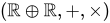
Every interval can be considered a symmetric interval around its midpoint. In a reconfiguration published in 1956 by M Warmus, the axis of "balanced intervals" [x, −x] is used along with the axis of intervals [x, x] that reduce to a point. Instead of the direct sum the ring of intervals has been identified[19] with the hyperbolic numbers by M. Warmus and D. H. Lehmer through the identification


where

This linear mapping of the plane, which amounts of a ring isomorphism, provides the plane with a multiplicative structure having some analogies to ordinary complex arithmetic, such as polar decomposition.
See also
[edit]References
[edit]- ^ Bertsekas, Dimitri P. (1998). Network Optimization: Continuous and Discrete Methods. Athena Scientific. p. 409. ISBN 1-886529-02-7.
- ^ a b Strichartz, Robert S. (2000). The Way of Analysis. Jones & Bartlett Publishers. p. 86. ISBN 0-7637-1497-6.
- ^ Weisstein, Eric W. "Interval". mathworld.wolfram.com. Retrieved 2020-08-23.
- ^ "Interval and segment", Encyclopedia of Mathematics, EMS Press, 2001 [1994]
- ^ Tao, Terence (2016). Analysis I. Texts and Readings in Mathematics. Vol. 37 (3 ed.). Singapore: Springer. p. 212. doi:10.1007/978-981-10-1789-6. ISBN 978-981-10-1789-6. ISSN 2366-8725. LCCN 2016940817. See Definition 9.1.1.
- ^ Cramér, Harald (1999). Mathematical Methods of Statistics. Princeton University Press. p. 11. ISBN 0691005478.
- ^ "Interval and segment - Encyclopedia of Mathematics". encyclopediaofmath.org. Archived from the original on 2014-12-26. Retrieved 2016-11-12.
- ^ Rudin, Walter (1976). Principles of Mathematical Analysis. New York: McGraw-Hill. pp. 31. ISBN 0-07-054235-X.
- ^ "Why is American and French notation different for open intervals (x, y) vs. ]x, y[?". hsm.stackexchange.com. Retrieved 28 April 2018.
- ^ Tao (2016), p. 214, See Lemma 9.1.12.
- ^ Kozyrev, Sergey (2002). "Wavelet theory as p-adic spectral analysis". Izvestiya RAN. Ser. Mat. 66 (2): 149–158. arXiv:math-ph/0012019. Bibcode:2002IzMat..66..367K. doi:10.1070/IM2002v066n02ABEH000381. S2CID 16796699. Retrieved 2012-04-05.
- ^ Complex interval arithmetic and its applications, Miodrag Petković, Ljiljana Petković, Wiley-VCH, 1998, ISBN 978-3-527-40134-5
- ^ Vind, Karl (2003). Independence, additivity, uncertainty. Studies in Economic Theory. Vol. 14. Berlin: Springer. doi:10.1007/978-3-540-24757-9. ISBN 978-3-540-41683-8. Zbl 1080.91001.
- ^ a b Heath, R. W.; Lutzer, David J.; Zenor, P. L. (1973). "Monotonically normal spaces". Transactions of the American Mathematical Society. 178: 481–493. doi:10.2307/1996713. ISSN 0002-9947. JSTOR 1996713. MR 0372826. Zbl 0269.54009.
- ^ a b Steen, Lynn A. (1970). "A direct proof that a linearly ordered space is hereditarily collection-wise normal". Proceedings of the American Mathematical Society. 24 (4): 727–728. doi:10.2307/2037311. ISSN 0002-9939. JSTOR 2037311. MR 0257985. Zbl 0189.53103.
- ^ Munkres, James R. (2000). Topology (2 ed.). Prentice Hall. ISBN 978-0-13-181629-9. MR 0464128. Zbl 0951.54001.
- ^ Engelking, Ryszard (1989). General topology. Sigma Series in Pure Mathematics. Vol. 6 (Revised and completed ed.). Berlin: Heldermann Verlag. ISBN 3-88538-006-4. MR 1039321. Zbl 0684.54001.
- ^ Kaj Madsen (1979), Review of "Interval analysis in the extended interval space" by Edgar Kaucher, MR 0586220
- ^ D. H. Lehmer (1956) Review of "Calculus of Approximations", MR 0081372
Bibliography
[edit]- T. Sunaga, "Theory of interval algebra and its application to numerical analysis" Archived 2012-03-09 at the Wayback Machine, In: Research Association of Applied Geometry (RAAG) Memoirs, Ggujutsu Bunken Fukuy-kai. Tokyo, Japan, 1958, Vol. 2, pp. 29–46 (547-564); reprinted in Japan Journal on Industrial and Applied Mathematics, 2009, Vol. 26, No. 2-3, pp. 126–143.
External links
[edit]- A Lucid Interval by Brian Hayes: An American Scientist article provides an introduction.
- Interval computations website Archived 2006-03-02 at the Wayback Machine
- Interval computations research centers Archived 2007-02-03 at the Wayback Machine
- Interval Notation by George Beck, Wolfram Demonstrations Project.
- Weisstein, Eric W. "Interval". MathWorld.
Interval (mathematics)
View on GrokipediaFundamentals
Definitions and Terminology
In mathematics, an interval is defined as a subset of the real numbers consisting of all numbers lying between two specified real numbers and (with ), potentially including or excluding the endpoints.[7] Specifically, the possible forms include , , , and .[1] Under the standard topology of the real line, intervals are precisely the connected subsets of , meaning they cannot be partitioned into two nonempty disjoint open sets.[8] This connectedness ensures that any two points in an interval can be joined by a continuous path within the set, distinguishing intervals from disconnected subsets like the union of disjoint points.[9] Key terminology includes closed intervals, which contain both endpoints; open intervals, which exclude both; and half-open or half-closed intervals, which include one endpoint but not the other.[1] Intervals may be bounded if both endpoints are finite real numbers or unbounded if one or both extend to or .[7] Endpoints can be finite or infinite, allowing for rays like or the entire line .[1] The nested interval principle, key to establishing the completeness of the real numbers, was developed in 19th-century real analysis by mathematicians including Karl Weierstrass, Heinrich Eduard Heine, and Georg Cantor.[10] Intervals are both connected and convex, meaning the line segment between any two points in the interval lies entirely within it, in contrast to non-convex or discrete subsets of .[7]Notations
In mathematics, intervals on the real line are commonly expressed using bracket notations that indicate whether the endpoints are included or excluded. The closed interval, which includes both endpoints and where , is denoted by .[1] The open interval, excluding both endpoints, is denoted by .[1] Half-open or half-closed intervals combine these conventions: includes but excludes , while includes but excludes .[1] For unbounded intervals extending to infinity, the notations incorporate the symbols and , always using parentheses since infinity is not a real number. A left-unbounded closed interval is written as , including but excluding .[11] Similarly, a right-unbounded closed interval is , and the entire real line is . Open unbounded variants, such as or , exclude the finite endpoint.[11] Intervals restricted to integers, often arising in discrete mathematics, are typically denoted using set-builder notation to specify the integer constraints explicitly. For integers from to inclusive, where and are integers with , the notation is . An equivalent compact form is , leveraging the real interval notation intersected with the integers. Alternative notations appear in specific contexts, such as to label an interval as a named set, particularly in analysis where the interval is referenced repeatedly.[11] Across mathematical fields like real analysis, topology, and algebra, the plain bracket notations and predominate for clarity and universality, though some texts use boldface (e.g., ) for emphasis in printed works or to distinguish from other bracket uses.[11]Types of Intervals
Bounded Intervals
Bounded intervals in the real numbers are subsets defined by two finite endpoints and with , forming connected sets between these points. These intervals are classified based on whether the endpoints are included or excluded, leading to four primary types: closed, open, half-open (or half-closed), and the other half-open variant.[1] A closed bounded interval, denoted , consists of all real numbers such that , thereby including both endpoints. In contrast, an open bounded interval, denoted , includes all such that , excluding the endpoints. Half-open intervals include one endpoint but exclude the other: contains , while contains . These classifications determine topological and analytical properties, such as boundary behavior and continuity requirements in functions defined on them.[1] The length of any bounded interval with endpoints and is given by , providing a measure of its extent independent of endpoint inclusion. For example, the closed unit interval has length 1 and serves as a fundamental domain in analysis and topology, while the open interval appears frequently in probability theory as the support for uniform distributions.[12] Every bounded interval is convex, meaning that for any two points , the line segment lies entirely within . This convexity follows directly from the total order of the real line, ensuring that intervals behave as the basic convex sets in .[13] In the subspace topology inherited from , closed bounded intervals are compact, as established by the Heine-Borel theorem, which guarantees that every open cover has a finite subcover. However, open or half-open bounded intervals are not compact, as they admit open covers without finite subcovers, such as the cover of by intervals for .[14]Unbounded Intervals
Unbounded intervals in the real numbers are subsets that extend infinitely in at least one direction, lacking a finite bound on that side. These intervals are defined using the extended real line, incorporating the symbols and as endpoints, with the convention that and are always excluded. There are three primary types: left-unbounded intervals of the form (excluding the finite endpoint ) or (including ); right-unbounded intervals (excluding the finite endpoint ) or (including ); and the fully unbounded interval , which coincides with the entire real line .[7] These intervals possess infinite length, formally defined as the Lebesgue measure or supremum of distances between points, which diverges to due to their unbounded extent. They are non-compact in the standard topology on , as they cannot be covered by finitely many compact sets without bound. Unbounded intervals commonly represent half-lines (rays) in applications, such as the positive real numbers or the non-positive reals , facilitating discussions in analysis where domains extend indefinitely.[7][15] In the context of the ordered field , unbounded intervals achieve maximality: the bi-unbounded interval is the largest possible connected subset under the order topology, encompassing all elements without upper or lower bounds, while one-sided unbounded intervals are maximal rays in the positive or negative directions. This structure underscores the completeness and archimedean property of , where no larger ordered extensions are needed for these sets.[7][2]Degenerate and Singleton Intervals
In mathematics, a degenerate interval refers to a closed interval where the endpoints coincide, specifically for some real number , forming a singleton set that is treated as an interval of length zero.[1] This construction arises naturally in the study of intervals on the real line, where the standard interval notation extends to such trivial cases.[16] Some authors also classify the empty set as a degenerate interval, though formal definitions of intervals often exclude it to maintain properties like connectedness; notations such as or with inconsistent bounds may informally suggest the empty set, but itself is not strictly an interval in many contexts.[17][18] Singleton sets like possess key topological properties on the real line: they are compact, as they are closed and bounded; connected, since they cannot be partitioned into nonempty disjoint open sets; and convex, as the line segment between any two points (trivially the point itself) lies within the set.[19][20][21] These singletons play a role in foundational definitions, such as limits and continuity at a point, where neighborhoods around isolated points are considered.[20] In some mathematical texts, degenerate intervals are excluded from the category of "proper" intervals to focus on those with positive length, but they are included in broader discussions for completeness and to handle boundary cases uniformly.[17] For instance, in the context of distributions, the Dirac delta function corresponds to a point mass supported on a singleton set, analogous to a degenerate interval as a zero-length point set.[22]Properties
Algebraic and Order Properties
Intervals on the real line possess fundamental order properties arising from the total ordering of . In particular, every interval is convex: if with , then for every with , it holds that .[13] This convexity ensures that intervals are connected subsets of , preserving the intermediate value property under the standard order.[7] Inclusion between intervals is determined by their endpoints relative to the order. For bounded intervals, the closed interval (with ) is a subset of the open interval (with ) if and only if . More generally, one interval is contained in another if the infimum and supremum of satisfy and , with adjustments for openness at the boundaries to ensure proper containment. Strict inclusion requires at least one inequality to be strict, depending on the endpoint types.[23] The intersection of two intervals is always itself an interval (possibly degenerate or empty). For closed bounded intervals and with and , the intersection is given by whenever ; otherwise, it is empty./07%3A_Volume_and_Measure/7.01%3A_More_on_Intervals_in_E._Semirings_of_Sets) This formula extends analogously to other types, such as open or unbounded intervals, by replacing maxima and minima with appropriate infima and suprema.[24] In contrast, the union of two intervals is an interval if and only if the intervals overlap or adjoin (i.e., their intersection is nonempty). If disjoint, the union consists of multiple disjoint components and thus is not an interval. For example, the union of and is , which is not an interval, whereas is an interval./07%3A_Volume_and_Measure/7.01%3A_More_on_Intervals_in_E._Semirings_of_Sets) The complement of an interval in (with respect to the universal set ) typically consists of one or two unbounded rays. For a bounded closed interval , the complement is . For an unbounded interval like , the complement is ; similarly, for , it is . The complement of is empty, and the complement of the empty set is .[25]Measure and Length Properties
The length of a bounded interval in the real line is defined as .[26] This notion extends naturally to the Lebesgue measure , where for any measurable interval , if is bounded.[27] All intervals, whether open, closed, or half-open, share this property, as the Lebesgue measure assigns the same value to sets differing only at endpoints of measure zero.[28] The Lebesgue measure on intervals exhibits key invariance properties. Translation invariance holds such that for any real number and interval .[29] Scaling, or homogeneity, satisfies for any nonzero real , reflecting the measure's behavior under dilation.[30] For unbounded intervals, such as , the Lebesgue measure is , while the empty set has .[27] All intervals are Jordan measurable, with their Jordan content equal to the Lebesgue measure.[31] This follows from the fact that the boundary of any interval consists of at most two points, which form a set of Lebesgue measure zero, satisfying the criterion for Jordan measurability.[31] Lebesgue measure is finitely additive over disjoint intervals: if are pairwise disjoint intervals, then the measure of their union is the sum of the individual measures, [27] This property underpins the measure's extension to more complex sets while preserving the intuitive notion of length for non-overlapping intervals.Special Intervals
Dyadic Intervals
In mathematics, dyadic intervals are a class of bounded intervals on the real line or the unit interval , defined as sets of the form where and are integers with . For the unit interval , ranges from 0 to , ensuring complete coverage without overlap. On , can be any integer, allowing dyadic intervals to tile the entire line at each level .[32][33] A concrete example at level is the single interval , which has length 1. At level , this refines into two intervals: and , each of length . Further refinement at subdivides each into , , , and , with length . In general, all dyadic intervals at level have equal length , and their disjoint union covers with total measure 1.[32][17] Dyadic intervals exhibit a nested structure: each interval at level contains exactly two subintervals at level , and is itself contained in exactly one "parent" interval at level of twice the length. This hierarchical property enables dyadic decompositions, where finer levels refine coarser ones systematically. The characteristic functions of these intervals span a dense subspace in spaces for , forming the foundation for the Haar basis in wavelet theory.[34]Integer Intervals
In mathematics, an integer interval is a subset of the integers that is an interval in the ordered set , consisting of all integers between two specified bounds. Analogous to real intervals, they can be closed, open, or half-open. For integers , the finite closed integer interval is defined as the set , which includes every integer from to without gaps. Infinite integer intervals extend one or both directions, such as for a ray starting at and proceeding to positive infinity, analogous to unbounded intervals in the reals but restricted to discrete points.[35][36] Common notations for integer intervals include to denote the closed finite case or for the infinite ray, emphasizing the integer restriction. The cardinality of a finite closed integer interval is , reflecting the count of consecutive elements. Closed integer intervals include their endpoints, while open ones like exclude them if and are integers.[1][36] A key property of integer intervals is their discrete convexity, or more precisely, order-convexity in the totally ordered set : if with , then every integer satisfying is also in the interval, ensuring no gaps between consecutive integers. Unlike real intervals, which are connected in the standard topology of , integer intervals inherit the discrete subspace topology from , making them totally disconnected as topological spaces despite their order-convex structure in .[35][1] In combinatorics, closed integer intervals like frequently appear as the domain for counting problems or summation. For instance, the sum of elements in follows the arithmetic series formula , which provides the total by averaging the first and last terms and multiplying by the number of terms. This formula establishes essential context for analyzing progressions in discrete settings.[37]Generalizations
Intervals in Ordered Sets
In a partially ordered set (poset) , an interval determined by elements with is defined as the subset .[38] This generalizes the familiar notion from totally ordered sets, where every pair of elements is comparable, to partial orders where incomparability is possible. In preorders, which relax antisymmetry but retain reflexivity and transitivity, the same formal definition applies, though equivalence classes may identify distinct elements under the induced partial order. If the poset lacks a global minimum or maximum, unbounded intervals such as the principal ideal or principal filter serve as one-sided analogs.[38] A subset is order-convex (or simply convex) if, whenever and satisfies , then .[39] Intervals are prototypical examples of convex subsets, as they contain all elements lying between their endpoints under the order. In general posets, convex sets capture the "intermediate" structure without requiring total comparability, and interval components refer to maximal convex subsets, which decompose the poset into irreducible convex blocks where no larger convex set can be formed by extension.[38] When the poset is a lattice—equipped with meets (infima) and joins (suprema) for every pair of elements—the interval inherits the lattice structure, forming a sublattice where the relative meet and join of elements are given by and , respectively.[38] This ensures that lattice operations remain closed within the interval, preserving algebraic properties like distributivity if present in the original lattice. If the poset is a chain (a totally ordered set), intervals reduce to the standard bounded or unbounded forms familiar from the real line, aligning with convexity in one-dimensional ordered structures.[40] A concrete example arises in the poset of all subsets of a fixed set , ordered by inclusion . For subsets , the interval consists of all intermediate subsets and forms a distributive lattice (a Boolean lattice if and ), illustrating how intervals in this poset capture chains of nested sets.[38]Multi-dimensional Intervals
In mathematics, multi-dimensional intervals extend the concept of one-dimensional intervals to higher-dimensional Euclidean spaces, typically as axis-aligned hyperrectangles or boxes. A hyperrectangle in is defined as the Cartesian product of one-dimensional intervals, such as the closed form where for each , or open variants like . These sets are also known as rectangular boxes and are fundamental in areas like measure theory and computational geometry due to their simple structure.[41] Hyperrectangles possess key topological and geometric properties. As the product of convex intervals, a hyperrectangle is itself convex, meaning that for any two points in the set, the line segment connecting them lies entirely within the set. Similarly, since each one-dimensional interval is connected, their Cartesian product is connected in the standard topology of . The Lebesgue measure, or volume, of a closed hyperrectangle is the product of its side lengths, given by , which generalizes the length of a one-dimensional interval.[41][42][43] Not all connected or convex sets in qualify as hyperrectangles; only those that are products of intervals along the coordinate axes fit this definition, distinguishing them from more general shapes like Euclidean balls, which are rotationally invariant but not axis-aligned products (with details on balls covered elsewhere). For instance, the unit square in is a two-dimensional hyperrectangle with side lengths 1 and volume (area) 1, illustrating how these sets capture rectangular regions in the plane.[41]Complex and Other Intervals
In mathematics, intervals can be extended to the complex plane, where the absence of a total order on prevents a direct analog to real intervals. Instead, complex intervals are typically defined as rectangular regions specified by bounds on the real and imaginary parts: , with and , .[44] This representation leverages real interval arithmetic on the components to perform operations like addition and multiplication while ensuring enclosures of the exact result.[44] Alternative definitions use disk-based forms, such as circular intervals centered at a point with a radius bound, but rectangular forms are more common for computational purposes due to their alignment with Cartesian coordinates.[45] A key property of these complex intervals is their convexity, which arises from the convexity of the bounding real intervals in the real and imaginary directions, despite the non-orderable nature of .[44] For instance, the sum of two rectangular complex intervals is the rectangular interval formed by summing their component real intervals, preserving convexity and providing tight bounds for interval arithmetic applications.[45] However, division requires careful handling to avoid including extraneous points, often using polar representations for improved enclosure in certain cases.[46] In metric spaces, balls serve as generalized interval analogs, capturing the notion of points within a bounded distance from a center. The open ball is defined as , where is the metric and , while the closed ball uses .[47] These structures extend the idea of open and closed intervals from (where the standard metric yields balls as intervals) to arbitrary metric spaces, forming the basis for open sets in the induced topology.[47] Convexity holds in normed spaces, where balls are convex sets, analogous to the convexity of real intervals. Convex polytopes generalize intervals to higher dimensions as bounded convex polyhedra, defined as the convex hull of a finite set of points in .[48] In one dimension, a polytope reduces to a line segment (an interval), while in higher dimensions, examples include simplices like triangles or tetrahedra, which are the convex hulls of affinely independent vertices.[49] These polytopes inherit interval-like properties such as convexity and compactness when bounded, but extend beyond rectangular products to include arbitrary finite-sided shapes.[50] In complex analysis, domains generalize open intervals as connected open subsets of , allowing for the study of holomorphic functions.[51] For example, the open unit disk is a simply connected domain, mirroring the connectivity of an open real interval.[52] Path-connectedness ensures that any two points can be joined by a continuous path within the set, a property that facilitates contour integration and analytic continuation, much like traversal within a real interval.[51]Applications
In Real Analysis and Calculus
In real analysis, intervals play a central role in the definition of continuity for functions on the real line. A function is continuous at a point if . In the real line, this is equivalent to the - condition: for every , there exists such that if , then . Equivalently, in topological terms, for every neighborhood of , there exists a neighborhood of (an open interval containing ) such that .[53] This formulation ensures that small perturbations within intervals around yield values of close to , capturing the intuitive notion that has no abrupt jumps or breaks at . Continuity on an interval requires this property to hold at every point in the interval, enabling key analytical properties like uniform continuity on compact intervals.[54] The Riemann integral is fundamentally defined over closed bounded intervals , where the integral exists for bounded functions that are continuous almost everywhere on . To compute it, one partitions into subintervals for , with , and forms Riemann sums for points ; the integral is the limit of these sums as the partition norm approaches zero.[55] This construction relies on the compactness of to guarantee the existence of such limits for continuous functions, distinguishing Riemann integration from more general theories.[56] The Fundamental Theorem of Calculus links differentiation and integration via intervals, stating that if is continuous on the closed bounded interval and , then is differentiable on with , and thus .[57] This theorem establishes antiderivatives as indefinite integrals and underpins much of calculus, showing how accumulation over intervals recovers the original function through differentiation. For continuous , the result holds without additional assumptions on differentiability.[58] The Intermediate Value Theorem asserts that if is continuous on a closed interval , then attains every value between and ; that is, for any with (or ), there exists such that .[59] This property ensures that continuous functions on intervals behave "without gaps" in their range, proving the existence of roots for continuous equations on such domains.[60] It is a cornerstone for solving equations and understanding connectedness in one dimension. Monotonic functions on intervals preserve order in their mappings: a strictly increasing continuous function , where is an interval, maps onto another interval while maintaining the order, so if in , then in .[61] For open intervals , the image is also an open interval, reflecting the order-preserving nature of monotonicity.[62] This preservation facilitates inverses for strictly monotonic functions and applications in solving inequalities over intervals.In Topology and Geometry
In general topology, the collection of all open intervals in the real line forms a basis for the standard topology on .[63] This basis generates the open sets as unions of such intervals, ensuring that every open set in can be expressed in this form. Additionally, the connected components of any subset of are precisely the intervals, whether open, closed, or half-open, highlighting the intrinsic connectedness of intervals in this space.[11] Unbounded intervals, such as rays of the form and , serve as elements in the subbasis for the order topology on .[64] The order topology on is generated by the subbasis consisting of all open rays and for , which aligns with the standard topology and underscores the role of intervals in defining the topological structure from the linear order.[65] In the context of homeomorphisms, intervals play a central role in classifying one-dimensional topological manifolds: every connected one-dimensional manifold is homeomorphic to either the real line , the circle , the closed interval , or the half-open interval .[66] More generally, any one-dimensional manifold decomposes into a countable disjoint union of these types, with intervals corresponding to the non-compact or bounded components without boundary cycles.[67] Geometrically, intervals represent geodesics in the Euclidean line , where the shortest path between any two points is the straight-line segment connecting them, which is itself an interval.[68] In Euclidean geometry, intervals are the fundamental convex sets on the real line, as a subset of is convex if and only if it is an interval, meaning it contains all points between any two of its elements.[69] This convexity property extends the topological role of intervals to geometric applications, such as defining line segments in higher-dimensional Euclidean spaces. An illustrative example of intervals in topology is their use in parameterizing paths for arc-connectedness: a topological space is path-connected (or arc-connected) if, for any two points, there exists a continuous map from the closed interval to the space joining them, with the interval serving as the parameter domain.[70] This parameterization ensures that path-connected components can be analyzed via images of intervals, mirroring the connectedness structure in .[43]In Computing and Numerical Methods
Interval arithmetic provides a framework for performing computations on ranges of real numbers, represented as closed intervals where , to account for uncertainties arising from rounding errors and measurement imprecision in digital computers. Basic operations are defined set-theoretically: for intervals and , addition is , subtraction is , multiplication is , and division (when ) is .[71] These operations ensure that the result interval contains all possible values of the expression evaluated over the input ranges, promoting reliable numerical results.[72] To handle floating-point representations, interval arithmetic incorporates directed rounding modes, particularly outward rounding, where the lower bound is rounded toward negative infinity and the upper bound toward positive infinity. This guarantees that the computed interval encloses the exact mathematical result, even under finite precision constraints.[73] For instance, the multiplication yields , as the minimum product is and the maximum is , demonstrating how interval methods can solve inequalities by propagating bounds through expressions.[71] The development of interval arithmetic for computing traces back to the early 1960s, with significant contributions from William Kahan, who advanced methods for more complete and reliable interval computations to address floating-point pitfalls.[74] Kahan's work emphasized practical implementation for error control in scientific computing.[75] In applications, interval arithmetic enables verified computing by producing enclosures that rigorously bound computation errors, essential for safety-critical systems. It is particularly valuable in numerical integration, where it bounds errors over intervals to certify results, such as in adaptive quadrature methods that refine enclosures until desired precision is achieved.[76] For example, integrating a function over using interval extensions of Riemann sums ensures the output interval contains the true integral value, facilitating automatic error estimation without pessimistic overbounds in many cases.[72]References
- https://proofwiki.org/wiki/Definition:Interval/Ordered_Set/Closed