



Community hub
Recent from talks
Contribute something
Nothing was collected or created yet.
Split-complex number
View on WikipediaIn algebra, a split-complex number (or hyperbolic number, also perplex number, double number) is based on a hyperbolic unit j satisfying , where . A split-complex number has two real number components x and y, and is written The conjugate of z is Since the product of a number z with its conjugate is an isotropic quadratic form.


The collection D of all split-complex numbers for forms an algebra over the field of real numbers. Two split-complex numbers w and z have a product wz that satisfies This composition of N over the algebra product makes (D, +, ×, *) a composition algebra.



A similar algebra based on and component-wise operations of addition and multiplication, where xy is the quadratic form on also forms a quadratic space. The ring isomorphism is an isometry of quadratic spaces.

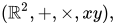

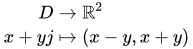
Split-complex numbers have many other names; see § Synonyms below. See the article Motor variable for functions of a split-complex number.
Definition
[edit]A split-complex number is an ordered pair of real numbers, written in the form

where x and y are real numbers and the hyperbolic unit[1] j satisfies

In the field of complex numbers the imaginary unit i satisfies The change of sign distinguishes the split-complex numbers from the ordinary complex ones. The hyperbolic unit j is not a real number but an independent quantity.

The collection of all such z is called the split-complex plane. Addition and multiplication of split-complex numbers are defined by

This multiplication is commutative, associative and distributes over addition.
Conjugate, modulus, and bilinear form
[edit]Just as for complex numbers, one can define the notion of a split-complex conjugate. If

then the conjugate of z is defined as
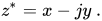
The conjugate is an involution which satisfies similar properties to the complex conjugate. Namely,
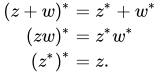
The squared modulus of a split-complex number is given by the isotropic quadratic form

It has the composition algebra property:

However, this quadratic form is not positive-definite but rather has signature (1, −1), so the modulus is not a norm.
The associated bilinear form is given by

where and Here, the real part is defined by . Another expression for the squared modulus is then


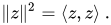
Since it is not positive-definite, this bilinear form is not an inner product; nevertheless the bilinear form is frequently referred to as an indefinite inner product. A similar abuse of language refers to the modulus as a norm.
A split-complex number is invertible if and only if its modulus is nonzero (), thus numbers of the form x ± j x have no inverse. The multiplicative inverse of an invertible element is given by

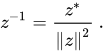
Split-complex numbers which are not invertible are called null vectors. These are all of the form (a ± j a) for some real number a.
The diagonal basis
[edit]There are two nontrivial idempotent elements given by and Idempotency means that and Both of these elements are null:
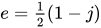



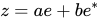
It is often convenient to use e and e∗ as an alternate basis for the split-complex plane. This basis is called the diagonal basis or null basis. The split-complex number z can be written in the null basis as

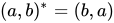
If we denote the number for real numbers a and b by (a, b), then zero is (0, 0), one is (1, 1), split-complex addition is given by and split-complex multiplication is given by


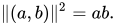
The split-complex conjugate in the diagonal basis is given by and the squared modulus by
Isomorphism
[edit]
On the basis {e, e*} it becomes clear that the split-complex numbers are ring-isomorphic to the direct sum with addition and multiplication defined pairwise.

The diagonal basis for the split-complex number plane can be invoked by using an ordered pair (x, y) for and making the mapping

Now the quadratic form is Furthermore,


so the two parametrized hyperbolas are brought into correspondence with S.
The action of hyperbolic versor then corresponds under this linear transformation to a squeeze mapping


Though lying in the same isomorphism class in the category of rings, the split-complex plane and the direct sum of two real lines differ in their layout in the Cartesian plane. The isomorphism, as a planar mapping, consists of a counter-clockwise rotation by 45° and a dilation by √2. The dilation in particular has sometimes caused confusion in connection with areas of a hyperbolic sector. Indeed, hyperbolic angle corresponds to area of a sector in the plane with its "unit circle" given by The contracted unit hyperbola of the split-complex plane has only half the area in the span of a corresponding hyperbolic sector. Such confusion may be perpetuated when the geometry of the split-complex plane is not distinguished from that of .


Geometry
[edit]
A two-dimensional real vector space with the Minkowski inner product is called (1 + 1)-dimensional Minkowski space, often denoted Just as much of the geometry of the Euclidean plane can be described with complex numbers, the geometry of the Minkowski plane can be described with split-complex numbers.


The set of points
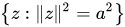
is a hyperbola for every nonzero a in The hyperbola consists of a right and left branch passing through (a, 0) and (−a, 0). The case a = 1 is called the unit hyperbola. The conjugate hyperbola is given by


with an upper and lower branch passing through (0, a) and (0, −a). The hyperbola and conjugate hyperbola are separated by two diagonal asymptotes which form the set of null elements:
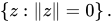
These two lines (sometimes called the null cone) are perpendicular in and have slopes ±1.
Split-complex numbers z and w are said to be hyperbolic-orthogonal if ⟨z, w⟩ = 0. While analogous to ordinary orthogonality, particularly as it is known with ordinary complex number arithmetic, this condition is more subtle. It forms the basis for the simultaneous hyperplane concept in spacetime.
The analogue of Euler's formula for the split-complex numbers is

This formula can be derived from a power series expansion using the fact that cosh has only even powers while that for sinh has odd powers.[2] For all real values of the hyperbolic angle θ the split-complex number λ = exp(jθ) has norm 1 and lies on the right branch of the unit hyperbola. Numbers such as λ have been called hyperbolic versors.
Since λ has modulus 1, multiplying any split-complex number z by λ preserves the modulus of z and represents a hyperbolic rotation (also called a Lorentz boost or a squeeze mapping). Multiplying by λ preserves the geometric structure, taking hyperbolas to themselves and the null cone to itself.
The set of all transformations of the split-complex plane which preserve the modulus (or equivalently, the inner product) forms a group called the generalized orthogonal group O(1, 1). This group consists of the hyperbolic rotations, which form a subgroup denoted SO+(1, 1), combined with four discrete reflections given by
and


The exponential map

sending θ to rotation by exp(jθ) is a group isomorphism since the usual exponential formula applies:

If a split-complex number z does not lie on one of the diagonals, then z has a polar decomposition.
Algebraic properties
[edit]In abstract algebra terms, the split-complex numbers can be described as the quotient of the polynomial ring by the ideal generated by the polynomial
![{\displaystyle \mathbb {R} [x]}](https://wikimedia.org/api/rest_v1/media/math/render/svg/453d1013f9dd290be70d5fe534e0d3311b0a7c6a)

![{\displaystyle \mathbb {R} [x]/(x^{2}-1).}](https://wikimedia.org/api/rest_v1/media/math/render/svg/a2095a29cf8115fc44ec86aa1f332545fd954645)
The image of x in the quotient is the "imaginary" unit j. With this description, it is clear that the split-complex numbers form a commutative algebra over the real numbers. The algebra is not a field since the null elements are not invertible. All of the nonzero null elements are zero divisors.
Since addition and multiplication are continuous operations with respect to the usual topology of the plane, the split-complex numbers form a topological ring.
The algebra of split-complex numbers forms a composition algebra since

for any numbers z and w.
From the definition it is apparent that the ring of split-complex numbers is isomorphic to the group ring of the cyclic group C2 over the real numbers
![{\displaystyle \mathbb {R} [C_{2}]}](https://wikimedia.org/api/rest_v1/media/math/render/svg/b416f6f9a6880397e3b88e12e950ce2010ad3df1)
Elements of the identity component in the group of units in D have four square roots.: say are square roots of p. Further, are also square roots of p.


The idempotents are their own square roots, and the square root of


Matrix representations
[edit]Using the concepts of matrices and matrix multiplication, split-complex numbers can be represented in linear algebra. The real unit 1 and hyperbolic unit j can be represented by any pair of matrices I and J satisfying I2 = J2 = I and IJ = JI = J with J ≠ ±I. Then a split-complex number a + bj can be represented by the matrix aI + bJ, and all of the ordinary rules of split-complex arithmetic can be derived from the rules of matrix arithmetic.
The most common choice is to represent 1 and j by the 2 × 2 identity matrix I and the matrix J,

Then an arbitrary split-complex number a + bj can be represented by:

More generally, any real-valued 2 × 2 matrix with a trace of zero and a determinant of negative one squares to I, so could be chosen for J. Regardless, det(aI + bJ) = a2 − b2, the squared modulus of the split-complex number.
Larger matrices could also be used; for example, 1 could be represented by the 4 × 4 identity matrix and j could be represented by the γ0 Dirac matrix.
History
[edit]The use of split-complex numbers dates back to 1848 when James Cockle revealed his tessarines.[3] William Kingdon Clifford used split-complex numbers to represent sums of spins. Clifford introduced the use of split-complex numbers as coefficients in a quaternion algebra now called split-biquaternions. He called its elements "motors", a term in parallel with the "rotor" action of an ordinary complex number taken from the circle group. Extending the analogy, functions of a motor variable contrast to functions of an ordinary complex variable.
Since the late twentieth century, the split-complex multiplication has commonly been seen as a Lorentz boost of a spacetime plane.[4][5][6][7][8][9] In that model, the number z = x + y j represents an event in a spatio-temporal plane, where x is measured in seconds and y in light-seconds. The future corresponds to the quadrant of events {z : |y| < x}, which has the split-complex polar decomposition . The model says that z can be reached from the origin by entering a frame of reference of rapidity a and waiting ρ nanoseconds. The split-complex equation expressing products on the unit hyperbola illustrates the additivity of rapidities for collinear velocities. Simultaneity of events depends on rapidity a; is the line of events simultaneous with the origin in the frame of reference with rapidity a.



Two events z and w are hyperbolic-orthogonal when . Canonical events exp(aj) and j exp(aj) are hyperbolic orthogonal and lie on the axes of a frame of reference in which the events simultaneous with the origin are proportional to j exp(aj).

In 1933 Max Zorn was using the split-octonions and noted the composition algebra property. He realized that the Cayley–Dickson construction, used to generate division algebras, could be modified (with a factor gamma, γ) to construct other composition algebras including the split-octonions. His innovation was perpetuated by Adrian Albert, Richard D. Schafer, and others.[10] The gamma factor, with R as base field, builds split-complex numbers as a composition algebra. Reviewing Albert for Mathematical Reviews, N. H. McCoy wrote that there was an "introduction of some new algebras of order 2e over F generalizing Cayley–Dickson algebras".[11] Taking F = R and e = 1 corresponds to the algebra of this article.
In 1935 J.C. Vignaux and A. Durañona y Vedia developed the split-complex geometric algebra and function theory in four articles in Contribución a las Ciencias Físicas y Matemáticas, National University of La Plata, República Argentina (in Spanish). These expository and pedagogical essays presented the subject for broad appreciation.[12]
In 1941 E.F. Allen used the split-complex geometric arithmetic to establish the nine-point hyperbola of a triangle inscribed in zz∗ = 1.[13]
In 1956 Mieczyslaw Warmus published "Calculus of Approximations" in Bulletin de l’Académie polonaise des sciences (see link in References). He developed two algebraic systems, each of which he called "approximate numbers", the second of which forms a real algebra.[14] D. H. Lehmer reviewed the article in Mathematical Reviews and observed that this second system was isomorphic to the "hyperbolic complex" numbers, the subject of this article.
In 1961 Warmus continued his exposition, referring to the components of an approximate number as midpoint and radius of the interval denoted.
Synonyms
[edit]Different authors have used a great variety of names for the split-complex numbers. Some of these include:
- (real) tessarines, James Cockle (1848)
- (algebraic) motors, W.K. Clifford (1882)
- hyperbolic complex numbers, J.C. Vignaux (1935), G. Cree (1949)[15]
- bireal numbers, U. Bencivenga (1946)
- real hyperbolic numbers, N. Smith (1949)[16]
- approximate numbers, Warmus (1956), for use in interval analysis
- double numbers, I.M. Yaglom (1968), Kantor and Solodovnikov (1989), Hazewinkel (1990), Rooney (2014)
- hyperbolic numbers, W. Miller & R. Boehning (1968),[17] G. Sobczyk (1995)
- anormal-complex numbers, W. Benz (1973)
- perplex numbers, P. Fjelstad (1986) and Poodiack & LeClair (2009)
- countercomplex or hyperbolic, Carmody (1988)
- Lorentz numbers, F.R. Harvey (1990)
- semi-complex numbers, F. Antonuccio (1994)
- paracomplex numbers, Cruceanu, Fortuny & Gadea (1996)
- split-complex numbers, B. Rosenfeld (1997)[18]
- spacetime numbers, N. Borota (2000)
- Study numbers, P. Lounesto (2001)
- twocomplex numbers, S. Olariu (2002)
- split binarions, K. McCrimmon (2004)
See also
[edit]
References
[edit]- ^ Vladimir V. Kisil (2012) Geometry of Mobius Transformations: Elliptic, Parabolic, and Hyperbolic actions of SL(2,R), pages 2, 161, Imperial College Press ISBN 978-1-84816-858-9
- ^ James Cockle (1848) On a New Imaginary in Algebra, Philosophical Magazine 33:438
- ^ James Cockle (1849) On a New Imaginary in Algebra 34:37–47, London-Edinburgh-Dublin Philosophical Magazine (3) 33:435–9, link from Biodiversity Heritage Library.
- ^ Francesco Antonuccio (1994) Semi-complex analysis and mathematical physics
- ^ F. Catoni, D. Boccaletti, R. Cannata, V. Catoni, E. Nichelatti, P. Zampetti. (2008) The Mathematics of Minkowski Space-Time, Birkhäuser Verlag, Basel. Chapter 4: Trigonometry in the Minkowski plane. ISBN 978-3-7643-8613-9.
- ^ Francesco Catoni; Dino Boccaletti; Roberto Cannata; Vincenzo Catoni; Paolo Zampetti (2011). "Chapter 2: Hyperbolic Numbers". Geometry of Minkowski Space-Time. Springer Science & Business Media. ISBN 978-3-642-17977-8.
- ^ Fjelstad, Paul (1986), "Extending special relativity via the perplex numbers", American Journal of Physics, 54 (5): 416–422, Bibcode:1986AmJPh..54..416F, doi:10.1119/1.14605
- ^ Louis Kauffman (1985) "Transformations in Special Relativity", International Journal of Theoretical Physics 24:223–36.
- ^ Sobczyk, G.(1995) Hyperbolic Number Plane, also published in College Mathematics Journal 26:268–80.
- ^ Robert B. Brown (1967)On Generalized Cayley-Dickson Algebras, Pacific Journal of Mathematics 20(3):415–22, link from Project Euclid.
- ^ N.H. McCoy (1942) Review of "Quadratic forms permitting composition" by A.A. Albert, Mathematical Reviews #0006140
- ^ Vignaux, J.(1935) "Sobre el numero complejo hiperbolico y su relacion con la geometria de Borel", Contribucion al Estudio de las Ciencias Fisicas y Matematicas, Universidad Nacional de la Plata, Republica Argentina
- ^ Allen, E.F. (1941) "On a Triangle Inscribed in a Rectangular Hyperbola", American Mathematical Monthly 48(10): 675–681
- ^ M. Warmus (1956) "Calculus of Approximations" Archived 2012-03-09 at the Wayback Machine, Bulletin de l'Académie polonaise des sciences, Vol. 4, No. 5, pp. 253–257, MR 0081372
- ^ Cree, George C. (1949). The Number Theory of a System of Hyperbolic Complex Numbers (MA thesis). McGill University.
- ^ Smith, Norman E. (1949). Introduction to Hyperbolic Number Theory (MA thesis). McGill University.
- ^ Miller, William; Boehning, Rochelle (1968). "Gaussian, parabolic, and hyperbolic numbers". The Mathematics Teacher. 61 (4): 377–382. doi:10.5951/MT.61.4.0377. JSTOR 27957849.
- ^ Rosenfeld, B. (1997) Geometry of Lie Groups, page 30, Kluwer Academic Publishers ISBN 0-7923-4390-5
Further reading
[edit]- Bencivenga, Uldrico (1946) "Sulla rappresentazione geometrica delle algebre doppie dotate di modulo", Atti della Reale Accademia delle Scienze e Belle-Lettere di Napoli, Ser (3) v.2 No7. MR 0021123.
- Walter Benz (1973) Vorlesungen uber Geometrie der Algebren, Springer
- N. A. Borota, E. Flores, and T. J. Osler (2000) "Spacetime numbers the easy way", Mathematics and Computer Education 34: 159–168.
- N. A. Borota and T. J. Osler (2002) "Functions of a spacetime variable", Mathematics and Computer Education 36: 231–239.
- K. Carmody, (1988) "Circular and hyperbolic quaternions, octonions, and sedenions", Appl. Math. Comput. 28:47–72.
- K. Carmody, (1997) "Circular and hyperbolic quaternions, octonions, and sedenions – further results", Appl. Math. Comput. 84:27–48.
- William Kingdon Clifford (1882) Mathematical Works, A. W. Tucker editor, page 392, "Further Notes on Biquaternions"
- V.Cruceanu, P. Fortuny & P.M. Gadea (1996) A Survey on Paracomplex Geometry, Rocky Mountain Journal of Mathematics 26(1): 83–115, link from Project Euclid.
- De Boer, R. (1987) "An also known as list for perplex numbers", American Journal of Physics 55(4):296.
- Anthony A. Harkin & Joseph B. Harkin (2004) Geometry of Generalized Complex Numbers, Mathematics Magazine 77(2):118–29.
- F. Reese Harvey. Spinors and calibrations. Academic Press, San Diego. 1990. ISBN 0-12-329650-1. Contains a description of normed algebras in indefinite signature, including the Lorentz numbers.
- Hazewinkle, M. (1994) "Double and dual numbers", Encyclopaedia of Mathematics, Soviet/AMS/Kluwer, Dordrect.
- Kevin McCrimmon (2004) A Taste of Jordan Algebras, pp 66, 157, Universitext, Springer ISBN 0-387-95447-3 MR 2014924
- C. Musès, "Applied hypernumbers: Computational concepts", Appl. Math. Comput. 3 (1977) 211–226.
- C. Musès, "Hypernumbers II—Further concepts and computational applications", Appl. Math. Comput. 4 (1978) 45–66.
- Olariu, Silviu (2002) Complex Numbers in N Dimensions, Chapter 1: Hyperbolic Complex Numbers in Two Dimensions, pages 1–16, North-Holland Mathematics Studies #190, Elsevier ISBN 0-444-51123-7.
- Poodiack, Robert D. & Kevin J. LeClair (2009) "Fundamental theorems of algebra for the perplexes", The College Mathematics Journal 40(5):322–35.
- Isaak Yaglom (1968) Complex Numbers in Geometry, translated by E. Primrose from 1963 Russian original, Academic Press, pp. 18–20.
- J. Rooney (2014). "Generalised Complex Numbers in Mechanics". In Marco Ceccarelli and Victor A. Glazunov (ed.). Advances on Theory and Practice of Robots and Manipulators: Proceedings of Romansy 2014 XX CISM-IFToMM Symposium on Theory and Practice of Robots and Manipulators. Mechanisms and Machine Science. Vol. 22. Springer. pp. 55–62. doi:10.1007/978-3-319-07058-2_7. ISBN 978-3-319-07058-2.
Number systems | |
|---|---|
| Sets of definable numbers | |
| Composition algebras |
|
| Split types | |
| Other hypercomplex | |
| Infinities and infinitesimals | |
| Other types | |


