Hubbry Logo
Operation DoppelkopfOperation DoppelkopfMain
Open search
Operation Doppelkopf
Community hub
Operation Doppelkopf
logo
8 pages, 0 posts
0 subscribers
Be the first to start a discussion here.
Operation Doppelkopf
from Wikipedia
Operation Doppelkopf
Part of Eastern Front of World War II

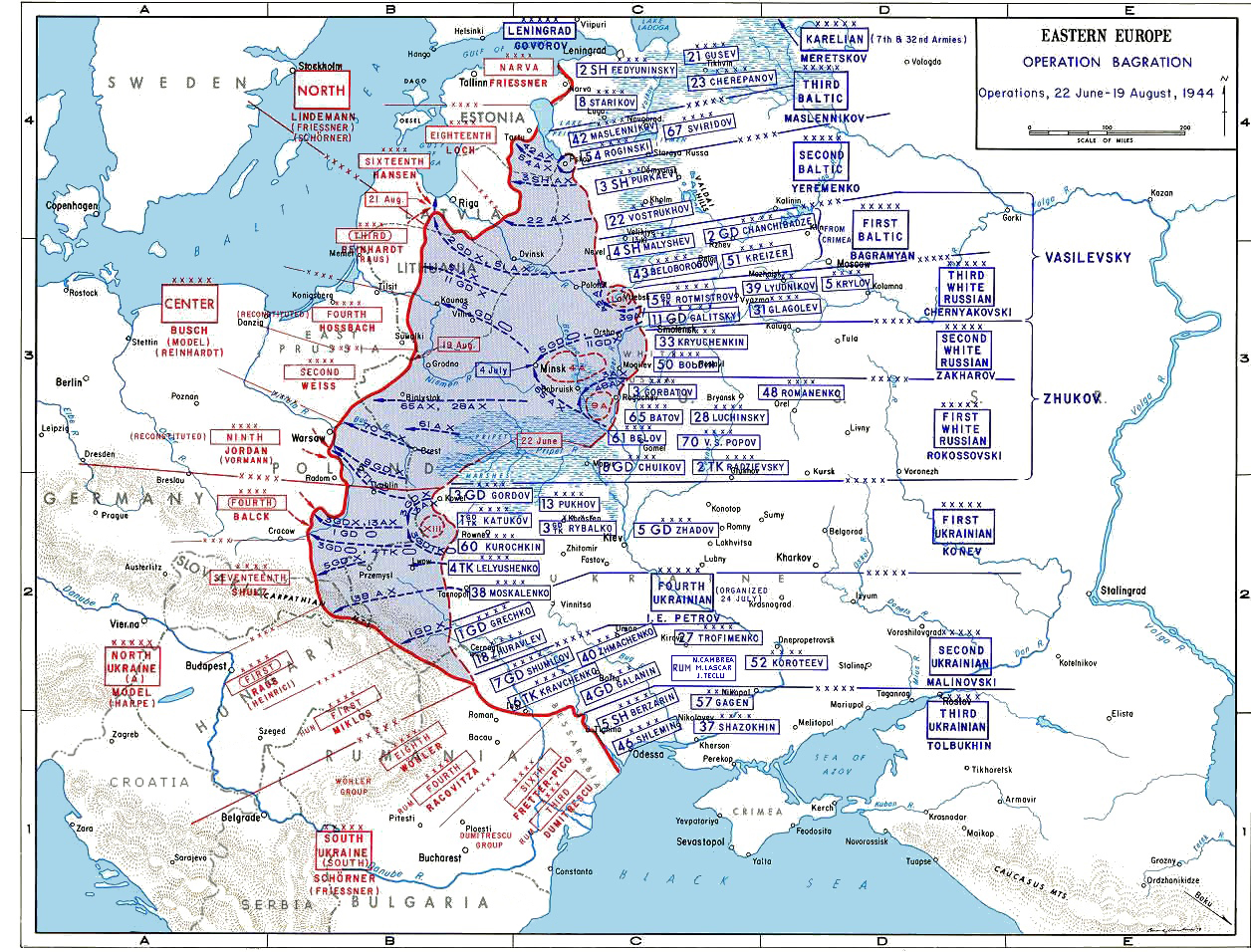
Eastern Front, June–August 1944. The attack at the connection between Army Groups Centre (Third Panzer Army) and North (Sixteenth Army) west of Riga is marked.
Date16 August 1944 – 27 August 1944
Location
Western Latvia
55°50′N 23°10′E / 55.833°N 23.167°E / 55.833; 23.167
Result Inconclusive
Belligerents
 Germany  Soviet Union
Commanders and leaders
Nazi Germany Georg-Hans Reinhardt
(Army Group Centre)
Nazi Germany Erhard Raus
(Third Panzer Army)
Soviet Union Ivan Chernyakhovsky
(3rd Belorussian Front)
Soviet Union Hovhannes Bagramyan
(1st Baltic Front)
Map

Operation Doppelkopf (German: Unternehmen Doppelkopf) and the following Operation Cäsar were German counter-offensives on the Eastern Front in the late summer of 1944 in the aftermath of the major Soviet advance in Operation Bagration with the aim of restoring a coherent front between Army Group North and Army Group Centre. The operation's codename was a reference to the German card game Doppelkopf.

Strategic situation

[edit]

By the end of July 1944, Soviet mechanised forces had reached the Gulf of Riga following their headlong advance in the Kaunas and Šiauliai offensives, part of the third and final 'pursuit' phase of the strategic offensive Operation Bagration.[1] The Soviet 2nd Guards Army had exploited a breach between the German 16th Army of Army Group North and the neighbouring 3rd Panzer Army of Army Group Centre, and severed the connection between them. German counter-attacks failed to restore it, and significant elements of the German armed forces were left isolated.

The Oberkommando des Heeres made immediate plans for an offensive to restore the connection between the two Army Groups.

Planning

[edit]

A number of armoured formations were assembled under Army Group Centre in Courland with orders to attack towards Jelgava (German: Mitau), cutting off the Soviet spearheads. The XXXX Panzer Corps, with the 7th and 14th Panzer Divisions, the Grossdeutschland Division and the 1st Infantry Division, was assembled at Liepāja / Libau, while the XXXIX Panzer Corps was assembled at Tauroggen.[2]

Deployments

[edit]

The offensive

[edit]

The operation commenced with an attack by the 7th Panzer Division on 15 August towards Kelmė. The main offensive began the following day, but there was strong resistance against the XXXX Panzer Corps from ten Soviet infantry divisions supported by three artillery divisions and anti-tank units.[2]

Von Saucken's XXXIX Panzer Corps opened operations on 18 August. Its left flank, an ad hoc formation under Hyacinth Graf Strachwitz, was preceded by a heavy artillery bombardment from the cruiser Prinz Eugen;[3] forces inside the pocket attacked to link up with Strachwitz's force. Strachwitz reached 16th Army at Tukums by midday.[4]

By 27 August, the corridor between 3rd Panzer Army and 16th Army had been enlarged to 18 miles in width, though the latter had come under renewed pressure from a fresh Soviet offensive against Riga.[5] The operation had also failed in its more ambitious objectives of retaking Šiauliai or of cutting off the 6th Guards Army threatening Riga.

Operation Cäsar

[edit]

A second German 'spoiling' attack, was planned to destroy Bagramyan's forces in the salient below Riga and push the front out to a straight line between the Segewold position and Šiauliai.[6] The main strike force was the reorganised XXXIX Panzer Corps, Third Panzer Army having been placed under the temporary overall control of Army Group North.[6] The attack began on 16 September,[7] in response to the Soviet Riga Offensive Operation, but by 19 September it had ground to a halt in the face of intense Soviet resistance after having penetrated only a few miles.[6] The German forces then assumed a defensive configuration.

Aftermath

[edit]

The Red Army attacked again on 5 October, in the Memel Offensive Operation.[8] Five days later, they reached the Baltic Sea and finally cut off Army Group North in what eventually became the Courland Pocket.[9] The German XXVIII Corps was isolated from the remainder of 3rd Panzer Army in a bridgehead at Memel.[9]

See also

[edit]

Footnotes

[edit]

References

[edit]

Further reading

[edit]
Revisions and contributorsEdit on WikipediaRead on Wikipedia
from Grokipedia
Operation Doppelkopf (German: Unternehmen Doppelkopf) was a limited counteroffensive launched by Nazi Germany's on the Eastern Front from 15 to 27 August 1944, aimed at restoring a severed land corridor between , isolated in the , and following the Soviet Red Army's rapid advances during and subsequent Baltic offensives that reached the sea at on 30 July. Commanded by and employing panzer corps such as the XL under General and XXXIX under General , with units including the 7th and 14th Panzer Divisions and the elite Grossdeutschland Division, the operation targeted Soviet positions held by the 1st Baltic Front under General Hovhannes Bagramyan and elements of the 3rd Belorussian Front. The offensive originated from Adolf Hitler's directive to reconnect the army groups and halt the Soviet momentum threatening and , but it achieved only partial tactical success by widening the corridor to approximately 18 miles (29 km) before stalling against determined Soviet defenses from the 2nd and 6th Guards Armies. Despite initial penetrations in western and the region of , Doppelkopf failed in its broader goals of recapturing or encircling the Soviet 6th Guards Army, incurring heavy German losses in men and armor while the soon resumed its pressure, leading to further encirclement of German forces in the . This operation, followed by the smaller Unternehmen Cäsar, underscored the Wehrmacht's mounting resource constraints and inability to reverse the strategic tide on the Eastern Front by late 1944, as Soviet numerical superiority and operational depth overwhelmed localized German armored thrusts.

Background and Strategic Context

Consequences of Soviet Operation Bagration

resulted in catastrophic losses for German Army Group Center, with approximately 400,000 casualties sustained between 22 June and 19 August 1944, including around 150,000 dead or missing. This offensive obliterated 28 of the group's 34 divisions, rendering it combat-ineffective and eliminating a quarter of the Wehrmacht's overall strength on the Eastern Front. German equipment losses exceeded 2,000 tanks and assault guns, alongside vast quantities of artillery and vehicles, crippling the army's ability to mount coherent defenses in the central sector. The rapid Soviet advances, averaging 30 kilometers per day in some areas, liberated by early July and propelled fronts toward the River, , and the approaches to . By mid-August, these gains had created a 400-kilometer-wide breach in the German lines south of the , exposing the flanks of adjacent formations. Soviet forces, particularly the 1st Baltic Front under General , exploited this vulnerability to thrust northwest, capturing key junctions like Šiauliai on 27 July and reaching the Baltic coast near by early August. These developments critically imperiled , isolating roughly 400,000 German troops in , , and by severing their sole overland supply route to and proper. Dependent thereafter on tenuous coastal shipping for reinforcements and evacuation, Army Group North faced , with Soviet bridgeheads along the coast threatening to compress it into shrinking pockets. The strategic shock prompted urgent German countermeasures, including the redeployment of panzer reserves from other fronts, but the irrecoverable manpower and materiel deficits from Bagration precluded any restoration of the pre-offensive front line.

German High Command's Response to Isolation of Army Groups

Following the Soviet , which commenced on June 22, 1944, and culminated in the destruction of much of German Army Group Center, Soviet forces under the 1st Baltic Front advanced to the , reaching on July 31, 1944, thereby isolating in the Kurland () region of and creating a separation exceeding 100 kilometers wide. This 'Baltic hole' severed land communications between Army Group North's Sixteenth Army and the remnants of Army Group Center, particularly the Third Panzer Army, threatening complete enclosure of approximately 200,000 German troops in the Baltic pocket. German generals, including former Chief of the General Staff Colonel-General , urged a major operational withdrawal from the northern Baltic positions as early as late June 1944 to consolidate forces and avert disaster, but rejected such proposals, insisting on holding the line to maintain as a potential for future counteroffensives. , who succeeded Zeitzler as Chief of the Army General Staff (OKH) on July 21, 1944, similarly advocated evacuation to preserve combat-effective units, yet Hitler prioritized static defense over retreat, viewing withdrawal as a sign of weakness that could demoralize the and expose . This stance reflected Hitler's broader strategic fixation on rigid fronts, despite logistical strains and Soviet numerical superiority, which numbered around 687 tanks opposing initial German armored efforts. In response, Hitler personally conceived Operation Doppelkopf as a limited counteroffensive to restore connectivity, directing OKH to formulate plans by , , under Guderian's oversight, rather than pursuing a full-scale evacuation. The operation aimed to exploit the gap with a spoiling attack, thrusting southeast from positions west of toward (Mitau) to link Third Panzer Army with Sixteenth Army and disrupt Soviet consolidation by targeting the rear areas of the 1st Baltic and 3rd Belorussian Fronts. Execution involved Generaloberst Erhard Raus's Third Panzer Army, deploying two panzer corps: XXXIX Panzer Corps under General (comprising 4th, 5th, and 12th Panzer Divisions) and XXXX Panzer Corps under General (14th Panzer Division and Grossdeutschland Division), initially fielding 141 tanks and 54 assault guns, with reinforcements from Romania swelling numbers to 299 by late August. This armored concentration, drawn partly from Center reserves, represented a tactical to achieve a narrow corridor without broader strategic repositioning, though it achieved only temporary relief before Soviet counterpressure reasserted the isolation by early September 1944.

Planning and Objectives

Formulation of Operational Goals

The operational goals of Operation Doppelkopf were conceived by by the end of July 1944, amid the crisis following Soviet advances in the and offensive operations, which severed land connections between and the remnants of Army Group Center. The (OKH) then formalized these objectives under the command of the , led by , emphasizing a rapid armored counteroffensive to restore a land corridor linking —trapped in the Kurland ( and —to German forces further south. The primary goal focused on thrusting northeast from concentrations in western , using the XL and XXXIX Panzer Corps, to eliminate Soviet penetrations by the 1st Baltic Front near and (Mitau), thereby reestablishing continuous front lines and sea access for supply to North's 16th and 18th Armies. This aimed to counter the Soviet 2nd and 5th Guards Armies' push toward , preventing further isolation and enabling potential reinforcement or repositioning of trapped forces without immediate evacuation, which Hitler explicitly forbade. Secondary objectives included a flanking strike southeast toward to target the rear of the Soviet 1st Baltic and 3rd Belorussian Fronts, disrupting their logistics and offensive momentum while buying time to reorganize depleted units like the 7th and 14th Panzer Divisions alongside elite formations such as the Grossdeutschland Division. Overall, the goals represented a limited spoiling action rather than a broad strategic reversal, constrained by resource shortages post-Operation Bagration, with success measured by creating a temporary 18-mile-wide corridor by late August 1944 rather than recapturing key cities like .

Logistical and Command Preparations

The Oberkommando des Heeres (OKH) initiated planning for Operation Doppelkopf immediately after Soviet forces severed the land connection between Army Group Center and Army Group North on or about August 10, 1944, during the Baltic Offensive. The operation fell under the overall direction of OKH, with Generaloberst Walter Model's Army Group Center responsible for assembling the assault forces from remnants of shattered units in the central sector. Generaloberst Erhard Raus, commanding the 3rd Panzer Army, was tasked with executing the main thrust, utilizing the reorganized XXXIX Panzer Corps as the primary striking element; this army was temporarily subordinated to Army Group North under General Ferdinand Schörner (who assumed command on July 25, 1944, replacing Johannes Friessner) to ensure coordinated efforts across the divided fronts. Logistical preparations emphasized the swift redeployment of armored assets via rail from southern and central fronts to assembly areas west of , including ad-hoc formations such as the 101st Panzer Brigade and elements of SS panzer brigades, despite chronic shortages of fuel, ammunition, and spare parts exacerbated by the recent destruction inflicted by . These transfers, completed in roughly one week, involved prioritizing panzer divisions over infantry support to achieve breakthrough velocity, with supply lines strained by partisan activity and bombed infrastructure. Support from heavy naval guns in the was integrated into command plans to offset deficiencies in , enabling preparatory bombardments ahead of the ground assault scheduled for August 15.

Forces and Deployments

German Army Group North and Reinforcements

, under Colonel-General , comprised primarily the Sixteenth Army in the critical Baltic sector following the Soviet advances of late July 1944, which severed land communications with Army Group Center by reaching the at on July 30. The Sixteenth Army, then commanded by General of Infantry , fielded infantry formations such as the 61st Infantry Division and elements of units, tasked with holding defensive lines north of the Soviet salient while preparing limited supporting thrusts southward to link with relief forces. These units, depleted by prior retreats and numbering around 200,000 men across the group, relied on fortified positions and for support amid severe supply shortages via sea routes. To execute Operation Doppelkopf, launched on August 16, 1944, reinforcements from the neighboring Third Panzer Army—temporarily subordinated to Army Group North's command—formed the primary striking power, comprising two panzer corps with approximately 500 tanks and assault guns. The XXXIX Panzer Corps, under General of Panzer Troops Dietrich von Saucken, included the 4th Panzer Division, 5th Panzer Division, and 12th Panzer Division, augmented by ad hoc kampfgruppen led by Hyacinth Graf Strachwitz von Gross-Zauche, emphasizing rapid armored penetration from the southern flank near Šiauliai. Complementing this, the XXXX Panzer Corps assembled the 7th Panzer Division, 14th Panzer Division, Grossdeutschland Panzergrenadier Division, and 1st Infantry Division near Liepāja, providing a secondary thrust with infantry support to exploit breakthroughs. These formations, drawn from reserves amid the broader Eastern Front crisis, represented the bulk of mobile reserves available, bolstered by Luftwaffe close air support and Kriegsmarine gunfire from destroyers Z-25 and Z-28. Logistical constraints limited reinforcement scale; the panzer divisions operated at 40-60% strength in personnel and armor, with the 4th Panzer Division fielding about 100 tanks, reflecting hasty redeployments from other sectors without full refit. Army Group North's integration of these assets aimed at pinching off the Soviet 2nd Guards Army's wedge, yet inherent weaknesses—such as fuel shortages and exposed flanks—constrained sustained advances beyond tactical gains of 40-50 kilometers by August 20.

Soviet Defending Formations in the Baltic Sector

The Soviet defenses in the Baltic sector opposite the German during Operation Doppelkopf were held by formations of the 1st Baltic Front, commanded by Army General Ivan Kh. Bagramyan. Formed in October 1943 from the Western Front, this front bore primary responsibility for the July 1944 Offensive, which advanced rapidly through to reach the at on July 31, isolating . By mid-August, its dispositions included the 43rd Army (Lieutenant General Vasily Gluzdovsky) on the left flank near , the 51st Army (Lieutenant General Yakov Kreizer) holding the central sector around Tukums and Šiauliai with its 1st, 16th, and 63rd Rifle Corps, and elements of the 6th Guards Army (Colonel General Ivan Chistyakov) redeployed to reinforce the right flank between the 51st and 5th Guards Tank Armies. The 51st Army, comprising approximately 120,000 troops, 300 tanks, and 2,000 artillery pieces at the onset of the German counteroffensive, formed the main defensive bulwark, having captured Šiauliai on July 27 with support from the 3rd Guards Mechanized Corps before transitioning to hasty defenses amid supply strains from overextended lines. Flanking support came from the (Lieutenant General ), which included the 29th Tank Corps and provided mobile reserves, though its armored elements were depleted from prior fighting, numbering around 150 operational tanks by August 15. These formations benefited from numerical superiority—over 500,000 personnel across the front—but faced challenges from fragmented command, logistical overstretch following Bagration, and terrain favoring German panzer maneuvers in open Lithuanian plains. To the north, the 3rd Baltic Front under General Ivan Bagramyan's counterpart in (though distinct), with the 61st Army and 10th Guards Army, indirectly screened the sector but focused on containing the 16th Army, leaving the 1st Baltic Front to absorb the brunt of Doppelkopf's thrust. Soviet defenses emphasized depth with minefields, antitank ditches, and fortified villages, yet German intelligence underestimated the resilience of these units, which inflicted significant attrition through massed and counterattacks despite lacking air superiority. Casualty figures for Soviet forces in the sector during the operation remain estimates, with the 51st Army alone reporting over 10,000 losses in the initial clashes, reflecting the intensity of Hyazinth Graf Strachwitz's panzer breakthroughs.

Execution of Doppelkopf

Initial Assault on August 15-16, 1944

The initial phase of Operation Doppelkopf commenced on August 15, 1944, with a probing attack by the 7th Panzer Division of the German XL Panzer Corps, directed northeast toward Kelmė in western , aimed at testing Soviet defenses ahead of the broader counter-offensive. This action was part of the 3rd Panzer Army's effort under to disrupt ongoing Soviet advances and lay groundwork for restoring a land corridor linking in the Kurland pocket to . The 7th Panzer Division, comprising armored and motorized elements, advanced against forward Soviet positions held by elements of the 1st Baltic Front, which included approximately 10 infantry divisions reinforced by three artillery divisions and anti-tank units. On August 16, the main assault intensified as additional German panzer forces, including the 14th Panzer Division and elements of the XXXX Panzer Corps, joined the push toward Jelgava, seeking to exploit initial gains and sever Soviet salients threatening East Prussia. Supported by the elite Großdeutschland Division and ad-hoc armored groups, the Germans encountered stiff resistance from the Soviet 2nd Guards Army and 5th Guards Army, which had pierced German lines near the Lithuanian border and were advancing toward Riga. Naval gunfire from units such as the heavy cruiser Prinz Eugen provided offshore support to coastal flanks, aiding in the containment of Soviet forward parties. Despite achieving limited local advances and inflicting disruptions on Soviet logistics, the initial assaults stalled short of major breakthroughs due to entrenched defenses and rapid Soviet reinforcements, setting the stage for the subsequent mobilization of the XXXIX Panzer Corps on August 18.

Main Offensive Phase and Key Engagements

The main offensive phase of Operation Doppelkopf launched on 16 August 1944, building on the preliminary thrust by the 7th Panzer Division toward Kelmė the previous day, as elements of the German 3rd Panzer Army under Generaloberst Erhard Raus sought to reestablish a land corridor to Army Group North's 16th Army. This involved coordinated attacks by the XXXX Panzer Corps, advancing from the Liepāja sector under General Otto von Knobelsdorff, and the XXXIX Panzer Corps, pushing from Tauragė under General Dietrich von Saucken, with the primary aim of recapturing Šiauliai and linking up west of Riga. German forces committed included the 14th Panzer Division, 7th Panzer Division, Grossdeutschland Panzergrenadier Division, and ad hoc formations such as Panzerkampfgruppe von Strachwitz, supported by heavy artillery and naval gunfire from units like the cruiser Prinz Eugen. Soviet defenses, primarily from General Hovhannes Bagramyan's 1st Baltic Front with contributions from the 3rd Belorussian Front, mounted fierce resistance through ten divisions reinforced by three divisions and extensive anti-tank assets, inflicting significant attrition on the German panzer spearheads amid challenging terrain and supply constraints. Key engagements centered on the drive toward , where XXXIX elements clashed intensely with Soviet forward positions, achieving a critical link-up with the 16th Army by midday during the offensive's early days, thereby restoring a tenuous overland connection severed by prior Soviet advances. Further fighting around and approaches to saw German armored thrusts penetrate Soviet lines temporarily but falter against counterattacks, failing to encircle or destroy major formations like the 6th Guards Army. By 27 August 1944, the Germans had widened the established corridor to approximately 18 miles (29 km) south of the Dvina River, blunting the momentum of the Soviet 1st Baltic Front's offensive and preventing immediate isolation of . However, the offensive stalled short of decisive breakthroughs, with heavy German losses in men and armor—exacerbated by fuel shortages and Soviet air superiority—limiting exploitation and allowing forces to consolidate positions for subsequent operations.

Follow-Up Operation Cäsar

Transition and Revised Objectives

Following the partial success of Operation Doppelkopf, which concluded on August 27, 1944, by establishing an 18-mile-wide land corridor linking 's 16th Army at with elements of but failing to retake Šiauliai or sever Soviet supply lines to the 6th Guards Army, German high command initiated planning for a follow-up offensive to consolidate gains and counter impending Soviet maneuvers. The narrow corridor remained vulnerable to Soviet encirclement efforts by the 1st Baltic Front under General , prompting commander General Ferdinand Schörner to advocate for renewed armored thrusts under led by Generaloberst . Operation Cäsar, launched on September 16, 1944, represented this transition, leveraging the momentum from Doppelkopf's XXXIX Panzer Corps under General to exploit weaknesses in Soviet dispositions before the onset of autumn rains and further reinforcements. Initial objectives for Cäsar focused on expanding the corridor southward, disrupting Soviet operational plans to isolate , and advancing toward to sever key enemy communications and potentially relieve pressure on . These aims built directly on Doppelkopf's unachieved goals, with Raus's forces—comprising panzer and divisions—tasked to penetrate Soviet lines held by the 1st, 2nd, and 3rd Baltic Fronts, inflicting attrition on Bagramyan's and General Andrei Eremenko's formations while restoring fuller connectivity between Army Groups North and Centre. The operation was conceived as a spoiling attack to preempt Soviet offensives, such as the impending Memel Offensive, rather than a decisive breakout, reflecting resource constraints including limited fuel and infantry support after Doppelkopf's expenditures of over 100 tanks. However, as Cäsar progressed, objectives were rapidly revised due to fierce Soviet resistance, logistical strains, and incomplete intelligence on buildups, shifting from offensive penetration to localized defensive consolidation by September 21, 1944. Initial advances of a few miles stalled against entrenched positions and counterattacks, compelling von Saucken's corps to prioritize securing the existing corridor over deeper strikes, thereby transitioning the effort into a holding action that preserved German positions but forfeited broader strategic gains amid deteriorating weather and Soviet numerical superiority exceeding 500,000 troops in the sector. This revision underscored the operational limitations imposed by Hitler's insistence on no retreats, forcing improvised tactics without adequate reserves for sustained momentum.

Conduct and Tactical Developments

Operation Cäsar was launched on 16 September 1944 as a spoiling attack by the German XXXIX Panzer Corps, under General , operating from the commanded by General within . The primary tactical aim was to disrupt the Soviet Riga Offensive Operation, which had severed land connections between Army Groups North and Centre, by striking Soviet positions west of Dobele in central near to regain a corridor and threaten the flank of the 1st Baltic Front under General Hovhannes Bagramyan. German forces, including panzer and divisions such as elements of the Großdeutschland Division, employed concentrated armored thrusts supported by infantry to penetrate Soviet defenses. Initial assaults achieved limited penetrations, with German units recapturing several kilometers of territory and inflicting casualties on forward Soviet elements of the 1st and 2nd Baltic Fronts. However, Soviet reserves, including mechanized units, rapidly reinforced the sector, mounting counterattacks that exploited terrain advantages and dense defensive networks to contain the German advance. By 18–19 , momentum stalled amid heavy fighting, as German panzer formations encountered anti-tank defenses and barrages that depleted their operational tempo. Tactical developments shifted from offensive probing to consolidation, with German commanders prioritizing the securing of salients against Soviet envelopment threats rather than deeper exploitation. The operation concluded on 21 without achieving a breakthrough or restoring inter-army group contact, as Soviet forces under the broader Baltic Fronts (1st, 2nd, and 3rd) maintained numerical superiority and logistical depth. German tactical withdrawals to prepared lines prevented immediate collapse but exposed the limitations of ad hoc armored spoiling attacks against entrenched Soviet positions, foreshadowing the isolation of in the . Casualty figures remain imprecise, though German reports noted moderate losses in vehicles and personnel relative to the operation's scale.

Results and Assessment

Tactical Achievements and Casualty Infliction

Operation Doppelkopf, conducted from 16 to 27 August 1944, achieved a limited tactical success by restoring a temporary land connection between the German (part of Center) and the 16th Army (), which had been severed by the Soviet Riga Offensive. The German XXXIX and , including elite formations such as the 4th, 5th, 7th, and 14th Panzer Divisions and the , advanced rapidly from positions west of (Schaulen), linking up with forward elements near and establishing a corridor approximately 20 kilometers wide by 29 kilometers deep. This maneuver threatened the rear of the Soviet 1st Baltic Front, halting its offensive momentum south of the (Dvina) River and stabilizing the front line west of by pushing back elements of the Soviet 51st Army. The operation demonstrated effective coordination of armored Kampfgruppen, with the 7th Panzer Division initiating probing attacks toward Kelmė on 15 August, followed by the main thrust on 16 August and reinforcement by the XXXIX Panzer Corps on 18 August, reaching objectives near (Mitau). However, the advance fell short of fully recapturing Mitau or achieving a broader breakout, as Soviet defenses and counterattacks prevented deeper penetration, and the corridor was lost again on 9 October 1944. German casualties during the operation totaled approximately 15,500 personnel killed, wounded, or missing, along with 80 tanks lost, reflecting the intense fighting against numerically superior Soviet forces supported by artillery and reserves. Soviet losses were not precisely quantified in available operational records, but the disruption of the 1st Baltic Front's advance and the destruction of forward units indicate significant attrition, contributing to the temporary relief of pressure on encircled German forces in .

Strategic Limitations and Criticisms

Despite achieving a temporary restoration of land communications between and the main front via a narrow 18-mile-wide corridor established by 27 August 1944, Operation Doppelkopf ultimately failed to prevent the subsequent isolation of German forces in the . Soviet forces, leveraging their numerical superiority in and artillery, rapidly countered the gains, severing the link during follow-on offensives in early September and confining to the . This outcome underscored the operation's strategic constraint: Germany's overstretched logistics and acute shortages of fuel, exacerbated by Allied campaigns against production, limited the sustainability of armored thrusts beyond initial penetrations. The operation's broader objectives—such as recapturing the key junction of or enveloping the Soviet 6th Guards Army to relieve pressure on —proved unattainable due to insufficient forces for exploitation phases, with committed panzer elements totaling around 150 tanks facing entrenched defenses. While it halted the immediate advance of the Soviet 1st Baltic Front south of the Dvina River by diverting enemy attention, the effort diverted elite reserves from more vulnerable central sectors, contributing to the rapid collapse of German lines elsewhere during the Soviet advance toward . Criticisms of the operation, as articulated in postwar analyses, highlight Hitler's insistence on offensive action over withdrawal or consolidation, which squandered irreplaceable armored assets without yielding decisive results; commanders like General , who directed the involved, later emphasized in memoirs the unrealistic expectations amid resource depletion following . The narrow focus on local relief, rather than enabling a phased evacuation of the Baltic bridgehead, reflected a broader strategic rigidity that tied down over 200,000 troops in Courland until May 1945, rendering them ineffective for the defense of the . Prit Buttar, in his examination of Baltic campaigns, notes that Doppelkopf's tactical successes masked an underlying failure to adapt to Soviet operational depth, as the corridor's vulnerability invited rapid Soviet ripostes without adequate infantry screens to hold flanks.

Comparative Analysis of German Counter-Offensives

Operation Doppelkopf represented a rare tactical success among late-war German counter-offensives on the Eastern Front, where Axis forces increasingly faced insurmountable numerical and logistical disadvantages following the Red Army's Operation Bagration. Launched on August 16, 1944, by the 3rd Panzer Army under Generaloberst Erhard Raus, it employed concentrated panzer formations—including the XXXX Panzer Corps and XXXIX Panzer Corps with units such as the 7th Panzer Division, 14th Panzer Division, and elite Panzergrenadier Division Großdeutschland—to exploit Soviet overextension after their rapid advances. The operation restored a temporary land corridor, approximately 18 miles wide, linking Army Group North's 16th Army at Tukums with Army Group Center by August 27, halting the Soviet 1st Baltic Front's momentum south of the Dvina River and disrupting elements of the 6th Guards Army. This limited achievement contrasted sharply with broader strategic paralysis, as Adolf Hitler rejected evacuation plans for Army Group North, dooming it to encirclement in the Courland Pocket despite the tactical bridgehead secured. In comparison to contemporaneous Western Front efforts like (Mortain Counterattack, August 7–13, 1944), Doppelkopf fared better by avoiding decisive Allied air interdiction, which swiftly neutralized German armored thrusts in through relentless bombing that destroyed over 300 tanks and immobilized follow-on infantry. On the Eastern Front itself, Doppelkopf's focused objective—reconnection rather than deep penetration—enabled surprise and rapid gains against fatigued Soviet units, unlike the overextended ambitions of later operations such as Frühlingserwachen (Spring Awakening, March 6–16, 1945). The latter, involving the 6th SS Panzer Army and aiming to recapture Hungarian oil fields, collapsed amid marshy terrain, inadequate reconnaissance, and Soviet counteroffensives, resulting in the destruction of significant armored assets without securing resources, exacerbating fuel shortages that had already constrained earlier efforts. Doppelkopf's employment of ad hoc kampfgruppen, like Panzerkampfgruppe von Strachwitz, demonstrated residual tactical proficiency in , inflicting disproportionate casualties on Soviet forward elements through assaults, though infantry shortages and lack of air superiority prevented exploitation.
OperationDateScale (Key Formations)Primary ObjectiveOutcome
DoppelkopfAug 16–27, 19442 Panzer Corps (e.g., 7th Pz, Gd PzGren)Restore corridor to Army Group NorthPartial tactical success; corridor achieved but not held long-term
FrühlingserwachenMar 6–16, 19456th SS Pz Army + alliesSecure Lake Balaton oil fieldsStrategic failure; heavy losses, no resource gains
Lüttich (Mortain)Aug 7–13, 19445th Pz Army elementsPinch off Allied Falaise salientRapid reversal; armored forces decimated by airpower
These counter-offensives underscored systemic German limitations: chronic manpower deficits (Eastern Front strength below 1.8 million by late , including auxiliaries), fuel curtailing panzer mobility, and Hitler's insistence on hold-or-die directives that squandered tactical gains. Doppelkopf's relative efficacy stemmed from operational surprise against dispersed Soviet reserves post-Bagration, yet it exemplified the pattern of local victories yielding no strategic reversal, as superiority in and reserves—evident in the 2nd Guards Army's rapid response—inevitably reasserted control. Historians note such efforts prolonged the war marginally but accelerated Axis collapse by diverting scarce panzers from defensive consolidation.
Add your contribution
Related Hubs
User Avatar
No comments yet.