Hubbry Logo
Operation IskraOperation IskraMain
Open search
Operation Iskra
Community hub
Operation Iskra
logo
8 pages, 0 posts
0 subscribers
Be the first to start a discussion here.
Operation Iskra
Operation Iskra
from Wikipedia

Operation Iskra
Part of the siege of Leningrad

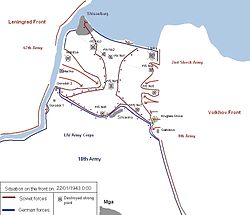
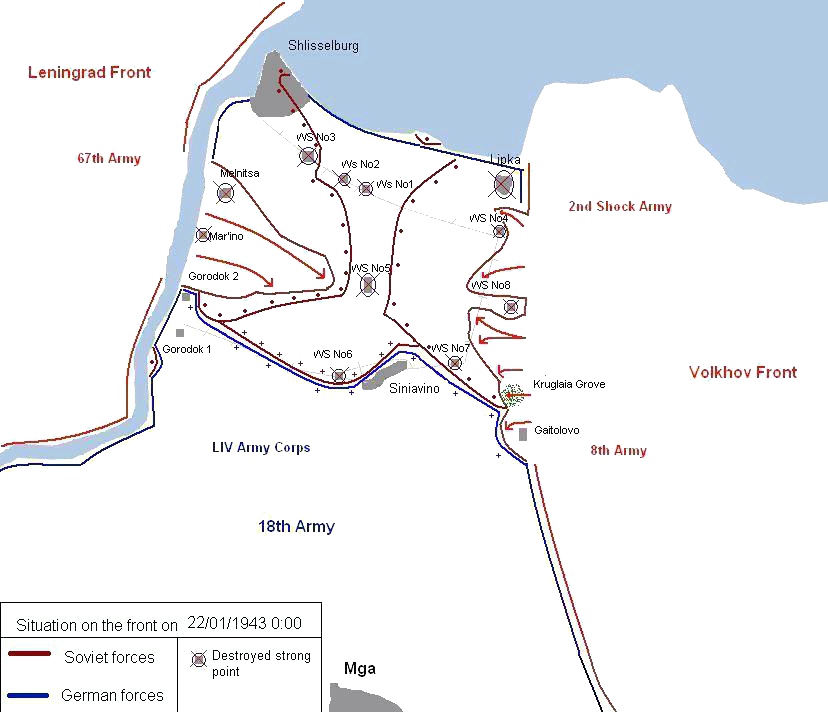
Front lines late January showing the efforts to displace the 18th Army (bottom) and link up the encircled Leningrad Front (left) with the Volkhov Front (right)
Date12–30 January 1943 (1943-01-12 – 1943-01-30)
Location
South of Lake Ladoga
59°54′00″N 31°04′03″E / 59.9000°N 31.0675°E / 59.9000; 31.0675
Result
  • Soviet victory
Belligerents
 Germany  Soviet Union
Commanders and leaders
Georg Lindemann
Units involved
18th Army
Strength
  • 26 divisions[1]
  • 700 artillery
  • 50 tanks[2]
  • 20 divisions
  • 15 brigades
  • 4,600 artillery
  • 500 tanks
  • 900 aircraft[2]
Casualties and losses
8,905[3] to 45,570 casualties[4] Krivosheev's official soviet data:
  • 33,940 killed
  • 71,142 wounded[5]
Map

Operation Iskra (Russian: операция Искра, lit.'Operation Spark'), a Soviet military operation in January 1943 during World War II, aimed to break the Wehrmacht's siege of Leningrad. Planning for the operation began shortly after the failure of the Sinyavino Offensive. The German defeat in the Battle of Stalingrad in late 1942 had weakened the German front.[vague] By January 1943, Soviet forces were planning or conducting offensive operations across the entire German-Soviet Front, especially in southern Russia; Iskra formed the northern part of the wider Soviet 1942–1943 winter counteroffensive.[6]

The operation was conducted by the Red Army's Leningrad Front, Volkhov Front, and the Baltic Fleet from 12 to 30 January 1943 with the aim of creating a land connection to Leningrad. Soviet forces linked up on 18 January, and by 22 January, the front line had stabilised. The operation successfully opened a land corridor 8–10 km (5.0–6.2 mi) wide to the city. A railroad was swiftly built through the corridor and allowed more supplies to reach the city than the Road of Life, across the frozen surface of Lake Ladoga, which significantly reduced the possibilities of the capture of the city and of any German–Finnish linkup.[7]

The success led to Operation Polyarnaya Zvezda less than two weeks later, which aimed to decisively defeat Army Group North and to lift the siege altogether. Polyarnaya Zvezda failed by achieving only minimal progress.[8] Soviet forces made several other attempts in 1943 to renew their offensive and to lift the siege completely, but they made only modest gains in each one. The corridor remained within range of German artillery, and the Red Army did not finally lift the siege until a year later, on 27 January 1944.[9]

Background

[edit]

The siege of Leningrad started in early autumn 1941. By 8 September 1941, German and Finnish forces had surrounded the city, cutting off all supply routes to Leningrad and its suburbs. However, the original drive on the city failed and the city was subjected to a siege. During 1942 several attempts were made to breach the blockade but all failed. The last such attempt was the Sinyavino Offensive. After the defeat of the Sinyavino Offensive, the front line returned to what it was before the offensive and again 16 km (9.9 mi) separated Leonid Govorov's Leningrad Front in the city from Kirill Meretskov's Volkhov Front.[10]

Despite the failures of earlier operations, lifting the siege of Leningrad was a very high priority, so new offensive preparations began in November 1942.[11] In December, the operation was approved by the Stavka and received the codename "Iskra" (Spark). The operation was due to begin in January 1943.[12]

By January 1943, conditions were improving for the Soviets. The German defeat in the Battle of Stalingrad had weakened the German front. The Soviet forces were planning or conducting offensive operations across the entire front, especially in southwestern Russia. Amidst these conditions, Operation Iskra was to become the first of several offensive operations aimed at inflicting a decisive defeat on Germany's Army Group North.[6]

Preparations

[edit]

The area south of Lake Ladoga is a heavily forested area with many wetlands (especially peat deposits) close to the lake. The forest shielded both sides from visual observation. Both factors greatly hindered the mobility of artillery and vehicles in the area, providing a considerable advantage to the defending forces. The Sinyavino heights were a key location, with terrain 150 m (490 ft) higher than the surrounding flat terrain. Because the front line had changed very little since the blockade was established, German forces had built an extensive network of interconnected trenches and obstacles, interlocking artillery and mortar fire.[13] The Neva River was partially frozen, allowing infantry to cross.[14]

German preparations

[edit]

The Germans were well aware that breaking the blockade was very important for the Soviet side. However, due to the reverse at Stalingrad and the Soviet offensive at Velikiye Luki to the south of Leningrad, Army Group North was ordered to go on the defensive and was stripped of many troops. The 11th Army, which was to lead the assault on Leningrad in September 1942, and which had thwarted the last Soviet offensive, was transferred to Army Group Center in October. Nine other divisions were also reassigned to other sectors.[15]

At the start of the Soviet offensive, the German 18th Army, led by Georg Lindemann consisted of 26 divisions spread across a 450 km (280 mi) wide front. The army was stretched very thin and as a result had no division-level reserves. Instead, each division had a tactical reserve of one or two battalions, and the army reserves consisted of portions of the 96th Infantry Division and the 5th Mountain Division. The 1st Air Fleet provided the air support for the army.[14]

Five divisions and part of another one were guarding the narrow corridor which separated the Soviet Leningrad and Volkhov Fronts. The corridor was only 16 km (9.9 mi) wide and was called the "bottleneck". The German divisions were well fortified in this area, where the front line had been virtually unchanged since September 1941, and hoping to repel the Soviet offensive.[11]

Soviet preparations

[edit]
Situation on front on 11 January

The plan for Operation Iskra was approved in December.

With the combined efforts of the Volkhov and Leningrad Fronts, defeat the enemy in the area of Lipka, Gaitolovo, Dubrovka, Shlisselburg, and thus penetrate the Leningrad blockade. Finish the operation by the end of January 1943.[16]

This meant recapturing the "bottleneck" and opening a 10 km (6.2 mi) corridor to Leningrad. After that, the two fronts were to rest for 10 days and resume the offensive southward in further operations.[16]

The biggest difference from the earlier Sinyavino Offensive was the location of the main attack. In September 1942 the Soviet forces were attacking south of the town of Siniavino, which allowed them to potentially encircle several German divisions, but also left the army open to flanking attacks from the north, and it was this which ultimately caused the offensive to fail. In January 1943 the offensive was conducted north of Siniavino, closer to the Ladoga Lake shore, which removed the threat of flanking attacks and increased the probability of success, but forced the Soviets to abandon the idea of encircling most of the German forces in the "bottleneck".[16]

The offensive was to be conducted by Leningrad Front's 67th Army and Volkhov Front's 2nd Shock Army commanded by Major General M.P. Dukhanov and Lieutenant General V.Z. Romanovsky respectively. The 8th Army, commanded by Lieutenant General F.N. Starikov, was to conduct a limited offensive on the 2nd Shock Army's flank and defend elsewhere.[17] 13th and 14th Air Armies provided air support.

The two fronts spent December training and preparing for the offensive, and received significant reinforcements. These included not just replenishment and additional rifle divisions and brigades, but also significant additional artillery and engineer units, which were vital for breaching the heavy German defenses. Specialized winter units included three ski brigades and four aerosani battalions.[18] To ensure the Soviet forces had air superiority, which they had lacked in the previous offensive, the air strength in the area was increased to a total of over 800 planes, predominantly fighters. Large tank forces could not operate well in the swampy terrain, so the tank forces were used primarily as battalions reinforcing divisions or slightly larger brigades, which were to operate independently.[19]

Originally the operation was due to begin on 1 January, but poor ice conditions on the Neva caused the offensive to be delayed until 12 January.[18] A number of measures were taken to prevent the details of the operation being revealed to the Germans. Only a limited number of senior officers were involved in the planning, all redeployments took place in bad weather or at night and simulated attack preparations were made elsewhere to confuse the German side.[20]

On January 10, Stavka sent Georgy Zhukov as its representative to coordinate the battle. The rifle divisions occupied their jumping-off positions on 11 January, and first echelon tanks moved into their advanced positions early on 12 January.[21]

Battle

[edit]

Start of the battle

[edit]
Soviet advance on 12 January

The night before the start of the operations, Soviet night bombers attacked the German divisional headquarters and artillery positions to disrupt German command and control. The bombers also attacked airfields and communication centres to disrupt the flow of reinforcements.[22] Operation Iskra began at 9:30 on 12 January, when the two Soviet fronts began their artillery preparation, which lasted for nearly two and a half hours on the western side and nearly two hours on the eastern side of the bottleneck. The Soviet attack started five minutes before the artillery preparation finished with a Katyusha barrage, to fully exploit its effects.[23]

The Leningrad Front forces achieved their greatest success between Shlisselburg and Gorodok 1 when the Soviet 136th and 268th Rifle Divisions with supporting tanks and artillery captured a bridgehead approximately 5 km (3.1 mi) wide and 3 km (1.9 mi) deep.[23] At 18:00, the sappers constructed bridges near Mar'ino to allow second echelon troops to advance. The attack further north at Shlisselburg failed, and attacks further south near Gorodok only resulted in the capture of the first line of German trenches. By evening, the Front command decided to exploit the formed bridgehead and troops attacking Shlisselburg across the Neva were redeployed across the river to attack it from the south.[24]

The Volkhov Front attack saw less success as the forces of the 2nd Shock Army managed to envelop but not destroy the German strong points at Lipka and Workers Settlement No. 8. The latter was an impressive defensive position with a garrison of 700 men and 16 bunkers. Heavy flanking fire from these strong points prevented any further advance, but the 2nd Shock Army penetrated the German defenses 2 km (1.2 mi) between these points. Further south, between Workers Settlement No. 8 and Kruglaya Grove, the advance was 1–2 km (0.62–1.24 mi) deep, while even further south, the flanking attacks by the 8th Army only managed to capture the first line of German trenches.[24]

The German side reacted by deploying their reserves to the region throughout the night. One improvised battle group consisting of five battalions from the 96th Infantry Division, supported by artillery and four Tiger tanks, moved to Gorodok No. 2 to reinforce the 170th Infantry Division to the west. Another similar battle group using battalions from the 96th Infantry Division was sent to Workers Settlement No. 1 to support the 227th Infantry Division.[25]

Soviet advance

[edit]
Soviet advance by 18 January

The next five days saw very heavy fighting as the Soviets slowly advanced through heavy German defences and repelled German counterattacks. On 13 January, bad weather prevented the Soviet side from employing their air force. That day they gained almost no ground and incurred heavy losses.[26] The German side, after their counterattacks had failed to throw back the Soviet troops, started further reinforcing the area by assembling battle groups using portions of divisions from the quiet parts of the front. These included battle groups from the 1st Infantry Division, the 61st Infantry Division, the 5th Mountain Division and the SS Police Division.[27]

On 14 January, the weather improved enough to allow air support again and the Soviet advance resumed, albeit at a slow pace. To speed up the encirclement of the strong point at Lipka, the Soviet side used the 12th Ski Brigade which crossed the ice of the Ladoga Lake and attacked the German rear lines. By the end of the day the German forces in the Lipka and Shlisselburg areas were almost completely cut off from the rest of the German forces.[28]

From 15 to 17 January, the Soviet fronts fought towards each other, capturing the strong points at Workers Settlements Nos. 3, 4, 7, 8, and most of Shlisselburg. By the end of 17 January they were only 1.5–2 km (0.93–1.24 mi) apart between Workers Settlements Nos. 1 and 5.[29] On 15 January, Govorov was promoted to Colonel General.[30]

Linkup and land corridor

[edit]
Joining of Leningrad and Volkhov Fronts
The linkup of the fronts at Workers Settlement No. 1

On 18 January, at 9:30, the lead elements from the 67th Army's 123rd Rifle Division and 2nd Shock Army's 372nd Rifle Division linked up near Workers Settlement No. 1, thus technically breaking the blockade and marking an important date in the Siege of Leningrad.[citation needed]

German forces north of the settlement were cut off. Group Huhner, made up of two battle groups under Lieutenant General Huhner, commander of the 61st Infantry Division, was supposed to hold the corridor between Workers Settlements Nos. 1 and 5 but was no longer able to do it. Later that day the Soviet forces captured Workers Settlement No. 5 after repelling a strong German counterattack. The lead elements from the 67th Army's 136th Rifle Division and 2nd Shock Army's 18th Rifle Division linked up to the north of the settlement at 11:45.[31] Group Huhner became cut off too and was ordered to break out through the forested area toward Siniavino before the main Soviet forces arrived and made a breakout impossible. Group Huhner abandoned its artillery and heavy equipment,[28] and ran "the gauntlet of fire" before reaching Siniavino on 19 January. The breakout was costly for both sides. By early afternoon, the Soviet forces cleared Shlisselburg and Lipka of German forces and started liquidating the forces remaining in the forests south of Lake Ladoga.[32]

From 19 to 21 January, the Soviet forces eliminated the encircled German forces and tried to expand their offensive southward towards Siniavino. However, the 18th Army significantly reinforced its positions there with the SS Police, 21st Infantry, and soon after the 11th Infantry and 28th Jäger Divisions. The Soviet forces captured Workers Settlement No. 6 but were unable to advance any further.[8]

Front line stabilises, railway construction

[edit]

There were no changes in the front line after 21 January as a result of Operation Iskra. The Soviet forces were unable to advance any further, and instead started fortifying the area to thwart any German attempt at re-establishing the blockade. On 21 January, work started on the rail line linking Leningrad to the rest of the country through the captured corridor. The plan from the State Defense Committee written on 18 January, ordered the construction to be finished in 20 days. The work was completed ahead of schedule and trains began delivering supplies on 6 February. The operation officially ended on 30 January.[33]

Aftermath

[edit]

Operation Iskra was a strategic victory for the Soviet forces. From a military perspective, the operation eliminated the possibility of the capture of the city and a German–Finnish link up, as the Leningrad Front was now very well supplied, reinforced and able to co-operate more closely with the Volkhov Front. For the civilian population, the operation meant that more food was able to reach the city, as well as improved conditions and the possibility of evacuating more civilians from the city.[8] Breaking the blockade also had a significant strategic effect, although that was overshadowed by the surrender of the German 6th Army at Stalingrad only a few days later. Notably, the first Tiger tank captured by the Soviets was taken during this battle. It was undamaged and evacuated by the Soviet forces for evaluation.[34]

The victory led to promotions for Govorov, who was promoted to colonel-general on 15 January, and Zhukov, who was promoted to Marshal of the Soviet Union on 18 January. In addition, Govorov and Meretskov were awarded the Order of Suvorov 1st Class on 28 January. The 136th and 327th Rifle Divisions were awarded the designation of 63rd and 64th Guards Rifle Divisions, while the 61st Tank Brigade was designated the 30th Guards Tank Brigade.[4]

For the German side, the battle left the 18th Army very stretched and exhausted. Lacking sufficient reinforcements, the command of Army Group North made the decision to shorten the front line by evacuating the Demyansk Pocket salient. The salient had been held throughout 1942, despite being encircled for a few months, as it was an important strategic bridgehead. Together with the Rzhev salient (which was also evacuated in spring 1943), it could potentially be used to encircle a large number of Soviet forces. However, in the situation that had developed, retaining it was no longer possible.[35]

Nevertheless, Stavka knew that Operation Iskra was incomplete, as the corridor it had opened was narrow and was still in range of the German artillery, and the important heights and strong point at Sinyavino remained under German control. This led Zhukov to plan Operation Polyarnaya Zvezda (Polar Star). This much more ambitious offensive operation aimed to decisively defeat Army Group North, but faltered early on.[8] The Soviet forces carried out several other offensives in the area in 1943, slowly expanding the corridor, making other small gains before finally capturing Siniavino in September.[36] However, the city was still subjected to at least a partial siege as well as air and artillery bombardment until January 1944, when the Leningrad-Novgorod Offensive broke through the German lines, lifting the siege completely.[37]

Notes

[edit]

References

[edit]

Further reading

[edit]
Revisions and contributorsEdit on WikipediaRead on Wikipedia
from Grokipedia
Operation Iskra was a major Soviet offensive launched on January 12, 1943, during , designed to breach the German by creating a narrow land corridor connecting the besieged city to the eastern Volkhov Front across the Sinyavino Heights. The operation was the third major Soviet attempt to relieve Leningrad, following failed efforts in 1941 and 1942, and was coordinated by Marshal as part of broader winter counteroffensives after the victory at Stalingrad. It involved coordinated assaults by the under Lieutenant General and the Volkhov Front under General , pitting approximately 302,800 Soviet troops, supported by over 4,500 artillery pieces, 1,000 tanks, and naval gunfire from the , against elements of the German Army Group North's Eighteenth Army, commanded by Colonel General Georg Lindemann, which fielded around 60,000 soldiers in the key sector. Despite fierce resistance in the heavily fortified "bottleneck" area near and Sinyavino, Soviet forces broke through on January 18, capturing key positions including and establishing an 8–11 kilometer-wide corridor along the southern shore of that allowed for the rapid construction of the "Road of Victory" railway, completed by , 1943, to deliver vital supplies and evacuate civilians. The offensive succeeded in partially lifting the 872-day —imposed since September 8, 1941, and already claiming over a million lives from and —but did not fully end the , which persisted until January 1944; nonetheless, it boosted Soviet morale, inflicted significant losses on the Germans, and secured Leningrad as a strategic and symbolic stronghold. Soviet casualties were heavy, totaling 115,082 (including 33,940 killed or missing and 81,142 wounded), while German losses included at least 12,000 dead, reflecting the intense close-quarters combat in frozen terrain.

Background

The Siege of Leningrad

The Siege of Leningrad began on 8 September 1941, when German forces of captured the fortress town of at the eastern end of the River, severing the city's last overland connection to the Soviet interior and isolating it from land-based supply routes. This encirclement, part of the broader German invasion under , left Leningrad—a major industrial center with a pre-war population exceeding 3 million—trapped between German positions to the south and Finnish forces to the north, with only the waters of providing a tenuous link to the outside world. German commander Wilhelm von Leeb's established defensive lines south of the lake, aiming to avoid a direct assault on the fortified city and instead starve its defenders and civilians into submission, as explicitly ordered by on 6 September 1941. The siege's most devastating effects unfolded during the winter of 1941–1942, when food rations plummeted to as low as 125 grams of bread per day for non-workers, triggering widespread that claimed approximately 500,000 lives in Leningrad alone during that season, contributing to over 1 million civilian deaths by the end of 1942 from , , and exposure. With rail and links severed, the city's inhabitants relied on the "Road of Life," an improvised ice route across frozen established in November 1941, where convoys of trucks transported essential supplies like flour and fuel while evacuating hundreds of thousands of civilians and wounded. Amid these hardships, Leningrad's industrial base adapted by relocating over 270 factories eastward or shutting them down by early 1942, while remaining plants shifted to wartime production under severe constraints, sustaining the Red Army's defense despite chronic shortages of raw materials and power. Previous Soviet efforts to relieve the city had faltered, most notably the Sinyavino Offensive of August–October 1942, launched by the Leningrad and Volkhov Fronts to link up and breach the encirclement but ultimately narrowing the German stranglehold without breaking it, as reinforcements from Erich von Manstein's Eleventh Army—totaling 12 divisions—counterattacked and encircled the Soviet 8th Army, inflicting heavy losses of around 114,000 men. This failure underscored the resilience of German defenses south of , preserving Army Group North's starvation strategy into late 1942 and heightening Soviet resolve to incorporate Leningrad's relief into broader winter counteroffensives of 1942–1943.

Strategic Situation in Late 1942

By late 1942, the strategic landscape around Leningrad had shifted following the failure of the Soviet Sinyavino Offensive in August–October, which allowed German forces to consolidate their defenses and widen the land gap between the Leningrad and Volkhov Fronts to approximately 12 kilometers south of . This narrow corridor, centered on the –Sinyavino heights, remained the primary barrier preventing a reliable land connection and exacerbating the isolation of the besieged city. The Soviet victory at Stalingrad, culminating in the encirclement and impending surrender of the German Sixth Army by early February 1943, profoundly influenced operations in the north, as the broader Eastern Front dynamics diverted critical reinforcements away from . Although planning for the Leningrad relief predated the full Stalingrad outcome, the disaster compelled Hitler to transfer the Eleventh Army and nine divisions from the Eighteenth Army southward, weakening the German grip on the region and creating opportunities for Soviet exploitation. In response, the Soviet High Command () issued a directive on 31 December 1942 ordering the Leningrad and Volkhov Fronts to prepare a coordinated offensive aimed at linking the two fronts and establishing a supply corridor south of . Meanwhile, German Army Group North, under Field Marshal , faced increasingly overstretched positions as it transitioned to a defensive posture amid the shifting momentum on the Eastern Front. The Eighteenth Army's divisions, such as the 170th and 227th Infantry, were thinly dispersed, often covering fronts exceeding 16 kilometers per unit, limiting their ability to maneuver or reinforce key sectors like the Sinyavino heights. This vulnerability was compounded by the ongoing in Leningrad, where had already claimed over 1 million civilian lives through starvation and bombardment since September 1941.

Opposing Forces and Commanders

Soviet Forces and Leadership

The Soviet forces committed to Operation Iskra comprised approximately 300,000 troops organized into 20 divisions and 15 brigades, drawn primarily from the and the Volkhov Front. The contributed elements of its 67th Army, commanded by Mikhail Dukhanov, which included several rifle divisions positioned in the Oranienbaum and along the southern approaches to Leningrad. Meanwhile, the Volkhov Front's , under Lieutenant General , formed the main striking force from the east, incorporating reinforced for breakthrough operations in the difficult terrain south of . These armies integrated forces from the Oranienbaum to create a coordinated aimed at shattering the German defenses in the Sinyavino heights. At the higher command level, the was led by , who emphasized meticulous planning and the exploitation of winter conditions to enhance Soviet mobility. The Volkhov Front fell under the direction of , whose experience in previous offensives informed the emphasis on massed infantry assaults supported by armor. Overall coordination was provided by Marshal as the representative of the (Supreme High Command), ensuring synchronization between the two fronts and the Baltic Fleet's . This command structure allowed for effective integration of the Oranienbaum forces, which had been maintained as a strategic lodgment despite earlier setbacks. In terms of equipment, the Soviet forces fielded around 4,600 pieces and mortars, providing overwhelming for the initial assaults, alongside 500 tanks—predominantly medium tanks suited to the forested and marshy terrain—and approximately 900 aircraft for air superiority and close support. Specialized units enhanced winter operations, including three brigades for rapid maneuvers over snow-covered ground and four aerosled battalions for logistical in deep snow. Logistical preparations were critical to the operation's success, involving the stockpiling of ammunition and supplies in forested areas to evade German , coupled with the of camouflaged and masked firing positions to conceal the buildup from aerial and ground observation. These measures underscored the Soviets' adaptation to the harsh northern winter environment, enabling a concentrated force capable of achieving local superiority despite the broader challenges of the Leningrad sector.

German Forces and Leadership

The German forces opposing the Soviet offensive in the Leningrad sector during Operation Iskra were primarily drawn from Army Group North's 18th Army, commanded by , a veteran Prussian officer who had earned the Knight's Cross for his service in and early campaigns of . Lindemann's army was tasked with maintaining the siege lines around Leningrad, stretching across a 280-mile (450 km) front that included challenging terrain such as frozen swamps, forests, and the strategic Shlisselburg-Sinyavino corridor. Overall, the 18th Army fielded approximately 200,000 troops organized into 26 divisions, though these were thinly spread and depleted from previous engagements like the failed Soviet offensives in 1942. Artillery support amounted to around 700 pieces, while armored forces were severely limited to just 50 tanks, reflecting the broader prioritization of panzer resources to other sectors of the Eastern Front, such as Stalingrad. Key defensive units in the critical Sinyavino heights and adjacent marshy lowlands included the 170th and 96th Divisions, which bore the brunt of holding the narrow corridor linking Leningrad to the east. These formations were part of the XXVI (encompassing the 1st, 227th, and 170th Divisions) and reserves drawn from the 96th Division's regiments (283rd, 284th, and 287th). Further south, the LIV included the SS Police Division and elements of the 5th Division, with limited reinforcements from the Spanish 250th Division (), which provided auxiliary support but was not positioned directly in the main assault zone. These units were entrenched in a multi-layered defensive system featuring three belts of fortifications in the corridor, designed to exploit the natural barriers of the terrain. Under Lindemann's direction, the emphasis was on an elastic defense in depth, a doctrinal approach adopted by the Wehrmacht in late 1942 to conserve manpower amid mounting Soviet pressure; this involved withdrawing from forward positions to counterattack from prepared lines rather than holding rigidly at all costs. Fortified positions, including minefields and strongpoints around Workers' Settlements Nos. 1–5, were integral to this strategy, aiming to blunt any breakthrough attempts in the bottleneck area. However, the defenses suffered from significant vulnerabilities, including widespread troop exhaustion from sustained fighting since 1941 and diminished air support, as Luftflotte 1 was overstretched across the northern front with limited aircraft available for close air support. These constraints contrasted sharply with Soviet superiority in artillery and tanks, which would prove decisive in the impending offensive.

Planning and Preparations

Soviet Planning

The planning for Operation , codenamed "" (Spark), was initiated by the Soviet (Supreme High Command) in late November 1942 to alleviate the ongoing by establishing a reliable land supply route. The primary objective was to forge an 8–12 km wide corridor linking the 67th Army, positioned south of Leningrad, with the in the Volkhov Front across the narrow gap south of , thereby piercing the German defensive lines and enabling the delivery of essential supplies to the besieged city. This goal was deemed critical after earlier failed attempts to breach the encirclement, with emphasizing a concentrated offensive to exploit the frozen winter terrain for mechanized advances. Detailed topographic maps were prepared to navigate the challenging landscape, including dense forests, marshy lowlands, and the elevated Sinyavino Heights rising to approximately 150 meters, which dominated the central sector and posed significant obstacles for and positioning. Stavka formally approved the operation in December 1942, following proposals from the Leningrad and Volkhov Front commands, with directives issued to coordinate a multi-axis beginning in mid-January 1943; planning had initially targeted a start on 27 December 1942, but this was postponed due to weather and logistical issues. The planning process involved meticulous of German positions, drawing on partisan reports and to identify weak points in the fortified German lines. To enhance operational security and mislead the enemy, Soviet planners incorporated deception measures, such as tight security protocols and night-time engineering work to conceal preparations. These efforts were designed to fragment German attention and prevent reinforcements from bolstering the primary target area. Coordination challenges were prominent during preparations, particularly in synchronizing the joint efforts of the Leningrad and Volkhov Fronts under the overall direction of General and General , respectively. Integrating from the Lake Ladoga Flotilla proved essential for suppressing German artillery along the lake's southern shore, though harsh winter conditions limited its effectiveness to clear ice channels. Logistical hurdles, such as ensuring fuel and transport over snow-covered roads, were addressed by leveraging , which facilitated tank mobility across otherwise impassable marshes, while engineers prepared bridging equipment for river crossings. These elements underscored the operation's reliance on precise timing and inter-service cooperation to overcome the environmental and command integration barriers inherent to the northern theater.

German Defenses and Preparations

The German defenses in the sector targeted by Operation Iskra, the narrow Shlisselburg-Sinyavino corridor south of , were organized by the 18th Army under as part of . This multi-layered defensive system consisted of three belts of fortifications amid forested swamps, frozen marshes, and fortified stone villages, featuring extensive trenches, anti-tank ditches, entanglements, and strongpoints designed to channel Soviet attacks into kill zones. Key emphasis was placed on holding the Sinyavino Heights, which provided critical observation posts overlooking the corridor and the approaches to Leningrad, with units from XXVI Corps (including the 1st, 170th, and 227th Infantry Divisions) and LIV Corps (SS Police Division and elements of the 5th Mountain Division) manning the lines; however, the average divisional frontage exceeded 10 miles, resulting in thinly held positions vulnerable to concentrated assaults. German intelligence assessments underestimated the scale of the Soviet buildup in late and early , as harsh winter weather—blizzards and deep snow—obscured troop movements and masked preparations across the frozen terrain. Lindemann's reports to Hitler highlighted persistent Soviet threats around Leningrad but stressed the strategic diversion of resources toward relieving the crisis at Stalingrad, portraying the northern front as stable enough to warrant minimal reinforcements despite ongoing siege maintenance. Soviet deception tactics, including strict operational security, further exploited these gaps by concealing the concentration of forces for a coordinated offensive. Preparations for the winter campaign were hampered by resource shortages and Hitler's "stand fast" orders, which prioritized rigid forward defenses over elastic maneuvers. Troops received limited , with soldiers camouflaged in white suits and positions fortified using dugouts, snow walls, and minefields, but many units lacked adequate heavy weapons and faced chronic supply issues due to overextended lines. Efforts to improve included constructing narrow-gauge rail links to expedite and delivery to forward positions, though these were insufficient to offset the army's secondary status compared to southern fronts. Contingency plans focused on rapid counterattacks to seal any penetrations, with Lindemann ordering reserves—such as elements of the 96th Infantry Division positioned near —to launch immediate thrusts supported by and the Tiger tanks of if breakthroughs occurred along the Sinyavino line. These measures aimed to restore the defensive integrity of the corridor while adhering to directives against retreats, though manpower constraints limited their effectiveness.

The Battle

Initial Assault (12–13 January 1943)

Operation Iskra commenced on 12 January 1943 at 9:30 a.m. with a massive two-hour barrage delivered by approximately 4,500 guns and mortars concentrated along a narrow 10-kilometer front, aimed at suppressing German defenses in the Shlisselburg-Gorodok sector. This preparation fire, supported by Katyusha rocket launchers, targeted fortified positions, bunkers, and emplacements of the German 18th Army, creating a dense curtain of explosions that one per 20 feet of frontline to disrupt enemy command and observation. The barrage was part of the broader Soviet objective to establish bridgeheads across the River and advance toward a linkup point near Workers' Settlement No. 5, piercing the German blockade of Leningrad. Following the artillery preparation, the 67th Army of the , under General Mikhail P. Dukhanov, launched its assault from the Oranienbaum bridgehead and the city's outskirts. The 45th Guards Rifle Division and elements of the 86th Rifle Division crossed the frozen River under covering fire, securing initial bridgeheads on the eastern bank despite intense German small-arms and machine-gun fire from the 170th and 96th Infantry Divisions. Simultaneously, the of the Volkhov Front, commanded by Lt. Gen. Vladimir Z. Romanovskii, advanced from the eastern sector toward Workers' Settlement No. 5, a key fortified strongpoint held by German forces, using infantry supported by engineers to clear paths through and trenches. The harsh winter conditions profoundly influenced the initial assaults, with temperatures ranging from -30°C to -40°C and deep cover complicating operations across the frozen marshes and forests of the sector. While these conditions favored Soviet ski-equipped reconnaissance and light infantry units for rapid maneuvers, they severely restricted tank deployment, as armored vehicles struggled in the drifts and bogs, limiting close support to the advancing riflemen. By the evening of 12 January, Soviet forces had achieved early penetrations of the outer German defensive lines, forming a wedge approximately 3 miles wide and 2 miles deep between and Gorodok, but progress slowed amid dense minefields and fierce counterfire from German howitzers and MG-42 machine guns. On 13 January, amid these clashes near Workers' Settlement No. 5, troops from the 18th Rifle Division of the captured the first intact German heavy tank, which had become mired in a peat bog; this vehicle was evacuated for technical evaluation, providing the Soviets with valuable intelligence on its design.

Breakthrough and Main Advance (14–17 January 1943)

Following the initial assaults that established bridgeheads on 12–13 January, Soviet forces exploited their gains through coordinated armored and infantry advances in the central sector during 14–17 January 1943. The of the Volkhov Front, spearheaded by the 372nd Rifle Division under Mikhail P. Iakimov, pushed forward 3–5 km daily toward the designated linkup point near , overcoming marshy terrain and fortified positions in the Sinyavino area. This methodical progress was supported by the Leningrad Front's flanking maneuvers from the Oranienbaum , where the 67th Army's units, including the 123rd Separate Brigade, conducted diversionary attacks to pin down German reserves and widen the breach in the enemy lines. A major challenge during this phase was clearing the heavily defended Sinyavino Heights, which dominated the central axis of advance and served as a . Soviet engineer units, augmented by flamethrower tanks such as OT-34s, played a crucial role in breaching minefields, pillboxes, and , allowing to dislodge entrenched German positions amid close-quarters combat. German counterattacks, launched by elements of the 18th and 96th Divisions, sought to restore their lines but were repeatedly repelled, notably by the 131st and 136th Rifle Divisions of the 67th Army, which inflicted heavy casualties on the attackers through defensive fires and local counterthrusts. Logistical support was essential to sustain the momentum, with the Soviet Air Force deploying approximately 900 aircraft for aerial resupply missions that delivered ammunition, fuel, and rations to forward units amid harsh winter conditions. Complementing this were temporary ice roads constructed across the Neva River, enabling limited truck convoys to ferry supplies and reinforcements to the advancing troops despite German interdiction. By 17 January, these efforts yielded key progress markers: the capture of Workers' Settlements Nos. 2 and 4 by elements of the 2nd Shock and 67th Armies, which narrowed the gap between the converging fronts to just 3 km and positioned Soviet forces for the imminent linkup.

Linkup and Corridor Creation (18–21 January 1943)

On 18 January 1943, following intense advances by Soviet forces from both the Leningrad and Volkhov Fronts, patrols from the 67th Army's 123rd Rifle Brigade and the 2nd Shock Army's 372nd Rifle Division linked up at approximately 09:30 near Workers' Settlement No. 1, east of , marking the initial breach in the German lines. This meeting point, located on the southern bank of the Neva River, connected the two fronts after days of coordinated assaults that had narrowed the German-held salient to a few kilometers. The linkup was confirmed through radio communications and personal contacts between forward units, establishing physical contact across the previously impassable gap. Over the ensuing days from 18 to 21 , Soviet troops expanded the breakthrough into a viable land corridor measuring approximately 8–11 kilometers wide and extending about 12 kilometers southward from the original front line along the . This narrow passage, secured amid ongoing fighting, immediately enabled the movement of convoys carrying essential supplies, initially delivering around 1,000 tons of , , and munitions per day—far surpassing the capacity of the seasonal and hazardous across . The corridor's establishment shifted logistics from the vulnerable frozen lake route to a more stable overland path, facilitating the rapid influx of reinforcements and evacuation of civilians from the besieged city. Soviet engineers played a critical role in consolidating the corridor, rapidly constructing pontoon bridges across the River to link the eastern and western banks while specialized units cleared extensive minefields and obstacles left by retreating German forces. Civilian volunteers from Leningrad, mobilized despite the ongoing hardships of , assisted in road construction efforts, using hand tools to level terrain, fill craters, and build corduroy roads through marshy areas to support the growing traffic of supply vehicles. These combined efforts ensured the corridor's operational viability within days, despite intermittent shelling from adjacent German positions. German forces, primarily elements of the 96th Infantry Division holding the Sinyavino Heights sector, mounted several local counterthrusts between 18 and 21 in an attempt to reseal the breach, including assaults on Workers' Settlements No. 1 and No. 5. These attacks, supported by artillery and limited armor, aimed to exploit the corridor's narrow profile but were repelled by concentrated Soviet defenses, including anti-tank units and flanking maneuvers that inflicted heavy casualties on the German infantry. Unable to restore their lines or prevent the Soviet consolidation, the 96th Division withdrew to prepared positions south of the corridor, ceding control of the vital link to Leningrad.

Frontline Stabilization and Securing Gains (22–30 January 1943)

Following the successful linkup of Soviet forces on 18 January 1943, the newly established land corridor south of —measuring approximately 8–11 kilometers wide and vulnerable to encirclement due to its narrow profile—faced immediate threats from German attempts to restore the blockade. The 67th Army of the , under Major General Mikhail P. Dukhanov, focused on fortifying the flanks of the salient through rapid entrenchment and deployment of defensive positions amid the frozen marshes and wooded terrain. German Army Group North, commanded by General , responded with coordinated counterattacks aimed at pinching off the corridor, deploying battle groups from divisions such as the 170th and 227th Infantry to exploit weaknesses at key points like Workers' Settlements No. 1 and No. 5, as well as Gorodok No. 2. These efforts, involving reinforcements including elements of the 96th Infantry Division supported by tanks, sought to sever the Soviet gains but were repeatedly repelled by determined defenses. Soviet forces bolstered their lines with extensive use of anti-tank guns, particularly 45mm and 76mm models, to counter armored probes, while aviation from the 13th Air Army provided to disrupt German assaults and protect the salient's narrow waist. Parallel to these defensive operations, Soviet engineers initiated development to solidify logistical support for Leningrad. Construction of the Shlisselburg–Polyany railway, a 33-kilometer line traversing the frozen marshes of the corridor, began on 20 and was completed by 7 , utilizing narrow-gauge tracks laid under harsh winter conditions by railway troops and local laborers. This "Road of Victory" enabled the transport of up to 3,000 tons of supplies daily by rail, far surpassing the capacity of the preceding across and ensuring sustained reinforcement for the besieged city. By 30 January 1943, Operation concluded with the frontline stabilized along the corridor, though German forces under Lindemann retained strong positions east of the salient, including the commanding Sinyavino Heights, maintaining oversight of the route.

Aftermath and Legacy

Casualties and Immediate Outcomes

The Soviet forces suffered heavy during Operation , with 33,940 personnel reported killed or missing and 81,142 wounded or sick, according to official data compiled by G. F. Krivosheev. These losses were exacerbated by intense urban combat in marshy terrain and severe winter conditions, which hampered mobility and increased exposure to fire. German were significantly lower but still substantial, with at least 12,000 confirmed killed, representing a notable strain on North's resources. Material losses on the Soviet side included approximately 225 tanks destroyed by the 67th Army alone, reflecting the high cost of breakthroughs against fortified positions. The Germans lost key assets, such as artillery positions that were neutralized along the new corridor, though no major territorial expansions beyond the initial linkup occurred. Notably, Soviet troops captured the first intact Tiger tank during the operation, which was nearly undamaged and included technical documentation for evaluation. The immediate outcomes of Operation Iskra provided critical short-term relief to Leningrad by establishing a narrow land corridor approximately 8–11 kilometers wide along Lake Ladoga's southern shore. This allowed for the increased delivery of supplies, sustaining the city's beleaguered population and garrison. Industrial production in Leningrad began to recover shortly thereafter, with output rising sharply and weapons manufacturing increasing significantly by February 1943.

Strategic and Long-Term Impact

Operation Iskra marked a pivotal step in the broader Eastern Front campaign by establishing a narrow land corridor to Leningrad, enabling subsequent Soviet offensives such as Operation Polyarnaya Zvezda in February–March 1943, which sought to encircle and defeat elements of . This breakthrough, occurring shortly after the Soviet victory at Stalingrad, significantly boosted morale across the and civilian population, reinforcing the momentum of the Soviet counteroffensive and demonstrating the feasibility of coordinated winter operations against entrenched German positions. Ultimately, the corridor created by Iskra facilitated the complete lifting of the siege on 27 January 1944 during the Leningrad-Novgorod Offensive, transforming Leningrad from an isolated stronghold into a viable defensive hub. Despite these gains, the operation's strategic limitations were evident in the precarious nature of the corridor, which measured only 8-11 kilometers wide at its narrowest point and remained vulnerable to German counterattacks. In , during the initial phases of Operation Polyarnaya Zvezda, German forces launched fierce assaults, including the , attempting to recapture the salient and sever the link-up, though these efforts ultimately failed to restore the full blockade. Iskra did not achieve the complete destruction of , allowing the Germans to maintain their overall defensive posture in the region until later offensives. The logistical legacy of Operation Iskra was profound, as the secured corridor permitted the construction of a permanent rail line connecting Leningrad to the Soviet rear, vastly improving supply lines and defensive capabilities. This infrastructure enabled the evacuation of approximately 1.5 million civilians from the city by mid-1943, alleviating the and allowing the to reinforce the front without the constant threat of . In modern , Operation Iskra is regarded as a tactical that highlighted the of Soviet winter warfare doctrines, with particular emphasis on the decisive role of massed barrages—over 4,500 guns fired in the initial assault—to shatter fortified German lines in harsh conditions. Post-1990s has been limited, with no major archival declassifications emerging by 2025 to revise established narratives; recent analyses note persistent gaps in unit-level operational studies and the under-examined impact of on maneuverability and .

References

Add your contribution
Related Hubs
User Avatar
No comments yet.