Hubbry Logo
SemikhahSemikhahMain
Open search
Semikhah
Community hub
Semikhah
logo
7 pages, 0 posts
0 subscribers
Be the first to start a discussion here.
Contribute something
Semikhah
Semikhah
from Wikipedia

Semikhah[a] (Hebrew: סְמִיכָה) is the traditional term for rabbinic ordination in Judaism.

The original semikhah was the formal "transmission of authority" from Moses through the generations. This form of semikhah ceased between 360 and 425 CE. Since then, semikhah has continued in a less formal way; throughout Jewish history, there have been several attempts to reestablish the classical semikhah.

The title of "rabbi" has "proliferated greatly over the last century".[1] Nowadays, semikhah is also granted for a comparatively limited form of ordination, bestowing the authority to apply Halakha in specific Jewish settings rather than across the Jewish people writ large. In non-Orthodox Jewish religious movements, rabbinical education often emphasizes the modern roles of rabbis, such as preaching, teaching, counseling, and pastoral work.[2]

In recent times, relatedly, some institutions grant ordination for the role of hazzan (cantor), extending the "investiture" granted there from the 1950s. Less commonly, since the 1990s,[citation needed] ordination is granted for the role of lay leader – sometimes titled darshan. Ordination may then also be specifically termed סמיכה לרבנות ('rabbinical ordination'), סמיכה לחזנות ('cantorial ordination'), or הסמכת מגיד ('maggidic ordination').

[edit]

The word semikhah derives from a Hebrew root סמכ (smk) that means to "rely on", in the sense of "lean on", or "to be authorized"; the literal meaning of semikhah is "leaning [of the hands]". Semikhah may refer to the "conferring" of the ordination, or as a noun, to the certification itself, where the plural is Semakhot (or Semachot); one with ordination may then be referred to as a Musmach. A precedent Biblical usage[3] is Numbers 8:10, describing the preparation of the Levites for service.

A rabbi is also sometimes referred to as a Moreh Hora'ah (מורה הוראה) "one who teaches [Halakhic] decisions", while the ordination itself is called Heter Hora'ah (היתר הוראה) "permission to make Halakhic decisions", certifying that the holder has the facility[4] to apply his "thorough knowledge of the Talmud"[5] to the facts of a given halakhic question, and (implicitly) certifies also that the candidate is suitable to function as a community rabbi.[6] These terms derive from Leviticus 10:11, where the requirement is specified[7] that halakhic decisions are to be made only by a qualified authority.

Concept

[edit]
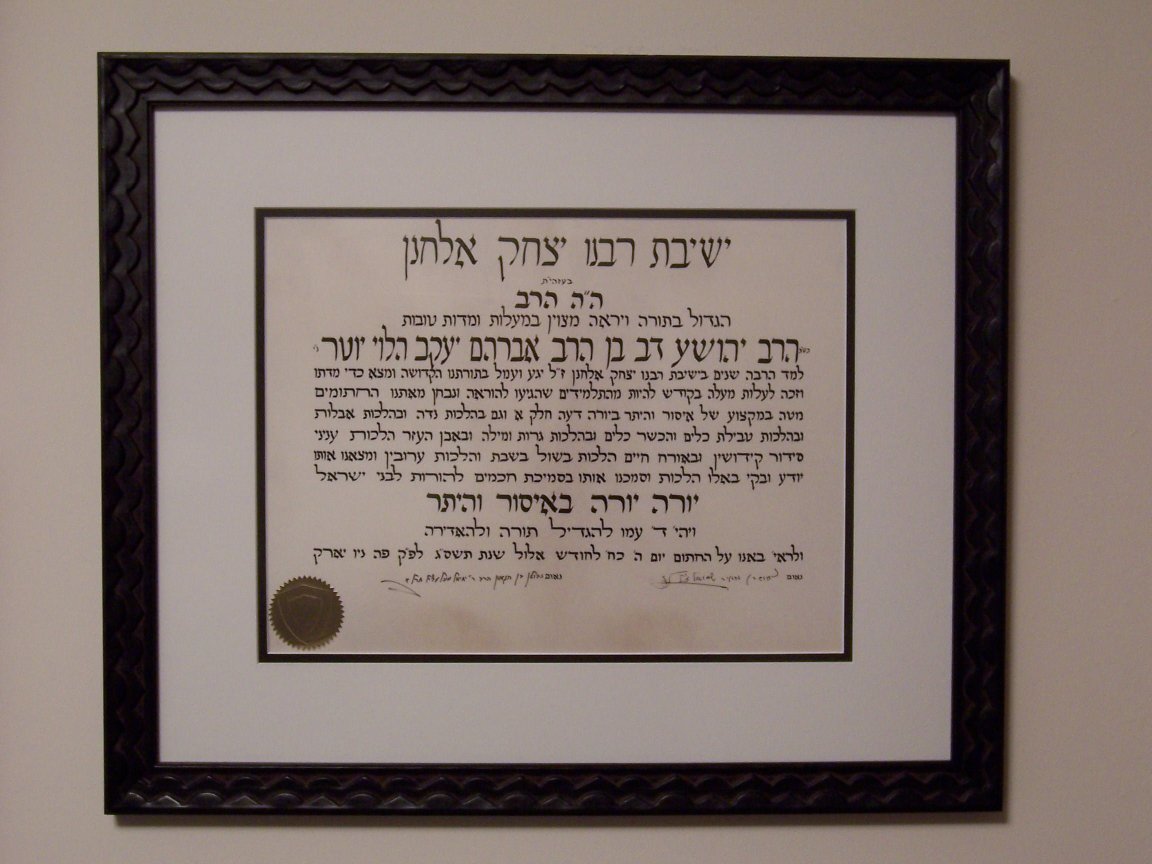
Example semikhah certificate, Yadin Yadin, of Rabbi Aryeh Kaplan awarded by Rabbi Eliezer Yehuda Finkel. The wording, as is typical, states that the holder is learned in Shas (ש״ס) – i.e. has wide knowledge of Talmud – as well as in Rishonim and Acharonim – i.e. has deep knowledge of Halakha. The phrase "כל מן דין סמוכין לנא"[8] is often included, and translates "anyone of this [caliber] may be ordained for us"; similarly often included is the phrase "הגיע להוראה" ("hegia leHora'ah"),[4] which describes the Musmach as having "arrived at [the level of] Hora'ah".

In concept, semikhah represents a "bond"[9] dating back to the time of Moses and Joshua. It is held that God taught the Torah to Moses on Mount Sinai in 1312 BCE and that since that time, the knowledge of the Torah has been passed from generation to generation by the conferment of semikhah, rabbinic ordination, or the unbroken transmission of authority dating back to that time. This unbroken chain of Torah teaching is thus said to have continued for over 3300 years and continues to this day.[10][11]

The ancient formula for semikhah was "Yoreh Yoreh. Yadin Yadin". ("May he decide? He may decide! May he judge? He may judge!"); and in the early days of rabbinical Judaism any ordained teacher could ordain his students.[citation needed] Classical semikhah was granted by a court of three judges[12] and it later required the participation of at least one who had attained this status himself. According to Maimonides the other two need not be semukhim.[13]

Today,[5][1] semikha is generally through an institution, a yeshiva or specialized kollel, but is often granted by an individual. The testing here[14][15][16][17] confirms one's ability to decide ("pasken") a question in halakha (Jewish law).[5] The examination has a dual concern: firstly it confirms knowledge of the law as presented in Shulchan Aruch, the standard code of law (with more recent applications from relevant teshuvot, or responsa); secondly, it also confirms an understanding of the underlying principles, by testing the relevant Talmudic sugyas, together with their development by the Rishonim and Acharonim, especially the Arba'ah Turim; see Yeshiva § Jewish law.

Varieties of ordination

[edit]

The Talmud lists three classes of semikhah issued:[18] Yoreh Yoreh, Yadin Yadin, and Yatir Bechorot Yatir; while the first two are still issued, the last is not. Additional forms of semikhah issued in modern times are discussed below.

  • Yoreh Yoreh (Hebrew: יורה יורה): The recipient of this semikhah demonstrated sufficient education and proper judgment to be able to render halakhic judgments on matters of religious law as it pertains to daily life, focusing on kashrut, referred to as "Issur v'Hetter", and niddah (both from Shulchan Aruch Yoreh De'ah), and permissible or forbidden activities on Shabbat and Yom Tov (Orach Chaim). The holder of this Semikha, as above, is referred to also as a Moreh Hora'ah and the ordination itself is called Heter Hora'ah.
  • Yadin Yadin (Hebrew: ידין ידין, Ashkenazi pronunciation: Yoden Yoden): The recipient of this semikhah demonstrated sufficient education and proper judgment to be able to render halakhic judgments on matters of religious law as it pertains to monetary and property disputes; the basis here is the Choshen Mishpat section, and will usually include parts of Even Haezer such as the laws of Gittin; this semikhah is usually required for a rabbi to act as a dayan (rabbinic judge), and, typically, is granted only to those already holding Yoreh Yoreh, even though the Talmud states that one can have be granted Yadin Yadin without Yoreh Yoreh.
  • Yatir Bechorot Yatir: The recipient of this semikhah demonstrated sufficient education and proper judgment to determine the ritual status of firstborn animals that have developed a blemish. This degree required extensive veterinary knowledge. See Burnt offering (Judaism) § Order and preparation.

Many Yoreh Yoreh programs, for example the Chief Rabbinate's and RIETS, include testing in Avelut (Laws of mourning; Yoreh Deah) and/or Jewish marital law (Even Ha'ezer section). Traditionally – and on the other hand – Yoreh Yoreh covered kashrut only,[19][1] and this is still often the case.[20] Although apparently limited,[21] the basis here is that, as mentioned, semikha is in fact a confirmation of the ability - and right - of the holder to pasken in general,[4] and that, as required, the rabbi can correctly apply his Talmudic and Halakhic knowledge to other areas (and where necessary refer complex cases to a posek, a more qualified authority; see Responsa § In Judaism). Similar, a semicha focusing on the laws of Shabbat is sometimes granted. Often, niddah will require a separate specialized certification, as – given their intricate and sensitive nature – an element of shimush, or "apprenticeship",[22] pertains particularly to these halakhot. (In fact shimush more generally, is (implicitly) required before one serves as a Rabbi.[23]) It is not uncommon for a rabbi to hold several certificates, with each semikha covering a specific area of halakha. Certification, with similar testing, is also required to qualify as a shochet, mohel, sofer, or menakker; these inhere a major practical element and thus require significant shimush.

Modern semakhot

[edit]

As outlined, additional forms of semikhah are issued in modern times[1] with their content departing from the above, to an extent reflecting[24][2] the contemporary Rabbinic role. See Yeshiva § Curriculum for further outline.

An Orthodox semikha, "Rav U'Manhig", "(pulpit) Rabbi and (community) leader",[25] essentially testifies that the recipient has sufficient Torah knowledge to serve in a position of leadership[6] (as "rabbi" essentially means "teacher", not necessarily "halakhic authority"). The testing here covers Orach Chaim extensively, usually with limited emphasis on the underlying Talmudic sugyas. See the related discussion re "semicha-testing programs" and "online semicha" at List of rabbinical schools § Orthodox.

Pluralistic and non-denominational movements grant an ordination titled "Rav U-moreh/morah BeYisrael", "Rabbi and Teacher in Israel". The curriculum here, as above, may emphasize "the other functions of a modern rabbi such as preaching, counselling, and pastoral work",[2] as opposed to Halakha; further, often in these institutions less emphasis is placed on Talmud and Jewish law, "but rather on sociology, cultural studies, and modern Jewish philosophy".[26] See List of rabbinical schools § Non-denominational.

In contrast to these, the Chief Rabbinate of Israel confers the further advanced semikhah of "Rav Ir", "[Chief] Rabbi of a City". This covers additional relevant topics from all sections of Shulchan Aruch - such as gerut - and, as for Dayanut, has Yoreh Yoreh as a prerequisite; see Chief Rabbinate of Israel § Semikhah.

Ordination ceremony

[edit]

The ceremony where ordination is conferred is known as Hag HaSemikha, the festival of ordination. Today, in most branches of Judaism, there is no laying on of hands; ordination is conferred as an academic degree with a diploma, signed by the officiating rabbis and often hand-written on parchment. Receiving ordination has been a festive occasion accompanied by celebration since Talmudic times. According to the Talmud, when the rabbis ordained Rabbi Zeira, they sang a bridal song in his honor: "Even though she painted not her eyes with antimony, neither darkened her cheeks with rouge, nor plaited her hair, she is still a graceful doe [of exceptional beauty]!"[27] the analogy and implication being: just as a bride is inherently beautiful, so for ordination, one's Torah knowledge must be immediately apparent.[28] They also sang at the ordination of Rabbi Ammi and Rabbi Assi: "Just like these, just like these, ordain for us!"; epitomizing, as they did, the ideal candidate for ordination.[8] This wording - כל מן דין סמוכו לנא - as per the certificate displayed, is still often included on semikhah diplomas.

Contemporary usage

[edit]

In the prevailing sense, "smicha" generally refers to the ordination of a rabbi within all modern Jewish religious movements from Reform to Orthodox.[29]

This "Smicha lerabbanut" signifies the transmission of rabbinic authority to give advice or judgment in Jewish law, thus overlapping to some extent with the classical usage, per #Concept above; see also Rabbi § Orthodox and Modern Orthodox Judaism. In this context, "Rav Muvhak" is sometimes used to refer to a student's primary teacher.

Smicha lehazzanut, ordination as a cantor, similarly signifies the transmission of authoritative knowledge about Jewish musical and liturgical traditions. This is granted within some denominations.[citation needed]

Status of current rabbis

[edit]

Although presently most functioning synagogue (i.e. "pulpit") rabbis hold semikhah, this was until quite recently not always required, and in fact many Haredi rabbis may possibly not be required to hold a "formal" semikhah even though they may occupy important rabbinical and leadership positions. The reasons being that what is prized in the communities they serve and lead is most of all a supreme mastery of the Talmud with a vast knowledge of the commentaries of the Rishonim and Acharonim and Responsa, added to knowledge of the Shulchan Aruch and Halakha ("Jewish Law"). In the UK, a communal minister who does not have semikhah has the title "Reverend" rather than "rabbi".[citation needed]

Many Hasidic rebbes and Rosh yeshivas of major Orthodox yeshivas are not required to "prove" to their flocks that they do or do not hold formal semikhah because their reputations as Torah-scholars and sages is unquestioned and esteemed based on the recommendations of trusted sages, and the experiences and interactions that many knowledgeable Torah-observant Jews have with them, which thus gives practical testimony based on experience that these great rabbis are indeed worthy to be called as such.[citation needed]

For example, according to some reports Rabbi Yisrael Meir Kagan (known as the Chafetz Chayim) did not officially receive semikhah until late in life, when a formal rabbinic qualification was necessary for him to call himself "rabbi" on an immigration application.[30] Most current poskim, however, do have semikhah.

Just as a debate exists about who is a Jew, there is little consensus as to who is a rabbi. The Reform movement in a Responsum[citation needed] states that for their Temples, pulpit rabbis need to attend and complete their academic program at the Reform movement's rabbinic schools. But they further state that this does not negate other sects of Judaism from accepting the time-honored semikhah of one-on-one. Nor do they deal with the issue of rabbis who are not pulpit rabbis but teach, study, and do research. They do say that the need for three rabbis is unneeded as the two additional rabbis are just witnesses and cannot attest to the new rabbi's knowledge.[citation needed]

Ordination of cantors

[edit]

Many cantorial institutions in the United States currently grant smicha lehazzanut to their students. Some have historically used the term investiture to describe the conferral of cantorial authority onto their graduates.[29]

The term investiture was originally intended to make a distinction between the ordination of rabbis and that of cantors. However, in response to the increased responsibility of the cantor in contemporary American synagogues, some institutions such as Hebrew Union College (Reform) have recently begun to use the term "ordination" instead of "investiture".[29] Other institutions that ordain cantors include Hebrew College (pluralistic),[31] the Academy for Jewish Religion (pluralistic),[32] and Aleph (Renewal).[33]

As of 2021, the Jewish Theological Seminary (Conservative) will begin ordaining its cantors.[34]

Modern lay leader ordination

[edit]

Beginning in the mid to late 1990s, the Reform, Renewal and Conservative Jewish movements have ordained lay leaders to positions such as spiritual director, darshan (chaplain), and pastor.[35] Lay leaders within Judaism serve both in formal spaces like synagogues, independent minyan, in Jewish and non-Jewish organizations, hospitals and community centers.

Several yeshivas and other academies now train and certify lay leaders, such as Darshan Yeshiva, ALEPH Pastor Program,[36] the Union for Reform Judaism,[37] and AJRCA's chaplaincy school.[38]

Classical semikhah

[edit]

Classical semikhah refers to a specific type of ordination that, according to traditional Jewish teaching, traces a line of authority back to Moses, the Great Assembly, and the Sanhedrin. The line of classical semikhah is generally believed to have died out in the 4th or 5th century CE, but it is widely held that a line of Torah conferment remains unbroken.[10][11]

Hebrew Bible

[edit]

According to the Hebrew Bible, Moses was the greatest prophet,[39] and the one individual who received the Torah from God.[40] Traditionally, Moses is also assumed to be the "first rabbi" of the Israelites. He is still known to most Jews as Moshe Rabbeinu ("Moses our rabbi").

Moses, before his death, ordained Joshua as his successor by resting his hands on Joshua:

Moses spoke to יהוה, saying, "Let יהוה, Source of the breath of all flesh, appoint someone over the community who shall go out before them and come in before them, and who shall take them out and bring them in, so that יהוה’s community may not be like sheep that have no shepherd." And יהוה answered Moses, "Single out Joshua son of Nun, an inspired man, and lay your hand upon him. Have him stand before Eleazar the priest and before the whole community, and commission him in their sight. Invest him with some of your authority, so that the whole Israelite community may obey. But he shall present himself to Eleazar the priest, who shall on his behalf seek the decision of the Urim before יהוה. By such instruction they shall go out and by such instruction they shall come in, he and all the Israelite [militia], and the whole community." Moses did as יהוה commanded him. He took Joshua and had him stand before Eleazar the priest and before the whole community. He laid his hands upon him and commissioned him—as יהוה had spoken through Moses.[41]

This procedure caused the "spirit" in Moses to enter Joshua as well: "Now Joshua son of Nun was filled with the spirit of wisdom because Moses had laid his hands upon him; and the Israelites heeded him, doing as יהוה had commanded Moses."[42] Similarly, when Moses found the task of leadership too difficult, God caused the "spirit" in Moses to enter seventy additional elders (though no resting of hands is mentioned here).[43]

According to later tradition, the elders ordained their successors in the same way, and their successors ordained others. This chain of hands-on semichah continued through the time of the Second Temple to an undetermined time.[44]

Mishnah and Talmud

[edit]

Despite the name, the classical semikhah did not require a literal laying on of hands; the operative part of the ceremony consisted of a court of three, at least one of whom himself had semikhah, conferring the authority on the recipient.[45] Both the givers and the recipient had to be in the Land of Israel, but they did not have to be in the same place.[46] In the Mishnaic era it became the law that only someone who had semikhah could give religious and legal decisions.[18]

The title ribbi (or "rabbi") was reserved for those with semikhah. The sages of the Babylonian Jewish community had a similar religious education, but without the semikhah ceremony they were called rav. The Talmud also relates that one can obtain the title of rabbi by those to whom he teaches or counsels.

After the failed Bar Kokhba revolt in 132–135 CE, the Romans put down the revolt, and the emperor Hadrian tried to put a permanent end to the Sanhedrin. According to the Talmud, Hadrian decreed that anyone who gave or accepted semikhah would be killed, any city in which the ceremony took place would be razed, and all crops within a mile of the ceremony's site would be destroyed. The line of succession was saved by Judah ben Bava, who took five students of the recently martyred Rabbi Akiva to a mountain pass far from any settlement or farm, and ordained all five students. When the Romans attacked them, Judah ben Bava blocked the pass with his body, allowing the others to escape, and became one of Judaism's ten Rabbinic Martyrs himself by being speared 300 times. The five new rabbis – Rabbi Meir, Shimon, Judah bar Ilai, Jose ben Halafta and Eleazar ben Shammua – escaped and became the next generation of Torah leadership.[47]

The exact date the original semikhah succession ended is not certain. Many medieval authorities believed that this occurred during the reign of Hillel II, around the year 360 CE.[48] However, Theodosius I forbade the Sanhedrin to assemble and declared ordination illegal. (Roman law prescribed capital punishment for any rabbi who received ordination and complete destruction of the town where the ordination occurred).[49] It seems to have continued until at least 425, when Theodosius II executed Gamaliel VI and suppressed the Patriarchate and Sanhedrin.[citation needed]

Post-Talmudic: The decline of classical semikhah

[edit]

The original line of succession seems to have died out in the 4th or 5th centuries. The Geonim, early medieval Jewish sages of Babylon, did not possess semikhah, and did not use the title "rabbi". They were formally known as "rav" and were entrusted with authority to make legal and religious decisions.[citation needed]

Some believe that classical semikhah may have even survived until the 12th century when semuchim from Lebanon and Syria were traveling to Israel in order to pass on semicha to their students.[50] Others, such as Yisroel ben Shmuel of Shklov (1770–1839), believed semikhah may not have been broken at all but that it continued outside of the land of Israel.[citation needed]

Since the end of classical ordination, other forms of ordination have developed which use much of the same terminology, but have a lesser significance in Jewish law (see Rabbi#Middle Ages).

Attempts to revive classical semikhah

[edit]

Maimonides ruled that "if all the sages In Israel would unanimously agree to appoint and ordain judges, then these new ordinants would possess the full authority of the original ordained judges".[51] Based on this ruling, in 1538 Jacob Berab attempted to reestablish semikhah in Safed. This attempt attracted some prominent supporters, including Joseph Karo (author of the Shulchan Aruch), who himself received semikhah from Berab, and then gave semikhah to others. However, other rabbis ruled that Berab's semikhah was invalid. In any case, Berab's chain of semikhah died out again after several generations.[citation needed]

Berab's attempt was the model for several other attempts to revive semikhah and reestablish the Sanhedrin, including one attempt in Israel in 2004.

See also

[edit]

Notes

[edit]

References

[edit]

Further reading

[edit]
[edit]
Revisions and contributorsEdit on WikipediaRead on Wikipedia
from Grokipedia

Semikhah (Hebrew: סְמִיכָה, "leaning [of the hands]"), also termed rabbinic ordination, is the Jewish process conferring authority on scholars to issue binding decisions in halachah (Jewish law), originally through physical imposition of hands by ordained judges and now via certification of expertise.
Tracing to Moses' ordination of Joshua via hand-laying (Numbers 27:23), classical semikhah formed an unbroken chain granting judicial powers, including over penalties, but required the Land of Israel, full legal mastery, and a court of at least one prior recipient.
Discontinued amid Roman bans post-Bar Kokhba revolt (circa 135 CE) and later internal rulings, possibly by 359–425 CE, it could not be revived due to unmet conditions like geographic restriction, severing authority for supreme courts (Sanhedrin).
Contemporary semikhah, distinct from its classical form, certifies proficiency in delimited areas—such as yoreh yoreh for ritual law or yadin yadin for monetary disputes—awarded by yeshivas after rigorous Talmudic and codical study, enabling practical rabbinic roles without claiming Mosaic lineage.
While Orthodox institutions limit it to men and emphasize halachic depth, non-Orthodox streams adapt it for broader leadership, including women, reflecting denominational variances in scope and prerequisites.

Terminology and Foundations

Etymology and Linguistic Origins

The term semikhah (Hebrew: סְמִיכָה) derives from the Hebrew root ש-מ-ך (ś-m-k), specifically the verb sāmaḵ (סָמַךְ), connoting "to lean upon," "to support," or "to rely on." This linguistic foundation reflects the physical act of leaning or laying hands to transfer , as in the biblical commissioning of , where Deuteronomy 34:9 states that samakh (laid or supported with) his hand upon him, endowing with and : "ki-samakh Moshe yado ʿalav" (כִּי־סָמַךְ מֹשֶׁה יָדוֹ עָלָיו). The noun form semikhah emerged in around the 2nd century CE, evolving from this biblical usage to denote formal rabbinic authorization, distinct from earlier biblical sacrificial contexts where semikhah referred to a layperson leaning on an animal's head before offering (e.g., Leviticus 1:4). In , the term underscores communal reliance on the ordained sage's halakhic decisions, preserving the root's implication of endorsement and stability.

Core Concept and Biblical Basis

Semikhah, derived from the Hebrew root s-m-k meaning "to lean" or "support," denotes the formal rabbinic ordination in that confers authority on a scholar to interpret (Jewish law), issue binding legal rulings (piskei halakha), adjudicate civil and ritual disputes, testify in rabbinic courts, and instruct others in observance. This process symbolizes a direct transmission of interpretive and judicial authority, establishing an unbroken chain (shalshelet ha-kabbalah) purportedly originating with ' receipt of the at Sinai and extending through successive generations of sages. In practice, it requires mastery of Talmudic texts, ethical conduct, and endorsement by qualified ordainers, distinguishing the musmach (ordained ) from other scholars. The biblical foundation of semikhah lies in the Torah's descriptions of authority transfer through the symbolic act of laying hands, initially in sacrificial rites and later in leadership succession. In Temple worship, semikhah involved the offerer pressing hands upon an animal's head to dedicate it to God, transferring personal responsibility or sin symbolically before slaughter (e.g., Leviticus 1:4; 3:2; 4:4), an obligatory rite emphasizing personal identification with the offering. For human ordination, the paradigmatic instance occurs in Numbers 27:18–23, where God commands Moses: "Take Joshua son of Nun, a man in whom is the spirit, and lay your hand upon him; and set him before Eleazar the priest and all the congregation, and commission him in their sight. You shall invest him with some of your authority... And he laid his hands upon him, and commissioned him as the Lord directed through Moses." This act endowed Joshua with wisdom and leadership, as affirmed in Deuteronomy 34:9: "Joshua son of Nun was filled with the spirit of wisdom because Moses had laid his hands upon him." Rabbinic tradition extends this model to Moses' ordination of the seventy elders (Numbers 11:16–25), where divine spirit rested upon them after prophetic selection, interpreting the laying of hands as conferring communal authority. Though the physical imposition of hands was geographically restricted to the Land of Israel and discontinued by the Talmudic era due to Roman prohibitions and internal disputes, the term semikhah persisted to evoke this biblical transference, adapting to verbal certification while preserving the conceptual essence of validated succession. This framework underscores semikhah's role in maintaining halakhic continuity, with the ordained rabbi (rav muvhak) empowered to act as a surrogate for Mosaic authority in legal matters.

Historical Development of Classical Semikhah

Origins in the Hebrew Bible and Early Tradition

The biblical foundation for semikhah lies in the Torah's account of Moses appointing Joshua as his successor, described in Numbers 27:18–23. There, God instructs Moses: "Take Joshua son of Nun, a man in whom is the spirit, and lay your hand upon him; and set him before Eleazar the priest and before all the congregation, and commission him in their sight. You shall invest him with some of your authority, that all the congregation of the people of Israel may obey." Moses complies by laying his hands upon Joshua and commissioning him before the priest and the assembly, symbolizing the transfer of leadership authority. This act of semikhah—from the Hebrew root s-m-kh, meaning "to lean upon" or "support"—establishes a precedent for conferring spiritual and judicial authority through physical imposition of hands, ensuring continuity of divine guidance for the Israelite community. This transfer is further affirmed in Deuteronomy 34:9, which states that Joshua "was full of the spirit of wisdom, for Moses had laid his hands on him," enabling Joshua to lead Israel after Moses' death. The ritual underscores a causal mechanism of authority inheritance: the laying on of hands imparts not only practical leadership but also a measure of prophetic spirit, as Joshua receives "some of [Moses'] authority" to interpret and enforce God's law. Rabbinic tradition later interprets this as the origin of an unbroken chain of transmission (mosdot), linking Mosaic authority to subsequent elders and judges, though the Bible itself does not detail further ordinations. In early Jewish , beyond the , semikhah appears in sacrificial contexts as a symbolic dedication, where the offerer leans hands upon the animal's head to identify with the offering and transfer personal merit or sin (e.g., Leviticus 1:4: "He shall lay his hand on the head of the burnt offering, and it shall be accepted for him to make for him"). This practice, obligatory for most sacrifices, parallels the rite by invoking divine acceptance through physical contact, though it lacks the explicit authority-transfer element seen in Joshua's case. Post-biblical sources, such as the (compiled ca. 200 CE), retroactively trace rabbinic semikhah to these biblical models, viewing the Second Temple era's court appointments (e.g., by elders or the ) as extensions of precedent, albeit without preserved records of hand-laying rituals until the tannaitic period. The absence of widespread documentation in prophetic or suggests semikhah functioned primarily as an implicit for elder selection rather than a formalized in pre-exilic .

Tannaitic and Talmudic Periods

During the Tannaitic period (c. 10–220 CE), semikhah represented the formal transmission of rabbinic authority, tracing its origins to ' ordination of through the , as described in Numbers 27:23, and the appointment of seventy elders in Numbers 11:16–25. Following the destruction of the Second Temple in 70 CE, Rabban Yochanan ben Zakkai reestablished rabbinic institutions at Yavneh, enabling the continuation of semikhah to preserve judicial and teaching authority amid Roman . The procedure required a court of three ordained rabbis in the , with at least one possessing semikhah, evolving from physical imposition of hands to verbal conferral using formulas such as yoreh yoreh (permitting rulings on ritual law) and yadin yadin (on civil matters). A pivotal event occurred around 132–135 CE during the Bar Kokhba revolt, when Roman authorities banned semikhah under penalty of death; Rabbi Yehuda ben Bava defied the decree by secretly ordaining five prominent sages—including Rabbi Meir, Rabbi Shimon, and Rabbi Yehuda—between the towns of Usha and Shefaram, ultimately sacrificing his life to sustain the chain. This act, detailed in Babylonian Talmud Sanhedrin 14a, underscored semikhah's exclusivity to Israel, distinguishing it from Babylonian scholarly titles like rav, which lacked equivalent formal authority. The title rabbi became reserved for those receiving semikhah in Israel, signifying comprehensive expertise across Jewish law, while limitations could specify domains or durations. In the subsequent Talmudic period (c. 220–500 CE), semikhah persisted among , maintaining the unbroken chain linking back to and Joshua's court, though increasingly confined to the as rabbinic centers shifted to . Discussions in the , such as 5a, affirmed its role in granting adjudication powers, with no numerical restrictions on ordinations—exemplified by King David's conferral on 30,000 warriors. had earlier instituted a requirement for the Nasi's approval, involving the Av Beit Din, to regulate the process. By the late fourth century, under Roman edicts and internal challenges, the practice waned; many sources date the chain's cessation to around 359 CE during Hillel II's tenure as Nasi, though some accounts suggest persistence into the fifth century or later. This interruption marked the transition to alternative certifications, as full classical semikhah demanded geographic and procedural continuity unattainable thereafter.

Decline in the Post-Talmudic Era

The unbroken chain of classical semikhah, conferring comprehensive judicial authority traceable to , terminated in the fourth century CE amid Roman and Byzantine suppression, with the Sanhedrin's dissolution under Hillel II around 360 CE marking a pivotal moment, as it severed the institutional framework necessary for continued ordinations. This event preceded the Babylonian Talmud's final circa 500 CE but ensured that post-Talmudic rabbinic leadership operated without the original semikhah's legal potency, particularly for enforcing capital and punishments or adjudicating land disputes in . The stringent conditions—requiring a court of at least three ordained scholars within Israel's borders—proved untenable due to imperial edicts, including Hadrian's post-Bar Kokhba prohibitions (132–135 CE) and later bans under (circa 425 CE), which imposed severe penalties for assemblies or ordinations. In the subsequent Geonic era (circa 589–1040 CE), Babylonian academies under the of Sura and assumed authority through scholarly expertise and responsa literature addressing global Jewish queries, compensating for the absent classical semikhah by emphasizing interpretive consensus over formal transmission. The , lacking ordained status, could not claim the Talmudic-era powers to impose binding decrees universally; their influence derived instead from institutional prestige and communal deference, leading to a decentralized model where local dayyanim (judges) handled routine matters based on reputation rather than hierarchical . This adaptation reflected a broader decline, as semikhah's judicial exclusivity yielded to pragmatic, academy-centered governance amid diaspora expansion and political fragmentation. Early substitutes like hattarat hora'ah—permissions to render halakhic decisions—emerged in Geonic responsa, but these conferred limited teaching rights without restoring semikhah's full scope, underscoring the institution's irreversible erosion. By the era's close, rabbinic roles increasingly hinged on affiliations or communal election, diluting the centralized authority once symbolized by the and contributing to varied regional practices that persisted into the medieval period.

Attempts to Revive Classical Semikhah

Medieval and Early Modern Initiatives

In the medieval period, the renewal of classical semikhah remained a theoretical halakhic question rather than a practical endeavor, with scholars generally regarding the chain as irrevocably broken since . (1138–1204), in (Hilchot 4:11), introduced a groundbreaking ruling permitting its restoration through scholarly consensus: if all rabbinic sages in the unanimously agree to ordain a qualified individual, that would confer authentic classical semikhah, enabling the recipient to transmit it further and potentially reestablish institutions like the . This mechanism diverged from prior views, such as those of earlier and , who deemed revival impossible absent prophetic authority or messianic redemption, as the original transmission traced unbroken from and required continuous geographic and scholarly linkage to Eretz Yisrael. Maimonides' position, codified amid his own era's geopolitical shifts—including Crusader disruptions and Jewish migrations—reflected a pragmatic jurisprudence aimed at bolstering judicial authority in a diaspora-dominated , though he qualified that the process demanded near-universal assent among Israel's chachamim to avoid schism. While accepted as authoritative in Sephardic and broader halakhic circles, it elicited caution from contemporaries like Ramban (, 1194–1270), who emphasized the risks of premature action without full consensus, prioritizing communal stability over institutional restoration. No recorded ordinations followed in the immediate centuries, as the requisite concentration of scholars in Eretz Yisrael was lacking, and medieval exiles reinforced reliance on customary rabbinic leadership without formal semikhah. Early modern developments, spanning the 15th to 17th centuries, saw heightened scholarly interest in semikhah's renewal amid Ottoman reconquest of (1516 onward) and influxes of Spanish-Portuguese exiles, which revitalized centers like as hubs of . Discussions intensified around rabbinic jurisdiction, influenced by ' template, as communities grappled with fragmented authority post-expulsions and sought mechanisms to enforce halakhah uniformly, including over ritual purity and . Yet, these remained preparatory—focusing on textual analysis and hypothetical consensus-building—without executed revivals, as divergences over prerequisites (e.g., exact scholarly or land boundaries) persisted, deferring action to more concentrated rabbinic gatherings. This era's initiatives thus laid interpretive groundwork, underscoring semikhah's symbolic role in aspiring Jewish sovereignty while adhering to caution against halakhic innovation without broad validation.

Key Figures and Outcomes, Including Jacob Berab's Effort

In 1538, Rabbi Jacob Berab (c. 1474–1541), a prominent Talmudic scholar and chief rabbi of , initiated a concerted effort to revive classical semikhah, aiming to restore the unbroken chain of rabbinic authority tracing back to . Berab argued that the conditions outlined in the ( 14a)—including the presence of a majority of qualified rabbis in the and their consensus—were met, given the influx of exiles to following the Spanish expulsion. He convened an assembly of 25 leading rabbis in , who collectively ordained him through semikhah, granting him authority to ordain others and potentially reconstitute a . Berab subsequently ordained four prominent disciples: (author of the ), Rabbi Moses di Trani (author of Beit Elohim), Rabbi Solomon Alkabetz (composer of the Lecha Dodi), and Rabbi Joseph Sagis. These ordinations were intended to propagate , enabling judicial authority over civil and ritual matters, including the power to enforce communal decisions and revive institutions like the . Supporters, including Karo, viewed the initiative as a step toward Jewish unity and redemption, amid messianic fervor in Safed's kabbalistic circles. The effort faced immediate and vehement opposition, led by Rabbi Levi ibn Habib, of and son of the RaLBaG (Rabbi Levi ben Gershon). Ibn Habib contended that revival required explicit consent from rabbis across the entire , not merely a local assembly in , and that the Talmudic prerequisites for geographic and scholarly consensus were unmet; he issued a ban declaring the ordinations invalid and excommunicated participants. This sparked a bitter war, with Berab defending the legality in public discourses and responsa, but the dispute fractured rabbinic unity rather than fostering it. Berab's death in April 1541 halted further ordinations, and the initiative collapsed without establishing a sustained ; subsequent generations did not recognize the semikhot as conferring classical , reverting to customary rabbinic certifications (heter hora'ah). While it highlighted tensions over rabbinic legitimacy in the and Eretz Israel, the outcome underscored the practical barriers to revival, including geographic dispersion and interpretive disagreements on Talmudic criteria, influencing later caution against similar attempts.

Modern Forms of Rabbinic Ordination

Orthodox Semikhah Practices and Requirements

semikhah refers to the contemporary rabbinic ordination process in , which certifies an individual's competence to render decisions in Jewish law () without the full authority of ancient classical semikhah. This form emerged after the cessation of classical semikhah around 425 CE and grants limited permissions rather than comprehensive judicial power. It is conferred exclusively on men who demonstrate rigorous scholarship and personal , typically after years of advanced study in yeshivas or rabbinical seminaries. The primary requirement for Orthodox semikhah is mastery of key texts, including the Babylonian , , and major commentaries, with emphasis on practical halakhic areas such as , , , and aveilut. Candidates must undergo intensive daily learning sedarim (study sessions), often full-time for several years, under the guidance of established roshei (deans). Personal observance of mitzvot and ethical conduct are prerequisites, as implies moral authority alongside intellectual prowess. The ordination process involves oral and written examinations, including the composition of teshuvot (halakhic responsa) and chazara (recitation from memory) of Talmudic passages and codes. In institutions like the (RIETS), candidates complete a four-year program with core courses in law, pastoral skills, and internships, culminating in endorsement by a panel of rabbis. Successful ordinands receive a semikhah klaf, a handwritten certificate specifying the scope of authority, such as yoreh yoreh for rulings. Two main types predominate: yoreh yoreh, authorizing decisions on everyday matters, and the advanced yadin yadin, permitting in civil and marital under Even HaEzer and Choshen Mishpat. While yoreh yoreh suffices for most rabbis, yadin yadin requires postgraduate-level expertise and is rarer. is granted by individual rabbis or institutional bodies tracing authority to traditional lineages, ensuring continuity with historical rabbinic standards. Lower forms like rav u-manhig exist for leadership roles but lack full halakhic decisional power and are not universally accepted for authoritative positions.

Non-Orthodox Ordinations and Variations

Non-Orthodox Jewish movements, including Conservative, , and , established distinct ordination processes in the late 19th and 20th centuries to adapt rabbinic training to modern contexts, emphasizing academic study, egalitarian inclusion, and community leadership over strict halakhic observance as defined in Orthodox tradition. These programs typically require 4-5 years of study, integrating courses in , rabbinics, Hebrew, , , and professional skills like , rather than the extensive Talmudic and -style immersion central to Orthodox semikhah. Ordinations from these institutions confer authority within their denominations but lack recognition from Orthodox rabbis, who view them as invalid for issuing binding halakhic rulings due to insufficient traditional scholarship and deviation from normative Jewish law, such as acceptance of patrilineal descent or driving. In Conservative Judaism, the Jewish Theological Seminary (JTS) in New York, established in 1886, oversees rabbinical through a five-year program that includes mastery of four (Hebrew, , , Ladino), Talmudic analysis, and practical fieldwork, culminating in semikhah granted by seminary faculty. The program assumes prior and allows dual degrees, such as with a Master of Arts in , but prioritizes "positive-historical" , conserving tradition while permitting halakhic evolution via committee decisions, as seen in rulings on women's roles. JTS ordained its first woman , Eilberg, in 1985, following faculty approval in 1983, marking a shift toward gender inclusivity not aligned with Orthodox standards. Ziegler School, JTS's West Coast affiliate, follows similar protocols and held ordinations as recently as May 2024. Reform Judaism's Hebrew Union College-Jewish Institute of Religion (HUC-JIR), founded in 1875 by in , pioneered American rabbinic training with a five-year curriculum focused on core subjects like , , and Jewish thought, supplemented by internships and a required year of study in . requires at least two years of professional experience, including student service, and has evolved to include virtual pathways for accessibility, with completion possible in three years for advanced students. HUC-JIR ordained Sally Priesand as the first woman from a major on June 3, 1972, advancing principles of in religious practice over classical semikhah's chain. Recent policies, updated in 2024, removed partner religious identity as a barrier to , reflecting Reform's emphasis on personal over traditional observance. Reconstructionist Judaism, originating from Mordecai Kaplan's philosophy in the early , ordains rabbis through the Reconstructionist Rabbinical College (founded ), with programs mirroring non-Orthodox peers in duration and content but stressing as an evolving . It pioneered women's in 1973 with Sandy Sasso, predating Conservative action, and integrates training, though its smaller scale limits institutional details compared to JTS or HUC. Across these variations, non-Orthodox semikhah prioritizes leadership in diverse congregations, often ordaining LGBTQ+ individuals and interfaith advocates, but Orthodox sources consistently deem such credentials non-authoritative for interpretation due to halakhic inconsistencies.

Ordination Ceremonies and Symbolic Elements

In contemporary , the semikhah ordination process emphasizes scholarly achievement over elaborate ritual ceremonies. Recipients typically undergo rigorous examinations in halakhic texts such as the and Yoreh De'ah, culminating in the conferral of a written that certifies proficiency and authorizes the issuance of halakhic rulings. This document, often titled yoreh yoreh for ritual matters or yadin yadin for civil law, serves as the primary symbolic element, representing transmitted authority without the physical discontinued since . Formal ceremonies, when they occur, are generally subdued and occur within settings, involving the presentation of the certificate by ordaining rabbis followed by a festive meal () accompanied by and songs, as recommended in the (Ketubot 17a). The term semikhah itself retains biblical symbolism from Numbers 27:18-23, evoking laying hands on to confer , though this tactile act is not replicated in modern practice. Instead, the ordination underscores intellectual mastery and communal reliance on the rabbi's judgment. Non-Orthodox movements, such as Reform and Conservative Judaism, incorporate more ritualized elements into ordination ceremonies to emphasize continuity and symbolism. In Reform practice, the ceremony often includes the physical laying on of hands (semikhah) by faculty and family, reviving the ancient gesture as a key symbolic act of transmission and communal endorsement, distinct from Orthodox restraint. Conservative ordinations similarly feature public services with Torah readings, blessings, and the bestowal of rabbinic titles, sometimes integrating gender-inclusive elements, though without uniform adherence to tactile rituals. These variations reflect differing emphases on historical reenactment versus halakhic precedent.

Contemporary Usage and Authority

Role and Status of Ordained Rabbis in Orthodox Contexts

In Orthodox Judaism, semikhah confers formal authorization upon the recipient to render decisions in Jewish law (halakha), particularly in ritual and practical matters, distinguishing ordained rabbis as poskim capable of issuing psak (authoritative rulings) on queries submitted by individuals or communities. Basic semikhah typically certifies competence in core areas such as Shabbat observance, dietary laws, and family purity, while advanced certifications—such as yoreh yoreh (authorizing general teaching and ruling) or yadin yadin (permitting adjudication in civil disputes)—expand this scope to include financial judgments or roles in rabbinical courts (batei din). This authority stems from rigorous examination by established Torah scholars, often in yeshivot in Israel or the United States, ensuring the ordinee's mastery of Talmudic sources and responsa literature. Ordained rabbis undertake multifaceted roles as educators, communal leaders, and halakhic guides, leading synagogue services (though not exclusively requiring ordination), instructing in yeshivas or schools, supervising kashrut compliance, and counseling on ethical and legal dilemmas. In positions like rav of a congregation or rosh yeshivah (head of a Torah academy), they shape community norms through sermons, dispute resolution, and precedent-setting opinions, with influence amplified by ongoing scholarship rather than ordination alone. Many maintain secular professions alongside these duties, reflecting the Orthodox emphasis on integrating Torah study with practical life, though full-time rabbinic service demands exceptional piety and expertise. The status of ordained rabbis derives from scholarly reputation, the prestige of their semikhah-granting institution (e.g., yeshivot in or ), and acceptance by peers and laity, rather than a or hereditary priesthood. Unlike in or , Orthodox rabbis hold no monopoly on ritual performance—any qualified layperson may lead prayers or conduct ceremonies—but their rulings carry binding weight when followed voluntarily, grounded in the rabbinic tradition's interpretive chain from Sinai. to a rabbi's psak is normative but not absolute, subject to appeal to higher authorities or consensus among poskim, underscoring that ultimate halakhic fidelity rests with individual observance informed by expert guidance.

Extensions to Cantors and Lay Leaders

In , semikhah is not extended to cantors (), whose primary function is to serve as prayer leaders (shlichei tsibbur) rather than halakhic decisors. The specifies qualifications for a , mandating that he be God-fearing (yerei shamayim), versed in the liturgical text and melody (nusach), possess a pleasant voice, maintain humility, and avoid moral lapses such as public sins. Professional typically undergo extended vocal and liturgical training, often at institutions like , followed by auditions and rabbinic endorsement for competence, but this process yields no semikhah or authority to render legal rulings. In most Orthodox synagogues, are lay volunteers—adult males post-bar —who are selected by congregational consensus for their piety and skill, particularly during High Holidays when professional services may be engaged temporarily. Lay leaders, including synagogue presidents (nasim), gabbaim (beadles or sextons), and board members, likewise receive no form of semikhah, as their roles center on administrative, financial, and logistical rather than interpretation or adjudication. These positions demand organizational acumen and communal trust but explicitly defer halakhic questions to rabbis with , preserving the hierarchical distinction between judicial authority and executive management. In smaller or remote Orthodox communities, lay individuals may multitask—leading prayers informally or handling basic ritual supervision—but such functions remain subordinate to rabbinic oversight and do not confer ordained status. This separation underscores semikhah's exclusivity to those rigorously examined in Talmudic sources like the and responsa literature, ensuring causal clarity in religious decision-making.

Institutional Frameworks in Israel and Diaspora

In , semikhah is conferred through decentralized private mechanisms alongside a centralized state-supervised process. Private ordinations are issued by rosh yeshivot (heads of yeshivas) or senior rabbinic authorities following intensive Talmudic and halakhic study, often without formal governmental involvement; these enable recipients to serve as dayyanim (judges), poskim (legal decisors), or communal rabbis in non-state roles. Institutions such as Ohr Torah Stone's Kollel Torat Yosef provide structured five-year programs culminating in semikhah for service within . For official positions under state auspices—such as municipal rabbis, marriage registrars, or conversion court members—semikhah must be obtained from the , which administers standardized examinations in key halakhic domains including laws, , taharat hamishpacha (family purity), and (divorce). Candidates typically pass at least six exams for basic rabbinic certification, with nine exams plus an interview required for regional rabbis and eleven for city rabbis. This framework ensures uniformity for state-recognized authority but has faced criticism for bureaucratic delays and political influences in appointment processes. In the , Orthodox semikhah operates without a singular authoritative body, relying instead on independent rabbinic seminaries and that evaluate candidates through coursework, oral examinations, and endorsements from established poskim. In the United States, the (RIETS) at grants semikhah after completion of advanced studies in areas like Yoreh De'ah (including basar b'chalav and ta'aruvot) and , with examinations administered semiannually. Similarly, institutions such as Ner Israel Rabbinical College in confer following rigorous training, emphasizing practical halakhic decision-making. These frameworks prioritize mastery of primary sources over standardized tests, with no universal criteria; recognition depends on the ordaining authority's reputation within Orthodox networks. Organizations like the (RCA) aggregate ordained rabbis but do not issue semikhah themselves, instead fostering communal standards through membership guidelines. In and other regions, semikhah often traces to local or international programs, such as those adapting models for diaspora needs. This decentralized approach reflects historical adaptations post-Temple, prioritizing scholarly lineage over institutional monopoly, though it can lead to variances in perceived authority across communities.

Controversies and Debates

Disputes Over Validity and Chain of Authority

The original semikhah (ordination) in Judaism established an unbroken chain of authority from Moses, granting recipients judicial powers including adjudication of capital cases, corporal punishments, and monetary fines, as codified by Maimonides in Mishneh Torah, Hilkhoth Sanhedrin 4:1-4. This chain terminated between the 4th and 5th centuries CE, with many authorities attributing the cessation to Hillel II's dissolution of the Sanhedrin around 360 CE amid Roman persecution, Jewish dispersal, and the institutionalization of a fixed calendar to obviate the need for semikhah-dependent witnesses for Rosh Chodesh. Consequently, post-Talmudic rabbinic courts operate with curtailed authority, functioning as extensions of prior ordained judges but lacking the full potency for certain penalties, relying instead on communal acceptance and scholarly consensus for halakhic decision-making. Maimonides proposed that semikhah could theoretically be renewed prior to the Messianic era if secured by unanimous consent of all Torah sages residing in the Land of Israel, interpreting Isaiah 1:26 as permitting restoration of judges without altering Torah law. This view, echoed by Rishonim such as Rashba and Meiri, sparked disputes over feasibility, as opponents like Ramban contended renewal requires the Messiah's advent, while others highlighted logistical impossibilities of unanimity amid geographic dispersion and the absence of a true samukh (ordainer) linked directly to Moses. The most prominent historical clash arose in 1538 CE when Rabbi Jacob Berab, leading 25 sages in , self-ordained and extended semikhah to figures including Rabbi Yosef Karo and Rabbi Moshe di Trani, invoking ' criteria to reinstate judicial authority and atone for Marrano conversions. rabbis, notably Rabbi Levi ibn Habib (Maharalbach), vehemently opposed this, authoring Kuntres ha-Semikhah to argue insufficient consensus—absent endorsement from all Israeli scholars—and practical futility, as revived semikhah could not override established calendrical or punitive dispensations like Hillel II's reforms. Rabbi David ibn Zimra (Radbaz) similarly invalidated it for lacking broad agreement, leading Berab's threats and eventual departure from ; the chain dissipated after Berab's 1541 death, with Karo omitting reference in , underscoring non-recognition. These disputes underscore ongoing questions of validity: while modern Orthodox semikhah certifies expertise in halakhah (semikhah hora'ah), it inherits no kedushah (sanctity) from the ancient chain, limiting it to advisory roles and exposing rabbinic to challenges over institutional rigor or inter-yeshiva variances, though no widespread invalidation prevails absent proven deficiencies. Later revival bids, such as efforts in invoking expanded Maimonidean consent via 700 rabbis, faced analogous rejections for failing traditional unanimity, perpetuating reliance on over formal transmission.

Gender and Ordination: Traditional Restrictions vs. Progressive Claims

In traditional , semikhah—rabbinic ordination conferring authority to issue halakhic rulings and lead communities—is restricted to men, based on longstanding interpretations of ic sources and medieval codes that exclude women from public judicial and teaching roles akin to those of . The (Sotah 20a) records Rabbi Eliezer's view that teaching to one's equates to imparting frivolity, reinforcing historical norms limiting women's formal and authority, though women have long engaged in informal study and piety. (, Hilchot 1:13) codifies that women are exempt from the obligation of , particularly the central to rabbinic training, viewing it as a time-bound positive commandment from which they are generally absolved. This exemption, combined with prohibitions on women serving in positions of serarah (public leadership or judging, per 36b and Rambam's Hilchot 2:4), forms the halakhic basis for barring female ordination, as rabbinic roles inherently involve such functions. Mainstream Orthodox bodies, including the (RCA) in its 2015 resolution and the Orthodox Union's 2017 rabbinic panel, unanimously affirm this exclusion, arguing that deviations risk undermining halakhic integrity and communal norms established over millennia without precedent for female rabbis. Progressive Jewish movements, departing from strict halakhic fidelity, have women as rabbis since the mid-20th century, framing such inclusion as essential for gender equity and adaptation to modern values. The movement led with the ordination of Sally Priesand on June 3, 1972, by Hebrew Union College-Jewish Institute of Religion in , marking the first such conferral in and signaling a rejection of traditional gender hierarchies in favor of egalitarian principles. followed, ordaining Amy Eilberg on May 12, 1985, by the Jewish Theological Seminary, after internal debates that prioritized women's participation despite tensions with classical sources like the Talmud's exemptions. These ordinations, numbering over 1,000 women rabbis across non-Orthodox seminaries by 2022, emphasize interpretive flexibility and historical reevaluation, often citing isolated Talmudic examples of learned women (e.g., Beruriah) to claim latent precedent, though Orthodox critics dismiss this as selective and ahistorical, lacking unbroken mesorah (tradition). Reconstructionist and Renewal movements similarly ordain women without halakhic constraints, viewing Judaism as evolving rather than divinely immutable. The core debate hinges on : Orthodox authorities deem non-Orthodox female ordinations invalid, as they neither trace to the unbroken chain of semikhah nor align with halakhic criteria requiring male eligibility and rigorous yoreh yoreh competence, rendering such rabbis unable to perform binding functions like (divorce documents) in Orthodox contexts. Fringe efforts, such as Yeshivat Maharat's as maharatot (female equivalents to rabbis in halakhic, pastoral, and roles) since 2009, have gained limited traction but faced rejection from bodies like the OU in 2016, which prohibited clerical titles for women to preserve doctrinal clarity. Proponents of progressive argue from first principles of and empirical shifts in female , yet Orthodox responses highlight causal risks: altering gender roles without consensus could erode halakhic observance, as evidenced by declining traditional adherence in egalitarian communities per surveys like Pew's 2020 study. This impasse underscores broader denominational divides, with Orthodox maintaining restrictions to safeguard causal links between tradition and spiritual efficacy, while progressives prioritize inclusivity over unimpeachable halakhic provenance.

Inter-Denominational Recognition and Halakhic Implications

maintains that semikhah (rabbinic ordination) from Conservative, , or other non-Orthodox institutions does not confer legitimate halakhic , as these movements are perceived to deviate from traditional Jewish through adaptations like egalitarian practices and non-mandatory observance of mitzvot. This stance reflects the Orthodox requirement for rabbinic to derive from strict adherence to the and Talmudic precedents without ideological concessions, a standard unmet by non-Orthodox seminaries such as the Jewish Theological Seminary or Hebrew Union College. Mainstream Orthodox bodies, including the and Agudath Israel, uphold this view, emphasizing that true semikhah demands an unbroken commitment to halakhic integrity rather than denominational innovation. Halakhic implications of this non-recognition are profound, rendering decisions by non-Orthodox rabbis non-binding in Orthodox contexts; for example, marriages (kiddushin) or divorces (get) officiated by them lack validity under Orthodox standards, often requiring re-performance by Orthodox rabbis to ensure halakhic compliance. Conversions (gerut) under non-Orthodox auspices similarly demand Orthodox reconversion for acceptance, as affirmed by poskim like Rabbi , who invalidated non-Orthodox procedures lacking full halakhic rigor. In , the Chief Rabbinate enforces this by rejecting non-Orthodox ordinations for official roles, such as personal status registries, to preserve communal halakhic uniformity. While Conservative rabbis may claim halakhic methodology, Orthodox critics argue their institutional tolerance for changes—such as or same-sex ceremonies—undermines authority, leading to case-by-case rejection of rulings rather than blanket acceptance. ordinations face even stricter dismissal, given the movement's explicit non-binding stance on , viewing it as inspirational rather than obligatory. Non-Orthodox denominations reciprocate limited recognition of Orthodox semikhah but prioritize internal validity, highlighting persistent denominational silos in Jewish authority. This divide fosters debates on unity, with some Orthodox voices warning against any formal acknowledgment to avoid eroding halakhic standards.

References

Add your contribution
Related Hubs
Contribute something
User Avatar
No comments yet.