


Community hub
Recent from talks
Contribute something
Nothing was collected or created yet.
Organizational architecture
View on Wikipedia| Business administration |
|---|


Organizational architecture, also known as organizational design, is a field concerned with the creation of roles, processes, and formal reporting relationships in an organization. It refers to architecture metaphorically, as a structure which fleshes out the organizations. The various features of a business's organizational architecture has to be internally consistent in strategy, architecture and competitive environment.[2]
It provides the framework through which an organization aims to realize its core qualities as specified in its vision statement. It provides the infrastructure into which business processes are deployed and ensures that the organization's core qualities are realized across the business processes deployed within the organization. In this way, organizations aim to consistently realize their core qualities across the services they offer to their clients. This perspective on organizational architecture is elaborated below.
Content
[edit]According to most authors organizational architecture is a metaphor. Like traditional architecture, it shapes the organizational (some authors would say the informational) space where life will take place. It also represents a concept which implies a connection between the organizational structure and other systems inside the organization in order to create a unique synergistic system that will be more than just the sum of its parts.
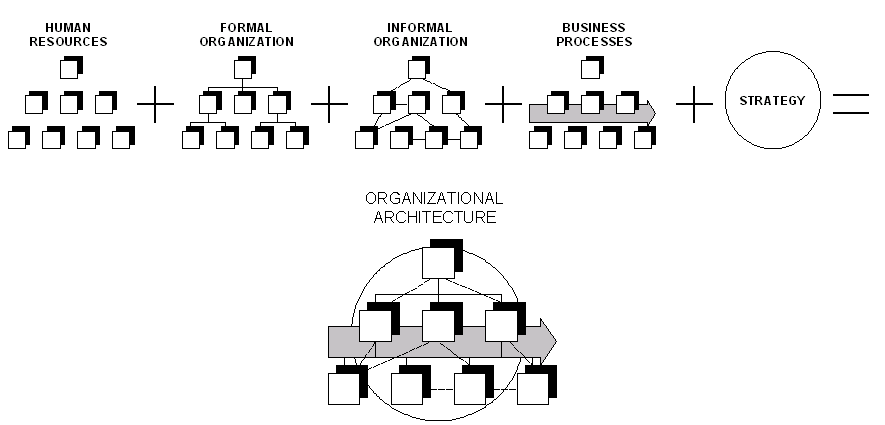
Conventionally organizational architecture consists of the formal organization (organizational structure), informal organization (organizational culture), business processes, strategy and the most important human resources, because what is an organization if not a system of people? The table shows some approaches to organizational architecture.[1]
| Nadler and Tushman (1997) | Merron (1995) | Galbraith (1995) | Henning(1997) | Churchill (1997) | Corporate Transitions International (2004) |
|---|---|---|---|---|---|
| Vision, strategic goals and strategic management | Strategy | The role of the organization | Strategy | ||
| Informal organization | Organizational culture | Reward systems | Reward systems | Organizational culture | Organizational culture |
| Formal organization | Organizational structure | Organizational structure | Groupings | Organizational structure | Organizational structure |
| Business processes | Processes and lateral links | Business processes and work design | |||
| Human resources | Human resources | Human resource development | Communication |
The goal of organizational architecture is to create an organization that will be able to continuously create value for present and future customers, optimizing and organizing itself.
Some under organizational architecture understand building blocks, which are mandatory for the growth of the organization. To design an organization means to set up a stage where the drama of life will take place.
Design
[edit]Design process and approach
[edit]Although the process of organization design isn't necessarily linear, a five milestone process has been created to organize the approach.[3] The five milestone design process is as follows:[3]
- Business case and discovery
- Goal: Build a business case for the change; compare the current state to future state and implications that would be involved.
- Milestone: at the end of this phase, the problem to be solved is clear.
- Strategic grouping
- Goal: Determine what basic grouping of work will create the capabilities necessary to deliver the decided strategy.
- Milestone: Decided on a structure change which supports the strategy.
- Integration
- Goal: The boundaries created by grouping work must be breached to deliver results for customers, partners and shareholders.
- Milestone: Pieces have been tied together and defined power relationships.
- Talent and leadership
- Goal: Determine the number of positions, the profile of a candidate who will fill those positions, and who will report to the leader of the new structure(s).
- Milestone: Critical roles have been designed and staffed and defined work for the executive team.
- Transition
- Goal: Set the transition plan to account for a logical implementation plan.
- Milestone: The change is being executed and lead, and closely monitoring the changes to prepare for any adjustments
Reshaping organization structure
[edit]
Organization design can be defined, narrowly, as the process of reshaping organization structure and roles. It can also be more effectively defined as the alignment of structure, process, rewards, metrics, and talent with the strategy of the business. Jay Galbraith and Amy Kates have made the case persuasively (building on years of work by Galbraith) that attention to all of these organizational elements is necessary to create new capabilities to compete in a given market. This systemic view, often referred to as the "star model" approach, is more likely to lead to better performance.
Organization design may involve strategic decisions, but is properly viewed as a path to effective strategy execution. The design process nearly always entails making trade-offs of one set of structural benefits for another. Many companies fall into the trap of making repeated changes in organization structure, with little benefit to the business. This often occurs because changes in structure are relatively easy to execute while creating the impression that something substantial is happening. This often leads to cynicism and confusion within the organization. More powerful change happens when there are clear design objectives driven by a new business strategy or forces in the market require a different approach to organize resources.
The organization design process is often explained in phases. Phase one is the definition of a business case, including a clear picture of strategy and design objectives. This step is typically followed by "strategic grouping" decisions, which define the fundamental architecture of the organization - essentially deciding which major roles will report at the top of the organization. The classic options for strategic grouping are to organize by:
- Behavior
- Function
- Product or category
- Customer or market
- Geography
- Matrix
Each of the basic building block options for strategic grouping brings a set of benefits and drawbacks. However, such generic pros and cons are not the basis for choosing the best strategic grouping. An analysis must be completed relative to a specific business strategy.
Subsequent phases of organization design include operational design of processes, roles, measures, and reward systems, followed by staffing and other implementation tasks.
The field is somewhat specialized in nature and many large and small consulting firms offer organization design assistance to executives. Some companies attempt to establish internal staff resources aimed at supporting organization design initiatives. There is a substantial body of literature in the field, arguably starting with the work of Peter Drucker in his examination of General Motors decades ago. Other key thinkers built on Drucker's thinking, including Galbraith (1973), Nadler, et al. (1992) and Lawrence and Lorsch (1967).
Organization design can be considered a subset of the broader field of organization effectiveness and organization development, both of which may entail more behaviorally focused solutions to effectiveness, such as leadership behaviors, team effectiveness and other characteristics of that nature. Many organizational experts argue for an integrated approach to these disciplines, including effective talent management practices.
Various approaches
[edit]There are various approaches to organizational architecture including
- (1986, 1991, 2004) - Kenneth D. Mackenzie
- (1992, 1993) - David A. Nadler and Michael L. Tushman.
- Organizational Architecture - by David A. Nadler, Marc S. Gerstein and Robert B. Shaw.
- (1993, 1995) - Designing organizations using the STAR Model as developed by Jay Galbraith
- Benjamin's Layered Model of organizations.
- The Organizational Adaption Model by Raymond E. Miles and Charles C. Snow.
- (1995) - Richard M. Burton and Børge Obel
- (2001) - Ralph Kilmann
- (2004) - Richard L. Daft
Five principles of good design
[edit]Source:[4]
- Specialization principle - the primary concern in the specialization principle how to group responsibilities into units. The unit boundaries should be defined to achieve the important benefits available.
- Coordination principle - this principle links closely with the specialization principle, to ensure the links are established between the units.
- Knowledge and competence principle - the primary concern in this principle is determining which responsibilities to decentralize and what hierarchical levels to create.
- Control and commitment principle - the primary concern in this principle is insuring managers have a process to effectively discharge decentralized principles.
- Innovation and adaptation principle - the primary concern in this principle is insuring the organization can change and evolve in the future.
Five good design tests
[edit]Source:[5]
Each tests coincides with the principles previously mentioned.
- Specialist culture test (Specialization Principle)
- Difficult links test (Coordination Principle)
- Redundant hierarchy test (Knowledge and Competence Principle)
- Accountability test (Control and Commitment Principle)
- Flexibility test (Innovation and Adaptation Principle)
Characteristics of effective organizational design
[edit]Some systems are effective and efficient whereas others are not. Successful systems may be attributable to the skill exercised in designing the system or to the quality of management practised during operations, or both. Successful systems are characterized by their simplicity, flexibility, reliability, economy, and acceptability.[6] Simplicity, flexibility, and reliability tend to be a function of design, whereas economy and acceptability pertain to both design and operations. Numerous relationships exist among these characteristics; for example, simplicity will affect economy and possibly reliability. Moreover, management must reach a compromise between economy and reliability, and between technical efficiency and organizational climate. The balance reached will determine whether short- or long-run objectives are optimized.
- Simplicity
An effective organizational system need not be complex. On the contrary, simplicity in design is a desirable quality. Consider the task of communicating information about the operation of a system and the allocation of its inputs. The task is not difficult when components are few and the relationships among them are straightforward. However, the problems of communication multiply with each successive stage of complexity.
The proper method for maintaining simplicity is to use precise definitions and to outline the specific task for each subsystem. Total systems often become complex because of the sheer size and nature of operations, but effectiveness and efficiency may still be achieved if each subsystem maintains its simplicity.
- Flexibility
Conditions change and managers should be prepared to adjust operations accordingly. There are two ways to adjust to a changing operating environment: to design new systems or to modify operating systems. An existing system should not be modified to accommodate a change in objectives, but every system should be sufficiently flexible to integrate changes that may occur either in the environment or in the nature of the inputs. For example, a company should not use the same system to build missiles as it uses to build airplanes, nor the same system to sell insurance as the one originally designed to sell magazines. However, it should be possible to modify an existing system to produce different sizes, varieties, or types of the same product or service.
A practical system must be well designed but it cannot be entirely rigid. There will always be minor variations from the general plan, and a system should be able to adapt to such changes without excessive confusion. The advantages associated with having a flexible system will become more apparent when we consider the difficulty of administering change.
- Reliability
System reliability is an important factor in organizations. Reliability is the consistency with which operations are maintained, and may vary from zero output (a complete breakdown or work stoppage) to a constant or predictable output. The typical system operates somewhere between these two extremes. The characteristics of reliability can be designed into the system by carefully selecting and arranging the operating components; the system is no more reliable than its weakest segment. When the requirements for a particular component — such as an operator having unique skills — are critical, it may be worthwhile to maintain a standby operator. In all situations, provisions should be made for quick repair or replacement when failure occurs. One valid approach to the reliability-maintenance relationship is to use a form of construction that permits repair by replacing a complete unit. In some television sets, for example, it is common practice to replace an entire section of the network rather than try to find the faulty component. Reliability is not as critical an issue when prompt repair and recovery can be instituted.
- Economy
An effective system is not necessarily an economical (efficient) system. For example, the postal service may keep on schedule with mail deliveries but only by hiring a large number of additional workers. In this case, the efficiency of the postal system would be reduced. In another example, inventories may be controlled by using a comprehensive system of storekeeping. However, if the cost of the storekeeping were greater than the potential savings from this degree of control, the system would not be efficient. It is often dysfunctional and expensive to develop much greater capacity for one segment of a system than for some other part. Building in redundancy or providing for every contingency usually neutralizes the operating efficiency of the system. When a system's objectives include achieving a particular task at the lowest possible cost, there must be some degree of trade-off between effectiveness and efficiency. When a system's objective is to perform a certain mission regardless of cost, there can be no trade-off.
- Acceptability
Any system, no matter how well designed, will not function properly unless it is accepted by the people who operate it. If the participants do not believe it will benefit them, are opposed to it, are pressured into using it, or think it is not a good system, it will not work properly. If a system is not accepted, two things can happen:(1) the system will be modified gradually by the people who are using it, or (2) the system will be used ineffectively and ultimately fail. Unplanned alterations in an elaborate system can nullify advantages associated with using the system.
Differentiation and integration
[edit]A basic consideration in the design of organizations is dividing work into reasonable tasks (differentiation) while giving simultaneous attention to coordinating these activities and unifying their results into a meaningful whole (integration). Two guidelines may be followed in grouping activities:
- Units that have similar orientations and tasks should be grouped together. (They can reinforce each other's common concern and the arrangement will simplify the coordinating task of a common manager).
- Units required to integrate their activities closely should be grouped together. (The common manager can coordinate them through the formal hierarchy).[7]
When units neither have similar orientations nor share their activities, the task of grouping becomes more difficult. For example, when units are similar in nature and function but are also relatively independent, the manager must base their decision on the most appropriate way to group activities according to their past experience.[7]
A difficult task associated with system-subsystem determination is to establish proper boundaries of operations. The more specific and distinct the goals of the operation, the easier it is to set boundaries. Other factors such as the influence of the environment, the availability of men and machines, the time schedule for design and operation, the cost of alternative designs, and the particular biases of the designers must be considered when establishing boundaries.[7]
The role of management
[edit]Designers with imagination have the best chance to group people and machines into workable combinations having the greatest efficiency and effectiveness within the recognized constraints. Certain characteristics should be designed into an effective and efficient system — simplicity, flexibility, reliability, economy, and acceptability.[8]
At this point, the designer must determine what has to be done to achieve the stated objective(s) and how the total task can be divided into meaningful units. Of the many possible combinations, one must be selected as that which satisfies the decision criteria better than the other alternatives. Of course, the balance between technical efficiency and the human factors that determine organizational climate should be included in making this decision. The eventual success or failure of the project is somewhat predetermined by management's attitude and the relationship between the designers and those who must implement the process.[8]
The systems approach suggests a new role for management. In the traditional view, the manager operated in a highly structured, rigid system having well-defined goals, clear-cut relationships, tight controls, and hierarchical information flows. In the flexible (or open) systems view, the organization is not static but is continually evolving to meet both external and internal changes. The manager's role is to develop a viable organization, cope with change, and help participants establish a dynamic equilibrium. Leonard Sayles has expressed the manager's problem as follows:
“The one enduring objective is the effort to build and maintain a predictable, reciprocating system of relationships, the behavioral patterns of which stay within reasonable physical limits. But this is seeking a moving equilibrium, since the parameters of the system (the division of labor and the controls) are evolving and changing. Thus, the manager endeavors to introduce regularity in a world that will never allow him to achieve the ideal”.[9]
The systems approach does not offer a prescription for making a manager's difficult and complex job easier. Rather it helps him understand and operate more effectively within the reality of complex systems. The systems approach suggests that operations cannot be neatly departmentalized but must be viewed as overlapping subsystems. In addition, it suggests that leadership patterns must be modified, particularly when dealing with professionals and highly trained specialists, and motivation must take the form of active, willing participation rather than forceful subjugation.[9]
Systems design involves establishing projects and facilitating subsystems to accomplish certain tasks or programs. In this approach, the network of human independence required to accomplish a given task is based on the shared responsibility of all members of the subsystem. In contrast, the traditional organization is geared to functional performance and the integrating force is authority. Instead of gearing participant activities to obedience to rules and closely structured behavior, the systems approach provides a basis for active cooperation in meeting task requirements. The manager is looked upon as a resource person who can help the group meet its goals and also as a source of authority and control. Thus, systems theory lends a structure by which the concepts of motivation, leadership, and participation can be applied effectively within the organization.[9]
Implementation is, of course, implicit in the connotation of systems design; otherwise it would be nothing more than an empty exercise. It follows that the interface between managers and systems designers is critical, and mutual understanding must be fostered to maximize returns from design efforts. The system must be tailored to the needs of the organization and adapted continually as circumstances change. In a general sense, managers engage in systems design on a day-to-day basis when they plan activities and organize systems to accomplish objectives. Specialized staff groups have evolved to perform tasks such as long-range planning, organizational studies, and systems design. However, since managers are ultimately responsible for organizational endeavors, they should make a special effort to help ensure the development of useful systems and to make design activities an extension of the manager's role rather than a separate function.[8]
Operating managers need to understand the organizational decision-making requirements and the information needed to support the system. Although the probability of success in implementation is enhanced considerably if management is vitally interested in the project, technical expertise and motivation for change are more likely to be found in staff groups. The solution to the apparent dichotomy would seem to be a team approach,[10] with specialists supporting operating managers who are responsible for the project's success. A manager might devote either part-time to such an effort or full-time temporarily, if the task requires it.
A project involving an integrated system for the entire company might well require years to complete. If operating people are delegated responsibility and authority for such a project, particularly if they are delegated the authority to outline specifications, they should also maintain sufficient contact with the day-to-day operations and its attendant information flow to retain their expertise for decision making. If the environment is dynamic or internal capabilities undergo change, it might be wise to rotate people from operations to systems design periodically, so that operating expertise is updated continually.[8]
See also
[edit]References
[edit]- ^ a b Miroslav Žugaj & Markus Schatten (2005). Arhitektura suvremenih organizacija. Varaždinske Toplice: Tonimir. pp. 1–6. ISBN 953-7069-50-8.
- ^ Baligh, Helmy H. (2006). "Structure, Performance, Cost, and Outcome". Organization Structures. Information and Organization Design Series. Vol. 5. Springer New York. pp. 1–31. doi:10.1007/0-387-28317-X_1. ISBN 978-0387258478.
- ^ a b Kesler, Gregory (2011). Leading organization design : how to make organization design decisions to drive the results you want. Kates, Amy. (1st ed.). San Francisco, CA: Jossey-Bass. pp. 9–10. ISBN 9780470912836. OCLC 693772818.
- ^ Goold, Michael (2002). Designing effective organizations : how to create structured networks. Campbell, Andrew, 1950 August 3-. San Francisco, Calif.: Jossey-Bass. pp. 49–57. ISBN 0787960640. OCLC 48783823.
- ^ Goold, Michael (2002). Designing effective organizations : how to create structured networks. Campbell, Andrew, 1950 August 3-. San Francisco, Calif.: Jossey-Bass. p. 93. ISBN 0787960640. OCLC 48783823.
- ^ Richard A. Johnson, Fremont E. Kast, and James E. Rosenzweig, The Theory and Management of Systems, 3rd ed. (New York: McGraw-Hill, 1973), pp. 144-46.
- ^ a b c Paul R. Lawrence; Jay William Lorsch (1967). Organization and environment; managing differentiation and integration. Boston: Division of Research, Graduate School of Business Administration, Harvard University. pp. 213–18. OCLC 229592.
- ^ a b c d Richard Arvid Johnson (1976). Management, systems, and society : an introduction. Pacific Palisades, Calif.: Goodyear Pub. Co. pp. 100–105. ISBN 0-87620-540-6. OCLC 2299496.
- ^ a b c Leonard R. Sayles (1964). Managerial behavior; administration in complex organizations. New York: McGraw-Hill. pp. 100–105. OCLC 965259.
- ^ Ackerman, Ben. "Organisation Design, why keep it a secret?".
Further reading
[edit]- Kates, Amy, and Gregory Kesler. Bridging Organization Design and Performance: 5 Ways to Activate a Global Operating Model. Hoboken, NJ: John Wiley & Sons, 2016.
- Kates, Amy, and Jay R. Galbraith. Designing Your Organization: Using the Star Model to Solve 5 Critical Design Challenges. San Francisco: Jossey-Bass, 2007.
- R.I. Benjamin and E. Levinson, A framework for managing IT-enabled change by Sloan Management Review, Summer 1993.
- Karen Dale and Gibson Burrell. The Spaces of Organisation & The Organization of Space -Power, Identity & Materiality at Work, 2008.
- Jay Galbraith, Designing Organizations, Jossey-Bass Publishers, San Francisco, 1995.
- Raymond E. Miles and Charles C. Snow, Organizational Adaption, 2003.
- Joseph Morabito, Ira Sack and Anilkumar Bhate, Organization Modeling, 1999.
- David A. Nadler, Marc C. Gerstein and Robert B. Shaw, Organizational Architecture, 1992.
- Harold G. Nelson and Erik Stolterman, The design way: Intentional change in an unpredictable world: Foundations and fundamentals of design competence, 2003.

Organizational architecture
View on GrokipediaFundamentals
Definition and Scope
Organizational architecture refers to the deliberate configuration of an organization's roles, processes, reporting relationships, and systems to align with its strategic objectives, ensuring structural integrity and operational functionality akin to a building's design.[3] This concept, rooted in information processing and contingency theories, emphasizes how these elements interact to facilitate decision-making, coordination, and performance.[4] The scope of organizational architecture encompasses both formal elements, such as hierarchies, policies, and incentive systems, and informal elements, including organizational culture, social norms, and employee behaviors, which together shape how the organization functions as a cohesive entity.[5] It differs from organizational structure, which primarily focuses on hierarchical arrangements and reporting lines, by integrating broader systemic and behavioral aspects.[6] In contrast to organizational design, which denotes the overall process of creating or modifying these configurations, architecture highlights the resulting framework itself. Much like building architecture, where a solid foundation (strategy) supports walls (structure) and a protective roof (culture) to ensure overall stability and adaptability to environmental changes, organizational architecture provides a metaphorical blueprint for resilience and efficiency. Through the synergy of these interconnected elements, organizational architecture generates value by producing outcomes—such as enhanced innovation and competitive advantage—that exceed the sum of individual components.[7] This integrated approach traces its roots to mid-20th century management theory, evolving from early studies on firm coordination and efficiency.[5]Historical Development
The concept of organizational architecture emerged in the post-World War II era as a response to the limitations of earlier rigid management models, such as Frederick Taylor's scientific management principles from the early 1900s, which prioritized efficiency through hierarchical control and standardized processes. By the 1940s and 1950s, Peter Drucker laid early foundations through his analysis of General Motors (GM), advocating for decentralized structures to foster autonomy in divisions while aligning them with overall corporate goals. In his seminal 1946 book Concept of the Corporation, Drucker critiqued GM's centralized bureaucracy and proposed management by objectives (MBO) as a way to empower managers with clear, measurable goals, marking a shift toward more adaptive organizational designs. This approach, further elaborated in Drucker's 1954 The Practice of Management, emphasized decentralized decision-making to handle complexity in large corporations. The 1960s and 1970s saw the rise of contingency theory, which influenced organizational architecture by stressing that effective structures depend on environmental factors. Paul Lawrence and Jay Lorsch's work in this period highlighted the need for differentiation—dividing organizations into specialized units to address diverse external demands—and integration—coordinating these units through mechanisms like teams and liaison roles to maintain unity. Their 1967 book Organization and Environment: Managing Differentiation and Integration provided empirical evidence from studies in plastics, consumer foods, and scientific instruments industries, showing that high-performing organizations balance differentiation and integration based on uncertainty levels. This contingency perspective challenged universal "one-best-way" models, paving the way for context-specific designs. In the 1980s, key frameworks formalized these ideas into integrated models of organizational architecture. Jay Galbraith's Star Model, introduced in 1973 and refined through the 1980s, conceptualized organizations as aligned systems comprising five elements: strategy, structure, processes, rewards, and people.[8] Galbraith argued that misalignment among these components leads to inefficiencies, drawing on consulting experiences to promote holistic design. Similarly, David Nadler and Michael Tushman's congruence model, developed in the early 1980s, focused on aligning organizational inputs (such as tasks and people) with outputs (like performance) through structure and culture to achieve fit.[9] Their 1980 article "A Model for Diagnosing Organizational Behavior" in Organizational Dynamics outlined this systems approach, emphasizing diagnostic tools for transformation. The evolution timeline reflects a broader shift from post-WWII Taylorist rigidity—characterized by top-down control and functional silos—to flexible, contingency-based systems by the 1980s and 1990s, driven by increasing environmental uncertainty from globalization and technological change.[10] Contingency theory's influence encouraged designs that adapt to external pressures, as seen in Lawrence and Lorsch's findings that integration mechanisms must scale with differentiation to handle uncertainty. Milestone publications like Drucker's Concept of the Corporation (1946) and Galbraith's Designing Organizations (1995) codified these developments, providing enduring blueprints for aligning strategy with structure.Core Components
Organizational Content
The foundational building blocks of an organization's architecture include both formal and informal elements that drive value creation. Formal elements encompass strategy, which defines core objectives and competitive positioning; processes that establish workflows and decision-making routines; and human resources focused on talent allocation and development. These provide the explicit framework for operational execution and alignment with organizational goals.[1] Strategy articulates the organization's vision and competitive stance, guiding resource allocation toward long-term objectives such as market differentiation or innovation leadership. For instance, it involves setting clear performance targets that incentivize behaviors aligned with strategic priorities. Processes complement this by defining standardized workflows and decision-making routines, such as performance evaluation systems that monitor progress and enable adaptive responses to internal and external changes. These routines ensure consistency in operations, reducing variability and enhancing efficiency in routine tasks.[1] Human resources form a critical formal element, emphasizing the allocation of talent to roles that maximize individual and collective contributions, alongside development initiatives that build skills and motivation. This includes reward systems—both financial and non-financial—that reinforce desired behaviors, such as linking compensation to strategic outcomes, and training programs that foster dynamic capabilities like collaboration and innovation. Effective talent management in this context integrates cognitive and non-cognitive attributes, such as knowledge and emotional resilience, to sustain competitive advantages.[1][11] Informal elements arise organically and include organizational culture, which embodies shared values, norms, and behaviors that influence daily interactions and employee engagement. Culture manifests through unspoken assumptions that guide how employees approach challenges, promoting cohesion or adaptability depending on its orientation. Informal networks, as communication channels outside prescribed hierarchies, facilitate rapid information exchange and collaboration, often accelerating problem-solving and idea generation beyond formal protocols. These networks emerge from personal relationships and shared interests, enabling fluid knowledge sharing that complements official channels.[12][13] The interdependencies among these elements are essential for value creation, as misalignment can undermine performance while synergy amplifies outcomes. For example, aligning culture with strategy motivates employees by embedding strategic goals into everyday norms, fostering a sense of purpose that enhances execution and innovation. Human resources development reinforces this by cultivating skills that support cultural values, such as risk-taking, while processes provide the routines that integrate informal networks into strategic workflows. When coherent, these interactions enable organizations to adapt dynamically, turning individual efforts into collective advantages that drive sustained growth.[12] A representative example is Google, where a culture of innovation—characterized by open collaboration and employee autonomy, and the former "20% time" policy for personal projects (introduced in the early 2000s and largely phased out by the 2010s, though its innovative spirit persists informally as of 2025)—has supported its exploratory strategy of organizing global information through rapid technological advancement. This alignment enabled breakthroughs like Gmail, emerging from employee initiatives, while talent development practices, such as data-driven leadership training from the Oxygen Project (launched in 2009), reinforce cultural norms of creativity and low turnover. By integrating these elements, Google sustains a competitive edge in dynamic markets.[14][15]Structure and Processes
Organizational structure encompasses the formal arrangements that define authority, roles, and relationships within an organization, including hierarchies, divisions, reporting lines, and span of control. Hierarchies establish vertical chains of command, where authority flows from top-level executives through middle managers to frontline employees, enabling clear decision-making pathways in stable environments.[16] Divisions organize units based on function, product, or geography; functional divisions group employees by expertise such as marketing or finance, promoting specialization but potentially siloing information.[16] Divisional structures segment operations by products or markets, allowing autonomy in diverse portfolios, while matrix structures blend functional and divisional elements, with employees reporting to both a functional manager and a project or product leader to balance expertise and responsiveness.[16] Reporting lines delineate accountability, forming an unbroken chain that links all positions, whereas span of control refers to the number of subordinates a manager oversees, influencing supervision intensity—narrow spans allow close oversight in complex tasks, while wide spans foster delegation in routine operations.[16] Processes operationalize these structures through mechanisms for information exchange, coordination, and resource distribution. Information flows occur vertically along hierarchies for directives and reports, and horizontally across units via shared systems or direct interactions to resolve interdependencies.[17] Coordination mechanisms include committees for collective decision-making on cross-unit issues, liaison roles where individuals facilitate communication between departments without formal authority, and standardized routines to align activities.[17] Resource allocation routines involve budgeting and planning processes that distribute financial, human, and material assets, often centralized at the top for strategic control or decentralized in divisional setups for local adaptability.[1] The integration of structure and processes determines organizational efficiency, as structures shape how processes unfold. For instance, hierarchical structures constrain processes by routing information upward for approval, which can delay responses but ensure consistency, whereas flat structures with wide spans of control enable rapid decision-making by minimizing layers and promoting direct interactions.[18] In matrix configurations, dual reporting lines enhance process flexibility for information flows but require robust coordination mechanisms to avoid conflicts.[16] Overall, structures enable processes by providing the framework for flows and routines, yet overly rigid hierarchies may hinder adaptive coordination, while loose arrangements demand strong informal processes to maintain order.[17] Common configurations contrast hierarchical and network structures in their approach to structure-process dynamics. Hierarchical structures, prevalent in machine bureaucracies, emphasize vertical control and standardization for scalability in large, stable firms, offering pros like clear authority and efficient resource allocation but cons such as reduced agility and slower information flows.[18] Network structures, akin to adhocracies, rely on horizontal linkages and mutual adjustment for agility in dynamic environments, providing pros like faster coordination and innovation through liaison roles but cons including scalability challenges and potential coordination overload without formal reporting lines.[18] These configurations illustrate trade-offs, with hierarchies suiting routine operations and networks favoring complex, uncertain tasks.[17]Design Principles
Design Process and Milestones
The design process for organizational architecture adopts an iterative approach that begins with assessment of the current state and concludes with implementation and monitoring, encompassing phases of diagnosis, planning, and execution to align structure with strategic objectives. This methodology ensures that changes are responsive to evolving business needs, allowing for adjustments based on feedback and unforeseen challenges throughout the project. The process emphasizes collaboration among leaders to build consensus and mitigate risks associated with redesign. A widely adopted framework for this process is the five-milestone technique developed by organizational design experts Amy Kates and Gregory Kesler, which provides a structured yet flexible roadmap for reshaping organizations. The milestones are: (1) business case and discovery, (2) strategic grouping, (3) integration, (4) talent and leadership, and (5) transition. This technique integrates elements of Jay Galbraith's Star Model to ensure holistic alignment across strategy, structure, processes, rewards, and people.[19] The first milestone, business case and discovery, involves diagnosing organizational gaps by assessing the current state against strategic priorities, creating a clear problem statement, and establishing design criteria to justify the need for change. Leaders conduct this phase through stakeholder interviews and data analysis to align the redesign with business strategy, ensuring buy-in from senior executives. For example, this step might reveal misalignments in resource allocation that hinder growth objectives.[19] In the second milestone, strategic grouping, activities are clustered based on purpose, customer segments, or functional needs to form the foundational structure, such as deciding on divisional, matrix, or functional configurations. This involves evaluating six design drivers—strategy, customer requirements, business processes, people capabilities, decision-making, and performance measures—to select optimal grouping options and adjust spans of control and layers of management. Stakeholder involvement is critical here, with management teams reviewing high-level organization charts to refine the blueprint.[19] The third milestone focuses on integration, where coordination mechanisms are added to connect grouped units, including lateral linkages like cross-functional teams, shared services, or decision-rights frameworks to facilitate information flow and collaboration. This step addresses potential silos by designing governance structures that balance autonomy and oversight, often using tools to map interdependencies.[19] The fourth milestone, talent and leadership, entails assigning roles to the new structure, developing staffing rules, and building leadership capabilities to support the design, with an emphasis on placing high-potential individuals in key positions. This phase includes talent assessments and succession planning to ensure the organization has the necessary skills for execution.[19] Finally, the transition milestone covers change management, implementation planning, and ongoing monitoring through feedback loops to evaluate effectiveness and make refinements. This involves creating detailed project timelines, communicating changes to employees, and using metrics to track progress against design criteria.[19] Tools and techniques supporting this process include organizational diagnostics such as employee surveys and interviews to gather data during discovery, as well as modeling software for simulating structural options in grouping and integration phases. Stakeholder involvement spans all milestones, with HR, executives, and line managers participating in workshops to foster ownership and address concerns.[19] For reshaping existing architectures, techniques such as delayering—reducing hierarchical layers to improve agility—and shifts between centralization and decentralization are applied during strategic grouping to optimize decision-making speed and resource allocation. These methods are selected based on design criteria, with examples including adopting matrix structures for complex environments or functional groupings for efficiency-focused firms.[19]Key Approaches and Frameworks
One prominent framework in organizational architecture is Jay Galbraith's Star Model, which posits that effective design requires alignment among five interdependent elements: strategy, structure, processes, rewards, and people.[1] Strategy defines the organization's direction and competitive positioning, while structure determines the placement of power and decision-making authority through specialization and departmentalization.[1] Processes facilitate information flow across vertical hierarchies (e.g., planning and budgeting) and lateral integrations (e.g., cross-functional teams), rewards motivate behavior through incentives like bonuses and recognition, and people involve selecting and developing talent with the right skills and mindsets.[1] Developed in the 1970s, this model emphasizes that misalignment among these elements undermines performance, serving as a foundational tool for designing organizations that support strategic goals.[20] Another influential framework is the Nadler-Tushman Congruence Model, introduced in the early 1980s, which views organizations as open systems where effectiveness depends on the fit—or congruence—among key components.[21] It consists of inputs (such as environmental factors, resources, and organizational history), a transformation process (encompassing work tasks, people, formal structures, and informal dynamics like culture), outputs (individual, group, and overall performance), and a feedback loop to assess and adjust alignments.[21] The model aids in diagnosing issues by identifying gaps, such as mismatches between employee skills and required tasks, to enhance overall system harmony.[21] The contingency approach represents a broader methodology, asserting that no single organizational design is universally optimal; instead, structure must adapt to contextual factors like environment, size, and technology.[22] Within this, Tom Burns and G.M. Stalker's 1961 distinction between mechanistic and organic designs highlights how stable environments favor mechanistic structures—characterized by rigid hierarchies, standardized procedures, and centralized control for efficiency—while dynamic settings suit organic designs, which feature decentralized decision-making, flexible roles, and adaptive processes to foster innovation.[22] For instance, mechanistic forms excel in predictable industries like manufacturing, whereas organic forms thrive in research-oriented fields.[22] Systems theory provides a holistic lens, treating organizations as interconnected open systems interacting with their environments through subsystems, inputs, processes, outputs, and feedback mechanisms.[23] Originating from Ludwig von Bertalanffy's general systems principles in the mid-20th century, it emphasizes interdependence, where changes in one subsystem (e.g., marketing) ripple across others (e.g., operations), and feedback from internal audits or external markets enables adaptation.[23] This approach underscores viewing organizations as dynamic ecosystems rather than isolated entities, promoting integrated designs that account for emergent interactions.[23] These frameworks differ in focus and scope, as summarized below:| Framework | Core Emphasis | Key Differentiation from Others |
|---|---|---|
| Star Model | Internal alignment of design policies | Prioritizes managerial controls (e.g., rewards, processes) for strategy execution, unlike the environmental adaptability in contingency theory.[24] |
| Congruence Model | Fit across system components | Stresses diagnostic harmony between inputs/outputs and internal elements, contrasting the Star Model's structured policy focus by incorporating culture and feedback more explicitly.[24] |
| Contingency Approach | Adaptation to external/internal factors | Centers on situational fit (e.g., mechanistic vs. organic), differing from systems theory's holistic interdependence by emphasizing discrete structural choices.[22] |
| Systems Theory | Interconnected dynamics and feedback | Offers a macro, ecosystem view of interactions, broader than the targeted alignments in Star or Congruence models.[23] |