


Community hub
Recent from talks
Contribute something
Nothing was collected or created yet.
Burger King Specialty Sandwiches
View on Wikipedia
 | |||||||||||
| Nutritional value per 1 burger (218.35 g) | |||||||||||
|---|---|---|---|---|---|---|---|---|---|---|---|
| Energy | 660 kcal (2,800 kJ) | ||||||||||
48 g | |||||||||||
| Sugars | 5 g | ||||||||||
| Dietary fiber | 2 g | ||||||||||
40 g | |||||||||||
| Saturated | 7g | ||||||||||
| Trans | 0 g | ||||||||||
28 g | |||||||||||
| |||||||||||
| Other constituents | Quantity | ||||||||||
| Cholesterol | 75 mg | ||||||||||
May vary outside US market. | |||||||||||
| †Percentages estimated using US recommendations for adults.[1] Source: BK Nutrition (PDF) | |||||||||||

The Burger King Specialty Burgers are a line of burgers developed by the international fast-food restaurant chain Burger King in 1978 and introduced in 1979 as part of a new product line designed to expand Burger King's menu with more sophisticated, adult oriented fare beyond hamburgers. Additionally, the new line was intended to differentiate the company from other fast food hamburger restaurants at the time. Since the line's introduction, the other burgers have been discontinued, leaving the chicken offering, the Original Chicken Burger (abbreviated as OCS), as the primary product left. Additionally, other burgers that utilize the same roll as the chicken burger have been introduced to the company's menu both domestically and internationally since the original product line was introduced.
Burger King markets the Original Chicken Burger under several different names globally, including the Long Chicken, BK Chicken and Chicken Royale in the international markets it does business. The company also produces other variants that are specifically tailored to meet local taste preferences or customs of the various regions and countries in which it does business. To promote continuing interest in the product, Burger King occasionally releases limited-time (LTO) variants in the line that have different toppings or ingredients such as ham, Italian sausage or pulled pork.
History
[edit]During the mid-1970s, Burger King was having issues with its operations, franchises and image.[2] In 1978, Donald N. Smith was hired from McDonald's to help restructure the corporate operations of Burger King to better compete against his former company as well as the then up-and-coming chain, Wendy's. As part of an operational overhaul he dubbed "Operation Phoenix", Smith reorganized the corporate operations of Burger King.[3] He also initiated a development plan for a new product line that would become the Specialty Burger line. Development began that year, and while the company found that the new product lines would add an approximate eight second delay to the production time of orders and would cost about $39 million in lost productivity,[4] the product was introduced in 1979.[2] Despite these possible sales losses and time issues, the new products were successful and the company's sales increased by 15 percent.[2]
This line — with many non-hamburger burgers, including chicken and fish — significantly expanded the breadth of the Burger King menu. The amount of new additions, several new burgers made with disparate ingredients was made possible due to the design of Burger King's kitchen. The chain's kitchen is modeled around a more flexible concept that allows for a multiple work-flow operations where preparation stations can be re-tasked more easily.[5] In comparison, McDonald's kitchen at the time was a more rigidly designed assembly line concept intended to quickly produce a more uniform product and was not easily adapted to new products.[6] This more rigid system prevented McDonald's from broadening its menu to effectively competing with Burger King and other similar chains that were more flexible and were better positioned to expand their menu.[7]
The introduction of the Specialty Burger line was one of the first attempts by a major fast food chain to target a specific demographic, in this case adults aged between 18 and 34 years, members of which were presumably willing to spend more on a higher quality product.[3]: 119 Included in the new line was the Original Chicken Burger, a ham and cheese burger, a roast beef burger, a new fish burger called the Long Fish Burger, and a new burger called the Sirloin Steak Burger.[2][5] The ham and cheese burger replaced an earlier version ham and cheese burger called the Yumbo that was served hot and was the size of a hamburger.[8] In 1981 the chain tested a veal parmigiana burger in limited areas of the United States and took it national in 1982.[9] It was also sold in New England as part of limited time offering (LTO) in 1988.[10]
While most of the line has since been discontinued, the company's Original Chicken Burger is still offered in North America, Europe and other markets. The ham and cheese burger was a regional offering,[11] however it was reintroduced nationally in the United States as the Yumbo Burger in November 2014. The Yumbo name refers to a smaller snack based burger from the 1970s and early 1980s which was a heated ham and cheese burger served on a smaller, hamburger roll.[12] The Long Fish was discontinued and the Whaler fish burger was reintroduced in 1983,[13] while the Steak Burger burger was discontinued altogether.
Product description
[edit]Original Chicken Sandwich
[edit]
The Original Chicken Sandwich consists of a breaded, deep-fried white-meat chicken patty with mayonnaise and lettuce on a sesame seed sub-style bun.[14] Burger King will also add any condiment it sells upon request based on its long standing slogan "Have It Your Way".[15] Additionally, Burger King has sold several different promotional varieties throughout the years as limited time offerings (LTO), such as the Philly chicken sandwich with American cheese, peppers and onions or the Angry Chicken Sandwich served with pepper jack cheese, bacon, "Angry" sauce, jalapeño slices, mayonnaise, lettuce and tomato.[16][17] In some markets the Original Chicken is called the "Chicken Royale", "King de Pollo" (King of Chicken), or the "BK Chicken".
Notable variants
[edit]-
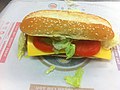 An American chicken sandwich
 -
 A French chicken sandwich
 -
 An Italian chicken sandwich
 -
 A chicken club sandwich


The International Chicken Sandwiches line was introduced in 1988 and is a group of three sandwiches with different toppings that are associated with cuisine from various international regions. The Italian Chicken Sandwich is a chicken parmigiana sandwich with marinara sauce and mozzarella, the French Chicken Sandwich is a Chicken Cordon Bleu sandwich with mayonnaise, ham and Swiss cheese, and the American Chicken Sandwich has mayonnaise, lettuce, tomato and American cheese.[8] Similar regional inspired sandwiches included the Philly Chicken Sandwich, which was a chicken version of a Philly cheesesteak sandwich made with red and green bell peppers, onions and cheese,[16][18] and the Hawaiian BK Chicken with mayonnaise, lettuce, bacon, American cheese and pineapple sold in New Zealand.[19][20] As of 2019, the entire International Chicken Sandwiches line is still sold at Burger King restaurants in Puerto Rico.
Burgers
[edit]-
 A Limo Burger
 -
 A Bulls Eye BBQ sandwich


Besides the Original Chicken sandwich, Burger King has sold or sells several other sandwiches that are similar to the Specialty Sandwiches. Several burgers have been sold on this family of sandwiches, including a pair of triple cheeseburgers called the Limo Burger and the X-Tra Long Cheeseburger,[21][22] the Bull's-Eye Barbecue Burger which was a type of double cheeseburger that included two hamburger patties, American cheese, bacon and Kraft Bull's-eye brand barbecue sauce,[23] and the BBQ Hero which was also another type of double cheeseburger with barbecue sauce, bacon, lettuce, tomato and onions.[8] The company introduced another burger in this family called the Extra Long BBQ Cheeseburger in June 2014. The sandwich consisted of two burger patties, BBQ sauce and onion rings.[24] It is similar in composition to the chain's Rodeo Cheeseburger.[25]
Other products
[edit]-
 A ham and cheese sandwich

A grilled Italian sausage sandwich was sold in 1992 and was served with onions and peppers or parmigiana style with mozzarella cheese and marinara sauce.[26] As part of the company's BK Dinner Baskets promotion in 1993, the chain introduced a grilled meatloaf sandwich with ketchup and onions in the United States.[27][28] In 2013, Burger King sold a bratwurst sandwich in a regional limited time offering in the US states of Wisconsin and Illinois. The sandwich featured a bratwurst manufactured by Johnsonville Foods, raw onion and yellow mustard.[29] Despite being discontinued, versions of the steak sandwich have been re-released several times since the 1970s. The BK Dinner baskets featured a steak sandwich,[30] and in 2003 Burger King New Zealand introduced the Big Bloke Steak Sandwich which was almost identical to the 1979 sandwich.[31]
In a 2015 summer promotion, Burger King brought back its pulled pork sandwich, previously sold in 2012 and 2013,[32][33] in a new format linked to its new "XL" (extra long) sandwiches.[34] The original sandwich was served on what the company called an "artisan" roll with pickles, onions, Sweet Baby Ray's brand barbecue sauce, and a coleslaw sauce,[32][33] while the 2015 XL Pulled Pork sandwich eliminated the coleslaw sauce and changed over to the 7-inch steak roll of the Specialty Sandwich.[34]
Advertising
[edit]Burger King introduced the Specialty Sandwich line under its Burger King and I promotional campaign developed by the J. Walter Thompson (JWT) agency.[35][36] The advertisements featured customers and employees praising the new sandwiches accompanied with a brief description of the products being sold.[37] Actor Stuart Pankin played a doorman in one commercial in the series.[38] Another one of the promotions used was a scratch card game called What's my Specialty? where the customer would receive a card with their purchase in which they would have to match famous people to said person's profession. The commercial explained that if you expected to lose, you would be disappointed, as all cards were winners. Prizes included fries, sodas and sandwiches.[37]
The veal Parmesan sandwich was introduced in a series of commercials from JWT centered around the new corporate ad slogan, "Aren't you hungry - for Burger King now?" targeting the 19- to 49-year-old male demographic. The campaign was part of a back-to-basics program designed to put the company on a more competitive footing with main rival McDonald's, who was outspending Burger King's advertising budget by a factor of three. With the new program, the company hoped to establish itself as the higher quality alternative to McDonald's.[39]
The meatloaf sandwich was part of the company's new BK Dinner Baskets product line and serving concept.[40] To promote the product line and concept, Burger King commissioned New York based agency D'Arcy Masius Benton & Bowles to create a series of "BK Teevee" ads featuring MTV VJ Dan Cortese. The tag line developed for the promotion was "BK, I love this place".[30][41][42] The advertising program was designed as part of a back to basics plan by Burger King after a series of disappointing advertising schemes including the failure of its 1980s Where's Herb? campaign. The Dinner Baskets were one of two main parts of the plan, as was a newly introduced value menu in response to similar offerings at McDonald's, Taco Bell and Wendy's.[43]
In the autumn and winter of 2007 BK advertised the Italian Chicken sandwich with a commercial produced by Crispin Porter + Bogusky (CP+B) that played the "Have it your Way" theme on an accordion with a simple text insert that asked the consumer if they had a problem with the sandwich being sold only at BK. This insert played up the Italian "tough guy" stereotypes.[44][45] Another advertisement in 2014 featured the sandwich as a featured part of the company's 2 for $5 promotion, a discount promotion where customers could purchase two sandwiches for $5.00.[46]
Controversies
[edit]The 1980 introduction of a veal-based sandwich raised the ire of animal rights groups. By 1982, several groups were alleging that the veal being sourced to Burger King was most likely kept in battery cages, unable to move, and fed a low iron diet designed to produce the lightly toned meat associated with veal. As a result of this protest, these groups lead a three-country boycott of Burger King in April 1982. Critics of the boycott claimed that the type of veal that was being used was more-likely to be free range veal due to cost issues, claiming that there is simply no way a $2.00 sandwich would use the higher quality $15.00/lb veal. The rights groups refused to back down despite the cost claims because Burger King would only release the name of the meat processor, not its veal suppliers.[9] The chain eventually announced that it intended to pull the sandwich from the market, stating that it was not because of the boycotts but because there was a lack of consumer demand. In fact, the chain said the sandwich sold best in the markets where the majority of the protests were occurring.[47]

A 2009 advertising campaign in Singapore for the company's new BK Super Seven Incher cheeseburger, caused a notable controversy over the content of the ad. Originally and erroneously attributed to Burger King's advertising firm at the time, Crispin Porter + Bogusky, which had generated controversy with some misogynistic and culturally insensitive American and European advertisements,[48][49][50] it was later revealed that a local, unnamed Singaporean firm was responsible for the campaign.[51] The print version of the advertisement (pictured) made an overt association with the sandwich and oral sex using imagery and less-than subtle innuendo in the printed description in the advertisement.[52] Critics across the globe complained that the ad was "disgusting",[51][53] and went "too far".[53]
Almost every aspect of the advertisement was criticized. Blogger Rein Bhagwandat noted that its copy featured terms such as "blow" which she felt alluded to the slang term "blow job". She also believed that the image of the woman in the advertisement had been overtly sexualized which she thought was objectifying of women in general.[54] An article in Psychology Today echoed Bhagwandat's concerns, adding that the advertisement was openly displayed in public spaces, and could have troubling implications for parents having to explain the content to younger children.[55]
See also
[edit]


References
[edit]- ^ United States Food and Drug Administration (2024). "Daily Value on the Nutrition and Supplement Facts Labels". FDA. Archived from the original on 2024-03-27. Retrieved 2024-03-28.
- ^ a b c d Gale, Thomas (2004). "History of Burger King Corporation". Encyclopedia.com. International Directory of Company Histories. Retrieved 8 October 2014.
- ^ a b Jakle, John A.; Sculle, Keith A.; Pappas, Douglas (27 March 2002). Fast Food: Roadside Restaurants in the Automobile Age (1st ed.). JHU Press. pp. 117–119. ISBN 0-8018-6920-X. Archived from the original on 13 March 2023. Retrieved 23 November 2013.
- ^ Peter Jones, ed. (18 August 2008). Handbook of Hospitality Operations and IT. Burlington, MA: Routledge. ISBN 978-0750687539.
- ^ a b Sasser Jr., W. Earl; Rikert, David C. (1 December 1980). "Burger King Corp". Cambridge, MA: Harvard Business Review. Archived from the original on 3 December 2013. Retrieved 25 November 2013.
- ^ Sasser Jr., W. Earl; Rikert, David C. (1 December 1980). "McDonald's Corporation". Cambridge, MA: Harvard Business Review. Archived from the original on 2 December 2013. Retrieved 25 November 2013.
- ^ Metz, Robert (30 December 1979). "Competition stiff for McDonald's". Sarasota Herald-Tribune. p. 1H. Archived from the original on 3 July 2023. Retrieved 26 November 2013.
- ^ a b c Romero, Peter J. (11 August 1988). "Chicken Internationals take Burger King test" (subscription required). Nation's Restaurant News. Archived from the original on 3 December 2013. Retrieved 1 March 2008.
Burger King is testing a new line of sandwiches called Chicken Internationals, each consisting of a chicken fillet topped with cheese.
- ^ a b Foster, Catherine (20 May 1982). "Why animal rights groups target the veal sandwich". Christian Science Monitor. Archived from the original on 3 December 2013. Retrieved 16 March 2014.
- ^ Romero, Peter J. (3 October 1998). "Burger King discounts mark shift to regional promo plays". Nation's Restaurant News. BNet.com. Archived from the original on 16 March 2014. Retrieved 27 October 2009.
Stores in New England resurrected the veal Parmigiana burger ...
- ^ In Student's Encyclopaedia (2007). "Burger King Corporation". Britannica Student Encyclopaedia. Archived from the original on 3 December 2013. Retrieved 23 November 2013.
- ^ Wohletz, Jenn (12 July 2012). "Five discontinued fast-food items I want back". Denver Westward. Archived from the original on 29 November 2014. Retrieved 21 November 2014.
- ^ "Burger King escalates war with 'Whaler'". Lewiston Daily Sun. Associated Press. 16 February 1983. Archived from the original on 3 July 2023. Retrieved 27 November 2013.
- ^ Burger King American menu, Original Chicken Sandwich, Burger King Brands, archived from the original on 25 May 2015, retrieved 24 May 2015
- ^ Dostal, Erin (13 December 2012). "The history of Burger King's Whopper". Nation's Restaurant News (subscription required). Archived from the original on 11 November 2013. Retrieved 6 November 2013.
- ^ a b Doss, Laine (8 January 2013). "Burger King Has New Menu Items: We Try Them". Miami New Times. Archived from the original on 3 December 2013. Retrieved 20 November 2013.
- ^ Marvo (8 January 2009). "Burger King Angry TenderCrisp & Angry Original Chicken Sandwich". The Impulse Buy. Archived from the original on 17 December 2013. Retrieved 17 December 2013.
- ^ "BK Shows Some Love with BOGO Chicken Sandwich Offer". QSRWeb.com (Press release). 22 January 2013. Retrieved 20 November 2013.
- ^ Beech, James (11 November 2009). "New burger outlet in demand". Otago Daily Times. Archived from the original on 3 December 2013. Retrieved 20 November 2013.
- ^ Burger King New Zealand, Hawaiian BK Chicken, Burger King Corporation, archived from the original on 14 January 2015, retrieved 1 December 2013
- ^ ""Limo Cheeseburger" Cruises Into Burger King Restaurants Across the United Arab Emirates" (Press release). 12 April 2007. Retrieved 2 December 2013.
- ^ Morran, Chris (26 January 2001). "Why Won't Burger King Share Its "X-Tra Long" Burgers With America?". The Consumerist. Archived from the original on 3 December 2013. Retrieved 2 December 2013.
- ^ "Burger king markets new product". Ocala Star-Banner. Associated Press. 3 October 1987. p. 10C. Archived from the original on 3 July 2023. Retrieved 2 December 2013.
- ^ Hoffman, Ken (25 June 2014). "New extra-long sandwich is the best-tasting thing on the King's menu". Houston Chronicle. Archived from the original on 14 November 2014. Retrieved 21 November 2014.
- ^ Q (12 June 2014). "Review: Burger King - Extra Long BBQ Cheeseburger". Brandeating.com. Archived from the original on 29 October 2014. Retrieved 21 November 2014.
- ^ Burger King Italian Sausage sandwich (Television commercial). 1992.
- ^ Hume, Scott (3 January 1993). "New from Burger King--meatloaf". AdAge. p. 48. Archived from the original on 16 July 2019. Retrieved 15 September 2019.
- ^ Menzie, Karol (31 March 1993). "Meatloaf Arrives An old dinner favorite goes upscale". The Baltimore Sun. Archived from the original on 3 December 2013. Retrieved 2 December 2013.
- ^ Khawsey, Ashley (2 November 2013). "Burger King kicks off football season with new Bratwurst Sandwich". Foodbeast.com. Archived from the original on 2 December 2013. Retrieved 2 December 2013.
- ^ a b "Burger King Goes To Mat With Table Service". The New York Times. 21 December 1992. Archived from the original on 3 December 2013. Retrieved 2 December 2013.
- ^ "Burger King - Big Bloke Steak Sandwich". 2003. Archived from the original on 3 December 2013. Retrieved 2 December 2013.
- ^ a b "Review: Burger King Memphis BBQ pulled". Brand Eating. 15 June 2012. Archived from the original on 11 July 2015. Retrieved 9 July 2015.
- ^ a b "Burger King $4.99 pulled pork". Brand Eating. 23 June 2013. Archived from the original on 11 July 2015. Retrieved 9 July 2015.
- ^ a b "Burger King introduces extra long pulled pork sandwich for summer". Brand Eating. 14 June 2015. Archived from the original on 11 July 2015. Retrieved 9 July 2015.
- ^ BKC publication. "Marketing and Advertising History". Burger King Holdings. Archived from the original on 25 May 2007. Retrieved 31 October 2007.
- ^ "Burger King Account Is Awarded to J.W.T." The New York Times. 30 August 1976. p. 40. Archived from the original on 23 July 2018. Retrieved 1 March 2010.
- ^ a b Specialty Sandwich commercial (Television commercial). 1978.
- ^ Stuart Pankin (1979). Specialty Sandwich commercial (Television commercial).
- ^ Dougherty, Philip H. (25 November 1981). "Hard Sell At Burger King". The New York Times. Archived from the original on 24 May 2015. Retrieved 16 March 2014.
- ^ Durisin, Megan (8 May 2013). "14 Fast Food Items You Can't Get Anymore". Business Insider. Archived from the original on 10 May 2015. Retrieved 24 May 2015.
- ^ BKC publication. "Marketing and Advertising History". Burger King Holdings. Archived from the original (Web page) on 2007-05-25. Retrieved 31 October 2007.
- ^ "Advertising Slogans, "B"". TV Acres.com. 4 August 2006. Archived from the original on 13 September 2012. Retrieved 31 October 2007.
- ^ Theresa Howard (1 November 1993). "Value in driver's seat as BK takes new route". Nations Restaurant News. Retrieved 6 February 2008.
Having survived such advertising blunders as Herb the Nerd and "sometimes you gotta break the rules" and such strategies as selling Domino's Pizza, Weight Watchers meals and offering table service, Burger King is proceeding along the value and back-to-basics route.
- ^ Emanuele, Alfano (22 October 2007). "Alfano Digest". www.iaovc.org/. Italian American One Voice Coalition. Archived from the original on 9 July 2015. Retrieved 9 July 2015. Letter in protest to the commercial, two postings.
- ^ Burger King - "Italian Chicken Sandwich". Crispin, Porter + Boguski. 2007.
- ^ "Burger King Italian Original Chicken Sandwich TV Spot". ispot.tv. Archived from the original on 10 July 2015. Retrieved 9 July 2015.
- ^ Foster, Catherine (7 December 1982). "Behind the veal protest that hit Burger King". Christian Science Monitor. Archived from the original on 25 May 2015. Retrieved 24 May 2015.
- ^ Popken, Ben (8 May 2006). "Ads We Love: Burger King's "Manthem"". AdJab.com. Archived from the original on 19 June 2006. Retrieved 27 October 2006.
- ^ "I Am Man, Hear Me Roar ... When My Heart Explodes". The Consumerist. 31 May 2006. Archived from the original on 13 November 2007. Retrieved 27 October 2007.
- ^ Bonello, Deborah (15 April 2009). "Burger King withdraws ad after Mexican objection". Los Angeles Times. Archived from the original on 23 January 2014. Retrieved 12 November 2013.
- ^ a b Gandleman, Joe (24 June 2009). "Burger King's New Ad: A New Low In Vulgar Ads Aimed At Young Customers". The Moderate Voice. Archived from the original on 2 December 2013. Retrieved 21 November 2013.
- ^ "Possibly a bit too NSFW: A Seven Inch Cheeseburger". Time. July 2009. Retrieved 21 November 2013.
- ^ a b Miller, Joshua R. (30 June 2009). "Critics Cringe at Ad for Burger King's Latest Sandwich". Fox News. Archived from the original on 13 December 2013. Retrieved 21 November 2013.
- ^ Bhagwandat, Rein (7 February 2012). "Feminist Analysis of BK's Super Seven Incher". Rhetoric and Pop Culture blog. Wordpress. Archived from the original on 21 February 2014. Retrieved 21 November 2013.
- ^ Joannides, Paul (27 June 2009). "Burger King's Seven-Incher vs. Calvin Klein's Threesome". Psychology Today. Archived from the original on 3 July 2023. Retrieved 21 November 2013.
| People | |||||||
|---|---|---|---|---|---|---|---|
| Products |
| ||||||
| Advertising |
| ||||||
| Franchises and related topics | |||||||
| Ownership | |||||||
| Legal issues and cases | |||||||

Burger King Specialty Sandwiches
View on GrokipediaHistory
Inception and Early Lineup (1978-1985)
Burger King initiated its Specialty Sandwiches line in 1978 as part of a broader menu expansion aimed at diversifying beyond its core hamburger offerings, with nationwide rollout occurring in 1979. This development responded to competitive pressures in the fast-food industry, where chains sought to appeal to consumers preferring alternatives to beef amid rising health concerns and varied tastes. The line emphasized premium, non-traditional sandwich formats using distinct buns and proteins to differentiate from standard burgers.[7] The inaugural product, the Original Chicken Sandwich, debuted in 1979, featuring a breaded, fried chicken fillet on an oblong sesame seed bun topped with shredded lettuce and mayonnaise. Priced as a value option relative to beef items, it quickly became a staple, contributing to Burger King's push into poultry-based menu items years before competitors like McDonald's expanded similarly. This sandwich's simple yet consistent formulation—maintained with minor updates over decades—underscored the chain's focus on reliable, flame-broiled or fried preparations.[3] Complementing the chicken offering, the Sirloin Steak Sandwich was introduced in 1979 as a limited-time item, consisting of chopped or sliced sirloin steak served on a sub-style roll, often with cheese and condiments. This product targeted customers seeking steakhouse-inspired fast food, though it saw shorter tenure due to supply and preparation challenges. Additional early entries included ham and cheese variants, building on prior tests like the 1960s Yumbo, alongside exploratory fish and roast beef sandwiches to broaden protein variety by 1980-1985. These items were marketed via print and TV ads highlighting their "specialty" status, with sales data indicating moderate success in urban markets but variable adoption elsewhere.[8] By 1985, the early lineup had laid groundwork for future innovations, though some products were phased out amid cost controls and shifting consumer preferences toward lighter options. The Specialty Sandwiches era marked Burger King's initial foray into segmented menu categories, influencing subsequent beef and chicken evolutions.[7]Evolution Through Acquisitions and Menu Shifts (1986-2000)
In 1989, British conglomerate Grand Metropolitan acquired Pillsbury Company, thereby gaining ownership of Burger King, which prompted operational restructuring and emphasis on product development to reverse declining market share against competitors like McDonald's.[1] This shift facilitated innovations in the specialty sandwich category, particularly chicken-based items, as fast-food chains responded to rising demand for poultry alternatives to beef.[1] A key menu addition came in February 1990 with the BK Broiler, Burger King's first flame-grilled chicken sandwich, featuring a marinated chicken breast patty on an oat bran sesame seed bun with lettuce, tomato, and mayonnaise dressing.[9] Positioned as a lower-fat option amid health trends favoring grilled over fried preparations, the BK Broiler achieved rapid success, selling approximately one million units per day in its initial rollout phase.[10] This product expanded the specialty lineup beyond the earlier fried Original Chicken Sandwich, introducing grilled variants that leveraged Burger King's flame-broiling expertise traditionally applied to burgers.[1] During the early 1990s, Burger King further diversified chicken specialties through the International Chicken Sandwiches series, which included regionally themed options such as the Italian Chicken Sandwich (crispy chicken with marinara sauce and melted mozzarella), American (with cheddar cheese and bacon), and French (featuring blue cheese dressing).[3] These items, advertised in national TV campaigns in 1991 and continuing into 1994, aimed to appeal to adventurous palates by varying toppings and sauces while maintaining a consistent breaded chicken patty base.[3] The 1997 merger of Grand Metropolitan with Guinness to form Diageo introduced new management priorities, including aggressive advertising spends, such as a $70 million french fries campaign that year, indirectly supporting broader menu visibility including specialty sandwiches.[1] Under Diageo, Burger King experimented with limited-time specialty variants, like barbecue-infused burgers, but retained core chicken sandwiches amid ongoing efforts to balance innovation with operational efficiency.[1] By 2000, these acquisitions and shifts had transformed the specialty sandwich segment from basic fried offerings to a more varied portfolio incorporating grilled, international, and promotional items, though inconsistent execution contributed to fluctuating sales performance.[1]Revival and Modern Adaptations (2001-Present)
In the early 2000s, Burger King expanded its specialty sandwich offerings with the introduction of the Chicken Club sandwich on July 13, 2000, which featured a breaded chicken patty, bacon, American cheese, lettuce, tomato, and mayonnaise on a sesame seed bun, promoted via radio campaigns starting July 17, 2000.[11] This addition built on the chain's existing chicken lineup, including ongoing sales of the Original Chicken Sandwich introduced in 1979, providing consumers with premium toppings to compete in the growing fast-food chicken segment.[12] By the 2010s, Burger King experimented with limited-time revivals of older specialty items, such as the Italian Original Chicken Sandwich, which had been discontinued around 2014 after intermittent availability since the 1990s, reflecting efforts to leverage nostalgia amid menu streamlining under parent company Restaurant Brands International.[3] These adaptations often involved minor formula tweaks to align with contemporary tastes and supply chain efficiencies, though specific nutritional or ingredient changes were not publicly detailed beyond standard quality assurances. A significant revival occurred in January 2023, when Burger King reintroduced an updated International Original Chicken Sandwiches lineup nationwide on January 5, featuring the American Original Chicken Sandwich with creamy mayonnaise and American cheese, the Italian Original Chicken Sandwich with marinara sauce and mozzarella, and the Mexican Original Chicken Sandwich with spicy queso sauce and crispy jalapeños, all built on the brand's classic breaded chicken patty.[12][13] This relaunch echoed the original International line from the mid-1980s to late 1990s, which included variants like French (cordon bleu-style), but focused on U.S.-centric adaptations to appeal to domestic demand in the competitive chicken sandwich wars.[14] The move was part of broader strategies to boost sales through differentiated flavors, with the sandwiches available for a limited time to test market response.[15] These modern adaptations prioritized affordability and familiarity, with prices typically ranging from $5 to $7 depending on location and promotions, while maintaining the core breading and frying process of earlier specialty chickens to preserve texture and taste consistency.[16] Availability varied by region, with some international markets like Puerto Rico retaining similar offerings year-round, underscoring Burger King's approach to localized menu evolution post-2001.[17]Product Descriptions
Chicken Sandwiches
The Original Chicken Sandwich features a lightly breaded, oblong white-meat chicken breast fillet on a long sesame seed bun, topped with shredded lettuce and mayonnaise.[18] Introduced in 1979, it marked Burger King's early entry into premium chicken offerings amid competition from emerging poultry-focused chains.[7] The sandwich's extended chicken patty differentiates it from round-fillet competitors, emphasizing a larger portion size that contributed to its longevity on the menu.[12] Burger King has periodically introduced variants of the Original Chicken Sandwich as limited-time or regional specialty items, often adapting the base patty with ethnic-inspired or enhanced toppings to test market preferences.[19] The Italian Original Chicken Sandwich replaces standard toppings with marinara sauce and two slices of mozzarella cheese atop the breaded chicken patty, served on the signature sesame bun.[20] Debuting in the late 1980s and relaunched multiple times, including in 2021 and 2023, it targets consumers seeking bolder flavors while retaining the core chicken profile.[19] The French Chicken Sandwich incorporates ham and Swiss cheese with mayonnaise alongside the chicken fillet, assembled on a long bun for a deli-style twist.[15] Offered in international markets and select U.S. promotions since the 1980s, it appeals to preferences for combined proteins and milder cheeses.[21] The American Original Chicken Sandwich adds American cheese, lettuce, tomato, and mayonnaise to the breaded patty, introduced in a 2023 international lineup revival.[12] This variant emphasizes fresh vegetables and basic dairy, aligning with classic U.S. sandwich conventions. The Chicken Club Sandwich builds on the Original with additions of bacon, American cheese, tomato, and mayonnaise, typically on a sesame or brioche bun.[22] Variants have appeared in various markets, providing a heartier option with smoked meats for enhanced savoriness.[23]Beef and Burger Variants
Burger King's beef and burger variants within its specialty sandwiches line featured flame-grilled beef patties or sliced beef served on elongated sesame seed buns, distinguishing them from standard hamburger buns. Introduced alongside chicken options in 1979, these variants aimed to expand menu diversity beyond basic burgers like the Whopper. The core beef patty consisted of 100% ground beef, typically 75% lean and 25% fat, flame-grilled for flavor.[24] The Roast Beef Sandwich, available circa 1980, comprised thinly sliced hot roast beef, fresh tomato slices, crispy lettuce, and real egg mayonnaise, with American cheese available upon request, all assembled on a long sesame seed sub roll. This offering sought to compete in the deli-style sandwich segment but was short-lived due to operational complexities in fast-food preparation.[25][6] The Sirloin Steak Sandwich, launched in 1979 as an early premium attempt, utilized an oval-shaped beef patty or cubed steak topped with onion rings and barbecue sauce on a sub roll, positioning it as a step above typical hamburgers. Despite initial hype, it underperformed commercially and was discontinued shortly thereafter.[8][26] Subsequent beef specialties evolved toward Whopper modifications, such as the Bull's-Eye BBQ Burger introduced in 1987 and promoted through 1992, featuring two flame-grilled beef patties, American cheese, bacon, onion rings, and Bull's-Eye brand barbecue sauce on a sesame seed bun. This variant emphasized bold, smoky flavors tied to Western-themed marketing.[27] In modern iterations, beef variants include premium Whopper extensions like the Steakhouse King from 2017, incorporating a quarter-pound beef patty, A.1. steak sauce, crispy onion straws, and mayonnaise. More recent limited-time offerings, such as the Steakhouse Bacon Whopper released on February 27, 2025, layer a flame-grilled patty with A.1. sauce, crispy onions, bacon, Swiss cheese, peppercorn aioli, lettuce, and tomato on a sesame seed bun, drawing from guest-inspired customizations.[28][29]Alternative Protein and Limited-Time Offerings
Burger King's primary alternative protein specialty sandwich is the Impossible Whopper, which replaces the beef patty with a plant-based patty developed by Impossible Foods using soy protein, coconut oil, and genetically engineered heme for a meat-like flavor and texture. The item was first tested in 60 St. Louis-area restaurants on April 1, 2019, before a nationwide U.S. rollout on August 8, 2019.[30][31] It retains the standard Whopper assembly on a sesame seed bun with lettuce, tomatoes, pickles, onions, ketchup, and mayonnaise, rendering it non-vegan without customer-requested modifications to omit dairy and egg-based elements.[32] Fish-based sandwiches provide another alternative protein option, centered on the Big Fish sandwich featuring a panko-breaded fillet of wild-caught Alaskan pollock topped with tartar sauce, pickles, and lettuce on a brioche-style bun.[33][34] This item, introduced as a seasonal offering tied to Lenten demand, has seen variants like the Fiery Big Fish Sandwich, which adds a spicy glaze and returned to menus in March 2025.[35] Pork-based alternatives include the Yumbo, a hot sandwich with Black Forest ham, melted American cheese, lettuce, and mayonnaise on a hoagie roll, originally launched in 1968 and discontinued by 1974 before sporadic limited-time revivals.[3] Limited-time offerings frequently feature specialty sandwiches with alternative proteins or unique flavor profiles to drive seasonal sales. Examples include plant-based Whopper variants promoted in select international markets, such as Jamaica's Plant Based Whopper alongside fish options in April 2024.[36] Fish-focused LTOs like the Fiery Big Fish emphasize panko-crusted pollock with added heat for broader appeal beyond traditional seasons.[35] Pork items such as the Yumbo have reappeared intermittently, capitalizing on nostalgia for pre-1974 menu staples.[3] Burger King has also tested and revived other specialty LTOs, including the Italian Chicken Sandwich—breaded chicken with marinara sauce and provolone, originally from 1988 and brought back in August 2023—and the BK Melts lineup of double-patty cheese sandwiches reintroduced in December 2024 at $4.99 each.[5][37] These promotions often align with holidays or marketing pushes, with sales data indicating strong performance for meatless trials like the Impossible Whopper in initial markets.[38]Nutritional Profile
Macronutrients and Caloric Content
Burger King's specialty sandwiches, particularly the core chicken offerings such as the Original Chicken Sandwich and Crispy Chicken Sandwich, typically deliver 660 to 700 calories per serving, with macronutrients dominated by fats from breaded or fried components and moderate protein from the chicken patty.[39] Total fat content ranges from 40 to 42 grams, primarily from vegetable oils used in frying or coating, while carbohydrates fall between 48 and 57 grams, largely from the sesame seed bun and any breading. Protein levels are 23 to 28 grams, derived mainly from the chicken fillet. These values reflect standard U.S. formulations as of recent nutritional disclosures and exclude condiments or modifications that could alter profiles.[39]| Sandwich | Calories | Total Fat (g) | Carbohydrates (g) | Protein (g) |
|---|---|---|---|---|
| Original Chicken Sandwich | 660 | 40 | 48 | 28 |
| Crispy Chicken Sandwich | 670 | 41 | 54 | 23 |
| Spicy Crispy Chicken Sandwich | 700 | 42 | 57 | 25 |
Ingredients, Allergens, and Preparation Methods
Burger King's specialty sandwiches, such as chicken club or Italian variants, primarily utilize either flame-grilled beef patties composed of 100% beef without fillers, preservatives, or additives, or breaded crispy chicken patties made from boneless chicken breast with rib meat, water, salt, monosodium glutamate, and breading consisting of bleached wheat flour, salt, spices, partially hydrogenated soybean and cottonseed oil, leavening agents, and dried garlic.[41][42] Buns for these items are typically sesame seed types containing enriched wheat flour, water, sugar or glucose-fructose, yeast, sesame seeds, vegetable oil (canola or soybean), salt, and monoglycerides.[43] Common toppings include fresh lettuce, tomatoes, onions, pickles, bacon, cheese (from pasteurized milk), and specialty sauces like mayonnaise (which incorporates soybean oil, egg yolks, and vinegar) or barbecue varieties with soy derivatives.[44] Preparation methods for beef-based specialties involve forming patties from ground beef and cooking them on a chain broiler for flame-grilling, which chars the exterior while retaining juices, followed by assembly on toasted buns with toppings.[41] Chicken-based specialties feature patties injected with solutions for tenderness, battered, breaded, and deep-fried in shared vats of vegetable oil blends including canola, corn, soybean, and cottonseed oils at temperatures around 350°F.[42] Buns are toasted on shared equipment, and sauces are applied during assembly; all processes occur in kitchens with shared utensils and surfaces, increasing cross-contamination risks.[44] Allergens are prevalent across specialty sandwiches due to ingredient composition and preparation practices. Chicken variants consistently contain wheat (from breading and buns), egg (in batter), soy (in oils and sauces), and often milk (from mayonnaise or cheese), with potential fish traces from shared fryers used for items like fish filets.[44] Beef specialties typically include wheat and soy, plus milk if cheese or certain sauces are added, but lack egg unless in custom sauces; sesame appears in buns for many items.[44] Cross-contamination is noted for fried components, as oils are shared with allergen-containing products like chicken nuggets and fish, and toasters contact gluten, milk, egg, and sesame residues.[44] Burger King advises consulting location-specific menus for updates, as supplier formulations can change.[45]| Sandwich Type | Key Allergens Present | Cross-Contamination Risks |
|---|---|---|
| Crispy Chicken Specialties (e.g., Club, Italian) | Wheat, Egg, Soy, Milk | Shared fryer (Fish, additional Soy); shared toaster (Gluten, Sesame) |
| Flame-Grilled Beef Specialties (e.g., BBQ variants) | Wheat, Soy (Milk if cheese/sauces) | Shared surfaces (Milk, Egg); no inherent fryer use |