Hubbry Logo
OskilOskilMain
Open search
Oskil
Community hub
Oskil
logo
8 pages, 0 posts
0 subscribers
Be the first to start a discussion here.
Oskil
Oskil
from Wikipedia
Oskil
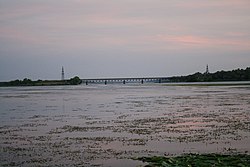
Oskil near Kruhliakivka
Donets river basin. The Oskil (red) is the northernmost large tributary
Map
Native name
Location
CountryRussia, Ukraine
Physical characteristics
MouthDonets
 • coordinates
49°06′00″N 37°24′31″E / 49.1001°N 37.4087°E / 49.1001; 37.4087
Length472 km (293 mi)
Basin size14,800 km2 (5,700 sq mi)
Basin features
ProgressionDonetsDonSea of Azov

The Oskil or Oskol[1] (Ukrainian: Оскiл; Russian: Оскол) is a south-flowing river in Russia and Ukraine. It arises roughly between Kursk and Voronezh and flows south to join the Siverskyi Donets which flows southeast to join the Don. It is 472 kilometres (293 mi) long, with a drainage basin of 14,800 square kilometres (5,700 sq mi).[2]

The river has its sources on the Central Russian Upland, and flows through Kursk and Belgorod Oblasts in Russia, and through the eastern part of Kharkiv Oblast in Ukraine, where it joins the Seversky Donets river. An artificial lake, the Oskil Reservoir, was created in 1958 to help with flood protection and as a source of electricity.[citation needed]

There are several towns along the Oskil: Stary Oskol, Novy Oskol and Valuyki in Russia, and Kupiansk, Kupiansk-Vuzlovyi, Kivsharivka, Borova and Dvorichna in Ukraine.[citation needed]

During the Russo-Ukrainian war

[edit]

On March 31, 2022, during the Russian invasion of Ukraine, the Oskil Dam was destroyed.[3] In September of 2022, to resist the 2022 Ukrainian Kharkiv counteroffensive, Russian forces unsuccessfully used the Oskil River as a defensive barrier, only managing to hold a small portion of territory along the river in northeastern Kharkiv oblast.[4][5]

Following the counteroffensive, the frontline stalled along the northeastern sector of the river in Ukraine. However, in late 2024, Russian forces restarted offensive operations in the area, making several attempts to recross the Oskil river.[6] On January 9, 2025, Russian forces successfully established a bridgehead across the Oskil river, southeast of Dvorichna.[7] Following this, Russian forces steadily advanced across the river, eventually capturing Dvorichna, and using their bridgehead as a launch post for advancing onto Kupiansk.[8][9]

References

[edit]
[edit]
Revisions and contributorsEdit on WikipediaRead on Wikipedia
from Grokipedia
The Oskil (Ukrainian: Оскіл; Russian: Оскол) is a south-flowing left-bank tributary of the Seversky Donets River, spanning approximately 472 kilometers through the border regions of Russia and Ukraine. Originating in the Central Russian Upland between Kursk and Voronezh oblasts, it traverses Belgorod Oblast in Russia before entering Kharkiv Oblast in Ukraine, where it joins the Seversky Donets near the city of Izium. The river drains a basin of 14,800 square kilometers and features an average width of 30–40 meters and depth of 2.5–3 meters in its lower reaches. The Oskil Reservoir, formed in the 1950s along its Ukrainian course, historically played a key role in regulating water flow for the Seversky Donets–Donbas Canal, supporting irrigation and industrial water supply in eastern Ukraine despite debates over its ecological impacts and partial draining during recent conflicts. In the context of the ongoing Russo-Ukrainian War, the Oskil has served as a tactical barrier and site of repeated crossing attempts in the Kupiansk sector, influencing frontline dynamics.

Geography

Course and Basin

The originates in in the Russian Federation and flows generally southward, passing through and oblasts before crossing into . In , it traverses eastern for approximately 178 kilometers, where it joins the Seversky Donets River as a left-bank near the city of . The total length of the river measures 472 kilometers. The Oskil drains a basin area of 14,800 square kilometers, spanning parts of and , primarily within the aforementioned oblasts. This basin is characterized by low in some sections and is fed mainly by from snow, with the river freezing from November to March. The watershed includes numerous small rivers and streams, particularly in the region, contributing to the overall hydrological network of the upper Seversky basin. The terrain features narrow valleys amid ridges, influencing the river's meandering path and flood dynamics.

Physical Characteristics

The Oskil River's channel width generally ranges from 10 to 40 meters, with occasional expansions up to 300 meters in wider sections. Depths fluctuate from 0.4 meters on shallow riffles to a maximum of 10 meters in deeper pools. The riverbed is uneven, characterized by alternating riffles and pools, which contribute to its varied hydraulic conditions. The river flows through a gently sloping, terraced with widths reaching up to 9 kilometers and depths of up to 125 meters. The is bilateral, supporting riparian ecosystems adapted to periodic inundation. Banks are predominantly composed of loamy soils, with some sections featuring steeper slopes due to erosional processes.

Hydrology

Flow and Discharge

The Oskil River's flow regime is predominantly nival, with snowmelt providing the primary source of water, resulting in pronounced spring flooding from late March to early May when discharges peak due to thawing in its upland headwaters. Summer and autumn flows are typically low, with minimal contributions from rainfall and groundwater, often leading to reduced volumes in August and September, consistent with patterns observed in many Eastern European steppe rivers. The river maintains a relatively gentle gradient of 0.29 meters per kilometer, supporting moderate flow velocities and depths averaging 2.5–3 meters, though maximum depths reach about 10 meters in deeper sections. Mean annual discharge near the mouth, approximately 10 kilometers upstream of the confluence with the Siverskyi Donets River, averages around 43 m³/s, though reported values range from 39 to 44 m³/s across hydrological assessments. At the Kupyansk gauging station farther upstream, long-term average discharge has declined markedly from 56.9 m³/s in 1994 to 25.4 m³/s by 2019, driven by reduced , higher , and climate variability in the basin, which spans arid conditions with annual runoff coefficients as low as 15–24 percent of . This trend underscores causal factors like diminishing accumulation and altered seasonal patterns, rather than solely anthropogenic influences upstream. The river freezes annually from early to , halting surface flow and concentrating discharge into ice storage, which contributes to post-thaw surges; ice breakup can exacerbate flooding in the lower reaches. Discharge variability is amplified by the basin's 14,800 km² extent, where upstream sections in receive slightly higher (400–500 mm annually) than downstream Ukrainian portions, leading to cumulative flow attenuation southward. Recent wartime disruptions, including the destruction of the Oskil Reservoir dam, have temporarily altered downstream discharge patterns by releasing stored volumes and exposing sediments, though long-term effects on average flows remain under assessment through regional hydrological monitoring.

Reservoirs, Dams, and Human Modifications

The primary human modification to the Oskil River is the construction of the Oskil Dam and associated in during the Soviet era. The structure, the eighth-largest in by area, spanned 122.6 km² with a total volume of 0.474 km³ (474 million m³), of which 33.5% consisted of shallow waters; average sediment accumulation reached 0.5–1 m depth across the basin. This impoundment regulated seasonal flow variability, storing water to maintain levels in the Severskyi Donets–Donbas for industrial, agricultural, and municipal supply to the and regions, including , especially during summer low-flow conditions when natural discharge decreases. The dam also generated hydroelectric power, contributing to local electricity needs. On April 2, 2022, amid the , Russian forces partially destroyed the , releasing 355.5 million m³ of water and causing flooding along the Oskil and downstream Severskyi Donets rivers. This breach exposed approximately 9,000 hectares of silted reservoir bed, accelerating sediment release into the river system and initiating partial reversal of the artificial toward a more natural regime, though residual structures hindered complete restoration of pre-1957 flow patterns. A subsequent breach in September 2022 rendered the inoperable for 22 months, further draining the reservoir and exposing accumulated pollutants and sediments to downstream ecosystems. By July 2024, international aid facilitated repairs to the Oskil Dam, alongside the Raihorodok Dam, to avert collapse risks, restore water retention for the canal system, and mitigate threats to nearby communities and infrastructure. No other major reservoirs or dams are documented on the Oskil, though the 1957 impoundment fundamentally altered the river's , dynamics, and low-flow stability prior to wartime damage.

History

Etymology and Early References

The name Oskil (Ukrainian: Оскіл; Russian: Оскол) is believed to derive from the nomenclature of ancient steppe nomads, potentially Turkic or Altaic-speaking groups that dominated the region prior to Slavic settlement. Linguist I.G. Dobrodomov analyzed the suffix -ol (or -köl/-göl) in Oskol and similar East Slavic hydronyms like Ingul and Vorskla as a vestigial Altaic noun denoting 'river' or 'valley', comparable to Old Turkic qol ('valley', 'arm of the sea') and Mongolian gol ('river'). This hypothesis aligns with the river's location in the Pontic-Caspian steppe, where pre-Slavic substrates from Iranian (e.g., Alan/Ossetian) and Turkic (e.g., Cuman) influences persisted in toponymy. Alternative interpretations posit a Turkic etymon indicating a boundary river, reflecting its role as a frontier between forest-steppe Slavic principalities and nomadic territories. The earliest documented reference to the Oskil appears in the Ipatiev Chronicle (a Kievan Rus' compilation) under the year 1185, noting the river as a strategic mustering site for Svyatoslavich and his brother Vsevolod during their campaign against the (Polovtsians). This account, preserved in the , describes Igor fording the nearby and encamping at the Oskol before advancing into territories, highlighting the river's early military utility. Subsequent medieval sources, including Mongol-era records from the , corroborate the name's usage in regional geopolitics, often alongside Rus' polities like . No pre-12th-century attestations survive, though archaeological evidence of nomadic settlements in the basin suggests the hydronym predates written Slavic history.

Pre-Modern and Modern Development

In the pre-modern era, the Oskil River served as a strategic in the region, where settlements emerged primarily in the 16th and 17th centuries as part of Muscovite efforts to populate the frontier with Ukrainian and peasants to counter Crimean Tatar incursions. These free, tax-exempt slobody (settlements) were positioned along rivers like the Oskil to secure crossings and foster amid the wild , transforming marginal lands into productive areas through slash-and-burn farming and livestock herding. An early fortified outpost was established at the Oskil's junction with the Siverskyi Donets River around 1599–1600, marking initial colonization efforts southwest of the Donets to control Tatar migration routes. The river facilitated limited navigation for local trade in grains, hides, and salt, while its banks supported fishing and milling, though nomadic threats restricted widespread development until the 18th century, when Russian imperial control stabilized the area. During the modern period, particularly under Soviet rule, the Oskil underwent significant engineering for industrialization and water management. Dams and reservoirs, constructed in the 1950s primarily to supply water via the for industrial and agricultural needs in the coal basin, altered the river's natural flow for , mitigation, and hydroelectric generation. The Oskil Dam, initially built pre-World War II, was demolished by retreating Soviet forces in August 1941 to impede German advances but was reconstructed to support the expanding canal system, which by the 1970s diverted substantial volumes for urban and mining uses. These modifications boosted regional agriculture—yielding crops like and sunflowers on irrigated floodplains—and powered local industry, though they reduced downstream ecological variability and increased sedimentation. Post-independence maintained these infrastructures for economic continuity until wartime disruptions in the .

Settlements and Infrastructure

Major Settlements Along the River

The Oskil River traverses several settlements in , , with emerging as the principal urban center along its course, situated directly on the riverbanks and functioning as a critical rail and node prior to the 2022 invasion. The city had a pre-war population of about 27,000, supporting industries tied to the river's proximity, including and transport infrastructure. Adjacent to Kupiansk lies Kupiansk-Vuzlovyi, a settlement hosting a vital railway bridge spanning the Oskil, which facilitated regional connectivity and before sustaining damage in 2022. Further north, , a rural settlement on the river's western bank roughly 17 kilometers from , marks a strategic point along the waterway, with its position influencing local defensive operations amid ongoing conflict. Borova, located on the Oskil's left bank within , encompasses communities affected by the river's hydrological features, including evacuation efforts from flood-prone areas during wartime disruptions. Smaller locales such as Kivsharivka, positioned near the river in the direction, have historically supported agrarian activities reliant on the Oskil's flow for and . These settlements collectively underscore the river's role in shaping regional , though many have experienced depopulation and infrastructure strain since 2022 due to proximity to frontlines.

Transportation and Economic Uses

The Oskil River contributes to the regional economy primarily through water resource management, supporting agriculture and industry in the area of . Its waters, augmented by the Oskil Reservoir, supply for farmland and technical water for industrial operations via the Siverskyi Donets-Donbas canal system, which relies on regulated flows from the river to sustain production in mining and manufacturing sectors. The reservoir also provided drinking water and facilitated agricultural activities by stabilizing seasonal water availability, though its destruction in 2022 disrupted these functions and prompted discussions on modernization of the broader . Hydropower generation from the Oskil Reservoir's added to local supply, with the associated hydroelectric plant producing to offset operational demands of the and nearby , albeit at a scale questioned for long-term economic viability relative to pumping costs. The reservoir further bolstered the by creating suitable habitats for , contributing modestly to regional food production and employment. Transportation along the Oskil relies on overland routes, with the river serving mainly as a crossing point via fixed bridges that connect settlements and support freight movement by road and rail in the and oblasts, rather than direct fluvial navigation. No significant commercial shipping occurs on the river due to its variable depth and flow, limiting economic to surface paralleling its course.

Ecology and Environment

Flora, Fauna, and Biodiversity

The Oskil River basin, situated in Ukraine's forest-steppe zone, hosts diverse riparian and aquatic ecosystems, including meadows, steppes, and oak-maple forests along its banks. Vegetation includes dominant such as (oak) and (Scots pine), alongside shrubs like and in areas. Aquatic and semi-aquatic features at least 61 of higher vascular in regional water bodies, with charophyte () represented by 10 including Chara vulgaris and Nitella mucronata. steppes in the Dvorichanskyi National Nature Park, which encompasses parts of the Oskil valley, support specialized such as Artemisia nutans, Artemisia salsoloides, Hyssopus cretaceus, and rare orchids including Fritillaria ruthenica and Tulipa quercetorum. Fauna diversity reflects the river's transitional habitats, with 19 fish species from 7 families documented in the drained Oskil Reservoir bed as of 2023, showing highest richness (17 species) near the river mouth; common taxa include rheophilic forms adapted to flowing water and economic species like carp (Cyprinus carpio), whose populations have stabilized or increased post-draining according to local reports. Invertebrates are abundant, with historical records of mollusk assemblages near Novyi Oskil and 211 spider species (Araneae) in 25 families in the Dvorichanskyi Park vicinity. Terrestrial insects include over 1,398 lepidopteran species, 11 of which are listed in Ukraine's Red Data Book. Birdlife features riparian and steppe species such as the common crane (Grus grus), white stork (Ciconia ciconia), grey partridge (Perdix perdix), and red-listed magpie wader (Himantopus himantopus) observed on post-draining shoals; small Oskil valley lakes support grebes including Tachybaptus ruficollis. Biodiversity has been influenced by human modifications, particularly the Oskil Reservoir (destroyed in 2022), which initially reduced flowing-water habitats but, upon draining, exposed 63 vascular plant species on the silted bottom—mostly native, with emergent red-listed taxa—and facilitated recovery of natural dynamics, improving oxygen levels and supporting rheophilic fish and waders. The Dvorichanskyi Park preserves rare riparian and aquatic , countering threats like silt erosion and invasive aliens introduced via wartime disruptions, though overall basin diversity aligns with broader Seversky Donets patterns, emphasizing conservation of endemic and elements.

Environmental Challenges and Conservation

The Oskil River basin has experienced persistent degradation primarily due to untreated discharges from industrial and municipal sources, exacerbated by rising air temperatures that promote algal blooms and reduced oxygen levels. A 2016 study analyzing from 1990 to 2012 identified these factors as the dominant drivers of ecological deterioration, with statistical assessments showing intensified degradation processes linked to insufficient monitoring and landscape alterations in the . Industrial activities in the surrounding region, including and processing, have contributed to heavy metal and chemical pollution inflows, further straining aquatic ecosystems despite limited regulatory enforcement. The since February 2022 has amplified these challenges through direct damage to the Oskil Reservoir . Breaches occurred in and 2022, with the latter event rendering the inoperable for approximately 22 months and causing partial drainage of the reservoir, which led to widespread die-offs of and in the affected area. This hydromorphological alteration disrupted sediment dynamics, reduced habitat connectivity, and facilitated proliferation amid ongoing military activities, compounding pre-existing with wartime debris and . Conservation efforts post-dam breaches emphasize restoring natural river flow over reconstruction, viewing the incident as an opportunity to mitigate long-term anthropogenic modifications like reservoir-induced stagnation that foster . Proposals include modernizing regional to reduce dependency on such dams, alongside calls for systematic ecological monitoring to track recovery and prevent further . However, wartime constraints have limited on-site interventions, with broader Ukrainian initiatives focusing on mine clearance and containment to safeguard downstream Seversky Donets River ecosystems.

Strategic and Military Significance

Historical Military Role

During World War II, the Oskil River (known as Oskol in Russian) served as a significant geographical feature in the Kharkov-Voronezh sector of the Eastern Front, acting as both a line of advance for Axis forces and a defensive obstacle for Soviet troops. In early July 1942, as part of Operation Case Blue—the German summer offensive aimed at capturing Soviet oil fields—Axis armored units, including elements of the 4th Panzer Army, pressed eastward, compelling Soviet forces to evacuate positions along the river near Staryi Oskol after prolonged resistance against tank assaults. Hungarian allied troops also deployed anti-aircraft units in the Staryi Oskol area to support the advance, highlighting the river's role in securing flanks during the push toward Voronezh and the Don River basin. Soviet counteroffensive planning in late explicitly targeted German positions along the Oskol River valley as a preliminary phase to broader operations, intending to eliminate enemy groupings from Staryi Oskol southward to Valuiki before thrusting toward the Northern River. This reflected the river's tactical importance in disrupting Axis logistics and supply lines in the region, though execution shifted priorities amid the Stalingrad crisis. By early 1943, during the Third Battle of Kharkov, residual fighting and maneuvers referenced the Oskol line, where Soviet forces aimed to consolidate gains against German counterattacks in the broader theater. The river's meandering course and floodplains contributed to its defensive utility, channeling movements and complicating mechanized crossings in the contested eastern Ukrainian and Russian borderlands.

Role in the Russo-Ukrainian War

Following Ukraine's counteroffensive in September 2022, Ukrainian forces advanced to the eastern bank of the Oskil River, liberating —a key rail and logistics hub in —on September 11, 2022, and stabilizing the frontline along the river's east-west course in eastern and western Luhansk oblasts. The Oskil, a tributary of the River spanning approximately 300 kilometers, provided a with steep western banks and marshy , enabling Ukrainian defenders to fortify positions west of the waterway and disrupt Russian logistics eastward. This positioning halted Russian momentum after their retreat from Lyman on October 1, 2022, though Ukrainian probes east of the Oskil in September-October 2022 yielded limited gains amid Russian reinforcements. Russian forces, seeking to recapture initiative in northern Donetsk and Kharkiv oblasts, launched repeated crossing attempts starting in late 2023, intensifying in 2024-2025 to threaten Kupiansk from the north and east. In March 2025, Russian elements established a partial bridgehead across the Oskil in Kharkiv Oblast near Novomlynsk, leveraging pontoon bridges and infantry assaults despite challenging terrain and Ukrainian interdiction. Ukrainian reports indicate that by December 2024, defenses had prevented sustained Russian lodgments west of the river, destroying assault groups via FPV drones, artillery, and mortars, with estimates of seven out of ten Russian infantry eliminated during crossings or on the eastern bank. By mid-2025, Russian offensives along the axis focused on seizing bridges and rail junctions like Kupiansk-Vuzlovyi to sever Ukrainian supply lines on the Oskil's western bank, with geolocated advances reported up to 2-3 kilometers west in sectors near Kruhliakivka and Petropavlivka. Ukrainian forces repelled multiple assaults, including one on October 21, 2024, destroying eight Russian infantry fighting vehicles and three tanks near a river crossing. Russian milbloggers claimed incremental gains toward enveloping by October 2025, but open-source analyses from the Institute for the Study of War—drawing on and frontline footage—assess that Ukrainian entrenchments and riverine obstacles limited Russian progress to attritional probing without decisive breakthroughs. These engagements underscore the Oskil's role as a chokepoint, where Russian manpower advantages are offset by vulnerability to precision strikes, contributing to high casualty rates estimated at over 1,000 per day across eastern fronts in peak 2025 phases.

References

Add your contribution
Related Hubs
User Avatar
No comments yet.