

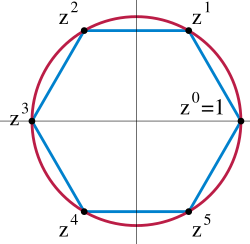

P-group
View on Wikipedia| Algebraic structure → Group theory Group theory |
|---|
 |
|
|

In mathematics, specifically group theory, given a prime number p, a p-group is a group in which the order of every element is a power of p. That is, for each element g of a p-group G, there exists a nonnegative integer n such that the product of pn copies of g, and not fewer, is equal to the identity element. The orders of different elements may be different powers of p.
Abelian p-groups are also called p-primary or simply primary.
A finite group is a p-group if and only if its order (the number of its elements) is a power of p. Given a finite group G, the Sylow theorems guarantee the existence of a subgroup of G of order pn for every prime power pn that divides the order of G.
Every finite p-group is nilpotent.
The remainder of this article deals with finite p-groups. For an example of an infinite abelian p-group, see Prüfer group, and for an example of an infinite simple p-group, see Tarski monster group.
Properties
[edit]Every p-group is periodic since by definition every element has finite order.
If p is prime and G is a group of order pk, then G has a normal subgroup of order pm for every 1 ≤ m ≤ k. This follows by induction, using Cauchy's theorem and the Correspondence Theorem for groups. A proof sketch is as follows: because the center Z of G is non-trivial (see below), according to Cauchy's theorem Z has a subgroup H of order p. Being central in G, H is necessarily normal in G. We may now apply the inductive hypothesis to G/H, and the result follows from the Correspondence Theorem.
Non-trivial center
[edit]One of the first standard results using the class equation is that the center of a non-trivial finite p-group cannot be the trivial subgroup.[1]
This forms the basis for many inductive methods in p-groups.
For instance, the normalizer N of a proper subgroup H of a finite p-group G properly contains H, because for any counterexample with H = N, the center Z is contained in N, and so also in H, but then there is a smaller example H/Z whose normalizer in G/Z is N/Z = H/Z, creating an infinite descent. As a corollary, every finite p-group is nilpotent.
In another direction, every normal subgroup N of a finite p-group intersects the center non-trivially as may be proved by considering the elements of N which are fixed when G acts on N by conjugation. Since every central subgroup is normal, it follows that every minimal normal subgroup of a finite p-group is central and has order p. Indeed, the socle of a finite p-group is the subgroup of the center consisting of the central elements of order p.
If G is a p-group, then so is G/Z, and so it too has a non-trivial center. The preimage in G of the center of G/Z is called the second center and these groups begin the upper central series. Generalizing the earlier comments about the socle, a finite p-group with order pn contains normal subgroups of order pi with 0 ≤ i ≤ n, and any normal subgroup of order pi is contained in the ith center Zi. If a normal subgroup is not contained in Zi, then its intersection with Zi+1 has size at least pi+1.
Automorphisms
[edit]The automorphism groups of p-groups are well studied. Just as every finite p-group has a non-trivial center so that the inner automorphism group is a proper quotient of the group, every finite p-group has a non-trivial outer automorphism group. Every automorphism of G induces an automorphism on G/Φ(G), where Φ(G) is the Frattini subgroup of G. The quotient G/Φ(G) is an elementary abelian group and its automorphism group is a general linear group, so very well understood. The map from the automorphism group of G into this general linear group has been studied by Burnside, who showed that the kernel of this map is a p-group.
Examples
[edit]p-groups of the same order are not necessarily isomorphic; for example, the cyclic group C4 and the Klein four-group V4 are both 2-groups of order 4, but they are not isomorphic.
Nor need a p-group be abelian; the dihedral group Dih4 of order 8 is a non-abelian 2-group. However, every group of order p2 is abelian.[note 1]
The dihedral groups are both very similar to and very dissimilar from the quaternion groups and the semidihedral groups. Together the dihedral, semidihedral, and quaternion groups form the 2-groups of maximal class, that is those groups of order 2n+1 and nilpotency class n.
Iterated wreath products
[edit]The iterated wreath products of cyclic groups of order p are very important examples of p-groups. Denote the cyclic group of order p as W(1), and the wreath product of W(n) with W(1) as W(n + 1). Then W(n) is the Sylow p-subgroup of the symmetric group Sym(pn). Maximal p-subgroups of the general linear group GL(n,Q) are direct products of various W(n). It has order pk where k = (pn − 1)/(p − 1). It has nilpotency class pn−1, and its lower central series, upper central series, lower exponent-p central series, and upper exponent-p central series are equal. It is generated by its elements of order p, but its exponent is pn. The second such group, W(2), is also a p-group of maximal class, since it has order pp+1 and nilpotency class p, but is not a regular p-group. Since groups of order pp are always regular groups, it is also a minimal such example.
Generalized dihedral groups
[edit]When p = 2 and n = 2, W(n) is the dihedral group of order 8, so in some sense W(n) provides an analogue for the dihedral group for all primes p when n = 2. However, for higher n the analogy becomes strained. There is a different family of examples that more closely mimics the dihedral groups of order 2n, but that requires a bit more setup. Let ζ denote a primitive pth root of unity in the complex numbers, let Z[ζ] be the ring of cyclotomic integers generated by it, and let P be the prime ideal generated by 1−ζ. Let G be a cyclic group of order p generated by an element z. Form the semidirect product E(p) of Z[ζ] and G where z acts as multiplication by ζ. The powers Pn are normal subgroups of E(p), and the example groups are E(p,n) = E(p)/Pn. E(p,n) has order pn+1 and nilpotency class n, so is a p-group of maximal class. When p = 2, E(2,n) is the dihedral group of order 2n. When p is odd, both W(2) and E(p,p) are irregular groups of maximal class and order pp+1, but are not isomorphic.
Unitriangular matrix groups
[edit]The Sylow subgroups of general linear groups are another fundamental family of examples. Let V be a vector space of dimension n with basis { e1, e2, ..., en } and define Vi to be the vector space generated by { ei, ei+1, ..., en } for 1 ≤ i ≤ n, and define Vi = 0 when i > n. For each 1 ≤ m ≤ n, the set of invertible linear transformations of V which take each Vi to Vi+m form a subgroup of Aut(V) denoted Um. If V is a vector space over Z/pZ, then U1 is a Sylow p-subgroup of Aut(V) = GL(n, p), and the terms of its lower central series are just the Um. In terms of matrices, Um are those upper triangular matrices with 1s one the diagonal and 0s on the first m−1 superdiagonals. The group U1 has order pn·(n−1)/2, nilpotency class n, and exponent pk where k is the least integer at least as large as the base p logarithm of n.
Classification
[edit]The groups of order pn for 0 ≤ n ≤ 4 were classified early in the history of group theory,[2] and modern work has extended these classifications to groups whose order divides p7, though the sheer number of families of such groups grows so quickly that further classifications along these lines are judged difficult for the human mind to comprehend.[3] For example, Marshall Hall Jr. and James K. Senior classified groups of order 2n for n ≤ 6 in 1964.[4]
Rather than classify the groups by order, Philip Hall proposed using a notion of isoclinism of groups which gathered finite p-groups into families based on large quotient and subgroups.[5]
An entirely different method classifies finite p-groups by their coclass, that is, the difference between their composition length and their nilpotency class. The so-called coclass conjectures described the set of all finite p-groups of fixed coclass as perturbations of finitely many pro-p groups. The coclass conjectures were proven in the 1980s using techniques related to Lie algebras and powerful p-groups.[6] The final proofs of the coclass theorems are due to A. Shalev and independently to C. R. Leedham-Green, both in 1994. They admit a classification of finite p-groups in directed coclass graphs consisting of only finitely many coclass trees whose (infinitely many) members are characterized by finitely many parametrized presentations.
Every group of order p5 is metabelian.[7]
Up to p3
[edit]The trivial group is the only group of order one, and the cyclic group Cp is the only group of order p. There are exactly two groups of order p2, both abelian, namely Cp2 and Cp × Cp. For example, the cyclic group C4 and the Klein four-group V4 which is C2 × C2 are both 2-groups of order 4.
There are three abelian groups of order p3, namely Cp3, Cp2 × Cp, and Cp × Cp × Cp. There are also two non-abelian groups.
For p ≠ 2, one is a semi-direct product of Cp × Cp with Cp, and the other is a semi-direct product of Cp2 with Cp. The first one can be described in other terms as group UT(3,p) of unitriangular matrices over finite field with p elements, also called the Heisenberg group mod p.
For p = 2, both the semi-direct products mentioned above are isomorphic to the dihedral group Dih4 of order 8. The other non-abelian group of order 8 is the quaternion group Q8.
Prevalence
[edit]Among groups
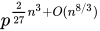
[edit]The Higman–Sims asymptotic formula states that the number of isomorphism classes of groups of order pn grows as , and these are dominated by the classes that are two-step nilpotent.[8] Because of this rapid growth, there is a folklore conjecture asserting that almost all finite groups are 2-groups: the fraction of isomorphism classes of 2-groups among isomorphism classes of groups of order at most n is thought to tend to 1 as n tends to infinity. For instance, of the 49 910 529 484 different groups of order at most 2000, 49487367289, or just over 99%, are 2-groups of order 1024.[9]
Within a group
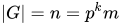
[edit]Every finite group whose order is divisible by p contains a subgroup which is a non-trivial p-group, namely a cyclic group of order p generated by an element of order p obtained from Cauchy's theorem. In fact, it contains a p-group of maximal possible order: if where p does not divide m, then G has a subgroup P of order called a Sylow p-subgroup. This subgroup need not be unique, but any subgroups of this order are conjugate, and any p-subgroup of G is contained in a Sylow p-subgroup. This and other properties are proved in the Sylow theorems.

Application to structure of a group
[edit]p-groups are fundamental tools in understanding the structure of groups and in the classification of finite simple groups. p-groups arise both as subgroups and as quotient groups. As subgroups, for a given prime p one has the Sylow p-subgroups P (largest p-subgroup not unique but all conjugate) and the p-core (the unique largest normal p-subgroup), and various others. As quotients, the largest p-group quotient is the quotient of G by the p-residual subgroup These groups are related (for different primes), possess important properties such as the focal subgroup theorem, and allow one to determine many aspects of the structure of the group.


Local control
[edit]Much of the structure of a finite group is carried in the structure of its so-called local subgroups, the normalizers of non-identity p-subgroups.[10]
The large elementary abelian subgroups of a finite group exert control over the group that was used in the proof of the Feit–Thompson theorem. Certain central extensions of elementary abelian groups called extraspecial groups help describe the structure of groups as acting on symplectic vector spaces.
Richard Brauer classified all groups whose Sylow 2-subgroups are the direct product of two cyclic groups of order 4, and John Walter, Daniel Gorenstein, Helmut Bender, Michio Suzuki, George Glauberman, and others classified those simple groups whose Sylow 2-subgroups were abelian, dihedral, semidihedral, or quaternion.
See also
[edit]- Elementary group – Direct product of a p-group and a cyclic group of coprime order
- Prüfer rank
- Regular p-group
Footnotes
[edit]Notes
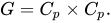
[edit]- ^ To prove that a group of order p2 is abelian, note that it is a p-group so has non-trivial center, so given a non-trivial element of the center g, this either generates the group (so G is cyclic, hence abelian: ), or it generates a subgroup of order p, so g and some element h not in its orbit generate G, (since the subgroup they generate must have order ) but they commute since g is central, so the group is abelian, and in fact


Citations
[edit]- ^ proof
- ^ (Burnside 1897)
- ^ (Leedham-Green & McKay 2002, p. 214)
- ^ (Hall Jr. & Senior 1964)
- ^ (Hall 1940)
- ^ (Leedham-Green & McKay 2002)
- ^ "Every group of order p5 is metabelian". Stack Exchange. 24 March 2012. Retrieved 7 January 2016.
- ^ (Sims 1965)
- ^ Burrell, David (2021-12-08). "On the number of groups of order 1024". Communications in Algebra. 50 (6): 2408–2410. doi:10.1080/00927872.2021.2006680.
- ^ (Glauberman 1971)
References
[edit]- Besche, Hans Ulrich; Eick, Bettina; O'Brien, E. A. (2002), "A millennium project: constructing small groups", International Journal of Algebra and Computation, 12 (5): 623–644, doi:10.1142/S0218196702001115, MR 1935567, S2CID 31716675
- Burnside, William (1897), Theory of groups of finite order, Cambridge University Press, ISBN 9781440035456
{{citation}}: ISBN / Date incompatibility (help) - Glauberman, George (1971), "Global and local properties of finite groups", Finite simple groups (Proc. Instructional Conf., Oxford, 1969), Boston, MA: Academic Press, pp. 1–64, MR 0352241
- Hall Jr., Marshall; Senior, James K. (1964), The Groups of Order 2n (n ≤ 6), London: Macmillan, LCCN 64016861, MR 0168631 — An exhaustive catalog of the 340 non-abelian groups of order dividing 64 with detailed tables of defining relations, constants, and lattice presentations of each group in the notation the text defines. "Of enduring value to those interested in finite groups" (from the preface).
- Hall, Philip (1940), "The classification of prime-power groups", Journal für die reine und angewandte Mathematik, 1940 (182): 130–141, doi:10.1515/crll.1940.182.130, ISSN 0075-4102, MR 0003389, S2CID 122817195
- Leedham-Green, C. R.; McKay, Susan (2002), The structure of groups of prime power order, London Mathematical Society Monographs. New Series, vol. 27, Oxford University Press, ISBN 978-0-19-853548-5, MR 1918951
- Sims, Charles (1965), "Enumerating p-groups", Proc. London Math. Soc., Series 3, 15: 151–166, doi:10.1112/plms/s3-15.1.151, MR 0169921
Further reading
[edit]- Berkovich, Yakov (2008), Groups of Prime Power Order, de Gruyter Expositions in Mathematics 46, vol. 1, Berlin: Walter de Gruyter GmbH, ISBN 978-3-1102-0418-6
- Berkovich, Yakov; Janko, Zvonimir (2008), Groups of Prime Power Order, de Gruyter Expositions in Mathematics 47, vol. 2, Berlin: Walter de Gruyter GmbH, ISBN 978-3-1102-0419-3
- Berkovich, Yakov; Janko, Zvonimir (2011-06-16), Groups of Prime Power Order, de Gruyter Expositions in Mathematics 56, vol. 3, Berlin: Walter de Gruyter GmbH, ISBN 978-3-1102-0717-0
External links
[edit]P-group
View on GrokipediaDefinition and Fundamentals
Definition
In group theory, a p-group, where p is a prime number, is a group G (finite or infinite) in which the order of every element is a power of p.[5] For finite p-groups, this condition is equivalent to the order of G being pn for some nonnegative integer n.[5] A basic consequence is that the trivial group, whose sole element has order 1 = p0, qualifies as a p-group for every prime p and is the unique group of order 1.[5] More generally, groups where all element orders are powers of primes from a set are termed -groups, with the single-prime case corresponding to .[5] The study of p-groups was advanced by Philip Hall in his 1928 work on solvable groups.[6]Finite versus Infinite p-Groups
A finite p-group is a group whose order is exactly a power of a prime p, denoted as |G| = p^n for some nonnegative integer n.[7] In such groups, the Sylow p-subgroup coincides with the group itself and is therefore normal.[8] A defining property of finite p-groups is that they are nilpotent, meaning their lower central series terminates at the trivial subgroup after finitely many steps; this follows from the nontrivial center of any nontrivial p-group and induction on the order. In contrast, an infinite p-group is an infinite group in which the order of every element is a power of p. While some infinite p-groups are locally finite (every finitely generated subgroup is finite), others are not; for example, there exist finitely generated infinite p-groups. A canonical example is the Prüfer p-group, also known as the quasicyclic p-group or ℤ(p^∞), which is the p-primary component of the quotient group ℚ/ℤ and consists of all p-power roots of unity in the complex numbers under multiplication; it is countable and torsion, with every proper subgroup finite and cyclic.[9] All elements in any p-group, finite or infinite, have order a power of p, ensuring the group is periodic and torsion.[7] A key distinction arises in structural properties: while all finite p-groups are nilpotent, infinite p-groups need not be, though they share the periodic nature of p-groups. Infinite p-groups connect to the Burnside problem, particularly its restricted variant, where solutions show that finitely generated p-groups of bounded exponent p^k are finite, implying any infinite finitely generated p-group must have unbounded exponents.[10] This highlights how infinitude in p-groups often involves unbounded torsion orders, contrasting the controlled finite structure.[11]Core Structural Properties
Non-Abelian Characteristics
A defining feature of non-abelian finite p-groups is that their center Z(G) is a proper, non-trivial subgroup, with |Z(G)| ≥ p.[12] This follows from the class equation for a finite group G of order p^n:Automorphism Groups
The automorphism group of a -group consists of all isomorphisms from to itself, forming a group under composition. A key subgroup is the inner automorphism group , which comprises conjugations by elements of and is isomorphic to , where is the center of ; since is nontrivial for non-trivial finite -groups, is itself a -group. The outer automorphism group is the quotient , which encodes symmetries of modulo inner ones. For finite -groups, exhibits rich -power structure. Any such admits a faithful action of on the Frattini quotient , where is the Frattini subgroup and is the minimal number of generators of ; this implies that is divisible by the -part of , namely . More strikingly, Helleloid and Martin proved that is itself a -group for almost all finite -groups of a given order , in the sense that the proportion of such groups where this holds approaches 1 as .[15] A prominent exception occurs for elementary abelian -groups , where , whose order includes factors coprime to . In fact, if and only if is elementary abelian of order .[16] Gaschütz established foundational results on outer automorphisms of finite -groups, proving that every such has nontrivial elements in , and moreover, if is not cyclic of order , then contains an element of -power order. This implies the existence of outer -automorphisms, highlighting the -local nature of symmetries in these groups. Extensions by Schmid show that for nonabelian finite -groups, such outer automorphisms can act trivially on the center. Regarding automorphism towers—the iterative construction , —Gaschütz's insights contribute to understanding stabilization in nilpotent settings, though full resolution for soluble groups relies on later work by Zelmanov resolving the general tower problem affirmatively. For infinite -groups, the structure of varies widely; while is often infinite (e.g., for the Prüfer -group , up to isomorphism, yielding infinite since is abelian), it can be finite in specific constructions. Notably, every group arises as for some locally finite -group , demonstrating the flexibility of outer symmetries even in infinite cases.[17]Key Examples and Constructions
Abelian p-Groups
Abelian p-groups form a fundamental subclass of p-groups, consisting of those where the group operation is commutative. These groups play a crucial role in the structure theory of abelian groups and serve as building blocks for more general classifications, including their appearance as Sylow p-subgroups in finite groups.[18]Finite Case
Finite abelian p-groups admit a complete classification via the fundamental theorem of finite abelian groups, which specializes to the p-primary component. Specifically, every finite abelian p-group G is isomorphic to a direct sum of cyclic groups of p-power order:Infinite Case
Infinite abelian p-groups exhibit greater diversity and lack a simple finite-type classification, but they can often be expressed as direct sums or direct products of cyclic p-groups. A canonical example is the Prüfer p-group , which is the direct limit of the system for $ n \geq 1 $ and serves as the injective hull of in the category of abelian groups.[19] For countable torsion abelian p-groups, Ulm's theorem provides a classification using Ulm invariants $ f_\alpha(G) $ for ordinals , where $ f_\alpha(G) $ counts the dimension of the -th Ulm factor, determining the isomorphism type uniquely.[20] In general, all abelian p-groups—finite or infinite—are precisely the torsion modules over the ring of p-adic integers.[19] The exponent remains well-defined as the lcm of element orders, though it may be infinite.[19]Non-Abelian Examples
Non-abelian p-groups provide essential examples that highlight the departure from commutativity in p-group structures, often arising as semidirect products or matrix groups with non-trivial centers. These groups illustrate key properties such as extraspecial structures and varying exponents, which are central to understanding the diversity of p-groups beyond the abelian case.[21] A fundamental example for p=2 is the dihedral group of order , denoted , which consists of symmetries of a regular -gon. It has the presentation , where r generates rotations and s a reflection, yielding a non-abelian group of order with a cyclic subgroup of index 2.[22] This construction extends the classical dihedral group and demonstrates how inversion actions produce non-commutativity in 2-groups.[23] Another prominent 2-group is the quaternion group of order 8, with presentation . Here, the center is , and all non-central elements have order 4, distinguishing it from other non-abelian groups of order 8.[24] This group exemplifies an extraspecial 2-group, where the center and derived subgroup coincide and have order 2.[7] For odd primes p, the Heisenberg group modulo p, also known as the extraspecial group of exponent p and order , can be realized as the group of upper triangular 3×3 matrices over the finite field with 1s on the diagonal. Elements are of the formAdvanced Constructions
One prominent construction of finite p-groups involves wreath products, particularly iterated ones. The regular wreath product $ \mathbb{Z}_p \wr \mathbb{Z}_p $ consists of a base group isomorphic to $ (\mathbb{Z}_p)^p $ acted upon by a cyclic group of order p, yielding a group of order $ p^{p+1} $.[28] Iterating this process—forming higher wreath powers such as $ \mathbb{Z}_p \wr (\mathbb{Z}_p \wr \mathbb{Z}_p) $ and continuing—produces p-groups of exponentially growing order and increasing nilpotency class. These iterated wreath products demonstrate that p-groups exist with arbitrarily large nilpotency class, as starting from a p-group of class at most p and iterating yields groups of unbounded class.[29] Another key construction arises from linear algebra over finite fields. The group UT(n, p) of n × n unitriangular matrices over the field $ \mathbb{F}_p $ (with 1s on the diagonal and entries above the diagonal in $ \mathbb{F}_p $) forms a p-group of order $ p^{n(n-1)/2} $, as the superdiagonal and above provide that many independent entries. This group is nilpotent of class exactly n-1, with the lower central series corresponding to the levels of superdiagonals.[30] Extraspecial p-groups provide a canonical family of non-abelian p-groups with controlled structure. An extraspecial p-group G is a non-abelian p-group such that its center Z(G), derived subgroup G', and Frattini subgroup Φ(G) all coincide and have order p, while G/Z(G) is elementary abelian of even rank 2m, giving |G| = p^{2m+1}. For odd p, there are two non-isomorphic extraspecial p-groups of each order p^{2m+1} (m ≥ 1): one of exponent p (the Heisenberg type) and one of exponent p^2 (the semidirect product type). Each family can be realized as central products of the corresponding basic extraspecial group of order p^3, where the Heisenberg group of order p^3 serves as the basic building block for the exponent-p family, and larger groups in each family are obtained by amalgamating centers in a controlled manner. For p=2, the classification involves central products incorporating dihedral and quaternion factors of order 8.[26][31] For infinite p-groups, constructions addressing the Burnside problem yield significant examples. The Golod-Shafarevich theorem provides a criterion for the infinitude of pro-p groups via inequalities on relations in presentations, enabling the explicit construction of infinite discrete p-groups generated by d ≥ 2 elements where every element has order a power of p (p-torsion). For every prime p and d ≥ 2, such an infinite d-generated p-torsion group exists, often realized as quotients of free groups satisfying the Golod-Shafarevich inequality. These groups highlight the existence of infinite p-groups with bounded exponent, contrasting with finite cases.[32]Classification Results
Small Order Classifications
The classification of p-groups begins with the smallest orders, providing foundational examples that illustrate both abelian and non-abelian structures. For order $ p $, where $ p $ is prime, there is only one group up to isomorphism: the cyclic group $ \mathbb{Z}/p\mathbb{Z} $, generated by any non-identity element, with presentation $ \langle x \mid x^p = 1 \rangle $.[33] This group is elementary abelian, has exponent $ p $, and nilpotency class 1. For order $ p^2 $, there are exactly two groups up to isomorphism, both abelian by the fundamental theorem of finite abelian groups. These are the cyclic group $ \mathbb{Z}/p^2\mathbb{Z} $, with presentation $ \langle x \mid x^{p^2} = 1 \rangle $ and exponent $ p^2 $, and the elementary abelian group $ \mathbb{Z}/p\mathbb{Z} \times \mathbb{Z}/p\mathbb{Z} $, with presentation $ \langle x, y \mid x^p = y^p = 1, , xy = yx \rangle $ and exponent $ p $. Both have nilpotency class 1.[34] For order $ p^3 $, there are five groups up to isomorphism, comprising three abelian and two non-abelian cases; this count holds for odd primes $ p $, while the non-abelian groups differ slightly for $ p = 2 $. The abelian groups follow from the fundamental theorem: $ \mathbb{Z}/p^3\mathbb{Z} $ (exponent $ p^3 $), $ \mathbb{Z}/p^2\mathbb{Z} \times \mathbb{Z}/p\mathbb{Z} $ (exponent $ p^2 $), and $ (\mathbb{Z}/p\mathbb{Z})^3 $ (exponent $ p $), all with nilpotency class 1.[34] The non-abelian groups are extraspecial p-groups of order $ p^3 $, each with center and derived subgroup of order $ p $, quotient by the center isomorphic to $ (\mathbb{Z}/p\mathbb{Z})^2 $, and nilpotency class 2. For odd $ p $, one is the Heisenberg group modulo $ p $ (also called the extraspecial group of exponent $ p $), with presentation $ \langle x, y \mid x^p = y^p = [x,y]^p = 1, , [[x,y],x] = [[x,y],y] = 1 \rangle $ and exponent $ p $; the other is the semidirect product $ \mathbb{Z}/p\mathbb{Z} \rtimes \mathbb{Z}/p^2\mathbb{Z} $, with presentation $ \langle x, y \mid x^p = 1, , y^{p^2} = 1, , yxy^{-1} = x^{1+p} \rangle $ and exponent $ p^2 $. For $ p = 2 $ (order 8), the non-abelian groups are the dihedral group $ D_4 $ of order 8, with presentation $ \langle x, y \mid x^4 = y^2 = 1, , yxy^{-1} = x^{-1} \rangle $ and exponent 4, and the quaternion group $ Q_8 $, with presentation $ \langle x, y \mid x^4 = 1, , x^2 = y^2, , yxy^{-1} = x^{-1} \rangle $ and exponent 4.[21] The following table summarizes the groups of order $ p^3 $, including presentations and key properties:| Group | Presentation | Exponent | Nilpotency Class | Notes |
|---|---|---|---|---|
| $ \mathbb{Z}/p^3\mathbb{Z} $ | $ \langle x \mid x^{p^3} = 1 \rangle $ | $ p^3 $ | 1 | Abelian, cyclic |
| $ \mathbb{Z}/p^2\mathbb{Z} \times \mathbb{Z}/p\mathbb{Z} $ | $ \langle x, y \mid x^{p^2} = y^p = 1, , xy = yx \rangle $ | $ p^2 $ | 1 | Abelian |
| $ (\mathbb{Z}/p\mathbb{Z})^3 $ | $ \langle x, y, z \mid x^p = y^p = z^p = 1, , [x,y] = [x,z] = [y,z] = 1 \rangle $ | $ p $ | 1 | Abelian, elementary |
| Heisenberg mod $ p $ (odd $ p $) | $ \langle x, y \mid x^p = y^p = [x,y]^p = 1, , [[x,y],x] = [[x,y],y] = 1 \rangle $ | $ p $ | 2 | Non-abelian, extraspecial |
| $ \mathbb{Z}/p\mathbb{Z} \rtimes \mathbb{Z}/p^2\mathbb{Z} $ (odd $ p $) | $ \langle x, y \mid x^p = y^{p^2} = 1, , yxy^{-1} = x^{1+p} \rangle $ | $ p^2 $ | 2 | Non-abelian |
| $ D_4 $ ($ p=2 $) | $ \langle x, y \mid x^4 = y^2 = 1, , yxy^{-1} = x^{-1} \rangle $ | 4 | 2 | Non-abelian, dihedral |
| $ Q_8 $ ($ p=2 $) | $ \langle x, y \mid x^4 = 1, , x^2 = y^2, , yxy^{-1} = x^{-1} \rangle $ | 4 | 2 | Non-abelian, quaternion |