Hubbry Logo
Honda Pacific CoastHonda Pacific CoastMain
Open search
Honda Pacific Coast
Community hub
Honda Pacific Coast
logo
8 pages, 0 posts
0 subscribers
Be the first to start a discussion here.
Honda Pacific Coast
Honda Pacific Coast
from Wikipedia
Honda PC800
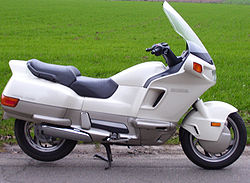
1989 Honda Pacific Coast with accessory tall windshield
ManufacturerHonda
Also calledHonda Pacific Coast
Production1989–1998
ClassTouring
Engine800 cc (49 cu in) 45° 3-valves per cylinder, V-twin, liquid cooled
Bore / stroke79.5 mm × 80.6 mm (3.13 in × 3.17 in)
Ignition typeCDI
TransmissionHydraulic clutch, 5-speed, shaft drive
Frame typeSteel
SuspensionFront 42 mm telescopic fork
Rear 4-way adjustable spring
BrakesFront 2x disc 290 mm, 2 piston calipers
Rear drumbrake 180 mm
TiresFront 120/80-17
140/80-15
Wheelbase59.1 inches (1,500 mm)
DimensionsH: 1,360 mm (54 in)
Fuel capacity16 L (3.5 imp gal; 4.2 US gal)

The PC800 Pacific Coast is a touring motorcycle manufactured and marketed by Honda between 1989 and 1998. Named after California's Pacific Coast Highway, over 14,000 were sold in North America, Europe and Japan, with a three-year hiatus between two production runs. The bike is noted for its single integrated trunk straddling the rear wheel, full bodywork, and distinctive two-tone paint.

Like the earlier Honda Gold Wing[1] and later Rune,[2] the Pacific Coast had been conceived and designed by Honda Research America specifically for the US market. Though subsequent Honda motorcycles would feature integral, side-opening trunks—namely the Deauville/NT700V, ST1100, Gold Wing and ST1300—the wheel-straddling, top-opening trunk concept remained unique to the Pacific Coast.[3]

An unorthodox motorcycle

[edit]

According to a 1998 Motorcycle.org article, "when the PC debuted, it was considered a radical bike."[4] The PC800 departed convention with its integral trunk, extensive bodywork and marketing aimed at the "white-collar professional."

Marketing

[edit]

"For some people, a road is more than just a strip of pavement connecting where they are with where they want to be. It's the reason for leaving home in the first place. The Amalfi Drive in Italy is a road like that. The Blue Ridge Parkway is too.

And so is Highway 1 in California, that magical ribbon of blacktop that snakes along the very edge of the continent. The place this motorcycle is named for. The Pacific Coast."

Honda Pacific Coast Motorcycle brochure, copyright American Honda Motor Co., Inc.[5]

In addition to naming the PC800 after an important American highway, Honda reinforced the association between the motorcycle and other notable highways of the world; advertising copy from the 1994 Pacific Coast brochure highlighted the famed Amalfi Drive and Blue Ridge Parkway, along with the Pacific Coast Highway.[5]

Similarly, the name of the lower body color for 1996 model referred to another important road, the Karakorum Highway, the highest international highway in the world.

In contrast to motorcycling advertising that emphasized rebellion or exaggerated masculinity, a 1989 30-second introductory television commercial for the PC800 depicted a couple awakening at a stylish waterfront home. She is seen running on the beach, he is seen showering, lifting his Rolex-like wrist watch from the bedside table, fixing coffee—all with a Honda PC800 next to a grand piano in their elegant living room, the waves crashing visibly beyond. The commercial ended with a single shot of the motorcycle at a very calm (i.e., pacific) shoreline carrying the voiceover: "Introducing the Pacific Coast, from Honda. It is the beginning of a new day."

Sales over the entire two-part production run averaged under 1,400 sales per year over ten years.[citation needed]

Trunk

[edit]

Unlike other motorcycles that offer detachable side or top cases for storage, the PC800 has an integral waterproof trunk under the pillion (passenger seat). The passenger seat is attached to a single trunk lid that hinges upward to reveal two storage areas that straddle the rear wheel — with sufficient capacity to carry "two full-face helmets and two medium-sized gym bags",[4] or "two grocery bags", or "four plastic bags full of groceries, along with a small bag of dog food."[4] The trunk lid is held up by a hydraulic strut and is controlled by a release mechanism under the lockable fuel filler door.

Bodywork

[edit]

Like other motorcycles with full bodywork, the PC800's plastic bodywork conceals almost the entirety of the motorcycle's mechanical underpinnings — in the manner of a scooter. While routine oil changes do not require panel removal the PC800 owners manual calls for removal and replacement of four panels (two each side) for servicing the spark plugs and seven panels for servicing the battery.

The design of the bodywork includes three vents (visible in the photo above) on each side of the bike to cool the mechanicals: a pair of forward vents on the wheel cowling, a lower vent on each side for the transmission, and two larger vents to accommodate the engine's cooling system.

In contrast to other motorcycles with full bodywork, the PC800's trunk occupies the full unbroken width of the bike's tailend while the front wheel carries a partial cowling, which reverted to an open fender in 1997-1998 model years. For the entire production run, the bodywork featured a lower-body accent color.

Features

[edit]

Honda outfitted the Pacific Coast as a "low-maintenance motorcycle for daily use" aimed primarily toward first-time motorcycle owners. Riding position is standard or neutral, instrumentation is "automobile-like,"[4] switches and controls are large and clearly marked, self-canceling turn signals were included until the 1997 model year along with a seat height of 30.1 inches (760 mm) and an integrated fairing and windshield. 1989 and 1990 models offered an optional AM/FM radio.

Production data

[edit]

The table below outlines production figures, factory paint colors and production notes.

The table uses serial numbers as a basis for estimating production: Official US production bikes carry serial number in the RC340 range, California models carry RC341 numbers, Japanese models carry RC341(J) numbers, and Canadian and European models carried RC342 serial numbers.

Model year Production [6] Body color/trim color Notes
MY1989 6,602 Pearl White/Ocean Gray All years: fender is upper body color
MY1989 562 Silver/Dark Grey Japan model S/N RC341(J)
MY1990 3,739 Candy Apple Red/Griffen Gray light blue option, France and Italy
MY1991 0 -- model year not offered
MY1992 0 -- model year not offered
MY1993 0 -- model year not offered
MY1994 1,193 Black-Z/Griffen Gray radio option no longer offered
MY1995 1,009 Black-Z/Griffen Gray --
MY1996 1,070 Magna Red/Karakorum Gray MY96-98: no clear coat above, MY97-98: no clearcoat below, lower color moulded in (not painted)
MY1997 713 Magna Red/matte black Self-canceling turn signals discontinued. Front wheel cowling reverted to fender, minor cosmetic, cost-cutting changes
MY1998 510 (approx) Magna Red/matte black --

References

[edit]
Revisions and contributorsEdit on WikipediaRead on Wikipedia
from Grokipedia
The Pacific Coast, officially designated as the PC800, is a produced by from 1989 to 1998, characterized by its innovative fully enclosed bodywork, integrated hard luggage trunk, and car-like styling intended to attract novice riders and automotive enthusiasts. Developed by R&D Americas and named after California's scenic Pacific Coast Highway, the PC800 was designed as an accessible entry into for those unfamiliar with traditional bikes, featuring extensive plastic fairings that concealed mechanical components and provided weather protection. The model debuted in 1989 with strong initial exceeding 7,000 units in its first year, primarily in the United States, but production paused after 1990 due to an economic that reduced demand. It was reintroduced in 1994 for the U.S. and European markets, continuing until 1998 with annual averaging under 1,000 units, leading to its discontinuation amid competition from more conventional touring models like the Kawasaki Concours. Overall, more than 14,000 units were sold across , , and during its production run. At the heart of the PC800 is a liquid-cooled, 45-degree displacing 798 cc, derived from the 1988 VT800, with a bore of 79.5 mm and stroke of 80.6 mm, three valves per cylinder, and a 9:1 . This powerplant delivers 57 horsepower at 6,500 rpm and 65 Nm (48 lb-ft) of torque at 5,500 rpm, paired with two Keihin carburetors, a five-speed transmission, and shaft final drive for smooth, low-maintenance operation suitable for long-distance touring. The bike achieves approximately 45-50 miles per gallon from its 4.2-gallon fuel tank, with a top speed around 110 mph and a 0-60 mph time of about 6 seconds. The PC800's chassis employs a full-cradle frame with rectangular spars, a 41 mm telescopic front offering 5.7 inches of travel, and dual rear shocks with 5.1 inches of travel, resulting in a 30-inch seat height, 61.2-inch , and curb weight of 630 pounds. Its standout design includes a large, waterproof rear trunk divided into two compartments capable of holding a full-face and groceries, a tall windscreen, dual seating with passenger grab rails, 17-inch front and 15-inch rear cast aluminum wheels, and TRAC anti-dive front suspension. While praised for comfort and practicality on extended rides, the extensive bodywork complicates maintenance, requiring the removal of multiple panels for routine tasks like changes or battery access. Despite its commercial shortcomings, the PC800 has garnered a among enthusiasts for its quirky, futuristic aesthetic and reliability, appearing in films such as Harley-Davidson and the Marlboro Man, Part III, and The Bourne Identity, with many units still in use today and supported by aftermarket parts. Priced at $7,700 upon launch in 1989 and rising to $8,700 by 1998, it represented Honda's bold experiment in blending automotive convenience with two-wheeled mobility.

Development and History

Origins and Design

The Honda Pacific Coast was conceived in the mid-1980s by Honda R&D America, based in , as a project tailored specifically for the American market to attract entry-level touring riders seeking an accessible introduction to long-distance . This initiative stemmed from Honda's establishment of its U.S. arm in 1975, aimed at blending automotive and expertise to create more efficient, user-friendly designs. The model's name drew inspiration from California's iconic Pacific Coast Highway (PCH), evoking visions of leisurely, scenic rides along coastal routes to position the bike as an inviting option for relaxed touring rather than aggressive performance. In terms of design lineage, the shared conceptual roots with Honda's Gold Wing and the later Rune, both developed by Honda's American R&D team to prioritize low-maintenance operation and automobile-like comfort for everyday usability. Key design influences arose from a collaborative effort between Honda's engineers, who handled the drivetrain and chassis, and automotive specialists from the division, who shaped the bodywork to appeal to car owners transitioning to two wheels. This partnership produced an unorthodox full-fairing with an integrated, hydraulically damped trunk that opened like a car boot, enclosing mechanical components in molded plastic to set it apart from conventional or motorcycles and emphasize practicality. For the powertrain, engineers selected a V-twin configuration derived from the , chosen for its inherent smoothness and reliability, further refined with rubber engine mounts to reduce vibrations and deliver a refined, car-esque riding experience. Initial prototype testing, conducted in the late , validated this approach by prioritizing low-maintenance elements and overall comfort, ensuring the design met the goals of accessibility for novice tourers.

Production Timeline

The Honda Pacific Coast (PC800) was initially produced from 1989 to , marking its launch in , , and . This first run featured the model in Pearl Pacific White for 1989 and Candy Glory Red for , with production totaling around 11,500 units across these years. Production halted after for a three-year hiatus from 1991 to 1993, primarily due to modest that resulted in surplus inventory and a broader market shift toward sportier motorcycles during the early . Manufacturing resumed in 1994 and continued through 1998, with annual output declining to fewer than 1,500 units per year as demand remained niche. Across both runs, approximately 16,000 units were produced in total. The second production period included minor annual updates, such as color schemes shifting to black in 1994 and 1995, Magna Red in 1996 and 1997, and adjustments to vents introduced earlier in 1990 for improved ignition cooling. In 1997, cost-cutting measures led to the removal of self-canceling turn signals and other simplifications like eliminating rotor covers. The model was discontinued after the 1998 model year, attributed to its limited appeal to a narrow audience of touring enthusiasts, competition from more versatile sport-tourers like the Honda ST1100, and ongoing low sales volumes that failed to justify continued investment.

Design and Specifications

Engine and Drivetrain

The Honda Pacific Coast features an 800 cc liquid-cooled 45° with a single overhead (SOHC) and three valves per cylinder, derived from the powerplant of the 1988 VT800 but adapted for enhanced smoothness in touring applications. The engine employs a longitudinal layout, which contributes to compact packaging within the motorcycle's integrated bodywork and helps minimize vibration through four rubber mounts, ensuring a refined riding experience suitable for long-distance travel. Performance is tuned for relaxed cruising, delivering 57 hp (42 kW) at 6,500 rpm and 65 Nm (48 lb-ft) of torque at 5,500 rpm, with emphasis on strong low-rev torque that provides effortless acceleration from as low as 2,000 rpm without frequent gear shifts. The drivetrain includes a five-speed transmission paired with a shaft final drive, which offers low maintenance and smooth power delivery, complemented by a hydraulic clutch for progressive engagement and reduced rider fatigue on extended rides. The fuel system utilizes dual 36 mm Keihin carburetors feeding a 16 L (4.2 US gal) tank, enabling highway of 45–50 , which supports the model's reputation for economical long-haul touring.

Chassis and Suspension

The Honda Pacific Coast features a full-cradle frame with a backbone design that integrates the as a stressed member and provides robust support for the extensive fairing and rear trunk, contributing to the motorcycle's overall stability and load-carrying capability. This construction ensures a low center of gravity, enhancing handling for long-distance touring. The front suspension consists of a 41 mm Showa with 145 mm of travel, offering compliant suited to absorbing road imperfections while maintaining precise steering response. At the rear, dual Showa shocks provide 130 mm of travel and feature four-way preload adjustment to accommodate varying loads, such as solo riding or two-up with luggage, promoting a balanced ride quality. These components prioritize comfort over aggressive sport performance, aligning with the model's touring focus. Braking is handled by dual 290 mm front disc brakes equipped with twin-piston for progressive stopping power, paired with a 180 mm rear that delivers reliable, low-maintenance performance under typical touring conditions. The Pacific Coast rolls on cast aluminum wheels measuring 17 inches at the front and 15 inches at the rear, fitted with tubeless tires in sizes 120/80-17 front and 140/80-15 rear, which enhance stability and puncture resistance during extended travel. Key dimensions include a of 1,554 mm (61.2 inches), a seat height of 765 mm (30.1 inches), and a dry weight of 262 kg (577 lbs), all optimized for rider accessibility and ease of handling in everyday and touring scenarios.

Bodywork and

The Honda Pacific Coast featured a full fairing that provided comprehensive enclosure of the frame, , and , creating a smooth, contoured exterior designed for touring comfort and protection. This bodywork included integrated crash bars with replaceable soft- sheaths on each side and pop-off mirrors to minimize damage from minor tip-overs. The fairing incorporated vents to duct hot air away from the rider, enhancing and preventing overheating during extended rides. For the 1989 model, the bodywork was finished in a distinctive two-tone scheme of Pearl Pacific White over Ocean Gray Metallic, emphasizing its clean, modern aesthetic. Ergonomically, the Pacific Coast promoted an upright riding position suited to beginners and long-distance riders, with a high, wide standard handlebar offering good leverage and mid-mounted footpegs positioned for relaxed knee angles around 100 degrees. The 30-inch seat height, combined with a low center of gravity, facilitated easy handling at low speeds and in parking lots, making the 620-pound machine feel more maneuverable despite its weight. The stepped seat provided wide, padded perches for both rider and passenger, though taller riders over six feet might find the rear ridge somewhat restrictive. The fairing's were refined through wind-tunnel development to reduce drag and provide torso and upper-leg protection, with an integrated headlight and turn signals seamlessly blended into the design for a streamlined profile. While the standard offered minimal buffeting, it directed wind noise toward the , and an optional taller screen was available to further improve airflow management. This setup exposed the feet and shins to crosswinds but overall contributed to stable high-speed touring. The Pacific Coast's unique styling departed from traditional motorcycle aesthetics, adopting rounded, car-like contours that fully concealed mechanical components with no exposed frame or parts visible, evoking a "baby Gold Wing" or two-wheeled automobile. This enclosed design prioritized practicality over sporty flair, integrating the rear trunk seamlessly into the bodywork for a cohesive, wagon-like appearance that appealed to non-traditional riders. Maintenance access was facilitated by removable body panels, allowing service to components like the battery (requiring up to seven panels) or spark plugs (four panels) without major disassembly, though the process could be time-consuming due to the layered plastic construction. Oil changes needed only one panel's removal, supporting the bike's low-maintenance ethos.

Features and Accessories

Luggage and Storage

The Honda Pacific Coast PC800 features an integrated main trunk constructed from , positioned to straddle the rear and designed as a top-opening unit that seamlessly blends with the 's bodywork. This waterproof compartment locks using the same key as the ignition, providing secure access via a hidden release latch, and is supported by gas struts for easy lifting of the hinged lid. Weatherproof seals around the lid ensure contents remain protected from rain and . The trunk is divided into two internal compartments, with the left side larger than the right, and its capacity accommodates two full-face helmets along with additional gear such as clothing or small tools, making it suitable for extended tours without requiring external luggage racks. Honda also provided optional saddlebags as factory accessories, allowing riders to expand capacity for longer journeys while maintaining the bike's streamlined profile. This storage configuration contributes to the PC800's appeal as a practical tourer by promoting balanced , with the low-mounted trunk keeping the center of down for improved stability during riding. The integrated design shields luggage from environmental exposure, eliminating the need for aftermarket covers on wet rides. However, the fixed dimensions of the trunk restrict customization options, such as varying compartment sizes or modular attachments, compared to traditional bolt-on luggage systems used on other touring motorcycles.

Instrumentation and Electronics

The Honda Pacific Coast PC800 featured an automobile-style analog instrument cluster positioned centrally on the for optimal visibility and ease of reading at speeds. This pod-style setup included a , with a 7500 RPM , , , and trip meter, contributing to the motorcycle's user-friendly, car-like operating experience. The controls followed a standard configuration, with handlebar-mounted switches for lights, horn, and engine start, complemented by foot controls for shifting and braking. Self-canceling turn signals were standard equipment through the 1996 but were eliminated starting in 1997 as a cost-saving measure. were straightforward and reliable, centered on a 12V DC system powered by a 340-watt and a 10 Ah sealed battery (YTX12-BS equivalent), which required no regular maintenance beyond periodic charging. The wiring harness was routed internally within the full fairing enclosure, reducing exposure to weather and debris for enhanced durability. An optional AM/FM cassette radio, available from 1989 through 1994, integrated into the with weatherproof speakers mounted nearby for touring convenience. Lighting consisted of a headlight (H4 bulb, 60/55 watts) housed in the front fairing for clear nighttime visibility, paired with an integrated taillight and brake assembly embedded in the rear trunk lid to maintain the streamlined bodywork aesthetic.

Marketing and Reception

Marketing Strategy

targeted the Pacific Coast PC800 at white-collar professionals and novice riders seeking a low-stress introduction to touring motorcycles, positioning it as an unorthodox alternative to bikes. The campaign emphasized its appeal to urban commuters and car owners, particularly those accustomed to vehicles like the , by highlighting the bike's approachable design and minimal maintenance requirements. Marketing efforts centered on the as the primary market, where the PC800 was introduced in to capture interest among riders desiring comfort without the intimidation of conventional . Limited exports extended to and , though sales volumes remained small in those regions compared to . Promotional materials, including sales brochures, showcased the PC800's unique features such as the integrated rear trunk, full fairing for weather protection, and overall ease of use, drawing direct comparisons to car-like convenience to broaden its appeal. This positioning framed the as a practical gateway for new riders into Honda's broader touring lineup, with dealer support focused on demonstrating its accessibility and reliability.

Sales Performance and Legacy

The Honda Pacific Coast experienced strong initial sales upon its 1989 debut, with over 7,000 units sold primarily , representing nearly half of the model's total global production of approximately 14,000 units across its two production runs. Sales declined sharply in 1990, halving from the previous year due to the onset of a , and averaged under 1,000 units annually during the 1994–1998 revival period, dropping to fewer than 600 units in the final year of 1998. This modest overall performance, averaging under 1,400 units per year globally, reflected the model's niche positioning amid broader economic shifts in the , including prolonged recessionary pressures that reduced on recreational vehicles. Market reception was mixed, with reviewers praising the Pacific Coast's innovative enclosed bodywork and exceptional touring comfort, which provided superior wind and weather protection for long-distance rides compared to conventional motorcycles of the era. However, enthusiasts often criticized its bland, car-like styling—described by some as polarizing or akin to a "big scooter"—and its relatively underpowered feel, exacerbated by a hefty 630-pound curb weight that made it less agile for sport-oriented riders. Contributing to the sales shortfall were its limited appeal to traditional motorcyclists, stiff competition from more affordable sport-tourers like the Kawasaki Concours (priced $1,000 lower in 1998) and Honda's own ST series, as well as the model's high introductory price of $7,700, which positioned it as a premium but unconventional option. Despite underwhelming commercial success, the Pacific Coast garnered a dedicated among owners who valued its legendary reliability, unique , and effortless for cross-country , fostering active owner communities that persist today through forums and group rides. Its engineering innovations, including the integrated trunk and protective fairing, influenced subsequent tourers like the ST1100, bridging the gap between scooter-like accessibility and full-dress touring capabilities in lineup. Post-1998 discontinuation, parts availability remains robust thanks to the model's shared components with other Honda V-twins and supportive owner networks, while its low production numbers have elevated it to collector status in modern times, with well-maintained examples holding steady values around $3,000 in good condition due to scarcity and nostalgic appeal.

References

Add your contribution
Related Hubs
User Avatar
No comments yet.