


Community hub
Recent from talks
Contribute something
Nothing was collected or created yet.
PT Fonts
View on Wikipedia | |
| Category | Font superfamily |
|---|---|
| Classification | Humanist sans-serif Transitional serif Monospaced font |
| Designers | Alexandra Korolkova with Olga Umpelova and Vladimir Yefimov |
| Commissioned by | Rospechat |
| Foundry | ParaType |
| Date created | 2009 |
| Date released | 13 January 2010[1] |
| License | SIL Open Font License or ParaType Free Font License |
The Public Type or PT Fonts are a family of free and open-source fonts released from 2009 onwards, comprising PT Sans, PT Serif and PT Mono. They were commissioned from the design agency ParaType by Rospechat, a department of the Russian Ministry of Communications, to celebrate the 300th anniversary of Peter the Great's orthography reform and to create a font family that supported all the different variations of Cyrillic script used by the minority languages of Russia, as well as the Latin alphabet.[1][2]
Primarily designed by Alexandra Korolkova, the family includes sans-serif and serif designs, both with caption styles for small-print text, and a monospaced font for use in programming. They are available under the English-language SIL Open Font License; the original font, PT Sans, was also released under ParaType's own Free Font License, and regular and bold with italics is free in Google.[clarification needed][3] Additional styles, such as extended, condensed and extra-bold, are sold from ParaType as PT Sans Pro and PT Serif Pro.[4][5]
Features
[edit].svg)
The fonts include Latin and Cyrillic characters and covers almost all minority languages of the Russian Federation. The slashed-Р ruble symbol (before it became official in December 2013) is included at the U+20B9…U+20CF code points.
In the most common open-source release, PT Sans and PT Serif feature regular, italic, bold and bold italic designs. They also include a caption style: this is a wider version of the typeface with a greater x-height (taller lower-case letters), designed for legibility at small font sizes and on outdoor signs. PT Sans also includes a condensed version in regular and bold without italics. In caption styles, PT Serif has a caption italic style while PT Sans has a bold version. PT Mono includes regular and bold styles.
Commercial releases include for PT Sans additional light, demi-bold, extra bold and black weights, in regular, narrow, condensed and extra-condensed styles. PT Serif gains an additional 32 styles, with narrow and extended widths, black, extra-bold and demi-bold weights. The professional releases also add text figures and small caps.
Inclusion in operating systems
[edit]PT Sans is included in the Fedora Linux package repository since February 2010,[7] in the Gentoo Linux repository since January 2011,[8] and in macOS since OS X Lion.[9]
PT Astra fonts
[edit]
In 2016, PT Astra Sans and PT Astra Serif fonts were developed for distribution with the Russian Astra Linux operating system. Both fonts are metrically compatible with Times New Roman.[10][11][12]
In 2021, the PT Astra Fact font was developed for Astra Linux. Based on a design inspired by Frutiger,[13] it is metrically compatible with Verdana. The need for domestic replacements came about as a result of sanctions preventing fonts from Monotype Imaging from being supplied with Astra Linux.[14]
Gallery
[edit]-
 PT Sans features
 -
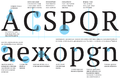 PT Serif features
 -
 PT Serif features
 -
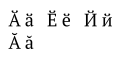 PT Serif cyrillic (top) and latin (bottom) letters difference
 -
 The open-source weights of the PT font series


See also
[edit]- Open-source Unicode typefaces
- Cantarell, the default typeface in past versions of GNOME
- Droid (typeface), the default fonts for first versions of Android
- Noto fonts, the default fonts for newer versions of Android
- Open Sans, another font based on Droid Sans
- Roboto, the default fonts for newer versions of Android
- IBM Plex, free and open-source fonts from IBM
- National Fonts, free and open-source Thai fonts
- STIX Fonts project, typefaces intended to serve the scientific and engineering community
References
[edit]- ^ a b Создан шрифт, поддерживающий все языки народов России (in Russian). Vesti. 2010-01-13. Retrieved 2010-08-04.
- ^ Разработан новый шрифт с поддержкой всех языков Российской Федерации (in Russian). Rossiyskaya Gazeta. 2010-01-14. Retrieved 2010-08-04.
- ^ "New version of PT Sans". 2010-04-02. Archived from the original on 2010-08-19. Retrieved 2010-08-04.
- ^ "PT Sans Pro". MyFonts. Retrieved 21 September 2014.
- ^ "PT Serif Pro". MyFonts. Retrieved 21 September 2014.
- ^ "Ruble symbol". 2013-12-11. Retrieved 2013-12-11.
- ^ "Bug 556308 - Review Request: paratype-pt-sans-fonts - A pan-Cyrillic typeface". Retrieved 2010-08-04.
- ^ "Gentoo Bug 314503 - media-fonts/pt-sans (new package)". Retrieved 2011-01-19.
- ^ "OS X Lion default fonts".
- ^ "ПараТайп Новости - Информация о новых гарнитурах и о различных шрифтовых событиях". www.paratype.ru (in Russian). Archived from the original on 2018-10-04. Retrieved 2020-04-25.
- ^ "PT Astra Sans". www.paratype.ru (in Russian). Retrieved 2020-04-25.
- ^ "PT Astra Serif". www.paratype.ru (in Russian). Retrieved 2020-04-25.
- ^ "Fact Font". www.paratype.com. Retrieved 2025-06-27.
- ^ "Россияне создали замену знаменитому американскому шрифту, который недавно вычистили из ГОСТов". www.cnews.ru (in Russian). 2021-06-07. Retrieved 2021-10-25.
External links
[edit]
- Official website

- The post in the official ParaType blog announcing PT Sans and telling the story of the project (in Russian)
- Alexandra Korolkova interview

| Software and libraries | |
|---|---|
| Licenses | |
| Operating system, corporate and professional |
|
| Government typefaces | |
| Other typefaces | |
| Groups and people | |

| Page | |||||||||||
|---|---|---|---|---|---|---|---|---|---|---|---|
| Paragraph | |||||||||||
| Character |
| ||||||||||
| Typeface classifications |
| ||||||||||
| Punctuation (List) | |||||||||||
| Typesetting | |||||||||||
| Typographic units | |||||||||||
| Digital typography | |||||||||||
| Typography in other writing systems | |||||||||||
| Related articles | |||||||||||
| Related template | |||||||||||

macOS typefaces | |||||||||
|---|---|---|---|---|---|---|---|---|---|
| Latin, Greek, Cyrillic |
| ||||||||
| Non-alphabetic | |||||||||

PT Fonts
View on GrokipediaHistory and Development
Origins and Project Initiation
The PT Fonts project originated within the "Public Types of Russian Federation" initiative, launched to commemorate the 300th anniversary of Peter the Great's reform of the Russian alphabet and the establishment of the civil typeface from 1708 to 1710, which laid the groundwork for modern Russian typography.[2][1] This historical civil script, distinct from ecclesiastical types, emphasized secular printing and readability, influencing subsequent Russian typographic developments.[1] The project's core motivation centered on enhancing national readability standards by creating open, high-quality typefaces optimized for Cyrillic and Latin scripts, addressing deficiencies in prevailing digital fonts such as suboptimal Cyrillic proportions and insufficient support for Russia's linguistic diversity.[2] As articulated in project documentation, the aim was "to make it possible for the people of the Russian Federation to read and write in their native languages," prioritizing empirical usability in printed and digital materials over aesthetic experimentation.[2] Development was undertaken by the ParaType foundry, with Alexandra Korolkova serving as principal designer, Olga Umpeleva contributing to glyph creation, and Vladimir Yefimov providing oversight to ensure alignment with Russian typographic traditions rooted in the civil script's legacy of clarity and functionality.[2] This collaboration sought to bridge historical precedents with demands for versatile, accessible fonts suitable for widespread public use.[2]Design and Release Timeline
PT Sans, the inaugural typeface in the PT Fonts family, was developed by designers Alexandra Korolkova, Olga Umpeleva, and Vladimir Yefimov at ParaType and released in 2009.[1] This humanist sans-serif font incorporated features from mid-20th-century Russian grotesque designs while introducing modern proportions optimized for both digital screens and print applications across Latin and Cyrillic scripts.[1] PT Serif followed as the serif complement in 2010, also by the same design team at ParaType, with deliberate alignment in metrics, x-heights, and proportions to the preceding PT Sans for seamless integration in mixed-style documents. The development emphasized transitional serif characteristics suited to extensive text setting, building on the foundational sans-serif to expand the family's versatility without disrupting baseline consistency or spacing uniformity. PT Mono, the monospace extension, was released in 2011 to address needs in tabular data, forms, and code-like contexts, preserving metric compatibility with its sans-serif and serif counterparts for reliable alignment in complex layouts. This final core addition completed the initial triad, enabling consistent rendering across variants in professional and governmental printing requirements.Funding and Government Involvement
The development of PT Fonts was primarily funded through the "Public Types of the Russian Federation" project, sponsored by Russia's Federal Agency for Press and Mass Communications (known as Rospechat), a state body responsible for media and publishing oversight under the Ministry of Digital Development, Communications and Mass Media.[1] This financial support, provided starting around 2009, enabled the collaboration between type designer Alexandra Korolkova, ParaType, and other contributors to create versatile font families optimized for Cyrillic and Latin scripts, including support for 54 official languages of the Russian Federation's ethnic groups.[8] The backing covered design, testing, and initial distribution costs, with the explicit aim of enhancing readability and typographic standards in public documents, education, and digital media to foster national literacy.[1] Government involvement extended beyond funding to project initiation, positioning PT Fonts as a public good rather than a commercial venture, which facilitated their release under an open-source license for unrestricted use. This approach aligned with pragmatic state interests in standardizing typography for Cyrillic-dominant regions and minority scripts, addressing empirical needs for accessible, high-quality typefaces in multilingual contexts without relying on foreign proprietary designs.[8] The open-source outcome—evident in the fonts' availability on platforms like Google Fonts—demonstrates no imposition of proprietary controls or ideological constraints on the design process, as the focus remained on functional utility for diverse users across educational and administrative applications.[1] Rospechat's role, while tied to broader media policy, did not alter the fonts' neutral, evidence-based glyph development, prioritizing empirical readability over any narrative-driven modifications.Core Font Families
PT Sans
PT Sans is a sans-serif typeface developed by ParaType for the Public Types of the Russian Federation project, initiated to create versatile open-source fonts supporting Cyrillic and Latin scripts. Designed by Alexandra Korolkova, Olga Umpeleva, and Vladimir Yefimov, it draws from Russian sans-serif designs of the mid-20th century while integrating modern humanistic elements such as angled terminals and varied stroke modulation for enhanced legibility. Released in 2010, the font targets body text applications across various sizes, including digital interfaces and print media.[9][1] The primary family comprises regular and bold weights with corresponding italics, providing a foundational set for standard typographic needs. Supplementary styles include caption variants optimized for small-scale text and narrow forms for compact layouts, expanding its utility in economic typesetting scenarios. Its high x-height relative to cap height facilitates quick visual parsing, while low stroke contrast maintains even tonal density, reducing eye strain during prolonged reading.[1][5] PT Sans exhibits open apertures in letters like 'a' and 'e', promoting clarity on low-resolution screens, alongside balanced proportions that support multilingual usage in Russian and related Cyrillic-based languages. These features stem from a design philosophy blending historical Russian type influences with contemporary demands for readability, resulting in a neutral yet characterful face suitable for headlines and extended prose without aggressive geometric rigidity.[8][2]PT Serif
PT Serif is a transitional serif typeface characterized by humanistic terminals, serving as the serif counterpart to PT Sans for complementary use in documents requiring both sans-serif and serif styles. Its design ensures harmony with PT Sans through matched metrics, proportions, weights, and overall aesthetic, facilitating seamless integration in layouts with mixed typeface applications.[10][11] Developed by Alexandra Korolkova, with contributions from Olga Umpeleva and Vladimir Yefimov, PT Serif was released by ParaType in 2010 as part of the Public Type project. The typeface includes regular and bold weights along with corresponding italics, supporting Latin and Cyrillic scripts to accommodate Russian-language texts, including extended Cyrillic glyphs essential for literary and official publications.[10][12] In print applications, PT Serif's subtle serifs enhance character differentiation and legibility, aligning with typographic principles that emphasize serifs' role in guiding the eye along lines of text and distinguishing similar letterforms, particularly beneficial for extended reading in body text. This design approach prioritizes functional readability over stylistic trends, contributing to its utility in professional and governmental printing needs.[13][14]PT Mono
PT Mono is the monospaced typeface in the PT Fonts superfamily, adapted from the proportions and design principles of PT Sans to provide uniform character widths suitable for technical and coding environments.[15] Developed by ParaType designers Alexandra Korolkova and Isabella Chaeva, with financial support from Google Web Fonts, it prioritizes legibility in contexts requiring precise alignment, such as programming code, terminal interfaces, and data tables.[16] The font maintains a humanistic sans-serif structure while enforcing fixed spacing, where each glyph occupies identical horizontal space to facilitate character-based columnar layouts and prevent misalignment errors common in proportional fonts.[17] Initially released around 2012 as part of the PT Project extensions following PT Sans (2009) and PT Serif (2010), PT Mono includes Regular and Bold weights, with a 2013 update adding italic variants and expanded Latin support for additional languages.[18][16] Its glyph set encompasses standard Western Latin, Central European, and Cyrillic characters, plus symbols essential for developers, such as brackets, operators, and punctuation marks optimized for differentiation in dense code blocks.[19] This design emphasizes clarity on low-resolution displays, with stroke weights and x-heights calibrated to reduce visual noise in monospaced rendering, making it effective for screen-based technical documentation and command-line applications.[20] In open-source software ecosystems, PT Mono's uniform metrics support reliable text alignment in tools like IDEs and version control diffs, where proportional variations could disrupt syntax highlighting or tabular data rendering. Its availability under the SIL Open Font License enables integration into free software projects, such as Linux distributions and web development frameworks, without licensing restrictions.[21] For instance, Fedora packages distribute PT Mono for system-wide use in coding environments, leveraging its Cyrillic compatibility for multilingual development teams.[22]Variants and Extensions
PT Astra Fonts
PT Astra Fonts consist of the sans-serif PT Astra Sans and the serif PT Astra Serif, developed by ParaType as metric-compatible derivatives of the core PT Sans and PT Serif families. Released in 2016, these typefaces were adapted to align with the proportions and spacing of widely used proprietary fonts such as Arial and Times New Roman, preventing layout distortions when substituting in document workflows.[23][24] This modification supports seamless integration in cross-platform and open-source environments, particularly for Russian governmental and institutional applications where import substitution of Western software and typefaces has been encouraged.[25] The design emphasizes adaptations for display and signage purposes, including increased stroke weights and optimized contrasts to enhance legibility at larger scales and distances. PT Astra Sans, derived from PT Sans, incorporates bolder forms suitable for wayfinding in public infrastructure such as transportation hubs and architectural signage, while maintaining humanistic proportions for readability. Similarly, PT Astra Serif adjusts PT Serif's terminals and serifs for higher visibility in environmental graphics, without altering the underlying aesthetic harmony of the PT family. These changes reflect targeted refinements for high-impact applications, tested for clarity in real-world viewing conditions like those in urban navigation systems.[25][26] In the context of Russian public sector initiatives, PT Astra Fonts have been promoted for use in official documents and signage to reduce reliance on licensed typefaces, aligning with broader policies favoring domestic open-source alternatives. Each family includes multiple weights—regular and bold for both Sans and Serif—supporting Cyrillic and Latin scripts with over 60 languages covered, ensuring broad applicability in multilingual signage projects.[26][27]Technical Specifications
Character Support and Glyph Design
The PT Fonts family offers extensive character support for Latin, Cyrillic, and basic Greek scripts, encompassing standard Western European, Central European, and pan-Cyrillic code pages, along with glyphs for languages designated as official in the Russian Federation.[1] Each font in the core families—PT Sans, PT Serif, and PT Mono—includes over 700 glyphs, enabling coverage of diverse linguistic needs without reliance on supplementary fonts.[28][29] Glyph design prioritizes empirical legibility through distinct forms that differentiate visually similar characters across scripts, such as the Cyrillic 'Б' (pronounced "be") from the Latin 'B', or 'Г' from 'P', to prevent confusion in bilingual texts common in Russian contexts.[30] This approach draws on established typographic practices for multilingual typesetting, where subtle structural variations— like adjusted stroke terminations or bowl shapes—ensure clarity without altering core humanistic proportions.[31] The fonts eschew decorative flourishes or stylistic excesses, favoring neutral, functional outlines that promote consistent glyph rendering across digital platforms and reduce variability in cross-script compositions.[2] This restraint aligns with the project's aim for versatile, government-backed typefaces suitable for official documents and public interfaces, where verifiability and readability supersede aesthetic embellishment.[8]Metrics, Proportions, and Humanistic Elements
The PT font families are designed with harmonized metrics and proportions across PT Sans, PT Serif, and related variants, enabling seamless interchangeability in typesetting while preserving uniform baseline alignment, cap height, and x-height ratios. PT Serif specifically coordinates with PT Sans in these metrics, proportions, and weights, facilitating consistent rendering in mixed usage scenarios such as bilingual documents supporting Latin and Cyrillic scripts. This alignment stems from ParaType's development approach, which prioritizes interoperability over isolated family optimization.[32][13] In PT Sans, key vertical metrics include an ascender height of 700 units and a descender depth of -200 units within a total height span of 1200 units, yielding a disproportionate emphasis on taller ascenders relative to shorter descenders to enhance perceived vertical rhythm and linearity without excessive line spacing demands. This configuration, observed consistently across weights like Regular and Bold, contrasts with more balanced ratios in some geometric sans-serifs, where ascender and descender extents often approximate equality for modular symmetry; instead, PT Sans favors empirical adjustments informed by rendering tests on diverse devices. Kerning pairs are integrated to refine inter-character spacing, compensating for proportional variances in Cyrillic and Latin glyphs while upholding family-wide consistency in optical alignment.[33][34][35] Humanistic elements manifest in subtle design choices that prioritize organic readability over rigid geometry, such as angled terminals in PT Sans that introduce directional stroke modulation—deviating from the uniform vertical stress of pure grotesque sans-serifs—and triangular, wedge-like serifs in PT Serif with modest contrast for naturalistic flow. These traits, including low-to-medium stroke width variation and open apertures, draw from calligraphic influences to mitigate visual fatigue in extended reading, as evidenced by the fonts' adaptation for small sizes via larger relative x-heights compared to peers like Open Sans. Unlike strictly modular geometric typefaces, which impose uniform circular and rectangular forms potentially at odds with human perceptual hierarchies, PT Fonts' organic proportions support causal efficacy in real-world applications like official documents, where empirical legibility trumps abstract symmetry.[35][36]Open-Source Implementation Details
The source files for PT Fonts, including PT Sans, PT Serif, and PT Mono, are distributed in the Unified Font Object (UFO) format, a cross-platform, extensible structure designed for storing glyph outlines, metrics, kerning data, and OpenType features in human-readable XML and plist files.[37][38] This format enables seamless editing in professional tools such as RoboFont, Glyphs, and FontForge, allowing developers to adjust contours, add glyphs, or refine spacing while preserving compatibility with font compilation pipelines. UFO support extends to version 3 specifications, which accommodate advanced features like variable font axes and custom positioning tables.[39] TrueType hinting instructions are embedded within the UFO sources, providing pixel-level optimizations for stem alignment, overshoot correction, and diagonal distortion mitigation during rasterization at small sizes (e.g., 9-12 pt on 72-96 dpi screens).[40] These hints, developed by ParaType during the original design phase around 2009-2012, ensure superior legibility in digital interfaces compared to unhinted counterparts, particularly for Cyrillic and Latin scripts in the PT families.[3] Developers can retain or modify these instructions using tools like Apple's TrueType hinter or VTT Talk for recompilation. Build processes from UFO sources follow standard open-source workflows, utilizing Python-based libraries such as ufo2ft (from FontTools) to generate OpenType or TrueType binaries, with scripts for feature compilation via makeotf or fontmake. ParaType provides verifiable instructions in associated documentation, such as FONTLOG files, outlining steps to regenerate font variants—e.g., compiling bold or italic styles from master UFOs—while validating output against original metrics like x-height (approximately 520 units in PT Sans Regular).[37] This setup supports scripting for automated builds, fostering forks and extensions without encumbrances beyond Open Font License compliance, as confirmed in release notes from 2009 onward.Licensing and Availability
License Terms and Redistribution
The PT Fonts family, including PT Sans, PT Serif, and PT Mono, is distributed under the SIL Open Font License version 1.1 (OFL-1.1), a permissive license tailored for font software that grants broad freedoms while requiring attribution.[1] This license explicitly allows users to install and use the fonts for any purpose, including personal, commercial, or embedded applications such as documents, websites, and software interfaces, without royalties or additional permissions.[41] Modifications, such as subsetting glyphs or converting formats, are permitted, enabling derivatives for specialized needs like accessibility or performance optimization.[42] Redistribution terms under the OFL-1.1 support bundling original or modified versions with software products, even for sale, as long as the font files are not offered standalone for profit and include the full license text, copyright notices, and any reserved font names (e.g., "PT Sans").[43] This provision facilitates integration into operating systems, applications, and digital products while prohibiting the commodification of the fonts themselves, ensuring they remain accessible tools rather than proprietary assets. Derivatives must rename files if using reserved names to avoid misleading users about origin or endorsement, promoting transparent compliance.[44] The license's irrevocable and perpetual nature guarantees ongoing free access, irrespective of the fonts' origins in a publicly funded project by Russia's Ministry of Industry and Trade in 2009–2010, thereby maximizing societal utility over restrictive proprietary models.[1] No clauses impose anti-competitive restrictions, such as field-of-use limitations or mandatory approvals for modifications, aligning with open-source principles that prioritize verifiable reuse and community contributions.[45] Compliance is enforceable through standard copyright mechanisms, with ParaType retaining rights to enforce terms against violations like unauthorized standalone sales.[46]Distribution Platforms
The PT Fonts family, including PT Sans, PT Serif, and PT Mono, are distributed through multiple open-source repositories and font hosting platforms, ensuring free access without paywalls. Primary download sources include the official ParaType website, where the fonts are hosted directly by their developer, ParaType PT, a Russian type foundry established in the 1980s.[3] These platforms have provided unrestricted global availability since the initial open-source releases in 2009–2010, under the SIL Open Font License, permitting broad redistribution and embedding in software and web applications.[47] Google Fonts serves as a major web-based distribution channel, offering PT Sans and PT Serif for direct embedding via CSS and downloadable desktop files, with support for Latin, Cyrillic, and other scripts as originally designed.[1] Similarly, Adobe Fonts integrates the family, allowing activation for desktop and web use within Adobe applications, while respecting the open-source terms that prohibit commercial resale.[5] These services emphasize stability, with minimal updates post-initial release to maintain compatibility across systems, as evidenced by version 2.003 for PT Sans released around 2010 and subsequent minor revisions focused on glyph refinements rather than overhauls.[48] In Linux ecosystems, PT Fonts are packaged in official repositories, such as Fedora's, where PT Sans and related variants are available via thegoogle-noto-pt-fonts or direct Paratype packages, installable through package managers like DNF for system-wide deployment.[8] This repository integration, dating back to early Fedora releases post-2009, facilitates easy access for developers and users without requiring manual downloads, aligning with the project's emphasis on open-source typography for multilingual interfaces. Other distributions, including those based on RPM packages, mirror these for consistency.[49]
Adoption and Usage
Inclusion in Operating Systems
PT Sans and related PT Fonts have been integrated into select Linux distributions through official package repositories, enabling their use in desktop environments such as GNOME and KDE. In Fedora Linux, the PT Sans font package has been available since February 2010, providing support for both Latin and Cyrillic scripts in system interfaces and applications.[8] Similarly, variants like PT Serif are packaged in distributions including Linux Mint and ALT Linux, facilitating optional installation for users requiring enhanced Cyrillic typography.[50][51] In macOS, PT Sans was added to the default font set starting with OS X Lion (version 10.7) in July 2011, appearing in Font Book alongside other international language fonts for improved multilingual rendering.[52] This inclusion persists in subsequent versions, such as macOS Sequoia, where PT Sans and its weights (e.g., Bold, Italic, Caption) are pre-installed with version 13.0d3e2, supporting consistent display in Cyrillic-heavy contexts without additional setup.[53] Major proprietary operating systems like Windows do not include PT Fonts by default in their standard installations, though they can be added manually via downloads from repositories or font providers.[54] (contextual absence in Windows font lists) In regions with prevalent Cyrillic usage, such as Russia, the availability in Linux and macOS packages contributes to UI consistency by offering fonts optimized for legibility in system menus and text rendering, reducing reliance on less suitable alternatives.[8]Integration in Web and Software Applications
PT Sans and PT Serif are hosted on the Google Fonts platform, enabling straightforward integration into web applications via the Google Fonts API. Developers incorporate them by linking to the API in HTML<head> elements, such as <link href="https://fonts.googleapis.com/css2?family=PT+Sans&display=swap" rel="nofollow" rel="stylesheet">, or using CSS @import statements, which load web-optimized WOFF2 files for efficient rendering across browsers.[1] This method supports variable weights and styles, with file sizes typically under 100 KB per variant, contributing to faster page load times compared to unoptimized custom fonts.[55]
For self-hosting, designers employ CSS @font-face rules to declare PT Fonts from local or CDN sources, specifying formats like WOFF2 for modern compatibility and fallback to TTF for legacy support; this approach allows fine-tuned control over loading behavior, such as using font-display: swap to prioritize text visibility. The fonts' humanistic proportions and Cyrillic glyph coverage enhance readability in web typography, particularly for bilingual sites mixing Latin and Cyrillic scripts.[1]
In non-web software, PT Fonts integrate via standard font installation mechanisms in applications supporting OpenType features, such as desktop publishing tools and PDF generators, where their extended character sets—including those for Russian Federation minority languages—support precise multilingual document rendering without substitution errors.[2] Their open-source licensing under the SIL Open Font License permits embedding in proprietary software, fostering adoption in content management systems and e-publishing platforms focused on Eastern European markets.[1]