Hubbry Logo
ParkinsoniaParkinsoniaMain
Open search
Parkinsonia
Community hub
Parkinsonia
logo
8 pages, 0 posts
0 subscribers
Be the first to start a discussion here.
Parkinsonia
Parkinsonia
from Wikipedia

Parkinsonia
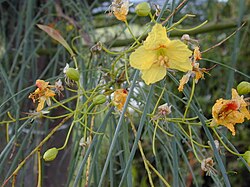
Flowers and leaves of Parkinsonia aculeata
Scientific classification Edit this classification
Kingdom: Plantae
Clade: Tracheophytes
Clade: Angiosperms
Clade: Eudicots
Clade: Rosids
Order: Fabales
Family: Fabaceae
Subfamily: Caesalpinioideae
Genus: Parkinsonia
L.
Type species
Parkinsonia aculeata
L.[1]
Species

See text

Synonyms

Cercidiopsis Britton & Rose
Cercidium Tul.
Peltophoropsis Chiov.
Rhetinophloeum H.Karst.[2]

Parkinsonia /ˌpɑːrkɪnˈsniə/, also Cercidium /sərˈsɪdiəm/,[3] is a genus of flowering plants in the pea family, Fabaceae. It contains about 12 species that are native to semi-desert regions of Africa and the Americas. The name of the genus honors English apothecary and botanist John Parkinson (1567–1650).[4]

They are large shrubs or small trees growing to 5–12 m (16–39 ft) tall, dry season deciduous, with sparse, open, thorny crowns and green bark. The leaves are pinnate, usually bipinnate, with numerous small leaflets; they are only borne for a relatively short time after rains, with much of the photosynthesis carried out by the green twigs and branches. The flowers are symmetrical or nearly so, with five yellow or white petals. The fruit is a pod containing several seeds.

Most American species are known by the common name of palo verde or paloverde, derived from the Spanish words meaning "green tree". This name is given due to its characteristic green trunk. The palo verde (not species-specific) is the state tree of Arizona.[5]

Ecology

[edit]

A major pollinator for Parkinsonia species in the southwestern United States and western Mexico is Centris pallida, a solitary bee known as the digger or pallid bee. C. pallida obtains nectar and pollen from this plant to fill a brood pot so that their larvae will have food when they hatch. The nectar and pollen give its bee bread a strong orange color.[6]

Selected species

[edit]

References

[edit]
[edit]
Revisions and contributorsEdit on WikipediaRead on Wikipedia
from Grokipedia
Parkinsonia is a genus of approximately 12 species of thorny trees and shrubs in the legume family, Fabaceae, characterized by their green, photosynthetic bark and adaptation to arid and semi-arid environments across the Americas and parts of Africa. The plants typically feature zigzag stems, bipinnate leaves that are often reduced or deciduous, and bright yellow flowers borne in axillary racemes, followed by flat, oblong seed pods containing one to several seeds. These are well-suited to dry habitats such as washes, grasslands, and semi-desert scrub, where the bark allows continued during leaf drop in prolonged droughts, supporting their survival and growth up to 11 meters in height. Ecologically, Parkinsonia provide essential shade, , and in arid ecosystems, attracting pollinators like bees with their spring-to-summer blooms and serving as browse for including , , and birds. Some, like , have become naturalized or invasive outside their native range, such as in and , due to prolific seed production and tolerance to disturbance. Notable species include Parkinsonia florida (blue palo verde), endemic to the and valued for its bluish-green bark and vibrant yellow flowers; Parkinsonia microphylla (foothill palo verde), with smaller leaflets and a more compact form; and Parkinsonia aculeata (Jerusalem thorn or Mexican palo verde), a widespread known for its long, weeping branches and potential as a . In human use, Parkinsonia trees are popular in for their drought tolerance and ornamental qualities, while historically, Native American communities harvested seeds for and used the plants for medicinal purposes or as . The genus, named after the 17th-century English botanist John Parkinson, was previously classified under Cercidium, but taxonomic revisions have unified it under Parkinsonia.

Description

Morphology

Parkinsonia species are typically large shrubs or small trees that grow to 4–10 m in height, characterized by thorny branches forming open, spreading crowns adapted to arid and semi-arid environments. These exhibit a multi-stemmed from the base, with zigzag stems that enhance light interception in sparse . The bark is smooth and green on younger trunks and branches, turning gray and fissured with age, which supports limited during periods of leaf loss. Leaves are alternate or clustered, even-2-pinnate (bipinnate) or appearing 1-pinnate due to reduction, with a flat main axis and 1–6 primary leaflets bearing 4 to many secondary leaflets that are small, oblong to obovate, and 1–8 mm long. These leaflets are drought-deciduous, often shed early in dry conditions, leaving persistent, spinescent petioles up to 10–40 cm long that function similarly to phyllodes in maintaining photosynthetic capacity. This adaptation minimizes water loss while preserving foliage-like structures for carbon fixation. Flowers are zygomorphic and hermaphroditic, borne in axillary racemes that vary in length and number of flowers by (typically 2–10 in species like P. florida and P. microphylla, but up to 20 or more in P. aculeata). Each flower features five free, reflexed sepals, five nearly equal or cream-white petals (one often enlarged as the standard), ten free and exserted yellow to orange stamens, and a single carpel. Petals measure 5–18 mm long, contributing to the plant's conspicuous spring display in response to rainfall. The fruit is an indehiscent or tardily dehiscent pod, linear to oblong and flat to slightly inflated, 2–20 cm long and 0.5–2.5 cm wide, often narrowed or constricted between . Each pod contains 1–10 , which are elliptic to oblong, compressed, 4–12 mm long, and enclosed in a hard, smooth, osseous testa that is brown to with a tan overlay for in harsh conditions. Thorns are prominent defensive structures, appearing as paired stipular spines at nodes or in leaf axils, with the main leaf axis often forming a strong spine; these measure 0.2–3 cm long and deter herbivory in open habitats.

Photosynthetic adaptations

Parkinsonia species have evolved specialized photosynthetic strategies that prioritize in arid environments, primarily by conducting carbon fixation through non-foliar tissues. The green cortex of branches and stems serves as the main site for , allowing the reduction of surface area to limit while sustaining energy production. This is particularly evident in species like Parkinsonia florida and P. microphylla, where the thin, chlorenchymatous bark enables year-round photosynthetic activity, even during leafless periods that can last up to six months. Chlorophyll is abundant in the bark and twigs, supporting a C3 photosynthetic pathway that operates efficiently under high light intensities and elevated temperatures typical of habitats. In P. florida, measurements indicate robust efficiency (Φ_PSII ≈ 0.142) in stems across wet and dry seasons, maintaining net photosynthetic rates comparable to those of leaves when adjusted for tissue economics. Stems feature functional stomata on their , which regulate and exhibit maximum conductance (g_s-max) positively correlated with stem , enhancing water-use efficiency during . Leaflet is a key response, where small bipinnate leaflets drop rapidly under stress, prompting a shift to twig-based for continued CO₂ assimilation. The persistent rachis and green twigs then become primary photosynthetic organs, with seasonal rates reaching approximately 10.5 µmol CO₂ m⁻² s⁻¹ in summer for P. microphylla. This mechanism not only conserves but also leverages the stems' hydraulic support to sustain carbon gain. Water storage in the swollen bases of branches and stems further bolsters these adaptations by maintaining tissue hydration, which supports stomatal opening and photosynthetic function amid prolonged dry spells. In P. microphylla, stems hold reserves that contribute to high xylem water potentials during , facilitating embolism repair and overall hydraulic integrity. Comparative studies show that in P. microphylla, stems account for about 72% of total , with leaves contributing only 24% and reproductive structures 4%, highlighting the dominance of cortical tissues in carbon economy. This stem-centric approach enhances drought survival, as demonstrated by near-total mortality in light-excluded P. florida plants under water stress.

Taxonomy

Etymology and history

The genus Parkinsonia was established by in his in 1753, named in honor of John Parkinson (1567–1650), an influential English herbalist, , and of botanical texts such as Paradisi in Sole Paradisus Terrestris (1629) and Theatrum Botanicum (1640). Linnaeus's initial description was monotypic, based solely on P. aculeata L., a spiny shrub or small tree collected from tropical America, which was designated as the of the genus. During the 19th century, the genus underwent significant expansion through taxonomic revisions, particularly by , who incorporated additional species into Parkinsonia in his comprehensive treatment of the Leguminosae in Genera Plantarum (1862–1883), emphasizing floral and pod morphology to delineate boundaries. In parallel, American botanists like Sereno Watson established the segregate genus Cercidium S. Watson in 1871 to accommodate certain arid-adapted species from the and , previously included under Parkinsonia, based on differences in leaf structure and habit; this separation persisted in many treatments for nearly a century. Twentieth-century studies further refined the , with key revisions confirming the genus's remarkable African-American disjunction—spanning semi-arid regions of both continents—through morphological and early biogeographic analyses, such as those by J.P.M. Brenan (1963). By the , morphological works like those of A.M. Carter () examined Cercidium species in detail, while shared traits like photosynthetic bark and reduced leaflets supported discussions of merger. A broad circumscription of Parkinsonia to include former Cercidium species gained consensus through phylogenetic studies, particularly Haston et al. (2005), despite occasional retention of Cercidium as a .

Classification and phylogeny

Parkinsonia belongs to the family , subfamily , and tribe Caesalpinieae, a placement supported by both morphological traits such as compound leaves and legume fruits, and molecular phylogenies that position it within the diverse clade. Within this subfamily and tribe, Parkinsonia exhibits relationships to other caesalpinioid genera, evidenced by shared features in floral structure and gene sequences. Molecular phylogenetic studies have confirmed the of Parkinsonia sensu lato, incorporating species formerly classified under Cercidium, based on analyses of markers including rbcL, trnL-F, and rps16 introns, which reveal strong support (posterior probabilities >95%) for a unified distinct from other Caesalpinieae genera. Although nuclear ribosomal ITS sequences have been used in broader Leguminosae phylogenies, the primary evidence for Parkinsonia's internal structure derives from these data, underscoring its cohesion without evidence of . The genus lacks formal subgeneric divisions, but informal groupings among species are recognized based on morphological variations such as persistence ( versus semi-evergreen) and pod morphology (e.g., compressed versus terete), which correlate with adaptations to arid environments. The evolutionary origin of Parkinsonia is traced to diversification during the in arid and semi-arid habitats of the , with molecular dating estimating key divergences around 5.2 million years ago for widespread species like P. aculeata, reflecting adaptation to expanding dry ecosystems. Subsequent natural intercontinental dispersal, likely via long-distance across the Atlantic, enabled colonization of prior to human-mediated introductions, resulting in the current distribution while maintaining American centers of diversity.

Distribution and habitat

Native range

Parkinsonia species are native to semi-arid and desert regions spanning the Americas from the southwestern United States to Argentina, and Africa from the Horn of Africa (Djibouti to Kenya) through southern Africa (Angola to South Africa). This distribution reflects adaptation to dry tropical and subtropical environments, with the genus exhibiting a marked disjunction between the two continents. The Americas represent the primary center of diversity for Parkinsonia, particularly in the Sonoran and Chihuahuan Deserts, where approximately seven to eight species occur, including endemics such as P. florida restricted to the Sonoran Desert region of the southwestern United States (Arizona, California, and Nevada) and northwestern Mexico. In contrast, African species—numbering about four—are fewer and more scattered across arid zones. These typically occupy washes, alluvial plains, and thorn scrub habitats, thriving at elevations from to 2,000 m. The genus's intercontinental disjunction is explained by ancient long-distance dispersal or vicariance events, as evidenced by phylogenetic studies indicating pre-human transoceanic movements within related lineages.

Introduced areas and cultivation

Parkinsonia aculeata, the most widely introduced species in the genus, has been deliberately established in regions beyond its native southwestern North American range, including , parts of such as and , tropical , and Pacific islands like , primarily for its utility as , shade provision, and in arid and semi-arid environments. In , where it was first planted in the late as an ornamental and , P. aculeata has become a of National Significance due to its aggressive invasion of riparian zones and rangelands, forming dense, thorny thickets that impede access and alter water flow. Similarly, in parts of tropical , including and countries like , , and , it is recognized as invasive, spreading rapidly in dry zones and competing with native vegetation after initial plantings for hedging and . Cultivation of P. aculeata favors well-drained, sandy or loamy soils in hot, dry climates, with the plant exhibiting high through adaptations like photosynthetic bark and deep taproots; it is typically propagated from scarified to enhance , and is employed in landscapes and as windbreaks in arid regions. Economically, P. aculeata contributes to soil improvement via as a member of the family, enhancing fertility in degraded , while its leaves and pods serve as nutritious for during seasonal droughts, though thorny branches limit direct grazing. Management of invasive P. aculeata populations emphasizes integrated approaches, including biological control in where seed-feeding insects such as the bruchid beetles Mimosestes ulkei and Penthobruchus germaini, along with the mirid bug Rhinacloa callicrates, have been released since the 1980s to reduce seed viability and slow spread, though efficacy varies by site.

Ecology

Pollination and reproduction

Parkinsonia species typically flower in spring within desert environments, from March to May, with blooms often triggered by rainfall events that follow winter dormancy. Pollination in Parkinsonia is predominantly entomophilous, mediated by bees, including large solitary species such as Centris pallida in the Americas, which provision larvae with pollen from these trees. Smaller bees also visit hermaphroditic flowers in some species such as P. microphylla, which are protandrous and self-incompatible to promote outcrossing and reduce geitonogamy for viable seed set. Reproduction is primarily sexual via , with production peaking in wet years when rainfall enhances flowering synchrony and set, yielding prolific pods containing multiple . Pods dehisce explosively upon drying, propelling short distances via ballistic dispersal, while flotation aids hydrochory during floods, distributing propagules along watercourses. form persistent soil banks with viability extending up to several years, though exact longevity varies by and conditions, supporting pulses after disturbance. is uncommon across the but occurs via suckering in P. aculeata, allowing clonal spread from damaged parent plants in riparian zones. Germination requires scarification to breach the impermeable seed coat, a process naturally achieved through abrasion during ephemeral floods or mechanical damage, which promotes imbibition and establishment on barren substrates. Without scarification, dormancy persists, but scarified seeds exhibit high germination rates (up to 90%) under warm, moist conditions following rain. This adaptation aligns seedling emergence with transient water availability, enhancing survival in arid habitats.

Biotic interactions

Parkinsonia species, as members of the family, form symbiotic associations with bacteria in root nodules, enabling biological that contributes to enhancement in arid and semi-arid ecosystems. Herbivory on Parkinsonia is common among mammals, with species such as (Odocoileus hemionus) and (Ovis canadensis) browsing twigs, leaves, and foliage, while livestock like goats consume pods despite the plant's thorny defenses that deter heavier grazing. Within food webs, Parkinsonia serves as a nectar source for bees, supporting pollinator communities with fragrant flowers that yield honey. Seeds and pods are consumed by birds and rodents, integrating the genus into granivory networks. Conservation threats to Parkinsonia include overgrazing by domestic and wild herbivores, which reduces seedling survival and exacerbates habitat loss in arid regions. Some species may face potential vulnerability from aridification driven by climate change. Parkinsonia provides key services in environments, offering shade that protects plants like (Carnegiea gigantea) seedlings from intense solar radiation and creating microhabitats for wildlife. As a facultative riparian species, it serves as an indicator of health, with its presence signaling stable washes and arroyos in systems.

Species

Diversity

The genus Parkinsonia comprises approximately 12 accepted worldwide, a number reduced from earlier estimates of around 29 through recent taxonomic revisions that incorporated phylogenetic and morphological analyses. is highest in the , with eight species primarily in arid and semi-arid regions from the to northern , while hosts three to four species in similar dry tropical environments; no species are native to . Morphological variation among Parkinsonia species includes differences in leaf persistence, with some (e.g., P. aculeata) and others semi-evergreen, as well as variation in pod shape from straight to curved and thorn length ranging from short stipular spines to longer axillary ones up to 1 cm. Hybridization is rare but documented, such as between P. florida and P. microphylla in the , where intermediates show blended leaflet sizes and flower traits.

Selected species

Parkinsonia aculeata, commonly known as Jerusalem thorn or Mexican paloverde, is a spiny or small native to the , , and Central and , where it thrives in dry, disturbed habitats such as riverbanks and roadsides. It has been widely introduced to tropical and subtropical regions globally, including , , and , often becoming highly invasive due to its rapid growth, prolific seed production, and tolerance to and poor soils. Ornamentally valued for its bright yellow flowers and feathery foliage, it is planted in landscapes for shade and , though its invasiveness has led to management challenges in many areas. Economically, P. aculeata is utilized for live fences in arid regions, leveraging its stout thorns to create impenetrable barriers for protection and field demarcation. Parkinsonia florida, or blue palo verde, is the state of and is endemic to the , ranging from central and southwestern through southeastern to northern , . Distinguished by its smooth, blue-green bark that performs during periods of leaf drop, it grows as a up to 12 meters tall in washes and bajadas, adapting to arid conditions with deep roots accessing . Its significance extends to desert restoration efforts, where it is planted to stabilize eroded soils and enhance biodiversity in degraded landscapes, contributing to and habitat recovery. Parkinsonia microphylla, known as foothill palo verde or littleleaf palo verde, is a smaller-statured tree, typically reaching 6-9 meters, native to the in the U.S. Southwest, particularly in , , and . It features bright yellow flowers in spring and tiny, needle-like leaflets that drop during , relying on its yellowish-green bark for , and is commonly found in foothill washes and rocky slopes where it tolerates seasonal flooding and aridity. Parkinsonia africana, the African horse-bean tree, is a thorny shrub or small tree native to arid and semi-arid regions of , including , , , and , where it grows on deep sands and rocky outcrops with annual rainfall under 300 mm. Adapted to harsh desert margins with its zigzag branches, paired spines, and drought-deciduous leaves, it forms scattered stands in woodlands and is valued locally for , fuelwood, and improvement in low-rainfall ecosystems.

References

Add your contribution
Related Hubs
User Avatar
No comments yet.