


Community hub
Paraconsistent logic
View on Wikipedia | This article needs additional citations for verification. (April 2018) |
Paraconsistent logic is a type of non-classical logic that allows for the coexistence of contradictory statements without leading to a logical explosion where anything can be proven true. Specifically, paraconsistent logic is the subfield of logic that is concerned with studying and developing "inconsistency-tolerant" systems of logic, purposefully excluding the principle of explosion.
Inconsistency-tolerant logics have been discussed since at least 1910 (and arguably much earlier, for example in the writings of Aristotle);[1] however, the term paraconsistent ("beside the consistent") was first coined in 1976, by the Peruvian philosopher Francisco Miró Quesada Cantuarias[2], under request of Newton da Costa, who is often credited as the creator of the field.[3][4] The study of paraconsistent logic has been dubbed paraconsistency,[5] which encompasses the school of dialetheism.
Definition
[edit]In classical logic (as well as intuitionistic logic and most other logics), contradictions entail everything. This feature, known as the principle of explosion or ex contradictione sequitur quodlibet (Latin, "from a contradiction, anything follows")[6] can be expressed formally as
| 1 | Premise | ||
| 2 | Conjunction elimination | from 1 | |
| 3 | Disjunction introduction | from 2 | |
| 4 | Conjunction elimination | from 1 | |
| 5 | Disjunctive syllogism | from 3 and 4 | |


Which means: if P and its negation ¬P are both assumed to be true, then of the two claims P and (some arbitrary) A, at least one is true. Therefore, P or A is true. However, if we know that either P or A is true, and also that P is false (that ¬P is true) we can conclude that A, which could be anything, is true. Thus if a theory contains a single inconsistency, the theory is trivial – that is, it has every sentence as a theorem.
The characteristic or defining feature of a paraconsistent logic is that it rejects the principle of explosion. As a result, paraconsistent logics, unlike classical and other logics, can be used to formalize inconsistent but non-trivial theories.
Comparison with classical logic
[edit]The entailment relations of paraconsistent logics are propositionally weaker than classical logic; that is, they deem fewer propositional inferences valid. The point is that a paraconsistent logic can never be a propositional extension of classical logic, that is, propositionally validate every entailment that classical logic does. In some sense, then, paraconsistent logic is more conservative or cautious than classical logic. It is due to such conservativeness that paraconsistent languages can be more expressive than their classical counterparts including the hierarchy of metalanguages due to Alfred Tarski and others. According to Solomon Feferman: "natural language abounds with directly or indirectly self-referential yet apparently harmless expressions—all of which are excluded from the Tarskian framework."[7] This expressive limitation can be overcome in paraconsistent logic.
Motivation
[edit]A primary motivation for paraconsistent logic is the conviction that it ought to be possible to reason with inconsistent information in a controlled and discriminating way. The principle of explosion precludes this, and so must be abandoned. In non-paraconsistent logics, there is only one inconsistent theory: the trivial theory that has every sentence as a theorem. Paraconsistent logic makes it possible to distinguish between inconsistent theories and to reason with them.
Research into paraconsistent logic has also led to the establishment of the philosophical school of dialetheism (most notably advocated by Graham Priest), which asserts that true contradictions exist in reality, for example groups of people holding opposing views on various moral issues.[8] Being a dialetheist rationally commits one to some form of paraconsistent logic, on pain of otherwise embracing trivialism, i.e. accepting that all contradictions (and equivalently all statements) are true.[9] However, the study of paraconsistent logics does not necessarily entail a dialetheist viewpoint. For example, one need not commit to either the existence of true theories or true contradictions, but would rather prefer a weaker standard like empirical adequacy, as proposed by Bas van Fraassen.[10]
Philosophy
[edit]In classical logic, Aristotle's three laws, namely, the excluded middle (p or ¬p), non-contradiction ¬ (p ∧ ¬p) and identity (p iff p), are regarded as the same, due to the inter-definition of the connectives. Moreover, traditionally contradictoriness (the presence of contradictions in a theory or in a body of knowledge) and triviality (the fact that such a theory entails all possible consequences) are assumed inseparable, granted that negation is available. These views may be philosophically challenged, precisely on the grounds that they fail to distinguish between contradictoriness and other forms of inconsistency.
On the other hand, it is possible to derive triviality from the 'conflict' between consistency and contradictions, once these notions have been properly distinguished. The very notions of consistency and inconsistency may be furthermore internalized at the object language level.
Tradeoffs
[edit]Paraconsistency involves tradeoffs. In particular, abandoning the principle of explosion requires one to abandon at least one of the following two principles:[11]
| Disjunction introduction | |
|---|---|
| Disjunctive syllogism |


Both of these principles have been challenged.
One approach is to reject disjunction introduction but keep disjunctive syllogism and transitivity. In this approach, rules of natural deduction hold, except for disjunction introduction and excluded middle; moreover, inference A⊢B does not necessarily mean entailment A⇒B. Also, the following usual Boolean properties hold: double negation as well as associativity, commutativity, distributivity, De Morgan, and idempotence inferences (for conjunction and disjunction). Furthermore, inconsistency-robust proof of negation holds for entailment: (A⇒(B∧¬B))⊢¬A.
Another approach is to reject disjunctive syllogism. From the perspective of dialetheism, it makes perfect sense that disjunctive syllogism should fail. The idea behind this syllogism is that, if ¬ A, then A is excluded and B can be inferred from A ∨ B. However, if A may hold as well as ¬A, then the argument for the inference is weakened.
Yet another approach is to do both simultaneously. In many systems of relevant logic, as well as linear logic, there are two separate disjunctive connectives. One allows disjunction introduction, and one allows disjunctive syllogism. Of course, this has the disadvantages entailed by separate disjunctive connectives including confusion between them and complexity in relating them.
Furthermore, the rule of proof of negation (below) just by itself is inconsistency non-robust in the sense that the negation of every proposition can be proved from a contradiction.
| Proof of Negation | If , then |
|---|


Strictly speaking, having just the rule above is paraconsistent because it is not the case that every proposition can be proved from a contradiction. However, if the rule double negation elimination () is added as well, then every proposition can be proved from a contradiction. Double negation elimination does not hold for intuitionistic logic.

Logic of Paradox
[edit]One example of paraconsistent logic is the system known as LP ("Logic of Paradox"), first proposed by the Argentinian logician Florencio González Asenjo in 1966 and later popularized by Priest and others.[12]
One way of presenting the semantics for LP is to replace the usual functional valuation with a relational one.[13] The binary relation relates a formula to a truth value: means that is true, and means that is false. A formula must be assigned at least one truth value, but there is no requirement that it be assigned at most one truth value. The semantic clauses for negation and disjunction are given as follows:






(The other logical connectives are defined in terms of negation and disjunction as usual.) Or to put the same point less symbolically:
- not A is true if and only if A is false
- not A is false if and only if A is true
- A or B is true if and only if A is true or B is true
- A or B is false if and only if A is false and B is false
(Semantic) logical consequence is then defined as truth-preservation:
- if and only if is true whenever every element of is true.


Now consider a valuation such that and but it is not the case that . It is easy to check that this valuation constitutes a counterexample to both explosion and disjunctive syllogism. However, it is also a counterexample to modus ponens for the material conditional of LP. For this reason, proponents of LP usually advocate expanding the system to include a stronger conditional connective that is not definable in terms of negation and disjunction.[14]

As one can verify, LP preserves most other inference patterns that one would expect to be valid, such as De Morgan's laws and the usual introduction and elimination rules for negation, conjunction, and disjunction. Surprisingly, the logical truths (or tautologies) of LP are precisely those of classical propositional logic.[15] (LP and classical logic differ only in the inferences they deem valid.) Relaxing the requirement that every formula be either true or false yields the weaker paraconsistent logic commonly known as first-degree entailment (FDE). Unlike LP, FDE contains no logical truths.
LP is only one of many paraconsistent logics that have been proposed.[16] It is presented here merely as an illustration of how a paraconsistent logic can work.
Relation to other logics
[edit]One important type of paraconsistent logic is relevance logic. A logic is relevant if it satisfies the following condition:
- if A → B is a theorem, then A and B share a non-logical constant.
It follows that a relevance logic cannot have (p ∧ ¬p) → q as a theorem, and thus (on reasonable assumptions) cannot validate the inference from {p, ¬p} to q.
Paraconsistent logic has significant overlap with many-valued logic; however, not all paraconsistent logics are many-valued (and, of course, not all many-valued logics are paraconsistent). Dialetheic logics, which are also many-valued, are paraconsistent, but the converse does not hold. The ideal 3-valued paraconsistent logic given below becomes the logic RM3 when the contrapositive is added.
Intuitionistic logic allows A ∨ ¬A not to be equivalent to true, while paraconsistent logic allows A ∧ ¬A not to be equivalent to false. Thus it seems natural to regard paraconsistent logic as the "dual" of intuitionistic logic. However, intuitionistic logic is a specific logical system whereas paraconsistent logic encompasses a large class of systems. Accordingly, the dual notion to paraconsistency is called paracompleteness, and the "dual" of intuitionistic logic (a specific paracomplete logic) is a specific paraconsistent system called anti-intuitionistic or dual-intuitionistic logic (sometimes referred to as Brazilian logic, for historical reasons).[17] The duality between the two systems is best seen within a sequent calculus framework. While in intuitionistic logic the sequent

is not derivable, in dual-intuitionistic logic

is not derivable[citation needed]. Similarly, in intuitionistic logic the sequent
is not derivable, while in dual-intuitionistic logic

is not derivable. Dual-intuitionistic logic contains a connective # known as pseudo-difference which is the dual of intuitionistic implication. Very loosely, A # B can be read as "A but not B". However, # is not truth-functional as one might expect a 'but not' operator to be; similarly, the intuitionistic implication operator cannot be treated like "¬ (A ∧ ¬B)". Dual-intuitionistic logic also features a basic connective ⊤ which is the dual of intuitionistic ⊥: negation may be defined as ¬A = (⊤ # A)
A full account of the duality between paraconsistent and intuitionistic logic, including an explanation on why dual-intuitionistic and paraconsistent logics do not coincide, can be found in Brunner and Carnielli (2005).
These other logics avoid explosion: implicational propositional calculus, positive propositional calculus, equivalential calculus and minimal logic. The latter, minimal logic, is both paraconsistent and paracomplete (a subsystem of intuitionistic logic). The other three simply do not allow one to express a contradiction to begin with since they lack the ability to form negations.
An ideal three-valued paraconsistent logic
[edit]Here is an example of a three-valued logic which is paraconsistent and ideal as defined in "Ideal Paraconsistent Logics" by O. Arieli, A. Avron, and A. Zamansky, especially pages 22–23.[18] The three truth-values are: t (true only), b (both true and false), and f (false only).
|
|
|
| |||||||||||||||||||||||||||||||||||||||||||||||||||||||||||||||||||||||
A formula is true if its truth-value is either t or b for the valuation being used. A formula is a tautology of paraconsistent logic if it is true in every valuation which maps atomic propositions to {t, b, f}. Every tautology of paraconsistent logic is also a tautology of classical logic. For a valuation, the set of true formulas is closed under modus ponens and the deduction theorem. Any tautology of classical logic which contains no negations is also a tautology of paraconsistent logic (by merging b into t). This logic is sometimes referred to as "Pac" or "LFI1".
Included
[edit]Some tautologies of paraconsistent logic are:
- All axiom schemas for paraconsistent logic:
- ** for deduction theorem and ?→{t,b} = {t,b}
- ** for deduction theorem (note: {t,b}→{f} = {f} follows from the deduction theorem)
- ** {f}→? = {t}
- ** ?→{t} = {t}
- ** {t,b}→{b,f} = {b,f}
- ** ~{f} = {t}
- ** ~{t,b} = {b,f} (note: ~{t} = {f} and ~{b,f} = {t,b} follow from the way the truth-values are encoded)
- ** {t,b}v? = {t,b}
- ** ?v{t,b} = {t,b}
- ** {t}v? = {t}
- ** ?v{t} = {t}
- ** {f}v{f} = {f}
- ** {b,f}v{b,f} = {b,f}
- ** {f}&? = {f}
- ** ?&{f} = {f}
- ** {b,f}&? = {b.f}
- ** ?&{b,f} = {b,f}
- ** {t}&{t} = {t}
- ** {t,b}&{t,b} = {t,b}
- ** ? is the union of {t,b} with {b,f}
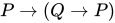






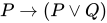
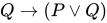




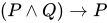
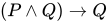





- Some other theorem schemas:
- ** every truth-value is either t, b, or f.








Excluded
[edit]Some tautologies of classical logic which are not tautologies of paraconsistent logic are:
- ** no explosion in paraconsistent logic
- ** disjunctive syllogism fails in paraconsistent logic
- ** contrapositive fails in paraconsistent logic
- ** not all contradictions are equivalent in paraconsistent logic
- ** counter-factual for {b,f}→? = {t,b} (inconsistent with b→f = f)











Strategy
[edit]Suppose we are faced with a contradictory set of premises Γ and wish to avoid being reduced to triviality. In classical logic, the only method one can use is to reject one or more of the premises in Γ. In paraconsistent logic, we may try to compartmentalize the contradiction. That is, weaken the logic so that Γ→X is no longer a tautology provided the propositional variable X does not appear in Γ. However, we do not want to weaken the logic any more than is necessary for that purpose. So we wish to retain modus ponens and the deduction theorem as well as the axioms which are the introduction and elimination rules for the logical connectives (where possible).
To this end, we add a third truth-value b which will be employed within the compartment containing the contradiction. We make b a fixed point of all the logical connectives.

We must make b a kind of truth (in addition to t) because otherwise there would be no tautologies at all.
To ensure that modus ponens works, we must have
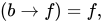
that is, to ensure that a true hypothesis and a true implication lead to a true conclusion, we must have that a not-true (f) conclusion and a true (t or b) hypothesis yield a not-true implication.
If all the propositional variables in Γ are assigned the value b, then Γ itself will have the value b. If we give X the value f, then
- .

So Γ→X will not be a tautology.
Limitations: (1) There must not be constants for the truth values because that would defeat the purpose of paraconsistent logic. Having b would change the language from that of classical logic. Having t or f would allow the explosion again because
- or


would be tautologies. Note that b is not a fixed point of those constants since b ≠ t and b ≠ f.
(2) This logic's ability to contain contradictions applies only to contradictions among particularized premises, not to contradictions among axiom schemas.
(3) The loss of disjunctive syllogism may result in insufficient commitment to developing the 'correct' alternative, possibly crippling mathematics.
(4) To establish that a formula Γ is equivalent to Δ in the sense that either can be substituted for the other wherever they appear as a subformula, one must show
- .

This is more difficult than in classical logic because the contrapositives do not necessarily follow.
Applications
[edit]Paraconsistent logic has been applied as a means of managing inconsistency in numerous domains, including:[19]
- Semantics: Paraconsistent logic has been proposed as means of providing a simple and intuitive formal account of truth that does not fall prey to paradoxes such as the Liar. However, such systems must also avoid Curry's paradox, which is much more difficult as it does not essentially involve negation.
- Set theory and the foundations of mathematics
- Epistemology and belief revision: Paraconsistent logic has been proposed as a means of reasoning with and revising inconsistent theories and belief systems.
- Knowledge management and artificial intelligence: Some computer scientists have utilized paraconsistent logic as a means of coping gracefully with inconsistent[20] or contradictory[21] information. Mathematical framework and rules of paraconsistent logic have been proposed as the activation function of an artificial neuron in order to build a neural network for function approximation, model identification, and control with success.[22]
- Deontic logic and metaethics: Paraconsistent logic has been proposed as a means of dealing with ethical and other normative conflicts.
- Software engineering: Paraconsistent logic has been proposed as a means for dealing with the pervasive inconsistencies among the documentation, use cases, and code of large software systems.[23][24][25]
- Expert system. The Para-analyzer algorithm based on paraconsistent annotated logic by 2-value annotations (PAL2v), also called paraconsistent annotated evidential logic (PAL Et), derived from paraconsistent logic, has been used in decision-making systems, such as to support medical diagnosis.[26]
- Electronics design routinely uses a four-valued logic, with "hi-impedance (z)" and "don't care (x)" playing similar roles to "don't know" and "both true and false" respectively, in addition to true and false. This logic was developed independently of philosophical logics.
- Control system: A model reference control built with recurrent paraconsistent neural network for a rotary inverted pendulum presented better robustness and lower control effort compared to a classical well tuned pole placement controller.[27]
- Digital filter: PAL2v Filter Algorithm, using a paraconsistent artificial neural cell of learning by contradiction extraction (PANLctx) in the composition of a paraconsistent analysis network (PANnet), based on the PAL2V rules and equations, can be used as an estimator, average extractor, filtering and in signal treatment for industrial automation and robotics.[28][29][30]
- Contradiction Extractor. A recurrent algorithm based on the PAL2v rules and equations has been used to extract contradictions in a set of statistical data.[31]
- Quantum physics
- Black hole physics
- Hawking radiation
- Quantum computing
- Spintronics
- Quantum entanglement
- Quantum coupling
- Uncertainty principle
Criticism
[edit]Logic, as it is classically understood, rests on three main rules (Laws of Thought): The Law of Identity (LOI), the Law of Non-Contradiction (LNC), and the Law of the Excluded Middle (LEM). Paraconsistent logic deviates from classical logic by refusing to accept LNC. However, the LNC can be seen as closely interconnected with the LOI as well as the LEM:
LoI states that A is A (A≡A). This means that A is distinct from its opposite or negation (not A, or ¬A). In classical logic this distinction is supported by the fact that when A is true, its opposite is not. However, without the LNC, both A and not A can be true (A∧¬A), which blurs their distinction. And without distinction, it becomes challenging to define identity. Dropping the LNC thus runs risk to also eliminate the LoI.
LEM states that either A or not A are true (A∨¬A). However, without the LNC, both A and not A can be true (A∧¬A). Dropping the LNC thus runs risk to also eliminate the LEM
Hence, dropping the LNC in a careless manner risks losing both the LOI and LEM as well. And dropping all three classical laws does not just change the kind of logic—it leaves us without any functional system of logic altogether. Loss of all logic eliminates the possibility of structured reasoning, A careless paraconsistent logic therefore might run risk of disapproving of any means of thinking other than chaos. Paraconsistent logic aims to evade this danger using careful and precise technical definitions. As a consequence, most criticism of paraconsistent logic also tends to be highly technical in nature (e.g. surrounding questions such as whether a paradox can be true).
However, even on a highly technical level, paraconsistent logic can be challenging to argue against. It is obvious that paraconsistent logic leads to contradictions. However, the paraconsistent logician embraces contradictions, including any contradictions that are a part or the result of paraconsistent logic. As a consequence, much of the critique has focused on the applicability and comparative effectiveness of paraconsistent logic. This is an important debate since embracing paraconsistent logic comes at the risk of losing a large amount of theorems that form the basis of mathematics and physics.
Logician Stewart Shapiro aimed to make a case for paraconsistent logic as part of his argument for a pluralistic view of logic (the view that different logics are equally appropriate, or equally correct). He found that a case could be made that either, intuitonistic logic as the "One True Logic", or a pluralism of intuitonistic logic and classical logic is interesting and fruitful. However, when it comes to paraconsistent logic, he found "no examples that are ... compelling (at least to me)".[32]
In "Saving Truth from Paradox", Hartry Field examines the value of paraconsistent logic as a solution to paradoxa.[33] Field argues for a view that avoids both truth gluts (where a statement can be both true and false) and truth gaps (where a statement is neither true nor false). One of Field's concerns is the problem of a paraconsistent metatheory: If the logic itself allows contradictions to be true, then the metatheory that describes or governs the logic might also have to be paraconsistent. If the metatheory is paraconsistent, then the justification of the logic (why we should accept it) might be suspect, because any argument made within a paraconsistent framework could potentially be both valid and invalid. This creates a challenge for proponents of paraconsistent logic to explain how their logic can be justified without falling into paradox or losing explanatory power. Stewart Shapiro expressed similar concerns: "there are certain notions and concepts that the dialetheist invokes (informally), but which she cannot adequately express, unless the meta-theory is (completely) consistent. The insistence on a consistent meta-theory would undermine the key aspect of dialetheism"[34]
In his book "In Contradiction", which argues in favor of paraconsistent dialetheism, Graham Priest admits to metatheoretic difficulties: "Is there a metatheory for paraconsistent logics that is acceptable in paraconsistent terms? The answer to this question is not at all obvious."[35]
Littmann and Keith Simmons argued that dialetheist theory is unintelligible: "Once we realize that the theory includes not only the statement '(L) is both true and false' but also the statement '(L) isn't both true and false' we may feel at a loss."[36]
Some philosophers have argued against dialetheism on the grounds that the counterintuitiveness of giving up any of the three principles above outweighs any counterintuitiveness that the principle of explosion might have.
Others, such as David Lewis, have objected to paraconsistent logic on the ground that it is simply impossible for a statement and its negation to be jointly true.[37] A related objection is that "negation" in paraconsistent logic is not really negation; it is merely a subcontrary-forming operator.[38]
Alternatives
[edit]Approaches exist that allow for resolution of inconsistent beliefs without violating any of the intuitive logical principles. Most such systems use multi-valued logic with Bayesian inference and the Dempster-Shafer theory, allowing that no non-tautological belief is completely (100%) irrefutable because it must be based upon incomplete, abstracted, interpreted, likely unconfirmed, potentially uninformed, and possibly incorrect knowledge (of course, this very assumption, if non-tautological, entails its own refutability, if by "refutable" we mean "not completely [100%] irrefutable").
Notable figures
[edit]Notable figures in the history and/or modern development of paraconsistent logic include:
- Alan Ross Anderson (United States, 1925–1973). One of the founders of relevance logic, a kind of paraconsistent logic.
- Florencio González Asenjo (Argentina, 1927-2013)
- Diderik Batens (Belgium)
- Nuel Belnap (United States, b. 1930) developed logical connectives of a four-valued logic.
- Jean-Yves Béziau (France/Switzerland, b. 1965). Has written extensively on the general structural features and philosophical foundations of paraconsistent logics.
- Ross Brady (Australia)
- Bryson Brown (Canada)
- Walter Carnielli (Brazil). The developer of the possible-translations semantics, a new semantics which makes paraconsistent logics applicable and philosophically understood.
- Newton da Costa (Brazil, 1929-2024). One of the first to develop formal systems of paraconsistent logic.
- Itala M. L. D'Ottaviano (Brazil)
- J. Michael Dunn (United States). An important figure in relevance logic.
- Carl Hewitt
- Stanisław Jaśkowski (Poland). One of the first to develop formal systems of paraconsistent logic.
- R. E. Jennings (Canada)
- David Kellogg Lewis (USA, 1941–2001). Articulate critic of paraconsistent logic.
- Jan Łukasiewicz (Poland, 1878–1956)
- Robert K. Meyer (United States/Australia)
- Chris Mortensen (Australia). Has written extensively on paraconsistent mathematics.
- Lorenzo Peña (Spain, b. 1944). Has developed an original line of paraconsistent logic, gradualistic logic (also known as transitive logic, TL), akin to fuzzy logic.
- Val Plumwood [formerly Routley] (Australia, b. 1939). Frequent collaborator with Sylvan.
- Graham Priest (Australia). Perhaps the most prominent advocate of paraconsistent logic in the world today.
- Francisco Miró Quesada (Peru). Coined the term paraconsistent logic.
- B. H. Slater (Australia). Another articulate critic of paraconsistent logic.
- Richard Sylvan [formerly Routley] (New Zealand/Australia, 1935–1996). Important figure in relevance logic and a frequent collaborator with Plumwood and Priest.
- Nicolai A. Vasiliev (Russia, 1880–1940). First to construct logic tolerant to contradiction (1910).
See also
[edit]
Notes
[edit]- ^ "Paraconsistent Logic". Stanford Encyclopedia of Philosophy. Archived from the original on 2015-12-11. Retrieved 1 December 2015.
- ^ Priest (2002), p. 288 and §3.3.
- ^ Marcolin, Neldson. "Newton da Costa: Passion and contradiction". Retrieved 2025-08-28.
- ^ Cantuarias, Francisco Miró Quesada; Alegre, Luis Felipe Bartolo (2020). "In the name of paraconsistency". philpapers.org. Retrieved 2025-08-28.
- ^ Carnielli, W.; Rodrigues, A. "An epistemic approach to paraconsistency: a logic of evidence and truth" Pittsburg
- ^ Carnielli, W.; Marcos; J. (2001). "Ex contradictione non sequitur quodlibet" (PDF). Bulletin of Advanced Reasoning and Knowledge. 1: 89–109.
- ^ Feferman, Solomon (1984). "Toward Useful Type-Free Theories, I". The Journal of Symbolic Logic. 49 (1): 75–111. doi:10.2307/2274093. JSTOR 2274093. S2CID 10575304.
- ^ Jennifer Fisher (2007). On the Philosophy of Logic. Cengage Learning. pp. 132–134. ISBN 978-0-495-00888-0.
- ^ Graham Priest (2007). "Paraconsistency and Dialetheism". In Dov M. Gabbay; John Woods (eds.). The Many Valued and Nonmonotonic Turn in Logic. Elsevier. p. 131. ISBN 978-0-444-51623-7.
- ^ Bueno, Otávio (2010). "Philosophy of Logic". In Fritz Allhoff (ed.). Philosophies of the Sciences: A Guide. John Wiley & Sons. p. 55. ISBN 978-1-4051-9995-7.
- ^ See the article on the principle of explosion for more on this.
- ^ Priest (2002), p. 306.
- ^ LP is also commonly presented as a many-valued logic with three truth values (true, false, and both).
- ^ See, for example, Priest (2002), §5.
- ^ See Priest (2002), p. 310.
- ^ Surveys of various approaches to paraconsistent logic can be found in Bremer (2005) and Priest (2002), and a large family of paraconsistent logics is developed in detail in Carnielli, Congilio and Marcos (2007).
- ^ See Aoyama (2004).
- ^ "Ideal Paraconsistent Logics" (PDF). Archived (PDF) from the original on 2017-08-09. Retrieved 2018-08-21.
- ^ Most of these are discussed in Bremer (2005) and Priest (2002).
- ^ See, for example, truth maintenance systems or the articles in Bertossi et al. (2004).
- ^ Gershenson, C. (1999). Modelling emotions with multidimensional logic. In Proceedings of the 18th International Conference of the North American Fuzzy Information Processing Society (NAFIPS '99), pp. 42–46, New York City, NY. IEEE Press. http://cogprints.org/1479/
- ^ de Carvalho Junior, A.; Justo, J. F.; Angelico, B. A.; de Oliveira, A. M.; da Silva Filho, J. I. (2021). "Rotary Inverted Pendulum Identification for Control by Paraconsistent Neural Network". IEEE Access. 9: 74155–74167. Bibcode:2021IEEEA...974155D. doi:10.1109/ACCESS.2021.3080176. ISSN 2169-3536.
- ^ Hewitt (2008b)
- ^ Hewitt (2008a)
- ^ Carl Hewitt. "Formalizing common sense reasoning for scalable inconsistency-robust information coordination using Direct Logic Reasoning and the Actor Model". in Vol. 52 of Studies in Logic. College Publications. ISBN 1848901593. 2015.
- ^ de Carvalho Junior, Arnaldo; Justo, João Francisco; de Oliveira, Alexandre Maniçoba; da Silva Filho, João Inacio (1 January 2024). "A comprehensive review on paraconsistent annotated evidential logic: Algorithms, Applications, and Perspectives". Engineering Applications of Artificial Intelligence. 127 (B) 107342. doi:10.1016/j.engappai.2023.107342. S2CID 264898768.
- ^ Carvalho, A.; Angelico, B. A.; Justo, J. F.; Oliveira, A. M.; Silva, J. I. D. (2023). "Model reference control by recurrent neural network built with paraconsistent neurons for trajectory tracking of a rotary inverted pendulum". Applied Soft Computing. 133 109927. doi:10.1016/j.asoc.2022.109927. ISSN 1568-4946.
- ^ de Carvalho Junior, Arnaldo; Justo, João Francisco; de Oliveira, Alexandre Maniçoba; da Silva Filho, João Inacio (1 January 2024). "A comprehensive review on paraconsistent annotated evidential logic: Algorithms, Applications, and Perspectives". Engineering Applications of Artificial Intelligence. 127 (B) 107342. doi:10.1016/j.engappai.2023.107342. S2CID 264898768.
- ^ de Carvalho Jr., Arnaldo; Da Silva Filho, João Inácio; de Freitas Minicz, Márcio; Matuck, Gustavo R.; Côrtes, Hyghor Miranda; Garcia, Dorotéa Vilanova; Tasinaffo, Paulo Marcelo; Abe, Jair Minoro (2023). "A Paraconsistent Artificial Neural Cell of Learning by Contradiction Extraction (PANCLCTX) with Application Examples". Advances in Applied Logics. Intelligent Systems Reference Library. Vol. 243. pp. 63–79. doi:10.1007/978-3-031-35759-6_5. ISBN 978-3-031-35758-9.
- ^ Carvalho, Arnaldo; Justo, João F.; Angélico, Bruno A.; de Oliveira, Alexandre M.; da Silva Filho, João Inacio (22 October 2022). "Paraconsistent State Estimator for a Furuta Pendulum Control". SN Computer Science. 4 (1) 29. doi:10.1007/s42979-022-01427-z. S2CID 253064746.
- ^ de Carvalho Junior, Arnaldo; Justo, João Francisco; de Oliveira, Alexandre Maniçoba; da Silva Filho, João Inacio (1 January 2024). "A comprehensive review on paraconsistent annotated evidential logic: Algorithms, Applications, and Perspectives". Engineering Applications of Artificial Intelligence. 127 (B) 107342. doi:10.1016/j.engappai.2023.107342. S2CID 264898768.
- ^ Shapiro, Stewart (2014). Varieties of Logic. Oxford, UK: Oxford University Press. p. 82. ISBN 978-0-19-882269-1.
- ^ Field, Hartry (2008). Saving Truth from Paradox. New York: Oxford University Press. ISBN 978-0-19-923074-7.
- ^ Shapiro, Stewart (2004). Priest, Graham; Beall, JC; Armour-Garb, Bradley (eds.). Simple Truth, Contradiction, Conistency. New York: Oxford University Press. p. 338. ISBN 978-0-19-920419-9.
- ^ Priest, Graham (1987). In Contradiction. A Study of the Transconsistent. New York: Oxford University Press. p. 258. ISBN 0-19-926330-2.
- ^ Littmann, Greg; Simmons, Keith (2004). Priest, Graham; Beall, JC; Armour-Garb, Bradley (eds.). A Critique of Dialetheism. New York: Oxford University Press. pp. 314–335. ISBN 978-0-19-920419-9.
- ^ See Lewis (1982).
- ^ See Slater (1995), Béziau (2000).
Resources
[edit]- Jean-Yves Béziau; Walter Carnielli; Dov Gabbay, eds. (2007). Handbook of Paraconsistency. London: King's College. ISBN 978-1-904987-73-4.
- Aoyama, Hiroshi (2004). "LK, LJ, Dual Intuitionistic Logic, and Quantum Logic". Notre Dame Journal of Formal Logic. 45 (4): 193–213. doi:10.1305/ndjfl/1099238445.
- Bertossi, Leopoldo, ed. (2004). Inconsistency Tolerance. Berlin: Springer. ISBN 3-540-24260-0.
- Brunner, Andreas & Carnielli, Walter (2005). "Anti-intuitionism and paraconsistency". Journal of Applied Logic. 3 (1): 161–184. doi:10.1016/j.jal.2004.07.016.
- Béziau, Jean-Yves (2000). "What is Paraconsistent Logic?". In D. Batens; et al. (eds.). Frontiers of Paraconsistent Logic. Baldock: Research Studies Press. pp. 95–111. ISBN 0-86380-253-2.
- Bremer, Manuel (2005). An Introduction to Paraconsistent Logics. Frankfurt: Peter Lang. ISBN 3-631-53413-2.
- Brown, Bryson (2002). "On Paraconsistency". In Dale Jacquette (ed.). A Companion to Philosophical Logic. Malden, Massachusetts: Blackwell Publishers. pp. 628–650. ISBN 0-631-21671-5.
- Carnielli, Walter; Coniglio, Marcelo E.; Marcos, J. (2007). "Logics of Formal Inconsistency". In D. Gabbay; F. Guenthner (eds.). Handbook of Philosophical Logic, Volume 14 (2nd ed.). The Netherlands: Kluwer Academic Publishers. pp. 1–93. ISBN 978-1-4020-6323-7.
- Feferman, Solomon (1984). "Toward Useful Type-Free Theories, I". The Journal of Symbolic Logic. 49 (1): 75–111. doi:10.2307/2274093. JSTOR 2274093. S2CID 10575304.
- Hewitt, Carl (2008a). "Large-scale Organizational Computing requires Unstratified Reflection and Strong Paraconsistency". In Jaime Sichman; Pablo Noriega; Julian Padget; Sascha Ossowski (eds.). Coordination, Organizations, Institutions, and Norms in Agent Systems III. Lecture Notes in Computer Science. Vol. 4780. Springer-Verlag. doi:10.1007/978-3-540-79003-7.
- Hewitt, Carl (2008b). "Common sense for concurrency and inconsistency tolerance using Direct Logic and the Actor model". arXiv:0812.4852 [cs.LO].
- Lewis, David (1998) [1982]. "Logic for Equivocators". Papers in Philosophical Logic. Cambridge: Cambridge University Press. pp. 97–110. ISBN 0-521-58788-3.
- Peña, Lorenzo (1996) [1996]. "Graham Priest's 'Dialetheism': Is it altogether true?". Sorites. 7: 28–56. hdl:10261/9714. Archived from the original on 2011-07-04. Retrieved 2009-05-03.
- Priest, Graham (2002). "Paraconsistent Logic.". In D. Gabbay; F. Guenthner (eds.). Handbook of Philosophical Logic. Vol. 6 (2nd ed.). The Netherlands: Kluwer Academic Publishers. pp. 287–393. ISBN 1-4020-0583-0.
- Priest, Graham & Tanaka, Koji (2009) [1996]. "Paraconsistent Logic". Stanford Encyclopedia of Philosophy. Retrieved June 17, 2010. (First published Tue Sep 24, 1996; substantive revision Fri Mar 20, 2009)
- Slater, B. H. (1995). "Paraconsistent Logics?". Journal of Philosophical Logic. 24 (4): 451–454. doi:10.1007/BF01048355. S2CID 12125719.
- Woods, John (2003). Paradox and Paraconsistency: Conflict Resolution in the Abstract Sciences. Cambridge: Cambridge University Press. ISBN 0-521-00934-0.
- De Carvalho, A.; Justo, J. F.; De Oliveira, A. M.; Da Silva Filho, J. I. (2024). "A comprehensive review on paraconsistent annotated evidential logic: Algorithms, Applications, and Perspectives". Engineering Applications of Artificial Intelligence. 127B 107342. doi:10.1016/j.engappai.2023.107342. ISSN 0952-1976.
External links
[edit]- Fieser, James; Dowden, Bradley (eds.). "Paraconsistent Logic". Internet Encyclopedia of Philosophy. ISSN 2161-0002. OCLC 37741658.
- Zalta, Edward N. (ed.). "Paraconsistent Logic". Stanford Encyclopedia of Philosophy.
- Zalta, Edward N. (ed.). "Inconsistent Mathematics". Stanford Encyclopedia of Philosophy.
- "World Congress on Paraconsistency, Ghent 1997, Juquehy 2000, Toulouse, 2003, Melbourne 2008, Kolkata, 2014"
- Paraconsistent First-Order Logic with infinite hierarchy levels of contradiction LP#. Axiomatical system HST#, as paraconsistent generalization of Hrbacek set theory HST
- O. Arieli, A. Avron, A. Zamansky, "Ideal Paraconsistent Logics"

Paraconsistent logic
View on GrokipediaCore Concepts
Definition
Paraconsistent logic refers to a class of nonclassical logical systems in which the presence of a contradiction—such as both a proposition and its negation being true—does not entail that every possible proposition follows, thereby rejecting the classical principle of explosion (ex falso quodlibet).[3] These systems enable reasoning with inconsistent information without the entire theory becoming trivial, where triviality would mean that all sentences are theorems or true in all models.[3] At its core, paraconsistent logic tolerates inconsistency as a manageable feature rather than a fatal flaw, allowing theories to remain informative and non-degenerate even when contradictions arise. This involves a clear distinction between inconsistency, which indicates conflicting beliefs or data, and triviality, which renders the system useless by validating arbitrary conclusions.[3] For instance, in a paraconsistent framework, an inconsistent set of premises can support specific deductions while excluding others, preserving the utility of logical inference in real-world scenarios prone to incomplete or conflicting evidence.[3] Semantically, paraconsistent logics support models in which contradictory sentences can both hold true without forcing the truth of every sentence in the language, thus avoiding the collapse of the theory into universality.[3] This property is achieved through modified consequence relations or truth-value assignments that block explosive inferences, ensuring that contradictions are localized rather than globally destructive.[3] The foundational ideas of paraconsistent logic trace back to Stanisław Jaśkowski's 1948 introduction of discussive logic, a system designed to model reasoning in collective discourses where individual assertions may conflict without invalidating the overall discussion.[6] These concepts were further formalized by Newton C. A. da Costa in the early 1960s through his development of hierarchical paraconsistent systems, which systematically restricted classical rules to contain inconsistencies.[3] The term "paraconsistent" itself was coined by Francisco Miró Quesada in 1976 at the Third Latin American Conference on Mathematical Logic, deriving from "para" (suggesting "beyond" or "quasi") and "consistent" to denote logics that go beyond strict consistency requirements.[3]Comparison with Classical Logic
In classical logic, the principle of explosion, or ex falso quodlibet, asserts that a contradiction implies every possible proposition. Specifically, from premises $ A $ and $ \neg A $, any statement $ B $ logically follows, rendering the entire theory trivial if inconsistencies arise. This stems from the unrestricted application of basic rules like disjunction introduction and disjunctive syllogism, which propagate truth indiscriminately from contradictory inputs.[7] Paraconsistent logics fundamentally diverge by rejecting this principle, ensuring that contradictions do not entail arbitrary conclusions and thus avoiding the collapse of inconsistent but non-trivial theories. This rejection is achieved by limiting the inference mechanisms that would otherwise allow explosion, allowing systems to tolerate inconsistencies without losing all discriminatory power. For instance, while classical logic's explosive nature enforces absolute consistency as a prerequisite for meaningful deduction, paraconsistent approaches prioritize containment of inconsistency to sustain partial coherence.[1] Regarding inference rules, classical logic relies on unrestricted modus ponens ($ A, A \to B \vdash B A \lor B, \neg A \vdash B $), which together enable the derivation of any proposition from a contradiction via intermediate steps like introducing disjunctions. Paraconsistent variants often preserve modus ponens but restrict or eliminate disjunctive syllogism—or analogous rules—when contradictions are involved, preventing the unchecked spread of inconsistency. Such modifications ensure that inferences remain valid only under controlled conditions, contrasting with classical logic's uniform applicability across all premise sets.[8] Classical logic upholds bivalence, assigning every proposition a definite truth value (true or false), and monotonicity, whereby enlarging a set of premises cannot invalidate prior entailments. In paraconsistent logics, bivalence may be relaxed through additional truth values or relevance constraints in inconsistent scenarios, while monotonicity is generally preserved: adding premises, including contradictory ones, does not block existing derivations but simply fails to entail everything due to the absence of explosion. Some paraconsistent variants incorporate non-monotonic elements for specific applications, but the core systems maintain monotonicity, enabling robust reasoning amid partial inconsistencies.[1] A concrete example highlights these differences. In classical logic, the following derivation trivializes the system from a contradiction:- $ A $ (premise)
- $ \neg A $ (premise)
- $ A \lor B $ (disjunction introduction from 1)
- $ B $ (disjunctive syllogism from 3 and 2)
Historical and Philosophical Background
Origins and Development
Early ideas precursor to paraconsistent logic can be traced to the 15th-century philosopher Nicholas of Cusa, whose concept of coincidentia oppositorum—the coincidence of opposites—anticipated dialetheic notions by suggesting that contradictions could coexist at a higher level of understanding without logical collapse.[9] This philosophical framework influenced later dialetheist approaches, though formal paraconsistent systems emerged much later.[10] In the 20th century, the foundations of paraconsistent logic were laid with Stanisław Jaśkowski's introduction of discussive logic in 1948, recognized as the first formal paraconsistent system, designed to handle inconsistent discourses by treating premises as contributions from multiple discussants rather than a single unified set.[6] Independently, in the 1960s and 1970s, Newton C. A. da Costa developed hierarchical paraconsistent logics, such as the systems (for ), which allowed controlled tolerance of contradictions within stratified semantic levels to prevent explosion while preserving classical behavior in consistent contexts. These works marked a shift toward rigorous axiomatization and application in mathematical foundations.[2] The 1980s saw further advancement through Graham Priest's integration of dialetheism with paraconsistent frameworks, notably in his 1987 book In Contradiction, where he argued for the acceptance of true contradictions (dialetheia) using logics like the Logic of Paradox (LP) to address paradoxes such as the liar without triviality.[11] Institutionally, da Costa's efforts fostered the Brazilian school of paraconsistency, centered in Campinas and São Paulo, which produced extensive research and hosted key events like the Third Brazilian Conference on Mathematical Logic in 1980, promoting international collaboration.[12] This period also featured growing global engagement, with the term "paraconsistent" coined by Francisco Miró Quesada in 1976 at the Third Latin American Conference on Mathematical Logic and overviews like da Costa and Marconi's 1987 survey highlighting developments.[13] Since the 2010s, paraconsistent logic has expanded computationally, with no major paradigm shifts but increasing integrations into AI for inconsistency-tolerant reasoning in knowledge bases and multi-agent systems, as well as quantum computing to model entanglement without classical explosion.[14] For instance, recent work as of 2024 applies paraconsistent approaches to quantum paradoxes, enabling non-trivial handling of superpositions.[15] These implementations underscore its practical evolution up to 2025.[16]Philosophical Motivations
Paraconsistent logic emerged as a response to the limitations of classical logic in handling inconsistent information without descending into triviality. In classical systems, the principle of explosion—where a contradiction implies every possible statement—renders any inconsistent theory useless, as it entails all propositions indiscriminately. This poses a significant problem for real-world scenarios, such as scientific theories during periods of transition, where temporary inconsistencies arise but contain valuable, non-trivial insights; for instance, early quantum mechanics involved contradictory descriptions that were informative despite their inconsistencies. Philosophers like Graham Priest argue that paraconsistent logics mitigate this by blocking explosion, allowing reasoners to extract meaningful consequences from contradictory premises without abandoning the entire theory.[17] This motivation underscores a normative approach to logical consequence, emphasizing epistemic utility in the face of inevitable inconsistencies in knowledge accumulation.[17] A core philosophical driver for paraconsistency is dialetheism, the thesis that some contradictions are genuinely true (dialetheia). Proponents contend that certain paradoxes, such as the liar paradox, reveal limits in classical logic where contradictions cannot be merely apparent but must be accepted as both true and false. Priest develops this view by demonstrating that dialetheism provides a coherent framework for understanding such boundary cases, challenging the assumption that all contradictions are false or resolvable. This acceptance motivates paraconsistent systems as tools for rational inquiry, enabling the endorsement of true contradictions without logical collapse.[18] Paraconsistent logic also addresses issues of vagueness and belief revision, where classical logic struggles with fuzzy boundaries or evolving knowledge. In vagueness, phenomena like the sorites paradox generate contradictory predicates at borderline cases—e.g., an object being both bald and not bald—suggesting that contradictions capture the imprecise nature of concepts more accurately than strict bivalence.[19] Paraconsistent approaches allow for tolerating these without triviality, facilitating belief revision by permitting temporary contradictions in rational deliberation, such as weighing conflicting evidence without discarding prior commitments. This is particularly relevant for dynamic contexts like legal or ethical reasoning, where revising beliefs amid inconsistencies preserves informational value.[17] Broader implications of paraconsistent logic extend to questioning the universality of the law of non-contradiction, proposing that inconsistency is inherent to certain aspects of reality and cognition. Priest posits that reason itself may be fundamentally inconsistent, as evidenced by limits like Gödel's theorems, urging a reevaluation of classical orthodoxy. Furthermore, paraconsistent interpretations resonate with Eastern philosophies, such as dialetheic readings of Madhyamaka Buddhism, where Nāgārjuna's tetralemma (catuskoti) embraces true contradictions in describing emptiness—both having and lacking inherent nature—without absurdity, aligning with paraconsistency's tolerance for non-trivial inconsistencies.[20] This cross-cultural motivation highlights paraconsistency's potential to unify diverse traditions in rejecting absolute consistency as a logical ideal.[21]The Logic of Paradox
The Logic of Paradox (LP) is a three-valued paraconsistent logic introduced by Graham Priest in 1979 to model reasoning in the presence of paradoxes, such as the Liar paradox, without leading to triviality.[22] LP interprets the third truth value as "both true and false," enabling sentences to satisfy contradictions coherently while avoiding the explosion principle of classical logic.[22] The logic employs the semantics of strong Kleene three-valued logic, where the designated values—those preserved under logical consequence—are true (t) and both (b), while false (f) is the sole undesignated value.[22] This structure allows contradictions to hold without forcing every sentence to be true, as assignments making contradictory premises designated do not necessarily make arbitrary conclusions designated.[22] The connectives in LP follow the strong Kleene truth tables, ensuring monotonicity in information content. For negation (¬), the truth table is as follows:| A | ¬A |
|---|---|
| t | f |
| f | t |
| b | b |
Formal Systems
Relations to Other Logics
Paraconsistent logics share a fundamental feature with relevance logics in rejecting the principle of explosion, which allows contradictions to imply arbitrary statements in classical logic. However, relevance logics, as developed by Alan Ross Anderson and Nuel D. Belnap, emphasize the requirement that premises must be relevant to their conclusions through resource-sensitive implications, preventing irrelevant inferences while maintaining paraconsistency.[23] For instance, systems like R and E in their framework ensure that the antecedent of an implication genuinely uses the resources of the premise set, distinguishing them from purely paraconsistent approaches that may tolerate broader inferential patterns.[23] Paraconsistent logics intersect with intuitionistic logic in their mutual rejection of the law of excluded middle, allowing for gaps in truth valuation without committing to bivalence. Yet, while intuitionistic logic, rooted in constructive mathematics, avoids contradictions by restricting proof standards to explicit constructions, paraconsistent systems extend tolerance to inconsistencies themselves, enabling non-trivial theories with both a proposition and its negation.[24] Newton C. A. da Costa's hierarchical systems, such as and , build on positive intuitionistic logic to incorporate paraconsistency, where classical negation is weakened to handle contradictions without explosion.[24] Many-valued logics provide a semantic foundation for certain paraconsistent systems, overlapping with fuzzy logics in assigning intermediate truth values to handle vagueness or uncertainty. In contrast to fuzzy logics, which prioritize gradual degrees of truth for imprecision, paraconsistent many-valued logics focus on accommodating outright inconsistencies, such as assigning both true and false to a statement in three-valued frameworks like Graham Priest's Logic of Paradox (LP).[25] LP, for example, uses a three-valued semantics where designated values include both true and both (true-and-false), allowing contradictions without deriving everything, thus prioritizing inconsistency tolerance over mere gradation.[25] Paraconsistent logics connect to substructural logics through mechanisms that control resource use in inference, akin to linear logic's avoidance of unrestricted contraction and weakening to prevent triviality from inconsistencies. Substructural approaches, by limiting how premises are reused, achieve paraconsistency without explosion, as seen in non-adjunctive systems that partition inconsistent premises to derive maximal consistent subsets.[26] Nicholas Rescher and Ruth Manor's work on inferences from inconsistent premises illustrates this link, where relevance-like restrictions on conjunction and disjunction manage resources to isolate contradictions, paralleling linear logic's structural rules for bounded inference.[26] This resource sensitivity positions paraconsistent substructural logics as tools for controlled reasoning in inconsistent environments. Paraconsistency stands orthogonal to the monotonicity debates in default logics, which address non-monotonic belief revision by allowing exceptions to defaults while assuming explosive consequence within consistent subsets. Unlike default logics that prioritize consistency restoration through defeasible rules, paraconsistent systems maintain non-explosion across potentially inconsistent bases, focusing on tolerance rather than revision of monotonicity.[27]Three-Valued Paraconsistent Logics
Three-valued paraconsistent logics employ a semantic framework with three truth values, typically denoted as T (true), F (false), and B (both true and false), where B represents a truth-value glut allowing a proposition to be true and false simultaneously.[28] Alternatively, some variants use U (undefined) to model truth-value gaps, but the glut interpretation with B is central to handling inconsistencies in paraconsistent settings.[29] The semantics are defined via matrices ⟨V, D, O⟩, where V = {T, F, B} is the set of truth values, D = {T, B} is the set of designated (true) values, and O specifies the operations for connectives, ensuring that non-designated values like F do not propagate to triviality.[29] The behaviors of connectives in these logics often follow the strong Kleene scheme, which preserves classical patterns for T and F while treating B as intermediate for monotonic operations.[29] For negation (¬), ¬T = F, ¬F = T, and ¬B = B, allowing contradictions to remain contained without explosion.[28] Supervaluation schemes may also be used in gap-oriented variants, where a formula is designated if it is true in all supervaluations over bivalent assignments, but strong Kleene is more common for glut-based paraconsistency.[29] As an example, the truth table for conjunction (∧) under the strong Kleene scheme in Priest's LP is as follows:| ∧ | T | F | B |
|---|---|---|---|
| T | T | F | B |
| F | F | F | F |
| B | B | F | B |