Hubbry Logo
PatxaranPatxaranMain
Open search
Patxaran
Community hub
Patxaran
logo
8 pages, 0 posts
0 subscribers
Be the first to start a discussion here.
Patxaran
Patxaran
from Wikipedia
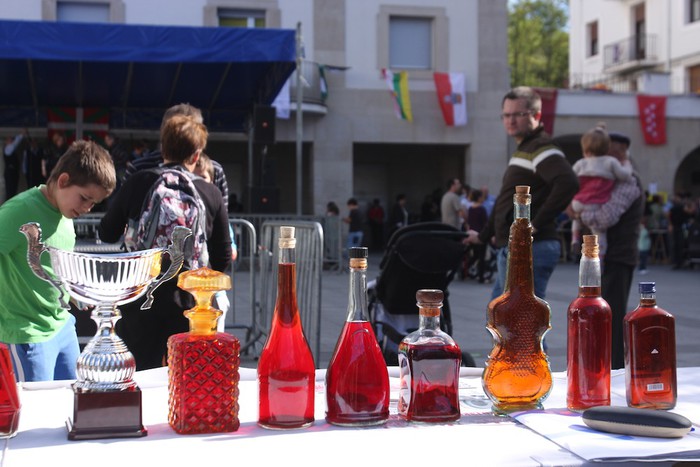
Homemade patxaran competition at a fair

Patxaran (Basque pronunciation: [patʃaɾan]; Spanish: pacharán) is a sloe-flavoured liqueur commonly drunk in Navarre, as well as in the Basque Country. It is usually served as a digestif either chilled or on ice.

Etymology

[edit]
'Zoco' patxaran

The word patxaran is the Upper Navarrese form of basaran, from Basque basa 'wild' and aran 'sloe'.[1] It also occurs in the various Basque dialects as baxaran, basarhan, baixaran and various other forms.[1]

Process

[edit]

Patxaran is made by soaking sloe fruits, collected from the blackthorn shrub, along with a few coffee beans and a cinnamon stick in anisette, for one to eight months.[2] The process produces a light sweet reddish-brown liquid around 25-30% in alcohol content by volume. In addition to dictating the amount of sloes to be used, the regulating body for Pacharán Navarro insists that no artificial colourings or flavourings be added and that the maceration last between one and eight months.

History

[edit]

Known to have existed in Navarre as early as the Middle Ages, patxaran was initially a home-made liqueur of rural Navarre and became popular during the late 19th century. It was commercialised in the 1950s and then became very popular outside Navarre. It now holds a PGI (protected geographical indication) status that protects the spirit's identity, including traditions and processes to make it, and also indicates that it can only be made and bottled in specific areas. [3]

Commercial brands and production

[edit]
'Las Endrinas' patxaran

Common pacharán brands include Zoco, Etxeko, Basarana, Berezko, Usua, La Navarra, Las Endrinas and Baines.

See also

[edit]

References

[edit]
[edit]
Revisions and contributorsEdit on WikipediaRead on Wikipedia
from Grokipedia
Patxaran (also spelled pacharán in Spanish) is a traditional sloe-flavored originating from the region in northern , deeply rooted in Basque culture and commonly enjoyed in the Basque Country. It is produced by macerating wild sloe berries (), the dark purple fruits of the blackthorn bush, in an anise-flavored neutral spirit, often with added sugar, resulting in a sweet, fruity, and slightly bitter ruby-red digestif with an (ABV) of 25–30%. The history of patxaran traces back to the , when it was initially crafted for medicinal purposes as a digestive aid, with the earliest written record dating to 1415 at the wedding of the son of the King of . Commercial production began in the late 19th century, gaining widespread popularity after in the 1950s as new producers entered the market and it became a staple in Navarrese households. In 1988, patxaran from received protected (PGI) status, ensuring traditional methods and regional authenticity. Production adheres to strict traditional processes under the PGI: fresh sloes are harvested in autumn, crushed or left whole, and steeped for 1 to 8 months in ethyl alcohol of agricultural origin (minimum 96% ABV, diluted to 26–60% ABV with ) with natural extracts to extract the berries' flavors. After maceration, the mixture is filtered, diluted with and sugar syrup (80–250 grams per liter), and rested briefly before bottling, yielding approximately 3 to 8 liters of per kilogram of sloes in line with PGI requirements of 125–300 grams of sloes per liter. Artisanal versions emphasize hand-picked wild sloes from Navarre's hedgerows, while commercial brands like Zoco maintain consistency through controlled processes. In and the Basque Country, patxaran is traditionally served chilled straight from the bottle or over ice as a post-meal digestif, often during festive occasions like San Fermín or family gatherings, symbolizing regional pride and heritage. Its intense sloe and profile also features in modern cocktails, such as the Patxaran Sour or with tonic, expanding its appeal beyond , though it remains a niche primarily consumed locally. As of 2008, five registered producers contributed to annual output, preserving this centuries-old elixir as a cornerstone of Spanish gastronomic tradition.

Description and Characteristics

Composition

Patxaran is fundamentally composed of sloe berries, the small, dark fruits of the blackthorn bush (), which are harvested in autumn when fully ripe. These berries provide the liqueur's signature deep red color via natural pigmentation from their skins, a and base flavor from their high content, and the primary fruity that define its character. Under the Pacharán Navarro Protected Geographical Indication (PGI) regulations, the composition specifies 125 to 300 grams of these sloes per liter of finished product, ensuring a balanced extraction of flavors. The berries are typically prepared by their skins with a or lightly crushing them to release juices during the subsequent maceration process, while taking care to avoid breaking the pits, which could impart excessive bitterness. The alcohol base consists of anisette, an anise-flavored spirit derived from ethyl alcohol of agricultural origin (at least 96% vol. prior to dilution) and natural extracts of anise (Pimpinella anisum L. or Illicium verum L.), which contributes licorice-like aromas and helps preserve the mixture. Sugar, in the form of sucrose at 80 to 250 grams per liter, is incorporated to mellow the sloes' acidity and achieve the final alcohol by volume of 25% to 30%. In traditional recipes outside strict PGI guidelines, optional additions such as a few coffee beans for subtle bitterness or a cinnamon stick for warm spice notes may be included, though these are prohibited in certified products. No artificial additives, colorants, or flavorings are permitted in PGI patxaran; the characteristic hue and clarity result solely from natural of the sloe particles after maceration and .

Flavor and Serving

Patxaran exhibits a distinctive flavor profile characterized by the pronounced tartness and fruitiness of sloe berries, balanced with the sweet licorice notes imparted by . This combination yields a sweet yet refreshing taste, often described as potent and aromatic, with a subtle spicy undertone from the aniseed. The liqueur's sensory appeal derives primarily from the maceration process, where sloe berries contribute their natural astringency and berry-forward essence. Visually, patxaran displays an intense cherry red color with violet hints, derived from the pigments in sloe berries, giving it a shiny, vibrant appearance. Its texture is velvety and slightly viscous, enhancing the sipping experience. With an alcohol content ranging from 25% to 30% ABV, it strikes a balanced strength suitable for contemplative consumption without overwhelming intensity. Traditionally served as a digestif after meals, patxaran is chilled to approximately 6-8°C to preserve its aromas and refresh the , either neat in small glasses of 50-100 ml or over in a brandy snifter to avoid excessive dilution. In Navarrese cuisine, it pairs well with desserts such as or , soft cheeses, and nuts, complementing their richness with its fruity acidity and herbal notes. This serving style underscores its role in promoting while highlighting regional culinary traditions.

Etymology and Terminology

Linguistic Origins

The term "patxaran" derives from the Basque word basaran, which refers to the sloe berry (), compounded from basa- (a combining form meaning "wild" or "of the forest," related to baso "woods" or "wilderness") and aran (meaning "sloe" or ""). An alternative etymology, commonly cited in popular sources, derives it from paitar or pattar ("spirit" or "") and aran ("sloe"), though scholarly analysis favors the basaran origin as an alteration referring to the berry and the resulting . This etymology reflects the wild, uncultivated nature of the berries used in the liqueur, distinguishing them from domesticated varieties. In the Orotariko Euskal Hiztegia, the official General Basque Dictionary compiled by , patxaran is listed as a variant of basaran, confirming its roots in Basque nomenclature for the fruit and the resulting beverage. Over time, basaran evolved into patxaran in modern Basque, particularly in the Upper Navarrese , through phonetic shifts common in the language's regional variations. Historical texts and dialectal records show forms such as baxaran, basarhan, and baixaran, illustrating adaptations influenced by local pronunciations across Basque-speaking areas like and the Valley. These variants underscore the word's organic development within Basque's isolate linguistic structure, unaffected by Indo-European influences. In non-Basque contexts, the term adapted to Spanish as pacharán, a phonetic rendering that preserves the original meaning without semantic alteration, as recognized in the Real Academia Española's dictionary. This adaptation facilitated the drink's broader recognition in Spanish-speaking regions while retaining its Basque linguistic essence.

Regional Variations

The name patxaran originates from the (Euskara), where it specifically denotes the sloe-based , while the variant is spelled pacharán with an accent on the 'a'. In , a bilingual region with strong Basque cultural ties, both patxaran and pacharán are used interchangeably in everyday and commercial contexts. This Basque-centric nomenclature extends across the into the , known as Iparralde, where producers and consumers alike refer to the as patxaran to emphasize its shared cultural heritage. However, beyond and the broader Basque territories, the term gains less traction in the rest of , where it is occasionally overshadowed by the more generic descriptor licor de endrinas for similar sloe-infused spirits lacking regional specificity. Regulatory frameworks further standardize naming for commercial protection; the European Union's Protected (PGI) status for Pacharán Navarro, granted to products from , mandates the Spanish spelling to ensure traceability and authenticity. This distinction underscores the liqueur's rooted identity in Navarrese production while allowing linguistic flexibility in informal Basque usage.

History

Early Development

Patxaran originated as a homemade rural liqueur in Navarre during the Middle Ages, crafted from the abundant sloe berries () that thrive in the region's hedgerows and woodlands. These wild blackthorn fruits, harvested in autumn, formed the basis of this spirit, which was initially produced in households across rural Navarre as a simple infusion with aniseed spirits. The Consejo Regulador del Pacharán Navarro recognizes this tradition as dating back at least to the 15th century, underscoring its deep roots in the area's agrarian lifestyle. The earliest documented mentions of patxaran appear in historical records from the early . In 1415, it was included on the wedding menu for the marriage of D. Godofre de Navarra, the natural son of King Carlos III of , to Doña Teresa de Arellano, highlighting its status as a valued beverage among Navarrese . Similarly, in 1441, Queen Blanca I of consumed patxaran to treat stomach ailments during her stay at the Monastery of Santa María de Nieva, providing evidence of its early recognition for therapeutic qualities. Prior to the , patxaran primarily functioned as a folk remedy and seasonal preserve, linked to the annual of blackthorn sloes by local communities in . Its use was tied to traditional healing practices, leveraging the berries' natural properties for digestive relief, though comprehensive written accounts remained scarce until the late 1800s. Throughout this period, patxaran's production and consumption were largely confined to and adjacent Basque territories, sustained by oral traditions that long predated formal documentation.

Modern Commercialization

In the late 19th century, patxaran transitioned from a primarily homemade rural to a regional specialty with initial commercial bottling efforts in , marking the first steps toward broader market availability. This popularization coincided with the establishment of early distilleries, some dating back to the early 1800s, which began scaling production beyond household consumption. The mid-20th century, particularly the , saw a significant boom in commercialization, as patxaran shifted from artisanal to bottled products through cooperatives and dedicated brands, enabling wider distribution across . This era transformed it into a marketable digestif, with consumption expanding rapidly outside during the 1970s and 1980s, stabilizing at around 85% of national patxaran sales by the late 1980s. In 1988, patxaran received protected status as "Pacharán Navarro" through Spain's Indicación Geográfica, regulated by a Consejo Regulador that ensures production within Navarre's provincial region, using local sloes (Prunus spinosa) macerated at 125–300 grams per liter in anise-flavored spirit. This protection, later recognized under EU regulations, limits authentic production to Navarre's 10,391 km² area, emphasizing quality and origin without artificial additives. By the 2020s, commercial production had grown substantially from its artisanal roots, reaching approximately 3.5 million liters annually, with over 95% adhering to PGI standards and supported by cultivated sloe areas exceeding 125 hectares (as of 2010).

Production

Traditional Maceration Process

The traditional maceration process for patxaran begins with harvesting ripe sloe berries () in late autumn, typically between October and November, when they have turned a deep blue-black color after the first frosts to ensure optimal ripeness and flavor extraction. Once collected, the berries are thoroughly washed to remove any debris and then pricked with a needle or thorn—traditionally from the blackthorn bush itself—to puncture the skins and facilitate the release of juices without crushing the bitter seeds. The prepared sloes, usually in quantities of 125 to 300 grams per liter, are then combined in clean glass jars or carafes with (an anise-flavored spirit), along with 2 to 3 beans per liter for subtle bitterness and one stick for aromatic warmth; these additions enhance the base composition without overpowering the sloe's natural tartness. The mixture is sealed and left to macerate in a cool, dark place for 1 to 8 months, depending on desired intensity, with periodic agitation—such as gentle shaking every few weeks—to promote even and dissolution of flavors. After maceration, the liquid is strained through a fine mesh or cloth to remove the solids, including the berries, , and , allowing the patxaran to settle naturally for clarity over several days or weeks without additional to preserve its authentic, rustic character in home recipes. If a sweeter profile is preferred, sugar syrup can be added at this stage and stirred in before final settling, though many traditionalists rely on the natural sweetness from the sloes. The resulting typically achieves an of 25 to 30 percent. For storage, the patxaran is bottled in dark glass to protect against light degradation and aged for 1 to 2 additional years in a cool, dark environment, during which its flavors mellow and integrate further, though it is best consumed within 2 to 3 years of production.

Regulations and Standards

The Protected (PGI) "Pacharán Navarro" governs the production of this sloe-based under regulations, restricting manufacturing to the Autonomous Community of , to preserve traditional methods and terroir-specific qualities. This geographic limitation ensures that all stages—from sloe harvesting to maceration, dilution, sweetening, and bottling—occur within this delimited area. Key production rules mandate a minimum of 125 grams of fresh, natural sloes (Prunus spinosa L.) per liter of finished product, with a maximum of 300 grams, and an (ABV) of at least 25% but not exceeding 30%. Ingredients are strictly limited to ethyl alcohol of agricultural origin (minimum 96% vol.), pure aniseed essential oil from Pimpinella anisum L. or Illicium verum L., and sugar (80 to 250 grams per liter); artificial colors, flavors, preservatives, or any other additives are prohibited to maintain authenticity. The maceration , involving the soaking of sloes in the aniseed-flavored alcohol, must endure for a minimum of one month and a maximum of eight months at controlled temperatures to extract flavors without compromising quality. Quality controls are overseen by the Consejo Regulador de la Indicación Geográfica Pacharán Navarro, which conducts mandatory sensory analyses assessing color (intense red or pinkish), aroma (fruity with sloe and notes), and taste (sweet, balanced, and persistent), alongside physicochemical testing for compliance. Producers undergo annual audits and unannounced inspections to verify adherence to standards, with non-compliant batches rejected. Certification requires that all approved products display the official PGI seal on the bottle label, featuring the geographical indication logo, the words "Indicación Geográfica Pacharán Navarro," and a unique batch identification number issued by the Consejo Regulador. This marking not only verifies origin and quality but also legally protects the designation from imitations produced outside the authorized zones, preventing misleading commercial use.

Commercial Production and Brands

Major Producers

The major producers of patxaran are predominantly small, family-owned distilleries and cooperatives based in , , adhering strictly to the Protected (PGI) standards that mandate the use of local sloe berries and aniseed. These entities emphasize artisanal methods while scaling production to meet demand, with no significant involvement from international conglomerates. Zoco, the oldest commercial brand, was established in 1956 by the Velasco family in Viana, , and remains the best-selling patxaran in , produced through a three-month maceration of 100% Navarrese sloe berries in aniseed spirit. Owned by the family-controlled Zamora Company, a Spanish spirits group, Zoco contributes to the category's prominence by maintaining traditional recipes without additives, achieving widespread distribution while upholding PGI compliance. Etxeko, produced by the Belasco family in Viana since across eight generations, operates in a style that highlights locally sourced sloes under 7mm in size, macerated in premium brandy with star anise for an intense, ruby-red profile. This artisan-focused , part of Grupo La Navarra, prioritizes fresh, regional ingredients to preserve the liqueur's authentic fruit-forward character within PGI guidelines. Basarana and Berezko represent family-run operations specializing in aged variants. Basarana, from Hijos de Pablo Esparza Bodegas Navarras—a fifth-generation distillery founded in 1872 in Falces—launched its patxaran line in 1972, offering velvety, ruby-red expressions like Etiqueta Negra at 25% ABV through slow maceration. Meanwhile, Berezko, produced by a Navarrese family distillery with over 50 years of experience and now under Zamora Company, innovates with vintage-style patxaran that maximizes sloe expression via meticulous selection and extended aging, delivering a fresh, fruity aftertaste. Other notable producers include Usua from Licores Usua, a small Navarrese distillery crafting premium editions like Usua Oro with balanced sweetness and complex red berry notes, and La Navarra, also from the Belasco family, which features distinguished, sloe-dominant profiles from controlled regional plantations. These brands collectively innovate through subtle variations in maceration duration and sloe selection—such as filtered for clarity versus unfiltered for intensity—all while remaining fully PGI-compliant and focusing on limited, high-quality releases rather than mass production.

Market and Distribution

Patxaran is predominantly a domestic product within , where it enjoys strong regional consumption, particularly in and the Basque Country. Pacharán Navarro, the variety protected by a and produced exclusively in , accounts for approximately 85% of all pacharan sales across . Annual production totals around 3.5 million liters, with over 95% originating from under the regulatory standards of the Pacharán Navarro Protected . Retail prices for a standard 70cl bottle typically range from 10 to 20 euros, reflecting its artisanal quality and local sourcing. Exports of patxaran have been steadily growing since the early , driven by interest in unique Spanish liqueurs among international consumers. The primary markets are in , including , , and the , with emerging demand in the United States (particularly the East Coast) and through specialty importers and gourmet distributors. While exact export volumes remain modest compared to domestic sales—estimated at less than 20% of total production based on industry trends—the focus on premium positioning has supported expansion in niche segments abroad. Distribution channels emphasize local and regional networks in , including supermarkets in the Basque Country and , as well as sales at traditional fiestas and venues that highlight Navarrese culture. Online platforms have facilitated international reach, allowing specialty retailers to ship to and beyond. Demand often peaks seasonally in autumn, aligning with the sloe harvest and festive gatherings. The patxaran market contends with challenges such as competition from analogous fruit liqueurs like English , fluctuations in sloe berry yields influenced by variable weather patterns, and lingering effects from the , which disrupted hospitality-driven sales in 2020–2021 before a gradual recovery.

Cultural Significance

Role in and Basque Traditions

Patxaran serves as an enduring icon of Navarrese-Basque heritage, embodying the region's rural traditions of wild sloe berries from the foothills and reflecting a sense of cultural autonomy through its long history of homemade production. Rooted in medieval practices, it symbolizes the untamed natural landscape of and the Basque Country, where the sloe bush's thorny growth evokes the rugged terrain. This connection to local underscores patxaran's role in preserving traditional self-sufficiency, distinct from industrialized spirits. In social customs, patxaran holds symbolic value as a customary during holidays and gatherings, reinforcing communal bonds in Navarrese and Basque communities. The liqueur's Protected Geographical Indication (PGI) status, granted by the , safeguards these traditions and ensures that only products from can use the protected 'Pacharán Navarro' designation. Patxaran features prominently in local fiestas, including the San Fermín festival in , where it is enjoyed as a celebratory element amid the revelry. In contemporary contexts, it bolsters regional identity through initiatives, such as guided visits to producers that highlight its historical maceration processes. Derived from the Basque words 'basa' (wild) and 'aran' (sloe), meaning 'wild sloe,' it underscores its deep cultural roots.

Consumption Practices

Patxaran is traditionally consumed as a digestif at the end of meals in Basque and Navarrese cuisine, where it is sipped slowly to complement the flavors of hearty dishes and promote a relaxed sobremesa, or post-dinner conversation. Typically, one or two small glasses are served per person to aid digestion without overwhelming the palate. In social contexts, patxaran fosters communal bonding during family gatherings or in gastronomic societies, where members prepare meals together and share the neat to celebrate culinary traditions and strengthen relationships. It is often chilled to around 8-12°C, served over in summer for a refreshing finish. Occasionally, patxaran is incorporated into desserts, such as sorbets or , where its bittersweet profile contrasts with creamy bases for a modern twist on regional sweets. Historically viewed as a digestive due to the sloe berries' properties, patxaran is believed to soothe the after rich meals, though its 25-30% necessitates moderate intake to avoid overconsumption. Commercial bottles, often from regulated producers, are popular for gifting during holidays or visits, symbolizing regional hospitality.

References

Add your contribution
Related Hubs
User Avatar
No comments yet.